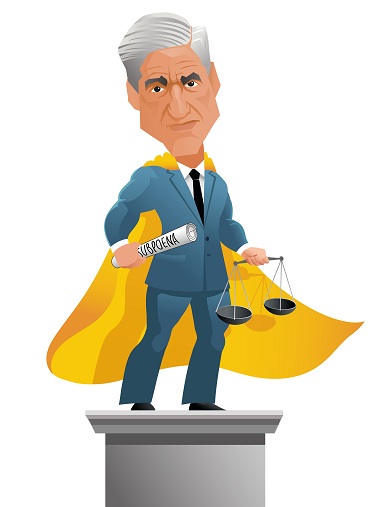
There is no doubt that Mueller used his special prosecutor role to engage in selective prosecution to further the role of the Deep State. Paul Manafort was sentenced to nearly four years in federal prison for cheating banks and the government out of millions of dollars. The prison sentence marks the end of a stunning selective prosecution for the downfall of the longtime political operative who helped elect four Republican presidents, including Trump. They were simply prosecuted because they sought to turn him as a witness to take down Trump.
Manafort was not a target of prosecution otherwise. He is among a half-dozen people in Trump’s circle who were charged as a result of special counsel Robert Mueller’s investigation into Russian interference in the 2016 presidential election and possible cooperation with the Trump campaign. None of Manafort’s crimes had anything to do with the purpose of investigating the Russian influence on the 2016 election, which is really absurd. Our model clearly forecast Trump would win and it targeted the 2016 election. Back in 1985, the model predicted that 2016 would be the first time a potential third party president would be elected. Moreover, AOC was elected to Congress for the very same trend – throw out the incumbent.
The mere fact that Mueller will criminally prosecute people for anything he can find when that is not the subject of his power proves beyond a shadow of a doubt that the power of prosecution is arbitrary and in that vein, it is a power of tyranny.
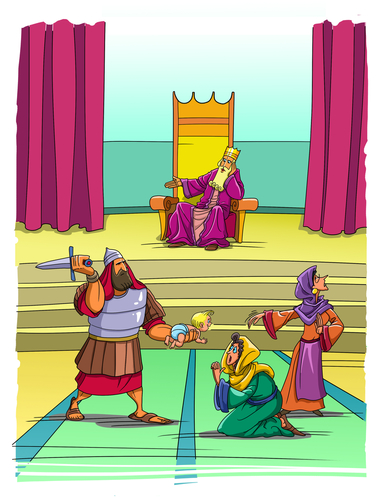
Historically, the king was the judge and that was his role in society. That is illustrated by the biblical story of King Solomon deciding the true mother of a child. The king was NEVER the prosecutor. Disputes were always private. Even in ancient Greece, if you killed someone, you were prosecuted by the family — not the state. The only crimes that were prosecuted by the state were those against the state or something that offended the gods, as was the case of Socrates.
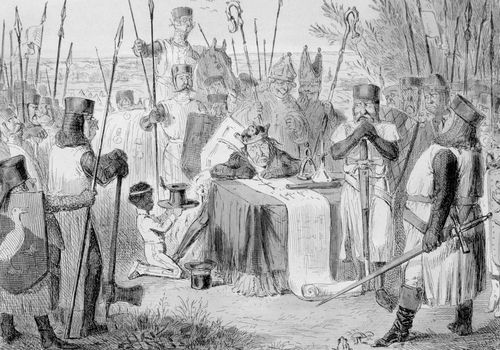
It was not until Magna Carta when the nobles rose up against King John who was fining people for all sorts of things. They demanded a right to trial by jury and this seriously reduced the king’s revenue. He changed the law at that time and suddenly cast himself as a victim in any private dispute. Two people fought and the king now claimed it disturbed his peace. Suddenly, what used to be private now became state crimes. I previously wrote about the history of civil asset forfeiture, which was deodand in ancient times whereby the object that caused someone’s death was sold and the proceeds were used for the victim’s funeral. The king replaces God with himself and today we have people’s assets being confiscated under the theory that the object offends God who has been replaced by the state.
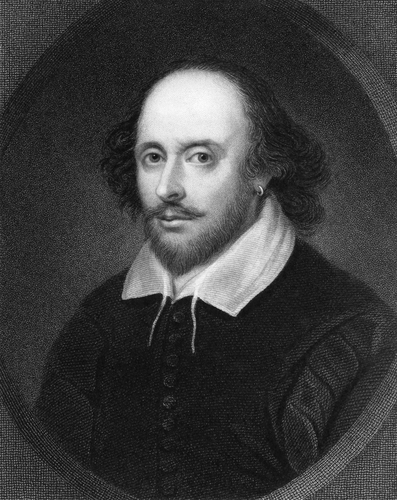
William Shakespeare’s most famous quote that just about everyone has ever heard comes from a tax rebellion against the king of England:
DICK: The first thing we do, let’s kill all the lawyers.
Cade: Nay, that I mean to do.
(Henry The Sixth, Part 2 Act 4, scene 2, 71–78)
The lawyers were not private lawyers since there were none at that time. The Sixth Amendment to the US Constitution is the right to counsel. It was part of the Constitution because you were not allowed to have a lawyer, only the king had lawyers who were what we call today are prosecutors such as Mueller. So you see, this corruption of the rule of law is our downfall. It allows the state to prosecute people for political purposes to serve its own interest. In this case, it is the tool of the Deep State and we are doomed as long as it possesses this type of power. It is the instrument of tyranny.
QUESTION: Mr. Armstrong; You seem to have studied history more than any professor I ever met. So I am directing this question to you. Did Rome have their Trump who tried to drain the swamp? Or was everyone just immersed in the swamp?
LR
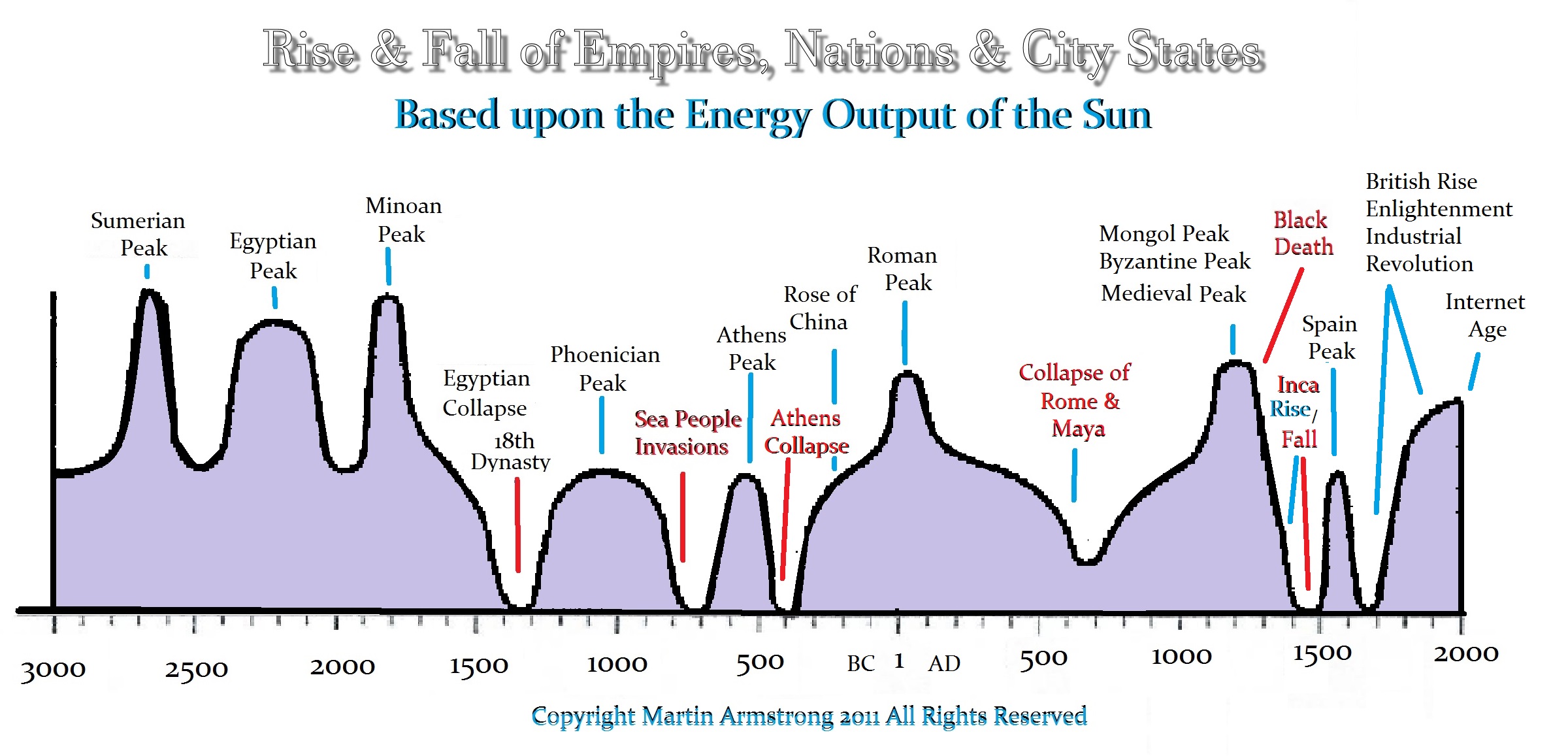
ANSWER: History repeats because human nature never changes no matter how much we progress technologically. So many people think history is irrelevant and you will often hear that this time it’s different. I have found no exceptions whatsoever and I have really searched very hard by studying the rise and fall of empires, nations, and city-states.
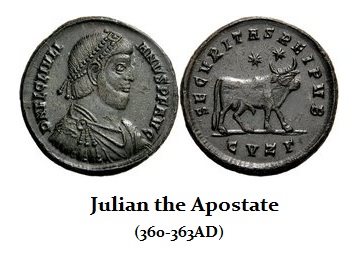
Flavius Claudius Julianus, known to history as Julian II, was born in Constantinople around 332 AD, the son of Julius Constantius who was the half-brother of Constantine the Great. His father was born by his grandfather’s second wife, Theodora. When Constantine the Great died in 337 AD, his son, Constantine II launched a midnight Palace Massacre whereby all persons who might be his rival for the throne and were not the direct descendant of Constantine I’s first wife were slaughtered. Fortunately for Julian, he managed to escape the Palace Massacre only due to his extremely young age. Julian was restored to the imperial favor as he grew and was given the rank of Caesar (Vice President) on November 6th, 355 AD, about the same time he married Constantius’ youngest sister, Helena.
Yet the Palace Massacre left a deep mark upon his character whereby he saw Christianity as just another cult and the preachings of thou shalt not kill meant really nothing when power was at stake. As a result, he was dubbed by theologians as Julian the Apostate. Julian’s coinage changed when he became Emperor. He grew a beard which was taken as a sign of being a pagan whereas Christians were clean-shaven. His coins would often display pagan motifs as well. Julian began his reign by throwing off his Christian cloak and declaring that all religions would be tolerated. He gave especially large donations to the pagan causes. He dismissed his Christian teachers and ended state subsidies for the church. He then took an active role in organizing pagan worship throughout all the provinces.
Julian’s own philosophical beliefs led him to idealize the reigns of Hadrian (117-138 AD) and Marcus Aurelius (161-180 AD). He described the ideal ruler as being essentially primus inter pares (“first among equals”), and thus not above the same laws that applied to everyone else. Julian frequently attended the Senate, participating in debates and making speeches. He was opposed to the traditional royal court operations that were used by his predecessors as inefficient, corrupt, and highly expensive. He cut the bureaucratic waste dismissing thousands of servants, eunuchs, and duplicated officials drastically reducing the cost of government for the taxpayers. He went as far as to prosecute corruption in government establishing the Chalcedon tribunal under the supervision of a magister militum Arbitio. He prosecuted former official under Constantius including the chamberlain Eusebius who ran the royal court finding them guilty and this sentenced to death. Yet Julian did not attend these proceedings that some argued meant he did not approve of these actions yet he took no steps to prevent them.
Julian also adopted the philosophy of Thomas Jefferson whereby he tried to reduce the federal bureaucracy expanding state and local authority at the expense of the imperial bureaucracy as Julian sought to reduce direct imperial involvement in urban affairs. For example, he went as far as to return city land owned by the imperial government and city council members were then compelled to resume civic authority.
There was really a massive invasion of people from the north as the climate began to turn colder. It was more than just barbarians seeking plunder. They were migrating due to climate change. In 357AD Julian, had defeated the barbarians known as the Alamanni giving him the prestige and political power to be respected. He stepped in and prevented a tax increase by the Gallic (France) praetorian prefect Florentius and personally took charge of the province of Belgica Secunda. Julian now cross from military to civil administration, where he demonstrated his philosopher training being influenced by his liberal education in Greece.
Julian’s first priority, still as Caesar and not Augustus (Emperor), was to drive out the barbarians who had breached the Rhine frontier. Thereafter, he won the support of the civil population by his fairness. He set out to rebuild the region creating a stable and peaceful economy following the barbarian invasions. Julian clashed with Florentius over the latter’s support of tax increases and the prevailing corruption within the bureaucracy.
Julian’s handling of tax reform was brilliant. As far as taxes upon the cities, Julian actually reasonably made the tribute in gold by the cities called the aurum coronarium astonishingly voluntary rather than a compulsory tax. Like Hadrian, who rectified tax situations and is said to have defended the weak against the strong, Julian followed his role model. Any arrears concerning land taxes were simply canceled. This was an essential reform reducing the power of corrupt imperial officials, as the unpaid taxes on land were often hard to calculate or higher than the value of the land itself. Forgiving back taxes both made Julian more popular and allowed him to increase collections of current taxes.
Clearly, Julian ceded much of the authority of the imperial government to the cities decentralizing the government in what we would call state-rights today. His actions, no doubt, provided the backdrop to Thomas Jefferson who studied everything he could about the Roman Empire and perhaps accounted for his anti-Federalist position.
Julian also took more direct control of the affairs of state to eliminate corruption himself. For example, new taxes and corvées had to be approved by him directly rather than left to the judgment of some bureaucrat. Julian was well aware of the need for society to be properly managed politically, but he also saw the religious side that had led to the horrendous and violent dislocation of religion during the 3rd century.
Julian purged the bureaucrats draining the swamp that were career appointees of previous administrations and instead drew heavily from the intellectual and professional classes with knowledge and experience – very novel in those days. His choice of consuls for the year 362 AD was highly controversial since he surprisingly chooses Nevitta, who had been Julian’s trusted Frankish general. Some argued that this appointment was showing his reliance upon the power of the army while others claim he was seeking the maintenance the support of the Western army that made him emperor.
Julian was convinced that an all-out war would become necessary against the Persians who had for centuries constantly caused the eastern provinces great trouble. In March of 363, Julian departed for his invasion of Persia taking 65,000 infantry and Calvary. After some minor success, he reached Ctesiphon, the capital of Persia, in June, but his food supply was running low. Realizing that he could not take the city, Julian ordered a retreat down the Tigris. Julian was injured by a spear. There was speculation that he was killed by a member of his own troops because of his religious beliefs. But this was only speculation.
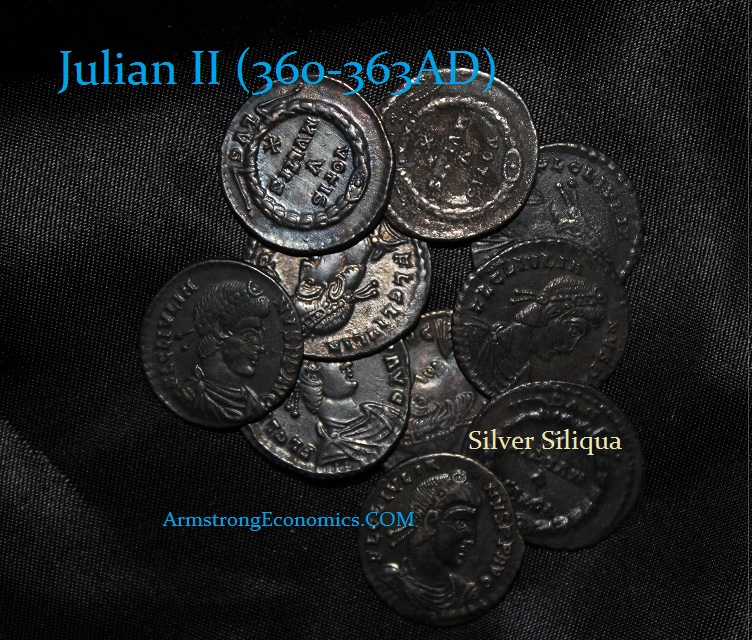
We have less than 100 silver Siliqua that are from a very famous hoard discovered in Britain. This is known as the Harptree Hoard discovered in 1887. This hoard was discovered in the village of East Harptree, located approximately 16 miles southwest of Bath. The hoard consisted of 1496 silver coins, five silver ingots, and a Roman silver ring set with a carnelian intaglio stone. The coins are 4th century, covering the period of Constantine the Great to Gratian (circa 306 to 383 AD).
The landowner, Mr. William Kettlewell, made the hoard available to the British Museum under the law, and it was first written up by John Evans in The Numismatic Chronicle of 1888 (pp. 22-46). The British Museum kept 25 of the most interesting coins from the hoard, and the rest of hoard was returned to the owner. We have purchased a portion of that hoard and are offering here the coins of Julian II (360-363 AD). Again, the quality of these coins is exceptional and grade Very Fine or better.
Looking back at how the Russia hoax began as the Mueller investigation wraps up. #Tucker#FoxNews FOX News operates the FOX News Channel (FNC), FOX Business Network (FBN), FOX News Radio, FOX News Headlines 24/7, FOXNews.com and the direct-to-consumer streaming service, FOX Nation. FOX News also produces FOX News Sunday on FOX Broadcasting Company and FOX News Edge. A top five-cable network, FNC has been the most watched news channel in the country for 17 consecutive years. According to a 2018 Research Intelligencer study by Brand Keys, FOX News ranks as the second most trusted television brand in the country. Additionally, a Suffolk University/USA Today survey states Fox News is the most trusted source for television news or commentary in the country, while a 2017 Gallup/Knight Foundation survey found that among Americans who could name an objective news source, FOX News is the top-cited outlet. FNC is available in nearly 90 million homes and dominates the cable news landscape while routinely notching the top ten programs in the genre.
Georgia Republican Rep. Doug Collins says that former Attorney General Loretta Lynch told former FBI Director James Comey to consider Hillary Clinton email scandal a ‘matter’ not an investigation.
Nigel Farage joins Brendan O’Neill to discuss democracy, the political class and his new Brexit Party. Support spiked: https://www.spiked-online.com/donate-…
This is a little funny. CNN’s Dana Bash interviews President Trump’s 2020 campaign manager Brad Parscale. The discussion is about the election, but on a granular level is really about data use in the 2020 election. Parscale has given these interviews before, the one with PBS [SEE HERE] is much better.
However, the more interesting aspect to the interview actually comes after the segment when CNN’s Jake Tapper happens to note what the DNC is attempting to do. Within Tapper’s remarks he happens to outline why the DNC is running the crew currently enlisted as candidates. Watch specifically at the 04:00 point.
.What Tapper notes as the urgent data collection priority of the DNC is specifically the reason why the club has enlisted Beto to draw-in the community they need to harvest. The Democrats, specifically young democrats, have no idea how the ‘club’ plans to use them.
It is important to remember the DNC and RNC are private clubs. The club rules and processes have have no direct connection to the administration of government.
The DNC and RNC are completely private organizations with the ability to make their own rules, membership terms, conditions and agendas. You’d be surprised how many people do not know that simple point.
Because they are private clubs it is always laughable when politicians talk about “campaign finance reform”. Quite simply if either club -or both- wanted to put limits or restrictions on the financial side of their club membership or activity, they could; easy peasy. Those rules have nothing to do with government; the clubs make the decisions not to do so.
The introduction of Robert Francis O’Rourke was weak at best. There was little to no fanfare from the DNC club. The roll out was horrible. This is not the entrance of ‘the chosen one‘.
The unofficial ‘chosen one‘, the intended party donor candidate, will not surface until April or May 2019. The DNC is predictable; it’s a club. It’s far too early for the anointed candidate to surface.
Planning, scheming, endless meetings, talking points, operational organization and strategy is one of the key elements of the Democrat party. This is what they do. This is all they do. It might seem weird at first, but the DNC club is not chaotic; and, from my perspective, that is their weakness. It makes them predictable.The Democrats rarely, if ever, go off script.
Now, let’s get down to business….
Remember, the DNC is a private club. They set their own member rules, bylaws and regulations.
The DNC is a private club, they do not need to allow anyone to become a member. The DNC controls the terms for membership.
[The RNC is the same]
Most voters have no idea about how the RNC and DNC being private clubs plays into U.S. elections. Let’s talk about the open secret.
Like any club, there are dues or fees associated with being a member. However, the primary currency for members to receive support from the DNC club does not revolve around direct payments to the club. Instead, the club membership agreement is based upon a much more valuable currency of data gathering. The citizens, or individual voters, represent the data the club needs to collect. The data is the game now.
Private companies like: Apple, Google, Facebook and Amazon have business models that are dependent on data collection. The data is you. Your data is valuable. When they have your data; your phone number, address, email, bank account,IP address, geolocation identifiers, pictures, vehicle location etc. they then have control over your profile. In essence, they know you… and they know your contacts… and your family… and your friends… and your work…. and your dentist… and your diet… and your secrets.
If you use your phone a lot, most people do, your phone holds a lot of your data. When you plug your phone into your computer the operating software downloads your phone data and transfers it to file sharing systems for transmission via the internet. Log on to a wifi network and the router automatically uploads that data to the host. If you plug your phone into a vehicle enabled with GPS or Bluetooth tech the same thing happens; the car downloads your phone data and then transmits it to the vehicle data-center.
Rental car companies make just as much money selling the uploaded phone data of rental car users as they do from the traditional business model of renting you the depreciating car.
In the business realm, the assembled profile allows the data owners to track you and influence you toward purchasing decisions. You, that is your ‘data profile’, then becomes a commodity; a currency of sorts. As a commodity the business can sell your data to another business who aggregates thousands, perhaps millions, of other profiles. Take a picture with your phone and voila, you’ve just shared data with the provider.
Your data is valuable.
The currency of the private club (RNC or DNC) is based on this model. Data is the trade-able currency for club membership. If you want to be an important club member; if you want the support of the club’s leadership; well, gather more data. Gather a lot of data and that data file is worth a great deal to the club management. They too want to influence your decisions.
Even if Joe Biden wanted to, he cannot gather the data needed for a 2020 presidential bid; Biden cannot pack an arena with 10,000 high-energy voters. So if the club wants to support Biden (or another party-favored milquetoast candidate), they need another method for data collection.
Enter Bernie Sanders….
Bernie is a great capitalist.
Bernie is perhaps the greatest capitalist on the left side of the ledger.
Bernie Sanders as a political candidate is a great harvester of data. What makes Bernie’s harvest so valuable is the type of data profile he is harvesting. Bernie is harvesting from a key audience. For whatever reason, the valuable audience loves Bernie. Jane and Bernie love the value of the audience data. Yum.
Bernie and Jane know their how to exploit their business model for their benefit. The DNC club loves that Jane and Bernie know how to harvest. The club pays Bernie and Jane a premium because their harvest product is full of healthy young data nutrients.
The club also doesn’t want to undermine Jane and Bernie’s efforts; so they wait. Bernie and Jane know the club is waiting for the deposit; the club rules require it. Jane and Bernie have their eyes on a very nice house. The future is bright for Bernie and Jane.
And so it goes…. and so it goes.
March is harvest month for Bernie and Jane. After the harvest the club will pay handsomely and then all will cheer.
The same role and responsibility applies to Beto; this is why President Obama visited Beto. However, unlike Bernie, Beto might just be stupid enough not to realize his role.
Additionally, just like the unsuspecting young couple who plugged their phone into the convenient rental car charger and gave away their data, the Bernie and Beto data providers will be oblivious.
A week after saying any Democrat who made the 2020 presidential race about “Trump’s personality” will beat him, Fox News owner Rupert Murdoch hires Paul Ryan to serve as a board member for the news organization. This announcement follows on the heels of Fox News hiring the former head of the DNC, Donna “Debate-Gate” Brazile, as a contributor.
Yes, it is clear to see the direction and intent of Rupert and Lachlan Murdoch.
It must also be remembered that in 2013 Fox News worked behind the scenes to facilitate the Senate’s comprehensive immigration reform platform. Additionally, a year later, Murdoch himself advocated for Jeb Bush and Marco Rubio as the preferred candidates in 2016, using Megyn Kelly to achieve their objective. Yes, it is all one unfortunate, political and ideological continuum.
(NBC News) Fox Corporation debuted as a public company on Tuesday with a new board member — former House Speaker Paul Ryan.
The company, which includes Fox News and the Fox broadcasting network, had been dubbed by some in the media industry as “New Fox.” On Tuesday it announced the completion of its separation from 21st Century Fox, which houses the company’s TV and movie assets that are being acquired by Walt Disney Co. The new entity will trade on the Nasdaq exchange. (read more)
A report from earlier today notes the anticipated departure of Deputy Attorney General Rod Rosenstein, initially scheduled for mid-March, has been delayed… There’s a brutally obvious reason.
WASHINGTON DC – Deputy Attorney General Rod Rosenstein has reached an agreement with Attorney General William Barr to stay on at the Justice Department “a little while longer,” a source familiar with their conversation told Fox News – despite initial plans to step down by now.
Fox News and other outlets previously reported that Rosenstein had planned to step down in mid-March. However, sources close to the deputy attorney general say Rosenstein has not yet given his two weeks notice.
He remains at the DOJ as Special Counsel Robert Mueller’s Russia probe enters what is widely believed to be its final phases.
DOJ sources confirmed to Fox News that Rosenstein is still the primary liaison between department headquarters and Mueller’s office, even though the recently confirmed Barr has ultimate oversight over the Russia investigation. (read more)
Taking in all of the recent developments, the simple explanation here is that new Attorney General William Barr is not letting Rosenstein exit the DOJ until the DAG cleans up the mess he created by initiating the Robert Mueller special counsel probe.
Any incoming executive would not want to be left holding the bag of consequence for a legal and political fiasco created by a subordinate executive who now attempts to head for the exits. One can reasonably project that AG Barr would tell DAG Rosenstein he ain’t leaving until the mass of crap he created has been resolved, reconciled and reduced to a manageable level.
Ask any effective senior executive and they’ll affirm:
…”Sorry skippy, once you start the bus, you ain’t getting off til the rides over”…
Oh dear, this doesn’t bode well for those who are concerned about U.S. imposed 20% auto tariffs on EU, mostly German, automobiles. [NOTE: Pay attention to the timing here as it relates to Nord Stream 2] Germany’s chancellor Angela Merkel has announced she will no longer uphold her prior agreement for NATO military spending.
At the 2014 NATO meeting in Wales, all NATO members agreed they would immediately begin a process to increase their military spending to two percent of GDP. However, over time, and in direct contravention to the purpose of the effort, Germany (Merkel) began secretly working behind the scenes with Russia (Putin) on the Nord Stream II gas pipeline.
The Nord Stream 2 pipeline delivers natural gas from Russia to Germany. That pipeline is expected to go on-line this November, 2019. Today, Angela Merkel announces she will no longer uphold Germany’s financial commitments to NATO. These two issues are directly related. It now looks like Merkel made a back-door agreement with Russia on NATO.
(Via Daily Mail) Germany’s military spending is set to fall below its NATO targets, in the latest flashpoint in Berlin’s long-running row with Washington.
The latest German budget plans, revealed on Monday, will see defence spending drop well below the two per cent of GDP expected from NATO members.
U.S. ambassador Richard Grenell said the cuts were a ‘worrisome signal’, while President Donald Trump has repeatedly accused Germany of freeloading on U.S. military might.
But German Chancellor Angela Merkel rejected the U.S. criticism, saying Germany will not cut foreign aid to raise military spending.
Merkel said today that ‘we will continue our effort’ in terms of raising defence spending, ‘but not at the expense of development aid’.
‘We have always said that we’re headed in the direction of two percent, and that by 2024 we will reach 1.5 per cent,’ she said.
‘I can understand that this is not enough for the American President, it’s not enough for many European allies.’ (read more)
I have no insider information for what I anticipate will be the response; however, my suspicion is that President Trump will respond to Merkel’s duplicity with an announcement of possible 20% to 25% tariffs on EU automobiles, directly targeting the German economy, if she doesn’t change her mind.
German auto exports (BMW, Audi, Mercedes, VW) are the vast majority of U.S. ‘car’ imports from the EU. There is already a 25% import tariff on German SUV’s and trucks; which is why BMW, Mercedes and VW make their SUV’s and large vehicles in the U.S.
Germany’s finance ministry had yesterday presented its budget planning for coming years, which signalled a drop.
It said defence spending would first rise to 1.37 percent of gross domestic product in 2020 but then likely fall back to 1.25 percent by 2023. (read more)
Angela Merkel is betting her entire economy on the principle that President Donald Trump cannot win the 2020 election.
President Donald Trump and Brazil’s President Jair Bolsonaro will be holding a joint press conference at approximately 1:45pm EST.
UPDATE: Video and Transcript Added:
.
[Transcript] – Rose Garden – 1:54 P.M. EDT – PRESIDENT TRUMP: Thank you very much everyone. Thank you. Today, I’m very thrilled to welcome President Bolsonaro of Brazil for his first visit to the White House. President Bolsonaro, I want to congratulate you again on your tremendous election victory last October. It was an incredible feat and, really, a truly incredible challenge. And the end result was something the whole world was talking about.
I also know that we’re going to have a fantastic working relationship. We have many views that are similar. And we certainly feel very, very true to each other on trade. I think Brazil’s relationship with the United States, because of our friendship, is probably better than it’s ever been by far.
I also want to congratulate you on your recovery from a truly horrible ordeal. It was an incredible recovery, and the people of your country know it. The great bravery you’ve shown — tremendous bravery.
For two centuries, the American and Brazilian people have been united by shared values, including an enduring love of faith and family and country.
The United States was the first nation to recognize Brazil’s independence in 1822. And in the Second World War, Brazil was the only South American country to contribute troops to the Allied war effort.
Today, the United States and Brazil are the two largest democracies and economies in the Western Hemisphere. We’re in close agreement on the incredible opportunities and continuing challenges facing our region. And we have a truly historic chance to forge even stronger ties between our two great nations.
This afternoon, the President and I discussed many of our mutual priorities, including Venezuela. Brazil has been an extraordinary leader in supporting the Venezuelan people’s efforts to reclaim their liberty and their democracy. Brazil has helped so much. Along with the United States, Brazil was one of the first nations to recognize Venezuela’s legitimate Interim President, Juan Guaidó.
I also want to express our profound gratitude to President Bolsonaro and all the Brazilian people for their efforts to provide humanitarian aid. We also thank you for allowing the United States to station extensive assistance and massive aid on the Brazilian border. The Brazilian people have been incredible.
Together, we could — and have been, really, very happy to feed thousands and thousands of starving Venezuelans. The Venezuelan people have appreciated it. And if the Maduro forces would step aside, it could be a truly great and successful humanitarian project.
We call on members of the Venezuelan military to end their support for Maduro, who is really nothing more than a Cuban puppet, and finally set their people free.
The United States and Brazil are also united in support of the long-suffering people of Cuba and Nicaragua. The twilight hour of socialism has arrived in our hemisphere. And hopefully, by the way, it’s also arrived — that twilight hour — in our great country, which is doing better than it’s ever done economically. The last thing we want in the United States is socialism.
So, President Bolsonaro, I will tell you that we’ll be consulting and talking a lot. We’ll be working on all of our both problems and assets. And we’re making tremendous strides. We had a great meeting today.
As I told President Bolsonaro, I also intend to designate Brazil as a “Major Non-NATO Ally,” or even possibly, if you start thinking about it, maybe a NATO ally — have to talk to a lot of people, but maybe a NATO ally — which will greatly advance security and cooperation between our countries.
Our nations are already working together to protect our people from terrorism, transnational crime, and drugs and weapons trafficking. Also, human trafficking, which has really become something that has come to the forefront of crime. Horrible, horrible situation. We look forward to an even deeper partnership and working together.
In our meetings, we also discussed the strong economic ties between our nations, grounded in the principles of fairness and reciprocity. My favorite word: reciprocity.
President Bolsonaro and I are both committed to reducing trade barriers, facilitating investment, and supporting innovation across a range of industries, particularly energy, infrastructure, agriculture, and technology.
The President’s vision for freeing the private sector and opening the economy is the right way for Brazil to achieve strong economic growth. And our great companies are ready to go when that table is flat and free.
To improve our business relationships, we have revived the U.S.-Brazil CEO Forum, and we have started a new U.S.-Brazil Energy Forum. We welcome Brazil’s aspirations to join Organization for Economic Cooperation and Development, a laudable goal and one that will make Brazil’s status as a developing and developed country. We also hope that all of us will be able to work together — all nations.
I’m also pleased to announce that after 20 years of talks, we are finalizing a Technology Safeguards Agreement to allow U.S. companies to conduct space launches from Brazil. It’s actually an incredible location when you study it and when you see it. We won’t go into it now. But because of the location, tremendous amounts of money would be saved. To put it very simply: The flights are a lot shorter.
Brazil’s proximity to the equator makes it an ideal launch location. My administration is committed to reviving America’s proud legacy in space. We’re looking very strongly, as you know, and working together with everybody on Space Force. And we are grateful for Brazil’s partnership.
Mr. President, thank you again for the honor of your visit today. A strong and thriving friendship between the United States and Brazil is essential to a future of security and prosperity for all of our citizens. It’s been a wonderful time getting to know you. You’re doing a fantastic job. You’ve brought the country together. And I look forward to working with you in a very close relationship for many years to come. Thank you. Thank you very much.
Mr. President, thank you very much.
PRESIDENT BOLSONARO: (As interpreted.) Your Excellency, Mr. President, Donald Trump, the President of the United States of America; my Cabinet ministers; members of the delegations joining us in this session today both from Brazil and from the U.S.; and ladies and gentlemen, media professionals, other guests: Thank you very much, President Trump, for your warm hospitality. It is an honor for us to be in Washington as part of my first bilateral trip ever since I was elected President of Brazil.
I would like to use the opportunity, by the way, to invite you to reciprocate this visit because you will indeed be very welcomed by the Brazilian people, at large. We do share a great deal in common.
I have always admired the United States of America. And this sense of admiration has just increased after you took office, at the presidency.
This meeting of ours today restores an old tradition of partnership. And, at the same time, it starts a new chapter of cooperation between Brazil and the United States. Inasmuch as today, we have revisited and have again decided to promote matters that were on our order of business for decades.
It is time to overcome old resistance and explore the very best potential that is there between Brazil and the United States. After all, it is fair to say that, today, Brazil does have a President who is not anti-American, which is really unprecedented in the past few decades.
The reforms we are currently undertaking have changed Brazil into an even more attractive country. We are strongly committed to striking a proper balance in government accounts and also, of course, totally changing the business environment. U.S. support to Brazil’s accession to the OECD will be clearly interpreted or construed as a gesture of mutual understanding, which will be very emblematic as part of the closer and closer ties we aspire to.
The private sectors of both countries should remain a high-profile player in our relations. And that is why we have decided to restore the CEO Forum between Brazil and the U.S. We also intend to attach priority to relaunching an energy forum with an emphasis on oil, gas, and other sources of energy.
The Brazilian government, as a sign of goodwill, has granted whole visa exemption to U.S. nationals, with a view to further encouraging tourism and business travels.
On the defense and space cooperation work front, we have signed a Technology Safeguards Agreement, which will, in turn, enable the Alcântara Satellite Launch Center.
Military cooperation has also expanded as we seek out partnerships in the development of defense systems. Science, technology, and innovation activity can certainly be expected to take on an increasing role as part of our bilateral agenda, hence our proposal to launch an innovation forum between Brazil and the U.S.
Efforts to tackle terrorism and organized crime is a matter of utmost urgency for our two peoples. We have decided to strengthen our bilateral security forum and do more against money laundering and drug trafficking.
Reestablishing democracy in Venezuela is also a shared interest between our two administrations. The dictatorial regime in Venezuela today is part of a broader international coalition, known as the “São Paulo Forum,” which nearly conquered power throughout Latin America in recent times. However, by democratic means, we were able to rid ourselves from that project in Brazil.
In conclusion, may I say that Brazil and the United States stand side by side in their efforts to ensure liberties and respect to traditional family lifestyles, respect to God, our Creator, against the gender ideology or the politically correct attitudes, and against fake news.
Drawing inspiration from Ronald Reagan, I wish to bring to Brazil his administration style, as summarized in the following citation: People should say what the government can do, and not the other way around.
The United States changed in 2017, and Brazil has just started to change now, in 2019. We stand together, side by side, to the ultimate benefit of our two nations. We want to have a great America, yes, and we also want to have a great Brazil.
Once again, may I voice my admiration and recognition to President Donald Trump on this beautiful day where we seal a promising alliance between the two most promising and largest democracies in the Western Hemisphere. May God bless Brazil, and may God bless the United States of America. Thank you very much, Mr. President. (Applause.)
PRESIDENT TRUMP: So we’ll take a couple of questions.
Roberta Rampton, please. Roberta. Reuters. Thank you.
Q Thank you very much, Mr. President. On Venezuela, you did the tough sanctions and you sent the aid, but it seems like Maduro is no closer to leaving. And I’m wondering if you’re getting worried about losing momentum. And how long are you being told that this going to take?
PRESIDENT TRUMP: I’m not being told any specific time. They’ve been there a long time, between him and his predecessor. At some point, I would imagine things will change. But we really haven’t done the really tough sanctions yet. We can do the tough sanctions. And all options are open, so we may be doing that. But we haven’t done the toughest of sanctions, as you know. We’ve done, I would say, right down the middle. But we can go a lot tougher if we need to do that.
But it’s a very sad thing, and we’re not looking for anything other than taking care of a lot of people that are starving and dying in the streets. What’s happening there is a disgrace. This was one of the wealthiest countries in the world, and all of a sudden it’s just — it’s grief-stricken, poverty-stricken, no food, no water, no air conditioning, no anything. No power for a long time last week. No power. And that’s going to break down again because it’s being held together by threads.
So it’s very sad, Roberta. Very sad to see. Okay?
Q May I ask President Bolsonaro? President Bolsonaro, are you open to the idea of allowing a U.S. base or U.S. military personnel or a military presence in Brazil to provide support on the border with Venezuela? And is that something that you talked about with President Trump today?
PRESIDENT BOLSONARO: (As interpreted.) Yeah, we have discussed the possibility of Brazil becoming a great Allied extra NATO. Recently, we requested that food was sent through Boa Vista, the capital of Roraima state, through our friends from America, so that humanitarian aid was provided to Venezuela.
At this point in time, this is where we stand. So for as much as it is possible for us to do together to sort out the issue of the Venezuelan dictatorship, Brazil will be more than willing and ready to fulfill this mission and take freedom and democracy to that country, which up until recently was one of the wealthiest countries in South America. But nowadays, people are starving to death, they are suffering violence, lack of medication. It’s something terrible that’s going on in there. And we need to put an end to this issue, which is pervasive to the whole wide world.
PRESIDENT TRUMP: Mr. President, yes.
Q (As interpreted.) Hello, Simone Iglesias from Bloomberg. I would like to know, if the U.S. actually have a military intervention in Venezuela, what’s the position of Brazil?
PRESIDENT BOLSONARO: (As interpreted.) Well, there are a few issues that, if you speak, they are no longer strategic. Therefore, these reserved issues, which may be discussed if they have not yet, will not become public, evidently.
I remember on a debate here in the United States when a candidate asked another candidate what he would do to fight the Islamic State. He said, “If I say, I will no longer be able to beat it.” So it’s a matter of strategy. For everything that we discuss here will be honored, but unfortunately certain pieces of information, if are to come to the table, may not be debated publicly.
Q (As interpreted.) President Trump, regarding the military intervention, do you think about this possibility of fighting Venezuela to remove Maduro from power?
PRESIDENT TRUMP: So, as I said, all options are open. I think of all possibilities. All options are open. We’ll see what happens.
And, by the way, I see in the audience the son of the President who has been fantastic. Would you please stand up? The job you’ve done during a very tough period of time is just fantastic. And I know your father appreciates it, that I can tell you. Okay? Thank you very much. Fantastic job.
Saagar Enjeti, from Daily Caller. Saagar.
Q Thank you. Thank you, Mr. President.
PRESIDENT TRUMP: Thank you.
Q I have two questions for you, sir, if I may. The first on the 2020 election. There’s a growing number of Democratic candidates who have endorsed the idea of adding seats to the Supreme Court. Is that an idea that you would entertain in the remainder of your term or possible next term? Or is that not something that you agree with?
PRESIDENT TRUMP: No, I wouldn’t entertain that. The only reason that they’re doing that is they want to try and catch up. So if they can’t catch up through the ballot box by winning an election, they want to try doing it in a different way. No, we would have no interest in that whatsoever. It’ll never happen. It won’t happen — I guarantee it won’t happen for six years.
Q Another question for you on social media. You tweeted in support of Congressman Nunes’s suit against Twitter. There’s part of a larger discussion that Senator Josh Hawley has been leading about making social media companies liable for the content that is on their platform, which they’re not currently. Is that an idea or a change in law that you would support?
PRESIDENT TRUMP: Well, we have to do something. I tell you, I have many, many millions of followers on Twitter. And it’s different than it used to be. Things are happening, names are taken off, people aren’t getting through. You’ve heard the same complaints. And it seems to be, if they’re conservative, if they’re Republicans, if they’re in a certain group, there’s discrimination and big discrimination. I see it absolutely on Twitter and Facebook, which I have also, and others I see.
But I really focus more on the one platform. And I have many different platforms. It’s — I guess we have 60 million — almost 60 million on Twitter. And if you add them all up, it’s way over 100 million people. And I get to see firsthand what’s going on, and it’s not good.
And we use the word “collusion” very loosely all the time. And I will tell you, there is collusion with respect to that, because something has to be going on. And when you get the back-scene, back-office statements made by executives of the various companies and you see the level of, in many cases, hatred they have for a certain group of people that happen to be in power, that happen to have won the election, you say that’s really unfair.
So something is happening with those groups of folks that are running Facebook and Google and Twitter. And I do think we have to get to the bottom of it. It’s very fair — it’s collusive, and it’s very, very fair to say that we have to do something about it. And if we don’t — you know, the incredible thing is that we can win an election and we have such a stacked deck. And that includes networks, frankly. You look at the networks, you look at the news, you look at the newscasts — I call it “fake news.” I’m very proud to hear the President use the term “fake news.” But you look at what’s happening with the networks. You look at what’s happening with different shows. And it’s hard to believe we win.
But, you know, I’ll tell you what it really shows: The people are smart. The people get it. They’ll go through all of that — whatever it is they’re fed — and in the end, they pull the right lever. It’s a very, very dangerous situation. So I think I agree. I think something has to be looked at very closely.
Q Thank you, sir. President Bolsonaro, and another question on the 2020 election: If a number of the Democrats who are running to replace the President have embraced or have considered socialist ideas — you’ve spoken critically of that in the past — if a socialist or a candidate who embraced socialism were to replace the President, how would it affect your relations with the United States?
PRESIDENT BOLSONARO: (As interpreted.) Well, it’s an internal affair. We will respect whatever the ballots tell us on 2020, but I do believe Donald Trump is going to be reelected fully.
PRESIDENT TRUMP: Thank you. I agree. (Laughter.)
PRESIDENT BOLSONARO: (As interpreted.) Yeah. This was the same — what happened to me. I think everyone will repeat their vote here in America.
So, every day, more and more people that are prone to socialism, and even communism, slowly are going to be opening their minds to the reality. And you can see the border with Venezuela and Brazil was recently closed — not for Brazilians, which are pro-socialism, to go into Venezuela, but the other way around, so that Venezuelans who support democracy wouldn’t go into Brazil. This feeling most certainly is going to be very much seen when 2020 comes.
PRESIDENT TRUMP: Mr. President, thank you very much.
Q Sorry —
PRESIDENT TRUMP: Go ahead. You want to go?
Q Yeah.
PRESIDENT TRUMP: You look like a very nice person.
Q Yeah.
PRESIDENT TRUMP: Go ahead. Watch — this will be the killer of all time. Watch. (Laughter.)
Q (Laughs.) Thank you, Mr. President. Beatriz Bulla from Estadão. The USTR is not supporting the entry of Brazil in the OECD. Is the U.S. government going to formally support Brazil’s entry on the OECD? And what have you asked as a trade-off?
PRESIDENT TRUMP: We will be supporting — we’re going to have a great relationship in so many different ways. That’s just a — just something that we’re going to be doing in honor of the President and in honor of Brazil.
We will be asking for things but not necessarily having to do with that. I think we’re just going to have a very fair relationship. Okay?
Q Thank you.
PRESIDENT TRUMP: Thank you.
Q And President Bolsonaro —
PRESIDENT BOLSONARO: Thank you! (Laughter.)
Q (As interpreted.) President Bolsonaro, does the United States expect the influence of China into Brazil? Yesterday, Paulo Guedes mentioned that it’s going to incentivize relations with China. How does the U.S. see that, and what you said about President Trump, about the Chinese in Brazil?
PRESIDENT BOLSONARO: (As interpreted.) Well, like I said, Brazil is going to keep on making as much business with as many countries as possible. No longer businesses are going to be found into the ideology, as it used to be. We are also following this objective for the good of our peoples.
PRESIDENT TRUMP: Thank you very much, Mr. President. I appreciate it. Thank you very much. And thank you everybody. Thank you very much.
Q Another round of trade talks with China, Mr. President?
PRESIDENT TRUMP: China is going — China is going very well. Talks with China are going very well.
I have created this site to help people have fun in the kitchen. I write about enjoying life both in and out of my kitchen. Life is short! Make the most of it and enjoy!
This is a library of News Events not reported by the Main Stream Media documenting & connecting the dots on How the Obama Marxist Liberal agenda is destroying America




 Centinel2012