Japan Exports Fall in July, Driven by 14.3% Decline in Shipments to China


Posted originally on the CTH on August 17, 2023 | Sundance 

Some economic data released by the land of the rising sun points to a larger global weakness in manufacturing demand.   Within the data year-over-year exports from Japan fell in July by 0.3%, which is the first time since 2021 the contraction was noted.

Digging a little deeper, the weakness in Japanese exports is driven primarily by a decline in exports to China of 14.3% in July, which follows a 10.9% decline in June.  Japan is a component supplier to China, which would indicate the demand for Chinese products globally is substantially less than Beijing has previously admitted.

That said, Japan’s direct export of finished goods to the U.S. actually increased 13.5%, mostly driven by the export of electric vehicles.

However, 13.5% is identical to the overall decrease in Japanese imports.

Essentially, component parts to China are down, but completed finished goods to the U.S. are up.  Overall, the results from Japan point to a soft overall global economic status, the result of continued contraction of Western economic activity.

TOKYO, Aug 17 (Reuters) – Japan’s exports fell in July for the first time in nearly 2-1/2 years, dragged down by faltering demand for light oil and chip-making equipment, underlining concerns about a global recession as demand in key markets such as China weaken.

Japanese exports fell 0.3% in July year-on-year, Ministry of Finance (MOF) data showed on Thursday, compared with a 0.8% decrease expected by economists in a Reuters poll. It followed a 1.5% rise in the previous month.

[…] Japanese policymakers are counting on exports to shore up the world’s No. 3 economy and pick up the slack in private consumption that has suffered due to rising prices.

However, the spectre of a sharper global slowdown and faltering growth in Japan’s major market China have raised concerns about the outlook.

The World Bank has warned that higher interest rates and tighter credit will take a bigger toll on global growth in 2024. (read more)

Meanwhile, I would not bet against Michael Burry.

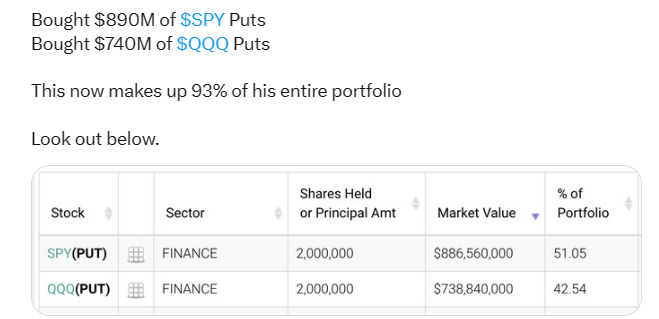
Burry is betting against the S&P 500 and Nasdaq 100 this week, according to his fund’s latest releases. Securities and Exchange Commission filings.  The filing shows that he is now holding options against the S&P 500, hedging $886.6 million against the index.

The filing also revealed that Burry sold his shares in Capitol One, First Republic, PacWest Bancorp, Wells Fargo and Western Alliance after betting on them earlier this year in Trying to make money from the regional banking crisis.  Burry also sold his stakes in Chinese e-commerce giants Alibaba and JD.com.

In addition, he bought $738.8 million in put options against the Invesco QQQ Trust ETF – a fund made up of popular high-tech Nasdaq companies, such as big tech companies Apple and Microsoft as well as Nvidia, Tesla and PepsiCo.

Burry has pulled money out of China investments and U.S. banks and is hedging against tech and the S&P.  He took these positions before the data from Japanese exports to China was released.

Americans Tapping into 401Ks amid Private Debt Crisis


From Armstrong Economics Posted Aug 14, 2023

Credit card balances in the US have surpassed $1 trillion for the first time, with balances up almost 20% from a year ago. The Federal Reserve Bank of New York reported that total credit card debt stood at $986 billion in the first quarter of 2023, unchanged from the record hit at the end of 2022. The average credit card interest rate offered in the US over the last three months of 2022 stood at 21.6%, according to WalletHub, a jump from about 18% a year prior. Americans are now tapping into their retirement funds to make ends meet.

Hardship withdrawals allow employees to pull money out of their 401K for an “immediate and heavy financial need.” No one would recommend doing this unless the situation was dire. Bank of America reported that 15,950 employees enrolled in 401K programs made a hardship withdrawal during the first three months of 2023, a 36% rise from Q2 22. Individuals must show evidence that the money will be used for a major hardship in order to avoid the 10% early withdrawal fee imposed for those under 59.5.

It costs more money to borrow thanks to rising interest rates. The majority of Americans do not have money stashed away for a rainy day, and those who do are rapidly draining their accounts to keep up with Biden’s economy. The CPI report in June showed a rise of 3% YoY, but look around, absolutely everything is more expensive. Shelter costs have reached an all-time high and the price of food is on the rise, especially with wheat price manipulation going on using the war in Russia as a guise. Why are we sending hundreds of billions to a foreign nation when our own people cannot afford to live? The masses need to wakeup and get mad at their current predicament before the next election if we even have one.

Bidenomics – Multiple Key Performance Indicators Spell Trouble Ahead


Posted originally on the CTH on August 10, 2023 | Sundance 

Several people have made queries about the current state of our national economic condition against the backdrop of disconnected data points that seemingly conflict. Here’s my review.

July and August are key months to gauge the prior six months of U.S consumer positioning.

Why?

Because all advance purchase orders for the U.S. holiday season are made in May, June and July for inventory builds and delivery schedules for September.  The decisions made by purchasing officers in late spring and early summer, reflect their predictive analysis for the holiday season.

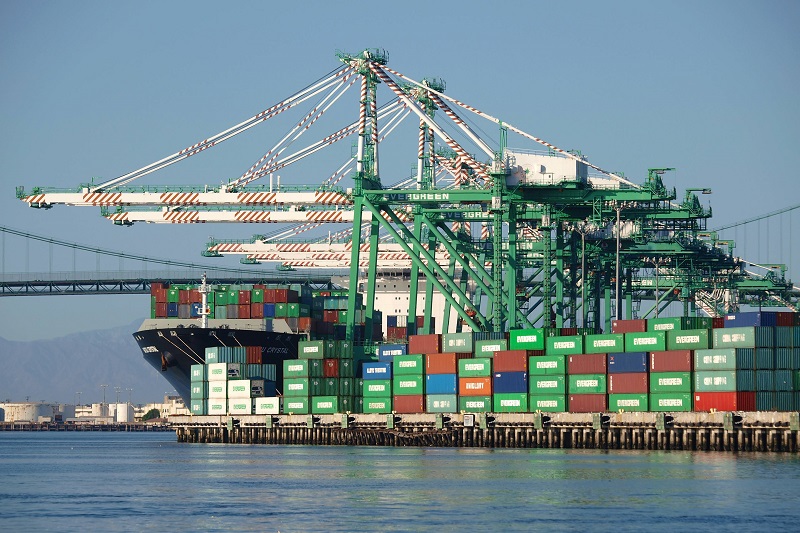
Inventories are evaluated, critical financial discussions are held, and orders are placed for September arrival and distribution.  This predictive activity is what we see in the July and August data that flows from the global, multinational and shipping corporations who facilitate the transfer of the goods.  Check what is happening in distribution, and you can see what eventually creates the boxcar effect in the supply chain that ultimately leads to shuttered manufacturing.

Those who are involved in the business of shipping goods are signaling the flares around the state of the consumer economy and what will happen.  At the same time, the wording is almost hilarious in this era of great pretending.  Instead of saying ordinary words like “poor sales results for durable goods,” the parseltongue calls sales, “destocking.”  Example:  “CEO Vincent Clerc said he saw no sign that the destocking which has curbed global trade activity would end this year.”

Global shipping company Maersk is warning that shipping volume is low because warehouse inventories are high.  The goods are unsold.

(Reuters) – […] CEO Vincent Clerc said he saw no sign that the destocking which has curbed global trade activity would end this year.

“We had expected customers to draw down inventories around the middle of the year, but so far we see no signs of that happening. It may happen at the beginning of next year,” Clerc said at a media briefing.  “Consequently, the uptick in volumes we had expected in the second half of the year has not occurred,” he said. (read more)

The lack of shipping leads to a review of inventory status for the warehouses who would receive the goods.

Bulging Warehouses – […] A review of corporate statements and briefings shows more than 30 U.S. and European companies, including Hugo Boss, Heineken and A.P. Moller-Maersk, 3M Co and Stanley Black & Decker complained that destocking hurt their second-quarter performance.

Retailers particularly have struggled with stocks of clothing and footwear as consumers splurge on holidays rather than goods as they did during pandemic lockdowns.

The downbeat outlook comes amid low expectations for second-quarter results as China’s post-pandemic recovery slows. Refinitiv I/B/E/S data shows U.S. and European companies are expected to report their worst quarterly results in years.

Companies which stockpiled last year are finding it harder to shed inventories when higher borrowing costs and inflation crimp consumer demand, corporate executives and analysts said.

In the euro zone, stocks of finished products hit records in August last year and destocking only started in May, based on latest euro-zone manufacturing data.

In the U.S., an analysis of U.S. Bureau of Labor Statistics by CFRA Research showed business inventories soared by 20% in mid-2022, the biggest jump on record based on data that goes back to 1993. Retailers led the trend – raising inventories by a quarter from a year earlier.

The date in this next paragraph is key:

[…] The U.S. inventory-to-sales ratio was 1.4 in May, up from 1.33 a year ago, which means retailers, manufacturers and wholesalers have more inventory than they can sell at a higher rate than a year ago. (link)

When purchase order decisions for the holiday season of 2023 were being made, the inventory levels were higher than 2022.  This is KPI (Key Performance Indicator) data, because the holiday of 2022 was a total mess.

Holiday sales last year were exceptionally weak as wage earners were struggling to pay for higher prices in essential goods and services, fuel, oil, heating, energy, gasoline, food and shelter.  The lack of consumer purchasing for non-essential goods and/or luxury items resulted in poor sales last year, and the inventory levels are actually higher this year than last year when this year’s purchasing decisions were being made.  That reality drops purchase orders.  The dropped purchase orders lead to Maersk saying they are shipping less goods.

Now, let’s get USA domestic…. because it’s all connected.  For that let’s turn to the U.S. Postal Service:

USPS DATA – First-Class Mail revenue increased $221 million, or 4.0 percent, on a volume decline of 678 million pieces, or 5.9 percent, compared to the same quarter last year. Shipping and Packages revenue remained relatively flat while volume declined 41 million pieces, or 2.4 percent, compared to the same quarter last year.

Marketing Mail revenue decreased $333 million, or 8.8 percent, on a volume decline of 2.6 billion pieces, or 16.0 percent, compared to the same quarter last year. The Marketing Mail decreases were driven by the continued decline in advertising spending due to economic pressures experienced throughout most of the fiscal year, a higher inflationary environment affecting print media production costs. (link)

So, let’s put it all together….

Consumers did not buy stuff.  As a result, spring inventories were high.  Purchasing managers forecast weak sales. Summer purchase orders were very low.  Shipping companies reflect declines in shipping because the purchase orders were low. Advertising and marketing budgets were cut to meet the decrease in consumer spending.  Consumers are not forecast to spend this holiday season.

The economic pie is getting smaller.

Keep in mind, this is all intentional.  This is all part of the outcome from “managing the transition” to a new energy economy.

As you are well aware the various western nation central banks including the U.S. Federal Reserve, are raising interest rates into a global economic contraction, a drop in demand.  Raising interest rates into a contracting economy is counterintuitive, it runs against the expressed interest of government to grow economic conditions.  However, there is a purposeful design to the contradiction.  [A TLDR Version Here]

The central bankers are trying to support western government policy.  Unfortunately, the government policy they are under obligation to support is the fundamental energy shift, or what the World Economic Forum (Davos Group) has called the “Build Back Better” climate change agenda.

Monetary policy can only impact one side of the inflation challenge.  The western bankers (EU central bank, U.S. federal reserve bank, and various banking groups) are raising interest rates in order to “tame inflation” by “taming demand.”  However, as you know the global economic demand has been declining for several quarters.  Raising interest rates into an already contracting economy only does one thing, it speeds up the rate of economic contraction.

Economic contraction is the lowering of economic activity.  Raise interest rates -in a general sense- and businesses invest less, borrowers borrow less, consumers purchase less, employers expand less, and the economy overall slows down. When the economy turns negative, meaning less products and services are produced, we enter a recession. Some businesses and employers do not survive a recession and subsequently unemployment rises.

During recessionary periods people buy less stuff, people have less income stability, and economic activity drops.  When the banks raise interest rates into an economy that is already stalled or contracting, unemployment and general pain on Main Street increases.  Workers are laid-off, incomes shrink, consumer spending drops and that leads to less employment.  Recessions are bad for middle-class and working-class people.

However, that said, there is one benefit from a recession…. Energy use drops.

Hard Currencies – Fiat v Legal Tender


Armstrong Economics Blog/Great Reset Re-Posted Aug 2, 2023 by Martin Armstrong

A man attempted to purchase strawberries with cash at an Aldi grocery store in the UK, possibly leading to his arrest. They want us to adjust to the cashless society that will implement globally by the World Economic Forum under its Digital Currency Governance Consortium. Some call cash “hard currency” to further differentiate it from the coming digital world of finance. Piers Corbyn, who happens to be the brother of British Labour Party leader Piers Corbyn, has gone viral for what many are calling an act of rebellion against the globalists.

The Aldi in Greenwich only accepts payments through the Aldi App. Aldi implemented this measure during COVID and never repealed it. Stores are commonly banning all cash transactions, and it is legal for them to deny cash. These stores may not realize that the WEF will soon implement one “globally coordinated approach to [digital currency] regulation” and their individual apps will be obsolete.

As for Corbyn, he placed his cash on the counter and left the store with his strawberries. People cheered as he left the store. Aldi employees called the authorities. “I’m offering exactly the right amount of money here,” he announced, “I’ve paid my legal tender.”

“Legal tender” is merely any form of payment accepted by law. So while the “hard currency” produced by the Royal Mint may be considered legal tender to some, the grey area here is that sellers do not need to accept it as a form of payment. So what was once a commonly accepted legal tender is now fiat, containing no intrinsic value without the backing of CONFIDENCE.

When the gold coin was money during the 19th century, it rose and fell in purchasing power no different than any paper currency. You cannot walk into a grocery today and pay in gold. People only accepted paper money because they knew others would accept it as a form of payment. Fiat is simply an arbitrary decree.

Governments are telling the people loud and clear that cash will be phased out. They are making us accustomed to the idea, gaslighting us into thinking digital is more convenient. The truth of the matter is that the day will come when they ask us all to turn in our “hard currencies” in exchange for CBDC. I applaud this man for his act of bravery and hope he was not arrested over a pint of strawberries.

The Myth of FDR’s New Deal


Armstrong Economics Blog/America’s Economic History

Re-Posted Aug 2, 2023 by Martin Armstrong

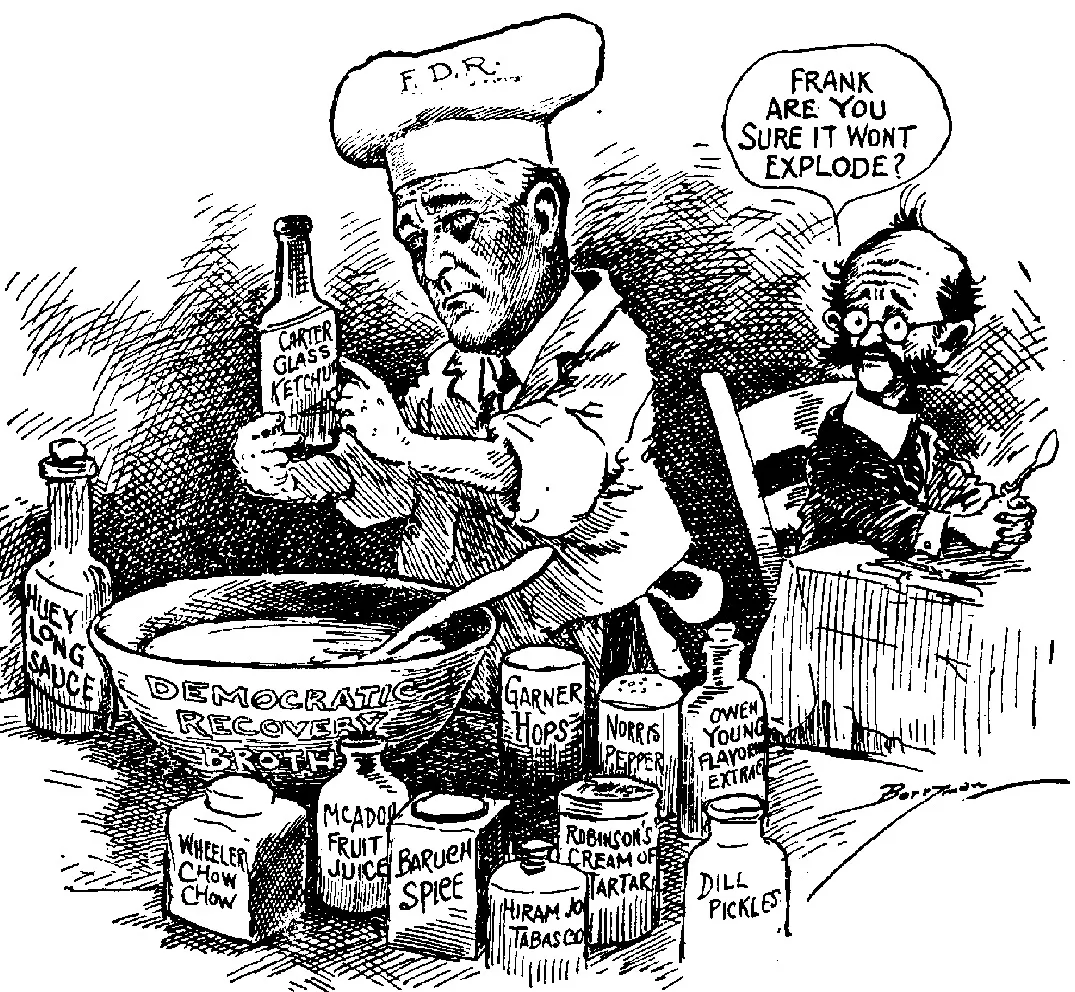
The victor gets to write history, and that is precisely what the LEFT did with FDR and the New Deal. You will never be an accurate analyst unless you accept that you are duty-bound to investigate the truth no matter where it may lead. The myth of the New Deal and its success in dragging the United States out of the Great Depression still prevails. This myth was the LEFT rewriting history, which truly became the propaganda that the Democrats had clung to right up to now, the Green New Deal.

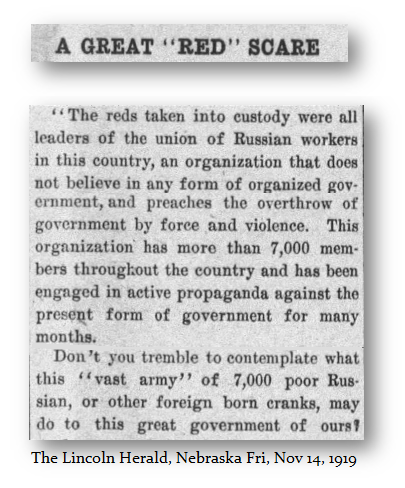
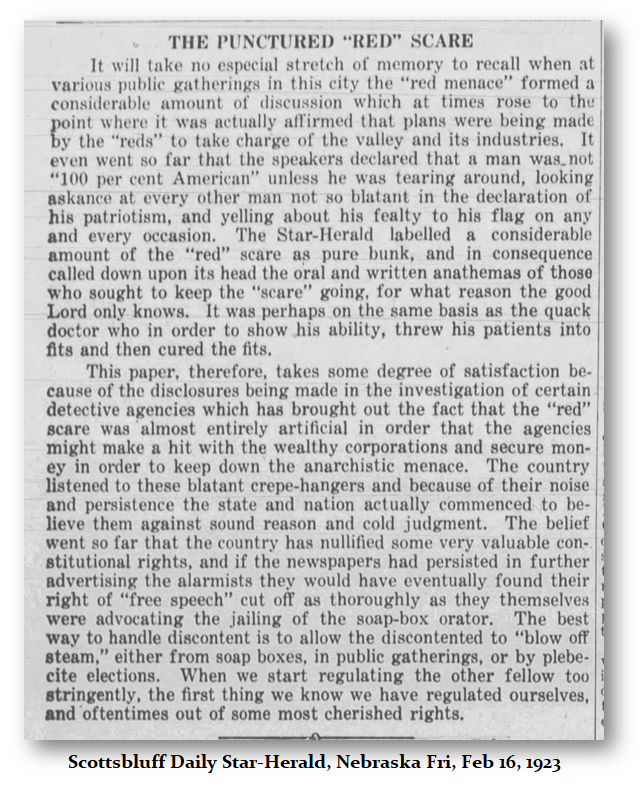
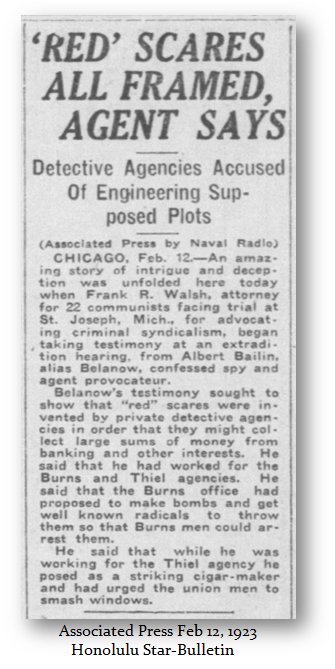
This country had a massive Red Scare following World War I from 1918 to 1923. They were targeting Russians and assuming they were all just Communists when many fled here from Communism. The Department of Justice (DOJ) exploited it just as they did terrorists. When we were going to hold a conference at the Convention Center in Philadelphia owned by the government, they demanded that we purchase Terrorist Insurance covering the entire city and the state. They did not disclose that in advance and stole our deposit when I refused to comply – typical government. The DOJ gained more power, and we suddenly had to take off our shoes to board a plane – the only country to do such a thing.

The paranoia created was used to launch Congressional hearings, censorship, and new sedition legislation used today by the Biden administration against Trump and his supporters, all because of this manufactured Red Scare. They ignored the fact that the vast majority of people who were Russians had fled Communism. Even the story of Saint Petersburg, Florida, got its name on a coin toss, as legend would have it. In 1875 John Constantine Williams of Detroit, Michigan, moved to Tampa and bought 2,500 acres of warm waterfront land that would eventually become St. Petersburg. Many years later, Peter Demens, who was an exiled Russian aristocrat fleeing Communism, financed the Orange Belt Railroad to Williams’s settlement. Williams and Demens flipped a coin to see who would name the city. Demens won the coin toss and named it after Saint Petersburg, Russia. Williams named the city’s first hotel after his birthplace, Detroit.

Then as now, they turned against anyone who was Russian. This was whipped up by the press and the Department of Justice as they did to the Japanese during World War II. It just seemed that they had to target someone, and this time it appeared to be Trump supporters. The interesting fact is that the Red Scare was exposed as FAKE. By 1923, the Red Scare was exposed as being manufactured to generate business. They were also targeting unions. The first victim of the Red Scare was the union of mine workers.

Nevertheless, it was during the New Deal that the real communists infiltrated Roosevelt’s Administration. The New York Times celebrated Joesph Stalin and communism as the future and cure for the Great Depression. Their top journalist Walter Duranty (1884-1957) even convinced Roosevelt to recognize Russia. Duranty met with Roosevelt to convince him that Communism was working and to encourage his New Deal. The mainstream press in the 1930s was very much touting the Communists. They wanted to hear of Utopia and so reported only what they wanted to believe, as they are doing once again.

The New York Times (NYT) journalist Walter Duranty on March 31, 1933, denounced reports of famine to cover up the fact that Stalin stole all the food from Ukraine. The NYT was so pro-Communism that this was the natural infiltration of Reds, but nobody did anything about that. They wanted to hear of Utopia and so reported only what they wanted to believe, as they are doing once again. The New York Times even promoted Duranty to be awarded the Pulitzer Prize for that reporting fake news. When Gareth Jones (1905-1935) in March of 1933 said this was all a lie, the truth finally began to appear. It took the New York Times until 1990 to admit they engaged in fake news pushing communism, covering up the famine in Ukraine to suggest that Stalinism was the Utopia they wanted to impose in the United States. The NYT wrote that their reporting on the Russian Revolution constituted “some of the worst reporting to appear in this newspaper.” Duranty was doing this also to support Roosevelt’s New Deal. He helped install drastic progressiveness in taxation.

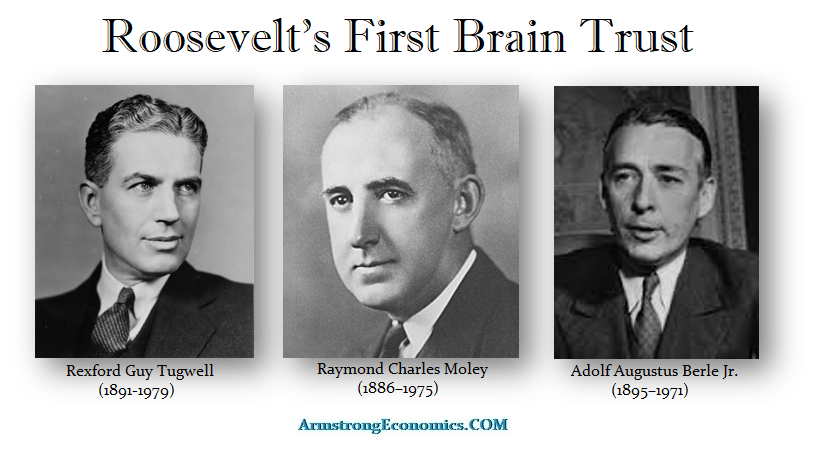
Roosevelt’s New Deal was based on Marxism. His first Brain Trust consisted of a group of Columbia Law School professor Adolf Berle, Jr. (1895-1971) and an economist Raymond Moley (1886-1975). In mid-1933, Moley began his break with Roosevelt when he saw that he was becoming increasingly Marxist. He abandoned Roosevelt entirely by 1936 when it became clear that the New Deal had failed. Roosevelt replaced Moley with a decisively leftist economist named Rexford Tugwell (12891-1979). Moley became highly critical of Roosevelt and Tugwell’s policies to such an extent he switched parties and became a Republican.

Tugwell, an academic economist, embraced the Utopian ideas of Stalinism. It was Stalin who Lenin warned should not follow him. Lenin wanted Communism, but each state retained its sovereignty, whereas Stalin was authoritarian and imposed central planning and carried out his Great Purge of 1937-1938, killing between 700,000 and 1.2 million, involving anyone he thought would oppose his central planning. Tugwell sought to impose Stalin’s central panning and crafted much of the legislation in those years that cartelized industry, controlled prices, and embarked on Soviet-style projects. Tugwell was a great admirer of Soviet “achievements” in agriculture and housing, believing the fake news published by the New York Times. Roosevelt even sought to stack the Supreme Court with Soviet admirers to overrule the U.S. Constitution to create this tremendous new Soviet Utopia in America.

All of these regulations did not save the United States – they actually made it far worse. LEFTIST historians have reached a consensus that regards the accomplishments of the New Deal as the major watershed event constituting a definitive dividing line in American social-economic history. These historians present the Roosevelt administration as marking the end of the passive state dominated by big business interests and the beginning of the interventionist state. This new interventionist state was designed to curb the concentrations of business power, claiming to be the protector of the rights and interests of the powerless and underprivileged. They have projected that they alone will secure the general welfare against the capitalists and their profit-seeking agenda. Against this revision of history, the opponents saw this New Deal as a conspiracy of leftist intellectuals with the help of labor union factions. Career politicians have always maintained the public image of Marxist Socialism while selling favors for money to lobbyists.

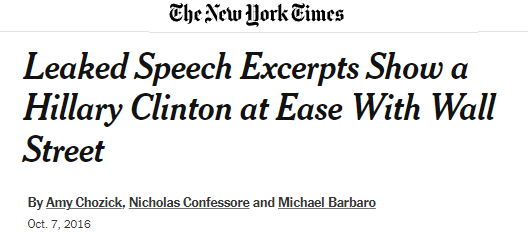
“Mrs. Clinton said she dreamed of “open trade and open borders” throughout the Western Hemisphere. Citing the back-room deal-making and arm-twisting used by Abraham Lincoln, she mused on the necessity of having “both a public and a private position” on politically contentious issues. Reflecting in 2014 on the rage against political and economic elites that swept the country after the 2008 financial crash, Mrs. Clinton acknowledged that her family’s rising wealth had made her “kind of far removed” from the struggles of the middle class.”

Consequently, the New Deal was the 20th-century evolution of the Marxist Interventionist State. Ironically, they would cut special favors for big business that allowed the Leftist Agenda to take hold. By introducing regulations to intervene in the economy, they corrupted the government by endorsing the rise of lobbyists.  What actually took place was that where big businessmen had failed to achieve monopolies during the 19th century, they turned to the Federal Government for protections of various sorts. This even allowed companies by Pfizer to be protected from lawsuits for their failure to provide safe drugs.

The great achievement reached a climax with the passage of the NationiaI Industrial Recovery Act (NIRA) of June 1933. This was one of the measures by which Roosevelt sought to assist the nation’s economic recovery during the Great Depression. This was a unique experiment in economic history that sanctioned, supported, and also enforced an alliance of industries. The Sherman Antitrust laws were actually suspended. Roosevelt insisted that companies were required to write industry-wide “codes of fair competition” that effectively fixed prices and wages, created production quotas, and imposed restrictions on the entry of other companies into the alliances. This was seeking Soviet-style control over industry without seizing private ownership. Promises of self-regulation enticed companies and declared codes of fair competition. While it was marketed as protecting consumers, competitors, and employers, the country’s various industries were to write their own regulations. Employees were given the right to organize and bargain collectively in unions. They were not to be required to join or refrain from joining a labor organization as a condition of employment.

The National Recovery Administration (NRA) was created by the National Industrial Recovery Act (NIRA) and was engaged chiefly in drawing up these industrial codes for all industries to adopt until March 1934. More than 500 codes of fair practice were adopted for various industries. Patriotic appeals were made to the public, and firms were asked to display the Blue Eagle, an emblem signifying NRA participation. However, in 1935, the U.S. Supreme Court unanimously declared the NRA unconstitutional. They held that it infringed the separation of powers under the United States Constitution. The NRA stopped operations. However, Roosevelt was not deterred, and much of the labor provisions reappeared in the National Labor Relations Act, passed later the same year – 1935. This resulted in the one-sided LEFTIST power of unions, which were the core of the New Deal but led to serious corruption over the course of the next three decades.

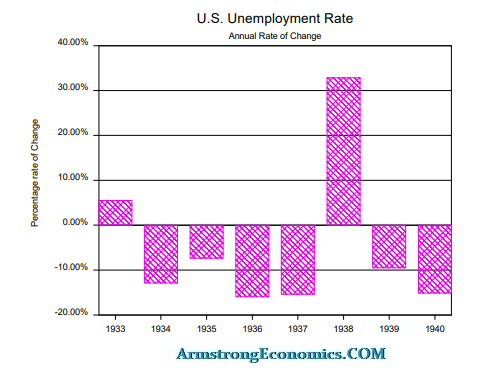
Yes, I know, we’ll never get rid of the Myth that the New Deal saved us, but the reality is that the Great Depression lasted longer than it would have otherwise taken due to the FDR intervention. We can see that unemployment was still greater than 10% even in 1937 despite the rally in the stock market between 1932 into 1937. It was 1938 when Roosevelt passed the Fair Labor Standards Act establishing a minimum wage. It was also when Hitler marched into Austria, establishing a geographical union of Germany and Austria. Then there was the Munich Pact, where Britain, France, and Italy agreed to let Germany partition Czechoslovakia.

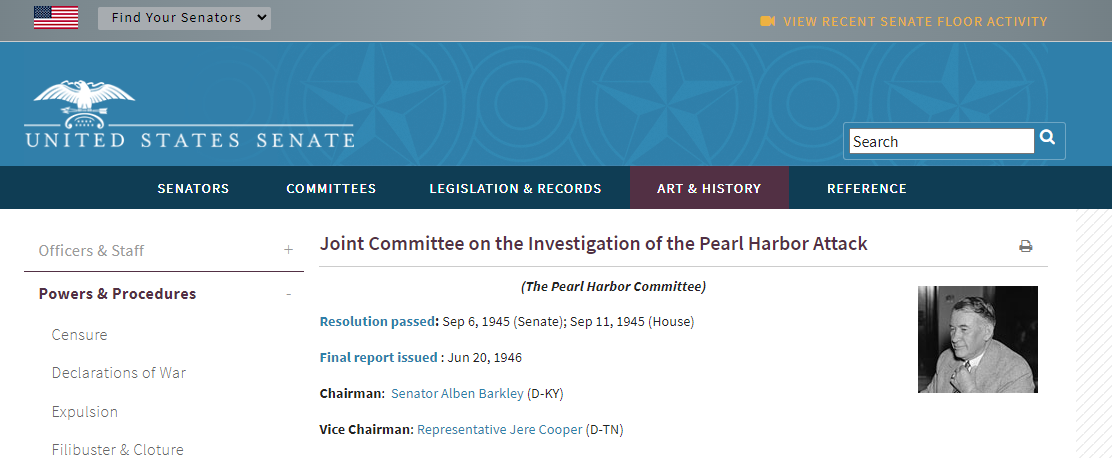
As we can see, the worst unemployment actually took place in 1936, some four years after FDR was elected. So much for his policies reversing the Great Depression. The real event was war, which is why FDR allowed Pearl Harbor to occur. The scandal was that we had broken the Japanese CODE, so the question was, why did we allow Pearl Harbor to take place? They concluded that there was no direct evidence that FDR knew.

Panic Buying Starts Again


Armstrong Economics Blog/Agriculture Re-Posted Jul 29, 2023 by Martin Armstrong

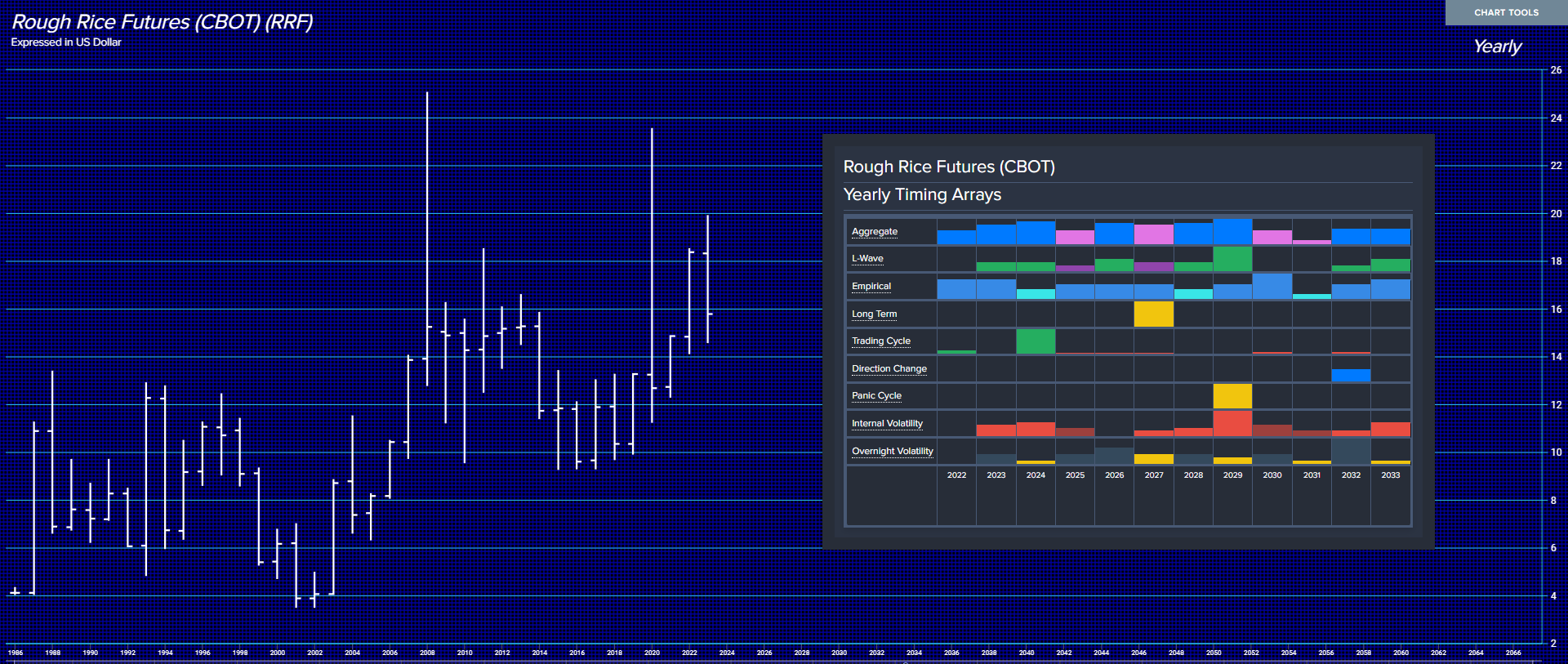
First, it was toilet paper, then baby formula, and now it’s non-basmati rice that people are running to the stores and buying in bulk. India has put into effect on July 20th the ban on non-basmati rice in order to calm domestic prices. According to the International Food Policy Research Institute, the global rice market prices have already risen 15%-20% since September of 2022. People have already started panic buying in Texas, Washington, Michigan, and other states. It has not hit every state yet; the impact of this ban has been more so in the regions of larger Indian-origin populations. Most grocery stores have already allegedly limited one bag of rice per customer. Wholesalers and other companies have been adjusting prices which leads to price gouging, so rice is selling for double than usual.

Rice was already at a high point price-wise during Covid-19 and with the war in Ukraine, it gouged the cost of wheat, causing rice production to increase. Allegedly, according to a store owner, there has not been a date specified that this ban in India exports will lift. He is suggesting that this ban will be anywhere from 6-8 months.

Socrates has projected that volatility would rise starting here in 20203, and prices should rise further into 2024. Thereafter, geopolitical instability may further impact supply.

Trying to Make Heads or Tails about Recessions


Armstrong Economics Blog/Economics Re-Posted Jul 28, 2023 by Martin Armstrong

QUESTION: Looking at Socrates,  do you think that these people who were constantly calling for a recession because there were two quarters that declined with covid really need revision? Socrates was correct, no recession. But it is showing major turning points in 2024 which seem to align with your old ECM forecast calling for commodity inflation into 2024. How would you define a recession?

EJ

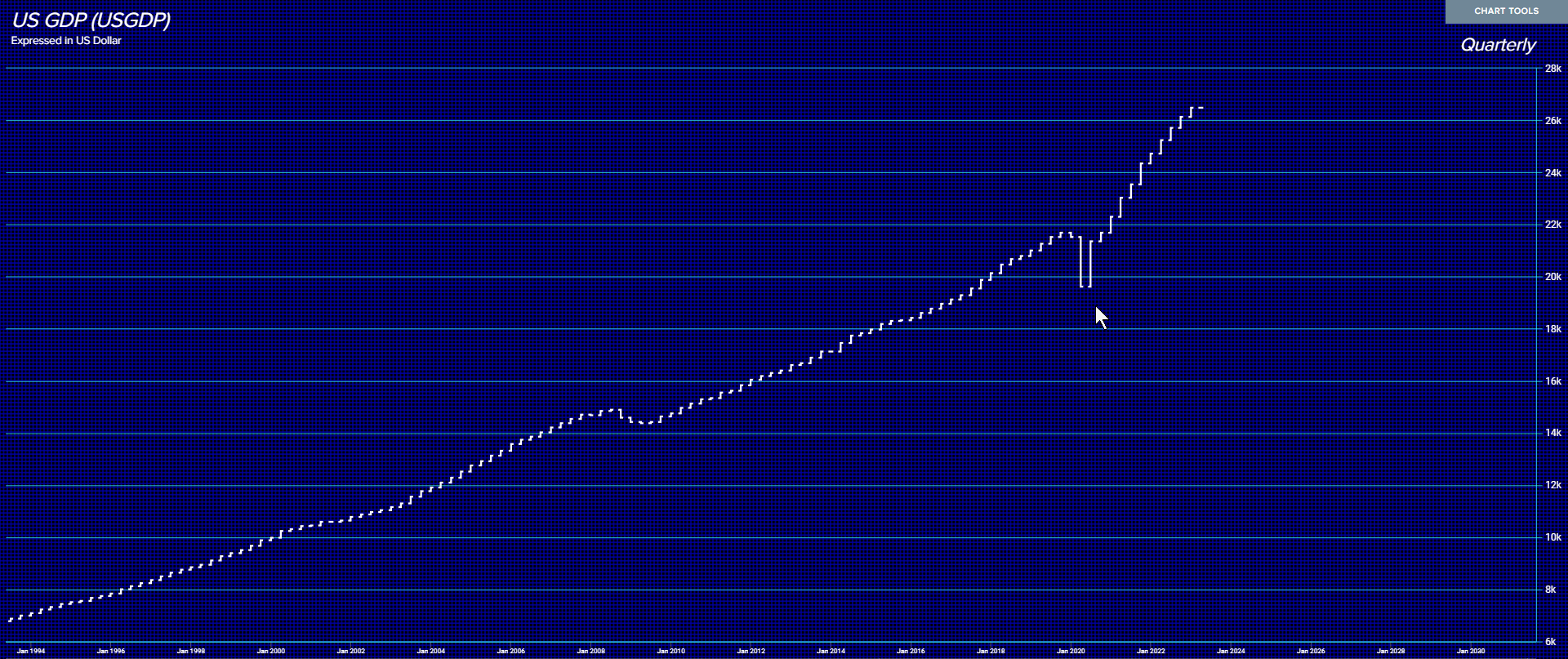
ANSWER: In trading, reactions are 1 to 3 time units. I believe that the same definition should be used for classifying a recession. They define a recession as two consecutive quarterly declines. If you look at the “Great Recession” of 2008-2009, you will see three consecutive quarterly declines and a rebound. If we look at the COVID recession caused by locking everyone down, that was just two consecutive quarterly declines.

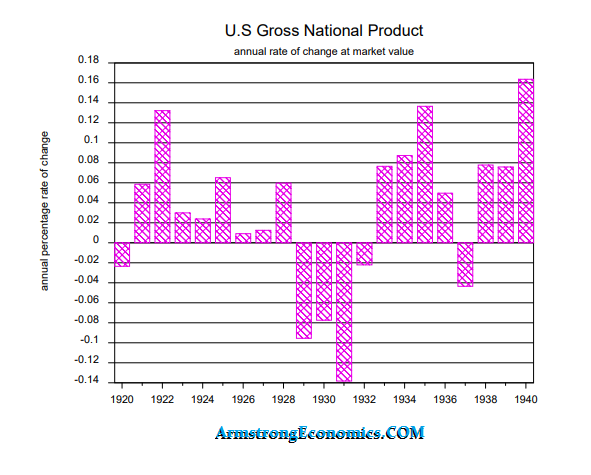
I personally would argue that a true economic recession MUST exceed three consecutive declines. Here is the chart of GNP from 1929 to 1940. There were three years of negative growth. I simply think that this definition of two quarters is wrong. You can have a slight decline of 1 to even 5%, but that does not suggest a recession. In the case of 1929, that was a decline of 9.5% in 1930 – the first year. Now look at the COVID Crash, which was also a decline of 9.53%. But the difference is that the COVID decline was forced and not natural. That is why it rebounded so quickly. Now the so-called “Great Recession” of 2008-2009 only saw a decline in GDP of 3.47%.

The “Great Recession” was not really so great. It wiped out real estate and bankers but did not fundamentally alter the economy. So who is right and who is wrong will always depend upon the definition. Yes, the AI Timing Arrays point to a recession starting Next Year by their definition. This will most likely be caused by the decline in confidence that will lead to UNCERTAINTY, and as such, the consumer will contract. Up to now, the continued expansion of the economy into 2024 has also been fueled by the shift in assets from public to private.

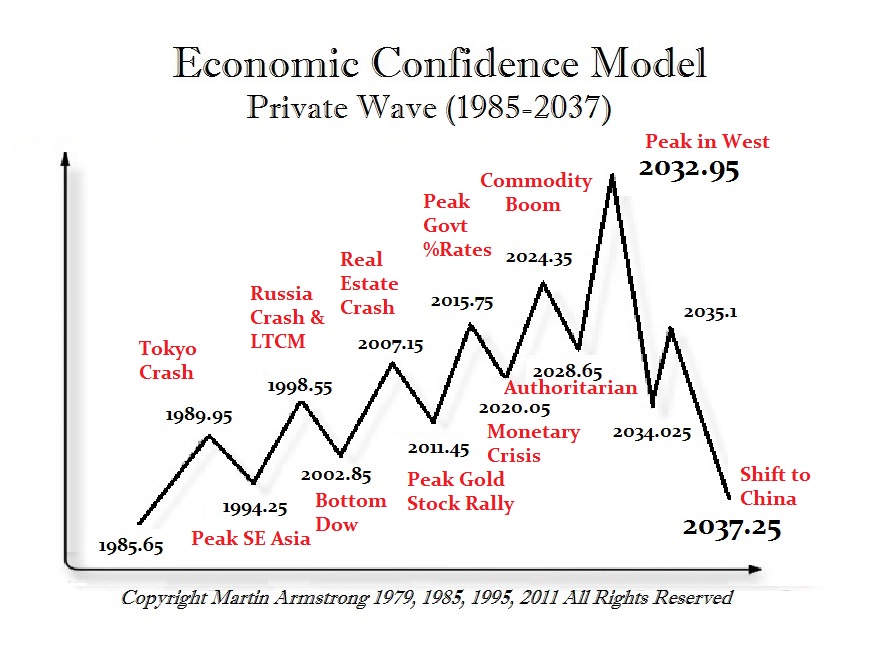
As originally forecast, we should have seen a commodity boom into 2023,

and we should expect a highly authoritarian attempt by 2028.

Spain’s Climate Minister Caught Faking Bike Transit for Cameras


Armstrong Economics Blog/Climate Re-Posted Jul 13, 2023 by Martin Armstrong

The above video is complete climate propaganda.

The climate zealots are laughing at us from their private jets. They swear doomsday is around the corner and the commoners must abandon all basic comforts to save the world. Their predictions have never come to fruition because they are based on nonsense. Spanish climate minister Teresa Ribera was caught faking a bike commute for cameras, and it is not the first time a climate tzar was caught pulling such an act.

Ribera flew on a private jet to attend a climate conference, where the elite decide what the Great Unwashed should forego. She hopped into a private car and drove 100 meters to the venue. Then, cameras captured her taking out a bicycle to ride the 100 meters to the venue. Pure propaganda.

The Great Unwashed must blindly obey why the fraudulent rulers mock us. Ribera boarded a private jet 17 times in 2022, costing taxpayers €170,000. She traveled via private jet 16 times in the past seven months, totaling €160,000. Do you think she cares about her carbon footprint?

Ribera is a World Economic Forum proponent, obviously, and participated in the C40 Cities Summit. She supports reducing air travel, meat consumption, and private car ownership. She said all cars must have zero emissions by 2040 to reach decarbonization by 2050. In fact, she believes all gas engines should be banned by 2035. As a former UN climate negotiator, she pressured the EU to abandon the Energy Charter Treaty. She pushed Spain to move away from coal and nuclear energy by 2030. She is simply another deep state minion hoping that the people are ignorant enough to believe that they are responsible for natural changes in the weather. Rules for thee but not for me will be more apparent than ever as we move toward the Great Reset goal.

Bankruptcy on the Rise


Armstrong Economics Blog/USA Current Events Re-Posted Jul 12, 2023 by Martin Armstrong

Chapter 11 bankruptcies in the US rose by 68% during the first six months of 2023, according to Equip Bankruptcy. You may have survived the pandemic, but surviving Bidenomics is proving too much for many businesses. There were 1,766 filings during the first six months of 2022, compared to the 2,973 businesses that went under this year. Chapter 13 personal bankruptcy also rose by 23% during this period.

Around 12,107 commercial filings were recorded during the first half of this year, marking an 18% increase year-on-year. Small businesses experienced a 55% increase in Chapter 11 filings during the same time period. Commercial bankruptcies increased 12% year-on-year in June alone, and small businesses saw a 111% spike. “The growth in filings is reflective of more families and businesses facing surging debt loads due to rising interest rates, inflation, and increased borrowing costs,” said ABI Executive Director Amy Quackenboss.

Everyone is in trouble here. This is becoming a trend as inflation is here to stay. Credit card debt has reached historical highs as people struggle to pay the basics. Businesses were already decimated by COVID policies, and some never regained the momentum. People have lost all confidence in the future and are less likely to spend. Many businesses attempted to recover from lockdowns and the supply chain disaster, but the increased regulations make it difficult for many to profit. It will only become more expensive to borrow money as Powell all but guaranteed additional hikes this year, and now many have no other option than to liquidate it all.

Gold Back Currency Reality


Armstrong Economics Blog/Gold Re-Posted Jul 8, 2023 by Martin Armstrong

QUESTION: Do you think the BRICS would create a gold-back currency as proposed by Russia?

SJ

ANSWER: The Neocon has directed the Biden administration to remove Russia from SWIFT. Their single-minded goal is destroying the world economy, but they do not care. They think they will conquer Russia and China and dominate the world so they will worry about the monetary system afterward.

You have to understand that if the BRICS followed that directive and created a single gold-back currency, they would have to end any idea of international trade. This proposal is understandable given the hostility of the United States from the Neocons, who are now in charge. Congress is oblivious to what is happening, and the American public is arguing over Transgender destroying the family unit.

This is not some simple one-dimensional idea that we create a limited-backed currency. That will be DEFLATIONARY and, at the same time, promote civil war in the United States. Politicians cannot run for office, promising endless gifts, forgiving student loans, etc. You cannot have deficits. This would NECESSITATE the end of Marxism once and for all.

This idea of a gold-back currency requires political change on a grand scale.  That is coming. Post-2032 will be a new monetary and political system. Before then, they are pushing CBDC, and they will restrict what you can buy or sell, and this is all to retain power because they KNOW they are losing it. But in the process, they are destroying everything. The people who voted for Biden had no clue that they were voting for a coup and the ultimate destruction of Western civilization as we have known it.

I buy gold, but I also understand the game. I do not want gold-back currency; I prefer gold to remain as a hedge against the government. If they back the currency with gold, this time, they will be knocking down every door to confiscate it all.

These Neocons have already divided the world economy in two. They think they will conquer the world. The enemy is within.