Inflation Plateau Continues During March, Real Wages Shrink Again, Future Energy Costs Start to Rise Again with Oil


Posted originally on the CTH on April 12, 2023 | Sundance

In the latest round of statistics from the Bureau of Labor and Statistics (BLS) the March inflation data has been released [DATA HERE]. The Consumer Price Index (CPI) climbed 0.1% in March after advancing 0.4% in February.  This puts the 12-month CPI outlook at 5% inflation. [See Modified Table A on Left]

A 4.6% decline in March gasoline prices was offset by higher rental and housing costs.  That was the primary driver of the lowered inflationary data as gasoline is weighted heavier in the impact.

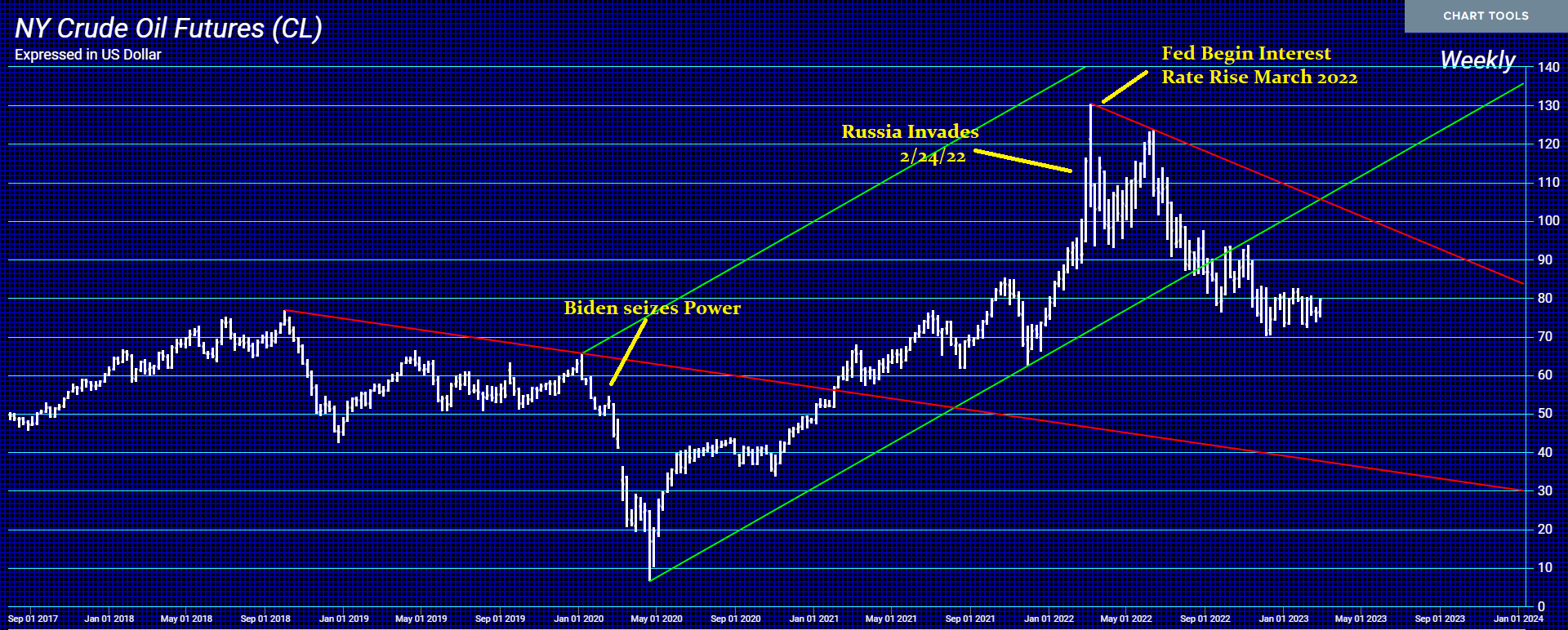
However, that said, gasoline prices are already rising again after Saudi Arabia and other OPEC+ oil producers early this month announced further oil output cuts.  This puts the April CPI data (starting to be assembled this week) on track to increase over March.

Overall, in the big picture the data shows the plateau of sorts as we described for this spring.  This plateau will be followed by another bump as a result of current input costs and prior energy costs traveling through the supply chain.

Energy services, electricity and natural gas, are stable but higher than last year.  The crop cycles carry those increased costs from field to fork.  Consumers cannot avoid those food prices increasing.  The more processing involved in the food sector, the higher the price increase.

Housing increases are another unavoidable cost and generally cycle with a lag within them.  As leases expire, the new lease rates increase accordingly.  The same is true for insurance rates.  Both unavoidable sectors have a rolling lag that hits the consumer upon renewal.

On the wage side [DATA HERE] wages went up .03% but the work week declined 0.3%.  Essentially nullifying earnings growth with fewer worked hours.  With inflation at 0.1%, real wages declined .01%.

For the total 12-month cycle noted by the BLS data, “real average hourly earnings decreased 0.7 percent, seasonally adjusted, from March 2022 to March 2023. The change in real average hourly earnings combined with a decrease of 0.9 percent in the average workweek resulted in a 1.6-percent decrease in real average weekly earnings over this period.” For the year, wages continue to fall far short of inflation; meaning real wages are negative.  Actual real wage growth has been negative for 24 consecutive months.

The main street economy is feeling all of these impacts.  The paper economy (Wall St) is not feeling these impacts at the same level.  The chasm between the haves and have-nots is widening.

Earn Six Figures Without Working


Armstrong Economics Blog/Politics Re-Posted Mar 31, 2023 by Martin Armstrong

The US government has been on a spending spree over the past few years and there is absolutely no way they can ever pay the bill. Federal spending hit $4.45 trillion in 2019 in the wake of the pandemic, according to the Congressional Budget Office (CBO). That figure hit $6.21 trillion as of the latest report, marking a 40% uptick in four years. What has changed?  

 This goes far beyond the Ukraine fiasco. While defense spending rose 18% over the past four years, nondefense spending shot up 43% to $941 billion. Spending on Social Security and retirement increased 33% from 2019 to 2023 as the Baby Boomer generation began to exit the workforce. Retirement has become a luxury with the current cost of living and many are opting to continue working rather than retire. Yet, the mentality of hard work paying off is dwindling. The effects of the pandemic can still be felt as the workforce dynamic has changed. The supplemental unemployment income distributed freely during the pandemic has had disastrous consequences. 

Spending on food stamps has increased by 102% from $63 billion in 2019 to $127 billion in 2023. Welfare support rose 50% as well from $32 billion to $48 billion. Unemployment costs have increased 32% over the past four years, despite the record-low unemployment rate. The US spent $53 billion on educational pandemic aid and $71 billion to help failing PBGC plans. The CBO now foresees a federal budget deficit of $1.4 trillion in 2023, and this number is expected to rise. 

Biden’s Build Back Better Act pushed for the largest welfare spending in US history. It pays NOT to work in Biden’s America. According to the Heritage Foundation

"Total government spending on the average poor family will rise from $65,200 per year to more than $76,400. When limited private earnings are added to this massive government spending, combined total resources will reach nearly $94,600 per year for the average poor family."

Biden repealed some of the reforms issued by the Clintons to boost reliance on government aid. People who choose not to work are eligible for unconditional cash grants funded by working taxpaying citizens. “Taxpayers would be required to pay larger sums to support welfare recipients, but recipients would have no reciprocal obligations,” the Heritage Foundation continued. Those who decide to marry receive less funding. Mothers who have children by multiple fathers receive more funding. Traditional values are punished. Why rely on family when you have the government? 

Some states pay six figures to “low-income” families through benefits and subsidiaries. A family earning nearly a quarter million per year could still qualify for ObamaCare subsidies, and in some states, families earning $300,000 annually still qualify. Unemployment benefits plus ObamaCare subsidies for a family of four are equivalent to the national median income in 24 states. Some states offer more than others. In New Jersey, a family of four can receive benefits up to $108,000 even if no one is working.  

Welfare was supposed to be a tool to help people during times of need. It should incentivize people to get back to work. Biden is giving your money to foreign countries. He is giving your money to US citizens who chose not to work. This is clearly socialism at play, as it does not pay to work in Biden’s crumbling America. 

Toxic Currencies – Good for the Yuan


Armstrong Economics Blog/China Re-Posted Mar 14, 2023 by Martin Armstrong

The Chinese yuan has out-traded the US dollar by volume for one of the first times in recent Russian history. The dollar was king in 1991 when the Soviet Union collapsed, but that is no longer the case after Moscow branded the dollar a “toxic currency” along with the euro. Toxic currencies accounted for 87% of exports from Russia at the beginning of 2022, but this figure fell to 48% by the start of the new year. The Bank of Russia has reported that the proportion of USD/ruble pair in exchange fell to only 36% in February. The central bank is calling this a “broad structural transformation of the Russian economy.”

As “unfriendly countries” and their “toxic currencies” band together, those on the outskirts are winning. China has become the new go-to country for new trade partnerships as it bypasses Western-imposed sanctions. Toxic currencies represented 46% of imports in December 2022 but were at 65% in January 2022 before the war. In contrast, the yuan’s share rose from 4% to 23% during that time.

Those who were previously shunned from the big table are now pulling up a chair to discuss economic prospects with China. This will make it much easier to phase out toxic currencies because more people are willing to accept the yuan. The confidence in the yuan is growing. Everything occurring may seem odd, but it is precisely on target. As I mentioned in my report “China on the Rise,” China will dethrone the United States to become the world’s leading economic powerhouse by 2032. It’s just time.

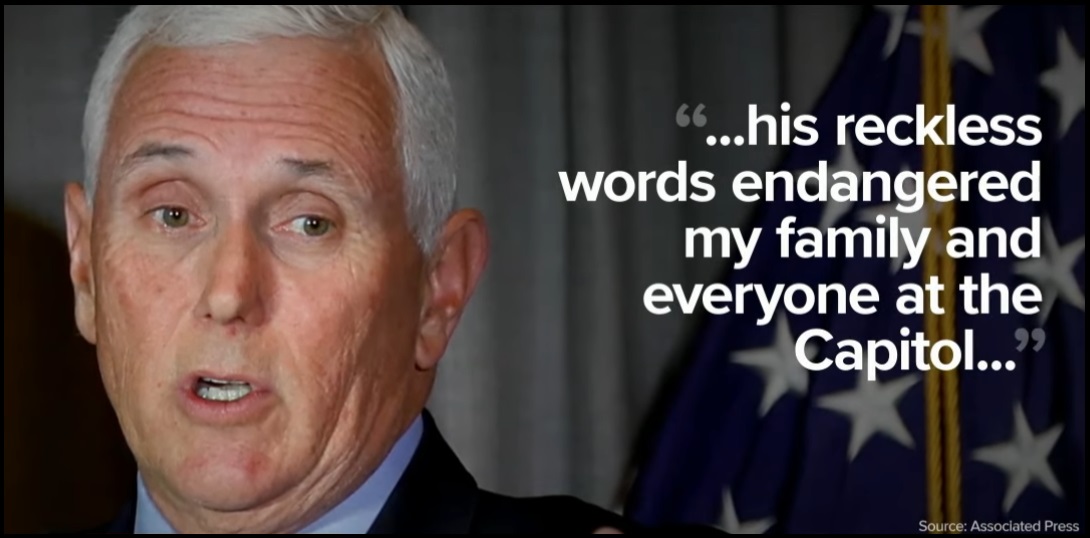
Mike Pence Blames President Trump for Events at Capitol Hill on January 6, 2021, “his reckless words endangered my family … history will hold Donald Trump accountable”


Posted originally on the CTH on March 12, 2023 | Sundance

Speaking at the Gridiron Dinner in Washington DC yesterday, former Vice President Mike Pence directly blamed President Trump for the events in Washington DC on January 6, 2021, saying:

“President Trump was wrong; I had no right to overturn the election. And his reckless words endangered my family and everyone at the Capitol that day, and I know history will hold Donald Trump accountable.”  ~ Mike Pence

Be of good cheer.  Despite the main takeaway being pushed by mainstream media, these remarks strike me as good news.

These remarks indicate to me that the professional Republican control officers are growing increasingly desperate as President Trump continues to command the new Republican Party.  If Ron DeSantis was making ground, the professional Republican class would not be as desperate as these remarks convey.  All of their collective GOPe effort isn’t working…. they are starting to reach for the kitchen sink.

WASHINGTON (AP) — Former Vice President Mike Pence on Saturday harshly criticized former President Donald Trump for his role in the Jan. 6 riot at the U.S. Capitol, widening the rift between the two men as they prepare to battle over the Republican nomination in next year’s election.

“President Trump was wrong,” Pence said during remarks at the annual white-tie Gridiron Dinner attended by politicians and journalists. “I had no right to overturn the election. And his reckless words endangered my family and everyone at the Capitol that day, and I know history will hold Donald Trump accountable.”

Pence’s remarks were the sharpest condemnation yet from the once-loyal lieutenant who has often shied away from confronting his former boss. Trump has already declared his candidacy. Pence has not, but he’s been laying the groundwork to run.

[…] With his remarks, Pence solidified his place in a broader debate within the Republican Party over how to view the attack. House Speaker Kevin McCarthy, for example, recently provided Tucker Carlson with an archive of security camera footage from Jan. 6, which the Fox News host has used to downplay the day’s events and promote conspiracy theories.

“Make no mistake about it, what happened that day was a disgrace,” Pence said in his Gridiron Dinner remarks. “And it mocks decency to portray it any other way.” (read more)

Manufacturing Indexes Continue Downward Trend as Consumers Leery of Big-Ticket Purchases


Posted originally on the CTH on March 6, 2023 | Sundance

Coming out of the pandemic related disruption, the larger story of U.S. manufacturing has been an odd blend of good data and bad data depending on the sector.  While some manufacturing was growing as a result of clearing supply chains, other sectors of manufacturing remained soft.

In total, the full supply chain rebound should have completed around the end of the third quarter, beginning of the fourth quarter of 2022.

However, simultaneous with the correction within the supply chain(s), consumer purchase activity began contracting.

The consumer pullback led to very weak holiday sales last year, and a combination of increased inventories of finished goods.

Keep in mind that Maersk overseas shipping noted significant drops in orders for the movement of material in the third quarter of last year.  Considering the lag, the previously noted inventory buildup in combination with the drops in unit sales of durable goods, would generally mean lower manufacturing purchase order activity Q4 (’22) and Q1 (’23).   This reality is reflected in the actual data as reported by The Wall Street Journal:

(Via WSJ) – […] New orders for manufactured goods contracted for the sixth straight month through February, according to surveys by the Institute for Supply Management. Manufacturing output is down 1.7% from its postpandemic peak in May 2022, according to a three-month moving average of Federal Reserve data. And the Commerce Department’s measure of civilian capital equipment orders, excluding aircraft—the building blocks of business—was down 3.4% in January from its recent high in November 2021, after adjusting for inflation.

[…] Production of appliances, furniture and carpeting was down almost 15% in January from the previous year, according to the Fed. That coincides with sales of previously owned homes falling for 12 straight months. Consumers often buy furnishings after they move.

Production of steel, iron and other primary metals was down 3.6% and machinery production fell by 1.8%. Output of plastics, food, beverage and tobacco products, and computers and electronics, also fell during that period.

[…] Business inventories swelled in the fourth quarter of last year, when consumer spending cooled. The ratio of inventories to sales for durable goods was higher in November and December than at any point since 2009, with the exception of April and May 2020, when pandemic-related lockdowns froze commerce.

Pat Weiler, chief executive of paving-equipment maker Weiler, said inventory levels are up more than 50% over the last two years. (read more)

Unfortunately, the U.S. doesn’t really manufacture much any longer.  Manufacturing only accounts for around 11% of GDP.  However, if purchase orders for inbound component goods are down for six straight months, we can generally infer the absence of downstream consumer demand.

I fully expected a recession statistic in the fourth quarter last year and was quite surprised we didn’t see one.  The scale in the drop of imports was statistically the majority reason for the outcome.  Imports are a deduction to GDP.  However, that said, there is nothing visible in the consumer purchasing side to indicate why durable good manufacturing is even as strong as it is.

We are in a very weird economic environment that is not helped by the financial punditry pretending that things are going swimmingly.

War Footing or Ukraine? – Biden Waives Section 303 of DPA Related to Weapons, Ammunition, Explosives and Components


Posted Originally on the CTH on February 27, 2023 | Sundance 

The Defense Production Act (DPA 1950 amended, pdf) essentially is a legislative hurdle that stops the executive from stepping into the private sector and restricting trade, commerce or manufacturing, unless the President says a critical shortage of “xxxx” is present and national security is at stake. It prevents citizens from the threat of govt nationalization of resource “xxxx”.

In the event the President makes a national security determination, he/she is required to inform congress, invoke the waiver authority, and identify which sectors he/she is now outlining as a national security… such that government purchase orders take precedent in the supply of “xxxx”.  Yesterday, President Biden invoked this authority.

Given the pandemic shortages are over, and given the sectors outlined, it looks like munitions, raw material, explosives, electronics and certain component issues related to the Defense Dept are outlined.

Key section: “Therefore, I waive the requirements of section 303(a)(1)-(a)(6) of the Act”

…”specifically for defense organic industrial base supply chains critical to the Department of Defense and critical supply chains for electronics, kinetic capabilities, castings and forgings, minerals and materials, and power and energy storage.” (link)

It’s a use of the DPA definitively targeting defense materials.  Which raises the question(s):

Is this to secure weapons for shipment to Ukraine?..  OR, Is this to secure a buildup of weapons for a larger purpose?   Meaning, is this preparing for an expanded war effort?

There is a lack of media curiosity.  However, perhaps drawing attention to it will stimulate someone to ask the Pentagon?

In the interim, ammunition might become a little harder to find.