Idiots who try to control the world and blame everyone else for their failure


COMMENT: Ok Mr. Armstrong, this is nuts; You are starting to freak me out with this forecasting. The last 2 months has blown me away when a few more elements of your methodology lit my bulb a little brighter. This may sound like you paid me to advertise for you but most of us know you’re not like Hillary. My simple approach combined 3 pieces important to me: 1. Basic knowledge of the markets on a global scale, 2. Basic understanding of your models and Socrates reports 3. Basic interpretation of the ArmstrongEconomics Blog. (utmost importance, hints included) Like Erwin said last year “it might save your life.”

He is so right.

Best to all;

RH

REPLY: I assume you are probably talking about this Vertical Market. This report is probably one of the most important I may have ever released. It’s not easy because so many people have been caught up in the Austrian School of economic thought and the Quantity of Money theory. The entire Quantitative Easy has proven that theory to be completely wrong.

I know this is like having to relearn everything. But that is just the way it is. I and my senior staff even are going to private meetings with central banks. Everything we have ever been taught in school is just dead wrong. This whole nonsense of Conspiracy Theories of people who are steering the world economy is just insane. If that were even true, then why call us at all?

The world economy is coming unglued. This is no joke. The sooner people wake up and just follow the money flows and forget the old theories, the sooner you will arrive at clarity. The only economic theories that were spot on were Adam Smith, who had no ax to grind in the observation of the Invisible Hand, and David Ricardo’s Comparative Advantage. Everyone else ever since has been about trying to eliminate the Business Cycle. This has caused a vast mess and we are about to pay the price.

We have insane politicians like the new Prime Minister of New Zealand, Jacinda Ardern who has declared that capitalism is a blatant failure while the former Greek finance minister Yanis Varoufakis says capitalism is ‘merely’ coming to an end because it is making itself obsolete.

Both witnessed the economic collapse, but instead of blaming the government and its socialist attempt to control the business cycle, they blame the people for not performing as they demand. What they are harping on is the disparity of wealth and want to take the wealth from the hated rich and somehow that is going to make it better. They are ignorant of the fact that this hated group they despise so much create the economy and jobs – not Marxism. Their failure to even recognize the collapse of Russia and China under Marxist theory is a tragedy that will only lead to internal class warfare.

I thank God I do not have much longer on the planet. I am compelled to watch idiots try to control the world and blame everyone else for their failure.

Lessons in Swamp Manuevers: Trump -vs- Clinton -vs- Mueller -vs- Sessions -vs- Rosenstein -vs- Comey, etc.


The leak from a sealed grand jury indictment within the special counsel Robert Mueller investigation, writ large, has everyone a-twitter…  Perhaps, a reminder is in order.

First lesson from the DC SwampEverything is about politics.  It’s not about the law; it’s not about the judiciary; it’s not about what’s legal, or the illegality of behavior;  only politics.  These are not legal issues, the entities involved are not connected to legal or illegal application of laws as they relate to the rest of American society.

You cannot view the current action through the transactional prism of modern judicial proceedings as they relate to you and me. These are political cases, that use the venue of the legal system.  They use the legal system to play out the optics and narrative of political battles for ideological wins and losses.

The closest reminder you might have familiarity with would be the case against George Zimmerman (never about the legal system); or the case against officer Darren Wilson; again it was never about the legal system.  Those were political cases run through the matrix of the legal system.  So too is this entire DC partisan dysfunctional investigative construct -surrounding all of the current DC cases- not about the application of law, it is about politics. Period.

The notification from the FBI through the DOJ to allow the unknown 2010 FBI witness to testify to congress about the Uranium One investigation has initiated a responsive action from Robert Mueller to save and use his political leverage.  This is not about laws broken; this is about political leverage to be retained.

The gamesmanship currently being pitched through the media is about political leverage.  That leverage in DC is traded like baseball cards amid the upper tier of those who float in an entirely divergent orbit from everyone else.

Repeat: this is not about law. It’s about politics.

If Mueller waited any longer to construct his political cases against those he is investigating he would open himself up to scrutiny from within his attachment to the Uranium One deal.

If the mystery FBI witness testified to congress before Mueller announced an indictment it would look like Mueller was retaliating against that testimony.  So Mueller plays the hand he’s carrying.

Now, by going first, regardless of the testimony from the FBI witness, any negative outcome therein would look like retaliation against him for indictments announced prior to the testimony.

See how that works?

Remember, this is not about laws, lawfulness, or the judicial system.  These participants operate above that system.  They are in a political system above the law; they use the landscape of the judicial system to advance politics.  Pause and repeat as needed.

Special Counsel Robert Mueller is simply attempting to retain his leverage within the game.  Going first allows him to keep and use that leverage.  If Mueller had waited he would have lost that leverage.

Congress has now lost leverage.  Regardless of what the FBI informant says to them regarding the Uranium One deal it is useless against the optic of retaliation for the special counsel investigation.

Conversely, those who were getting sick and tired of this investigation dragging on also know how the game is played.  They knew if they brought in the angle of the FBI informant it would force Mueller to act fast.  Again, this is politics, not legal.

Mueller has protected himself from the leverage congress was assembling and now he has cards to trade for any outcomes therein.  Mueller knew by planting the leak tonight his leverage would have all weekend to grow and establish itself through the media.

This is the exact same hand James Comey played when he intentionally leaked his memo notes to the New York Times right before he was fired.  Comey was losing leverage; Comey needed to gain back leverage to protect his interests.

Changing and trading leverage is politics.

Establish enough leverage and you can break any law with impunity.

Nothing more.

Enjoy your weekend….


Cars Sales Dropping as Taxes Rise


The demand for cars has been declining rapidly in Britain and that is impacting German car sales rather sharply. All price levels in cars have been declining, not just the high end. The sales figures for small cars and the medium class have already declined significantly in the last few months. Now the losses are also becoming apparent in the case of expensive brands, especially for the German car manufacturers.

As taxes have risen upon the average person and this hunt for more tax revenue unfolds globally, this is what creates the recession and deflation. It a strange paradox for many as they see deficit spending rise. Many have a hard time comprehending that if the money supply increases, how can there be deflation? It is always the bottom-line. If you keep raising taxes, you will reduce the standard of living, and that in turn comes back and results in lower economic activity.

Is Europe Repeating the 1930s?


Europe is now replicating the 1930s and the mistakes it made with austerity back then as well outside of Germany. Of course, Merkel has imposed the German view of austerity based on their experience but has ignored the opposite experience of the rest of Europe that led to the 1931 Sovereign Debt Crisis and mass defaults.

It was the year of 1925 when then chancellor of the Exchequer, Winston Churchill, returned Britain to the gold standard. Britain was trying desperately to reestablish itself as the financial capital of the world as if nothing had taken place. Returning to the gold standard resulted in wages being forced down to compete with America.John Maynard Keynes at the time pleaded that this was madness. The pound was overvalued against the dollar by 10% trying to reestablish confidence in Britain but the net result crippled exports and unemployment began to rise and workers engaged in strikes for having wages reduced even though the pound was worth more officially.

Churchill acted in an effort to restore Britain but he was dead wrong. Keynes proved to be correct and this lesson has still been ignored by Europe today. The overvalued pound led to deflation and ultimately forced the economic collapse in 1931. The capital was fleeing Britain and bankers were pleading for austerity to retain bond values. The Labour government collapsed and a coalition national government was formed. They ignored the pleas of the bankers and abandoned the gold standard overnight. The pound fell from $4.85 to $3.40 against the dollar.

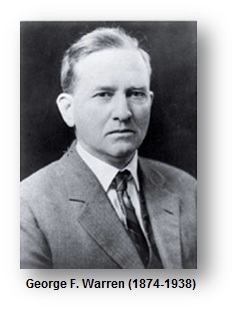
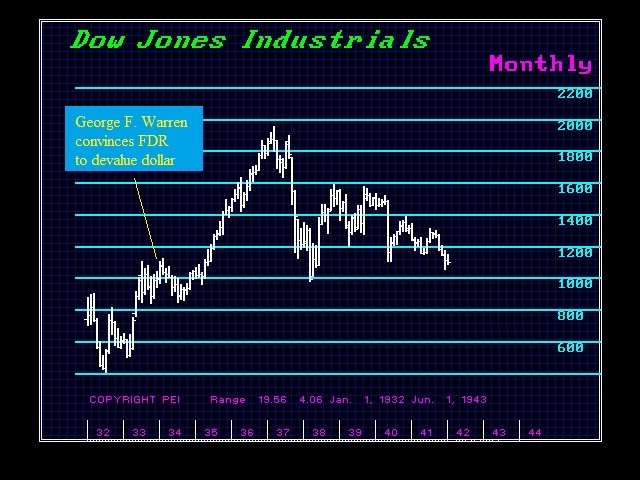
Warren-3NEVERTHELESS, despite the dire forecasts of ultimate catastrophic consequences if Britain abandoned the gold standard, the economy held and began to recover. There was no revolution in the streets as predicted. The devaluation of the pound actually stimulated the economy and the austerity crowd proved to be completely wrong. Within just four years, the British industrial production had risen by 25% and unemployment fell from 3 million to 2 million. It was this experience that provided the support for the economist George Warren (1874-1938) who convinced Roosevelt that austerity was wrong and devaluation would also kick-start the American Economy. None of Roosevelt’s Brains Trust was ever experienced in economics. Most were simply lawyers trying to get around the Constitution. They too argued for austerity as Merkel does today. However, Roosevelt looked at the events of 1925-1931 in Britain and listened to Warren. The dollar devaluation is what turned the economy around at that moment in time.
dj3242-m-warren

The USA share market began to recover from the depths of the Great Depression. History repeats, but I have stated it is like a Shakespeare play – the plot remains the same, but the actors change over hundreds of years. The lessons of history, therefore, repeat over and over again albeit by the same foolhardy reasoning.

Europe is trapped in similar orthodoxy to that of their prewar forebears. In Germany, they hold the firm belief that inflation is the greatest evil to inflict humankind. Yet the ECB has mastermind the greatest monetary expansion in history without success of stimulating anything. The policy of quantitative easing has been done only at the government level as taxes and tax enforcement has risen and thereby the people and consumption have been totally ignored for fear of inflation. This approach has created an economic nightmare that actually threatens to bankrupt the ECB. Unlike the US Federal Reserve which has the power to create elastic money, the ECB needs authority from government.

They do not flinch even when a quarter of high street shops close. They are like doctors laying the sick in the snow to see who will survive. Yet they hurl cash at friendly bankers and watch it vanish into the maws of directors and offshore speculators. And they dole out billions to prop up a euro of which they are not even members.

Keynes was right in 1925 – and proved right in 1931. Flexible exchange rates are a more painless way of forcing down labor costs and promoting trade than government austerity. Inflation is a better way of easing debt. The remedy for depressed demand is increased demand, simple as that. The risk of inflation in Britain at present is trivial compared with that of deflation and recession. And at least Britain’s currency can float. Imagine if it were part of the euro and trade had to cope with a pound probably 20% higher in value than now.

Hardly a month passes without another euro crisis and more imposed austerity. It is as if Keynes had never lived. Yet water still refuses to flow uphill. Heavily indebted countries certainly need to restructure their public sectors in the long term – and have plausible plans to do so – but they cannot repay debt, short or long term when they are in recession. Increasing unemployment and suppressing demand impedes growth and is no use to anyone.

Worse, Europe’s drawn-out austerity is undermining the very authority required to enforce it. When governments fall, no package can be enforced. Greece was forced last month into de facto default. Who would now buy a Spanish bond? What is the value of a Dutch finance minister? What price Nicolas Sarkozy’s signature on a bailout deal? As long as the euro shackles the continental economy in austerity it will never achieve political stability or a return to growth.

The euro was a Locarno dream. It was the last cry of the 20th century, envisaging a brave new order in which bankers and businessmen, workers and peasants, would stand arm in arm, singing Ode to Joy. All labor costs would become equal. There would be fiscal and regulatory integration across the entire continent. The euro would unlock the door of united states of Europe. Ireland and Greece would be to Germany what Nevada is to New York. The euro would squeeze and stretch the peoples of Europe until they were one.

This concept of a union must rank among the great mistakes of history. Like other pan-continental visions, it has proved no match for the crooked timber of European mankind. Its acolytes cannot bear revisionism or tolerate dissent. They have driven Greece into chaos and Spain into severe depression, with half its youth now unemployed. The Eurocrats do not care. Their incomes are secure. They dance only round the euro and claim its blood sacrifice. They will do anything but admit they were wrong.

The one salvation on the horizon is a true democracy. Last week the French electorate said no to more austerity and the Dutch government fell for the same reason. Spain faces a similar crisis, and the streets of Athens hold untold dangers. Even in Britain polls suggest an electorate unconvinced by the longevity of what by any standards is mild austerity. The peoples of Europe have had enough. The prospect of imposing on its nations the budgetary disciplines required for more German bailouts is unthinkable.

The Six Groups of Investors and Traders


The recent report by the Commodity Futures Trading Commission (CFTC), shows that the professional investors have continued to bet on falling Dow Jones “short” as private investors are starting to bet heavily on rising prices ( “Long”). Professional investors remain suspicious of a further rise in the US stock market. The private investors’ view is exactly the opposite. The question is; Who will be right?

There have been plenty of times that the professional is dead wrong and the average person on the street has actually outperformed the professionals. Reuters reported that 69% of hedge fund investors expected the second half of 2017 to be worse than the first half. So why are the professionals so pessimistic?

When you live and breath the market every single day, it is hard to get a grip on vertical markets. The professionals, more so that even the average street investor, tends to do worse in such markets because it makes them uncomfortable. Then there is the self-gratifying notion that the market is over when the retail invest comes in. But they tend not to look at the fact that there is a huge difference between the average retail investor and the person who has never invested who rushes in to join the party at the top simply be everybody else if there.

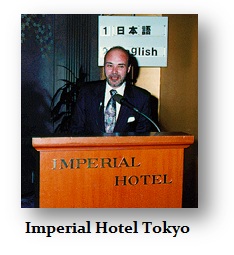
I have told the story before how I was doing an institutional only seminar in Tokyo at the Imperial Hotel. This individual bribed someone in the hotel to get in. He came up to me and apologized offering to pay. He said he just had to speak to me. I asked him what was the problem, He explained he had bought the Japanese share market on the very day of the high and now it was crashing. His investment was $50 million. But the intrigue came when he said it was the first time in his life he had purchased any stock. He then had my attention since I was talking to the guy who bought the high.

I asked him what made him buy that day for the first time in his life? He said brokers had called him every year saying the Nikkei rallied on average 5% every January with the New Year. He watched it for 7 years and then finally bought the high. That is what I mean as the difference between the average retail investor and the fool who rushes in at the end because everybody else is there. It is when that final group of people rush in that marks the end of the market – not when simply average investors buy who follow the market generally.

We have four actual groups:

  1. smart strategic big money (long-term portfolios)
  2. professional short-term traders
  3. the day trader who thinks he is limiting his risks
  4. program traders who try to arbitrage ticks
  5. the average retail investor
  6. the fool who rushes in at the last minute

In most real good vertical markets, it is the professional short-term traders who keep trying to sell the new highs. This has been the group that has been bearish ever since 2009. They never saw new highs coming, and they still will try to sell every new high today. They falsely believe that they are “professional” and so they will be right and the average investor is the fool. But the average investor sees the trend for what it is, goes with the trend, while the short-term “professional” keeps trying to beat the market.

Usually, the day trader who thinks he is limiting his risks and the program traders who try to arbitrage ticks will typically get caught when they suddenly find the lack of liquidity traps than in a position they cannot get out of.

Macron’s Call to Federalize Europe


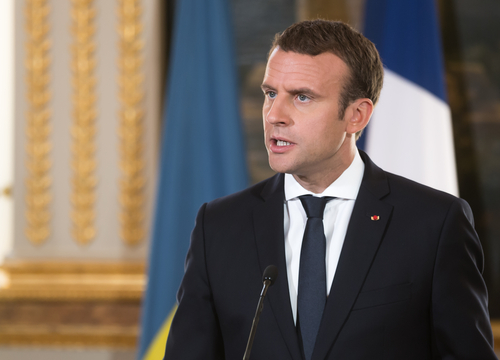
France’s President Emmanuel Macron is calling for a radical restructuring of the whole EU. Macron has presented his map for the EU into 2024. He is proposing that the Eurozone budget must include a joint force for military operations. Macron intends to finance this new budget with its tax – the “EU tax” he calls it.

Macron has looked at the numbers and see that France will go the way of Greece if something is not changed and soon. Macron hopes just to throw all the rotten eggs into one basket and hope nobody will notice. It’s the Three Musketeers – All for one; One for All just times 28.

Germany is still dominated by its misunderstanding of the Hyperinflation. Former Greek finance minister Yanis Varoufakis supports Macron’s federalist proposals on the euro single currency but believes only a real threat could make Germany budge on the issue. It has been Germany that opposed the consolidation of the debts to form the Euro. They are trying to remain isolated in their austerity posture refusing to budge on the debt consolidation, while at the same time they want the single currency to facilitate German exports eliminating foreign exchange risk among other members. They just cannot have it both ways.

The extent of Macron’s plan goes beyond just an EU Tax.  He also says that Europe is moving at “different speeds” and that those states which fall behind should not stand in the way of his proposals. He is calling for a European defense budget and a standard minimum rate for company taxes.

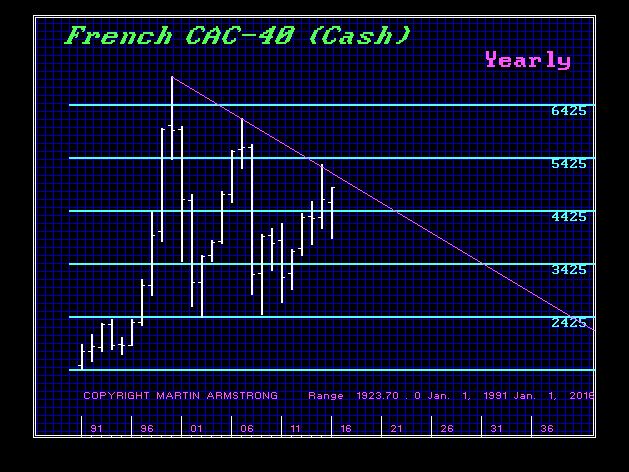
Macron has noted the high cost of taxing the rich. The Socialist agenda under Hollande imposed a wealth tax which drove 10,000 people with about 35 billion euros to flee the country. And that is just what they admit publicly. The tax was imposed on personal assets of more than 1.3 million euros is part of Macron’s reform, but the socialists are demanding they be taxes even more until they all leave one must assume.  As promised by President Emmanuel Macron in the election campaign, the tax will now only apply to real estate, meaning other forms of wealth such as shareholdings in companies will be exempted. Macron realizes that the French share market has one of the worst performance in Europe next to Greece. While the world is worried about bubble markets, Macron is concerned that new lows will unfold on the next crisis.

“When someone leaves the country because of the wealth tax… collectively all French lose.” But the Socialists just refuse to stop their hatred of the rich. Macron has abolished the wealth tax and the socialists are calling him the “President of the rich” and remain oblivious to reality.
More than fifty years ago, back in 1965, it was the French President Charles de Gaulle who withdrew his ministers from the Council of the EU, thereby constituting a de facto veto over all decisions, which became known as the “Empty Chair Crisis.” There were several issues regarding European political integration led to The Empty Chair Crisis. There was a push at that time to create the quasi-federalization of Europe. De Gaulle believed that national governments should move towards integration, but he did not agree with the Commission’s attempt to create some new super central state or a federalized Europe, extending powers of the EU beyond national borders as we have today, which Margaret Thatcher also opposed.
President Charles de Gaulle has proposed the Fouchet Plan was a plan back in 1961 to create a new grand design for Europe. Charles de Gaulle wanted to develop a three-power directorate, consisting of France, Britain and the United States. The idea was to form a new ‘Union of States’, as an alternative to the European Communities (EC). De Gaulle feared a loss of French national influence in the EC as there was a drive to federalize Europe back then.
After the failure of the Fouchet Plan and De Gaulle’s veto of the United Kingdom’s application for EC membership, the Commission attempted to move towards integration by proposing an idea that would combine the Common Agricultural Policy (CAP), the European Parliament, and Commission. De Gaulle supported the creation of the CAP and favored its enactment. However, he disagreed with the Parliament’s new role, the Commission’s strength, the shift towards federalization and a super central state, and the budget proposals for financing the CAP. De Gaulle made it a condition that majority voting with a right to veto must exist if France was to participate in the EC. When de Gaulle was denied a more intergovernmental Commission or voting and veto rights, the French representative left the Council of Ministers thereby creating the Empty Chair Crisis.
The Luxembourg Accord was an agreement reached in January 1966 to resolve the “Empty Chair Crisis” which had caused a stalemate within European Economic Community. Then on June 21, 1966, de Gaulle withdrew France in a shocking move taking its troops from the North Atlantic Treaty Organization (NATO). This decision led by French president Charles de Gaulle complicated relations between the U.S. and Europe amidst clashing American and Communist spheres of influence. Though France remained politically in NATO, its actions cast doubt on the organization’s future as a counter to Soviet military power and control back then.
Disagreement within the EU is by no means something new. We may yet see a political breakdown as the economy continues to spiral lower and the ECB bond-buying program has been transformed from an economic stimulus to simply life-support for government debts to try to keep interest rates from exploding and no bid for government debt.

Apart from the new EU tax, Macron did not make any funding proposals for his very far-reaching program. The FT reported his “wish list” and presented the most desired demands of Macron:

  • EU intervention group and budget by 2020
  • a European Intelligence Academy to train spies
  • a European civil protection group for responding to disasters
  • a European prosecutor for terrorism and organized crime
  • a European asylum seeker for the joint processing of claims, common procedures
  • a European border police
  • a carbon dioxide tax levied on imports into the EU
  • a European innovation agency for the investigation of artificial intelligence
  • EU subsidies to support the development of electric vehicles
  • Taxation of US tech companies with a tax on sales, rather than on profits
  • a larger EU budget to finance investments and dampen economic shocks
  • Review of agricultural policy and the new EU Food Authority
  • accelerated harmonization of corporation tax bases
  • gradual harmonization of corporation tax rates and social security contributions
  • a guaranteed minimum wage for each country
  • all young Europeans will be able to spend six months as a student or trainee in another EU country
  • Creation of European universities on the basis of networks of institutions
  • six-month series of national and local conventions to discuss the future of Europe
  • half of MEPs to EU Parliament is to come from EU-wide lists until 2024
  • a much smaller European commission, only 15 commissioners
  • a Europe of different speeds, to which Great Britain could also return
  • a new European prosecutor ensures that the competitors comply with the EU rules
  • a Franco-German cooperation agreement focusing on the harmonization of company regulation

Europe’s Economic Death Spiral


QUESTION: Mr. Armstrong, you said when you were here in Berlin that the EU Commission is about as incompetent as the US Congress. You also said Macron is trying to federalize Europe as the solution Could you elaborate on that comment?

ANSWER: The EU Commission at present is composed of 28 Commissioners, who must always ensure that they are dependent on the nomination from the home country mush as American congressmen who are supposed to represent their state. Every member of the Commission, therefore, has a personal self-interest in staying in office. The complexity of regulations and initiatives often have hidden agendas that are often far too difficult to identify. One of the proposals of Macron is to reduce the Commission to just 15 eliminating state representation and the priority would then, in theory, be given to the professional competence of the candidates rather than representing member states. This would be the FEDERALIZATION of Europe and totally eliminate and democratic process. The people would have no say in changing the direction of Europe.

Macron is proposing to create European politicians. To deal with the end of a democratic process, he has suggested that these 15 commissioners be elected by all EU citizens in the longer term. He has said that with BREXIT, the British vacancies should be the first to be open to elections of all remaining Europeans in the EU. When commissioners are elected by their own politicians, then Macron argues they are not being elected by a European choice of citizens.

In fact, a smaller Commission and a Parliament he hopes would portray Europe as a whole that would forge the EU as a single government at last. This is argued would end the current paralysis that the EU is unable to get out of the economic hole it finds itself in and the ECB has failed with its stimulation to end deflation for nearly 10 years of quantitative easing

Europe suffers from extremely high taxes, taxes and social security contributions combined, which account for around 50% of the business cost which has produced nothing but higher levels of unemployment. In the US and Asia, the comparative rates are between 30% and 40%. Europe just cannot compete in the world economy and is slowly dying.

Macron wants to unify the corporation tax of all EU states or at least the Eurozone members and to make them available to an EU for infrastructure investments. Macron still fails to see that higher taxes produce lower economic growth. Until politicians wake up and see themselves are the source of the problem, there is little hope in producing meaningful economic reform anywhere in the world.After all EU countries suffer from financial distress, the plan can only lead to even more taxes being collected and not less. This also limits the scope of the holdings.

The development of the internal market is constantly being discussed because Europe cannot really compete in the world economy with a high tax burden. However, the fundamental obstacle to creating the internal market within Europe they believed would be settled with a single currency. But that has not proven to be correct as it has merely imposed austerity upon Southern Europe after forcing their past debt to be redenominated in Euro, which then doubled in real value.

Companies operating across Europe are forced to have their own accounting system for each country and act as if they were companies in the country in which they are exporting. The cost of compliance with different rules and taxes in every member state defeats the entire idea of a single currency would solve everything.

Then there is the EU going after Apple and Amazon claiming they were given unfair tax advantages by Ireland and Luxembourg sho they should pay retroactively the difference to the higher tax rate in Europe.

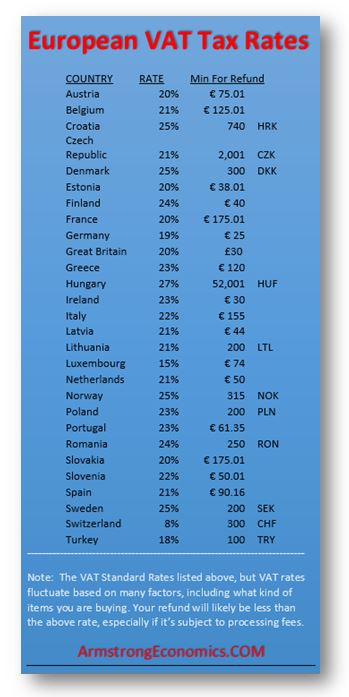
In addition, a complex control system was used to make larger tax evasion responsive to even the smallest billing. There is no talk about these obstacles because each state believes that the existing regulation will generate more tax revenues. A uniform value-added tax and the distribution of revenues to all Member States have been rejected by the member states.

The different VAT tax rates among member states are illustrated here. There is no uniformity. sentences are only part of the problem.

Then there is the Pension Crisis. which is setting the stage where the public sector is facing an explosion of the deficits from 2018 onward.

The reduction of the tax burden MUST be the number one priority, yet that is never addressed. The European Central Bank will not be able to maintain zero and minus interest rates forever. As a result, the states will have to pay higher interest rates on outstanding debt and new debt, which will have an explosive impact on the deficits. We are coming to the point where this system of perpetually borrowing more and more every year will be impossible to maintain once the people begin to realize Europe is in an economic death spiral.

The core problem is never addressed. All of these proposals on how to end the European economic paralysis simply never consider the role of government and its leftist Marxism that failed in China and Russia. They will continue to raise the retirement age across Europe to try to survive another year. Europe has become an economic catastrophe of untold proportions. The high tax burden prevents a dynamic renewal of the economy reducing the standard of living for everyone and perpetuating high unemployment as twice that of the rest of the industrialized world.

The GDP Decline Post-2015.75


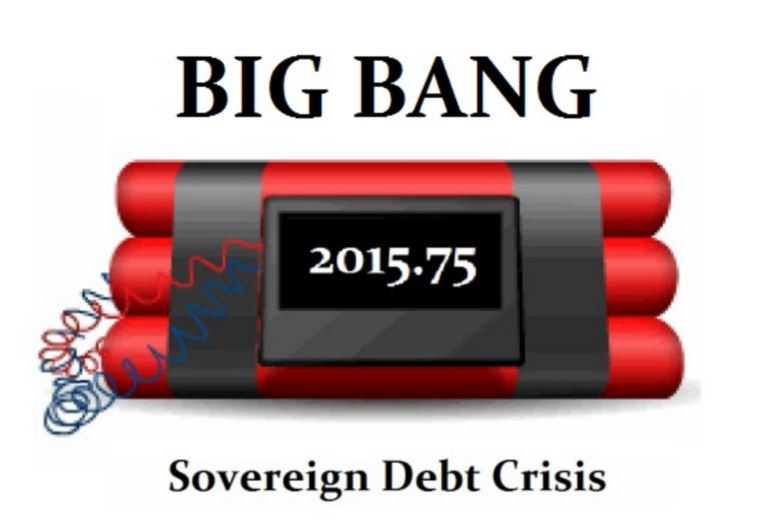
The economic decline that we are now in moving into really 2036, is significantly different than pre-2015.75. The confidence shifted and 2015.75 was the peak in confidence in government. This is the rising discontent which produced Trump, BREXIT, and the rising separatist movements around the globe. The old way of running the economy is what has been declining and even when the GDP growth rate is being reported as up, the levels of growth are substantially in a bear market.

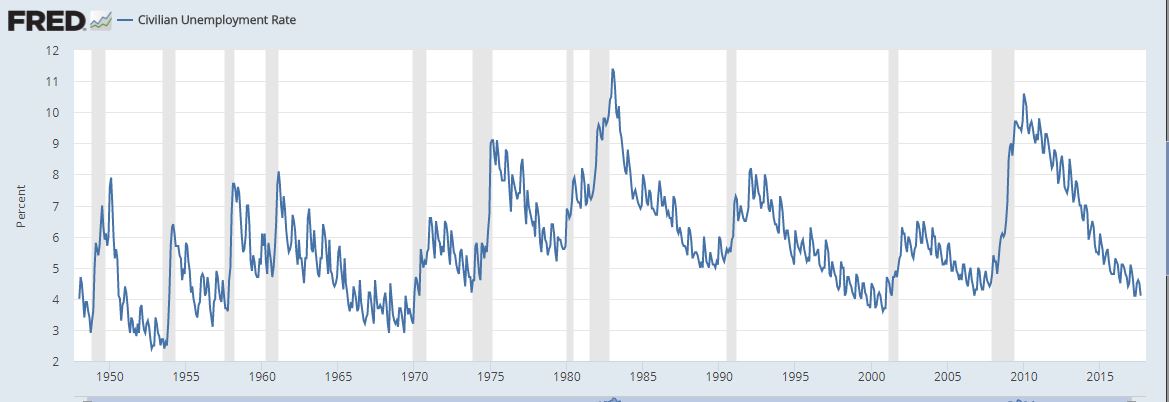
Likewise, unemployment has decline the the USA while rising outside, but even this is misleading. The quality of jobs has declined and much of the rise is attributed to part-time employment while more than 60% of college graduates cannot find employment in the field in which they paid a lot of money for. The student loans imposed upon them by the Clinton saddle the youth with such burdens for worthless degrees they are forced to live at home with their parents into their 30s. It has been the drop-outs who are the real innovators. Ernst & Young has been one of the top graduate recruiters in the UK and USA. They have announced the firm will be removing the degree classification from its entry criteria, saying there is “no evidence” that success at university correlates with achievement in later life. The best education has ALWAYS been an apprenticeship – not some university course taught by someone who has never practiced what they teach.

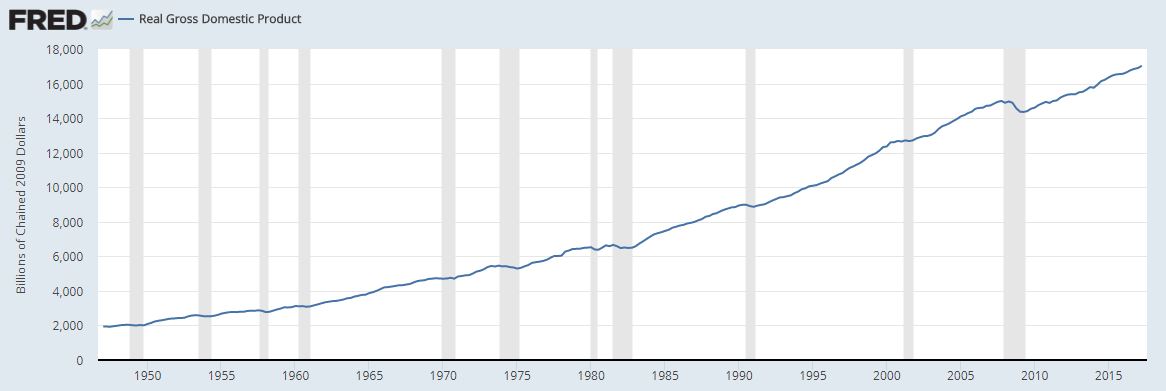
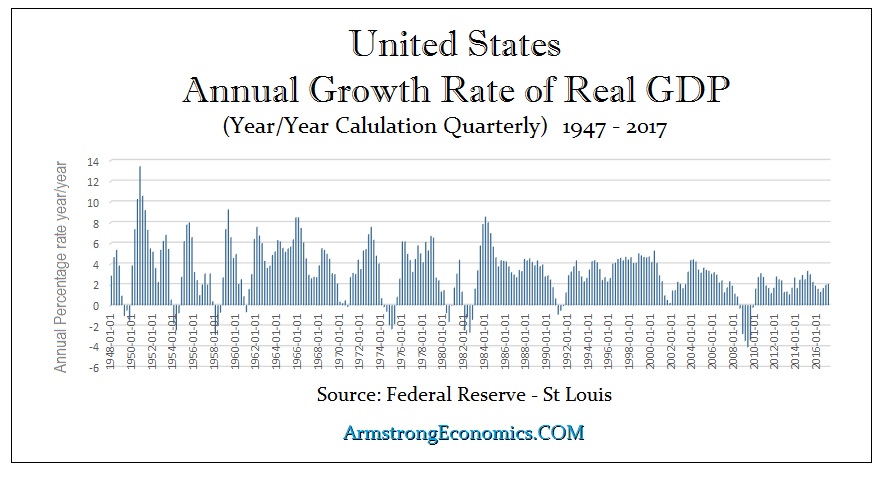
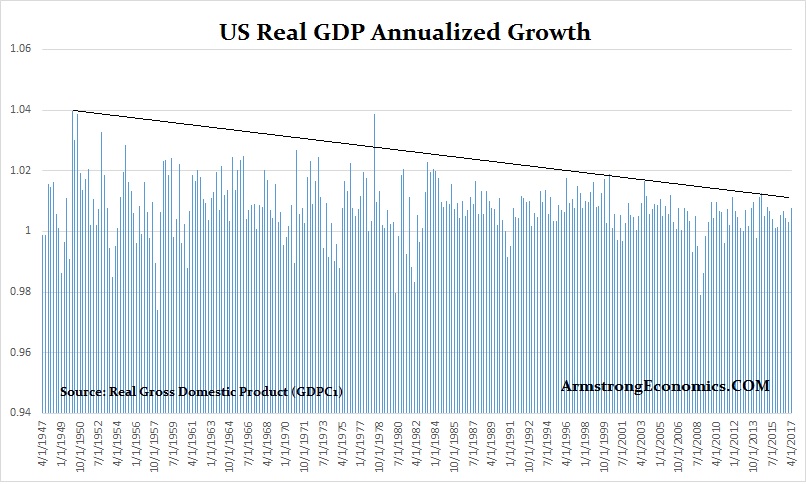
The economic growth is distorted and not really what governments are reporting. But even if we use their numbers as is we can see that the 2007-2009 recession was the worst since World War II. The top chart is the Fed data showing gross dollars so it looks like the economy is rising. Now let us look at that data on an annual growth rate basis. We can see the peaks and valley in GDP growth rates much more clearly. The third chart is simply month over month growth rates, very short-term. Now you can see what the central banks are so concerned about. The growth rate is declining sharply. Since 2015.75, even the USA is having a very hard time to reach 2% and sustain it and the USA IS THE BEST IN THE WORLD!!!!
Because the US is the core economy in the world, I have been stating that the decline unfolds from the peripheral first and moves into the core. The trouble we see in Europe and the start of the Refugee Crisis began with 2015.75. We see the rising economic problems even in China no less Japan. Emerging market debt has exploded and will be ripe for default. Trump was elected because the average person sees they are losing ground, not gaining. The youth no longer believe in the American Dream.
The model is forecasting NOT a “recession” in the old terms, but an economic decline. This is why taxes keep rising for they need money to try to retain bower. This creates DEFLATION and not the HYPERINFLATION that so many falsely believe is the only way empires, nations, and city states crumble into the dust of history.
As far as unemployment is concerned, here too we have to pick up the rug. Even the Post Office is hiring part-time workers so they do not have to pay pensions. There has been a rise in part-time employment to escape the benefits of Obamacare. The definition of employment has also been altered. You are not unemployed unless you look for a job.
This is all part of the economic decline that began with 2015.75. Even the poverty rate in Europe, the great socialist economy, has risen to 16% and is still rising. This is part of the discontent. The youth unemployment in Europe is just astonishing. High taxes on the “rich” who create small businesses that employ 70% of the population has devastated Europe. But the politicians are so married to Marxism, they cannot see what they are doing is the same economic extinction that took place in China and Russia that forced political change.
The USA is holding everything up right now. But our growth rates have declined and we are looking at the USA turning more negative starting from 2018 onward.

The Coming One-World Currency


QUESTION:

Bitcoin + Cryptocurrencies
Firstly, thank you – I’ve learned more from your blog and models that high-school would ever have hoped to teach me. And even after a year I am a still at the start-line of knowledge.
I am also been a follower and investor/gambler on crypto for over a year.
I concur with your findings that Govt’ will ultimately try to ban or regulate to tax crypto currencies. It really is all about tax. nothing else. I really don’t see how it can have anything to do with terrorist funding and the need to track all transactions, considering that as far back as 1996 the Federal Reserve that “ about $200 billion to $250 billion of U.S. currency was abroad at the end of 1995, or more than half the roughly $375 billion then in circulation outside of banks.” So how do the track this cash? or do they really care?
But what happens if the people just ignore the gov’t(s) attempt to ban crypto? What then?
Is it likely, or even remotely possible that most gov’ts would work jointly and simultaneously to ban crypto currencies?
Will there always be several countries that will ignore / not join this movement to benefit from the flow of currency – even if this inflow is crypto currency or not hard currency?
What will happy if the people just revolt and ignore the gov’’s efforts to tax crypto or ban it?
Some insight on how and what happened with previous alternative currencies who help shed some light on this. Could you also recommend some reading in this area.
Thanks again for your patience and skill in translating your work into digestible English so people like myself can benefit from your knowledge
D

ANSWER: This is a battle to the death.  A cryptocurrency is a digital asset designed to work as a medium of exchange using cryptography to secure the transactions and to control the creation of additional units of the currency. However, this idea has also falsely embraced the notion that a cryptocurrency will be a store of value and hence defeat inflation. That has proven to be absolute nonsense. The rise of cryptocurrency is a reflection that people do not trust government. Those in power know that and see this as unacceptable. Edward Snowden has pointed out that BitCoin is not as safe as everyone believes. He said:

“Obviously, Bitcoin by itself is flawed. The protocol has a lot of weaknesses and transaction sides and a lot of weaknesses that structurally make it vulnerable to people who are trying to own 50 percent of the network and so on and so forth.” … “Focusing too much on bitcoin, I think is a mistake. The real solution is again, how do we get to a point where you don’t have to have a direct link between your identity all of the time? You have personas. You have tokens that authenticate each person and when you want to be able to interact with people as your persona in your true name, you can do so.”

Zcash is far better than BitCoin for to remain equally interchangeable, units of Zcash are unlinked from their history so that one unit is as good as any other unit and this makes them really fungible in the to cryptocurrency world. They have unlinked shielded coins from their history on the blockchain. This means they can be used for tax avoidance and the government can use its Terrorist Card. They will not allow cryptocurrency to defeat taxes and BitCoin is not secure enough in that manner.

The rise in cryptocurrency has another side to it that is not being mentioned. Many of the people cheering BitCoin, are the dollar-haters who also tend to be the goldbugs. The interesting question that arises from this is very blunt. Has the introduction of cryptocurrency  been displacing gold as the alternative currency?

This is a subject that requires a lot more space for analysis than a blog post. We also have central banks looking at creating their own cryptocurrency  and that raises the possibility that private cryptocurrency will be banned.

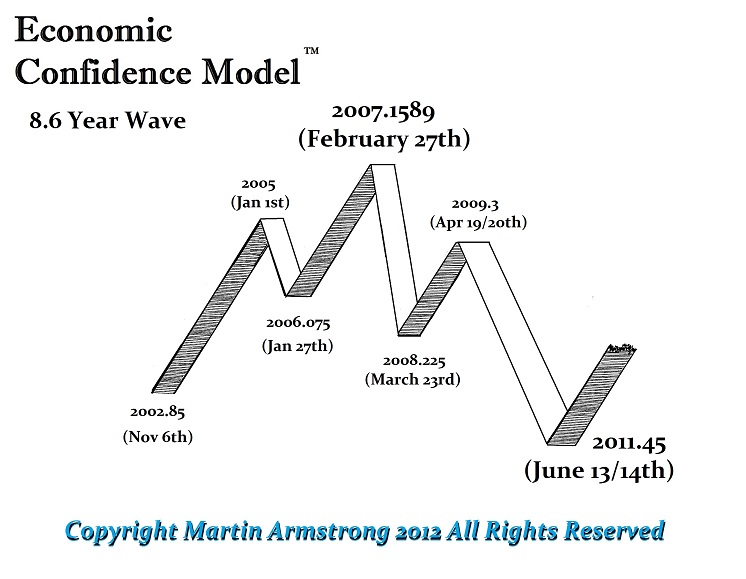
There is absolutely no question that we are heading into a new Monetary System. The Monetary Crisis Cycle turns up next year. We saw what happened as soon as the ECM peaked in 2007 and we forecast new highs in the Dow back in 2010 (See Barrons), the War Cycle turned up in 2014 and our Political Cycle that pinpointed the political change in 2016 produced Trump, the ECM peak in 2015.75 marked the day of the Russian invasion of Syria that began the Refugee Crisis in Europe, our Models of Britain forecast BREXIT, and those on Catalonia forecast the separatist movement would rise 2 years in advance – just to mention a few.

We will issue a special report on the coming One World Currency. There is just too much to address in a blog post and this will be food for thought as we move forward through the end of this current cycle wave on the ECM.

Being Humble is Required for Trading


QUESTION: I have a personal question. You have said that what you know has been taught to you by your clients. People who attend your WEC say you are humble and not arrogant. Could you explain that?

MN

ANSWER: Look. You cannot go to university to get a degree in trading or being a hedge fund manager. You have to be self-taught in this field. If you want to be a successful trader, you MUST be humble!!!!!! The market is the ONLY thing that is 100% infallible. So you better be humble and survive. If you want to be arrogant and try to dictate what the market should do, you will not survive very long. So I do not understand why that should be a surprise. This is about reading the markets and listening to what they are trying to tell us. This is NOT about being personally right or wrong. Your bank account will determine that. You can tell someone who will never survive because as soon as they start blaming other people for their own failures like Hillary Clinton, they should quit and save a lot of money for they will NEVER be a good trader.

Trading teaches you to be humble or you will not survive. The market is much bigger than you or even government. One primary trading tip I have perhaps been famous for saying is: Intelligence is not measured in the definitive knowledge that is never wrong. It is measured by the ability to see when you are wrong and quickly adapt to the new reality.

There are some people who could never do anything with respect to trading if they (1) cannot admit a mistake, and (2) be a dynamic thinker where you see everything around you.

I have been TRAINED by my clients. I was given a seminar in Zurich in the early ’80s. People were flying in from many different countries. This became the origin of the WEC events. Why are they so different? Because you have a very diverse audience. At that Zurich seminar, a client from Canada had asked about gold. I responded that it would be a short-term buy. The guy from Zurich quickly said that since I had said the Swiss franc would rise more than gold, he would lose money on that trade. Right then and there I began to realize that giving advice depended COMPLETELY upon your currency base.

Once I understood that I had to tailor advice and forecasts to the currency base of every client, that was the first step in understanding currency flows. From there, the world began to come into focus.

So if you define “humble” as being flexible to adapt to the changing trends, then you will survive.