Herod Agrippa I (41-44AD)


Armstrong Economics Blog/Uncategorized

QUESTION: Was it Herod Agrippa who ruled Jerusalem when Jesus was Crucified? Someone said his coins are common.

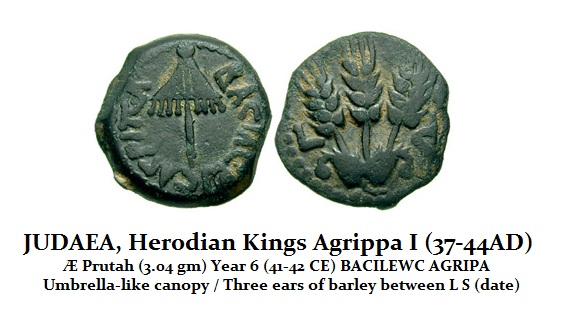
ANSWER: No. It does get confusing. Herod Agrippa I (born 11BC; ruled 41 – 44 AD) after Jesus was crucified. Agrippa I was the last King of Judea with the royal title reigning over Judea. He was also the father of Herod Agrippa II, who was the last King from the Herodian dynasty. Herod Agrippa I  was the grandson of Herod the Great and son of Aristobulus IV and Berenice. He was born Marcus Julius Agrippa being named in honor of Roman general and statesman Marcus Vipsanius Agrippa, who had been the right hand of Emperor Augustus. Herod Agrippa I is the king named Herod in the Acts of the Apostles 12:1 (Acts 12:1). The Jewish historian Josephus refers to him as “Agrippa the Great”.

Josephus tells us that, following the murder of his father, Herod Agrippa I was sent by Herod the Great to the imperial court in Rome. There, Tiberius became very fond of the boy and he was educated alongside his own son Drusus with whom he became good friends. He also became a close friend of the future Emperor Claudius. On the death of Drusus, Agrippa, who had been recklessly extravagant and was deeply in debt, was obliged to leave Rome.

All the Judean kings of the Herodian Dynasty issued small bronze coins. They did not put their portrait on these small bronze coins They are fairly common. The Herod you are thinking about was Herod III Antipas.

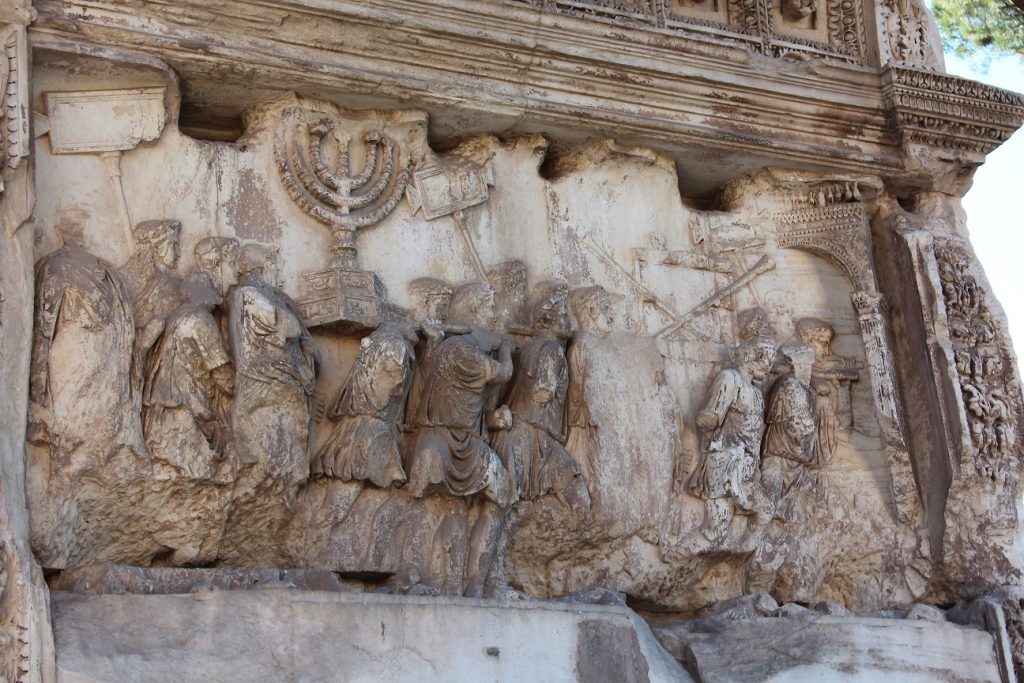
The Judaea Move for Independence 66-70AD


QUESTION: Was the first Jewish revolt about taxes? I think you said it was previously.

HJB

ANSWER: Correct. While there were tensions over religion, what really began the crisis was taxation. Later, the death of Nero and religion came into play about 2 years after it began. It is true that the rebellion of Judaea began in the year 66 AD, originating in ethnic and religious tensions but Rome had generally allowed every region to keep their own gods. In the case of Judaea, they were not fond of using coins with images of various gods. The crisis truly erupted due to anti-taxation protest that resulted in attacks upon Roman citizens.

The Roman governor, at that time, was Gessius Florus. As the rebellion over taxes began, he responded by plundering the Jewish Temple seizing wealth to compensate for the decline in taxation. The following day he arrested numerous senior Jewish figures who were not directly connected to any violence. Meanwhile, on September 22nd, 66AD, Emperor Nero created the Legio Legio I Italica. He also appointed Titus Flavius Vespasian legate of the army of Judea and in command of three legions — V Macedonica, X Fretensis and XV Apollinaris. These actions resulted in justifying a large-scale rebellion which began in October 66AD. The rebels were able to annihilate the Roman garrison (a cohort of Legio III Cyrenaica) in Jerusalem resulting in King Herod Agrippa II and all Roman officials fleeing from Jerusalem for their lives. Meanwhile, Sicarii captured the fortress of Masada overlooking the Dead Sea.

With the fall of Jerusalem, Cestius Gallus, legate of Syria, marched into Judea and lead a Roman army of 30,000 men to put down the Jewish rebellion. At its core was Legio XII Fulminata, plus 2,000 picked men from the other three Syrian legions, six more cohorts of infantry, four alae of cavalry, and over 14,000 auxiliaries. The auxiliaries were furnished by Rome’s eastern allies, which included Herod Agrippa II and two other client kings, Antiochus IV of Commagene and Sohaemus of Emesa, who lead their forces (largely archers and cavalry) in person.

Gallus lead his main force down the coast from Caesarea via Antipatris to Lydda, detaching other units, by land and sea, to neutralize the rebel strongholds at Joppa, Narbata and the Tower of Aphek. With Galilee and the entire Judean coast in his hands, Gallus turned inland and marched on Jerusalem but broke-off the siege in November 66AD. As he withdrew his forces to retire to winter quarters, the Jewish rebels ambushed and defeated him. Some 5,300 Roman troops are killed in the battle. The Jewish rebels now captured his pack animals and his artillery which they used during the next siege by Titus four years later. This was a major victory for the Jewish rebels and it became a major disgrace of the Roman military. The Jewish rebels captured even the eagle standard of Legio XII Fulminata. Gallus abandoned his own troops in disarray and fled for his own life to Syria.
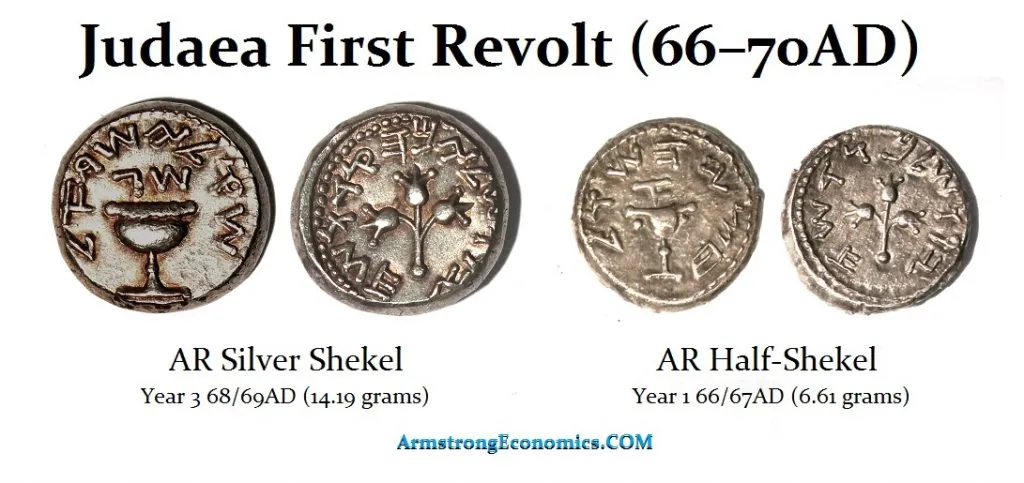
During 66AD, the Jews thus took control of Jerusalem and began to issue their own coins. The Judean Free Government was formed in Jerusalem including former High Priest Ananus ben Ananus, Joseph ben Gurion and Joshua ben Gamla elected as leaders. Yosef ben Matityahu was appointed the rebel commander in Galilee and Eleazar ben Hanania as the commander in Edom. Later, in Jerusalem, an attempt by Menahem ben Yehuda, leader of the Sicarii, to take control of the city failed. He was executed and the remaining Sicarii were ejected from the city. Simon bar Giora, a peasant leader, was also expelled by the new government.

Vespasian was given the task by Nero of crushing the rebellion in Judaea province. His son Titus was appointed as second-in-command. Vespasian invaded Galilee in the fall of 67AD. He avoided a direct attack on the reinforced city of Jerusalem. Instead, Vespasian launched a directed campaign to crush rebel strongholds and punish the population. Within several months Vespasian and Titus took over the major Jewish strongholds of Galilee and finally overran Jodapatha, which was under the command of Yosef ben Matitiyahu, as well as subdued Tarichaea, which brought an end to the war in Galilee.
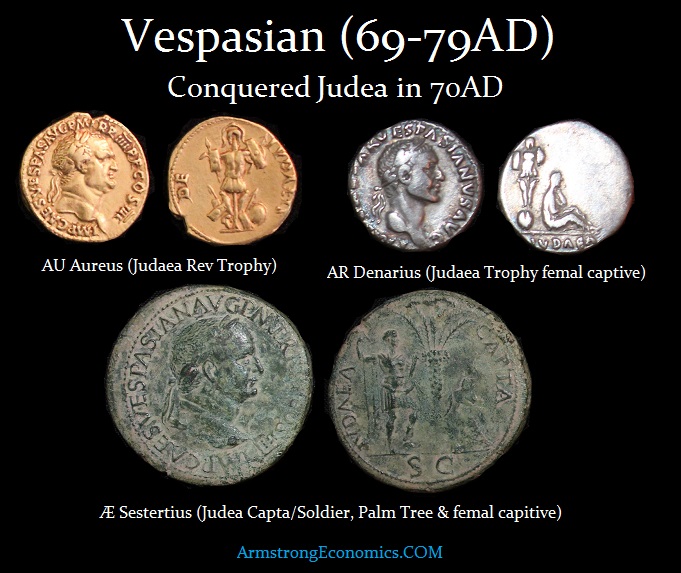
With the death of Nero in 68AD, Rome moved into a Civil War. Vespasian became the rival general to ain over Otho and Vitellius. Now the Judea situation was a matter of critical importance. Vespasian became emperor in 69AD and the defeat of the Jewish Revolt was critical for if they succeeded, then other provinces would rally against Rome as well.
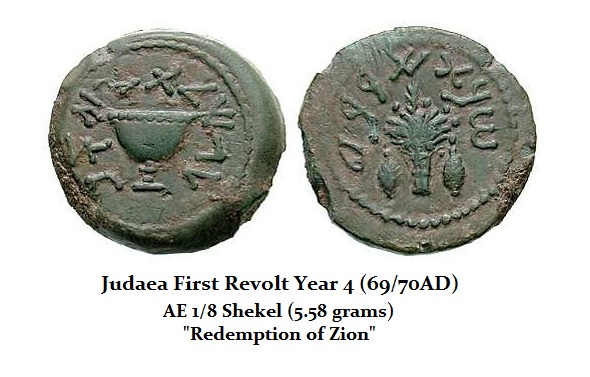
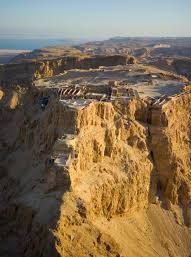
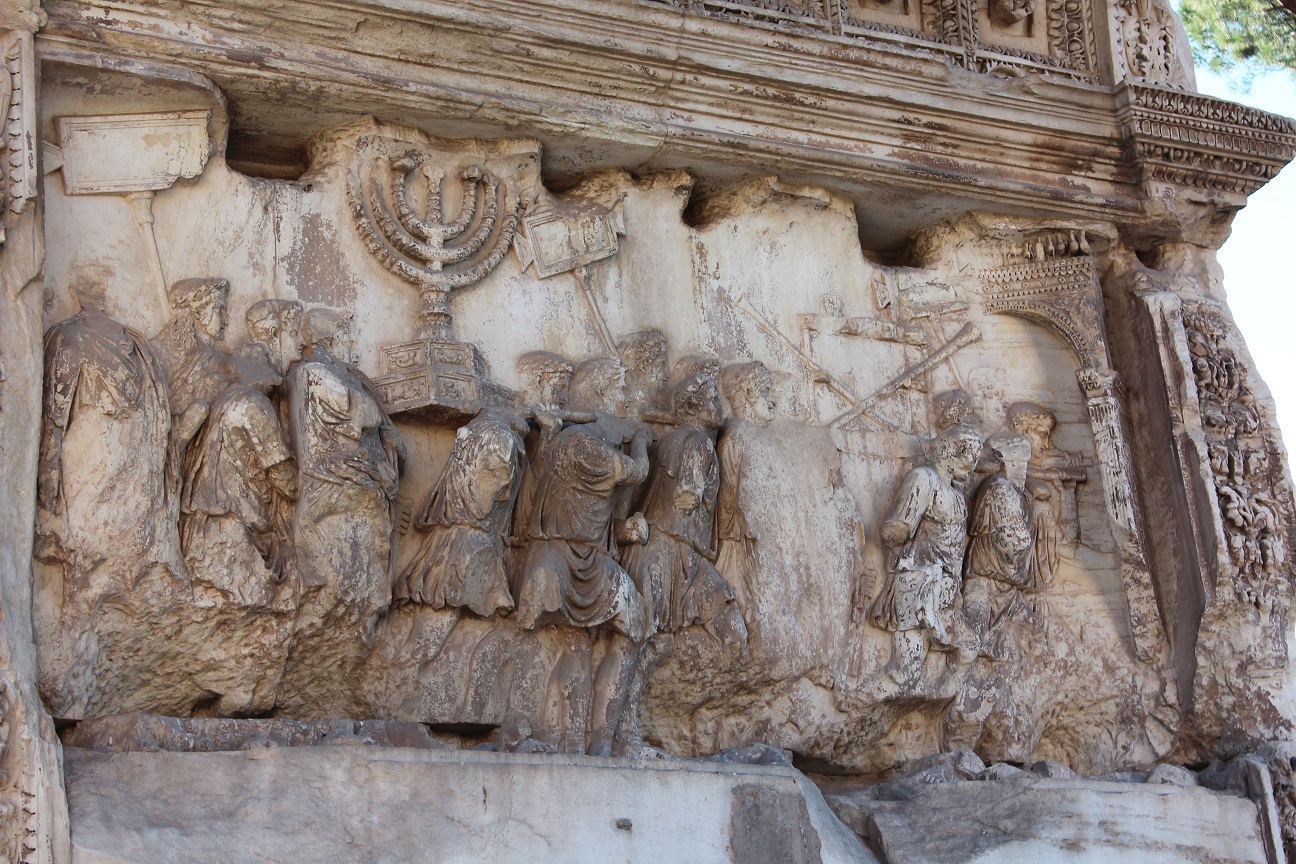
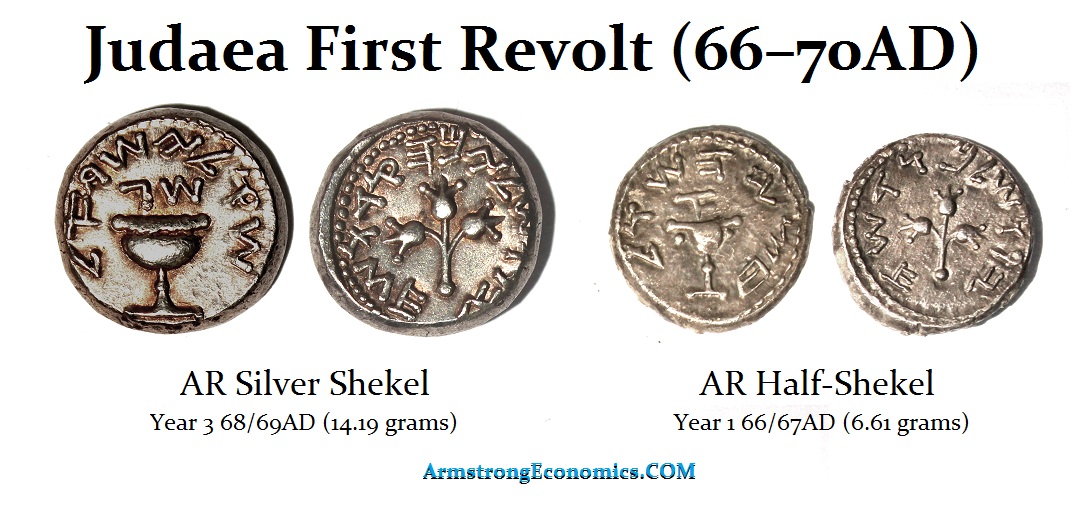
The first Jewish coins boasted the slogan: “For the Freedom of Zion.” The Jewish War for Independence last 4 years covering the period of 66-70AD until the conquest of Jerusalem. Recently, a bronze coin was discovered in Israel from the fourth year of the failed rebellion against Rome which reflected the change in attitudes. The coins of Year 4 saw a change in the slogan to “For the Redemption of Zion.” The Temple was sacked in 70AD and the clean-up skirmishes followed which took several years. The historian Josephus tells us of the last stand at Masada which took place around 73-74 AD.

Year 1 (66/67 CE) Jewish shekels and half shekels are scarce, year 2 (67/68 CE) shekels and half shekels and year 3 (68/69 CE) shekels and half shekels are relatively common, year 4 (69/70 CE) shekels and half shekels and year 5 (70 CE) shekels are extremely rare.

Virtually EVERY revolution throughout history appears to emerge from a tax rebellion. It will often expand into ethnic or religious slogans, but at the core, it is always taxation. The American revolution was the class – No Taxation Without Representation. Yet the greed of politicians inevitably leads to their own destruction for they cannot resist spending other people’s money.

What to Advise Your Children to Do in Seeking a Degree


QUESTION: Mr. Armstrong; You said that over 60% of graduates cannot find a job on what they have a degree in. Is there any recommendation you would care to make on how to advise one’s children on what subject to pursue a degree?

Thank you

DF

ANSWER: Engineering and Programming. I have NEVER met a CFO yet who had a degree in economics. The overwhelming degree I encounter as a CFO is usually engineering. The reason this seems to be the best degree is it teaches you HOW to solve a problem whereas economics tells you the solution, which has never worked anyhow. Then take programming. This will be the essential skill in the future. Not that you write code for generic apps. But if you understand a subject matter, then you will have the skill to write a program to accomplish that objective. I have the programming skills. However, no matter if I am the best programmer in the world, I still could not write a program like Socrates without the ability to trade.

Programs that have blown up like the Black & Scholes that ended up winning the Noble Prize just before blowing up the world economy in Long-Term Capital Management Crisis of 1998, took place because you had two math geniuses who lacked trading skills. The formula that blew up the Real Estate models in 2007 made the same mistake. You cannot reduce the market to a single formula. That is a fool’s quest. As soon as you think you created the best model since sliced bread, it will blow up because those people cannot understand how to trade. There is no shortcut using math to generate the best model that ever existed. Even the high-frequency trading systems immediate shut down when volatility rises.

Economic Confidence Model & Weather


QUESTION: Do you have any correlation illustrations between weather and your ECM?

CG

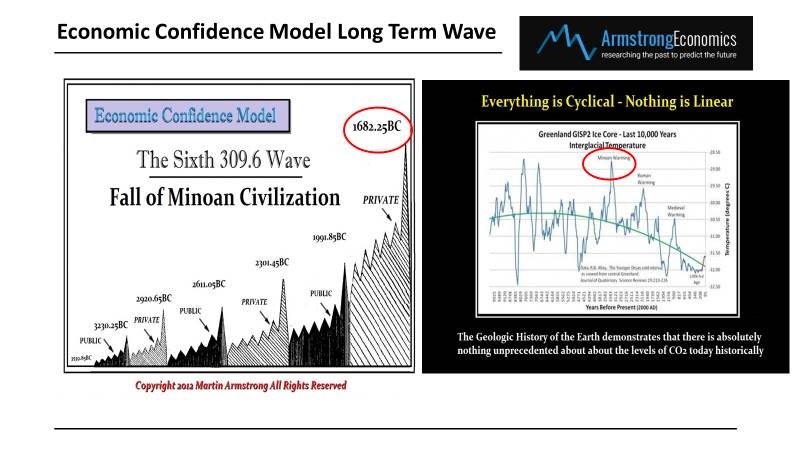
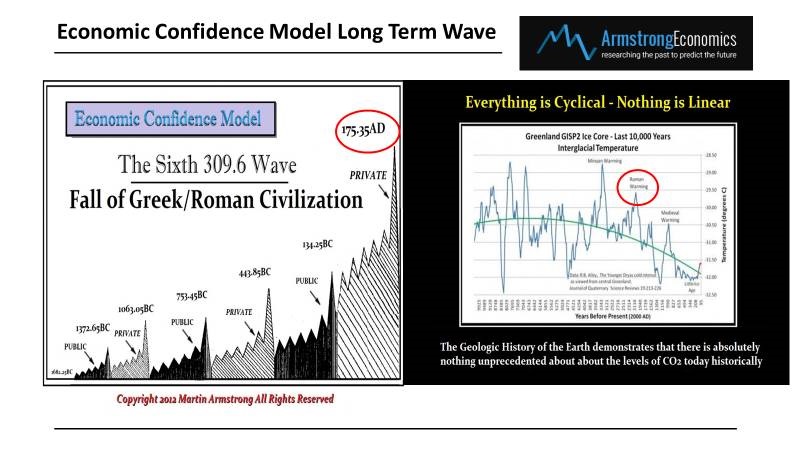
ANSWER: Yes. Here they are on a grand scale

Hidden Order Inside the Chaos or “Noise”


QUESTION: Martin, I have been reading about machine learning recently and have come across a concept that I believe you might have figured out that no one else has. To quote Max Welling “The information we receive from the world has two components to it: there is the part of the information which does not carry over to the future, the unpredictable information. We call this “noise”. And then there is the information that is predictable, the learnable part of the information stream.” Have you through Socrates figured out a way to filter noise entirely from the system or something of this nature?

Kind regards,

Andrew

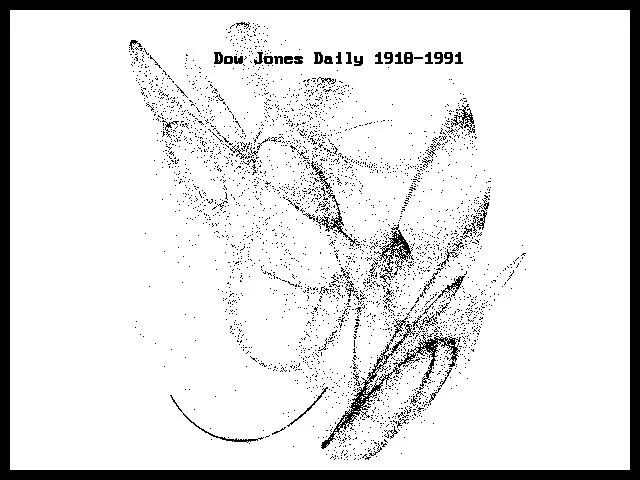
ANSWER: No. That statement is based upon the idea that the “noise” is just chaos. They cannot see behind the surface and look deep within. There is ALWAYS order to the “noise” and 99.9999% of the problem is that people do not understand how to deal with chaos. Here is a plot of a daily file of closing in the Dow Jones Industrial Index from 1918 to 1991, which we published long ago. There is a hidden order within that “noise” if you understand how to extract it

Interesting Way to Increase Sales During the Great Depression


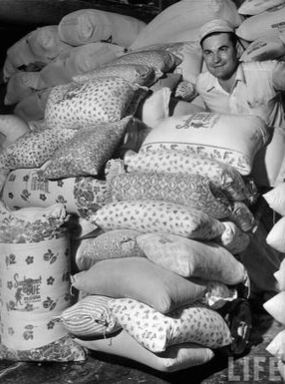
How bad did it get in some segments of the population during the Great Depression? Actually, during the Great Depression, women began reusing the fabric from flour sacks to make dresses. When the flour companies woke up and suddenly realized the purpose their flour bags were providing, they began to print their bags with various floral and other designs to make them more attractive to consumers who would buy flour to be able to use the cloth for clothing. Interesting way to increase your sales.

The future of NATO


Published on Jul 12, 2018

Arguably the most successful alliance in human history, NATO’s very existence is under attack. Are we about to commit a tragic error, or is it time for a long-overdue restructuring?

The Violence in Northern Ireland is Not Finished


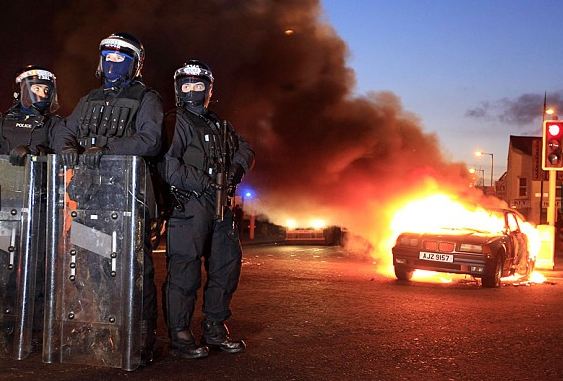
Reuters is reporting that Northern Ireland was hit by a new wave of street violence overnight on the eve of annual parades. This is demonstrating that there remains underlying tensions between pro-British Protestants and Irish nationalist Catholics in the British occupied region. Vehicles were set on fire, petrol bombs were thrown, and roads were closed off in violence in several towns. The parade marks the 1690 victory of Protestant King William of Orange over Catholic King James of England. Therefore, it feeds right into the conflict between the Protestants and Catholics which has existed since the time of Henry VIII’s seizure of the Catholic Church to affect the divorce he was being denied.

The first death in the conflict in Belfast is disputed involving Francis McCloskey (aged 67) who died one day after being hit on the head with a baton by a member of the Royal Ulster Constabulary (RUC) during street disturbances in Dungiven, County Derry on Sunday, July 14th, 1968. The official first death was the fatal shooting of a Catholic on Thursday, August 14th, 1969. The person was John Gallagher was shot dead by the Ulster Special Constabulary (‘B-Specials’) during street disturbances on the Cathedral Road in Armagh. John Gallagher is recorded as the first ‘official’ victim of tensions in Northern Ireland. The first Protestant Civilian to be killed took place on Friday, August 15th, 1969 named David Linton (aged 48) who died after being shot by a Republican group during street disturbances in North Belfast. The actual first members of Irish Republican Army (IRA) to be killed took place on Friday, August 15th, 1969. His name was Gerald McAuley (aged 15), who was a member of Fianna Éireann, which was the youth section of the Irish Republican Army (IRA). He was shot dead by Loyalists during street disturbances in the Lower Falls area of Belfast.

From a cyclical perspective, if we begin on August 15th, 1969, then we are concluding a 51.6-year wave on 2021.2219178, which will be March 22nd. It is lining up with the Economic Confidence Model and the Monetary Crisis Cycle. Therefore, the violence will reemerge with a new trend once again driven by economics. Violence has continued sporadically but it has been rising gradually again since 2013.


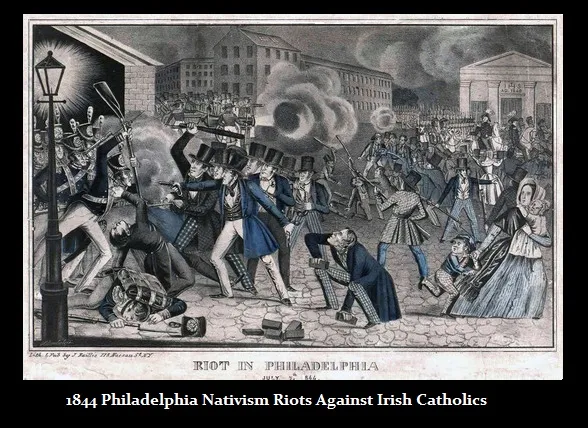
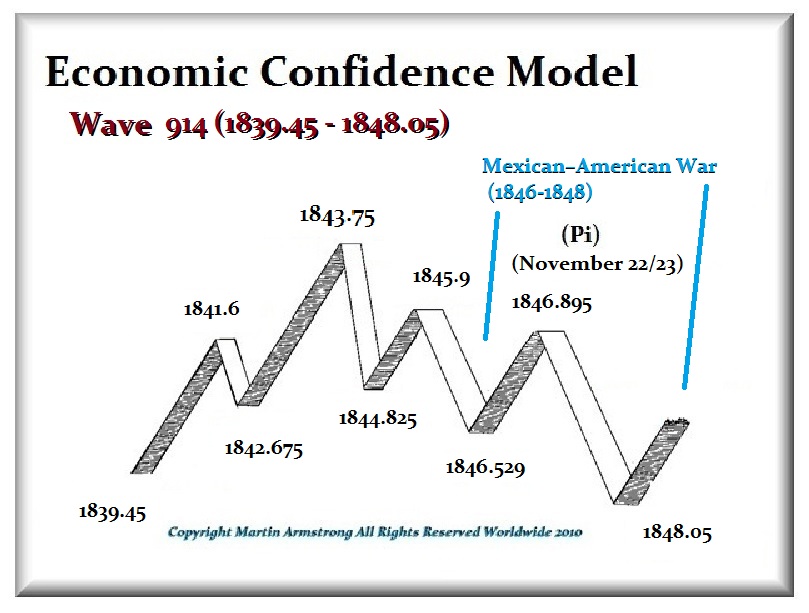
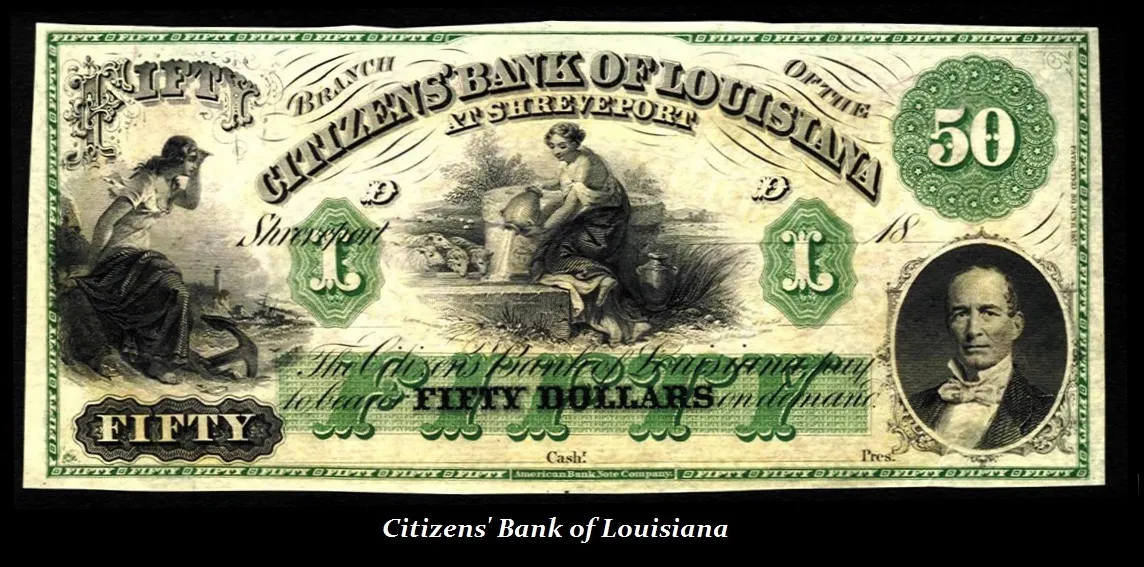
The violence against Irish Catholics in America erupted in 1844 during the Sovereign Debt Defaults of states and the economic decline in the aftermath of the Panic of 1837 (Dates of ECM Waves). When Andrew Jackson shut down the central bank, the Bank of the United States at that time, all banks began to issue money of their own. The economy was flooded with frauds and nobody knew what banks were real or safe. As banks failed, the States tried to bail out the banks to save their economy and they too were pushed into default. The Depression that followed raised unemployment and violence.

Oldest Version of Homer’s Iliad and The Odyssey was Just Discovered


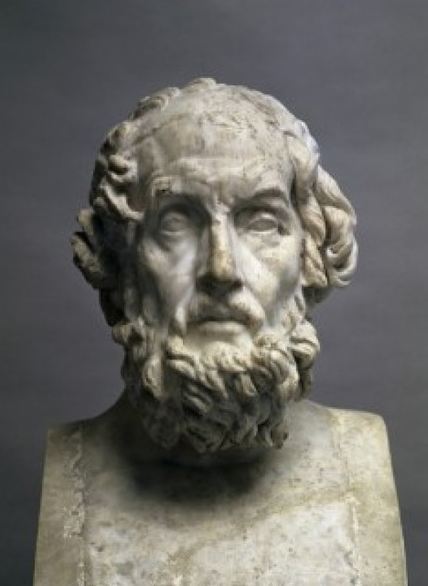
A remarkable discovery has been made and reported by the BBC. A clay tablet recording the story of Odysseus after the fall of Troy by Homer who is the famous Greek poet who was born sometime between the 12th and 8th centuries BC. He is believed to have possibly been born somewhere on the coast of Asia Minor in Turkey rather than the mainland Greece. He is famous for the epic poems The Iliad and The Odyssey, which have had an enormous effect on Western culture, but very little is known about their author.

This latest discovery of a clay tablet was found near the ruined Temple of Zeus in the ancient city of Olympia, during an excavation which has taken three years. The tablet has been dated to Roman times generally and was engraved with 13 verses from the poem The Iliad and The Odyssey. It has been argued that Homer was simply a tale for children because it was handed down in an oral tradition for hundreds of years before the tablet was inscribed. Far too often ancient history is disregarded as myth.

SchliemannHeinrich Schliemann (1822 – 1890) was a German businessman and a major pioneer of field archaeology. He believed in the historical accuracy of Homer’s Iliad and The Odyssey and Virgil’s Aeneid and that they recorded stories that reflected actual historical events. Of course, all the academics pronounced Homer’s writing was a story for children. Schliemann was an amateur archaeological excavator. He took Homer at face value and believed it was history. To this day people still diminish his contributions because he dared to challenge the academics. Many hate his guts for proving them wrong since they pontificated Homer was a story for children without any proof because they never set foot out into the field to prove that statement was even correct.

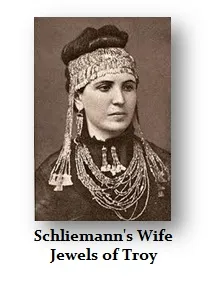
This picture of Schliemann’s wife wearing the jewels discovered in Troy was accused of being fake by academics while Schliemann called it Priam’s Treasure. The treasure was smuggled out of Turkey and the official assigned to watch the excavation was sent to prison as a result. The Ottoman government revoked Schliemann’s permission to dig and sued him for its share of the gold. Schliemann thereafter went on to Mycenae where he discovered another part of the Homer epic.

Eventually, Schliemann traded some treasure to the government of the Ottoman Empire in exchange for permission to dig at Troy again. That is located in the Istanbul Archaeology Museum. The rest of his discovery was acquired in 1881 by the Royal Museum of Berlin where it remained until 1945 when it disappeared from a protective bunker beneath the Berlin Zoo. The Russians seized the Treasure yet denied they had it until September 1993 when the treasure turned up at the Pushkin Museum in Moscow. Germany’s request to return it was rejected as Russia asserted that was compensation for the war destruction by Germany. Whether this Treasure was Priam’s is doubtful for it appears to be actually a thousand years older than Homer’s King Priam of Troy.

Lions-Gate

Schliemann not merely discovered Troy, he discovered much of ancient Greece including the Lions Gate pictured here as the entrance to Mycenae. disagreed. He was not an archaeologist, just a history enthusiast with money. He discovered Troy and most of the Greek cities of the Heroic Age, including Mycenae with its Lion’s Gate, described by Homer, not to forget the gold death mask of Agamemnon where Homer said he was buried.

This latest discovery of a clay tablet recording Homer’s tale is the oldest so far. This further demonstrates that the story was part of Greek history and not merely just a legend