The final straw for the revolution in Nepal was the government’s attempt to stifle free speech by banning social media platforms. These events did not take place because a few kids had their tablets taken away. Extreme government corruption ran rampant for years while the elite lived luxurious lifestyles in spite of the people they ruled over. The Nepalese government attempted to prevent the people from freely voicing their growing discontent, and then, when the people attempted to protest, the government murdered over 20 school-aged children in cold blood.
The media has poorly portrayed the cause of events by calling it the “Gen Z” revolution, sparked by a social media ban, which is entirely misleading, as the culprit was corruption and poverty. One in four citizens lives below the poverty line, with the average Nepali earning $1,400 USD annually. The poorest 20% spend around 67% of their income on food, and, much like most nations, in 2025, the majority is struggling to maintain the cost of living.
What began as an online trend has now become the core of a national uprising. The hashtag #NepoKids exposed the lavish lifestyles of political elites' children, revealing a stark contrast to the struggles of ordinary Nepali youth facing unemployment and economic hardship.
Then you have over 20% unemployment among the youth. In contrast, there is a “Nepo Kid” online trend where the children of the wealthy elite flaunt their luxurious lifestyles. The hashtags #PoliticiansNepoBabyNepal, #NepoKids, and #NepoBaby began circulating online during the protests. “The leaders’ children return from abroad with Gucci bags, the people’s children in coffins,” read a placard held by a protestor. The “coffin” remark may allude to the return of deceased Nepali citizens who work as mercenaries in the Ukraine-Russia war.
The parents of these Nepo Kids are extremely corrupt and have sold out their fellow countrymen in favor of their own self-interest.Transparency International, a nonprofit connected to the World Economic Forum and World Bank, deemed Nepal as the one of the most corrupt nations in Asia. The scandals are numerous. At least $71 million USD was embezzled during the construction of the international airport in Pokhara city. The New York Times reported that Nepali government leaders were preying on the youth through a scheme where they’d promise to secure them refugee status in the United States for a fee.
In January 2025, FORMER Prime Minister Oli’s administration declared an ordinance amending 29 laws, which reversed prior Supreme Court verdicts mainly against illegal land swaps and hoarding. The ruling protected corrupt government officials facing corruption charges. National property was transferred to private ownership for the government elite. Over the summer, there was a massive scandal connected to state-run enterprises issuing fraudulent contracts. The corruption is endless, and the children of these corrupt politicians openly flaunted their family’s unearned wealth online.
The protests began peacefully. The government quickly acted to silence the voice of the people. Social media is one of the last free platforms of speech that permits people to connect instantaneously. The revolution will not be televised, but it will be live streamed across all social media platforms. As the protests grew, the government began to panic and authorities became increasingly aggressive toward protestors until tensions rose to a head and the police began shooting into the crowd. The people of Nepal watched as a young boy in his school uniform was shot in the head by the police.
Revolts are swift and violent. Fueled by anger, the people began to destroy the government at its source. The Parliament building was infiltrated and burned to the ground before Former PM Oli could issue his recognition. Thousands of people livestreamed the event. Angry mobs sought out the politicians whom they believed were responsible for their economic hardships. PM Oli’s residence in Bhaktapur was set on fire, as was the residence of President Ram Chandra Paudel. The wife of Nepal’s largest political party, who also serves as the minister of foreign affairs, was ambushed and beaten in her home. The wife of Nepal’s former prime minister was unable to flee when her home was set ablaze and burned alive. I reported how the minister of finance was chased through the streets, beaten, and paraded around in his underwear before the people tossed him into the river.
(Foreign Minister Arzu Rana Deuba was attacked in her home)
History has shown that these revolutions become extremely violent. Look at what the people did to Benito Mussolini, hanging his disfigured body in the public square. Or in France where the people executed Marie Anointenne who was known for flaunting her wealth in a perceived mockery of the poverty-stricken public. Civil unrest grows, government attempts to contain it with force, and the collective anger of the people implodes like a nuclear weapon. Violence is inevitable when the people feel unheard and have nothing to lose.
Reports are stating that certain dissenting political groups are using the revolution to push their own agenda. Former Prime Minister Prachanda went into hiding when the protests erupted and has been accused of employing bad actors to incite violence and kill his political rivals. Criminal court cases are being destroyed. Prisons have been infiltrated and hundreds of people have been released.
The mainstream media is portraying this as a Gen Z protest over social media because the political elite are scared. In reality, the people collectively rose up against government tyranny and toppled the government within 48 hours. Revolutions are the product of failed governments, corruption, and the refusal of those in power to yield when the cycle has already turned against them. The youth are the first to stand up because they have no vested interest in preserving a corrupt system. They see no future in servitude to debt or a political class that only serves itself.
Nepal’s revolution is a foreshadowing of what is to come elsewhere. It is always the smaller, weaker nations that flip first, sending shockwaves through the system. This is not about left versus right, rich versus poor, or even democracy versus authoritarianism. It is about the collapse in confidence in government itself. That is the real cycle, and it is in motion now.
Posted originally onSep 11, 2025 by Martin Armstrong
The notable revolutions in Nepal include the 1951 Nepalese revolution, the 1990 Nepalese revolution, the Nepalese Civil War from 1996 to 2006, and the 2006 Nepalese revolution. Each of these events played a significant role in shaping Nepal’s political landscape. Nepal has a fairly regular revolutionary cycle in its blood. This one in 2025 is right on schedule. The tension began to escalate as the year 2024 drew to a close.
Posted originally on Sep 10, 2025 by Martin Armstrong |
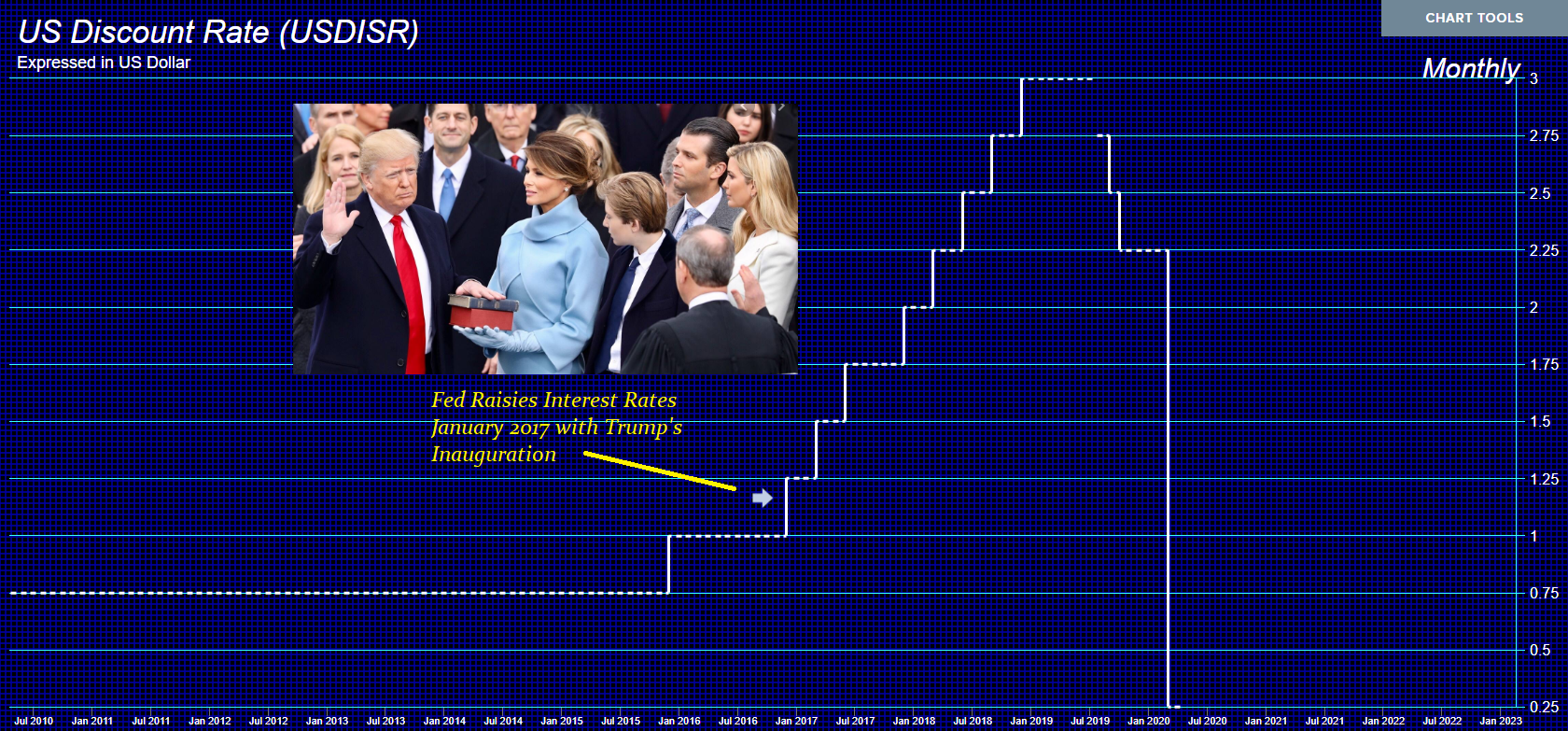
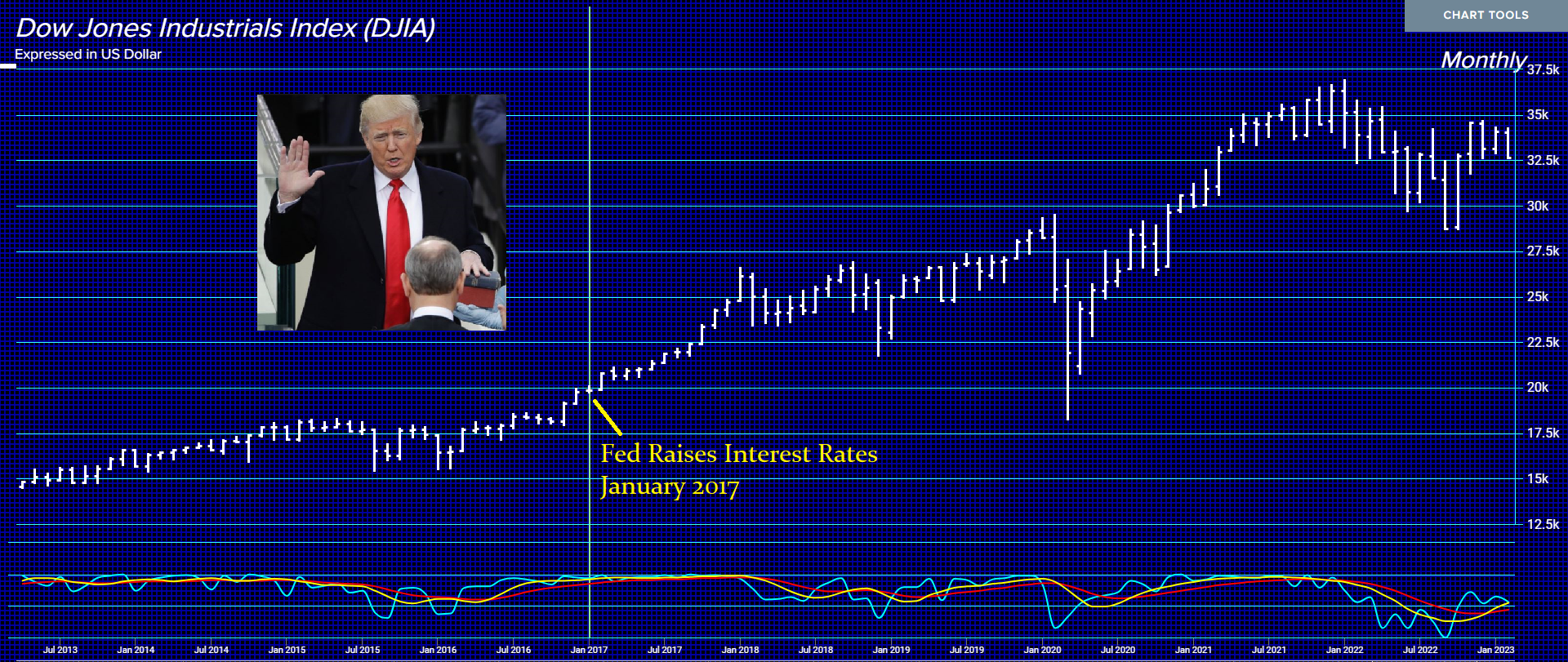
COMMENT: The comment you posted was correct. Jim Cramer always said bad news is good news. He and everyone else continue to advocate for lower interest rates, and you have shown that when rates decline, so does the economy and stock markets. It looks like Trump is not much better with his constant attack on the Fed.
Joe
ANSWER: I am a trader – not a promoter, academic, or a TV host. When you actually have skin in the game, you cannot trade based on stupid theories. The fact that these people can say that BS time and time again that lower rates are suitable for the economy, makes the word STUPID and a compliment to their mental capability, for they have not yet invented a word to describe their cognitive ability, which seems to be so myopic that they are at the level of an ameba.
I agree, Trump’s attack on the Fed is absolutely dead wrong. The Fed has lowered rates during the Great Depression and every single recession right up to the 2007-2009 recession with ZERO impact whatsoever. No matter how loud I scream, they will NEVER change this propaganda, and they will not only doom the country, but also cause a lot of economic harm to people who act on this propaganda.
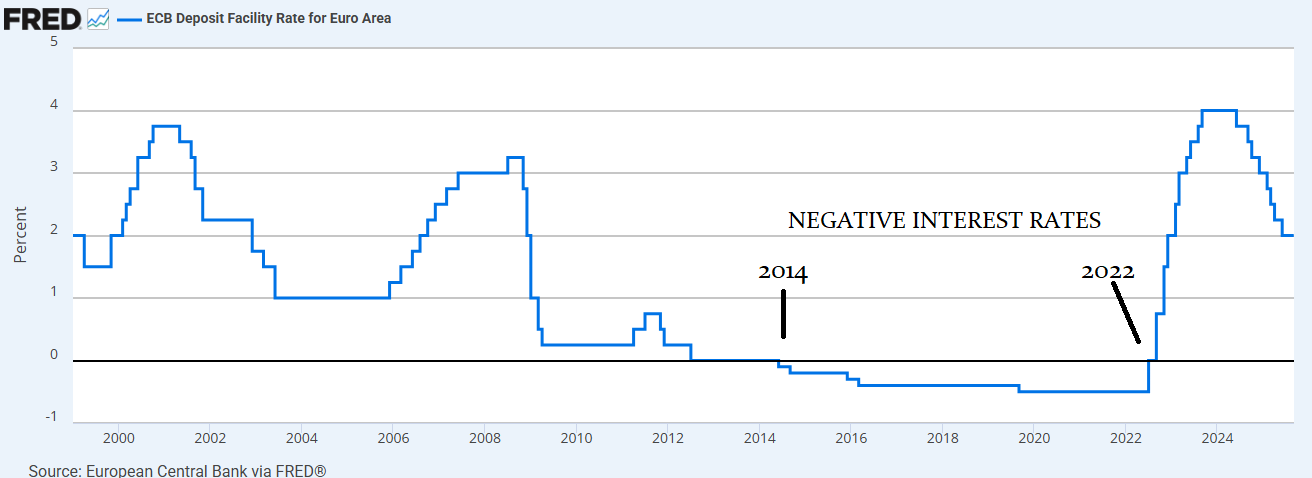
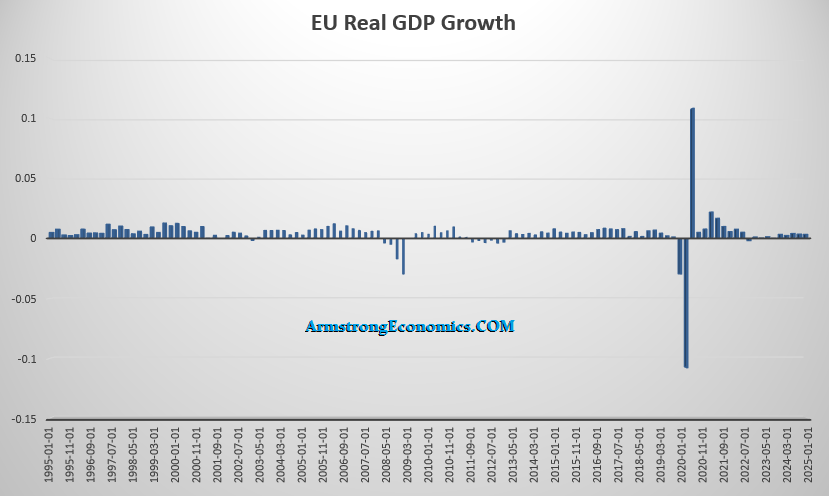
The ECB went NEGATIVE on interest rates in 2014 and maintained that until 2022, with ZERO impact on reversing the economic downtrend. They will NEVER learn, and this is what 2032 is all about. Those in power neither understand how the economy functions nor do they care about trying even to figure it out.
No matter what you show a Democrat, it just makes them “feel all warm and fussy” inside to hurt people who have more than they do. They refuse to look at history and show just once where their theories have EVER worked a single time. We have the same entrenched stupidity on the right with this nonsense that lowering rates is good for the economy. We are doomed because of this foolishness on both sides and the REFUSAL even to look to see if this propaganda is right or wrong.
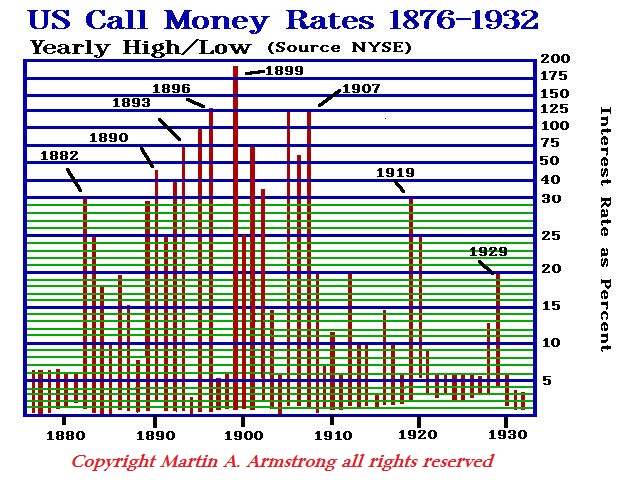
The stock market has NEVER peaked at the same level twice in history. The peak in Call Money was 1899, and the reason was a financial crisis in Britain that forced capital to be recalled from the emerging markets, which was, back then, the USA. The capital outflows led to shortages in cash, causing rates to rise. In 1929, the biggest rally occurred, with rates at their lowest, as capital from around the world concentrated in the USA following World War I.
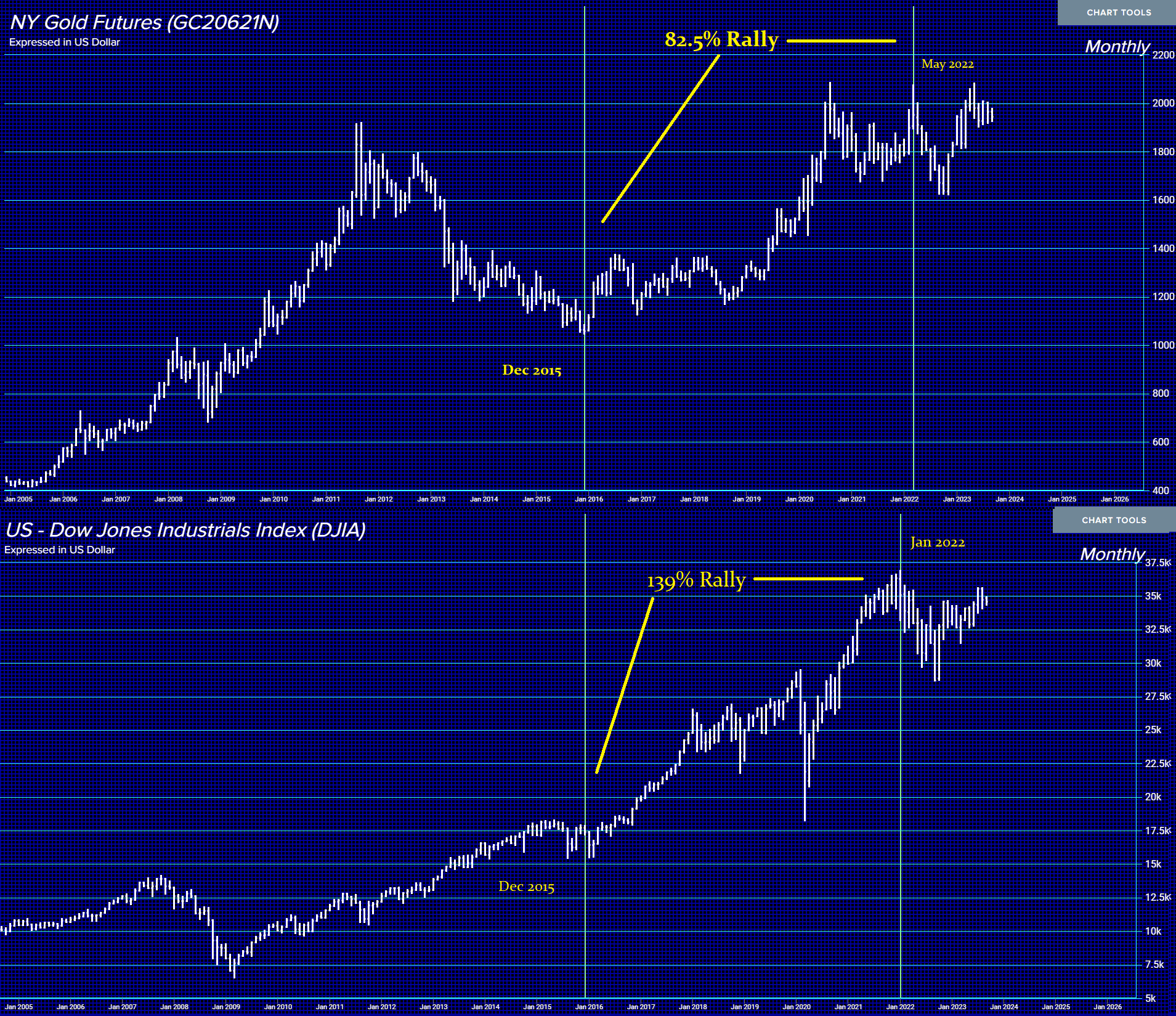
The goldbugs have told everyone to sell stocks and that only gold will rise. Like the Marxists, it just makes them feel warm and fuzzy inside to hate stocks and preach only gold, but will NEVER investigate what they are saying. This is what makes it so hopeless.
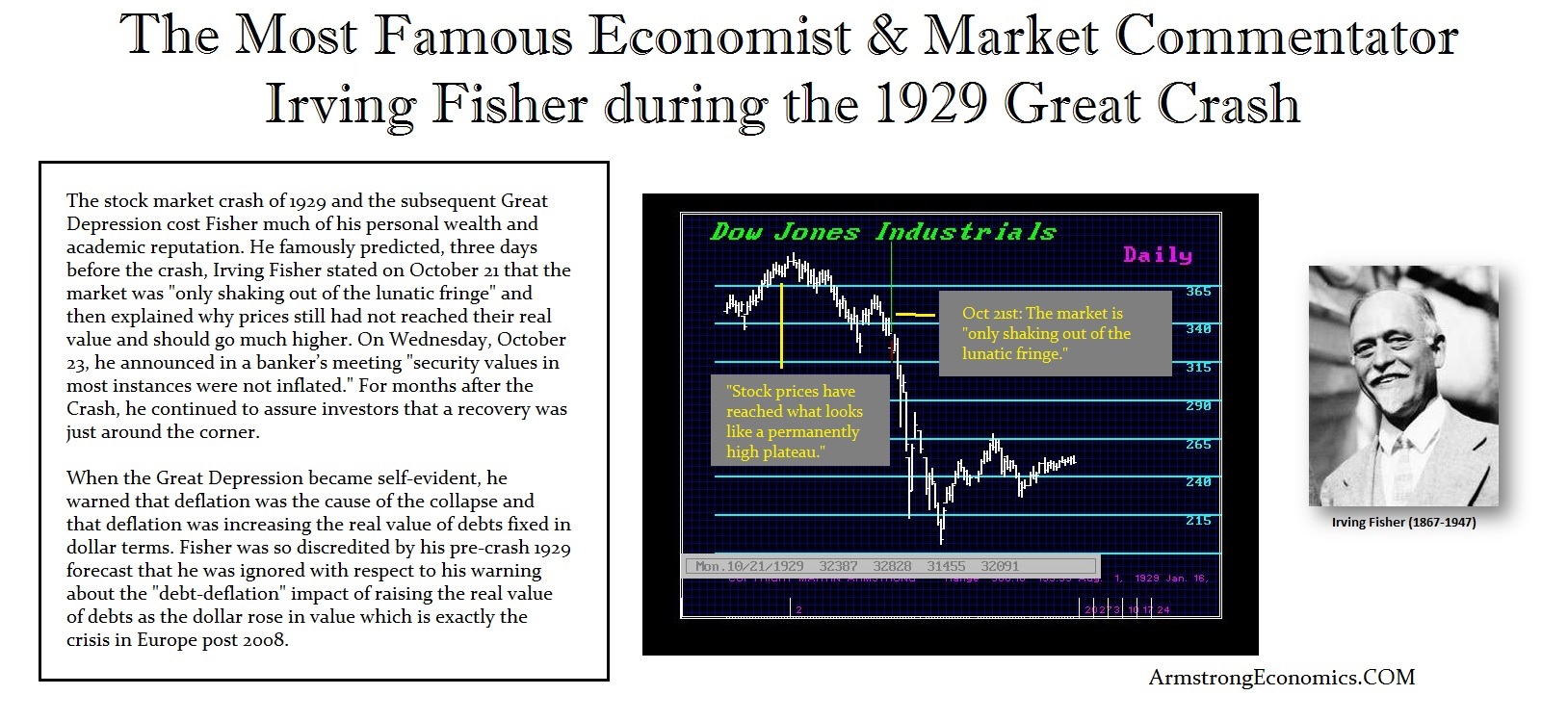
Even during the Great Depression, the most famous analyst was Irving Fisher. He predicted that the market had reached a new plateau and implied it would never crash. He was dead wrong, and his reputation was severely impacted. Irving Fisher’s contemporary public reputation was utterly destroyed by the 1929 crash, primarily because of a famously ill-timed statement.
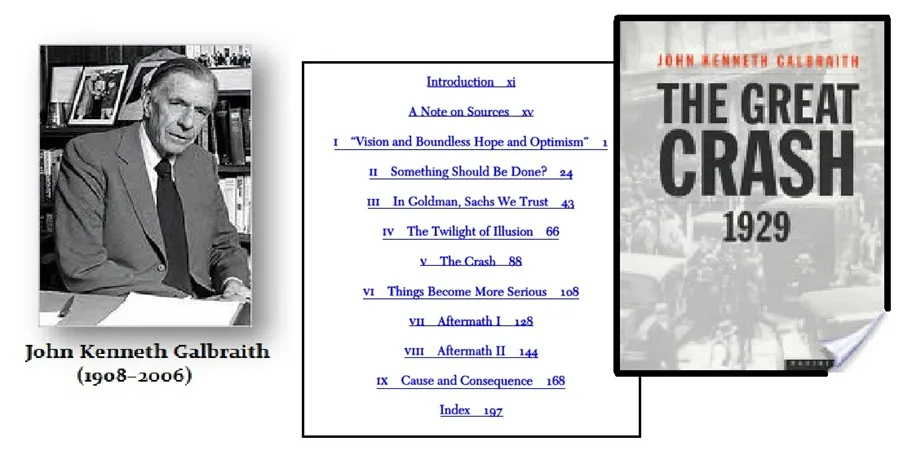
Galbraith’s socialist philosophy clouded his view of the Great Depression, blaming speculation and the private sector while ignoring the government defaults from Europe and Asia that contributed to the collapse of 9,000 banks. The primary issue in analysis is that people often start with a theory and attempt to prove it, rather than genuinely learning from the data.
Every single BS theory these people espouse is just utter nonsense. They have NEVER looked at markets and are incapable of basic research. They open their mouths and spit out words merely because everyone else does, and they are scared to death of peer review by yet other idiots. Yes, I have fought against the bankers, the Deep State, and various intelligence organizations, and all try to silence me and put out BS, desperate to try to prevent people from simply understanding reality.
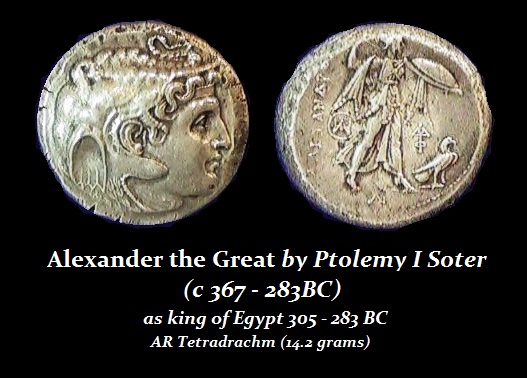
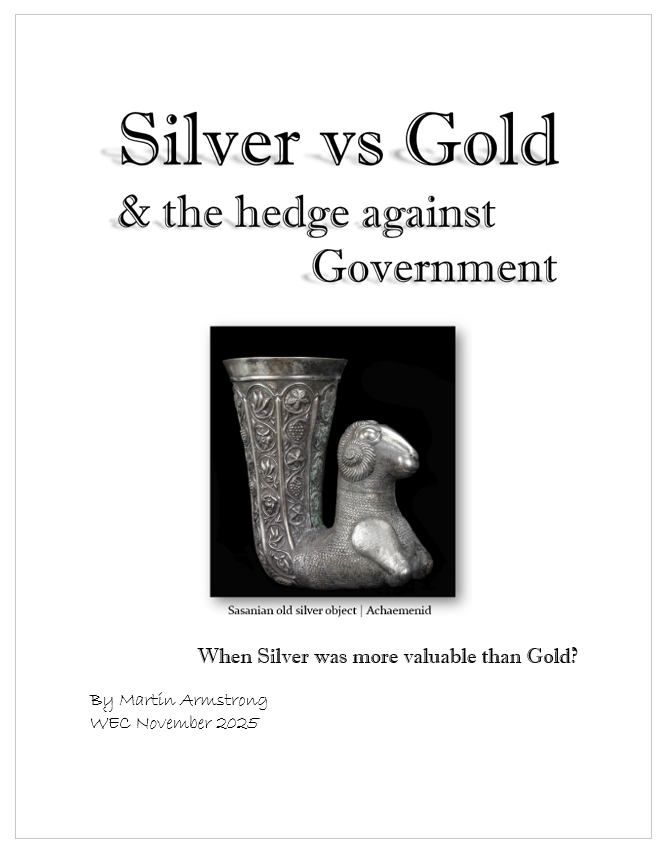
Even the complete nonsense that currencies are FIAT and only gold will survive is another absolute piece of raw BS. Again, they just take the Austrian School nonsense and never look at the monetary system at that point in history, when in fact the exchange rates between currencies were purely based on the metal content. There was no real superpower or centralized dominant economy when they were trying to come up with explanations of a process they did not fully understand. The first non-metal monetary system was based on a central ledger system of entries in ancient Egypt. Money was essentially equivalent to wheat that they deposited in a bank, and they were the first to implement a GIRO banking system in the world. You could transfer money from your account to another (GIRO), which did not appear until the Italian bankers of the Middle Ages. The Egyptians did not use coins until they were conquered by Alexander the Great in 332BC. So for thousands of years, it was purely book entries in a bank.
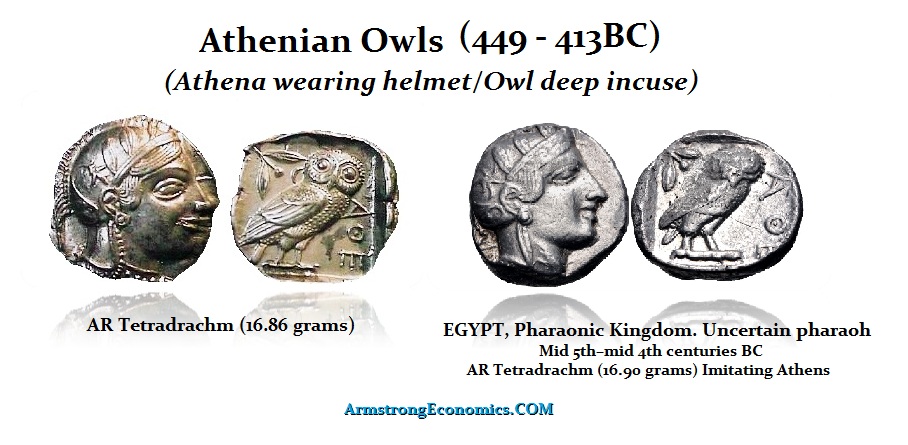
In order for Egypt to engage in international trade, it issued imitations of Athenian Owls. This proved that the value of an Athenian Owl was worth more than the metal content. They could have issued their own coinage, but did not. They imitated the Athenian Owl because that was the recognized currency in international commerce. There was a premium to the metal content or “fiat”; it was backed by Athens itself, not the metal content. Instead, its value comes from the trust people place in the government that issues it and the fact that it is the only legally accepted form of money for paying debts and taxes. The word “fiat” comes from Latin and means “let it be done” or “by decree.” Essentially, the currency has value because the government says it does, or because the people trust that government over others.
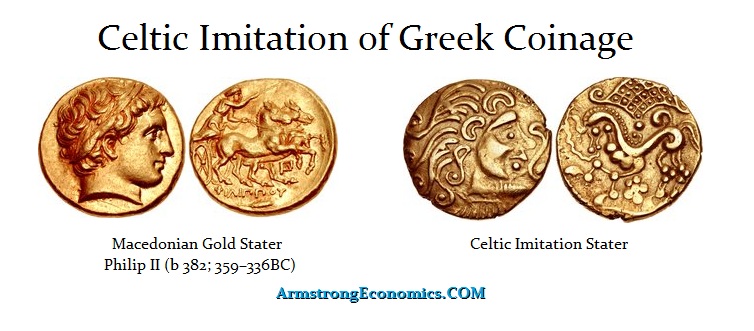
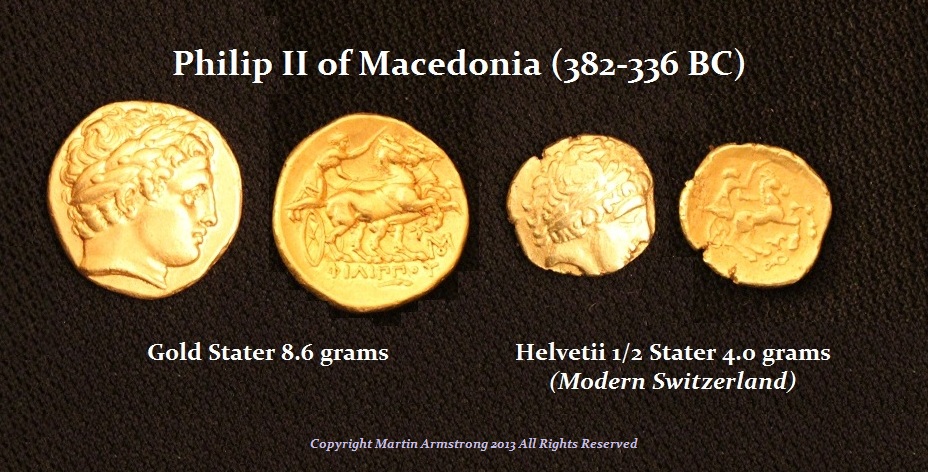
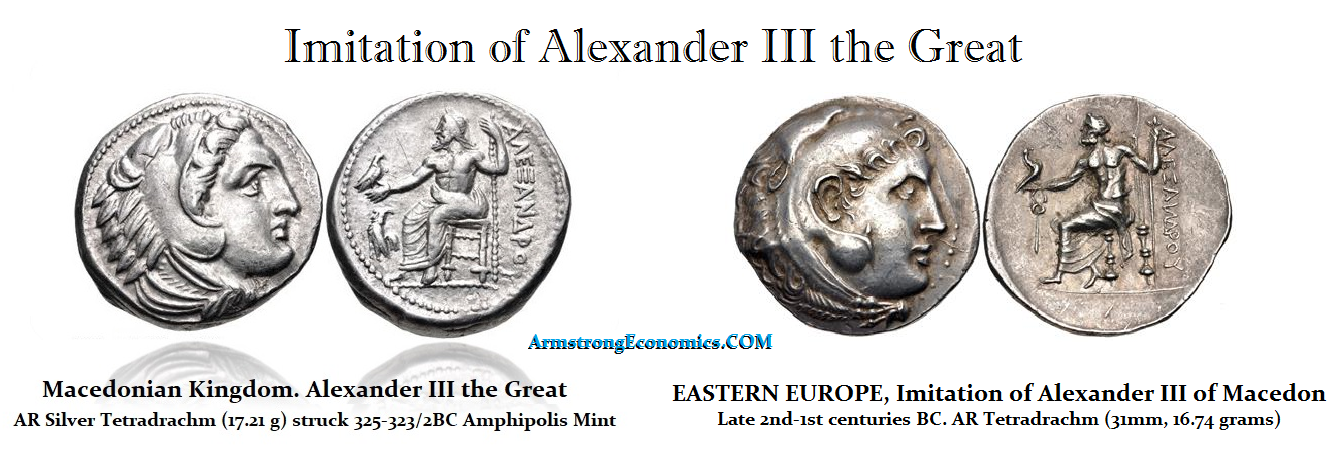
The Celts routinely imitated the coinage of Macedonia, starting with the gold of Philip II and then the silver of his son Alexander the Great. Again, this demonstrated that there was a premium to the coinage over and above that of the metal content. This is the very definition of a fiat currency, whose value is based on the fact that the government issues it.
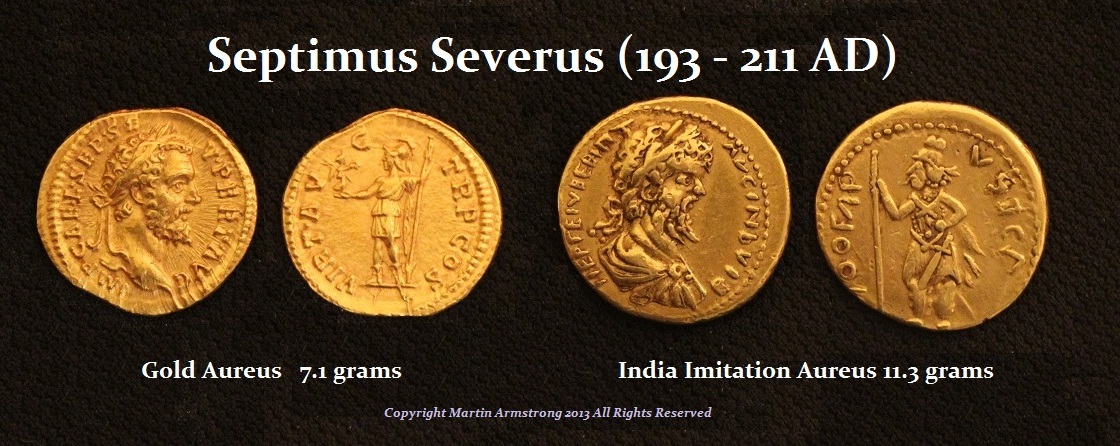
India was the source of the spice trade. They dealt extensively with Rome and Roman coins that circulated in India. They too imitated Roman coinage, and again, the value of the currency was NOT the metal content, but who do you trust? Proof of that statement is here, an Indian imitation gold aureus which weighs nearly 60% more than a genuine gold aureus of Rome.
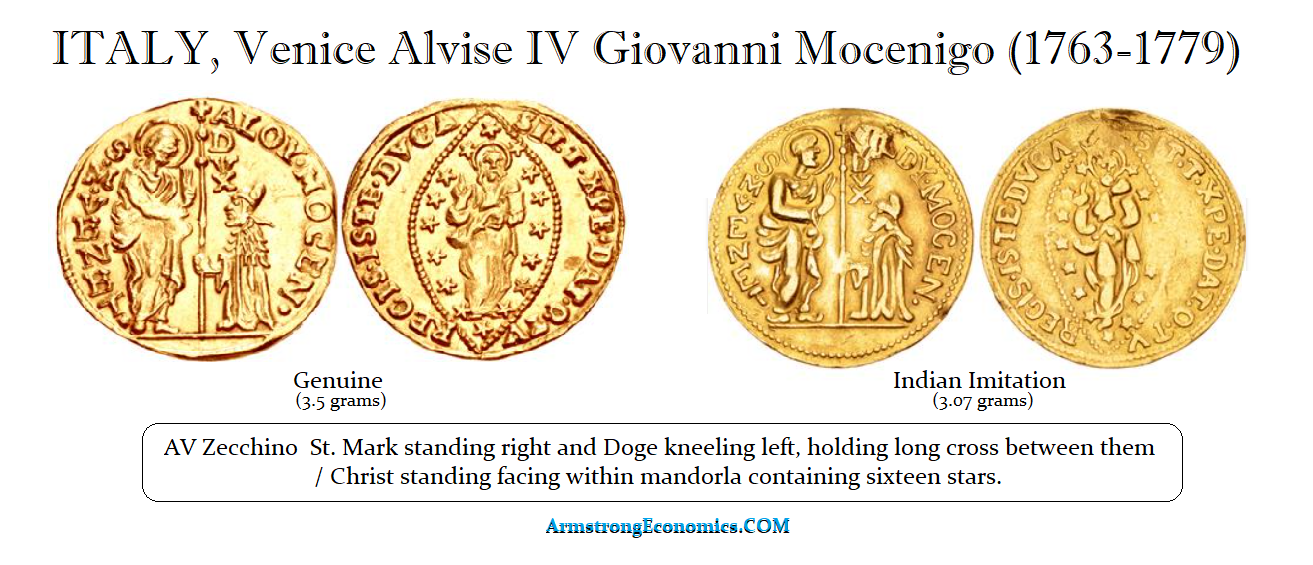
India was still imitating the coinage of the Venetian Empire during the 18th century. Issuing gold in the form of the most recognized currency in world trade confirms that the value of the currency was more than the metal content.
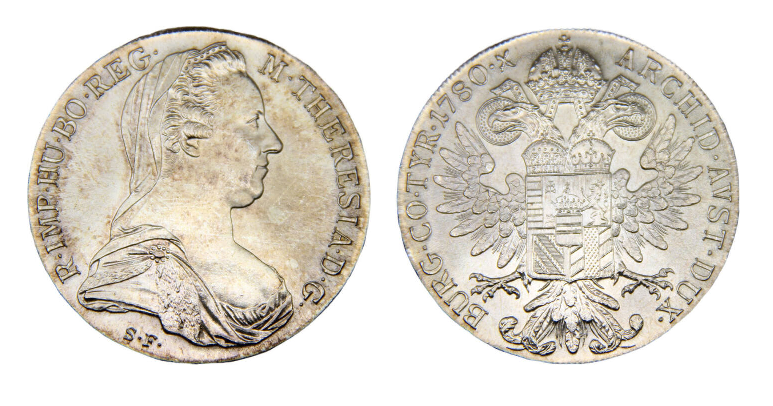
The Austrian Maria Theresia Thalers are perhaps the most imitated coin, for they were used in international trade by far. She died in 1780, so they continued to strike coins dated 1780, the year of her death. Again, the metal content is generally correct, showing that the coins were acceptable internationally.
Fortunately, you will NEVER convince a fool that he is foolish. There will be plenty of these people who will refuse to listen. They MUST lose their shirts, pants, the house, car, the wife, and the kids before they will ever understand. We learn ONLY from our mistakes – not our victories. So there will be a herd for us to trade against.
Posted originally on Aug 29, 2025 by Martin Armstrong |
COMMENT: Thank you for the private blog on the sovereign debt crisis. With both the UK and France in trouble and the possibility of the IMF bailing out these two major countries, everything you have been warning about is coming to a head. I was impressed. There was over $20 trillion in the room at the last WEC. This year’s WEC will be more than just an ‘I told you so’ event. Can’t wait. You certainly have a lot to cover.
WL
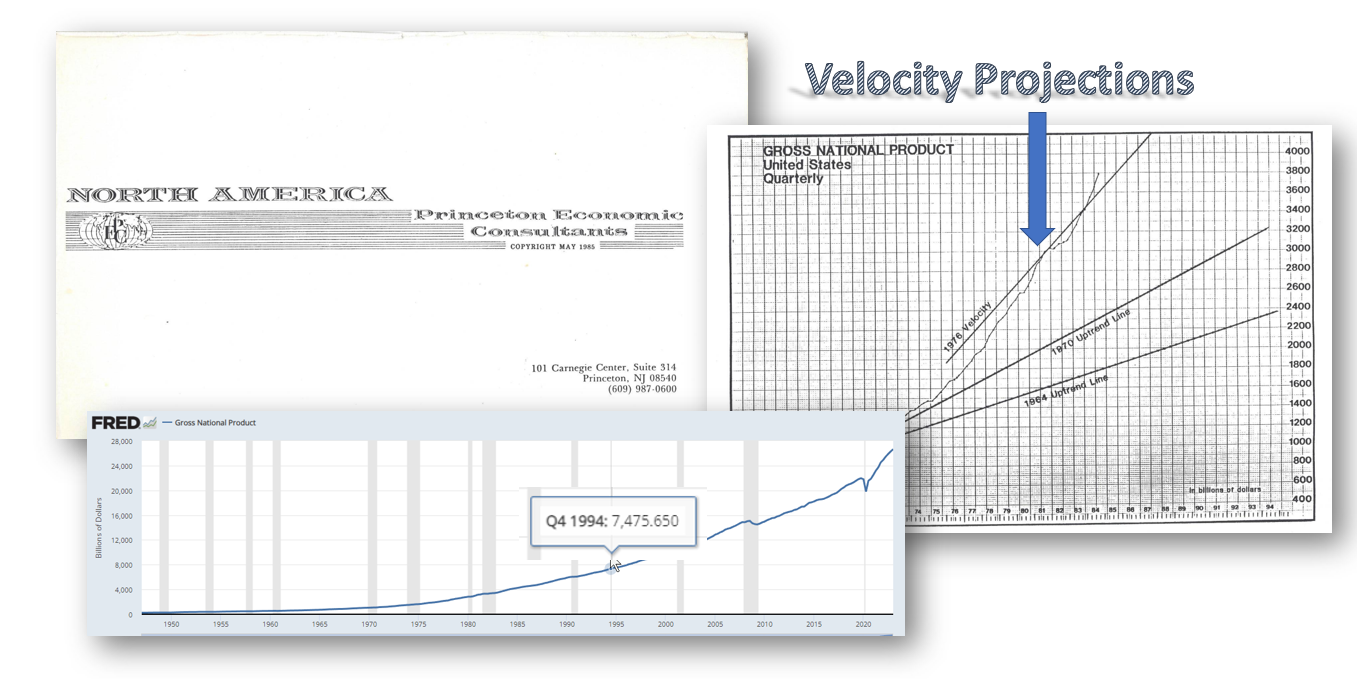
REPLY: Well, between War, Sovereign Debt Crisis, shift in capital flows, risk of cancelling paper currencies, and even the rise in volcanic activity on target with Socrates’ forecast, we are looking at a profound shift with wildcards coming in from many directions. This year is our 40th anniversary since the first World Economic Conference was held in Princeton in 1985. Thank God for Socrates. It monitors everything and performs the work of over 1,000 analysts to provide us with a clear picture of what lies ahead.
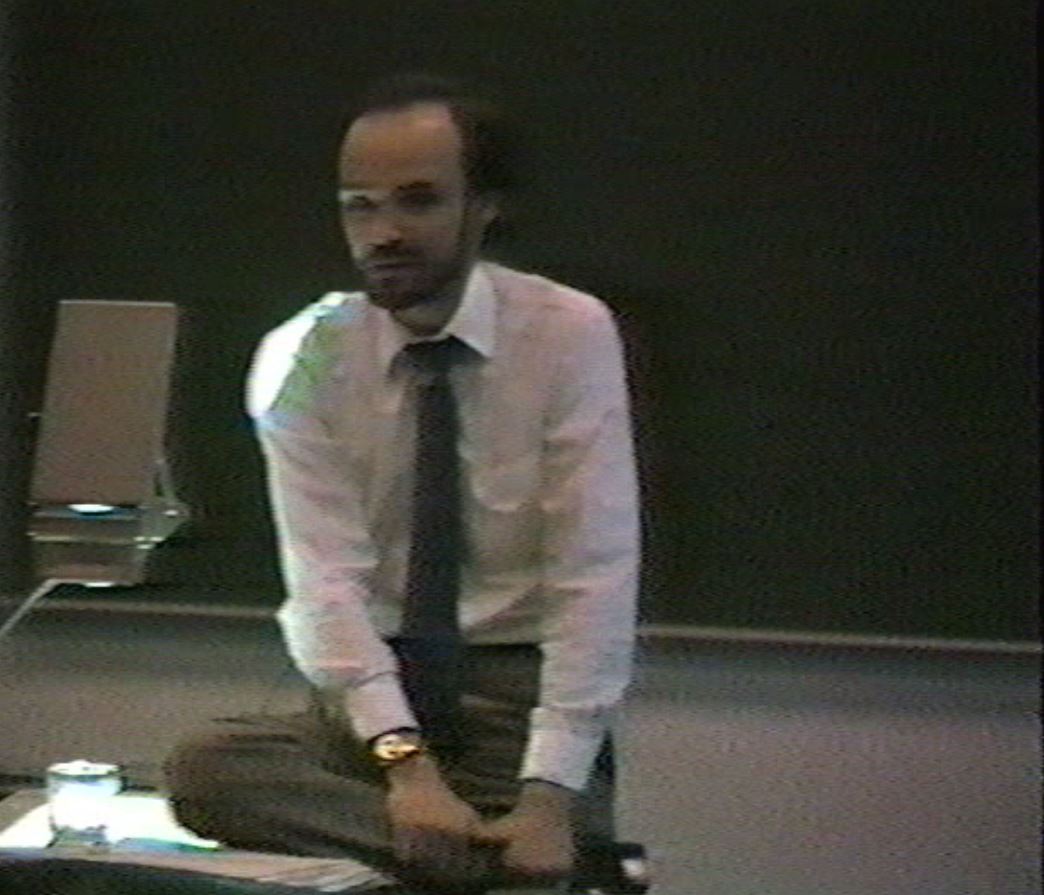
I still had some hair back then and was probably 20 pounds lighter. We have the videos of that one, and there I was forecasting, look at the volatility we will experience in the decades ahead. That was undoubtedly an eye-opener at the time.
We did every country, and the charts were all hand-drawn for that conference back in 1985.
Posted originally on Jul 30, 2025 by Martin Armstrong
The fact that Trump is threatening sanctions against India for buying Russian oil and to hammer Russia to somehow force Putin to his knees and accept whatever terms Europe demands, proves that Trump is now taking advice from Lindsey Grachm, NATO, their puppet EU leaders, and the Neocons with the likes of Cheney in the background witgh a HUGE smile on her face.
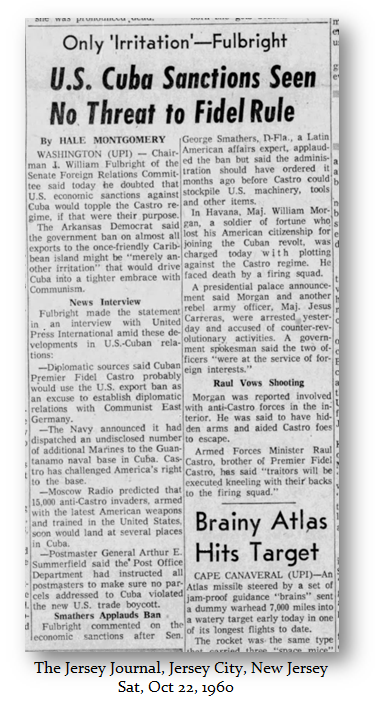
Cuba (1960s-present): U.S. sanctions have failed to topple the Castro regime or force democratic reforms. Despite economic hardship, the government adapted through alternative trade partners and domestic resilience, suggesting sanctions can entrench regimes and slter the world economy, which has taken place with the development of BRICS. The U.S. embargo (blockade) against Cuba remains in place, requiring Congressional action to lift it entirely. While some sanctions have been eased temporarily, no administration has completely ended them. After more than 60 years, this stands as a prime example of how sanctions have NEVER worked even once.
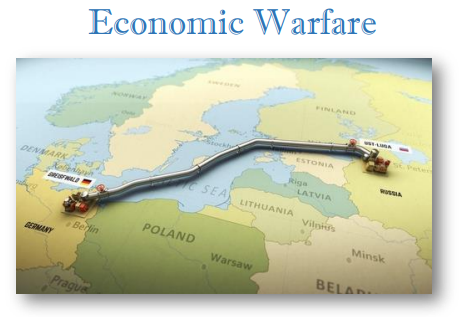
The United States has imposed sanctions on German and other European companies involved in the construction of the Nord Stream 2 gas pipeline, which was designed to transport Russian natural gas to Europe. In 2019–2021, the U.S. sanctioned firms like Swiss-based Allseas (forcing it to withdraw) and later targeted Russian and German entities.
The U.S. imposed sanctions on the Soviet-European gas pipeline in 1982 (under Reagan), targeting Western companies supplying equipment for the Urengoy–Pomary–Uzhhorod pipeline, which supplied gas to Western Europe. The U.S. opposed this project due to concerns over European energy dependence on the USSR. They, too, failed and had to be relaxed under Allied pressure.
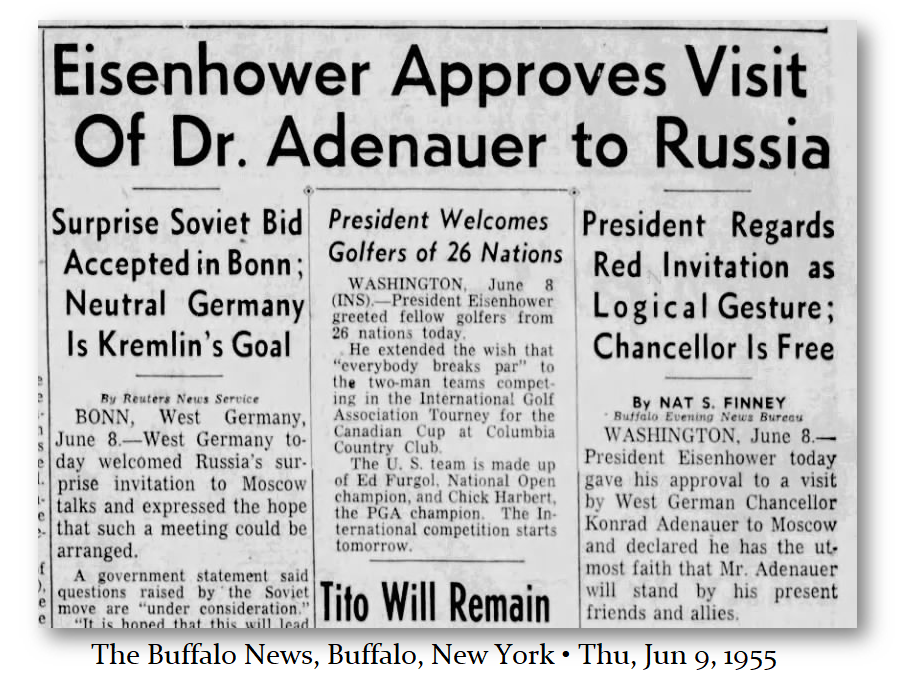
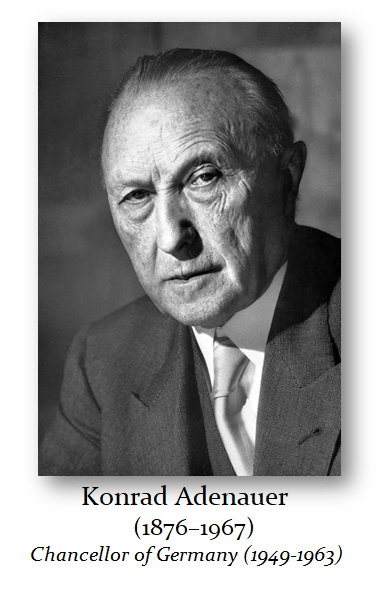
The Neocons, from the outset of any negotiations between Germany and Russia back in the communist days, did everything in their power to deny Germany access to Russian energy. It was 1955 when West German Chancellor Konrad Adenauer (1876-1967) visited Moscow in June and then established diplomatic relations for the first time between the new Federal Republic of Germany and the Soviet Union. The Neocons were outraged, but President Eisenhower saw it as no threat given Adenauer’s oppression by Hitler. The Necons wanted to prevent any meeting but Eisenhower declined.
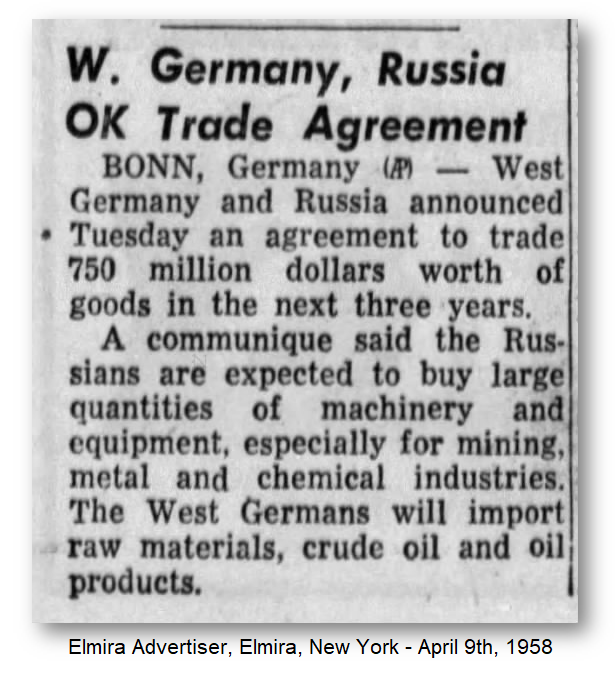
Adenauer was Chancellor from 1949 to 1963. Adenauer was one of the first opponents of the leader of the Nazi Party. Konrad Adenauer helped draft a constitution completed in May 1949. He opened the door for the trade agreement that followed in 1958, and by 1960, bilateral trade between the countries was booming.
The Trade Agreement was reported worldwide by the Associated Press on April 9th, 1958 (1958.271). Even so, from the very beginning, that trade link between Germany and Russia was controversial, to say the least. The United States, at the direction of the Neocons, was always against it and would criticize Germany behind every closed-door session. However, the US intimidation failed because it was necessary for the German people and their future.
While the U.S. did not impose formal sanctions on German pipe producers in 1955–1958, it actively discouraged such trade, setting the stage for the 1960s pipe embargoes. The major crackdown came later, but diplomatic and economic pressure began in the late 1950s.
Iraq (1990s): UN sanctions after the Gulf War devastated the economy, reducing GDP by nearly 50%, but Saddam Hussein’s regime remained intact. Political change only occurred after the 2003 invasion, not sanctions alone, and civilian suffering often strengthened regime propaganda.
North Korea (2000s-present): Decades of sanctions have crippled the economy but haven’t shifted the Kim regime’s policies or structure. Black market trade and Chinese support have mitigated impacts, and the regime uses isolation to reinforce control.
South Africa (1980s-1990s): Comprehensive sanctions, including trade bans and financial restrictions, the Neocons insist, contributed to ending apartheid. However, there was already internal resistance. It still took 14 years before any democratic reforms took place by 1994. Studies estimate that the sanctions reduced South Africa’s GDP only by 1-2% annually.
Iran (2010s): Heavy U.S. and EU sanctions targeting oil exports and banking, which the Neocons insist forced Iran to negotiate the 2015 nuclear deal (JCPOA). Oil revenues dropped by over 50% from 2011 to 2013, and inflation soared, but the regime did not fall. The regime didn’t fundamentally change its political system, showing again that sanctions have NEVER even once overthrown the core governance.
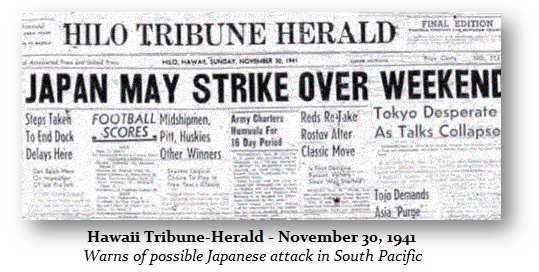
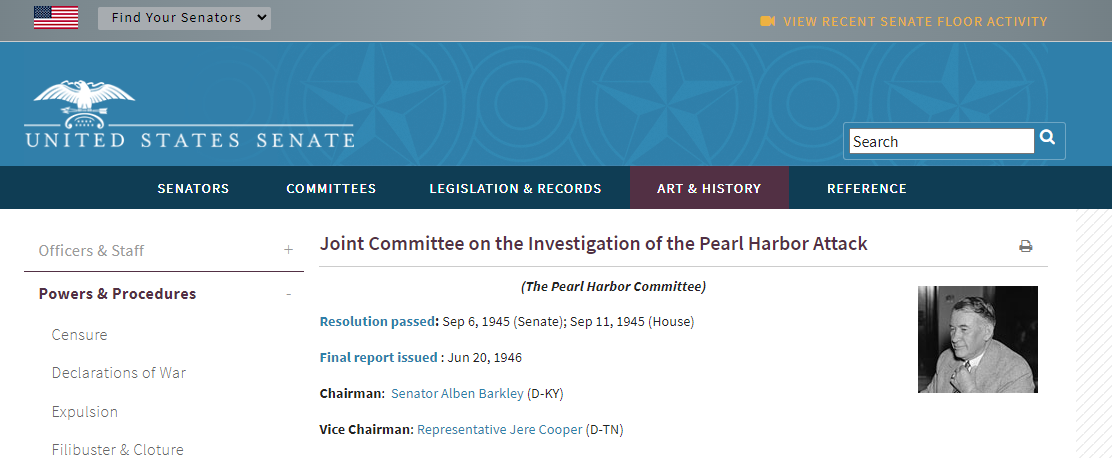
FDR deliberately imposed sanctions on Japan to get them to attack the United States, all because Congress would not authorize joining World War II in Europe. That led to a Senate investigation later because it became so obvious that FDR even knew when Pearl Harbor would take place and deliberately allowed thousands to be killed just so he could enter the war. It came out that US had broken the Japanese code and knew all about the attack. There was even a lead to the press a few days before reporting that they were about to be attacked.
Before the attack on Pearl Harbor on December 7, 1941, President Franklin D. Roosevelt (FDR) imposed a series of escalating economic sanctions on Japan in response to its aggressive expansion in Asia, particularly its invasion of China. These sanctions were meant to pressure Japan into halting its militaristic actions, but ultimately contributed to the tensions that led to war.
In 1938, FDR imposed a “moral embargo” on aircraft and aviation parts sales to Japan following its bombing of Chinese civilians. This was not a formal ban but a strong discouragement of exports. Then in July 1939, FDR announced the termination of the 1911 U.S.-Japan Treaty of Commerce and Navigation, removing legal barriers to future trade restrictions. This took effect in January 1940.
Now that the door was open for sanctions, in July 1940, the U.S. restricted exports of aviation fuel, lubricants, and high-grade scrap metal to Japan under the Export Control Act. That was followed by the September 1940 complete embargo on scrap iron and steel.
Then, FDR, like the West has done to Russia, froze all Japanese assets in the U.S. (July 26, 1941), effectively cutting off trade and financial transactions. That was followed by a complete oil embargo along with Britain and the Dutch government-in-exile. Since Japan relied on the U.S. for 80% of its oil, this was a crippling blow. FDR knew that Japan would take it as an act of war, as they then saw these sanctions as an existential threat, as they crippled its ability to fuel its military and industry.
The oil embargo, in particular, forced Japan to either negotiate a withdrawal from China (which it refused) or seize oil-rich territories in Southeast Asia (which risked war with the U.S.). The sanctions contributed to Japan’s decision to attack Pearl Harbor (December 7, 1941) to neutralize the U.S. Pacific Fleet before invading British and Dutch colonies. These sanctions deliberately pushed Japan toward a desperate military confrontation, culminating in the attack on Pearl Harbor and the U.S. entry into World War II, which was the objective of FDR from the outset. The outrage was so intense that in 1945, after the war, the Senate was forced to investigate FDR’s action and whitewashed the affair, claiming they were unsure if FDR had been fully advised of the Pearl Harbor attack in advance, even though leaks made the papers in advance.
There is NOT a single incident to demonstrate that sanctions have EVER worked. Nevertheless, the Neocons constantly advise heads of state to impose sanctions, hoping that they will bring about the collapse of that government. They will not work this time either and the real risk is that they will lead to war as we saw in FDR’s actions against Japan.
I have created this site to help people have fun in the kitchen. I write about enjoying life both in and out of my kitchen. Life is short! Make the most of it and enjoy!
This is a library of News Events not reported by the Main Stream Media documenting & connecting the dots on How the Obama Marxist Liberal agenda is destroying America



 Centinel2012