President Trump held a wide-ranging impromptu press conference departing the White House for the G7 summit in Canada. WATCH:


President Trump held a wide-ranging impromptu press conference departing the White House for the G7 summit in Canada. WATCH:

QUESTION:
Hi Marty,
I hope you’re keeping well? More news from the “EU beacon of light” for you. I’ve enclosed an article regarding Irish pension money in Italian bonds. This is very very scary if true and we really are heading for a disaster from which a little country like ours won’t recover if we ever did anyway! In the article Mercer says that “after the financial crisis the ECB put in place a system to limit a contagion”.
Is this just more whistling in the dark? I believe it is.
Kind regards,
E
ANSWER: The very design of the euro promotes contagions. Because there was no national debt, the “reserve” status for banks is the debt of all member states. In the United States, ONLY the national debt federally is acceptable. Therefore, if California or Illinois goes bust they do not create a contagion that brings down the whole. Even the government has come out and warned there may be a contagion will emerge if Italy fails and/or breaks with the EU.
The euro crashed BECAUSE there is no such prevention of a contagion. That is totally FALSE and a made up excuse. Fears of the new Italian government of the five-star movement and the right-wing populist Lega came into the markets and sent the euro crashing. A risk of contagion sparked by Italy infecting the entire Eurozone was “not yet completely off the table,” said ECB Vice President Vitor Constancio. This applies in particular if the sharp rise in Italian government bond yields. At the same time, Constancio came out and said that US Treasuries have the greatest risk because the Fed keeps raising interest rates. There is no such mechanism to prevent contagions – PERIOD! It is all smoke & mirrors.

QUESTION: Mr. Armstrong; There are these people so desperate to argue that cryptocurrency will change the world, I have heard the same pitch behind gold and I suspect most are just goldbugs who gave up and moved to cryptocurrencies. The same arguments of fiat and central banks are at the base of this as well. Do you think that cryptocurrency can somehow emerge as a solution after the Crash and Burn? How can there be thousands of these cryptos? If the dream they pitch is even plausible, then does there not have to be just one cryptocurrency?
Thank you
Hank
ANSWER: We have to ask what is at the core of this trend. In essence, it is the very same trend that put Trump in office. The entire 2007-2009 global financial crisis and bank bailout created an entirely new “skepticism” of government in most countries. This is where the digital assets have come into play. Are they capable of altering or influencing traditional global monetary policy? The answer: absolutely no possible way. To accomplish that we MUST end socialism. I doubt these people really understand the full scope of structural changes that would need to be made to move to any cryptocurrency. Adam Smith’s Invisible Hand rules the question. Until it is in the self-interest of those in power to hand back the scepter of power itself, there is just no way to accomplish such a monumental change without the house burning down FIRST. The other possibility is that governments just usurp the crypto world like they confiscated gold and then control it for taxes. They do want to eliminate all paper currency to collect 100% taxes they believe are avoided. They also pitch it would end crime as we know it. The black market would then no doubt emerge as barter once again. To think that cryptocurrency can defeat central banks and governments is really far-fetched.
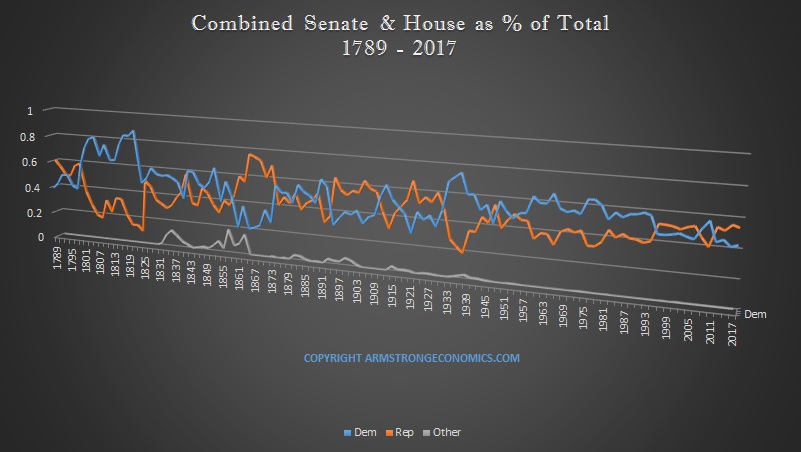
The political changes are monumental. Politicians can no longer run for office promising benefits by robbing the rich and handing it to the poor. In order for crypto assets to replace money, it would require a profound change in politics. It is not simply central bank money. The entire pitch of cryptocurrency is that it will take the creation of money away from central banks and thus government. Think that through. Career politicians would be completely at a loss. They have no qualifications with respect to management of an economy. The Democrats have been selling the same promise since FDR’s first election. Just look at the chart above and you will see that the Democrats have been in a bear market ever since FDR. They pretend that someone cannot get rich without oppressing the poor. Wealth to them is very Marxist and a zero-sum game. They are stuck in the idea that someone makes a product and the capitalist profits on their labor. They fail to comprehend that someone can invent something like Google, Amazon, Microsoft, or our Socrates Platform that by no means oppressed some poor individual to create it. They are frozen in time and cannot comprehend the Invisible Hand of Adam Smith. This is why I say that socialism is dead and indeed the entire cryptocurrency movement is part of that collapse in the public’s confidence in government.
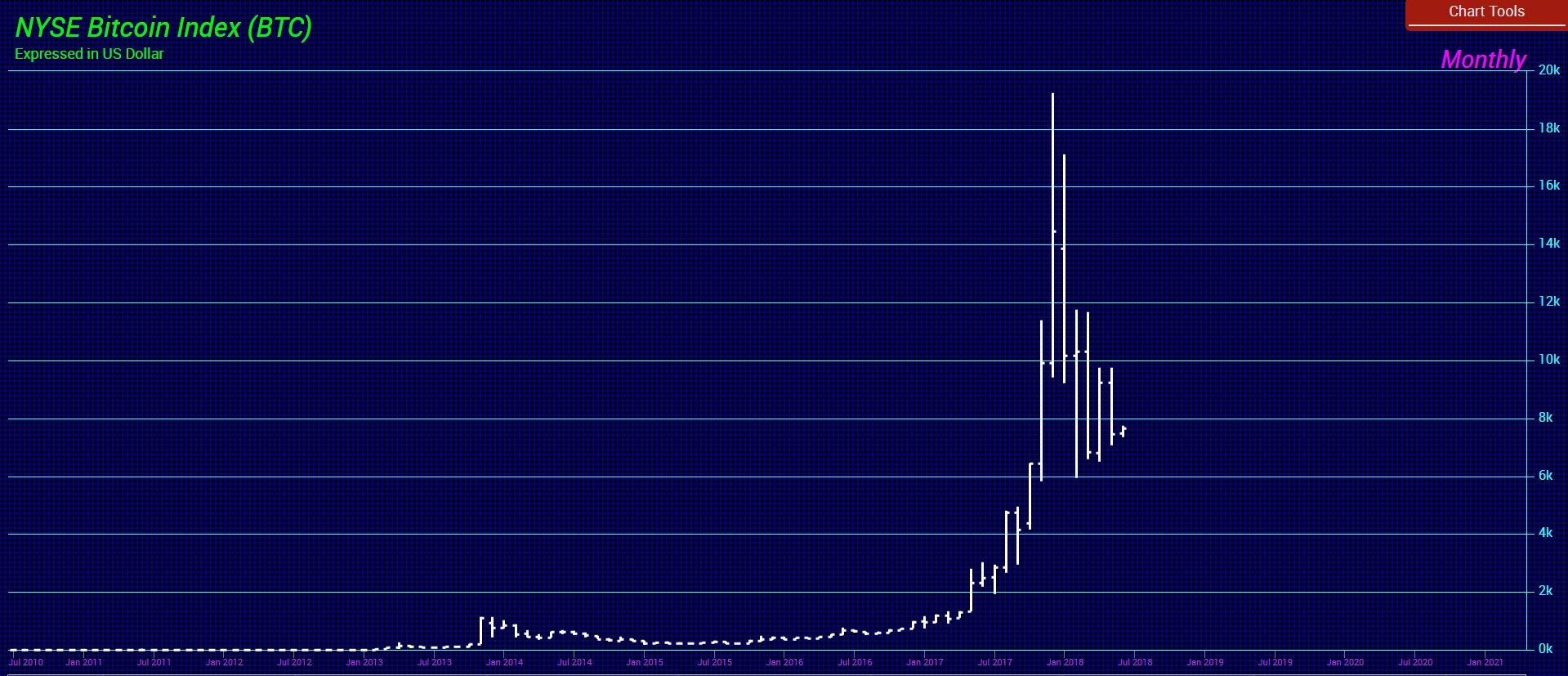
Additionally, cryptocurrencies are promising to end fiat currencies, and in reality, it is a return to a sort of commodity-based money not so dissimilar from a gold standard. The problem with all of this is the idea that if we somehow returned to a gold standard, then money would be worth “something” as if it would never change in value. That just cannot exist and NEVER has. Whatever you define as money, it will rise and fall against assets. That is fundamental to the economy. It is why communism failed. Here is a chart of Bitcoin. It has risen and crashed. It did not hold on to value permanently at some fixed level. This is why I say it is an “asset class” fluctuating against the currency – the dollar.
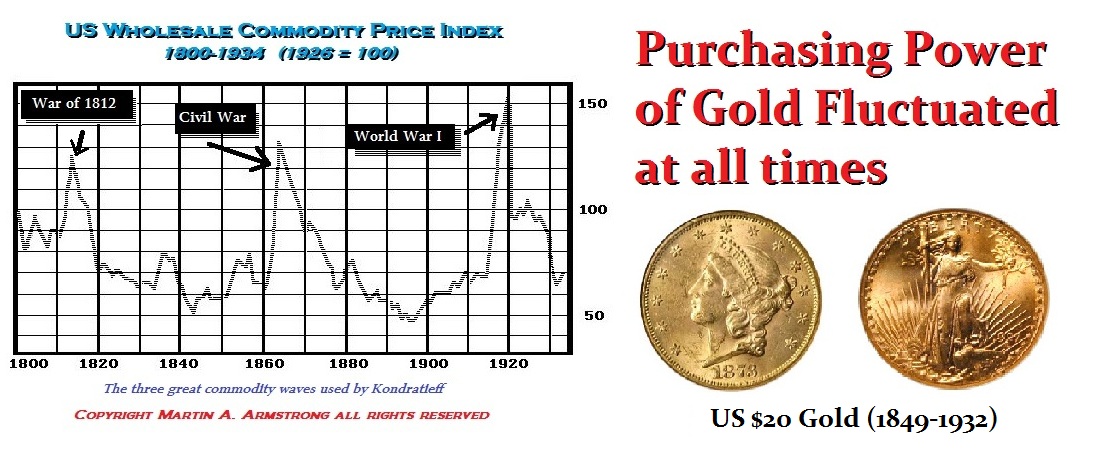

Here is a chart of the rise and fall of the inflation index when gold was money. These very swings in the economy are what Kondratieff studied and created his long wave. Gold did NOT prevent the boom and bust cycle. That is part of nature that CANNOT be eliminated. When gold was money and the stock market rose in value, that meant money declined in purchasing power which was gold. It acted economically NO DIFFERENT it money were paper, seashells, or cattle.
So, will cryptocurrencies replace paper currency? The actual amount of transactions today in physical money is less than 5%. So we are already using electronic money every day, such as when you buy something online. So will that emerge eventually as a cryptocurrency? Perhaps. There is nothing to prevent that once we get the crash and burn, and the “burn” is the replacement of the political system.
Will there be only ONE cryptocurrency for the entire world? Unlikely. I would probably bet on each government adopting a cryptocurrency per nation and prohibit the use of “foreign” cryptocurrency domestically. We also must respect that government WANTS to create some sort of cryptocurrency to ensure that everyone pays taxes. Australia already uses the phrase – “Cash is for Criminals.”
 What I disagree with is the notion that somehow cryptocurrency will force political change and government will simply yield and hand back the scepter of power when politely asked. That has NEVER taken place, not even one time throughout history. Governments do NOT voluntarily surrender power. They will use whatever power they have to the bitter end. So, sorry. History is on my side on this one. Dream all you want. Human nature never changes throughout the centuries. Those in power will act in their own self-interest and defend against the loss of that power.
We are headed into a major economic crisis. Cryptocurrency will not save the day. We have to crash and burn. That is the ONLY way such economic imbalances have been resolved throughout history. That is NOT my personal OPINION. It is simply reality
Earlier today, following discussions with Japanese Prime Minister Shinzo Abe and U.S. President Donald Trump Secretary of State Mike Pompeo held a press conference to discuss “C-VID”, the Complete, Verifiable and Irreversible Denuclearization of the Korean Peninsula. WATCH:
.

[Transcript] SANDERS: Good afternoon. Thanks for being patient with us. Obviously, there’s a great deal of interest on the upcoming summit with the North Koreans. We have Secretary Pompeo here, who will make some brief opening remarks and then take questions on that topic. As you know, the President has already done a press conference today, so we’ll keep questions limited to that. And we’ll be around the rest of the day to answer other news of the day.
Thanks. With that, Mr. Secretary.
SECRETARY POMPEO: Thanks, Sarah.
QUESTION: Sarah, are you going to take questions after (inaudible)?
SECRETARY POMPEO: Yes, I’m going to take a couple questions. (Laughter.) A couple. Good afternoon. It’s great to be joining you all here today. Early in his presidency, President Trump made a commitment to address the threat of North Korea, which has been a threat to our nation for far too long.
President Trump has been, and continues to be, committed to ridding the United States and the world of threats posed by North Korea’s weapons of mass destruction and ballistic missile programs. These programs threaten our homeland, our allies and partners, and the broader non-proliferation regime. North Korea’s past activities also make clear that it is proliferation to other actors that creates a risk, in addition to the primary risks. It has supporting infrastructure that is also of concern.
In early 2017, the Trump administration decided on a policy we have referred to as the “maximum pressure campaign.” The campaign enacted the strongest economic and diplomatic sanctions against North Korea in history. The goal was to set the conditions for the DPRK to make a strategic decision to denuclearize as the best means by which it will achieve its own security.
American leadership rallied the international community to send a strong message to Chairman Kim Jong Un and the world that we would not stand for the DPRK’s illegal weapons programs. The President’s bold decision to meet with Chairman Kim Jong Un grew from this incredibly strong and targeted campaign. The President’s policy directly led to the historic summit that will take place on June 12th in Singapore.
Back on March 8th, Chairman Kim Jong Un expressed his desire to meet with President Trump as soon as possible. And then on May 9th, I met with Chairman Kim Jong Un in Pyongyang and explained America’s expectations for denuclearization.
At that time, we also secured the release of three Americans: Kim Dong-chul, Tony Kim, and Kim Hak-song. We view this as a sign of goodwill from Chairman Kim Jong Un.
The United States and North Korea have been holding direct talks in preparation for a summit, and North Korea has confirmed to us its willingness to denuclearize. A comprehensive whole-of-government effort in support of President Trump’s upcoming summit is under way. White House- and State Department-led advance teams are finalizing logistical preparations and will remain in place in Singapore until the summit begins. The President continues to follow every development closely, and is getting daily briefings from his national security team.
The fact that our two leaders are coming to the table shows that the two sides are very serious. The diplomatic model we’ve used to date is different from past efforts. Our efforts give us hope that we can find real success where past efforts have fallen short.
President Trump is hopeful, but he’s also going into the summit with his eyes wide open. We’ve seen how many inadequate agreements have been struck in the past. And you can be sure that President Trump will not stand for a bad deal. The United States has been clear, time and time again, that complete, verifiable, and irreversible denuclearization of the Korean Peninsula is the only outcome that we will find acceptable.
The President recognizes that North Korea has great potential, and he looks forward to a day when sanctions on the DPRK can begin to be removed. However, that cannot happen until the DPRK completely and verifiably eliminates its weapons of mass destruction programs.
President Trump and Chairman Kim will certainly also discuss security assurances for the DPRK, establishing a peace regime, and improving relations between our two countries. Until we achieve our goals, the measures that the world, alongside the United States, has put on the regime will remain. In the event diplomacy does not move in the right direction, these measures will increase. Throughout the entire process, the United States has been unified with Japan and South Korea in response to the threats from North Korea.
I will be traveling with my — excuse me, I will be traveling to meet with my Japanese and South Korean counterparts after the summit to continue to coordinate with them. I will also stop in Beijing following the Singapore summit. I’ll provide them with an update and underscore the importance of fully implementing all sanctions that are imposed on North Korea.
President Trump recognizes North Korea’s desire for security and is prepared to ensure a DPRK free of its weapons of mass destruction is also a secure North Korea.
President Trump has made it clear that if Kim Jong Un denuclearizes, there is a brighter path for North Korea and its people. We envision a strong, connected, secure, and prosperous North Korea that is integrated into the community of nations. We think that the people of the United States and North Korea can create a future defined by friendship and collaboration, and not by mistrust and fear.
We believe that Chairman Kim Jong Un shares this positive vision for the future, and we are committed to finding a path forward. And we assume and hope that that belief is sincere.
We’re looking forward to being in Singapore in just a few days.
SANDERS: As a reminder, we’ll take just a few questions before the Secretary has to depart.
Roberta.

QUESTION: Thank you. What progress have you made in narrowing the gap in your understanding of denuclearization and North Korea’s definition of denuclearization? Has there been progress in bringing that definition closer together?
SECRETARY POMPEO: Yes.
QUESTION: Can you describe that a little bit?
SECRETARY POMPEO: No.
(Laughter.)
SANDERS: That was quick. Jon Decker.
QUESTION: Thank you, Sarah. Thank you, Secretary Pompeo. As you mentioned in your remarks, North Korea, in the past, has reneged on prior agreements that it’s made with the U.S. government. So I have two questions for you. The first question has to do with your experience meeting with Kim Jong Un. Do you trust him? And my second question has to do with the negotiations that are upcoming with North Korea. Who, in your opinion, has the upper hand in the negotiations, and why?
SECRETARY POMPEO: So with respect to your first question, I’ve had the chance to meet with Chairman Kim Jong Un twice now. I can tell you he is very capable of articulating the things that he is prepared to do, present clearly the challenges that we all have to overcome. It’s why the two leaders are meeting. It’s the opportunity to lay those out clearly between the two leaders so that we can see if we can find a path forward together that achieves the outcomes that both countries want.
And your second question?
QUESTION: Who has the upper hand in the negotiations?
SECRETARY POMPEO: Yeah. We don’t think about it in terms of who has the upper hand. We know this has been a long, intractable challenge. It’s gone on for decades. The President has said repeatedly: Previous administrations weren’t prepared to do what we’ve done already. It’s not about who has the upper hand. It’s about trying to find a way where the two sides can come to an understanding, where we can get concrete steps, not just words, that resolve this challenge.
Pamela.
QUESTION: Mr. Secretary, first of all, the President said that he doesn’t believe he needs to prepare very much ahead of this summit. Do you think that’s a prudent approach?
And also, I want to get your reaction to Rudy Giuliani’s comments that “Kim Jong Un got back on his hands and knees and begged” for the summit to go back on — whether you think he should be weighing in on these international affairs and whether you agree with that assessment.
SECRETARY POMPEO: So back to your second question. I took him as it being a small room and not being serious about the comments. I think it was a bit in jest, and —
QUESTION: Do you think it could jeopardize the summit or —
SECRETARY POMPEO: We’re moving forward. We’re focused on the important things. I know Rudy. Rudy doesn’t speak for the administration when it comes to this negotiation and this set of issues.
With respect to your first question, you know, progress — we’re making progress, inch by inch. And we’re going to travel there. This is different. The approach that President Trump is taking is fundamentally different. In the past, there have been months and months of detailed negotiations, and it got nowhere. This has already driven us to a place we’ve not been able to achieve before.
SANDERS: Dave Boyer.
QUESTION: Thank you, Mr. Secretary. The President said today that if the Singapore meeting goes well, he’d like to bring Kim Jong Un to Washington, possibly, for further meetings. Has Kim Jong Un invited the President to come to North Korea?
SECRETARY POMPEO: So I don’t want to talk to you about the conversations that have been had between the North Korean side and the United States. I’ll leave that for the President to talk to.
But I do want to get to — and this comes back to the other question that you asked about the President’s preparation. So in my previous role — and I’ve said this before; you can look it up — there were few days that I left the Oval Office after having briefed the President that we didn’t talk about North Korea. So over months and months, days and days, President Trump has been receiving briefings on this issue about the military aspects of it; the commercial, economic aspects of it; the history of the relationship. And in the past few months, there have been near-daily briefings, including today, where we have been providing the President all the information that he needs. And I am very confident that the President will be fully prepared when he meets with his North Korean counterpart.
QUESTION: Just having met the man twice now, what can you tell us about what opinions you’ve formed of Kim Jong Un as a person?
SECRETARY POMPEO: Yeah. So I haven’t spent that much time with him. What I have said publicly is he has indicated to me, personally, that he is prepared to denuclearize; that he understands that the current model doesn’t work, that he’s prepared to denuclearize.
And that, too, he understands that we can’t do it the way we’ve done it before — that this has to be big and bold, and we have to agree to making major changes. We can’t step through this over years, but rather need to acknowledge it will take some amount of time, that this doesn’t happen instantaneously. But that the model for succeeding — security assurance; and political normalization; and denuclearization completely, verifiably, and irreversibly — for that to take place, we’ve got to make bold decisions.
And I’m hopeful that Chairman Kim Jong Un is prepared to make that decision for his country. A big shift in his strategic understanding of his security.
SANDERS: Ayesha.
QUESTION: Thank you. So you said that you — that the President is prepared to talk about security guarantees for North Korea. We have seen in this administration that you can — that when new administrations come in, they can undo things that prior administrations have done. How can President Trump guarantee long-term security for North Korea and for Kim, in particular?
SECRETARY POMPEO: Well, look, we’re going to have to do things that convince Chairman Kim that that’s the case. All right? That’s what we’ll have to do.
So let me give you an example. We are hopeful that we will put ourselves in a position where we can do something the previous administration didn’t do. Right? They signed a flimsy piece of paper, and we’re hoping to submit a document that Congress would also have a say in — that would give currency and strength and elongation to the process, so that when administrations do change, as they inevitably do, and this one will — six and half years from now — when that takes place, that Chairman Kim will have comfort that American policy will continue down the same path, on the course that we hope we’re able to set in Singapore.
SANDERS: We’ll take one last question. Zeke.
QUESTION: Thank you, Mr. Secretary. At the top of your remarks — first, to follow up briefly on your comments just about Asia. When you say a “document” that Congress would sign off on, are you referring to a treaty?
Then second, at the top of your remarks, you said that there’s also this threat to the United States and its allies from the North Koreans’ WMDs, as well as ballistic missiles. Is that a condition for the President in any negotiation agreement with Chairman Kim, that its ballistic missile program and chemical weapons also be part of that?
And third, finally, can you discuss the format of the meeting between the President and Chairman Kim? What will it look like? Who will be there?
SECRETARY POMPEO: So I’ll leave it to the White House to talk about the format of the meetings when the time is right.
With respect to proliferation risk, it’s very real. There is a history of that, with respect to North Korea and some of our other difficult challenges in the world today. They are connected. The reason you want complete, verifiable, and irreversible is precisely that. To the extent there remain stockpiles, knowledge bases, warehouses, systems, infrastructure, fissile material production facilities — I could go on — to the extent those remain, the risk of proliferation continues. And it’s our aim, through the CVID process and providing the security assurances that Chairman Kim will want, that we can greatly reduce the risk that proliferation ever happens as a result of North Korean actions.
SANDERS: Thanks so much —
QUESTION: One more please, Sarah.
QUESTION: Mr. Secretary, can you explain the President’s shift — when he’s gone from talking about defining success for this meeting as denuclearization of the Peninsula, to now talking about the need for more meetings? Can you explain what happened there and why this shift? And can you also describe your disagreements over North Korea internally with the national security advisor?
SECRETARY POMPEO: Yeah, with respect to the second one, I’ve read a little bit about this. And I love good fiction as next as — as much as the next person, but it is without foundation, so much so that — I’ll be polite, since I’m a diplomat now. Suffice to say, those articles are unfounded and a complete joke.
QUESTION: Surely, there had to be — must have been some —
SECRETARY POMPEO: Oh, sure. Ambassador Bolton and I will disagree with great, great consistency over time, I’m confident. Right? We’re two individuals. We’re each going to present our views. I’m confident that will happen on issues from how long this press conference ought to go — (laughs) — to issues that really matter to the world.
So it’s absolutely the case that Ambassador Bolton and I won’t always agree, and I think the President demands that we each give him our own views.
QUESTION: (Inaudible.)
SECRETARY POMPEO: Yeah. So you had a first — your first question, I’ll try to answer. I’ll try to answer your first question, too. I don’t see the shift as disjunctive as you do. The President has always understood that this was a process. It’s been very clear that there would — that it would always take a great deal of work to do this.
So I think your — you can interpret it how you will, but I think your characterization of that also doesn’t reflect the President’s understanding. I think his understanding about this process has been pretty consistent since I’ve been working with him now, almost a year and a half ago.
SANDERS: Thanks so much, guys.
[END]
Prior to the G7 meeting in Canada, President Trump and Japanese Prime Minister Shinzo Abe are holding discussions at the White House. Both are anticipated to deliver remarks at a 2:00pm EDT joint news conference.
UPDATE: Video Added
WH Livestream Link – GST Livestream Link – Fox News Livestream Link

As the hurricane season officially starts, President Trump, First Lady Melania Trump and the majority of the Cabinet attend the critically important 2018 FEMA briefing.
.
REMARKS BY PRESIDENT TRUMP AT 2018 HURRICANE BRIEFING – FEMA Headquarters, Washington, D.C., 2:06 P.M. EDT [Transcript Link]
THE PRESIDENT: Well, I want to thank you. Great job, Brock. Really fantastic. Thank you very much. And we really appreciate the job you’ve done. It’s been amazing, and you really have kept quite busy, I would say, unfortunately. We had no choice. We were hit hard. But you’ve done a fantastic job. So I want to thank you very much.
ADMINISTRATOR LONG: Thank you.

THE PRESIDENT: Secretary Nielsen, Administrator Long, I want to thank you for hosting this incredible group of people. I’d like to sort of maybe say and pay some respects to some of the people here today. I have a list.
Of course, we have to start with our great First Lady, Melania. Thank you, Melania. She’s doing great. (Applause.) She went through a little rough patch, but she’s doing great. And we’re very proud of her. She’s done a fantastic job as First Lady. The people love you. The people of our country love you. So thank you, honey.

And Vice President Pence. Mike. Mike, another great job you are doing. Secretary Michael Pompeo. We’re keeping him very busy. We’re keeping you so busy. You’re going to be flying — a lot of flying in the next couple of weeks. But what a job you’ve done, and we appreciate it. The whole country appreciates it, Mike. Thank you very much.
SECRETARY POMPEO: Thank you, sir.
THE PRESIDENT: Thank you. Steve Mnuchin. Steve, wherever you may be. He’s working hard on those taxes and keeping the taxes down. We passed the greatest tax cut in the history of our country, and lots of other things. And thank you very much. Great.
I think we say that we have had the strongest — this is the strongest, from an economic standpoint, that our country has ever been. We’re doing better in terms of business, in terms of unemployment. We’ve broken the record with so many different groups. African American, the lowest unemployment in history. The Hispanic lowest unemployment in history. Women, lowest unemployment in 21 years. Seven trillion dollars in worth we’ve created since the election. Seven trillion with a “T.” Not with even a “B.” And that’s a number that nobody would have thought was possible. So thank you to everybody. That’s been fantastic.
Attorney General Jeff Sessions. Thank you, Jeff. Thank you very much. Secretary Ryan Zinke. Keeping very busy. I know that, Ryan. That’s good. That’s good for you. Right? Keeping busy and opening up those lands so people can use them and enjoy them. Largest landlord in the world, Ryan. Nobody knows that. But you’re the largest — by far, the largest landlord. It’s almost half the United States if you think about it. Right? So great job you’re doing. Sonny Perdue. And those farms are doing well, and I did the farmers a big favor last night. Right?
SECRETARY PERDUE: You did. Absolutely.
THE PRESIDENT: I did a big, big favor for the farmers. We love the farmers, and they were happy.
SECRETARY PERDUE: They love you.
THE PRESIDENT: I know that Senator Grassley and Senator Ernst were very happy with what we did. So thank you for your help. I appreciate it.
Wilbur Ross, Secretary. I appreciate it, Wilbur. We’re renegotiating a lot of trade deals, and they’re really fantastic. And it’s going to — we have the worst trade deals ever made. And we’re going to have now fair trade deals. We have made the worst deals ever made. NAFTA is a disaster. World Trade Organization is a disaster. I could go deal after deal, and it’s been very unfair to our country, to our workers, to our companies, and to everybody else involved. And we’re changing them around rapidly. So, Wilbur Ross, thank you very much.
Secretary Alex Azar. Alex, I’m very proud of what you’ve done. And you’re coming up in about another month with healthcare. Maybe even sooner than that. We’re going to have a great healthcare bill planned. And it’s going to be great healthcare for a much smaller price than anybody ever thought possible. And I really appreciate that. And our new project that we’re really working on very hard is reducing the cost of prescription medicine. And that’s going to be something that people will not forget. Some people think that’s almost more important than the healthcare. I’ve had people say, “Which is more important?” They’re both important. But we’re reducing the cost of medicine because of what you’re doing, and we appreciate it.
Secretary Ben Carson, who’s got some things going on at HUD that we’re very excited. We had lunch the other day, and what you’re doing is great, Ben. That’s really inspirational. More than just brick and mortar. It’s really inspirational, Ben. And we appreciate it very much. Thank you very much.
Elaine Chao, Secretary. All you do is produce. You do it in a very quiet way and so effective and so incredible. What a job you’re doing with transportation. It was a great decision. Thank you very much.

Rick Perry. Rick is — I thought you were going to the VA. But we have great people at the VA, so — (laughter) — so now we don’t have to worry about the VA. I think we have great — I always thought Rick — I’d put him right over in the VA, and you would have done great there, too. But you’re doing a fantastic job at Energy. And we’re now the largest in the world in energy, Rick. The largest in the world. And we’re now exporting energy for the first time. Never did it. Now we’re exporting energy. But we have become the largest energy producer in the world. Who would have thought? But we’ve opened it up a little bit, Rick, right? And we’ve let our people go and do their thing. And they’re doing a great job.
Acting Secretary of the VA, Peter O’Rourke. And, Peter, the combination of you and Wilkie, I think that’s going to be an unbeatable combination. So thank you for all your help. I’m hearing only good things.
Secretary Nielsen. I don’t know, what do I say about you? (Laughter.) Huh? You are doing great. And the border is coming along. And the wall is going up. We have $1.6 billion being spent on phase one of the wall and we’ll get additional funding. And every week that goes by, people realize it more and more that we have to have the wall. And we’re doing great in San Diego and different places.
General John Kelly is here someplace. General? Good, General. Great job, John.
Administrator Scott Pruitt. Thank you, Scott, very much. EPA is doing really, really well. And you know, somebody has to say that about you a little bit. You know that, Scott. (Laughter.) But you have done — I tell you, the EPA is doing so well. So many approvals — and disapprovals. If they don’t qualify, they don’t qualify. But we don’t have to wait 15 years to tell somebody they don’t qualify. And people are really impressed with the job that’s being done at the EPA. Thank you very much, Scott.
Mick Mulvaney. He’s got two hats on now, right, Mick? You’ve got two hats, not just one. And you’re doing great at both. But Office of Management and Budget has been good, and our budget this year will be — there will be a lot of cutting, because we want to cut. You know, Mick is really more of a cutter than the other. But we had to get the military through. We got $700 billion approved for military. We needed that.
And in order to get that done, we had to do some things for the Democrats that we would normally not do — because we consider a lot of it waste and a horror show. But in order to get our military and $6 billion for opioid. So we got the — which Melania is so heavily involved in — and we got that taken care of. And very importantly, next year, $716 billion for military. So, Mick, great job. And this time, you can start cutting, okay? Because we have our military taken care of now, so you can start really cutting.
A friend of mine for a long time, Administrator Linda McMahon. And, Linda, I was just being told the other day what you’ve done in small business has been incredible. One of the real stars. And Vince and myself and your family, we’re all proud of you. But what you’ve done is fantastic. So much work. People don’t realize your small business is really — it’s really a very massive business. And you add it all up and those numbers are not small business. They’re bigger than just about any company you can even think of. So congratulations, Linda. Thank you very much.
Governor Rick Scott. We have a lot of people around and watching. You know, we’re on screens all over the country and I think beyond. But we have Governor Rick Scott of Florida is there, and he’s watching and he’s done a fantastic job. He’s now running for the United States Senate. And I won’t get political, but I think you’re going to do very well, okay? That’s not political, is it?

Secretary Patrick Shanahan, Deputy, who is — thanks, Patrick — really doing a job. And you’re bringing in all that money under budget. I know that. You know, you’re going to buy two airplanes instead of one for the same price, right? That’s what we want. He did a fantastic job at the company that he worked for on that. And we appreciate that very much. And it’s so important that when you go out and buy the equipment that we’re talking about buying — you know, hundreds and hundreds of jet fighters and bombers and planes and boats and ships and everything — we got to get the great price. All right? We got to get the great price. And if we can help you, let us know. Because there’s very few things so important.
Administrator Mark Green, U.S. Agency for International Development. And thank you very much, Mark. We appreciate it very much. Thank you.
Assistant Secretary Neil Jacobs and Administrator Brock Long. Vice Chairman Paul Selva. General Terrence J. O’Shaughnessy. And, as you know, Charles Ray. Good old — I knew Ray Charles. I didn’t know Charles Ray, but — (laughter) — now I know Charles Ray. So, you know, that’s pretty good, too. I dont know, maybe Ray Charles is even better, right? I don’t know. But we appreciate the great job you’ve done. Thank you very much.
I want to start just by saying that we’ve had three devastating major hurricanes that hit our country within a month’s time. There’s never been really anything like it. And in the case of Texas, it wouldn’t even go away. It would come in. We thought it was gone. It would go back out. It would reload. And this happened three different times, Brock. That was a record raindrop. That was a record water drop on a state, and it wasnt even close.
And shortly thereafter, we dealt with the threat of another hurricane and then destructive wildfires along the West Coast, in California and other places. America has never experienced so many large-scale disasters in so short a period of time. And we have the most qualified staff between the Secretary and Brock, and all of your people. You’ve been fantastic. And it goes a little bit unrecognized, because all you do is see people fighting and working, and getting the fires out and the water off the land, and all of the things.
But believe me, the country has watched, and they’ve seen an incredible job what you’ve done.
Our entire government leapt into action to coordinate the response, along with the state and local leaders. And we did have a lot of help from some really great governors — Florida, Texas. A lot of great people helped us, and it was great.
Families in Texas and Louisiana, the U.S. Virgin Islands, Puerto Rico, Florida, South Carolina, Georgia, Alabama, Mississippi — they were all affected. Hard to believe. And on tribal lands, where the hit was catastrophic, and the storms were really historic in their severity.
But in the wake of such tragedy, we also witnessed the resilience of the American people and the professionalism, talent, and devotion of the men and women of FEMA. Good group, right?
ADMINISTRATOR LONG: Great group.
THE PRESIDENT: That’s a great group of people, and throughout our government. Last year, more than 17,000 FEMA and other federal employees, as well as 14,000 personnel from the Department of Defense National Guard, were deployed to support the massive response and recovery efforts left by these storms and these tragedies.
Administrator Long, I want to thank you in particular for the incredible job and the unbelievable teams of men and women that you led to take care of these problems. You have done a job. They’re talking about you all over. Don’t leave us, though, okay? Just relax. (Laughter.)
SECRETARY NIELSEN: Oh, he’s here.
THE PRESIDENT: In fact, we could have put him in a different position. We didn’t want to. We want him right there. It’s not an easy position. But you have really stepped forward, and we appreciate it.
I also want to recognize the Coast Guard, our other military services. I have to tell you, the Coast Guard saved 16,000 people. What do you think of that, Ben? Sixteen-thousand people. (Applause.) And I think — you know, honestly, they don’t get enough credit in many ways.
Mike made the commencement address this year at the Coast Guard Academy. I did it the year before. I don’t think the Coast Guard gets enough credit. And I’ve said it, and I even say it to the Army, Navy, Air Force, Marines. I said, I think this year the Coast Guard, maybe in terms of increased branding — the brand of the Coast Guard has been something incredible what’s happened. Saved 16,000 people, many of them in Texas, for whatever reason that is. People went out in their boats to watch the hurricane. That didn’t work out too well. That didn’t work out too well.
So I just want to thank all of the people in the Coast Guard and all of our services for having been incredible. The National Weather Service; the American Red Cross — been amazing;, state and local governments; our brave first responders; law enforcement — always law enforcement; and so many others who came together to save lives, restore hope, and rebuild our communities.
As we enter the hurricane season again — here we go. Right? You’re ready?
ADMINISTRATOR LONG: Yes, sir.
THE PRESIDENT: But we’re entering it. This is it. We are marshaling every available resource to ensure maximum preparation for rapid response. That’s what we had last year. Disaster response and recovery is best achieved when it’s federally supported, state-managed, and locally executed. You agree with that, I think, Brock — right?
ADMINISTRATOR LONG: Yes, sir.
THE PRESIDENT: This is really the great model that we’ve built, and there’s no better model anywhere in the world. And we do help other countries, also, when there’s catastrophic events, like in Mexico and other places. We’re always there. We’re always there for them.
So I look forward to your briefing and I look forward to a very productive discussion. It’s an honor to be with all of the great people that work so hard in the Trump administration.
And, Mike, I’m going to ask you to say a few words. And thank for having done a great job.

.
.

There is much hope buzzing around in Europe that Draghi is planning on ending Quantitative Easing. This is giving the Euro a bit of a lift in hopes that higher interest rates will stem to drastic capital outflows from Europe that resemble rats fleeing a sinking ship. Back on May 14th, Mario Draghi said the European Central Bank would avoid surprising investors with sudden changes to its stimulus plans. He further stressed that inflation was still too low and U.S. trade policies meant that a stronger Euro was a concern. Meanwhile, back in April, the ECB hinted that they would wait until the July meeting to talk about ending the QE program.
Meanwhile, the new Italian government has outlined the first guidelines of its economic policy. The new Prime Minister Giuseppe Conte said Wednesday that he wanted to organize the cooperative banking sector differently than the previous governments. His plan will most likely meet with considerable resistance from the financial sector and most likely Brussels. He seems to be toying with the idea that he wants to separate the banks as Glass-Steagall did during the aftermath of the Great Depression. He wants the future investment banks to be separated from retail banks.
The banking crisis in Europe has been perpetuated by the fact that there is the prejudice to actually merge economies despite a central government structure in Brussels. In the USA, the bad loans were taken from the banks whereas in Europe that has not taken place. The Italian banks are still sitting on a huge mountain of bad loans. If the ECB had actually created a program like the USA to take the bad loans from than banks, then this would have resulted in a disparity among member states. The southern states would have received a bailout at the expense of the northern members. This is the same structural problem of the Euro which infects almost every crucial policy to actually make the Eurozone function as a collective economy.
I have created this site to help people have fun in the kitchen. I write about enjoying life both in and out of my kitchen. Life is short! Make the most of it and enjoy!
De Oppresso Liber
A group of Americans united by our commitment to Freedom, Constitutional Governance, and Civic Duty.
Share the truth at whatever cost.
De Oppresso Liber
Uncensored updates on world events, economics, the environment and medicine
De Oppresso Liber
This is a library of News Events not reported by the Main Stream Media documenting & connecting the dots on How the Obama Marxist Liberal agenda is destroying America
Australia's Front Line | Since 2011
See what War is like and how it affects our Warriors
Nwo News, End Time, Deep State, World News, No Fake News
De Oppresso Liber
Politics | Talk | Opinion - Contact Info: stellasplace@wowway.com
Exposition and Encouragement
The Physician Wellness Movement and Illegitimate Authority: The Need for Revolt and Reconstruction
Real Estate Lending


 Centinel2012