The Unsound Theory of Inflation


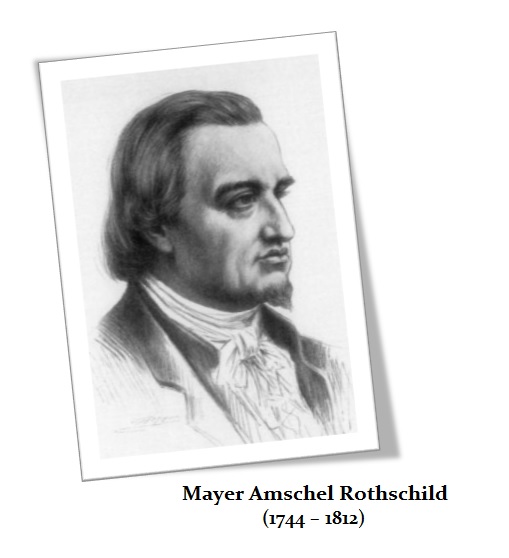
QUESTION: You defend central banks yet the Rothschilds when clearly Mayer Amschel Bauer Rothschild said: “Give me control of a nation’s money and I care not who makes it’s laws.”  Any comment?

SL

ANSWER: No problem. He never said any such thing it was completely made up. It was attributed to him in 1838 when he was already dead for 26 years. Besides that, what is very clear is that this is based on the assumption that money is fiat. The USA began to issue paper money in 1861. During the period that Mayer lived, the money supply was primarily coined.  The only plausible reference would be implied that he debased them. He was a banker and never produced the coinage.

It would be nice just for once that you bothered to actually understand the role of central banks as originally set forth. What they do today with Quantitative Easing has proven that the entire theory of an increase in money supply will be inflationary is outright BOGUS.

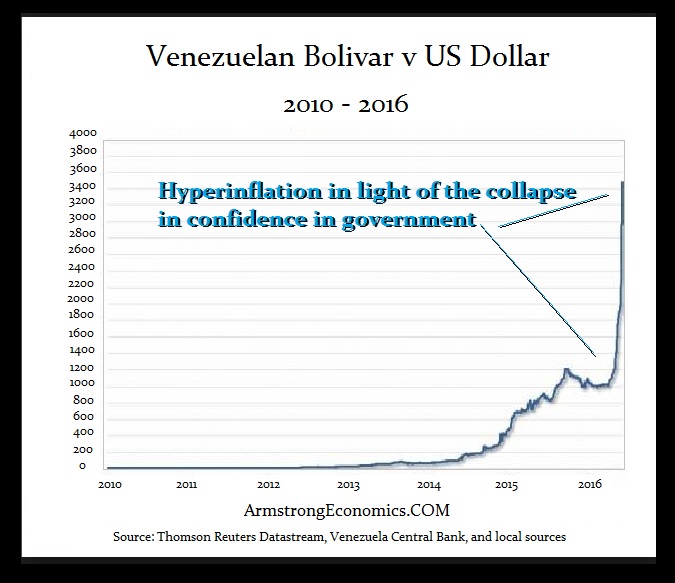
In every case of HYPERINFLATION, not even once did inflation ever begin by increasing the money supply. Inflation begins when PEOPLE lose CONFIDENCE in the government and they spend the currency as fast as they can or outright refuse to accept it. I have explained that the Japanese Emperor used a different approach. He DEVALUED all outstanding money to 10% of his new coinage. That led to the collapse in CONFIDENCE to the point that the people never trusted the government and as a result, the Japanese lost the ability to produce money for 600 years.

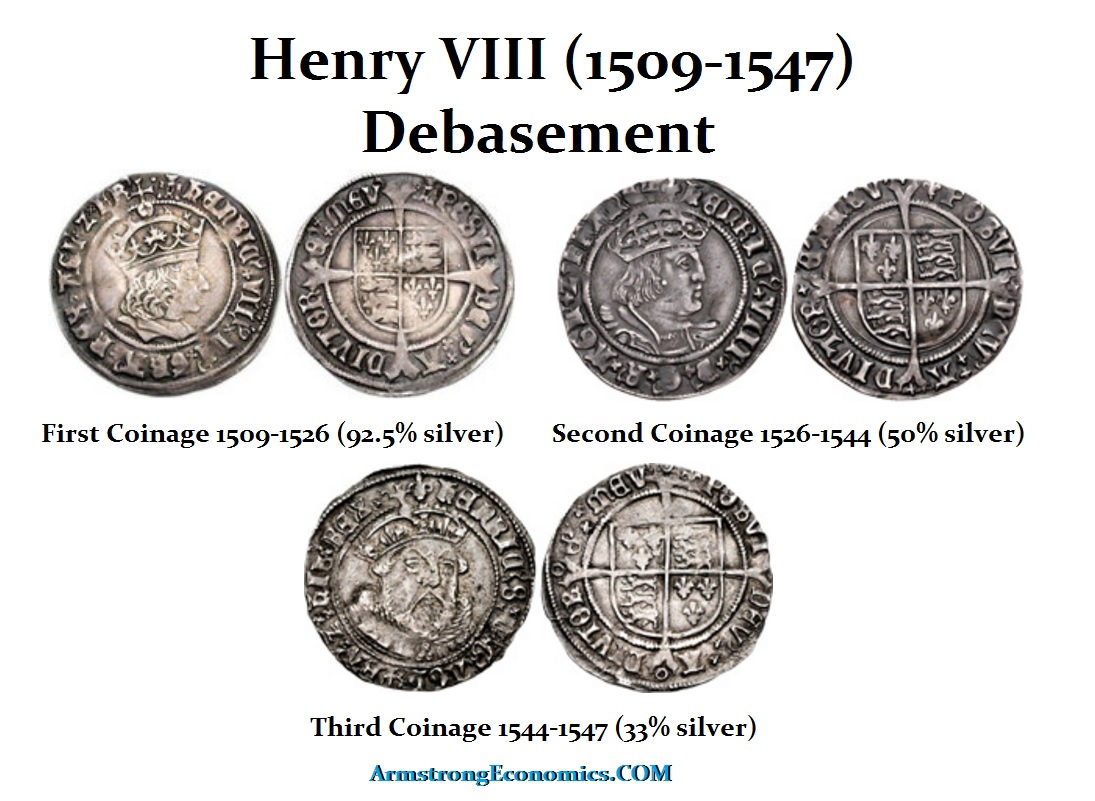
The definition of what creates inflation is entirely wrong. Even Gresham’s Law needs to be placed in context. Gresham worked in the foreign exchange markets in Amsterdam. Henry VIII debased the English coinage. But coinage traded on foreign exchange markets according to its metal content. The inflation Gresham referred to was experienced in the foreign exchange markets so what he truly observed was the decline in the British coinage value on international markets. Don’t forget, this predates the central Bank of England which was established in 1694.

The entire observation of inflation began with Gresham. However, it was extended by David Hume (1711-1776) who made observations BEFORE paper money began. This observation is not respected even today. David Hume showed why net exporting in exchange for gold currency, which then increased the domestic money supply and was hoarded by Britain, could not actually enhance wealth. Hume’s argument was essentially the monetarist quantity theory of money which would influence others over time. Prices in a country would change directly with changes in the money supply. Hume explained that as net exports increased and more gold flowed into a country to pay for them, the prices of goods in that country would rise with the economic boom. The USA saw this through the course of World War I and World War II ending up with 76% of the world’s official gold reserves. Consequently, an increased flow of gold into England would not necessarily increase England’s wealth substantially was Hume’s argument because the increase in domestic prices due to the gold inflow would discourage exports and encourage imports. Hence, this trend then counter-reacts with trade and automatically this will start limiting the amount by which exports would exceed imports. The more money that flowed into a country, like the USA, the higher the prices and this would then reduce exports. Adam Smith’s attack on mercantilism and argument for free trade, strangely ignored Hume’s argument. Hume’s view of capital flows can be verified throughout history and is really the underlying foundation of the balance-of-payments issues that Trump fails to understand. Hume also advanced the idea of “creeping inflation” that takes placed with a gradual increase in the money supply that would lead to economic growth. This is largely correct, but money supply growth must also keep place with population growth or you will produce deflation – more people and less money to go around.

With the introduction of paper money during the mid to late 18th century, the relationship between the over-supply of banknotes and a resulting depreciation in their value was noted by earlier classical economists such as David Ricardo (1772-1823). However, the issue of paper money during the American Colonial period must also take into consideration two factors: (1) England starved America and extracted money assuming they were using Spanish coinage, and (2) the American Revolution which was funded by creating paper money. There was again a lack of CONFIDENCE to the extent that when the American Revolution ended, the Constitution prohibited States from issuing money again and federally no paper money was issued again until the American Civil War in 1861.

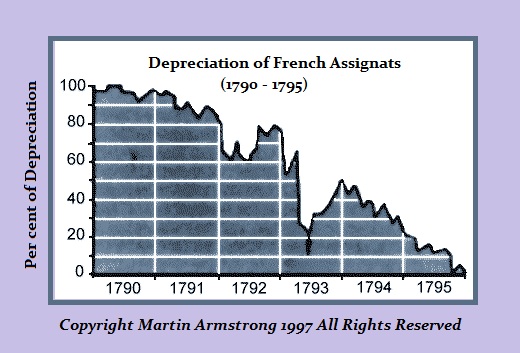
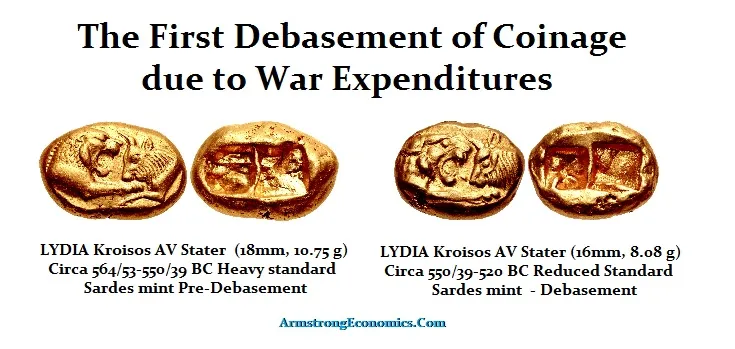
Therefore, most HYPERINFLATION periods are associated with war like the American and French experiences. However, in Lydia, the very first government to issue coins, we see the debasement unfold as a direct result of war. Therefore, there is no evidence of hyperinflation unfolding absent a collapse in the CONFIDENCE of the people in that government.

In the case of Venezuela, obviously there has been a collapse in CONFIDENCE. The same was true in Zimbabwe after it seized all the property of white farmers. Foreign investors refused to ever participate again.

The German HYPERINFLATION came with the Communist Revolution in 1918. That sent capital into hiding and fled overseas, primarily to the United States.

Defining a Cycle Inversion


QUESTION: Can you define cycle inversion and answer the below?

1. What are the specific requirements to confirm a cycle inversion? I have found three elements discussed in the writings, but I am somewhat unclear whether all must be present to confirm a cyclical inversion.

i. The period following the turning point must close higher than the prior period.

ii. The period following the turning point must exceed the high of the prior period.

iii. The period following the turning point must not breach the low of the prior period.

Kindly elaborate.

2. Can a cyclical inversion be confirmed beyond the month immediately following the turning point? Notably, the turning points referenced above have been evenly spaced, each separated by a single month. What if each of the turning points were separated by 5 or 6 months?

Could a high on Month 3 (which is not itself a turning point, but rather mid-way between two turning points) indicate a cycle inversion? Wouldn’t a high on Month 3 (which is not a turning point) suggest an error in the array?

Thanks.

Best,
Dan

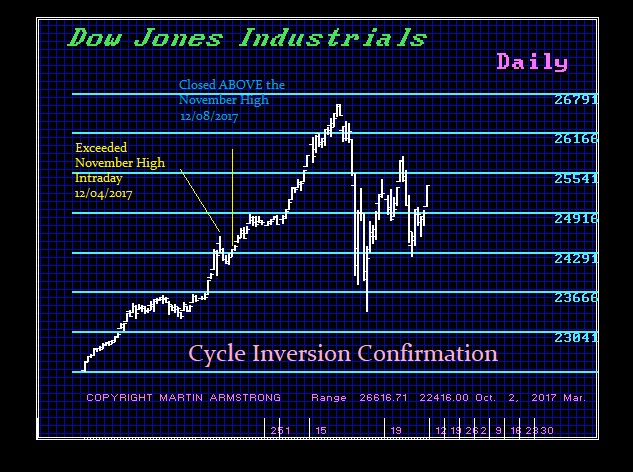
ANSWER: In the immediate instance, simply exceeding the January high would imply the next turning point would invert into a high. Corrections are confined to a maximum of 3 timing intervals, which means April. A failure to make new highs and a penetration of the February low after April would imply a correction moving into probably July. Just exceeding the January high intraday MAY BE good enough to qualify as a cycle inversion, but typically you need to CLOSE ABOVE it or it could be just a double top formation. The same is true in reverse with lows.

You can normally assume a cycle inversion once that event is exceeded or broken on a closing basis. We previously warned that exceeding the November high is December would lead to a January high. That confirmed the Cycle Inversion. The same will be true with respect to the January high.

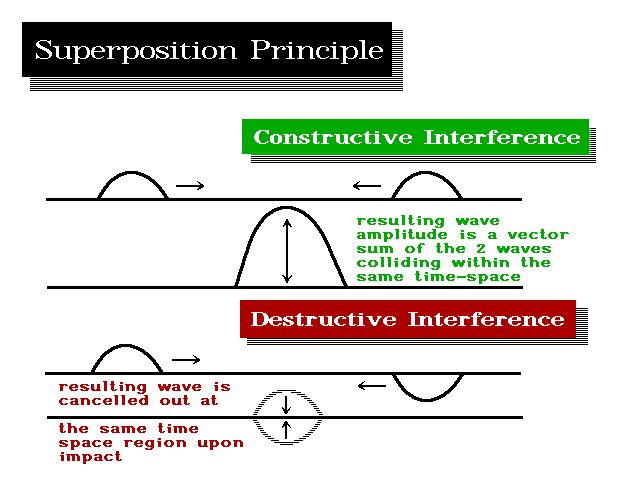
The only time an Array would appear to be wrong where the TOP line fails to produce a definitive turning point tends to be when there is a Directional Change say the month before. A Directional Change can influence and become dominant. However, this is usually when a given market is being influenced by another. A major panic in one important economy can become a SUPERPOSITION influence distorting a local market by a more dominant global trend. This is still rare. The Array typically picks this up in advance. The Array can change shifting the turning point from one month to the next because of such a Superposition Principle.

This will really have to be answered in a more detailed report on cycles.

Visualizing Cycles in Your Mind Helps to Comprehend How to Respond to Events


QUESTION: Is there a way to teach cycles that will enable others to see them more easily?

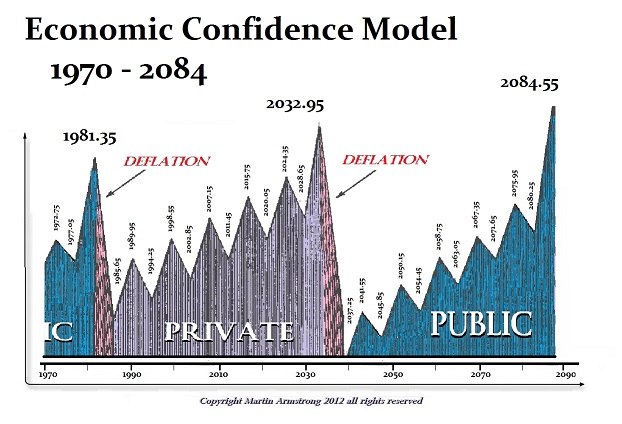
ANSWER: Oh yes. Students who developed visual mental models of cyclical principles flourish, while students who tried to learn cycles by rote invariably struggled. The mental picture is critical. It is a roadmap to the future. Just visualize the Economic Confidence Model and it will help to comprehend the business cycle and where you are at any given moment.

For example, in 2007 when everyone is buying houses, you can keep this in mind and take a pause, encouraging yourself to wait until next year. The same is true for expanding your business. The first time I really used this model in that decision process was 1976. I signed a lease for space and I got them to give me a 10-year lease. I negotiated the elimination of a CPI clause. Everyone was talking about a depression. My accountant thought I was nuts. I told him this model was never wrong and I was going with it. The space I took at $10 a square foot was $45 by 1980.

This model can provide tremendous guidance if you keep it visualized in your mind.

Culture – Law – And Different Ways


Several women have written in and disagree with what I wrote about prostitution. They argue that 75% of prostitutes come from broken homes, which today is over 50% of marriages. They also state that these girls were abused as children in every way possible and many are runaways. Some also argue that these girls turn to prostitution because they are addicted to drugs and became pregnant at very young ages in their teens and have to support a child on their own.
All of that said, I agree that there are girls that fall into each of those categories. However, There are strikingly different cultures and different solutions around the world that warrant looking at both in Asia and Europe. In Thailand, they have a different culture and sex is not looked down upon as it is in the West. The girls are not drugged out or abducted. They are there to make money typically to support their families, which include their parents. Many also do dream of meeting the right guy in the process. In fact. studies show that 15% of the women in the Thailand sex trade marry their customers when they are foreign men (see a study published by Khon Kaen University).
Amsterdam is also strikingly different. The girls are not drugged out and they fall more into the professional category and some may cling to that dream of meeting Mr. right while others have probably given up on the dream of love at first sight and the knight in shining armor will come to carry them away. Both Thailand and Amsterdam show that even prostitutes do find love, which was the story-line of Pretty Woman.
Similarly, in Japan, there are a few private clubs where the girls are virgins and if you wish to select one, and she agrees, you paid $250,000+ and she was yours. You then had to provide her an apartment in Tokyo and support her as a concubine. She would be there for you whenever you were in Tokyo. They did this to be taken care of and a portion of the money always went back to her family. There are different cultures around the world and different morals.
I know in East Europe, men were going there and pretending to want to marry. They entered into the arranged marriage and took the girl and then promptly sold her into sex slavery. That was common when the Wall Fell in 1989, and parents are wise to that scam these days.  There is just a stark difference between what we see in Thailand and Amsterdam compared to where prostitution is illegal. My point is that if there is a legal industry then the girls are protected and this would tend to reduce the abductions.
I have written before when I was in New York standing on the corner in front of the Plaza hotel during the day, this girl came up to me dressed in genes. She asked if there was anything she could do for me. That is using the words spoken by a hooker, but she looked like 13 to me. I was confused and said no, and she asked again. I was not sure and was giving her the benefit of the doubt because she looked so young. I thought perhaps she wanted money for food or something. Then the doorman came over and told her to get out and she turned and cursed him. I then asked was she a hooker? He said yes she bothered the guests routinely. She was probably a runaway working for someone I suppose.
I knew a girl who worked for me once who was raped by her step-father between 7 and 10. She ran away to an aunt in another State. She was strong enough to tell me the story when she was 25. She did not become a prostitute. I respected her strength and she put her life together.
You can pass all the laws you want. It will not stop the abuse. Amsterdam, Japan, and Thailand are a different issue and there are girls who do hope to meet that special someone.
  • Outlaw booze and you created the Mafia.
  • Outlaw prostitution and you create abduction.
There has to be a better way. Girls are abducted and sold into sex slavery only because it is profitable. Remove the profit with legal competition, and you just may end the abductions. Promote safe-houses for runaways and you may save a life.

Roger Scruton: The Utopian Fallacy and The Planning Fallacy


Published on Sep 27, 2017

Sir Roger Vernon Scruton is an English philosopher and writer who specialises in aesthetics and political philosophy, particularly in the furtherance of traditionalist conservative views. In recent years he taught courses in Buckingham University, Oxford University and University of St. Andrews. In this clip he talks about two fallacies of organizing society: The Utopian Fallacy and The Planning Fallacy. Complete video quoted under fair use: https://www.youtube.com/watch?v=Ytp1O… — This channel aims at extracting central points of presentations into short clips. The topics cover the problems of leftist ideology and the consequences for society.

White House Trade Lesson: “Determining Trade Balances”…


It is going to take a heck of a lot of deep-weed education to cut through the economic gaslighting of the multinational corporations, Wall Street and their purchased institutional media.  However, I give the White House team (Secretary Ross, Secretary Mnuchin, Ambassador Lighthizer and Adviser Peter Navarro) a measure of strong credit for beginning:

WHITE HOUSE:  Measurement of trade flows is usually an uncontroversial topic relegated to macroeconomic classrooms and government technocrats. Recent debates about trade policy have brought the topic out of the shadows, and we hope to clarify how economists measure trade.

Every day there are international transactions for tens of thousands of different products. Physical goods, interchangeably called merchandise, are what usually comes to mind first. However, an increasing share of international trade is in services that are not physically transported between countries—think about financial insurance, licensing of trademarks, or services like consulting.

To make the world a bit more complicated, goods and services are increasingly bundled together, such as when a manufacturer sells a piece of machinery along with an international maintenance contract. The machinery is a good, but the maintenance agreement is a service.

From a macroeconomic perspective, economists typically use the balance of payments (BOP) basis. The BOP captures flows of what we would normally think of as imports and exports of goods, but also includes a series of adjustments. This process better aligns trade data with national income accounts such as GDP. The BOP has the added advantage of being applicable to service transactions as well.

The International Monetary Fund defines BOP as “a statistical statement that systematically summarizes, for a specific time period, the economic transactions of an economy with the rest of the world.” BOP transactions are valued using BPM6 methodology that emphasizes using balance sheet analysis to understand international economic developments and to improve comparability with other countries.

In order to construct the BOP, start with the customs value of imports and exports. A frequently used U.S. government data source reports monthly “customs basis” for transactions. There are different methods of customs valuation.

The transaction value method is the price actually paid by the buyer for the imported goods and includes all payments made as a condition of sale. But the transaction may or may not occur at the border—some international shipments change ownership when loaded, others when unloaded, some even at a specified point in transit.

Recognizing this array of contracts, alternative methods that evaluate imports based on identical or similar goods, deductive value, or computed value are used in various situations. Government statistics are specific about where the customs value is reported, with common specifications including “free on board” (f.o.b.), “free alongside ship” (f.a.s.), or “customs, insurance, and freight” (c.i.f) to designate how much of shipping costs are included in the transaction value.

Starting from the customs value, a series of adjustments are made to arrive at BOP. These adjustments are typically fairly small, but they can be significant in aggregate. The current U.S. adjustments are:

In 2017, the aggregate difference between customs goods imports and BOP goods imports was $19.0 billion on a customs basis of $2.34 trillion. For goods exports, the correction was similar—a difference of $4.0 billion on a customs basis of $1.55 trillion.

Subtracting imports from exports gives the trade balance. Trade balances can be calculated for goods, for services, for goods and services, for one country, for a group of countries, or for the whole world.

The most inclusive measure of trade covers both goods and services. Some economists worry about the measurement of trade in services, which may be subject to inconsistencies, and so prefer to focus on trade in goods alone. After all, goods are tangible things that are easier to count.

Others prefer to focus on goods alone because on average all goods-producing industries have higher wages than all service-producing industries; in Q3 of 2017 average total compensation per hour worked in goods-producing industries was about 20 percent higher at $39.97 while the same measure for service-producing industries was $32.21.

Although BOP accounting is similar across nations, each country can interpret BOP methods slightly differently, which leads to differences in reported values of surpluses and deficits. These details are typically spelled out in exhaustive detail in government documents that could be prescribed as a cure for insomnia. For an example, see the Bureau of Economic Analysis document here.

To illustrate some of the concepts presented in this post, consider U.S. bilateral trade balances with Canada. In 2017, the U.S. goods and services balance was a surplus of $2.77 billion. The goods alone balance on a BOP basis was a U.S. deficit of $23.16 billion, but on a customs basis it was a deficit of $17.58 billion. Note that the difference between the BOP goods and services balance and the BOP goods alone balance implies a trade surplus in services of $25.93 billion.

In contrast, Canadian statistics report a goods and services trade surplus with the United States of $26.76 billion, using the Canadian BOP methodology. The goods alone balance is $40.50 billion on a BOP basis.

One important difference in BOP methodology between the Canadian and U.S. approaches is the treatment of re-exported goods. USTR raised a related issue, on the role of re-exports in Census-based bilateral trade balances, in its 2018 Annual Report.  (link)

President Trump Delivers Remarks at the Shamrock Bowl Presentation by Prime Minister Leo Varadkar…


Earlier today President Donald Trump and First Lady Melania Trump welcomed Irish Prime Minister Leo Varadkar to the White House.  Part of the festivities included the presentation of a Shamrock Bowl by the Prime Minister to the American people.

What We Face Requires a Cyclical Perspective


To survive what we face clearly requires an open mind to understand that everything in nature moves through a cyclical pattern. The majority of people see the world only in a linear fashion. Politicians proclaim they can change the world and create perpetual prosperity and/or punish those that cause recessions. Naturally, there are no mirrors in government so the culprit must always exist outside of their shenanigans.

I often get the question WHAT IF everyone followed my work. The answer is simple. That is IMPOSSIBLE. That is like saying why can we all not just vote the same. There will never be a single political party that the people would vote for because there are differences of opinion. The majority of society ignores history because that is the past and somehow irrelevant because we are more sophisticated today and those people ran around in diapers chucking spears at each other. This merely ensures that history repeats because they are far too ignorant to comprehend that life is like a Shakespeare play. It has been performed for hundreds of years and the only thing that changes has been the actors.

Human society as a whole expects a linear life of happily ever after and when that fails, they advocate punishing the person responsible. They cannot dare investigate that just perhaps the world works in a far more complicated manner than just that.

Those who think only linear cannot avoid the crash and burn. Those who see the world cyclically understand there is a time and place for everything.

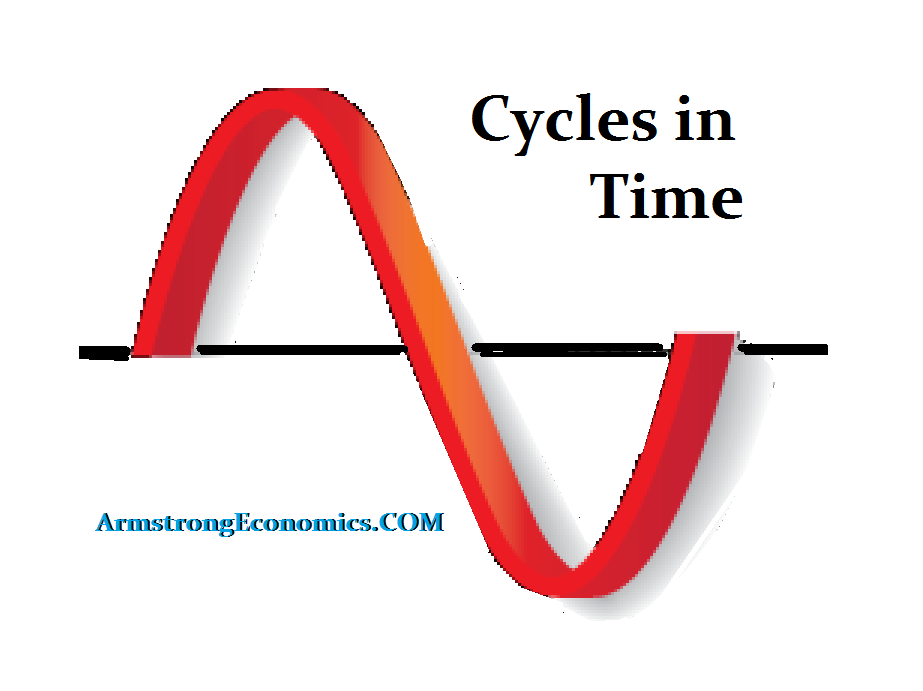
Cycles in Time – Origin of the Theory & Why It Was Ignored in Western Culture


QUESTION: Mr. Armstrong; Just about every culture outside of Christianity believed in the cyclical aspects of time and nature. Do you have any idea why Western Christian culture failed to incorporate cyclical theory?

GN

ANSWER: If you actually read the Bible, you will find the very similar cyclical references and numbers. It just seems that the mainstream interpretation overlooked it post Dark Age. There is so much in there from the maxim that there is a time and place for everything to the Revelations that forecast the Devil will be cast into the abyss for 1,000 years and then it will begin again between the tribes of God and Magog. That describes a cycle. For some reason, the general religious teaching fails to point that aspect out. This seems to be rooted in the prejudice of the Dark Age for that is clearly a line of demarcation in every field of knowledge that was lost after the barbarian invasions.

Throughout the centuries, there has been an understanding of cycles that have come down to the present age through the corridors of time. There has been a knowledge that comes from the dim ages of past eras, that seems to emanate from all the races, as well as the different schools of thought. Just what is the origin of this basic understanding of cycles cannot be traced to some specific teaching by a single culture or person. There is unquestionably an unbroken direct line throughout the ages that extend further back than even the time of Greeks who the Romans viewed a knowledgeable. There are references to cycles that we find in many extracts that even go back to the ancient Egypt and Chaldea. These appear to have influenced the Pythagoras (about 500 bc) and Ancient Grecian arcane schools of philosophy. Where did they come from? The answer seems to stretch back to still more remote and arcane investigations of the universe and the heavens.

There are traces of cyclical theory in the arcane teachings in the records of Persia and Medea. The inspiration for the original philosophical teaching of Gautama, who was the founder of Buddhism, not religion, seems to originate from even older arcane sources. Traces are also to be found in the Hebrew teachings of the “Kabbalah” and the “Zohar.” The Greeks clearly relied upon the arcane teaching undoubtedly obtained directly from Egyptian sources through Pythagoras. The relation connection between the early Grecian teaching and philosophies with the even older school of ancient Egypt predating the Greeks by thousands of years. Pythagoras is known to have received instruction from Egyptian and Persian hierophants, who were priests in ancient that interpreted sacred mysteries or esoteric principles. Many believed that the origin was even yet an older understanding.

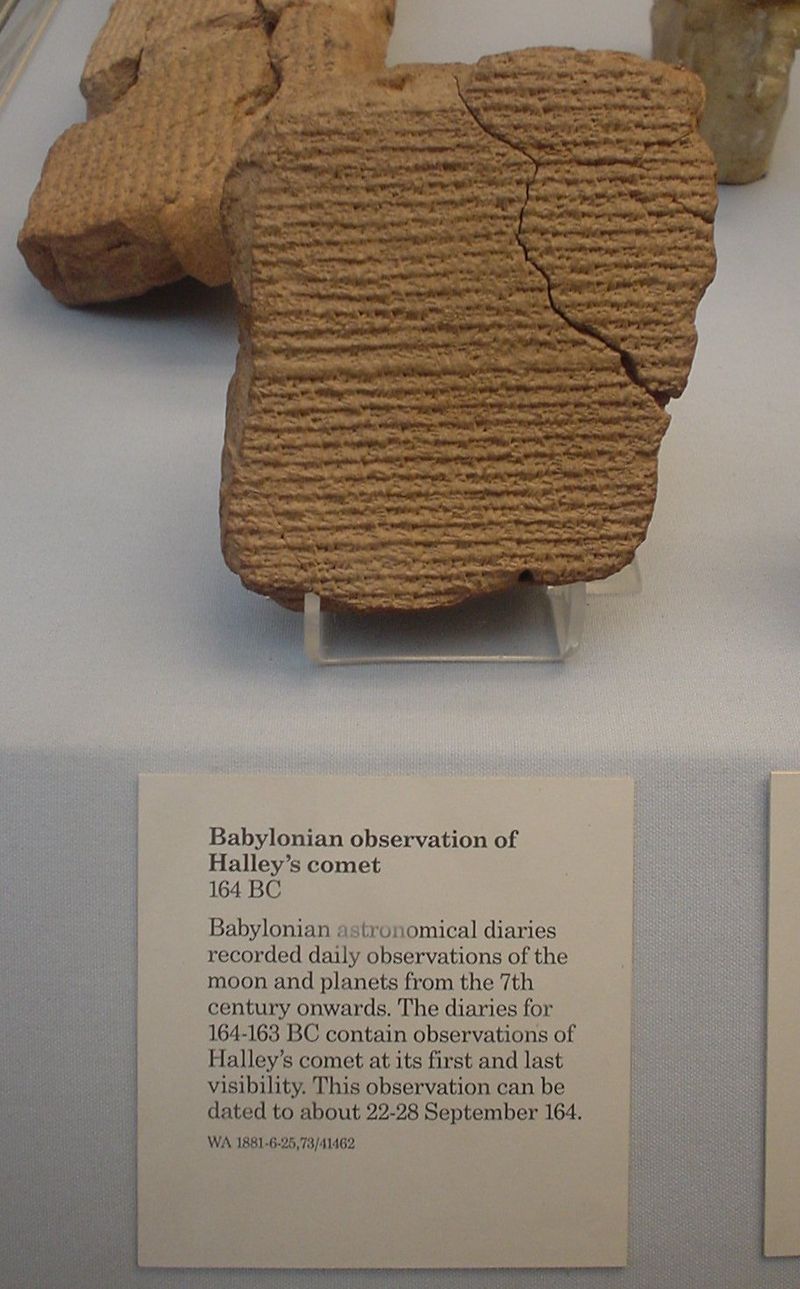
The origins of Western astronomy and astrology are interconnected and can be found in Mesopotamia. Here is a clay tablet from 164BC recording the observation of Haley’s Comet which moved through the heavens on a cyclical path. Cycles certainly were understood by merely observing the heavens. The Babylonians conducted a major investigation recording when events in the heavens took place, what were the effects on Earth. Obviously, Western efforts at the beginning of sciences are descendants in a direct line from the work of the late Babylonian astronomers, yet extend even further back to Sumerian astronomy. The earliest Babylonian star catalogues date back to about 1200 BC. Many star names appear in Sumerian, which implies that there is a continuity reaching into the Early Bronze Age.

Hipparchus of Nicaea (c. 190 – 120 bc) was a Greek astronomer, geographer, and mathematician who first discovered the cyclical nature of the universe being the Precession of the Equinoxes which is the journey of our solar system around the center of the universe taking 25,800 years. He is also known as the father of trigonometry, and he compiled a comprehensive star catalogue. He discovered the Precession of the Equinoxes by looking at the star charts of the Babylonians about 1,000 years before his time and noticed how the heavens had moved. The Maya also discovered the Precession of the Equinoxes and studied TIME, which I have written about – The Mayan Discovery of Time.

We have to understand that during the Dark Ages, there was a lot of superstition. Mathematics was seen as the work of pagans and thus the Devil. This meant that to guide a ship, a Christian could not engage in such calculations. This is why the Jews were captains of ships or navigators, as well as bankers. Fibonacci brought back math and numbers from the Arabs and this was acceptable for it was used in gambling. Much of the early mathematicians were clandestinely hired by royalty to win at gambling – the early card counters.

Bathing also was shunned in much of Europe during the  Middle Ages because Roman baths were generally public where mixed sexes attended and often they were frequented by prostitutes or frequent sex. During the 4th and 5th centuries, after the time of Constantine I the Great, Christian authorities allowed people to bathe for cleanliness and health. However, Christians routinely condemned attendance to public bathhouses for pleasure and condemned women going to bathhouses that had mixed facilities. Generally, over time, more restrictions appeared and finally, Christians were prohibited from bathing naked at all. The Church began to disapprove of any “excessive” indulgence in the habit of bathing. Over the course of time, this original association of a bathhouse with prostitution culminated in the Medieval Church authorities proclaiming that public bathing led to immorality, promiscuous sex, and diseases. You would never say you went to take a bath, it was implied you had sex.

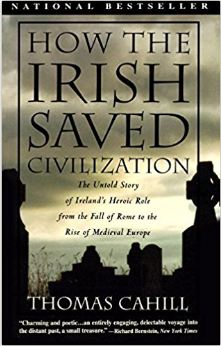
Without question, knowledge evaporated during the Dark Ages and superstitions replaced much. Most of the old books had been lost by the invasions of various barbarian tribes. Much of the knowledge resurfaced from three primary sources. First, the fall of Constantinople to the Turks in 1453 saw the scholars fled to Rome and began opening up schools. Secondly, much of the sources of ancient books were preserved by the Arabs and made their way back to Europe. The third source, some have called it How the Irish Saved Civilization. It may be called the Italian Renaissance, but it was the century when ancient Greek and Latin manuscripts preserved in Irish monasteries were discovered and read and discussed once again thus paving the way for the Renaissance. This was the rebirth of antiquity which, in synthesis with Christianity, produced a unique new awakened civilization. By the time of the American Revolution, the Founders were mesmerized by the writings of ancient Rome and sought to overthrow the monarchy as they did and formed a Republic.

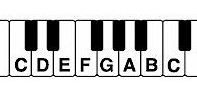
Therefore, it is of no surprise that Christianity failed to comprehend the cyclical aspect that ran through the veins of ancient knowledge. Throughout the Bible, there are numerous references to cycles and measuring things in seven or multiples of seven from creating the world in seven days to a woman’s menstrual cycle lasting 7 days. There are seven notes on a piano. We just have not bothered to look at the cyclical nature preserved with Christianity because of the prejudices formed during the Dark Ages. Any hint of using math was seen as the Devil’s work. This is why you also see so many ancient statues that are beheaded because they assumed any statue was a pagan god. The Dark Age was a period of true ignorance.