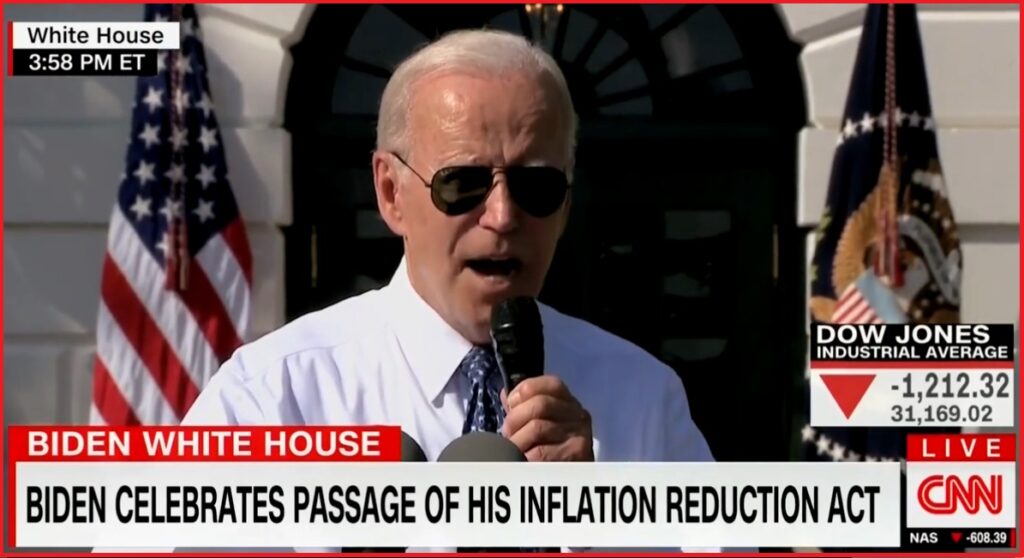
Posted originally on the conservative tree house on September 16, 2022 | sundance
You know that moment just before the tsunami hits, when the water is pulled out to sea? Yeah, that.
Media are starting to realize what a destabilizing force ‘food insecurity’ can become as the pre-existing high prices are about to go even higher.
(WASHINGTON, Via The Hill) – […] the five items that have seen the largest year-over-year price increase based on the latest report from the Labor Department, and how much the price has changed: Eggs 39.8%, Margarine: 38.3%, Butter: 24.6%, Flour/prepared flour mixes: 23.3%, Olives, pickles, relish: 19.4%
Many of the items listed in the Consumer Price Index have seen prices rise by more than 15% compared to August 2021. That includes chicken (16.6%), soups (18.5%), cereals (17.4%), and milk (17%).
[…] Worsening food inflation is a particular strain on lower-income families, more of whom have had to turn to food banks and other aid as inflation has worsened. Mary Jane Crouch, executive director of America’s Second Harvest of Coastal Georgia, which works with a network of food banks, told the Associated Press 38% more food was distributed in August compared with July.
Sales at grocery stores rose 0.5% in August, the Commerce Department reported Thursday. Overall spending has slowed and shifted increasingly toward necessities like food, while spending on electronics, furniture, new clothes and other non-necessities has faded. (read more)
The energy driven inflation in seed, fertilizer, diesel fuel, solvents and industrial surfactants is about to travel from the field into the food supply chain with the fall harvest commencing. Wave 3 food price increases are likely to be higher than the prior two waves combined.
Overlay that pricing issue with global shortages and what do you get?….
Fortunately, I am optimistic that most readers here are well prepared.
Posted originally on the conservative tree house on September 15, 2022 | Sundance
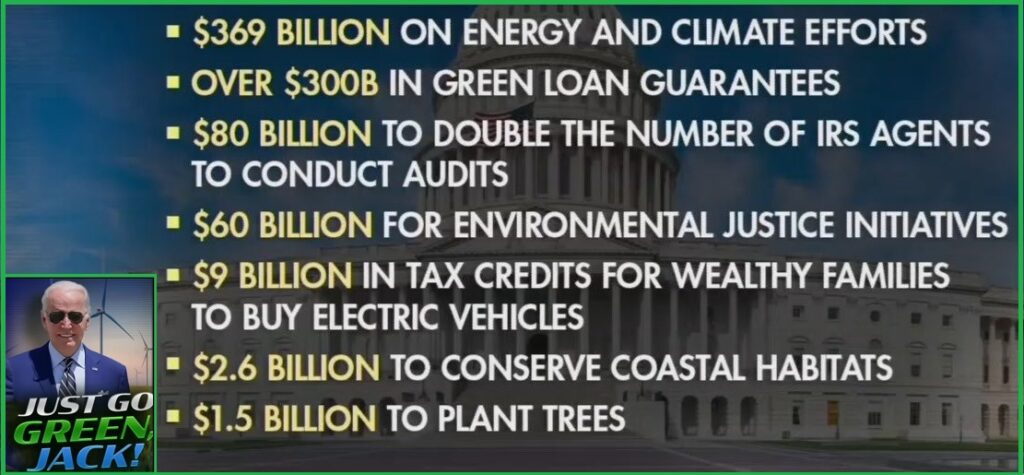
Deep inside the legislative language of the falsely titled “inflation reduction act”, aka The Green New Deal legislative vehicle constructed by lobbyists and passed by congress, people are now starting to realize a carbon-trading system was created.
Ultimately, a carbon trading system has always been the holy grail of the people who run the western financial system and want to create mechanisms to control wealth by using the ‘climate change’ agenda.
A carbon trading system is a very lucrative financial transfer mechanism with a potential scale to dwarf the derivative, Wall Street betting, market. Secondarily, such a market would cement the climate change energy policy making it very difficult to reverse. The new creation as explained by the Wall Street Journal, holds similarities to the EPA ethanol program.
BACKGROUND – The Renewable Fuel Standard (RFS) is a government mandate, passed in 2005 and expanded in 2007, that requires growing volumes of biofuels to be blended into U.S. transportation fuels like gasoline and diesel every year. Approximately 40 percent of corn grown in the U.S. is used for ethanol. Raising the amount of ethanol required in gasoline will result in the need for more biofuel (corn).
The EPA enforces the biofuel standard by requiring refineries to submit purchase credits (known as Renewable Identification Numbers, or RINs) to the Environmental Protection Agency (EPA) proving the purchases. This enforcement requirement sets up a system where the RIN credits are bought and sold by small refineries who do not have the infrastructure to do the blending process. They purchase second-hand RIN credits from parties that blended or imported biofuels directly. This sets up a secondary income stream, a trading market for the larger oil companies, refineries and importers.
Understanding how that system operates, back in June I said, ‘the RIN credit trading platform is similar to what we might expect to see if the ‘Carbon Trading’ scheme was ever put into place’. Well, based on the legislation within the Green New Deal/Inflation Reduction Act, that’s exactly what is happening.
(Via Wall Street Journal) – WASHINGTON—A brand-new market for green tax credits is taking shape as bankers and advisers figure out how to funnel tax breaks from energy companies that generate them to profitable corporations eager for smaller tax bills.
The market is forming because Congress last month expanded renewable-energy tax credits and made them transferable in the law known as the Inflation Reduction Act.
[…] The tax-credit sales mark a shift in the U.S. strategy for attracting public and private capital to renewable-energy projects, and they will happen alongside existing climate-finance markets such as carbon offset purchases. The deals won’t start in earnest until 2023, but lawyers and financiers are already structuring transactions. They are discussing arrangements in which credits would be sold at discounts from face value, and they are determining how to cushion tax-credit buyers against potential risks.
“The conversations are happening. The market making is happening right now,” said Nicholas Knapp, senior managing director at CohnReznick Capital in New York.
Within a year or two, it could be easy for a corporation with no direct renewable-energy investment — a profitable retailer, pharmaceutical maker or high-tech company — to purchase tax credits. Because of the expected discounts, companies could earn an instant profit, paying $90 or $95 for a $100 coupon off their income-tax liability.
These transferable credits, however, expose a potential dilemma for Democrats. The party aimed to raise corporate tax bills and prevent large, profitable companies from paying too little. But the tax-credit transfers open a new avenue for many of those same companies to pay less.
“They can basically purchase the tax credits, advance their ESG goals and get certain economics from the credits without taking any construction or operational risk of the project,” said Hagai Zaifman, a partner at Sidley Austin LLP in New York who helps structure renewable-energy deals. (read more)
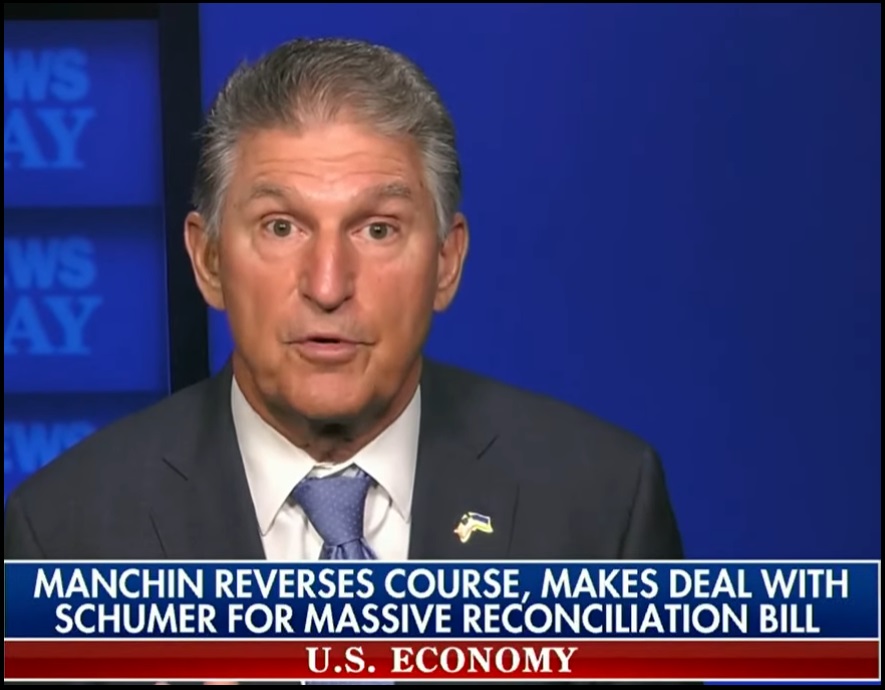
We know exactly who we have to thank for this, West Virginia Senator Joe Manchin.
Now watch what Senator Joe Manchin’s family starts doing.
Posted originally on the conservative tree house on September 14, 2022 | Sundance
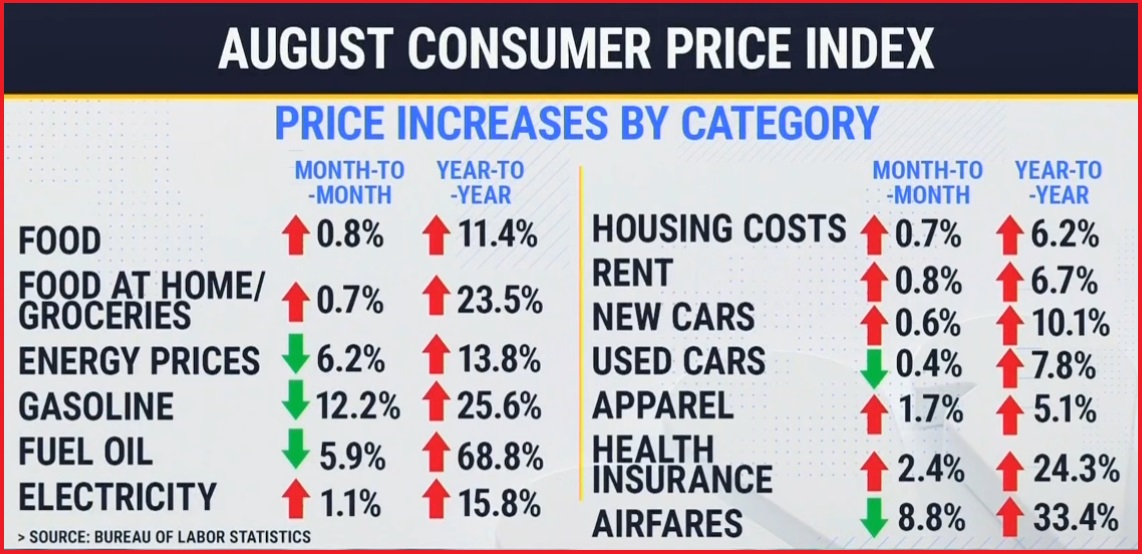
Someone had requested a simple to see infographic of the Bureau of Labor and Statistics August inflation data with monthly and yearly outcomes. I thought everyone might find this graphic as a good tool for sharing with your network. [Data Source Link]
Additionally, the BLS also released the producer price index today [DATA HERE]. The PPI for goods dropped slightly, as we expected, due to the August temporary decline in gasoline and diesel. However, the PPI for final demand services moved up 0.4 percent in August, the fourth consecutive rise.
We are now seeing service providers having to raise their prices to cover their increased costs. This could be trouble for employment in the long-term.
Posted Originally on the conservative tree house on September 13, 2022 | Sundance
We are in an abusive relationship with our own government. If you want a real-time example of how governmental bureaucracy fits into this statement, look no further than the footnote at the bottom of this article ¹cited from the BLS report today.
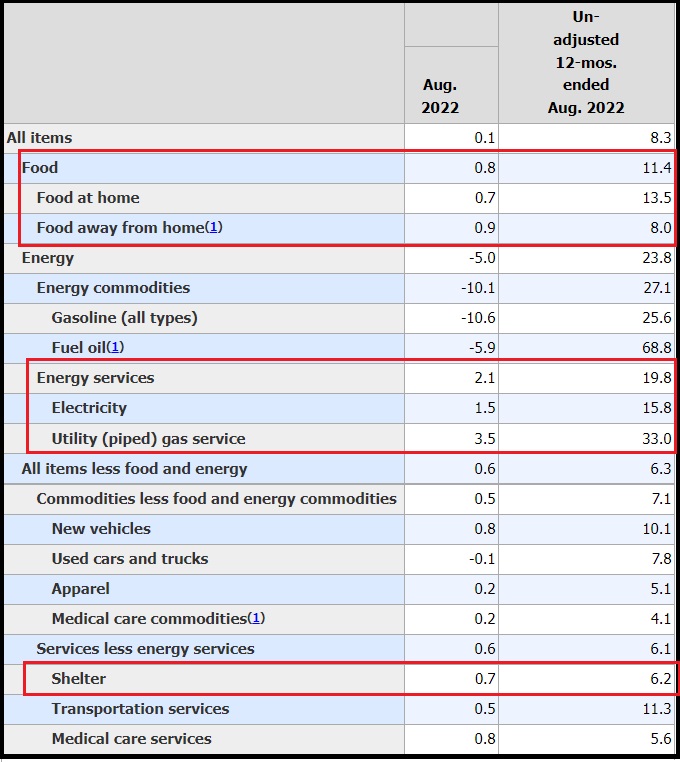
The Bureau of Labor and Statistics (BLS) has released the August inflation data today [DATA HERE] with a top line at 8.3 percent year over year. Unfortunately, things are unfolding exactly as we previously shared. [Modified Table 1 at left]
Despite the temporary drop in gasoline prices (-12%), the costs of food (+13.5%), electricity (+15.8%) and housing (+6.7%) are crushing U.S. consumers. The stock market is responding accordingly. We can only imagine the inflation data if the heavily weighted gasoline factor was not pushing overall toplines down. Estimation of inflation would be well over double digits.
Keep in mind, as you read this review the price of the current harvest (prior field costs) is only right now coming into the food supply chain.
Food inflation is running at its highest rate since 1979 (+11.4%) and it will go higher as the third wave in this sector hits.
To give you an example, margarine increased in price 7% in August alone, that’s an annualized rate of 94% [Table 2 details]. Flour is also on pace for another 22.8% increase right as the holiday baking season begins.
We cannot eat gold, silver or durable goods. Electricity, home heating (natural gas), food and housing costs are priorities right now. Main Street USA is being crushed by Joe Biden overall economic and energy policies. It’s bad now, and going to get worse – much worse, as the third wave of food inflation has only just begun.
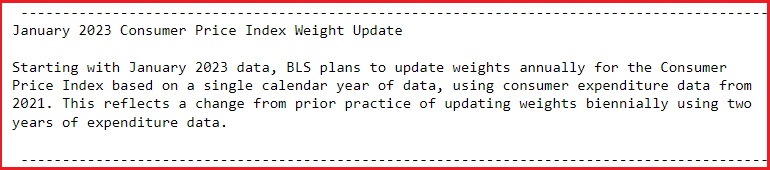
¹Before sharing a MSM perspective I want to draw your attention to the BLS notation for 2023. This innocuous footnote tells us just how manipulative the governmental bureaucracies are:
In order to give the statistical appearance of things being better than they are, the BLS is going to reset their weighting for the CPI to only compare against 2021. This is being done with purpose to give the illusion next year that things are not as bad. 2021 was when Joe Biden’s inflation policies first surfaced. By comparing consumer prices to the timing when those prices first increased, the scale of future price increases will be statistically diminished. We are in an abusive relationship with our government.
.
(CNBC) – Inflation rose more than expected in August as rising shelter and food costs offset a drop in gas prices, the Bureau of Labor Statistics reported Tuesday.
The consumer price index, which tracks a broad swath of goods and services, increased 0.1% for the month and 8.3% over the past year. Excluding volatile food and energy costs, CPI rose 0.6% from July and 6.3% from the same month in 2021.
Economists had been expecting headline inflation to fall 0.1% and core to increase 0.3%, according to Dow Jones estimates. The respective year-over-year forecasts were for 8% and 6% gains.
Energy prices fell 5% for the month, led by a 10.6% slide in the gasoline index. However, those declines were offset by increases elsewhere.
The food index increased 0.8% in August and shelter costs, which make up about one-third of the weighting in the CPI, jumped 0.7% and are up 6.2% from a year ago. (read more)
For readers who do advanced preparation to offset prices. THINK BEEF right now, you will thank me four months from now. If you see a deal now, buy it and freeze it now. Anticipate retail ground beef costs be somewhere around $10 to $15/lb by spring to mid 2023 perhaps even higher. Also remember, processed foods will increase in price at twice the rate of the fresh food sector. Both fresh and processed food prices will rise, but the increased costs associated with the food processing will double the price.
As in late times, as rulers come and go, the currency changes to reflect the change of power. In ancient Rome, for example, they would announce the coming of a new emperor on the coinage. The Romans used the reverse of their coinage as newspapers announcing victory, great building projects as the opening of the Colosseum, or political events such as the destruction of tax records by Emperor Hadrian recording one of the earliest tax amnesty events. Pictured here is the famous “Eid Mar” denarius of Brutus (85-42 BC), announcing he killed Caesar on the Ides of March in 44 BC.
Queen Elizabeth’s death will also cause numerous changes in currency. “Current banknotes featuring the image of Her Majesty The Queen will continue to be legal tender,” the Bank of England said shortly after her passing. The Royal Mint is continuing to “strike coins as usual” and has not announced when they plan to replace her image with the newly appointed Kings Charles III. The currency was updated five times during her rule to reflect the natural aging process. There are currently 4.7 billion UK banknotes in circulation worth an estimated 82 billion pounds ($95 billion). These bills will circulate for years to come as it takes an extensive amount of time to swap out currency.
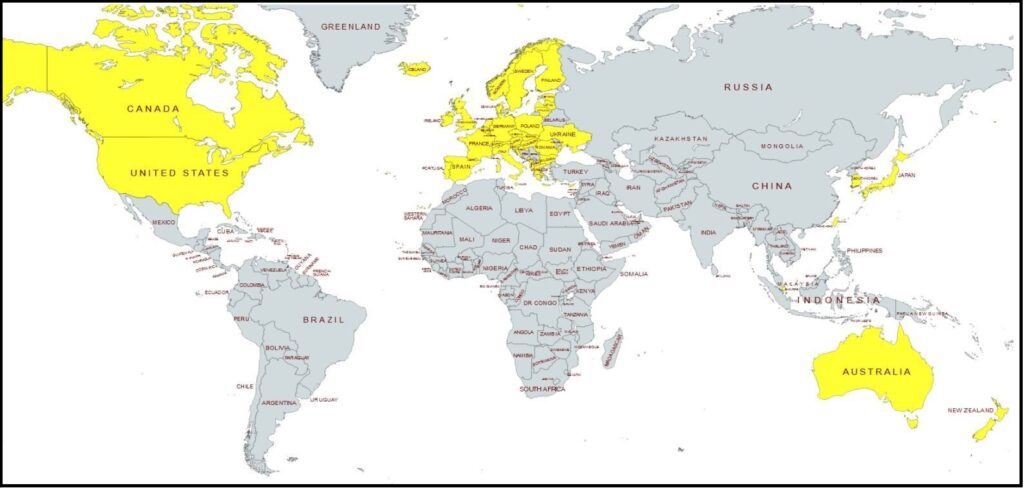
The United Kingdom is not the only one who now must change its currency. Queen Elizabeth II broke the Guinness Book of World Records for being the longest reigning monarch after sitting on the throne for over 70 years. She also made history by appearing on more currencies than any other living monarch. At least 33 countries feature currency with the late queen’s image. Some countries removed the queen’s image decades ago after gaining independence. Jamaica replaced her image in 1966 with Marcus Garvey, while Bermuda changed its banknotes to feature native animals. Trinidad and Tobago also replaced her image with a coat of arms.
Canada, Australia, New Zealand, Belize, and many others will need to update some of their currency. While the UK is refraining from making a statement until after the 10-day mourning period, other nations have explained their plans. The Reserve Bank of New Zealand, for example, said, “All coin stock for a denomination showing the Queen will be issued before new stock goes out with her successor’s image. This is a few years away.” The central bank said that it would be “wasteful” to shorten the lifespan of the existing currency in circulation, but they do plan to transition to currency featuring the new king in “several years.” The bank is also concerned that a rapid transition could affect its liquidity due to supply chain disruptions or sudden demand.
All existing currency with the queen’s image is valid and legal tender. It takes years for the currency to change, as it is an expensive and gradual process.
India is the largest rice exporter in the world. The nation saw the highest volume of rice exported last year at 18.75 million metric tons. In contrast, the second-largest exporter, Vietnam, sold about 6.5 million metric tons of rice that same year. Rice is the main staple in diets throughout the world. In the midst of food shortages, the Indian government decided to impose a 20% export duty on rice.
Importers are not too keen on the new export levy, and the plan has backfired. One million tons of grain now stand idle at Indian ports as buyers are refusing to pay the additional 20%. BV Krishna Rao, President of the All India Rice Exporters Association (AIREA), has stated that India has stopped loading all vessels with rice shipments. Another problem is that many buyers already paid for their orders but are now expected to pay an additional 20%. The margin for rice is small, and most buyers are not willing to cut into profits.
Perhaps the Indian government would like the world to see it has a stronghold over the world’s rice supply. India currently sells to over 150 countries and now has leverage, considering the ongoing food shortages.
QUESTION: I’m a subscriber and I read you every day. Your weekend article 9/10/22 that a gold standard will not work as gold fluctuates just as Fiat currencies do. Then what in your opinion is the proper currency model, or can we just simply keep printing dollars endlessly because for now, we’re the least dirty of all the dirty shirts? If you’ve done an article or book on this please guide me to it. Thanks and keep up the great work with such accurate insights.
CG
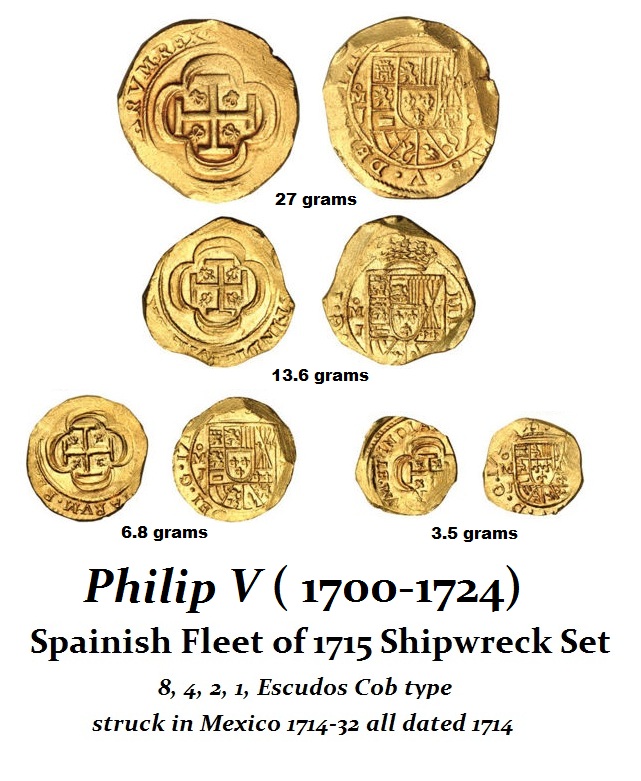
ANSWER: Don’t mix the problem of the quantity of money with what is actually money. They are two separate issues. The theory that inflation is tied to the quantity of money truly extends back to when metal was the money supply. The sudden discovery of America led to a huge wave of inflation in Europe. The FISCAL MISMANAGEMENT of Spain led to its total collapse. They were borrowing against the next shipload of gold coming in from the New World. They would not wait even to get it in, and they were so excited to spend it before it arrived.
Spain became the richest nation in Europe thanks to the wanderings of Columbus. Nonetheless, the amazing Decline and Fall of Spain is perhaps the greatest lesson if someone wishes to write “How NOT to Manage Government For Dummies.” The Spanish became both the richest nation and the greatest debtor, not that dissimilar from the United States, and succeeded in ending up as the poorest.
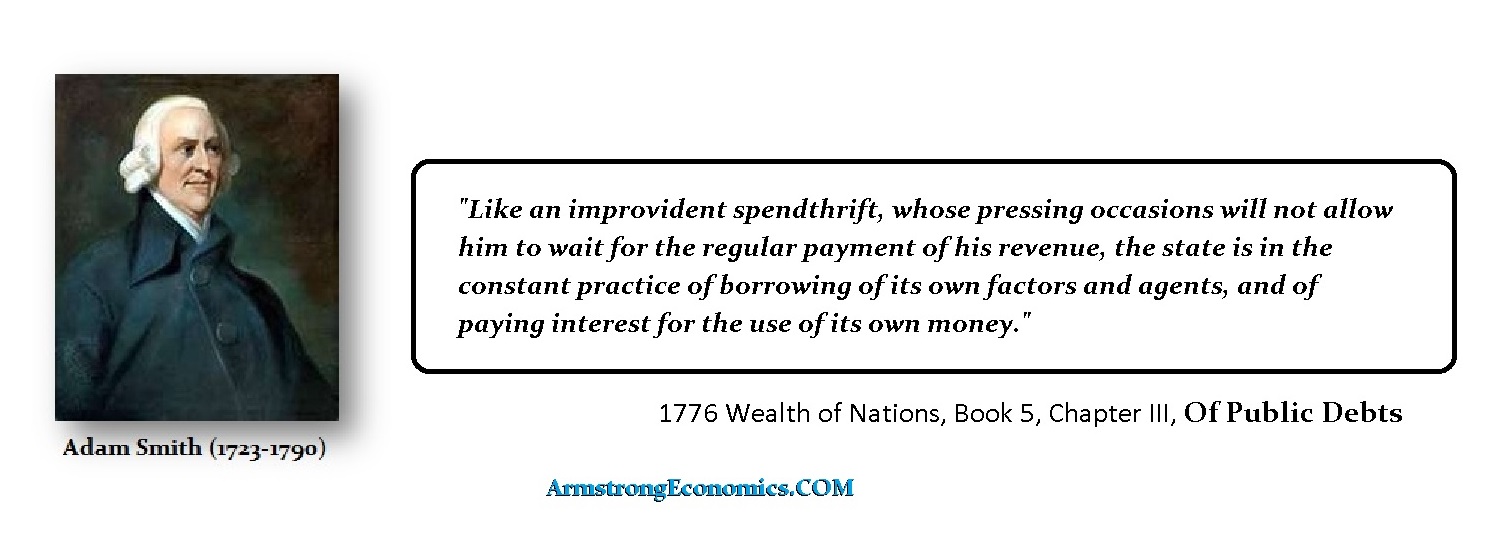
Spain became a serial defaulter beginning in 1557, followed by 1570, 1575, 1596, 1607, and 1647 ending in a 3rd world status without hyperinflation. Their economic model was one of conquest and plunder rather than developing domestic industry and a viable economy. The lesson to be learned from Spain is precisely what Adam Smith wrote in his 1776, “Wealth of Nations.”
The first such default that is definitively recorded took place at least in the 4th century BC when ten out of thirteen Greek municipalities in the Attic Maritime Association defaulted on loans from the Delos Temple of Apollo.
The endless increase in the supply of dollars is not the problem. That is like blaming the gun for killing someone rather than the person with the gun. The issue has ALWAYS been the fiscal mismanagement of those in power.
This is an entirely SEPARATE QUESTION from what is money!
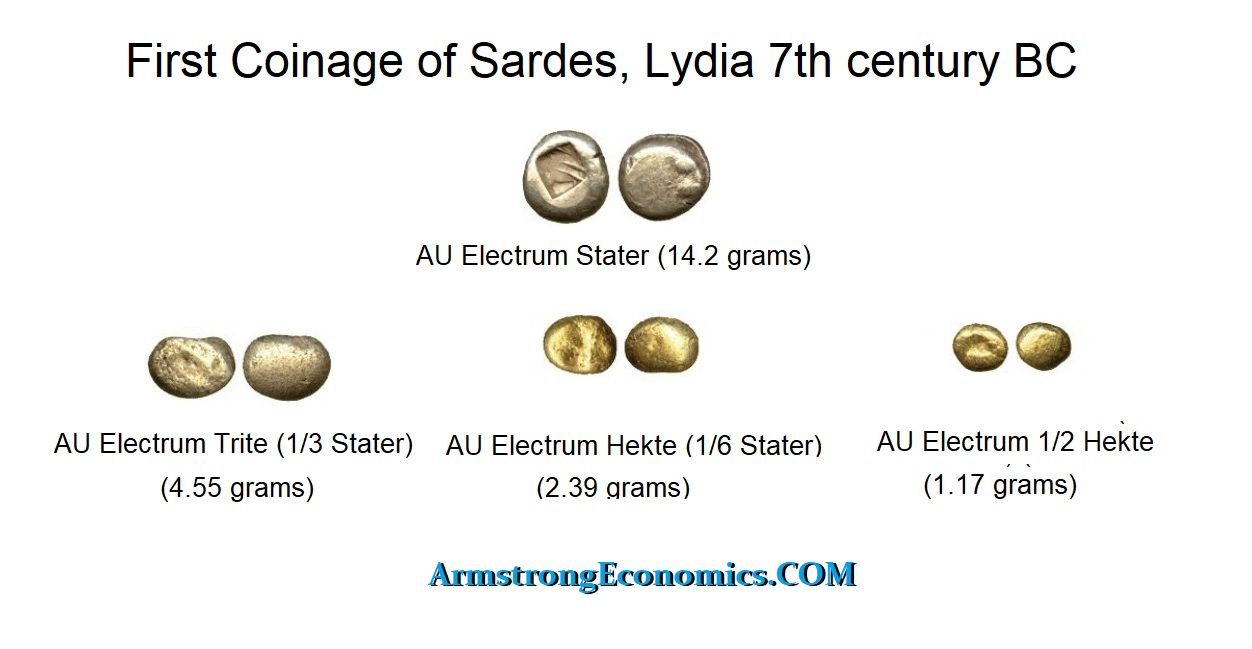
Our problem is NOT that money is paper. The problem is those in charge of the government. In China, cowrie shells were once money. In Rome, the earliest form of money was cattle. When bronze began to replace cattle, you see this Roman Aes Signatum with the image of a cow that was the symbol of money. The Egyptians had paper money, but they were receipts for grain storage which would change hands. There was no fiscal mismanagement.
To trade with the outside world, the Egyptians did not have their own coinage. They produced silver imitations of the Athenian Owl — Tetradrachms.
There have been many two-tier monetary systems throughout history. Even South Africa had the Financial Rand for international use and the Rand, which was restricted to domestic. Russia, after 1991, had some shares that traded as ADRs on foreign markets, which were 10 to 20x that of the shares traded on the Russian exchange, which were restricted to Russian investment. That is what the foreigners were abusing setting up shop in Moscow and then buying local shared and lobbying companies like Gazprom to adopt Western accounting standards to make a 30-fold profit while claiming they were some white knight concerned about corruption — all total propaganda.
Even going back further to the Minoans who created the Bronze Age, the ingots used in trade were made in the form of sheepskin, which had been money in the ancient Greek world.
Gold was reserved for the pharaohs, so naturally, others wanted it. The Bible refers to the weighing of the silver in Genesis 23:16: “Abraham listened to Ephron; and Abraham weighed out for Ephron the silver which he had named in the hearing of the sons of Heth, four hundred shekels of silver, commercial standard.” Even a “Deutsche Mark” referred to a “mark of silver,” which was a weight. The same in Britain. The British “Pound” was one pound of silver .925.
Our entire weight system remains that which was established in ancient Rome, with an ounce being 28.34 grams and a troy ounce being 31.0 grams. The Romans started with even a coin that was called the “uncia” during the Republic period.
Therefore, the problem with a “gold standard” is the goldbugs keep suggesting that gold would be “fixed” in value. They will only blow up in everyone’s face. There have been many crises.
Riots against bankers have been very common, especially when international lending has led to economic chaos. When Edward II (1307-1327) of England was captured, riots broke out in London. The mobs attacked the Italian bankers who had extracted huge interest payments from England. The famous Italian bankers at the time were the Bardi family. The English mob attacked their London office in 1326, illustrating the age of nationalism and protectionism that was festering during the 14th century. As much as things appear to change, they remain very much the same at the root core
Those who think the gold standard brings stability must also believe in the Tooth Fairy. There was a huge CONTAGION that became widespread because of debasements during the 14th century. The silver to gold ratio was disrupted everywhere in Europe thanks to French debasements. The ratio stood at 13.1 in Florence compared to 12:1 in France during 1316 and was trying, like the Silver Democrats of the 19th US Century, to overvalue the price of silver. By driving the price of silver even higher relative to gold, they forced the ratio in France down to 5:1 in 1343, setting off riots in Florence. Silver was being drained from the local economy flowing to France, where it was over-valued, and this created a sharp recession in Florence with the shortage of money (silver) for domestic use.
Why? For you see, wages and local commerce were conducted in silver. Gold was used only for international trade. Driving the price of silver higher raised the cost of production, which simultaneously reduced the value of trade and even outstanding loans made to individuals and sovereigns alike. This caused a drop in production and rising unemployment. Hence, the first riot came in 1343, whereby the French debasement had contributed to the impatience of the population. Switzerland did the same thing pegging the franc to the euro because the franc was rising, and manufacturers threatened to leave. Hence, Switzerland has imported massive inflation, raising the cost of living and doing business there to TWICE that of the United States.
The Political-Economic Revolt of 1343 in Florence may have had its roots in a corrupt government, as we are also seeing in Europe and Ukraine, but it was set in motion by the economic events driven by over-valuing silver. There was an uprising of workers that erupted on September 24, 1343. The people stormed the palaces of the rich merchant-banking families located in the Oltrarno quarter of the city that was on the left bank of the Arno River. This was where the palaces of the Bardi, Frescobaldi, Rossie, Nerli, Mannelli, and many others were located. The rioters barricaded the bridges, and on the 25, they captured the palaces of the Rossi and Frescobaldi. They also stormed the Bardi palace forcing the members of that family to abandon their fortress and flee for their lives. The mob then sacked the Bardi Palace and set it on fire. Contemporary accounts tell us that the Bardi lost that day 60,000 florins in the destruction that took place in Florence – truly a vast amount of money that would be in the tens of millions of dollars today.
The Florence monetary system was a two-tier system whereby gold was used ONLY for settling international trade, and silver was used for domestic commerce. Those who simply think because coins were precious metals and thus were not “fiat,” yielding some land of Utopia where the value of money was constant while assets rose and fell, cannot grasp the simple concept that assets rise and fall ONLY in terms of purchasing power of the currency. This is true regardless of what you use for the money, be it gold or St Patrick’s discovery of slave girls that were the unit of account for money in Ireland.
No matter what is money, it CAN NOT be fixed in value. It must be allowed to float, for there are always trends that shift back and forth. Therefore, the relentless creation of money is not because they are paper dollars. As I said, you are blaming the gun rather than the shooter. This is fiscal mismanagement created by Marxism, where the politicians no longer know how to run for office without bribing the people for their votes. This is the system that is completely doomed, the very same as communism fell. It’s just our turn.
Posted originally on the conservative tree house on September 12, 2022 | Sundance
Mid-August CTH noted, “amid all of the headline warnings about inflation and prices of essential products, CTH notes that if we are to continue waiting about six months, we would see a massive backlog of unsold goods and as a consequence the prices of non-essential durable goods would begin a rapid decline. That exact scenario is about to unfold.” {link}
Today the world’s second largest appliance manufacturer, Electrolux, announced a collapse of corporate earnings -the result of the western alliance economic contraction- leading to major cost cutting and future incentive programs. [Announcement Link, emphasis mine]
(Electrolux) – […] Market demand for core appliances in Europe and the US so far in the third quarter is estimated to have decreased at a significantly accelerated pace compared with the second quarter, driven by the impact of high inflation on consumer durables purchases and low consumer confidence. High retailer inventory levels have amplified the impact of the slowdown in consumer demand.
In combination with supply chain imbalances resulting in significant production inefficiencies and increased costs, the third quarter earnings for the Group are expected to decline significantly compared to the second quarter 2022 also excluding the one-time cost to exit the Russia market. This has been driven mainly by Europe and North America. Business Area North America is expected to report an operating loss in the third quarter exceeding the loss in the second quarter.
Since market demand for 2023 is expected to continue to be weak in both regions, the Board has today decided to initiate a Group-wide cost reduction program addressing both variable and structural costs. The program, which starts immediately, will focus on reducing variable costs, with special attention to eliminating cost inefficiencies in our supply chain and production. The structural cost reductions will primarily take place in Europe and North America. (more)
Keep in mind, this is not necessarily a collapse of total global economic activity; what we are seeing is a collapse of western nation economic activity that is impacting the rest of the world. A great economic fracturing is taking place as the western nations intentionally shrink their economy. The supplier nations are feeling the consequences.
Keep in mind, South Korean factory output is now negative (electronics etc). European factory output is now negative (industrial equipment). Japanese factory output has dropped dramatically, and U.S. factory output has stalled. All of these issues overlay the statements by Maersk that shipping is not needed.
The western economies are contracting in response to the collective energy policies of the Build Back Better climate change agenda, and the high cost of energy that comes from stopping energy production.
Energy production in western nations has been slowed or stopped (Build Back Better). Western nation inflation is being driven by higher energy costs as a result of less energy products being produced, oil, coal, gas. Western banking groups have raised interest rates to slow down the economic engines to meet the drop in energy production.
All of this is being done with intent, purpose and control. This is a managed decline.
California sent out an emergency public notification to warn residents that the power grid was under a strain. Since people are likely unwilling to turn off their power during the summer heat, California is concocting “de-energization” plans. Simply put, California plans to temporarily turn off the power grid in the name of public safety.
This is the same state that plans to eliminate gas-powered cars yet does not have the capability to maintain the current electrical grid. Companies are already creating advice for residents to “get ready for a PSPS” (Public Safety Power Shutoff). PG&E warned that some residents may be without power for “several days.” Their advice seems quite dystopian. Those who will DIE without power due to medical conditions may receive an exemption to power their medical devices.
Several days without electricity will cripple small businesses, and large businesses will also suffer. Those who may need but do not qualify for an exemption could die. They are recommending that people use camping stoves and outdoor charcoal grills to cook, but that is not an option for many. The elderly are especially vulnerable without power. Those without power banks will be unable to charge their phones and will be isolated from the world. Kids will be unable to attend school. They are asking people to power their EVs, but you can only go so far on one charge. It will come as no surprise if they shut off electricity for the poorest areas first.
Perhaps we could have funded this project instead of sending over $120 billion to Ukraine. California is still pushing to end the use of fossil fuels but look at the situation they are in currently.
Posted originally on the conservative tree house on September 10, 2022
It is good to see at least one energy finance analyst at the Institute for Energy Economics and Financial Analysis, speaking commonsense. In an article by Clark Williams-Derry for Barron Magazine [SEE HERE], the author accurately outlines how significant U.S. Liquified Natural Gas (LNG) exports are driving up prices for American consumers.
The author accurately refutes the notion that exports do not drive-up domestic prices, by walking through the example of how natural gas prices dropped for U.S. consumers when the liquefied natural gas plant in Quintana, Texas [Freeport LNG] was temporarily shut down, blocking a portion of the export capacity. However, that facility is about to come back on-line and with increased exports from other facilities domestic U.S. prices have already doubled.
According to the U.S. Energy Information Association (IEA), U.S. storage of Liquified Natural Gas (LNG) is 12% below the five-year average (LINK). Additionally, the IEA is expecting the U.S. to export 11.7 billion cubic feet of LNG per day during the fourth quarter of 2022 — up 17% from the third quarter. The destination of that export is Europe.
Consider that 43% of U.S. households use LNG for home heating, and power suppliers use LNG to create electricity. With the massive 2022 exports of LNG to Europe (+17% in fourth quarter alone), that means lower domestic supplies and increased prices here in the United States for electricity and home heating. We are seeing and feeling these massive price increases right now.
Barrons – […] If you need more evidence of the impact of natural gas exports on prices, just compare supply and demand fundamentals for the year leading up to February 2020 (the last pre-pandemic month) versus the year leading up to this May (the most recent month with full federal data). Annualized production rose over the period, while domestic consumption remained roughly flat. Yet LNG exports almost doubled—a surge that tightened U.S. gas markets and doubled the price that U.S. consumers pay for the fuel.
The growth of global demand for U.S. LNG can be tied to many market forces, including the shortfalls in Europe due to Russia’s manipulation of European Union gas markets. Sustained high demand in wealthy Asian nations has contributed to export growth as well. And so has the U.S. gas industry’s dogged determination to ship its wares to the highest bidder, foreign or domestic.
Russia’s role has been particularly critical in the rise of global LNG demand. As Russia choked off gas shipments to Europe, EU buyers have turned to global LNG markets to make up the shortfall. Global LNG prices rose in response, and U.S. LNG companies ramped up output, shipping more cargoes to Europe. But Russia responded by further clamping down on gas supplies to the EU—a vicious circle that has hurt Europe’s economy even more severely than it has harmed America’s.
There’s little sign that U.S. gas prices will ease in the coming years. Freeport’s demand will be back online soon enough, and there are three other massive LNG export projects under construction, with more than a dozen of others waiting for financing.
[…] Curiously, federal regulators have consistently found that the gas export projects are in the public interest—meaning they were in the economic interest of LNG companies and gas drillers. But now, exports are creating sky-high costs for U.S. consumers, and drillers are reluctant to boost gas output lest prices fall back to earth. So, it’s high time to consider whether soaring U.S. LNG exports are actually in America’s interest—or if, instead, runaway LNG exports are fueling energy inflation and undermining the nation’s economic competitiveness. (read more)
Not only are U.S. taxpayers directly paying for the majority of costs in Ukraine, but we are also subsidizing the European Union by exporting LNG and driving up the price for energy here at home.
We the taxpayers are directly paying Ukraine, and indirectly paying Europe to maintain gas sanctions against Russia. As a result, we the taxpayers are also paying higher prices here at home. This is the reality of the current exfiltration of wealth as created by the Biden administration.
I have created this site to help people have fun in the kitchen. I write about enjoying life both in and out of my kitchen. Life is short! Make the most of it and enjoy!
This is a library of News Events not reported by the Main Stream Media documenting & connecting the dots on How the Obama Marxist Liberal agenda is destroying America