Posted originally on the conservative tree house on September 23, 2022 | Sundance
The DeSantis Crew, formerly the 2016 Cruz Crew, is up in arms over a selectively edited soundbite from Jared Kusher, President Trump’s son-in-law. {Direct Rumble Link}
Florida Governor Ron DeSantis went shopping for South American aliens at an El Paso migrant processing facility in Texas. The DeSantis people took the aliens to a hotel with plans to fly them to Delaware, Joe Biden’s home state. However, facing backlash over the legality of spending Florida funds on a previous operation to move Texas migrants to Martha’s Vineyard, the DeSantis team abandoned the recruited Venezuelan aliens at the hotel, leaving them confused and stranded.
Jared Kushner noted in a Fox appearance that he did not like the approach of recruiting, manipulating and using arriving aliens as political pawns. Immediately the DeSantis supporters pulled an 8-second soundbite from a one-hour Fox News appearance and proclaimed Kusher was criticizing Ron DeSantis, which in the world view of Team DeSantis makes Kushner an enemy. However, the full statement with context is not controversial at all, and in my opinion Kusher is correct. WATCH:
.
The fact that Ron DeSantis sent people to Texas to recruit aliens from an El Paso processing facility with the promise of a flight to Delaware, then abandoned them when the political heat started, literally leaving them at the hotel confused and waiting for a bus that never arrived, shows the operation itself was using aliens as “political pawns,” and it is unseemly.
The DeSantis people can try to spin this against Kushner, but the outrage should really be toward the people working for DeSantis who pulled this stunt.
Posted originally on the conservative tree house on September 22, 2022 | Sundance
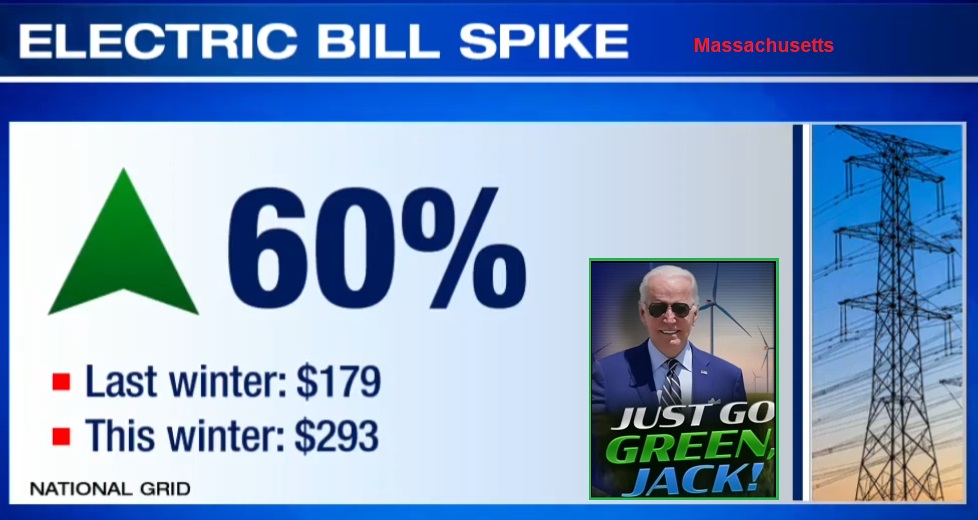
National Grid and Eversource are the two major electricity providers for Massachusetts. Both companies have notified the Department of Public Utilities (DPU) that rates for electricity are about to skyrocket.
National Grid has announced a 64% increase in electricity rates effective November 1st. While Eversource is on a different schedule, they too have announced an increase in natural gas rates of 38% on November 1st and the January 1, 2023, electricity rate will be announced in the next few weeks. Eversource is anticipated to announce a similar rate increase to National Grid. WATCH:
Both major power companies rely on natural gas to create electricity. Thanks to Joe Biden’s energy policies, which includes the massive export of natural gas in LNG form, domestic prices for natural gas have skyrocketed and will continue increasing as production is further shut down by regulation.
We are helping the EU survive their sanction driven energy crisis by sending them natural gas (LNG format), while simultaneously forcing Americans to pay more in order to maintain the EU export. Everything about the process is FUBAR.
Massachusetts – […] National Grid said the monthly bill of a typical residential customer using 600 kilowatt-hours of electricity will increase from $179 last winter to about $293 this winter, an increase of about 64%. National Grid said the delivery portion of electric bills will basically remain flat.
“National Grid buys electricity on behalf of its customers from the wholesale power market through a regulatory approved process established 20 years ago. That process has served customers well over the years and provides flexibility for unforeseen events, like limited supplier response to solicitations. But things have fundamentally changed,” Helen Burt, the company’s chief customer officer, said in a statement. “Today, under a sustained, high market price environment, it is challenging to maintain affordable prices. Given that, we think it’s a good time to work with our regulators and other stakeholders to review the process and electricity supply dynamics in the region, with an eye toward reducing price volatility and maintaining a secure, reliable and resilient energy system for the future.”
The company also announced that its natural gas rates are expected to rise on Nov. 1. They said they have a pending proposal with the state Department of Public Utilities that would result in the monthly bill for an average Boston Gas residential heating customer using 115 therms per month of $278, an increase of $50, or 22%, compared to last winter’s rates.
Eversource, the state’s other major electric provider, said in an email that it is on a different schedule than National Grid for setting its electric rates so no increases are currently planned.
“We file electric base service rates twice per year with the DPU,” company spokesman Chris McKinnon said. “Our last change was on July 1, 2022 and our next change will be January 1, 2023, which we will be filing for in the coming months.”
Eversource did announce Wednesday that it has submitted a proposal to the Department of Public Utilities seeking to raise its natural gas rates. They said their average residential customer using 126 therms of gas a month would see an increase of about 38%, or $86 on their natural gas bill over last winter. Those rate increases would take effect Nov. 1. (read m0re)
Posted originally on the conservative tree house on September 22, 2022 | Sundance
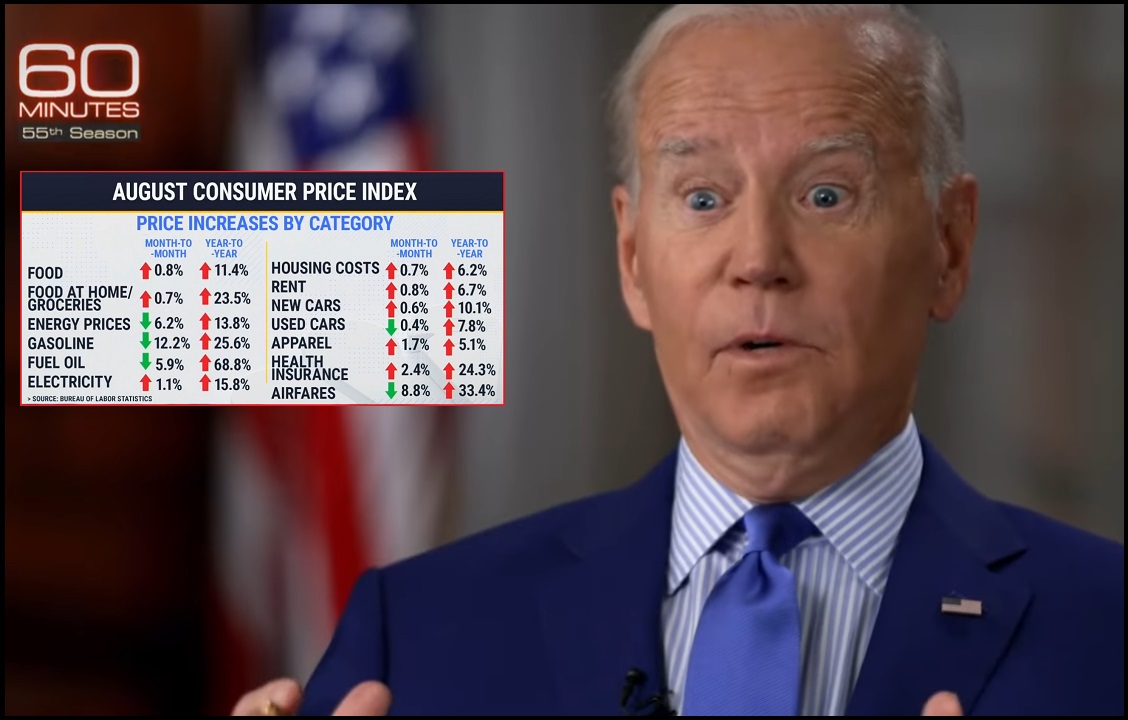
With most financial media being intentionally obtuse with the Biden economic impact upon Main Street, it is refreshing to see analysis that cuts to the heart of the matter. HatTip to ZeroHedge who provides a link to a great article outlining reality for blue and white-collar working families.
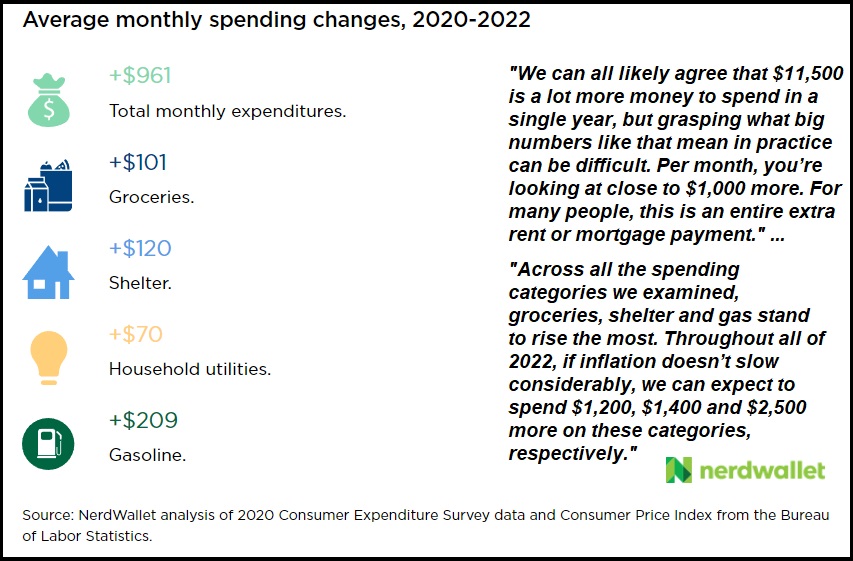
The folks at NerdWallet have taken the inflation date from the Bureau of Labor and Statistics (BLS) and applied the math to real life. The result is a good encapsulation of checkbook economics and how the Biden economy is painful for the working class.
In total, Joe Biden’s energy policy driven inflation has added $961/month to preexisting expenses. That’s $11,532 a year just to retain the status quo standard of living.
(NerdWallet) – […] In all of 2020, American households spent $61,300, on average. This number includes everything we spend our money on: housing, food, entertainment, clothing, transportation and everything else. In 2022, it stands to reach $72,900, a difference of more than $11,500 if consumers want to maintain the same standard of living. Keep in mind, this is an average, a number that represents an approximation across all Americans, but one that’s exact to a very few. Those who earn (and therefore spend) more will see more dramatic dollar increases. Those who earn less may see less dramatic dollar jumps, but the impact of these rising prices could be more significantly felt. (read more)
If the average household spent $61,300 and inflation is adding $11,500 to the expense, that means we now have to spend 18.7% more just to maintain the current standard of living. That average is in line with what we are seeing in the real world.
Posted originally on the conservative tree house on September 21, 2022 | sundance
Federal Reserve Chairman Jerome Powell announced another 75-point increase in federal interest rates today. This is the third consecutive 0.75 percentage point increase. Additionally, Fed policymakers have pledged to continue raising rates as high as 4.6% in 2023.
While Powell walked through his reasoning to continue targeting inflation by lowering consumer demand, not once in any of his remarks did he mention energy policy driving up the cost of materials and goods. The Great Pretending continues. WATCH:
The Fed chair is trying to manage the economic policy transition by reducing economic activity to match intentionally diminished energy supplies. Lowering economic activity drops demand for energy. Unfortunately, as admitted by Powell on August 26, 2022, in Jackson Hole, this means a period of “some pain” for Americans as the central banks join together in an effort to lower consumption.
What does “some pain” mean? It means lower incomes, higher prices, lowered standards of living and more scarce resources. During this transition to owning nothing and being happy about it, the pain is your wealth being stripped as the economy is intentionally diminished.
We will not be able to afford much; we won’t be able to afford the foods we want; we will not be able to purchase anything except the essentials, and those essentials will cost much more; we won’t be able to vacation, travel, or enjoy recreational activities; we won’t be able to afford any indulgences; but at the end of the process, we will learn to live more meager existences based on lowered expectations needed for sustaining the planet. Pay no attention to the elites who don’t have those concerns, comrade.
Posted originally on the conservative tree house on September 20, 2022 | sundance
Trying to survive current price increases in housing costs, energy costs, electricity costs, food and fuel costs has forced consumers to reevaluate purchasing decisions. As consumer demand for non-essential items has collapsed, and as Americans dig deeper into their savings just to sustain current unavoidable expenses, major retailers are now cancelling Christmas inventory orders.
On one hand the leaders of large multinationals must pretend everything is splendid; after all, the only acceptable position they can articulate is to support interest rates being raised because demand is just too darned high. lololol… pretending. But on the other hand – those same retailers are furiously trying to calculate how to avoid being stuck with billions worth of unsold inventory.
RetailWire – Walmart, Target, Macy’s and Kohl’s are among retailers that have recently said they are canceling some orders to better balance inventory levels, a replay of a strategy used at the start of the pandemic.
Other steps retailers are using to clear inventories as spending has slowed on some non-discretionary categories are employing markdowns and packing away products for the following year. The elevated inventory levels also reflect intentional over-buying to mitigate shortages and the easing of supply chain constraints.
[…] Christina Hennington, Target’s EVP and chief growth officer, said steps being taken by the discounter’s buying team include “rigorously reforecasting expectations for the balance of the year and beyond and determining where to reduce future receipts and orders. In some cases, it meant working with vendor partners to reduce our fall receipts in light of our updated expectations. It also meant quickly building compelling promotional plans to drive unit velocity for product we already owned, all with a focus on providing great value and generating excitement for our guests.”
John David Rainey, Walmart’s EVP and CFO, said it had cleared most summer inventory, was reducing exposure in electronics, home and sporting goods, and canceled “billions of dollars in orders” to realign inventories. He said, “Our actions in Q3 will allow us to make significant progress toward rationalizing absolute levels and mix, which will enable our stores to be well positioned ahead of the holiday season.” (read more)
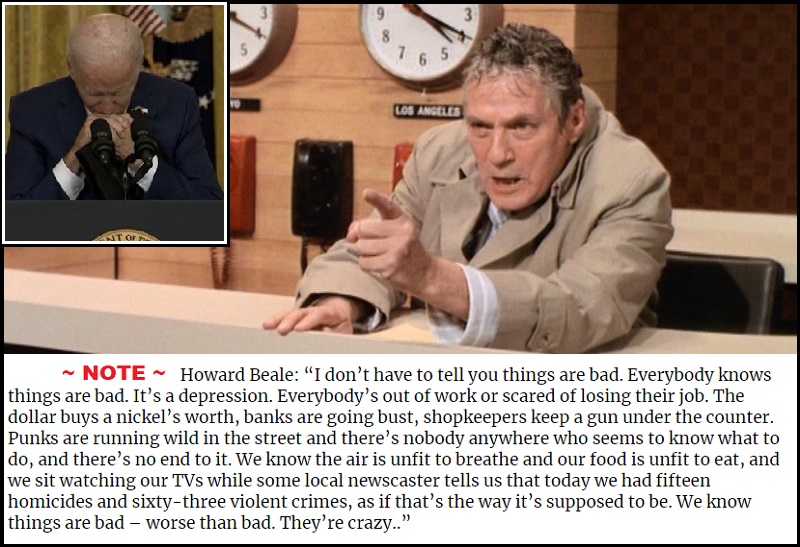
Well positioned Mr Beale. You must say we are “well positioned.”
Where “well positioned” means put loaves of bread and sausages where the flat screen televisions used to be located.
This is a reminder of why I warn against listening to the talking heads. Unlike advanced AI software, these mouthpieces speak from a biased perspective. On March 11, 2008, Jim Cramer told his audience on CNBC’s “Mad Money” that “Bear Stearns was fine!” At the time, the stock was going for $62 before crashing down to $2 only five days later.
When a viewer wrote in to Cramer to ask about Bear Sterns experiencing a liquidity crisis, Cramer shouted: “NO, NO, NO! BEAR STEARNS IS FINE! DO NOT TAKE YOUR MONEY OUT! If there’s one takeaway, Bear Stearns is not in trouble.” He added, “I mean, if anything, they’re more likely to be taken over. Don’t move your money from Bear. That’s just being silly. Don’t be silly.”
Cramer later tried to claim he never said to buy the stock, but was simply discussing the banking sector. He was trying to prevent a panic, he claimed. In reality, this man has repeatedly made poor calls, yet still remains on air. His screaming tirades are interrupted by commercials and his show is nothing more than the QVC of stocks.
Cramer is an entertainer. Even if I were to go on TV and make forecasts solely from my own viewpoint, I would be doing a disservice to my audience. If you’re looking for true analysis, then there is only one tool that is unbiased and capable of tracking every market around the world.
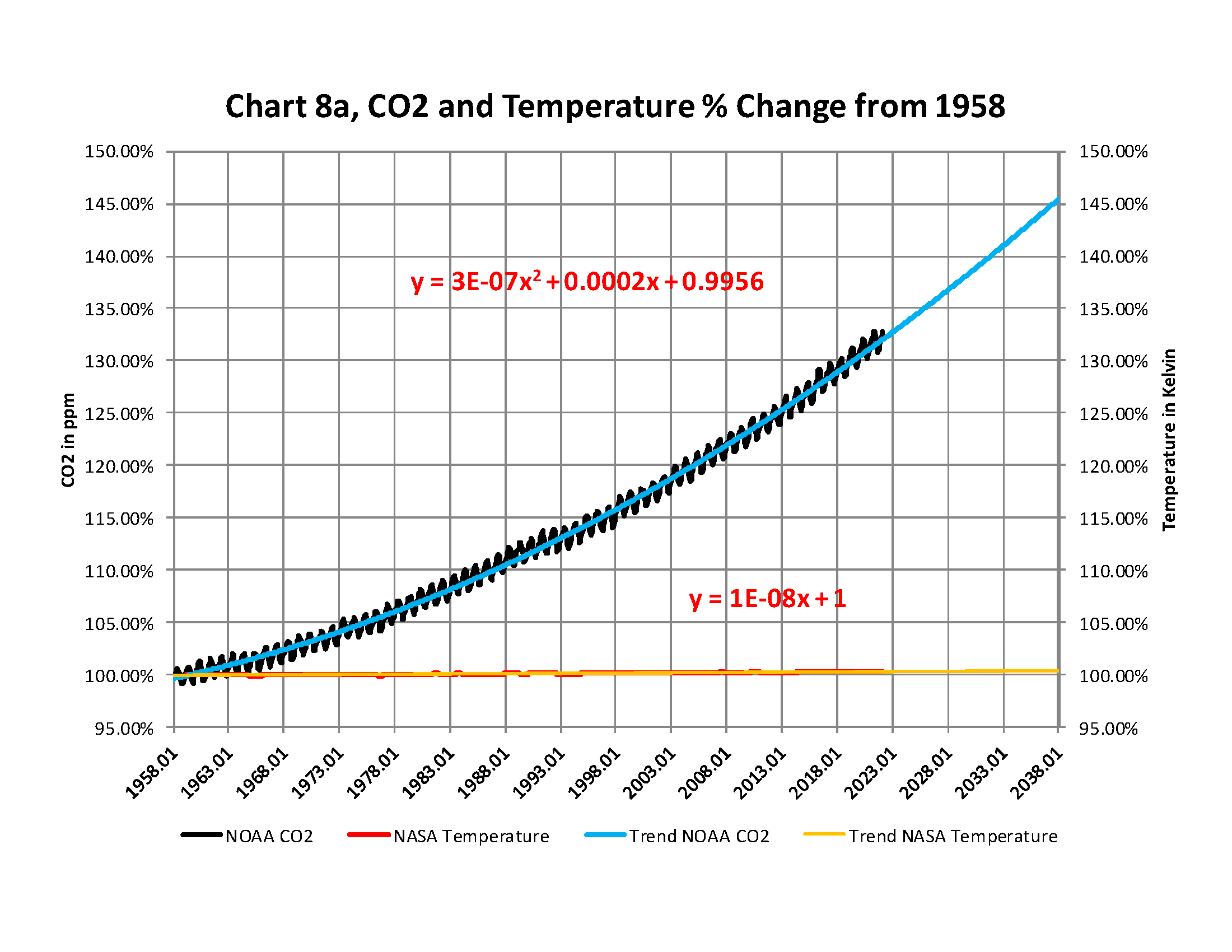
From the attached report on climate change for August 2022Data we have the two charts showing how much the global temperature has actually gone up since we started to measure CO2 in the atmosphere in 1958? To show this graphically Chart 8a was constructed by plotting CO2 as a percent increase from when it was first measured in 1958, the Black plot, the scale is on the left and it shows CO2 going up by about 32.0% from 1958 to August of 2022. That is a very large change as anyone would have to agree. Now how about temperature, well when we look at the percentage change in temperature also from 1958, using Kelvin (which does measure the change in heat), we find that the changes in global temperature (heat) is almost un-measurable at only .4%.
As you see the increase in energy, heat, is not visually observably in this chart hence the need for another Chart 8 to show the minuscule increase in thermal energy shown by NASA in relationship to the change in CO2 Shown in the next Chart using a different scale.
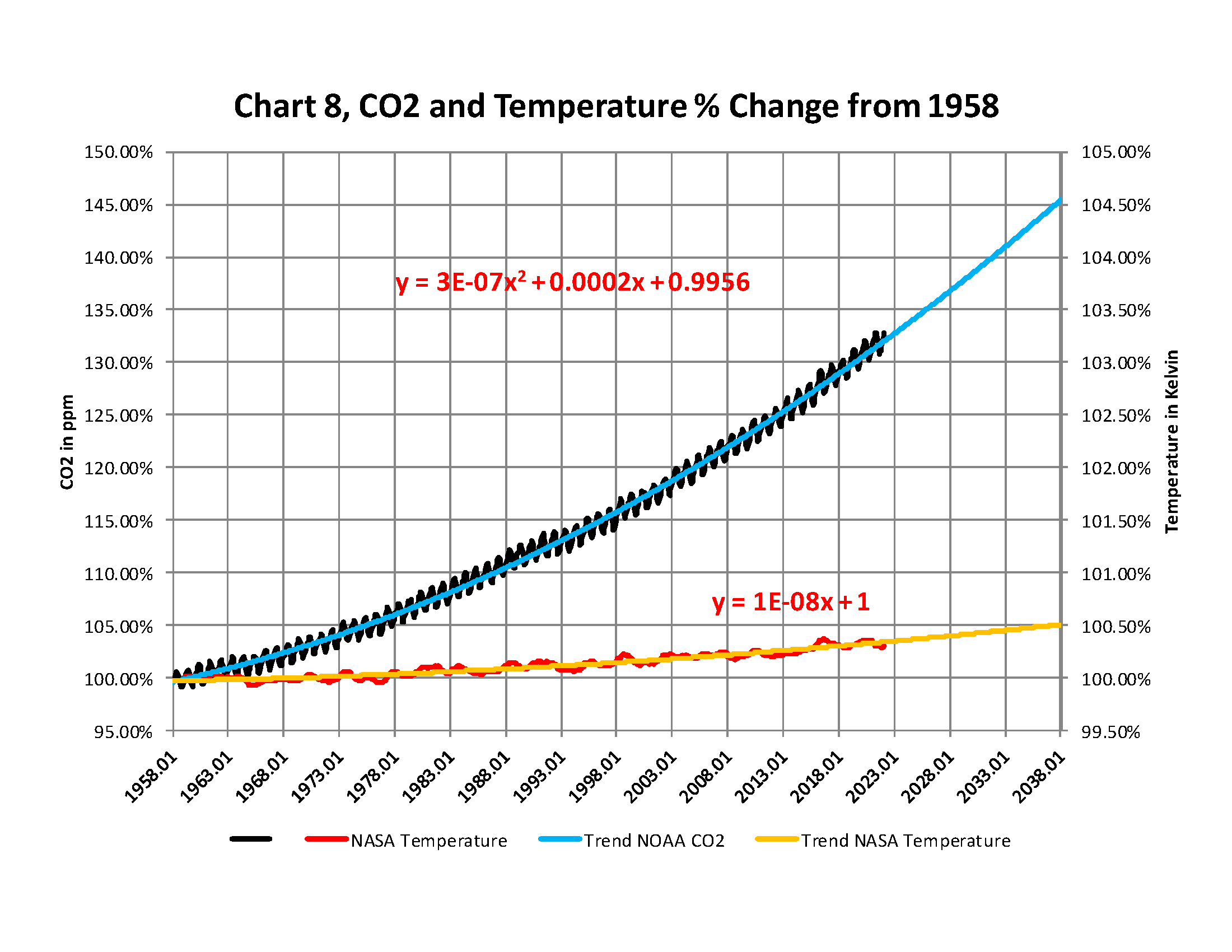
This is Chart 8 which is the same as Chart 8a except for the scales. The scale on the right side had to be expanded 10 times (the range is 50 % on the left and 5% on the right) to be able to see the plot in the same chart in any detail. The red plot, starting in 1958, shows that the thermal energy in the earth’s atmosphere increased by .40%; while CO2 has increased by 32.0% which is 80 times that of the increase in temperature. So is there really a meaningful link between them that would give as a major problem?
Based to these trends, determined by excel not me, in 2028 CO2 will be 428 ppm and temperatures will be a bit over 15.0o Celsius and in 2038 CO2 will be 458 ppm and temperatures will be 15.6O Celsius.
The NOAA and NASA numbers tell us the True story of the
Changes in the planets Atmosphere
The full 40 page report explains how these charts were developed .
Posted originally on the conservative tree house on September 18, 2022 | Sundance
If you combine government use of energy policy, government regulation on individuals around that energy policy, and the self-interested need to control political opposition, you discover one of the most effective ways to control human activity is to control their finance.
Canadian Prime Minister Justin Trudeau gave us a great example of that when he weaponized the power of the Canadian government to target the protesting truckers and those who support them. You might remember Trudeau’s government locked down bank accounts, froze assets, denied loans, blocked mortgages and generally confiscated the wealth and incomes of his political opposition without any due process; all because the people were challenging his totalitarian COVID dictates. {Go Deep}
Take those reference points as an overlay and now consider this undiscussed recent announcement from the Biden administration:
[White House] – President Biden often summarizes his vision for America in one word: Possibilities. A “digital dollar” may seem far-fetched, but modern technology could make it a real possibility.
A United States central bank digital currency (CBDC) would be a digital form of the U.S. dollar. While the U.S. has not yet decided whether it will pursue a CBDC, the U.S. has been closely examining the implications of, and options for, issuing a CBDC. If the U.S. pursued a CBDC, there could be many possible benefits, such as facilitating efficient and low-cost transactions, fostering greater access to the financial system, boosting economic growth, and supporting the continued centrality of the U.S. within the international financial system. However, a U.S. CBDC could also introduce a variety of risks, as it might affect everything ranging from the stability of the financial system to the protection of sensitive data.
Notably, these benefits and risks might vary significantly based on how the CBDC system is designed and deployed. That is why Executive Order 14067, Ensuring Responsible Development of Digital Assets, placed the highest urgency on research and development efforts into the potential design and deployment options of a U.S. CBDC. The Executive Order directed the Office of Science and Technology Policy (OSTP), in consultation with other Federal departments and agencies, to submit to the President a technical evaluation for a potential U.S. CBDC system.
Today, OSTP is publishing its report, Technical Evaluation for a U.S. Central Bank Digital Currency System, which lays out policy objectives for a potential U.S. CBDC system and analyzes key technical design choices for a U.S. CBDC system. The report also estimates the technical feasibility of building a CBDC minimum viable product and describes how a U.S. CBDC system might affect Federal operations. The report makes recommendations on how to prepare the Federal Government for a U.S. CBDC system. Importantly, the report does not make any assessments or recommendations about whether the U.S. should pursue a CBDC, nor does it make any decisions regarding particular design choices for a potential U.S. CBDC system. (read more)
When you read that full announcement, you realize they have already built the system.
If the system is built and they are now making policy recommendations for implementation, the question becomes ‘what’s the goal’?
We do not have to look far for the explanation.
the World Government Summit 2022 took place on March 29 and 30 in Dubai, hosting more than 4,000 individuals from 190 countries including senior government officials, heads of international organizations, and global “experts.” The invited participants presented ideas and worldviews from within their various fields of specialty.
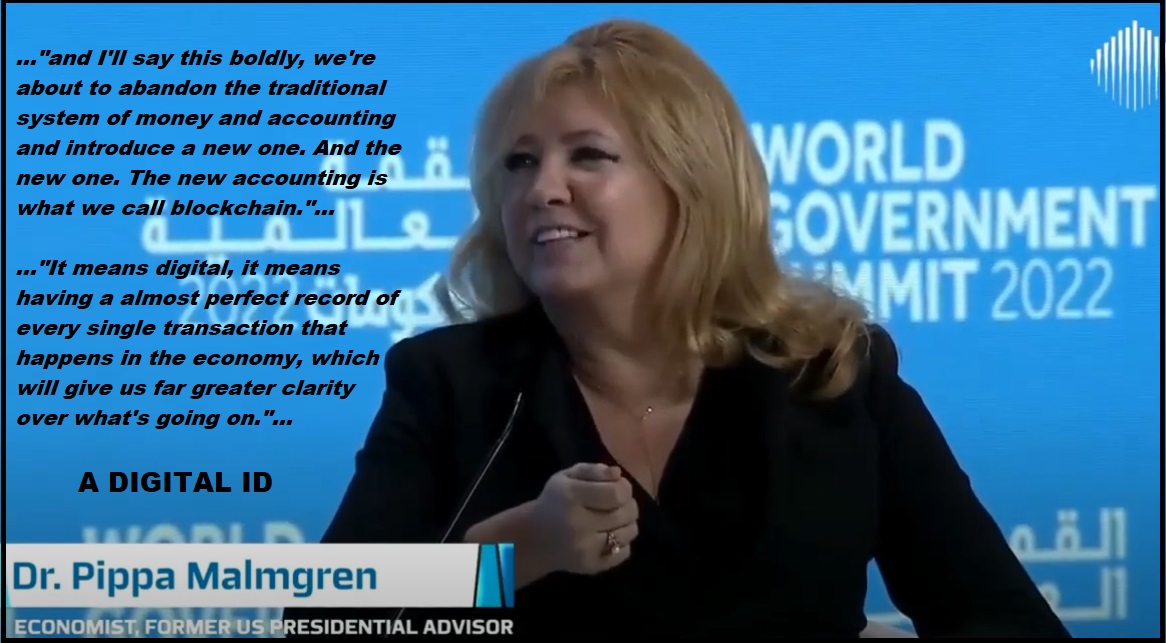
One presentation was from Dr. Pippa Malmgren, an American economist who served as special advisor on Economic Policy to President George W. Bush.
Her father, Harald Malmgren, served as a senior aide to US Presidents John F. Kennedy, Lyndon B. Johnson, Richard Nixon, and Gerald Ford. In this segment, Mrs. Malmgren says the quiet part out loud. Yes, they are no longer hiding the construct; indeed, as you will hear they are saying quite openly what the future will look like. WATCH (2 minutes):
Transcript – Dr. Malmgren: “What underpins a world order is always the financial system. I was very privileged. My father was an adviser to Nixon when they came off the gold standard in 71. And so, I was brought up with a kind of inside view of how very important the financial structure is to absolutely everything else.
And what we’re seeing in the world today, I think, is we are on the brink of a dramatic change where we are about to, and I’ll say this boldly, we’re about to abandon the traditional system of money and accounting and introduce a new one. And the new one. The new accounting is what we call blockchain.
It means digital, it means having a almost perfect record of every single transaction that happens in the economy, which will give us far greater clarity over what’s going on. It also raises huge dangers in terms of the balance of power between states and citizens.
In my opinion, we’re going to need a digital constitution of human rights if we’re going to have digital money. But also this new money will be sovereign in nature. Most people think that digital money is crypto, and private. But what I see our superpowers introducing digital currency, the Chinese were the first the US is on the brink, I think of moving in the same direction the Europeans have committed to that as well.
And the question is, will that new system of digital money and digital accounting accommodate the competing needs of the citizens of all these locations, so that every human being has a chance to have a better life? Because that’s the only measure of whether a world order really serves!”
The entry into a digital currency, needs a digital identity.
The end goal of a digital currency is why western political leaders have not been worried about following the COVID-19 spending demands from the World Economic Forum. {Go Deep}
When the global trade currency does not need to be pegged to anything to determine value, it is completely fiat. This is the current problem with global trade and transactions taking place in U.S. dollars, which arbitrarily lifts the standard of life for Americans while providing no similar benefit to other nations. That view became the underlying motive for Osama Bin Laden to target the World Trade Center, twin towers. That view was/is also the perspective carried by Barack Obama, that lay behind his “fundamental change” statement.
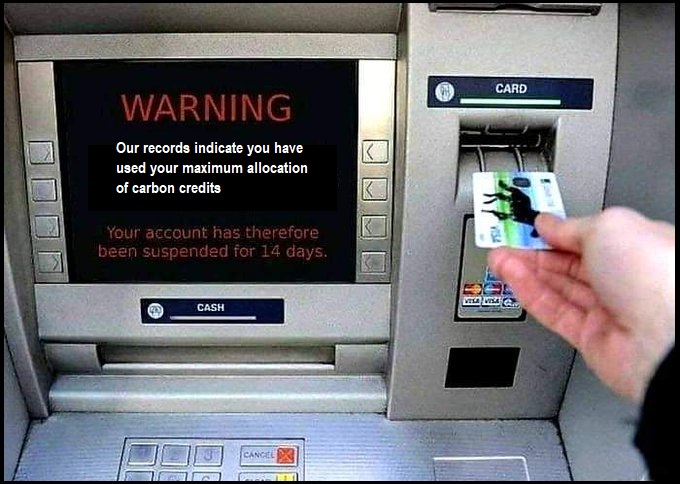
A digital currency allows ultimate control on a global basis by a one world government, or western system of collective governments, that can assign value. No other mechanism will have as much control over the life of a person than a digital currency that will create a system of transactional credits and debits, perhaps also influenced by your social credit score.
The digital currency requires a digital identity in order for apportionment based on your value to society. This is essentially an extension of the Fabian mindset into the world of financial transactions and monetary evaluations. Fabians believed that some form of socioeconomic tribunal would be needed in order for each citizen to be quantified according to their “worth” to society. The Chinese social credit score is a variant of that same concept.
The phrase “you didn’t build that,” when espoused by former President Obama and current Senator Elizabeth Warren is also based on this collective worldview. Both believe that individuals do not succeed independently, but rather gain their ability to grow wealth by using the resources of the larger society, infrastructure, labor and education. The phrase “it takes a village” to raise a child, as espoused by Hillary Clinton is another variant of the same collective advocacy.
A digital currency and digital identity is not a conspiracy theory, these “global leaders” are explaining it to us out loud. However, I am concerned that most will not hear it, or understand it, until it is too late.
Habibi Bros. Published originally on Rumble on September 16, 2022 1,627 Views
The Habibi Bros discuss the Rolling Blackouts in California and the energy crisis around the world. Buckle up and grab your drink cause you are going to need it.
I have created this site to help people have fun in the kitchen. I write about enjoying life both in and out of my kitchen. Life is short! Make the most of it and enjoy!
This is a library of News Events not reported by the Main Stream Media documenting & connecting the dots on How the Obama Marxist Liberal agenda is destroying America