The best laid plans of mice-like men simply collapsed when the shadow of President Trump entered the G7 in Charlevoix, Canada.
It’s one thing to talk about the boss when he’s out of town; it’s another thing entirely when he’s sitting next to you. POTUS Trump sets the standard for the scale of influence. Really, it’s such a basic truth – it becomes self-evident. Watch, it is remarkable:
President Trump has taken the Godzilla Trump meme to levels beyond ordinary imaginings. In advance of the G7 summit in Charlevoix, Canada Prime Minister Trudeau sounded the alarm and called in all like-minded allies to help fend off horrible Trump and his arsenal of tariffs.
L-R: European Council President Donald Tusk, British Prime Minister Theresa May, German Chancellor Angela Merkel, U.S. President Donald Trump, Canada’s Prime Minister Justin Trudeau, French President Emmanuel Macron, Japanese Prime Minister Shinzo Abe, Italian Prime Minister Giuseppe Conte and European Commission President Jean-Claude Juncker
French President Emmanuel Macron responded to Trudeau’s plea and arrived two-days early to coordinate the strategic message. Together they were looking for leverage in advance of Godzilla Trump’s arrival. Germany’s Angela Merkel, and U.K. Prime Minister Theresa May even brought non-G7 members European Council President Donald Tusk, and European Commission President Jean-Claude Juncker as back-up.
Apparently the six-against-one plan was considered unfair to the six, so they added two more. Unfortunately for Canada, France, Germany and the U.K., Japanese PM Shinzo Abe and Italian Prime Minister Giuseppe Conte are not foolish enough to take on Godzilla.
As an entirely predictable outcome, President Trump won again. It’s just so darned funny to watch this play out. The era of the titan is back, and deliciously the titan is an American President, Donald J Trump. He’s one guy, and he has them all surrounded; and he’s laughing the entire time. He’s impenetrable, sharp, funny as heck and monolithic in stature making all of his opposition look decidedly less-than.
Emmanuel Macron and Justin Trudeau try to use pontificating snark; it matters not. They seem like foolish gnats. Merkel, May, Tusk and Junker are standing there with their jaws agape. Shinzo Abe and Giuseppe Conte are trying not to laugh – but gosh, you can tell they are loving it. Titans just don’t get embarrassed, they dominate.
British Prime Minister Theresa May gave it the old college try on Friday warning both Trump and the EU of the dangers of entering a tit-for-tat trade war over tariffs, and urging both sides to instead focus on China’s excess steel production. Trump responded: “We’re going to deal with the unfair trade practices. If you look at what Canada, and Mexico, the European Union – all of them – have been doing to us for many, many decades. We have to change it. And they understandit’s going to happen,” Trump said.
Have a crumpet.
(Reuters) U.S. trading partners are furious over Trump’s decision last week to impose tariffs on steel and aluminum imports from Canada, the European Union and Mexico as part of his “America First” agenda. Some have retaliated.
Trump just doesn’t care.
Friday’s trade session, where G7 allies planned to confront the U.S. president over trade tariffs, had “some emotions” but was civilized and diplomatic, said the official who followed the talks.
“The other leaders presented their numbers and Trump presented his. As expected he did not budge.
[…] Expectations for a breakthrough at the summit, however, are low, with U.S. allies focused on avoiding rupturing the G7, which in its 42-year history has tended to seek consensus on major issues.
“It’s highly unlikely there will be a final communique,” a G7 official said on condition of anonymity.
[…] He plans to leave the summit four hours earlier than originally planned to fly to Singapore to meet with North Korean leader Kim Jong Un, the White House said. (link)
Oh man, this is too funny. Remember the Bowing Ball metaphor? Well, in order for the G6+1 grand plan of Emmanuel from France and Justin from Canada to work they would need the U.K, Germany, Japan and Italy to agree…. outlook not-so-good.
President Trump sits down for a bilateral meeting with half of the dynamic duo. President Trump starts out the public comments with a joke-not-joke that Justin will drop all current trade tariffs against the U.S. and Trump will happily concur. ROFLMAO. Immediately drawing out the trade hypocrisy at the heart of matter. Must Watch:
.
The disconcerted look on Justin’s face is priceless.
Where does renowned financial and geopolitical analyst Martin Armstrong see big trouble brewing? Look no further than the bond market. Armstrong explains, “The bond market is going down. . . . We’ve already started into it. . . .You have to understand both Japan and Europe have destroyed their bond markets. They have completely and utterly destroyed them. They are the buyers. That’s it. There is no pension fund that can buy 10-year paper at 1.3% when they need 8% to break even. They are locking in a 10 year loss. They can’t do it. We have been helping major funds shift into equities because it is the only place they can go. . . . Once you start seeing the cracks in Europe, you are going to see interest rates rise faster than you have ever contemplated in your life. There is nobody in their right mind that can buy an Italian bond at 1.3%. It’s just not going to happen. Once the ECB is forced to stop, those rates are going to jump to 10% instantaneously. Once it starts to crack, that’s it, it’s gone. What is going to make everyone know it is cracking is when you see rates going up dramatically, and the ECB is at a point it just can’t buy any more.” Armstrong does not see a big War in the near term, but one is brewing in the Middle East. What Armstrong does see right now is “increasing civil unrest.” On gold, Armstrong sees the yellow metal “fighting a stronger dollar” but predicts it will have its day sometime after 2020 to 2021. Join Greg Hunter as he goes One-on-One with financial and geopolitical expert Martin Armstrong. Donations: https://usawatchdog.com/donations/
I hope you’re keeping well? More news from the “EU beacon of light” for you. I’ve enclosed an article regarding Irish pension money in Italian bonds. This is very very scary if true and we really are heading for a disaster from which a little country like ours won’t recover if we ever did anyway! In the article Mercer says that “after the financial crisis the ECB put in place a system to limit a contagion”.
Is this just more whistling in the dark? I believe it is.
Kind regards,
E
ANSWER: The very design of the euro promotes contagions. Because there was no national debt, the “reserve” status for banks is the debt of all member states. In the United States, ONLY the national debt federally is acceptable. Therefore, if California or Illinois goes bust they do not create a contagion that brings down the whole. Even the government has come out and warned there may be a contagion will emerge if Italy fails and/or breaks with the EU.
The euro crashed BECAUSE there is no such prevention of a contagion. That is totally FALSE and a made up excuse. Fears of the new Italian government of the five-star movement and the right-wing populist Lega came into the markets and sent the euro crashing. A risk of contagion sparked by Italy infecting the entire Eurozone was “not yet completely off the table,” said ECB Vice President Vitor Constancio. This applies in particular if the sharp rise in Italian government bond yields. At the same time, Constancio came out and said that US Treasuries have the greatest risk because the Fed keeps raising interest rates. There is no such mechanism to prevent contagions – PERIOD! It is all smoke & mirrors.
QUESTION: Mr. Armstrong; There are these people so desperate to argue that cryptocurrency will change the world, I have heard the same pitch behind gold and I suspect most are just goldbugs who gave up and moved to cryptocurrencies. The same arguments of fiat and central banks are at the base of this as well. Do you think that cryptocurrency can somehow emerge as a solution after the Crash and Burn? How can there be thousands of these cryptos? If the dream they pitch is even plausible, then does there not have to be just one cryptocurrency?
Thank you
Hank
ANSWER: We have to ask what is at the core of this trend. In essence, it is the very same trend that put Trump in office. The entire 2007-2009 global financial crisis and bank bailout created an entirely new “skepticism” of government in most countries. This is where the digital assets have come into play. Are they capable of altering or influencing traditional global monetary policy? The answer: absolutely no possible way. To accomplish that we MUST end socialism. I doubt these people really understand the full scope of structural changes that would need to be made to move to any cryptocurrency. Adam Smith’s Invisible Hand rules the question. Until it is in the self-interest of those in power to hand back the scepter of power itself, there is just no way to accomplish such a monumental change without the house burning down FIRST. The other possibility is that governments just usurp the crypto world like they confiscated gold and then control it for taxes. They do want to eliminate all paper currency to collect 100% taxes they believe are avoided. They also pitch it would end crime as we know it. The black market would then no doubt emerge as barter once again. To think that cryptocurrency can defeat central banks and governments is really far-fetched.
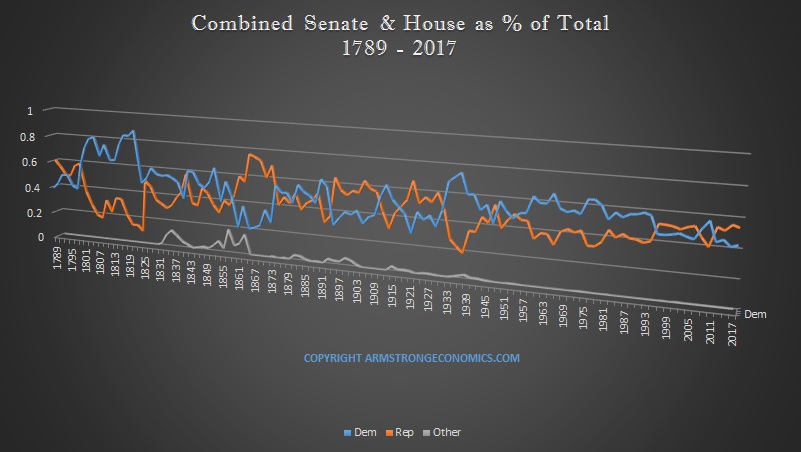
The political changes are monumental. Politicians can no longer run for office promising benefits by robbing the rich and handing it to the poor. In order for crypto assets to replace money, it would require a profound change in politics. It is not simply central bank money. The entire pitch of cryptocurrency is that it will take the creation of money away from central banks and thus government. Think that through. Career politicians would be completely at a loss. They have no qualifications with respect to management of an economy. The Democrats have been selling the same promise since FDR’s first election. Just look at the chart above and you will see that the Democrats have been in a bear market ever since FDR. They pretend that someone cannot get rich without oppressing the poor. Wealth to them is very Marxist and a zero-sum game. They are stuck in the idea that someone makes a product and the capitalist profits on their labor. They fail to comprehend that someone can invent something like Google, Amazon, Microsoft, or our Socrates Platform that by no means oppressed some poor individual to create it. They are frozen in time and cannot comprehend the Invisible Hand of Adam Smith. This is why I say that socialism is dead and indeed the entire cryptocurrency movement is part of that collapse in the public’s confidence in government.
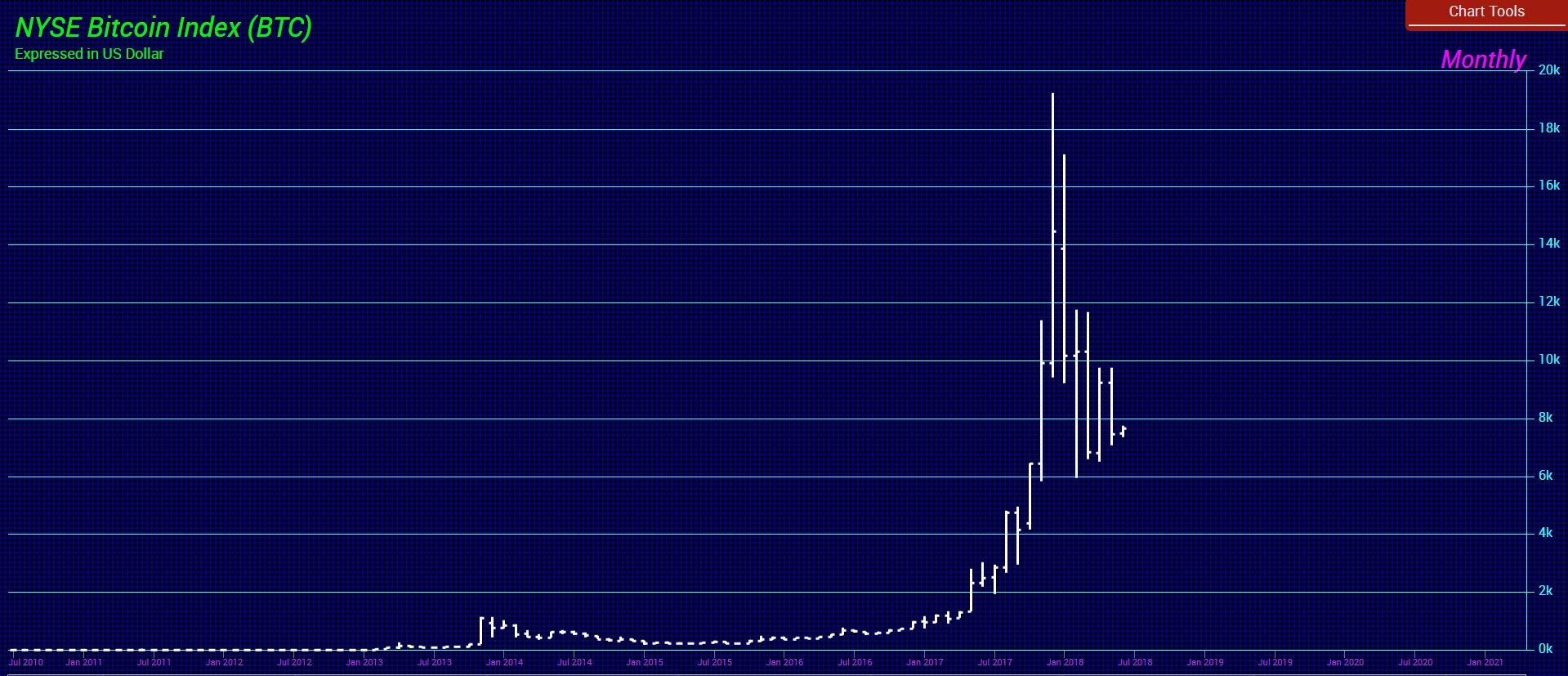
Additionally, cryptocurrencies are promising to end fiat currencies, and in reality, it is a return to a sort of commodity-based money not so dissimilar from a gold standard. The problem with all of this is the idea that if we somehow returned to a gold standard, then money would be worth “something” as if it would never change in value. That just cannot exist and NEVER has. Whatever you define as money, it will rise and fall against assets. That is fundamental to the economy. It is why communism failed. Here is a chart of Bitcoin. It has risen and crashed. It did not hold on to value permanently at some fixed level. This is why I say it is an “asset class” fluctuating against the currency – the dollar.
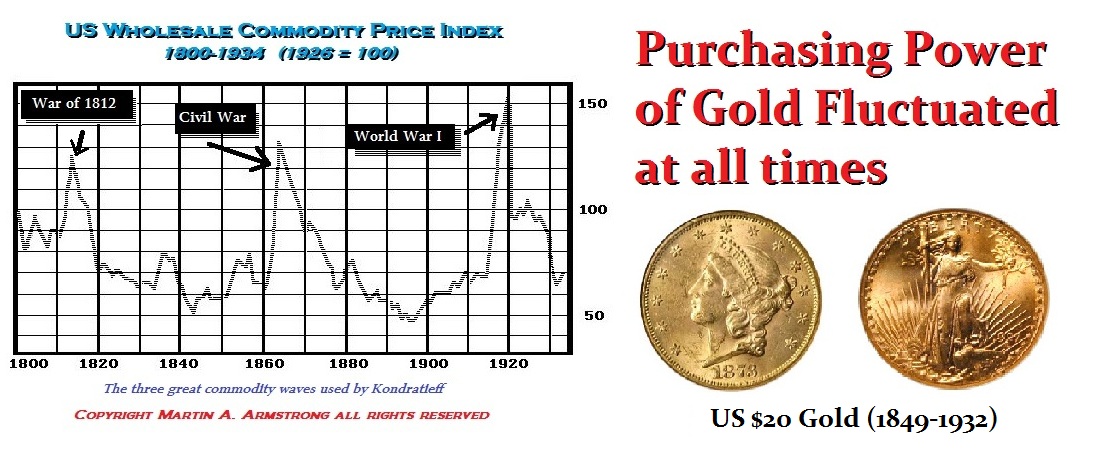
Here is a chart of the rise and fall of the inflation index when gold was money. These very swings in the economy are what Kondratieff studied and created his long wave. Gold did NOT prevent the boom and bust cycle. That is part of nature that CANNOT be eliminated. When gold was money and the stock market rose in value, that meant money declined in purchasing power which was gold. It acted economically NO DIFFERENT it money were paper, seashells, or cattle.
So, will cryptocurrencies replace paper currency? The actual amount of transactions today in physical money is less than 5%. So we are already using electronic money every day, such as when you buy something online. So will that emerge eventually as a cryptocurrency? Perhaps. There is nothing to prevent that once we get the crash and burn, and the “burn” is the replacement of the political system.
Will there be only ONE cryptocurrency for the entire world? Unlikely. I would probably bet on each government adopting a cryptocurrency per nation and prohibit the use of “foreign” cryptocurrency domestically. We also must respect that government WANTS to create some sort of cryptocurrency to ensure that everyone pays taxes. Australia already uses the phrase – “Cash is for Criminals.”
What I disagree with is the notion that somehow cryptocurrency will force political change and government will simply yield and hand back the scepter of power when politely asked. That has NEVER taken place, not even one time throughout history. Governments do NOT voluntarily surrender power. They will use whatever power they have to the bitter end. So, sorry. History is on my side on this one. Dream all you want. Human nature never changes throughout the centuries. Those in power will act in their own self-interest and defend against the loss of that power.
We are headed into a major economic crisis. Cryptocurrency will not save the day. We have to crash and burn. That is the ONLY way such economic imbalances have been resolved throughout history. That is NOT my personal OPINION. It is simply reality
Earlier today, following discussions with Japanese Prime Minister Shinzo Abe and U.S. President Donald Trump Secretary of State Mike Pompeo held a press conference to discuss “C-VID”, the Complete, Verifiable and Irreversible Denuclearization of the Korean Peninsula. WATCH:
[Transcript] SANDERS: Good afternoon. Thanks for being patient with us. Obviously, there’s a great deal of interest on the upcoming summit with the North Koreans. We have Secretary Pompeo here, who will make some brief opening remarks and then take questions on that topic. As you know, the President has already done a press conference today, so we’ll keep questions limited to that. And we’ll be around the rest of the day to answer other news of the day.
Thanks. With that, Mr. Secretary.
SECRETARY POMPEO: Thanks, Sarah.
QUESTION: Sarah, are you going to take questions after (inaudible)?
SECRETARY POMPEO: Yes, I’m going to take a couple questions. (Laughter.) A couple. Good afternoon. It’s great to be joining you all here today. Early in his presidency, President Trump made a commitment to address the threat of North Korea, which has been a threat to our nation for far too long.
President Trump has been, and continues to be, committed to ridding the United States and the world of threats posed by North Korea’s weapons of mass destruction and ballistic missile programs. These programs threaten our homeland, our allies and partners, and the broader non-proliferation regime. North Korea’s past activities also make clear that it is proliferation to other actors that creates a risk, in addition to the primary risks. It has supporting infrastructure that is also of concern.
In early 2017, the Trump administration decided on a policy we have referred to as the “maximum pressure campaign.” The campaign enacted the strongest economic and diplomatic sanctions against North Korea in history. The goal was to set the conditions for the DPRK to make a strategic decision to denuclearize as the best means by which it will achieve its own security.
American leadership rallied the international community to send a strong message to Chairman Kim Jong Un and the world that we would not stand for the DPRK’s illegal weapons programs. The President’s bold decision to meet with Chairman Kim Jong Un grew from this incredibly strong and targeted campaign. The President’s policy directly led to the historic summit that will take place on June 12th in Singapore.
Back on March 8th, Chairman Kim Jong Un expressed his desire to meet with President Trump as soon as possible. And then on May 9th, I met with Chairman Kim Jong Un in Pyongyang and explained America’s expectations for denuclearization.
At that time, we also secured the release of three Americans: Kim Dong-chul, Tony Kim, and Kim Hak-song. We view this as a sign of goodwill from Chairman Kim Jong Un.
The United States and North Korea have been holding direct talks in preparation for a summit, and North Korea has confirmed to us its willingness to denuclearize. A comprehensive whole-of-government effort in support of President Trump’s upcoming summit is under way. White House- and State Department-led advance teams are finalizing logistical preparations and will remain in place in Singapore until the summit begins. The President continues to follow every development closely, and is getting daily briefings from his national security team.
The fact that our two leaders are coming to the table shows that the two sides are very serious. The diplomatic model we’ve used to date is different from past efforts. Our efforts give us hope that we can find real success where past efforts have fallen short.
President Trump is hopeful, but he’s also going into the summit with his eyes wide open. We’ve seen how many inadequate agreements have been struck in the past. And you can be sure that President Trump will not stand for a bad deal. The United States has been clear, time and time again, that complete, verifiable, and irreversible denuclearization of the Korean Peninsula is the only outcome that we will find acceptable.
The President recognizes that North Korea has great potential, and he looks forward to a day when sanctions on the DPRK can begin to be removed. However, that cannot happen until the DPRK completely and verifiably eliminates its weapons of mass destruction programs.
President Trump and Chairman Kim will certainly also discuss security assurances for the DPRK, establishing a peace regime, and improving relations between our two countries. Until we achieve our goals, the measures that the world, alongside the United States, has put on the regime will remain. In the event diplomacy does not move in the right direction, these measures will increase. Throughout the entire process, the United States has been unified with Japan and South Korea in response to the threats from North Korea.
I will be traveling with my — excuse me, I will be traveling to meet with my Japanese and South Korean counterparts after the summit to continue to coordinate with them. I will also stop in Beijing following the Singapore summit. I’ll provide them with an update and underscore the importance of fully implementing all sanctions that are imposed on North Korea.
President Trump recognizes North Korea’s desire for security and is prepared to ensure a DPRK free of its weapons of mass destruction is also a secure North Korea.
President Trump has made it clear that if Kim Jong Un denuclearizes, there is a brighter path for North Korea and its people. We envision a strong, connected, secure, and prosperous North Korea that is integrated into the community of nations. We think that the people of the United States and North Korea can create a future defined by friendship and collaboration, and not by mistrust and fear.
We believe that Chairman Kim Jong Un shares this positive vision for the future, and we are committed to finding a path forward. And we assume and hope that that belief is sincere.
We’re looking forward to being in Singapore in just a few days.
SANDERS: As a reminder, we’ll take just a few questions before the Secretary has to depart.
Roberta.
QUESTION: Thank you. What progress have you made in narrowing the gap in your understanding of denuclearization and North Korea’s definition of denuclearization? Has there been progress in bringing that definition closer together?
SECRETARY POMPEO: Yes.
QUESTION: Can you describe that a little bit?
SECRETARY POMPEO: No.
(Laughter.)
SANDERS: That was quick. Jon Decker.
QUESTION: Thank you, Sarah. Thank you, Secretary Pompeo. As you mentioned in your remarks, North Korea, in the past, has reneged on prior agreements that it’s made with the U.S. government. So I have two questions for you. The first question has to do with your experience meeting with Kim Jong Un. Do you trust him? And my second question has to do with the negotiations that are upcoming with North Korea. Who, in your opinion, has the upper hand in the negotiations, and why?
SECRETARY POMPEO: So with respect to your first question, I’ve had the chance to meet with Chairman Kim Jong Un twice now. I can tell you he is very capable of articulating the things that he is prepared to do, present clearly the challenges that we all have to overcome. It’s why the two leaders are meeting. It’s the opportunity to lay those out clearly between the two leaders so that we can see if we can find a path forward together that achieves the outcomes that both countries want.
And your second question?
QUESTION: Who has the upper hand in the negotiations?
SECRETARY POMPEO: Yeah. We don’t think about it in terms of who has the upper hand. We know this has been a long, intractable challenge. It’s gone on for decades. The President has said repeatedly: Previous administrations weren’t prepared to do what we’ve done already. It’s not about who has the upper hand. It’s about trying to find a way where the two sides can come to an understanding, where we can get concrete steps, not just words, that resolve this challenge.
Pamela.
QUESTION: Mr. Secretary, first of all, the President said that he doesn’t believe he needs to prepare very much ahead of this summit. Do you think that’s a prudent approach?
And also, I want to get your reaction to Rudy Giuliani’s comments that “Kim Jong Un got back on his hands and knees and begged” for the summit to go back on — whether you think he should be weighing in on these international affairs and whether you agree with that assessment.
SECRETARY POMPEO: So back to your second question. I took him as it being a small room and not being serious about the comments. I think it was a bit in jest, and —
QUESTION: Do you think it could jeopardize the summit or —
SECRETARY POMPEO: We’re moving forward. We’re focused on the important things. I know Rudy. Rudy doesn’t speak for the administration when it comes to this negotiation and this set of issues.
With respect to your first question, you know, progress — we’re making progress, inch by inch. And we’re going to travel there. This is different. The approach that President Trump is taking is fundamentally different. In the past, there have been months and months of detailed negotiations, and it got nowhere. This has already driven us to a place we’ve not been able to achieve before.
SANDERS: Dave Boyer.
QUESTION: Thank you, Mr. Secretary. The President said today that if the Singapore meeting goes well, he’d like to bring Kim Jong Un to Washington, possibly, for further meetings. Has Kim Jong Un invited the President to come to North Korea?
SECRETARY POMPEO: So I don’t want to talk to you about the conversations that have been had between the North Korean side and the United States. I’ll leave that for the President to talk to.
But I do want to get to — and this comes back to the other question that you asked about the President’s preparation. So in my previous role — and I’ve said this before; you can look it up — there were few days that I left the Oval Office after having briefed the President that we didn’t talk about North Korea. So over months and months, days and days, President Trump has been receiving briefings on this issue about the military aspects of it; the commercial, economic aspects of it; the history of the relationship. And in the past few months, there have been near-daily briefings, including today, where we have been providing the President all the information that he needs. And I am very confident that the President will be fully prepared when he meets with his North Korean counterpart.
QUESTION: Just having met the man twice now, what can you tell us about what opinions you’ve formed of Kim Jong Un as a person?
SECRETARY POMPEO: Yeah. So I haven’t spent that much time with him. What I have said publicly is he has indicated to me, personally, that he is prepared to denuclearize; that he understands that the current model doesn’t work, that he’s prepared to denuclearize.
And that, too, he understands that we can’t do it the way we’ve done it before — that this has to be big and bold, and we have to agree to making major changes. We can’t step through this over years, but rather need to acknowledge it will take some amount of time, that this doesn’t happen instantaneously. But that the model for succeeding — security assurance; and political normalization; and denuclearization completely, verifiably, and irreversibly — for that to take place, we’ve got to make bold decisions.
And I’m hopeful that Chairman Kim Jong Un is prepared to make that decision for his country. A big shift in his strategic understanding of his security.
SANDERS: Ayesha.
QUESTION: Thank you. So you said that you — that the President is prepared to talk about security guarantees for North Korea. We have seen in this administration that you can — that when new administrations come in, they can undo things that prior administrations have done. How can President Trump guarantee long-term security for North Korea and for Kim, in particular?
SECRETARY POMPEO: Well, look, we’re going to have to do things that convince Chairman Kim that that’s the case. All right? That’s what we’ll have to do.
So let me give you an example. We are hopeful that we will put ourselves in a position where we can do something the previous administration didn’t do. Right? They signed a flimsy piece of paper, and we’re hoping to submit a document that Congress would also have a say in — that would give currency and strength and elongation to the process, so that when administrations do change, as they inevitably do, and this one will — six and half years from now — when that takes place, that Chairman Kim will have comfort that American policy will continue down the same path, on the course that we hope we’re able to set in Singapore.
SANDERS: We’ll take one last question. Zeke.
QUESTION: Thank you, Mr. Secretary. At the top of your remarks — first, to follow up briefly on your comments just about Asia. When you say a “document” that Congress would sign off on, are you referring to a treaty?
Then second, at the top of your remarks, you said that there’s also this threat to the United States and its allies from the North Koreans’ WMDs, as well as ballistic missiles. Is that a condition for the President in any negotiation agreement with Chairman Kim, that its ballistic missile program and chemical weapons also be part of that?
And third, finally, can you discuss the format of the meeting between the President and Chairman Kim? What will it look like? Who will be there?
SECRETARY POMPEO: So I’ll leave it to the White House to talk about the format of the meetings when the time is right.
With respect to proliferation risk, it’s very real. There is a history of that, with respect to North Korea and some of our other difficult challenges in the world today. They are connected. The reason you want complete, verifiable, and irreversible is precisely that. To the extent there remain stockpiles, knowledge bases, warehouses, systems, infrastructure, fissile material production facilities — I could go on — to the extent those remain, the risk of proliferation continues. And it’s our aim, through the CVID process and providing the security assurances that Chairman Kim will want, that we can greatly reduce the risk that proliferation ever happens as a result of North Korean actions.
SANDERS: Thanks so much —
QUESTION: One more please, Sarah.
QUESTION: Mr. Secretary, can you explain the President’s shift — when he’s gone from talking about defining success for this meeting as denuclearization of the Peninsula, to now talking about the need for more meetings? Can you explain what happened there and why this shift? And can you also describe your disagreements over North Korea internally with the national security advisor?
SECRETARY POMPEO: Yeah, with respect to the second one, I’ve read a little bit about this. And I love good fiction as next as — as much as the next person, but it is without foundation, so much so that — I’ll be polite, since I’m a diplomat now. Suffice to say, those articles are unfounded and a complete joke.
QUESTION: Surely, there had to be — must have been some —
SECRETARY POMPEO: Oh, sure. Ambassador Bolton and I will disagree with great, great consistency over time, I’m confident. Right? We’re two individuals. We’re each going to present our views. I’m confident that will happen on issues from how long this press conference ought to go — (laughs) — to issues that really matter to the world.
So it’s absolutely the case that Ambassador Bolton and I won’t always agree, and I think the President demands that we each give him our own views.
QUESTION: (Inaudible.)
SECRETARY POMPEO: Yeah. So you had a first — your first question, I’ll try to answer. I’ll try to answer your first question, too. I don’t see the shift as disjunctive as you do. The President has always understood that this was a process. It’s been very clear that there would — that it would always take a great deal of work to do this.
So I think your — you can interpret it how you will, but I think your characterization of that also doesn’t reflect the President’s understanding. I think his understanding about this process has been pretty consistent since I’ve been working with him now, almost a year and a half ago.
Prior to the G7 meeting in Canada, President Trump and Japanese Prime Minister Shinzo Abe are holding discussions at the White House. Both are anticipated to deliver remarks at a 2:00pm EDT joint news conference.
I have created this site to help people have fun in the kitchen. I write about enjoying life both in and out of my kitchen. Life is short! Make the most of it and enjoy!
This is a library of News Events not reported by the Main Stream Media documenting & connecting the dots on How the Obama Marxist Liberal agenda is destroying America








 Centinel2012