How Convenient, Biden State Dept Says They Will No Longer Publish List of U.S. Weapons Given or Sold to Foreign Countries


Posted originally on the conservative tree house on August 26, 2022 | Sundance 

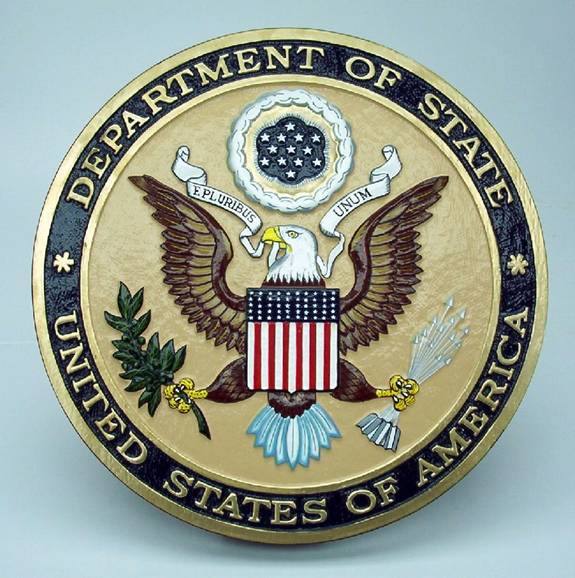
Buried inside Section 5114(b)(4) of the National Defense Authorization Act for Fiscal Year 2022 was a repeal of 1994 law that required the U.S. State Department to publish an annual list of arms sales to foreign countries.  The “World Military Expenditures and Arms Transfers” report (WMEAT) put sunlight every year on what weapons the U.S. was selling to foreign countries.

Conveniently timed with the $60+ billion aid package to Ukraine, the U.S. State Dept, now says the WMEAT report will not be published any longer.  If a person was to believe the Ukraine arms deals were essentially money laundering operations, well, this announcement by the State Dept. might be interpreted as a way to hide it. [LINK]

State Dept – WMEAT 2021, which the Department of State published in December 2021, is the final edition of World Military Expenditures and Arms Transfers (WMEAT). Section 5114(b)(4) of the National Defense Authorization Act for Fiscal Year 2022 repealed the 1994 statutory provision that required the Department of State to publish an edition of WMEAT every year. Consistent with this repeal, the Department of State will cease to produce and publish WMEAT.

Copies of all editions of WMEAT dating from 1974 to 2021 remain publicly accessible as Adobe PDF or Excel spreadsheet documents  (LINK)

Jerome Powell Says Fed Effort to Make U.S. Economy Smaller Will Create “Some Pain” for Americans During Biden Transition to Clean Energy


Posted originally on the conservative tree house on August 26, 2022 | Sundance

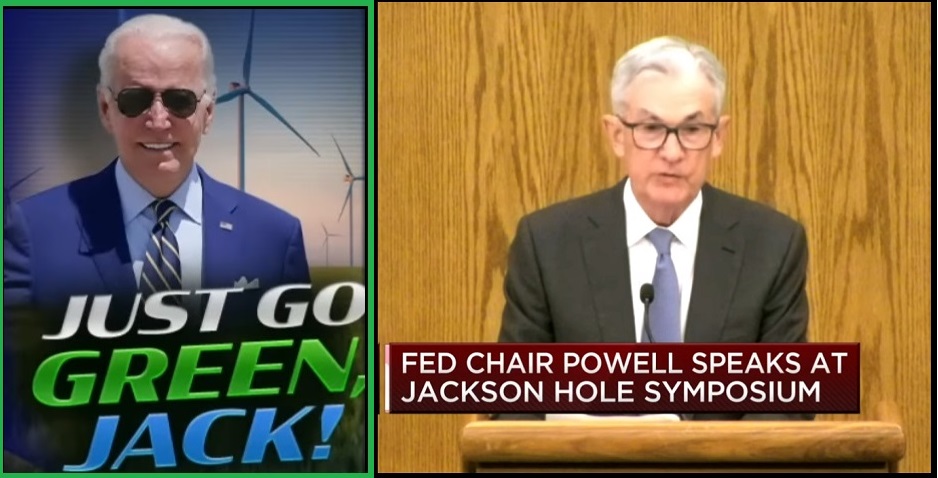
When Chairman Powell says things are really, really going to suck as monetary policy tries to support Biden’s goals to reduce energy supplies, will people believe him?

The agenda of the federal reserve was clearly outlined today in the remarks from Chairman Powell in Jackson Hole, Wyoming.  The Fed chair is trying to manage the economic policy transition by reducing economic activity to match intentionally diminished energy supplies.  Lowering economic activity drops demand for energy. Unfortunately, as admitted by Powell today, this means a period of “some pain” for Americans as the central banks join together in an effort to lower consumption.  WATCH:

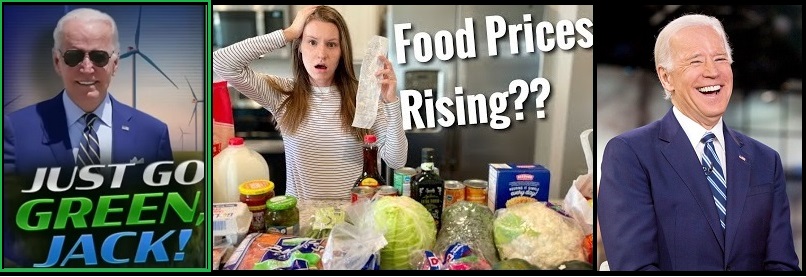
What does “some pain” mean?  It means lower incomes, higher prices, lowered standards of living and more scarce resources.   During this transition to owning nothing and being happy about it, the pain is your wealth being stripped as the economy is intentionally diminished.

We will not be able to afford much; we won’t be able to afford the foods we want; we will not be able to purchase anything except the essentials, and those essentials will cost much more; we won’t be able to vacation, travel, or enjoy recreational activities; we won’t be able to afford any indulgences; but at the end of the process, we will learn to live more meager existences based on lowered expectations needed for sustaining the planet.   Pay no attention to the elites who don’t have those concerns, comrade.

[Transcript] – POWELL: “At past Jackson Hole conferences, I have discussed broad topics such as the ever-changing structure of the economy and the challenges of conducting monetary policy under high uncertainty. Today, my remarks will be shorter, my focus narrower, and my message more direct.”

The Federal Open Market Committee’s (FOMC) overarching focus right now is to bring inflation back down to our 2 percent goal. Price stability is the responsibility of the Federal Reserve and serves as the bedrock of our economy. Without price stability, the economy does not work for anyone. In particular, without price stability, we will not achieve a sustained period of strong labor market conditions that benefit all. The burdens of high inflation fall heaviest on those who are least able to bear them.

Restoring price stability will take some time and requires using our tools forcefully to bring demand and supply into better balance. Reducing inflation is likely to require a sustained period of below-trend growth. Moreover, there will very likely be some softening of labor market conditions. While higher interest rates, slower growth, and softer labor market conditions will bring down inflation, they will also bring some pain to households and businesses. These are the unfortunate costs of reducing inflation. But a failure to restore price stability would mean far greater pain.

The U.S. economy is clearly slowing from the historically high growth rates of 2021, which reflected the reopening of the economy following the pandemic recession. While the latest economic data have been mixed, in my view our economy continues to show strong underlying momentum. The labor market is particularly strong, but it is clearly out of balance, with demand for workers substantially exceeding the supply of available workers. Inflation is running well above 2 percent, and high inflation has continued to spread through the economy. While the lower inflation readings for July are welcome, a single month’s improvement falls far short of what the Committee will need to see before we are confident that inflation is moving down.

We are moving our policy stance purposefully to a level that will be sufficiently restrictive to return inflation to 2 percent. At our most recent meeting in July, the FOMC raised the target range for the federal funds rate to 2.25 to 2.5 percent, which is in the Summary of Economic Projection’s (SEP) range of estimates of where the federal funds rate is projected to settle in the longer run. In current circumstances, with inflation running far above 2 percent and the labor market extremely tight, estimates of longer-run neutral are not a place to stop or pause.

July’s increase in the target range was the second 75 basis point increase in as many meetings, and I said then that another unusually large increase could be appropriate at our next meeting. We are now about halfway through the intermeeting period. Our decision at the September meeting will depend on the totality of the incoming data and the evolving outlook. At some point, as the stance of monetary policy tightens further, it likely will become appropriate to slow the pace of increases.

Restoring price stability will likely require maintaining a restrictive policy stance for some time. The historical record cautions strongly against prematurely loosening policy. Committee participants’ most recent individual projections from the June SEP showed the median federal funds rate running slightly below 4 percent through the end of 2023. Participants will update their projections at the September meeting.

Our monetary policy deliberations and decisions build on what we have learned about inflation dynamics both from the high and volatile inflation of the 1970s and 1980s, and from the low and stable inflation of the past quarter-century. In particular, we are drawing on three important lessons.

The first lesson is that central banks can and should take responsibility for delivering low and stable inflation. It may seem strange now that central bankers and others once needed convincing on these two fronts, but as former Chairman Ben Bernanke has shown, both propositions were widely questioned during the Great Inflation period.1 Today, we regard these questions as settled. Our responsibility to deliver price stability is unconditional. It is true that the current high inflation is a global phenomenon, and that many economies around the world face inflation as high or higher than seen here in the United States.

It is also true, in my view, that the current high inflation in the United States is the product of strong demand and constrained supply, and that the Fed’s tools work principally on aggregate demand. None of this diminishes the Federal Reserve’s responsibility to carry out our assigned task of achieving price stability. There is clearly a job to do in moderating demand to better align with supply. We are committed to doing that job.

The second lesson is that the public’s expectations about future inflation can play an important role in setting the path of inflation over time. Today, by many measures, longer-term inflation expectations appear to remain well anchored. That is broadly true of surveys of households, businesses, and forecasters, and of market-based measures as well. But that is not grounds for complacency, with inflation having run well above our goal for some time.

If the public expects that inflation will remain low and stable over time, then, absent major shocks, it likely will. Unfortunately, the same is true of expectations of high and volatile inflation. During the 1970s, as inflation climbed, the anticipation of high inflation became entrenched in the economic decisionmaking of households and businesses. The more inflation rose, the more people came to expect it to remain high, and they built that belief into wage and pricing decisions. As former Chairman Paul Volcker put it at the height of the Great Inflation in 1979, “Inflation feeds in part on itself, so part of the job of returning to a more stable and more productive economy must be to break the grip of inflationary expectations.”2

One useful insight into how actual inflation may affect expectations about its future path is based in the concept of “rational inattention.”3 When inflation is persistently high, households and businesses must pay close attention and incorporate inflation into their economic decisions. When inflation is low and stable, they are freer to focus their attention elsewhere. Former Chairman Alan Greenspan put it this way: “For all practical purposes, price stability means that expected changes in the average price level are small enough and gradual enough that they do not materially enter business and household financial decisions.”4

Of course, inflation has just about everyone’s attention right now, which highlights a particular risk today: The longer the current bout of high inflation continues, the greater the chance that expectations of higher inflation will become entrenched.

That brings me to the third lesson, which is that we must keep at it until the job is done. History shows that the employment costs of bringing down inflation are likely to increase with delay, as high inflation becomes more entrenched in wage and price setting. The successful Volcker disinflation in the early 1980s followed multiple failed attempts to lower inflation over the previous 15 years. A lengthy period of very restrictive monetary policy was ultimately needed to stem the high inflation and start the process of getting inflation down to the low and stable levels that were the norm until the spring of last year. Our aim is to avoid that outcome by acting with resolve now.

These lessons are guiding us as we use our tools to bring inflation down. We are taking forceful and rapid steps to moderate demand so that it comes into better alignment with supply, and to keep inflation expectations anchored. We will keep at it until we are confident the job is done.” [Transcript End]

Three Minutes of Pure Sunlight, The Truth and The Constitution are President Trump’s Weapons


Posted originally on the conservative tree house on August 26, 2022 | Sundance

Attorney and former Constitutional Law Clerk for Justice Gorsuch, Mike Davis, highlights the reason why the U.S. Dept of Justice and FBI will never allow their fabricated political case against President Trump to ever reach a courtroom.  This is a must watch

.

Davis nails everything in that first three minutes, including the background motives of the DOJ, FBI and even congressional oversight authorities like the Senate Select Subcommittee on Intelligence, to desperately fear the evidence held by President Trump in Mar-a-Lago.   All of the events are a massive cover-up effort to retrieve evidence of their own wrongdoing.

CTH knows part of what is in those boxes being discussed because CTH assembled a 4-year, 600-page, brief pointing directly to the location of the agency silos that contained the documents. Essentially a roadmap and specific index showing where the documents are, what they are titled, who is the agency holding them and how it is all connected.

Copies of that brief were distributed to ensure a very visible record was always known.  The truth has no agenda.  Yes, you followed that effort, and I can tell from the activity of the stakeholders discussed, that evidence is a part of the trail Main Justice is trying to quash…. but it’s too late.

Declassification Memorandum ]

A Review of the Big Picture and Stakeholder Interests Within FBI Affidavit Justifying Raid on Trump


Posted originally on the conservative tree house on August 26, 2022 | Sundance

The specific level of GOPe misinformation; a constructed narrative currently advocated by Karl Rove; surrounding the release of the FBI affidavit justifying the raid on President Trump’s home, is very telling.

I’ll have more on that later; suffice to say, it’s clear now the republican wing of the DC UniParty knew the plan all along, and yes, the downstream consequences align with the instructions to the created Trump alternative, Ron DeSantis.  This is all organized.

Review Techno Fog article for the legal perspective on the affidavit [SEE HERE].  From my perspective it becomes important to talk about the bigger picture of what lies behind this entire operation.

First, as to the documents themselves, the general public is clueless about how classified documents exist.  Some even believe classified documents are never copied, which is stunningly false.  All source material is held at the originating agency in its original form.  All versions of documents that are provided to stakeholders in government, including the President are copies.

A well-known example of multiple copies of classified documents -as assembled- is the Daily Presidential Brief.  The president is never given the originating source classified document of anything.   The president, like all other users of classified material, would receive a copy for review. Declassification is done by declassifying the copy and then the declassification directive travels back to the originating agency for them to change the classification status of the original.

We know now, with direct information from both media and the shape of the DOJ/FBI statements, that the documents held by President Trump in his Mar-a-Lago home are documents showing malfeasance and targeting by the DOJ and FBI surrounding the false accusations of a Trump-Russia collusion case.

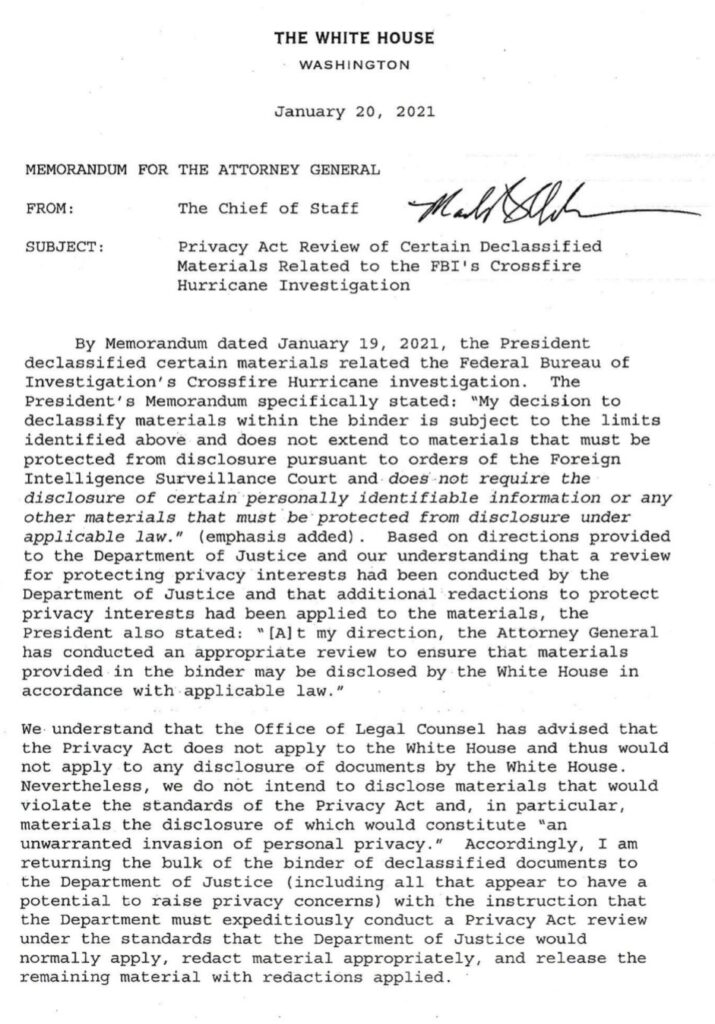
[Jan 19, 2021 – Presidential Memorandum Declassifying Trump-Russia Documents] In essence, the documents are the evidence behind the Trump targeting operation, and the collusion network between Main Justice and U.S. media.  This should not be a surprise.

As a result, the DOJ/FBI main justice operation from Washington DC was centered around retrieving the evidence of their own corrupt -and generally illegal- activity against Trump.

This motive explains the need for main justice to use the presidential records act, coordinated in concert with the national archives, to justify the document retrieval mission.  Main Justice is trying to throw a bag over the trail of documentary evidence of their own misconduct.  That is the underlying nature of this effort.

President Trump, his advisors and his lawyers, have stated unequivocally that during his administration President Trump declassified the documents in question.  [SEE HERE] He declassified them from the copy he was provided to review.

However, as noted in the January 20, 2021, memo above from the office of the president, the agencies, specifically the DOJ and FBI, held a motive to not follow through on the declassification order itself.

This conflict between President Trump declassifying the evidence of DOJ and FBI misconduct, and the DOJ and FBI refusing to declassify the evidence – for obvious reasons, is the originating source of the issue.   Inasmuch as the DOJ may attempt to stop Trump by using lawfare against him, ultimately in a court of law this conflict should come out.

In the biggest of big pictures, President Trump has no legal exposure.  However, the FBI and DOJ need to leverage the appearance of illegal conduct in order to continue their ongoing targeting operation, which, as you can clearly see, has a very specific agenda behind it.  Charging Donald Trump with any form of criminal conduct will ultimately fail.

The sunlight upon the background of the conflict is averse to the interests of the officials making the criminal accusations.  The truth has no agenda and the best defense President Trump carries is just that, the truth.

It is important to remember, the presidential records act –the presented pretext for the document conflict– is not a criminal statute.  An FBI raid cannot be predicated on a document conflict between the National Archives and a former president.

The FBI affidavit, which leads to the search warrant and the subsequent raid on Mar-a-Lago, could -by its very nature- only be justified if it related to records the U.S. government deems “classified” and material vital to national security interests.  Hence, DOJ National Security Division involvement, and all of the documents and affidavit are framed around this pretext.

Main Justice could not conduct the operation to retrieve the evidence of their corruption, if they did not shape the operation as an investigation giving the impression that national security was compromised.  The baseline is the ruse.  The predicate behind the retrieval operation is false.

♦ So, what are the DOJ and FBI so desperate to retrieve?

In broad terms there are two sets of documents that intermingle and are directly related. First, documents that highlight the activity of Hillary Clinton’s team in creating the false Trump-Russia conspiracy theory (2015/2016).  Second, documents that highlight the activity of government officials targeting Donald Trump within the same timeframe (Crossfire Hurricane), that continued into 2017, 2018 and 2019 (Robert Mueller).

Think of the two sets of documents as evidence against two teams working in synergy.  Team one (Clinton) was outside government. Team two (DOJ/FBI) was inside government.  The documents pertain to both groups but are also divided.  That helps to explain the wording of the memo above.

The documentary evidence against the outside group (Clinton et al) would also involve government documented evidence as the DOJ/FBI inside group interacted with them.  Notes from interviews, materials provided, FBI 302 summaries of interviews, etc.

We can extract a lot of information on the first sets of evidence from the lawsuit filed by President Trump in March of this year, mostly against the outside actors. [LINK HERE]

The lawsuit was filed against specific persons and most of those persons were interviewed by the FBI as part of the originating investigation.  Within the subjects of the lawsuit we find names and groups including:

Hillary Clinton, Hillary for America Campaign Committee, DNC, DNC Services Corp, Perkins Coie, Michael Sussmann, Marc Elias, Debbie Wasserman Schultz, Charles Dolan, Jake Sullivan, John Podesta, Robby Mook, Phillipe Reines as well as Fusion GPS, Glenn Simpson, Peter Fritsch, Nellie Ohr, Bruce Ohr, Orbis Business Intelligence, Christopher Steele, Igor Danchenko, Neustar Inc., Rodney Joffe, James Comey Peter Strzok, Lisa Page, Kevin Clinesmith and Andrew McCabe.

In addition to being named in the lawsuit, many of those names were interviewed by the FBI as part of the origination of the Trump-Russia investigation, and/or part of the ongoing investigation of the Trump-Russia fabrication. Each of those interviews would carry an FD-302 report summarizing the content of the interview, the questions and answers given.

The totality of those 302 documents is a lot of evidence likely consisting of hundreds of pages.

For the government officials on the inside, in addition to 302’s (ex Bruce Ohr) there would be documents of communication between them.

Think about the full unredacted text messages between Lisa Page and Peter Strzok as an example.  The DOJ publicly released over 600 pages of those text messages, and that wasn’t all of them.  The text messages were also redacted, under claims of privacy and national security.  We can assume any version of these text messages declassified by President Trump would not be redacted.  Hence, you go back to the January 20th memo and see the notes about “privacy.”

We also know there are many pages of communication between DOJ lawyer Lisa Page and her boss in the FBI Andrew McCabe.  Almost none of them were ever made public; but they exist.  This internal communication is likely the type of material contained in both the “binder,” left for the DOJ to release, and the boxes at Mar-a-Lago to be used as evidence against the named defendants in the lawsuit.

Bruce Ohr has 302’s and emails relating to his involvement as a conduit between Fusion GPS and the FBI.  Some of those were released in redacted form, and some of them were never released.  Additionally, Nellie Ohr, Bruce’s wife, who worked at Fusion GPS invoked spousal privilege when called to testify before the House committee investigating the issues.  However, it is almost certain the FBI interviewed her so there are likely 302’s on Nellie Ohr.

Chris Steele, Igor Danchenko and Rodney Joffe were also interviewed by the FBI.  Those 302’s were never released.  Presumably John Durham has stakeholder equity in that part of the Trump-Russia hoax, but the documentary evidence prior to January 20, 2021, that exists outside the special counsel could also be records at Mar-a-Lago.

Then we get to the big stuff…. The records and evidence in unredacted and declassified state, that would drive the DOJ-NSD to claim vital national security interests.

The NSA compliance officer notified NSA Director Admiral Mike Rogers of unauthorized use of the NSA database by FBI contractors searching U.S. citizens during the 2015/2016 presidential primary.  That 2016 notification is a classified record.

The response from Mike Rogers, and the subsequent documentary evidence of what names were being searched is again a classified record.  The audit logs showing who was doing the searches (which contractors, which agencies and from what offices), as noted by Director Rogers, was preserved.  That is another big-time classified record.

In addition, we would have Admiral Rogers writing a mandatory oversight notification to the FISA court detailing what happened.  That’s a big and comprehensive classified record, likely contained in the documents in Mar-a-Lago… and then the goldmine, the fully unredacted 99-page FISA court opinion detailing the substance of the NSA compromise by FBI officials and contractors, including the names, frequency and dates of the illegal surveillance.  That is a major classified document the Deepest Deep State would want to keep hidden.

These are the types of documents within what former ODNI John Ratcliffe called “thousands of pages that were declassified by President Trump,” and given to both John Durham and Main Justice with an expectation of public release when the Durham special counsel probe concluded.

In short, President Trump declassified documents that show how the institutions within the U.S. government targeted him.  However, the institutions that illegally targeted President Trump are the same institutions who control the specific evidence of their unlawful targeting.

These examples of evidence held by President Donald Trump reveals the background of how the DC surveillance state exists.  THAT was/is the national security threat behind the DOJ-NSD search warrant and affidavit.

The risk to the fabric of the U.S. government is why we see lawyers and pundits so confused as they try to figure out the disproportionate response from the DOJ and FBI, toward “simple records”, held by President Trump in Mar-a-Lago.   Very few people can comprehend what has been done since January 2009, and the current state of corruption as it now exists amid all of the agencies and institutions of government.

Barack Obama spent 8 years building out and refining the political surveillance state.  The operators of the institutions have spent the last six years hiding the construct.

President Donald Trump declassified the material then took evidence to Mar-a-Lago.  The people currently in charge of managing the corrupt system, like Merrick Garland, Lisa Monaco, Chris Wray and the Senate allies, are going bananas.  From their DC perspective, Donald Trump is an existential threat.

Given the nature of their opposition, and the underlying motives for their conduct, there is almost nothing they will not do to protect themselves.  However, if you peel away all the layers of lies, manipulations and corruption, what you find at the heart of their conduct is fear.

What do they fear most?…

…..THIS!

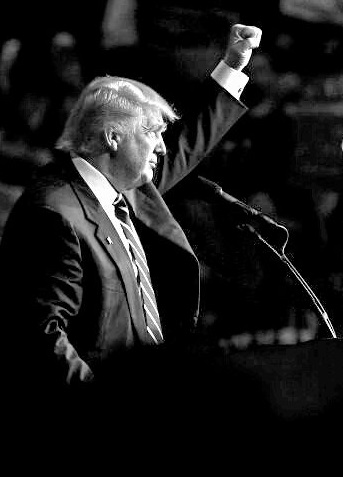
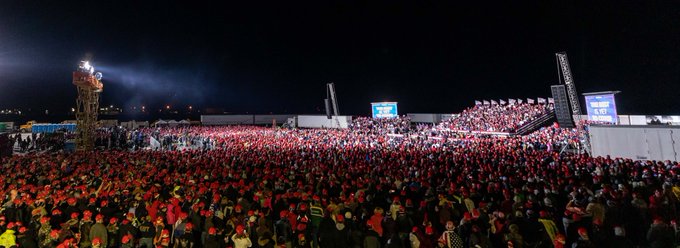
People forget, and that’s ok, but prior to the 2015 MAGA movement driven by President Donald J Trump, political rallies filled with tens-of-thousands of people were extremely rare; almost nonexistent.  However, in the era of Donald J Trump the scale of the people paying attention has grown exponentially.  Every speech, every event, every rally is now filled with thousands and thousands of people.

The frequency of it has made us numb to realizing just how extraordinary this is.  But the people in Washington DC are well aware, and that makes President Trump even more dangerous.  Combine that level of support with what they attempted in order to destroy him, and, well, now you start to put context on their effort.

The existence of Trump is a threat, but the existence of a Trump that could expose their corruption…. well, that makes him a level of threat that leads to a raid on his home in Mar-a-Lago.

[Support CTH Here]

Court Releases Heavily Redacted 38-Page FBI Affidavit Used to Justify Raid on President Trump Home


Posted originally on the conservative tree house on August 26, 2022 | Sundance

U.S. Magistrate Bruce Reinhart accepted the proposal from the U.S. Dept of Justice (DOJ) to release, in heavily redacted form, the underlying affidavit used to justify the search warrant issued by Reinhart to raid President Trump’s home in Florida. The DOJ tailored the redactions and Reinhart accepted the modifications without issue. The affidavit has now been released to the public.   [SEE HERE for Pdf Form]  – Mar-a-Lago Raid Affidavit

We are reviewing the just-released documents and will be providing more analysis shortly.

DeSantis Beats Trump on Fundraising – However, Donor Financials Highlight Corporate Version vs Grassroots Version of The Republican Party


Posted originally on the conservative tree house on August 25, 2022 | Sundance 

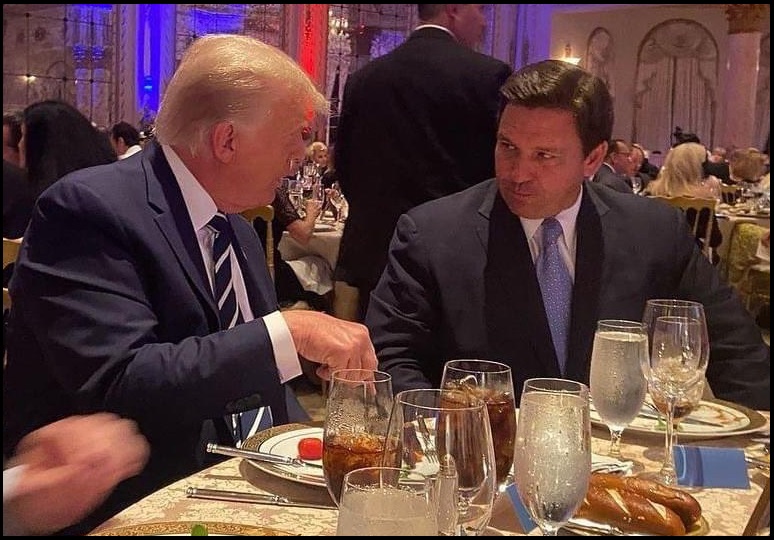
A solid dive by Law.Com and Daily Business Review into the background of who is financing Donald Trump versus who is financing Ron DeSantis should help to clarify the nature of the difference between them.

President Trump is funded primarily from massive amounts of small contributions from small donors, the MAGA base.

Governor Ron DeSantis is funded primarily by a small group of exclusive Wall Street corporations, billionaires and hedge fund managers, and almost no small donors.

Essentially, if you are thinking about MAGA populism -vs- corporate republicanism; well, there’s the issue in easiest to understand data form.

Additionally, the new managers of DeSantis have recently noticed the vulnerability and hired firms to try and stimulate small donor amounts in an effort to avoid the jaw dropping difference in average donation.  A strategy deployed by Jeb Bush in 2015.    Pay attention to the names giving large donations to DeSantis and you will see: (a) where the economic policy distinction comes from; and (b) where the RDS branding and consulting image is coming from.

Business Daily Review – Republican Florida Gov. Ron DeSantis has raised more money than Donald Trump since the former president left office, relying on deep-pocketed donors rather than the small-dollar contributors he’ll need if he seeks the White House in 2024.

DeSantis … has amassed $142 million from the start of 2021 through Aug. 5 this year from donors such as the hedge fund billionaires Ken Griffin and Paul Tudor Jones.  That tops the $136 million Trump collected over a slightly shorter period.

Unlike Trump, who relies largely on a network of small-dollar donors to fund his postpresidential political operations, DeSantis has raised the bulk of his money from a small number of wealthy donors writing him giant checks. That gives him plenty of money for his reelection effort in Florida, where laws allow unlimited contributions.

But it also raises doubts about the level of grassroots support for DeSantis and suggests he’ll have to widen his fundraising base for any presidential bid because federal rules limit direct contributions to candidates to just $2,900 per donor.

About 500 donors have given $50,000 or more to Friends of Ron DeSantis, his political action committee which under Florida law can accept donations in unlimited amounts, accounting for $88 million of his fundraising haul. His big donors come from finance and real estate, health care and construction and a wide range of other businesses, a Bloomberg analysis of Florida campaign finance filings shows.

By contrast, donors who made contributions of less than $200 accounted for $8 million, or just 6%, of his haul. Unlike Trump, who’s raised $74 million or 54% of his total from January 2021 through June 30 from small-dollar donors, DeSantis doesn’t send multiple, daily fundraising pitches to supporters. Recently his campaign went a month without sending a text message to potential donors who signed up to receive them.

His top 500 donors include 10 billionaires, including Citadel’s Griffin, who moved his hedge fund’s headquarters to Miami from Chicago 14 months after giving $5 million. Other contributors include Tudor Jones, the chief executive officer of Tudor Investment Corp., Home Depot Inc. co-founder Bernard Marcus and Thomas Peterffy, the chairman of Interactive Brokers Inc. (read more)

Ron DeSantis has done a great job in Florida, mostly on social impact issues.  However, on a national policy level, specifically on a presidential level for 2024, the donor influence becomes troubling.

Issues around school choice, school boards, woke policy and social issues in general are easier to handle for voters at a local level.  City, county and state representatives, and the elections they come from, are the people and places where voters can make a substantive difference in their own outcome.

As a parent or individual you have the ability to fight back against social and ideological issues at a city, county and state level.   However, when it comes to issues of national economics, international trade policy and national energy policy, those battles happen at the federal level.  That’s where the President of the United States has a major influence.

As examples, the price of gasoline and energy are influenced by the president through regulatory policy.  Similarly, international trade agreements, economic policy and monetary policy, have consequences for domestic investment, economic growth, jobs, employment, wage growth and expanded domestic wealth.

Simply put, the president has a strong impact on the nation, and the people within it, from an economic perspective.

All modern republicans are incapable of executing a policy that is pro-U.S. worker, because every modern republican is a beneficiary of Wall Street, hedge funds and multinational corporate contributions; exactly like those outlined for Ron DeSantis.  As a consequence, economic policy adverse to the interests of Wall Street, Banks, hedge funds and multinational corporations do not come from modern republican politicians.

This dynamic reflects the distinction that made Donald Trump unique.

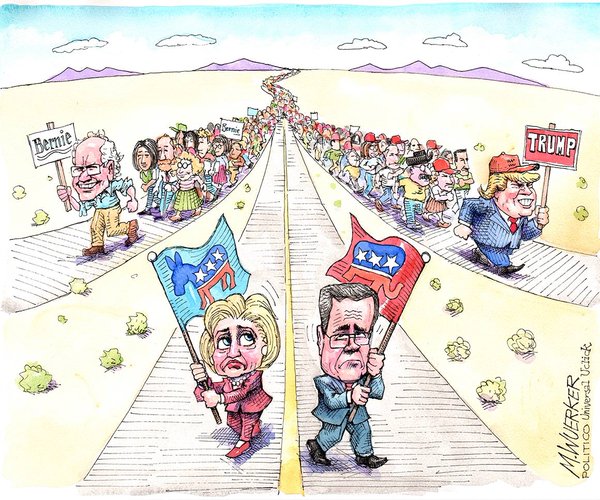
Unlike traditional republicans, Donald Trump and Bernie Sanders both agreed on the problem.  Where they disagreed was the solution.

Donald Trump used domestic economic policy tools like trade tariffs and countervailing duties to change the corporate behavior of the multinationals.  Bernie Sander’s approach is to regulate the corporations and force a behavior change.

Put another way, Bernie wants to change the economic referees, while Trump’s approach is to change the economic rules of the game and let the teams play it.

You might remember a large percentage of Bernie Sanders voters joined team Trump in 2016.  That’s because both teams agreed on the problem within our national economic situation.   The result was MAGA, a massive coalition of working-class voters, based on economics, that cuts through every social distinction of race, color, sex, orientation, etc.  The issue that binds the MAGA voters together is economic policy.

Florida Governor Ron DeSantis is a good governor for Florida, and he should be reelected easily.  However, do not fool yourself into believing the massive coalition of MAGA voters would ever transfer to a corporate republican.  It will not. EVER.

When people ask me who should come in after Trump, my answer is simple….  Show me the economic nationalist.

If there isn’t another one,… well, what does that tell you about the Republican party?

Last point.  Florida republicans have a major blind spot they keep ignoring and DeSantis is very lucky Charlie Crist doesn’t have the resources to exploit it.

Housing costs, rents and homeowners’ insurance in Florida have skyrocketed.  In some places home insurance has tripled just this year; yes, tripled.  Energy costs also increased massively in Florida, in many areas electricity rates have doubled.  Water utility costs in Florida have consistently been the highest in the nation due to the nature of the infrastructure and rapid expansion of the population.  Additionally, property tax costs -even with homestead protections- are a serious issue for lots of voters.

Put those economic issues, all being ignored by the governor’s office – as he campaigns around the country to raise his national profile, on top of high gasoline and food prices and DeSantis is very vulnerable on the way Floridians feel about their economic security.

Focusing on wokeism and social issues is an option when economic issues are not in crisis.  However, focusing on social issues while ignoring the economic pain and crisis, and you find yourself looking detached. aloof and vulnerable to political attack….. Then again, a typical republican.

.

The Managing of DeSantis HERE

The Branding of DeSantis HERE

The Selling of DeSantis HERE

The Solution


Armstrong Economics Blog/Economics Re-Posted Aug 24, 2022 by Martin Armstrong

Twitter Whistleblower Surfaces Presenting Challenge for U.S. Surveillance State, Enter CNN and The Washington Post


Posted originally on the conservative tree house on August 23, 2022 | sundance 

The background story behind Jack’s Magic Coffee Shop takes an interesting twist today, as a whistleblower deep inside the Twitter technology side of the platform begins to outline what CNN calls, “a threat to its own users’ personal information, to company shareholders, to national security, and to democracy.”

This discussion is where it becomes critical to remember the nature of stakeholders in media.

CNN is the national media firm protecting the interests of the U.S. State Dept.  The Washington Post is the national media firm protecting the interests of the U.S. intelligence apparatus.  The latest Twitter whistleblower information originates in,.. wait for it… “an explosive whistleblower disclosure obtained exclusively by CNN and The Washington Post.”

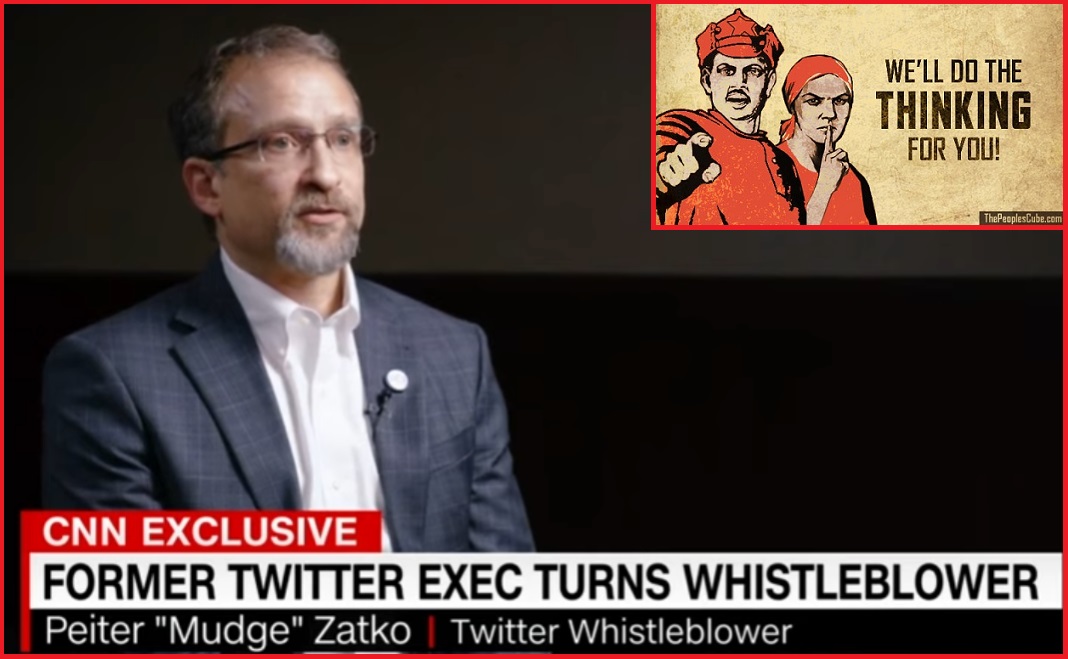
The whistleblower is a former technology expert who came from within the research farm of DARPA, the Defense Advanced Research Projects Agency.  Peiter “Mudge” Zatko, is a well-known cybersecurity expert who left government work, entered the public world, and eventually became the head of Twitter security, reporting directly to the CEO.

Peiter “Mudge” Zatko is now saying the background technology of Twitter is vulnerable to manipulation.  I’m not going to go into the granules of what Mudge is outlining, instead I prefer to focus on the bigger picture, a scenario we have been outlining for quite a while that could, emphasize *could*, become very explosive, especially considering the legal challenges between the social media platform and Elon Musk.

The nub of the bigger story is essentially that the database of Twitter, and likely other social media platforms, is integrated with the U.S. intelligence system.  The database of Twitter is not necessarily vulnerable to hacking by outside entities, although that is the framework used by media reporting this whistleblower issue.

The bigger risk to the surveillance state is discovery that Twitter and the U.S. intelligence community are in a public-private partnership. The Dept of Homeland Security has access by design, not flaw.  How the stakeholder media are reporting on the issue shows the nature of the risk, (emphasis mine):

[…] The scathing disclosure, which totals around 200 pages, including supporting exhibits — was sent last month to a number of US government agencies and congressional committees, including the Securities and Exchange Commission, the Federal Trade Commission and the Department of Justice. The existence and details of the disclosure have not previously been reported. CNN obtained a copy of the disclosure from a senior Democratic aide on Capitol Hill. The SEC, DOJ and FTC declined to comment; the Senate Intelligence Committee, which received a copy of the report, is taking the disclosure seriously and is setting a meeting to discuss the allegations, according to Rachel Cohen, a committee spokesperson. (link)

How would it damage the U.S. government if previous claims about the Chinese government having access to all user data on TikTok, are shown to be exactly identical to the U.S. government having access to all user data on Twitter?

Let that question settle in for a few moments, because that is exactly what I have been alleging since, well, 2011, when the U.S. State Dept first collaborated with Twitter in a joint public-private partnership to use the platform as a communication tool exploiting the Arab Spring uprising in Egypt, Libya and beyond.

The issue of Jack’s Magic Coffee Shop is an issue of financial viability.  The business model of Twitter just doesn’t exist as a free social media discussion platform while running the ultra-expensive data processing system needed for millions of simultaneous users.  A global chat that requires exponential database responses as an outcome of simultaneous users is just ridiculously expensive. {Go Deep} However, if the computing system and massive database were being subsidized by the U.S. government, then the viability of the ‘free coffee‘ business model makes sense.

“Cloud computing is one of the core components of the strategy to help the IC discover, access and share critical information in an era of seemingly infinite data.” … “A test scenario described by GAO in its June 2013 bid protest opinion suggests the CIA sought to compare how the solutions presented by IBM and Amazon Web Services (AWS) could crunch massive data sets, commonly referred to as big data.” … “Solutions had to provide a “hosting environment for applications which process vast amounts of information in parallel on large clusters (thousands of nodes) of commodity hardware” using a platform called MapReduce. Through MapReduce, clusters were provisioned for computation and segmentation. Test runs assumed clusters were large enough to process 100 terabytes of raw input data. AWS’ solution received superior marks from CIA procurement officials”… (MORE)

♦ Legal Stuff – The issue of American citizen privacy and U.S. constitutional limits against the government listening in on communication is functionally obsolescent.  The Foreign Intelligence Surveillance Act (FISA) prohibits communication intercepts on U.S. citizens without a valid search warrant.  However, if a U.S. citizen is engaged in a conversation with a foreign person, all privacy restrictions are essentially gone. [Insert example of Michael Flynn taking to Russian Ambassador Sergey Kislyak here]

Your phone calls can be intercepted by the government from the foreign side of the call.  The govt can freely monitor the calls that involve foreign actors.  The only rule is that your privacy must be maintained. If the foreign actor is in communication with a U.S. citizen, the U.S. citizen must be “minimized” or not identified in any intercept.

However, what happens when the phone call is on a community line that is connected, and visible, to the entire world?   That’s the benefit of social media monitoring from a surveillance perspective. It is from that opaque and unresolved archaic legal perspective that surveillance authority of social media platforms, by the U.S. intelligence community, exists.   Now you see why the SSCI is taking an interest in the Twitter whistleblower, classic risk mitigation.

Hopefully, you can also see why the 200-page whistleblower document was leaked, by a Democrat staffer, to the Washington Post and CNN.

CNN defends the equity interests of the U.S. State Dept., and WaPo defend the Intelligence Community (CIA, DHS, etc).

Within the narrative as constructed you will note, “Zatko further alleges that Twitter’s leadership has misled its own board and government regulators about its security vulnerabilities, including some that could allegedly open the door to foreign spying or manipulation, hacking and disinformation campaigns.”

If the relationship between Twitter and the U.S. intelligence community is a public-private partnership, why would Twitter want to shut down the portals given to the Dept of Homeland Security?

Answer, they wouldn’t… Ergo the response from Twitter to the whistleblower complaint is (emphasis mine), “What we’ve seen so far is a false narrative about Twitter and our privacy and data security practices that is riddled with inconsistencies and inaccuracies and lacks important context.

Put another way, the “lacks important context” is the nature of the security risk, which is structural to the relationship between the intelligence community and the platform.  See how that works?

The integration between Twitter and the United States Intelligence Community has been hiding in plain sight:

July 26, 2021, (Reuters) – A counterterrorism organization formed by some of the biggest U.S. tech companies including Facebook (FB.O) and Microsoft (MSFT.O) is significantly expanding the types of extremist content shared between firms in a key database, aiming to crack down on material from white supremacists and far-right militias, the group told Reuters.

Until now, the Global Internet Forum to Counter Terrorism’s (GIFCT) database has focused on videos and images from terrorist groups on a United Nations list and so has largely consisted of content from Islamist extremist organizations such as Islamic State, al Qaeda and the Taliban.

Over the next few months, the group will add attacker manifestos – often shared by sympathizers after white supremacist violence – and other publications and links flagged by U.N. initiative Tech Against Terrorism. It will use lists from intelligence-sharing group Five Eyes, adding URLs and PDFs from more groups, including the Proud Boys, the Three Percenters and neo-Nazis.

The firms, which include Twitter (TWTR.N) and Alphabet Inc’s (GOOGL.O) YouTube, share “hashes,” unique numerical representations of original pieces of content that have been removed from their services. Other platforms use these to identify the same content on their own sites in order to review or remove it. (more)

A shared hashing protocol is a form of data system integration.  The databases of the identified social media platforms are integrated with the U.S. intelligence system.

So, what is the angle here?  Peiter/CNN’s objective is to support Musk‘s part of the legal argument. That support helps Elon Musk exit from Twitter deal. That exit allows Twitter/IC to return to surveillance operations and intel gathering with exposure risk removed. That’s Peiter’s objective.

I shall leave on a happy note, which highlights the nature of the risk:

After this article was initially published, Alex Spiro, an attorney for Musk, told CNN, “We have already issued a subpoena for Mr. Zatko, and we found his exit and that of other key employees curious in light of what we have been finding.” (LINK)

Hello, fellas…

.

Now, for the pantomime, and to showcase the need for extreme control by the narrative engineers.  Notice how the directors of the CNN segment use alternative actors to shape the context of what Mr. Peiter “Mudge” Zatko is saying.  This is classic intelligence community media tradecraft.

Notice what is expressly attributed to Mudge in his own words, versus what is implied toward Mudge from alternative voices and faces that appear.  Once you see the strings on the marionettes, you can never return to that moment in the performance when you did not see them.  WATCH:

Bye, Bye Fauci… Trish Regan Show S3/E147


The Trish Regan Show Published originally on Rumble on August 22, 2022 

#TrishRegan #Fauci #Fed
Markets are waiting on Jerome Powell’s speech at Jackson Hole this Friday…and any way you slice it, it won’t be good for the economy or for Wall Street. Powell messed up bigtime and the American economy is stuck paying the price. On the bright side, Anthony Fauci is (finally) retiring! Join me for a look at today’s headlines.

zelensky freaking out, putin wins big


The Dive With Jackson Hinkle Published originally on Rumble on August 22, 2022