The Archegos Capital was founded by the former Tiger Management equity analyst, Bill Hwang. Archegos Capital, the “home office” hedge fund owned by Bill Hwang, lost an unbelievable $110 billion in just five days. The strategy was the classic leverage using SWAPS. They never purchased shares of stocks in companies like ViacomCBS. Archegos Capital was entering into equity swaps with numerous different banks and investment banks in a similar manner to what would be called money laundering where we borrow from one bank to pay off another.
By engaging SWAPS, Archegos Capital never actually owned shares of the underlying stock. What they did was effectively leveraged themselves by as much as 500%, which would prove to be their undoing. The problem with such hedge funds is that they really take a personal view of the performance of the market going forward. This is ALWAYS the undoing of these hedge funds going back to Long-Term Capital Management which took a fundamental view that they would make a guaranteed fortune on the high interest of Russian debt and that bribes were being paid in the IMF that they thought would keep the loans going to Russia without end.
I cannot stress enough that ANY fund which is dominated by fundamental expectations that override quantitative models, should be AVOIDED like the plague. We are into a whole new world of finance which is moving in a counter-reaction to the Great Reset. There is NO QUESTION that the March 2020 crash was not only UNIQUE in history, it was clearly an assault that attempted to create another 2007-2009 economic contraction which would have made facilitated the Great Reset by the intentional destruction of the economy. They have had to rely upon the virus scare to accomplished what they had hoped would have be a far easier road.
QUESTION: Hello Martin, can you explain to me how a currency would sustain value for international trade if a country, like Canada (where I live), did what you suggested and stopped issuing debt and just printed money to level that was 5% – 10% of national GDP? would it depend on the attractiveness of what a country exports eg: Canada exports oil, lumber, crops like wheat/soy/canola, minerals – both precious and functional? What would happen to a country that didn’t have exports as a significant portion of it’s GDP? I am curious about how currencies would react to your restructuring plan that eliminated the need for a country to issue debt. Thanks for all your insights and theories. Very helpful.
Trapped in Canada with an egoistic misguided Prime Minister who doesn’t appear to like Canada (he keeps telling us how awful we are) or Canadians, he prefers spending time with global elites and is following their plan even though it damages Canada pretty significantly. MB
ANSWER: Right now, every country spends more than it takes in. The deficits are funded by selling debt, which then competes against the private sector. The interest rates rise and fall on sovereign debt based upon the confidence from one week to the next. If they stopped borrowing, then the capital investment would turn to the private sector, creating more economic growth. If income taxes were eliminated, the economy would grow based upon innovation which is what it should be driven by.
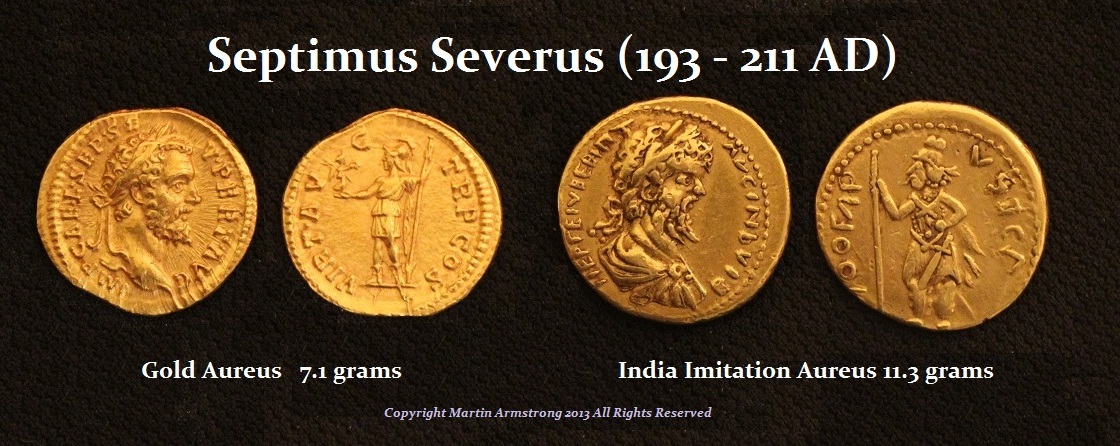
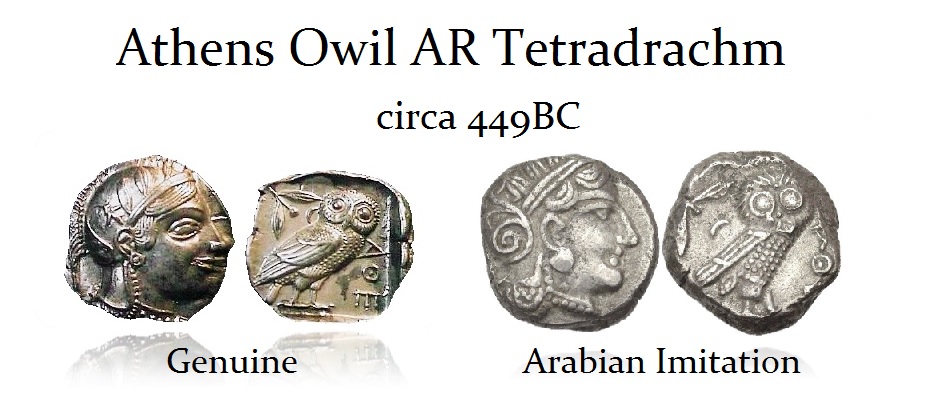
The confidence in the currency would simply depend upon the strength of the economy, as was the case for Athens and Rome in ancient times. Their coinage was imitated because they were the dominant economies of their time. The value of a currency is the strength of its economy. It has NEVER been about its backing, which is purely a theory that arrived with paper money. Rome had no national debt. The value of the currency was more than its metal content. Here we have a gold aureus of Septimus Severus (193-211 AD) and the imitation in gold made in India. The imitation weighed more than the original. Imitations were made in the same quality of metal, so it proves that it was not a counterfeit but that a coin from the core economy possessed a greater value than the raw metal.
Just compare Russia, which has tremendous resources, against China, Japan, and Germany that had really no gold reserves. Russia did not expand its economy while the others boomed because of its people. The value of a currency is the TOTAL productive capacity of its economy — the work ethic of its people. Russia has not been able to rise substantially because it never fully embraced the idea of capitalism. They moved from communism to an oligarchy.
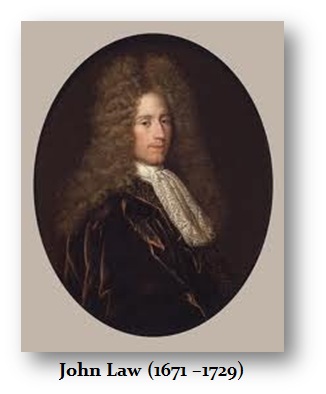
COMMENT: Hi Mr. Armstrong…..this is a surprising (to me) summary, on John Law. Every piece I ever read about him, cast him as a complete scoundrel, yet you obviously write with admiration. Just another example of history depending on someone’s perspective. You never cease to surprise. And that’s good.
HS
REPLY: John Law was actually a brilliant man. His legacy is not so different from John Maynard Keynes. He advocated deficit spending ONLY in times of recession, but governments have spent relentlessly with deficits that never end. We call this “Keynesian economics” when in fact he never advocated such a system. Likewise, John Law never advocated what the French government did in creating the Mississippi Bubble.
It is true that John Law fled to Amsterdam, but this is when he studied real banking operations and saw that money was actually virtual. Because coins were counterfeited or their edges shaved, bank money was more valuable than coins. Once the coins were deposited, each had to be inspected. So the bank became a sort of guarantor of the validity of the coins. Here is an ancient coin from Lydia with numerous banking marks applied, verifying that the coin had been inspected by them before for the same reasons.
It was this first-hand observation that led John Law to see that money was actually virtual, whereby people preferred bank money to actual coins. John then returned to Scotland, where he published in 1705 his Money and Trade Considered, with a Proposal for Supplying the Nation with Money. Law would later publish a second edition in 1720. He attempted to use his writing to convince the Scottish Parliament to adopt his ideas about money, but they declined, giving rise to the adage that a genius is never acknowledged in his native land (i.e. Columbus, Einstein to just mention two). Law had captured a glimpse of the virtual money supply as he was fascinated with the development of “bank money” that was displacing bullion in circulation.
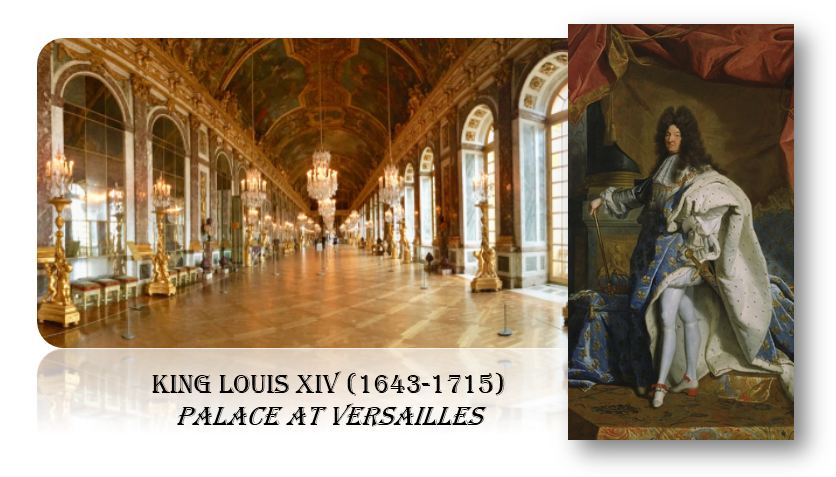
Therefore, John Law has been hated by hard money people because they fail to understand that coins became second-best to actual paper money, for it relieved the problem of having to test every coin in a large transaction. Where Scotland refused to listen to John Law, France took him up on his observations. In 1716, John Law was invited by France to give it a shot. King Louis XIV (1643-1715) had squandered France’s resources on numerous wars and the construction of the Palace at Versailles. The idea of borrowing to fund wars and expansion had ruined the governments of men. Louis XIV had also adopted the theory that it was a divine right of kings to act as a dictator. This idea has persisted behind the curtain for centuries and dominates even American politics where you cannot sue the government without its permission.
For 54 years, Louis XIV worked daily for 8 hours, where he concerned himself with the very smallest of all details of state. He controlled everything from troop movements, infrastructure construction, court etiquette, and even theological disputes. He subordinated the nobles who had often instigated civil wars. Over the previous 40 years, there had been about 11 such civil wars.
The cost of this construction of his Palace at Versailles was far beyond the imagination. He effectively ran the country from Versailles and distanced himself from the people and Paris. Yet for all his extravagance, through the assistance of Jean-Baptiste Colbert (1619-1683), he was responsible more than anyone else for forging France into a more modern country.
John Law has been blamed for the Mississippi Bubble when, in fact, France was on the brink of its third bankruptcy when it contacted him. The government entered a partial default by consolidating its debt and changing its terms. Its new issue of billets d’etat was still required for more funding. The shortage of gold and silver coinage was plunging the economy into a depression. Law’s first proposal for a national bank issuing bank money was rejected. The second proposal to create a private bank was accepted and thus Banque Generale was established in May 1716.
The bank began to lend on its own shares, and the government intervened to support the price of its share by decree. Like the US government ordering the Federal Reserve to provide a floor to US bonds during World War II, likewise, the French government tried to maintain the value of the shares at 9,000 liver. Law begged the government to reduce the floor to 5,000, but they refused. They ended up blaming Law and arresting him no so unlike how the Democrats charged owners of S&Ls which failed when it was Congress who was changing the laws and creating a one-way market where everyone tried to sell.
Europe is coming under a lot of pressure. In the UK, people ate becoming very angry over PM Boris Johnson’s consideration of “sinister and discriminatory” domestic Covid-19 passports. In France, the lockdown has become a symbol of total corruption and a viral report on secret luxury dinners for government ministers is reminiscent of the old Soviet Union where the leaders lived in luxury in hidden military bases which the people starved. In France, l’Opinion has written that the government can deny the allegations but the damage has already been done.
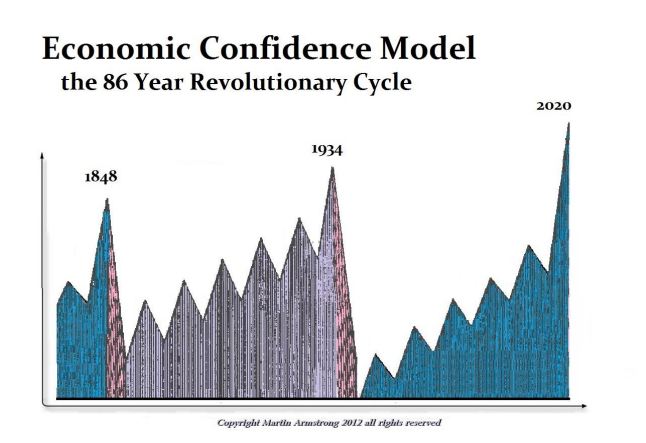
All of this is coming from the World Economic Forum which has virtually total control over Europe at this time. Even the head of the IMF and the European Central Bank are both board members of the World Economic Forum. This is strangely right on time. The last two leftist movements were those of 1848 and 1934. Indeed, in France, the revolutionary events ended the July Monarchy (1830–1848) and led to the creation of the French Second Republic. Following the overthrow of King Louis Philippe in February 1848, the elected government of the Second Republic ruled France. There is a very serious risk that these forced lockdowns will result in civil uprisings.
Ironically, in 1853, the French government launched the Crimean War against Russia. If this remains on target, we should expect a war to start by 2025 and it may very well be over Crimea once more.
We have confirmation from readers in Rome that there has been a protest in Piazza Montecitorio which began as a sit-in protest by restaurateurs and other categories were taking place today on the emergency closures for Covid. The peaceful protest has degenerated into a clash between protestors and police forces who assaulted the people launching various types of bombs and objects. The protestors were yelling at the police who would obviously just follow orders as did the Nazis in Germany calling them “buffoons” and “freedom” and the protestors turned on the ruthless police breaking through the barriers and the police turned violent.
NEVER in 6,000 years has any government tried to lockdown its people because of a claimed virus. The death rates are no different between states that locked down and those that remained open in the United States. This is a political agenda coming from the World Economic Forum. In the meantime, we have Spirt Airlines going tyrannical kicking off the plane a family because a two-year old does not have a mask. When ALL the studies show that even masks do not work, yet we have been subjected to outright tyranny on such a scale.
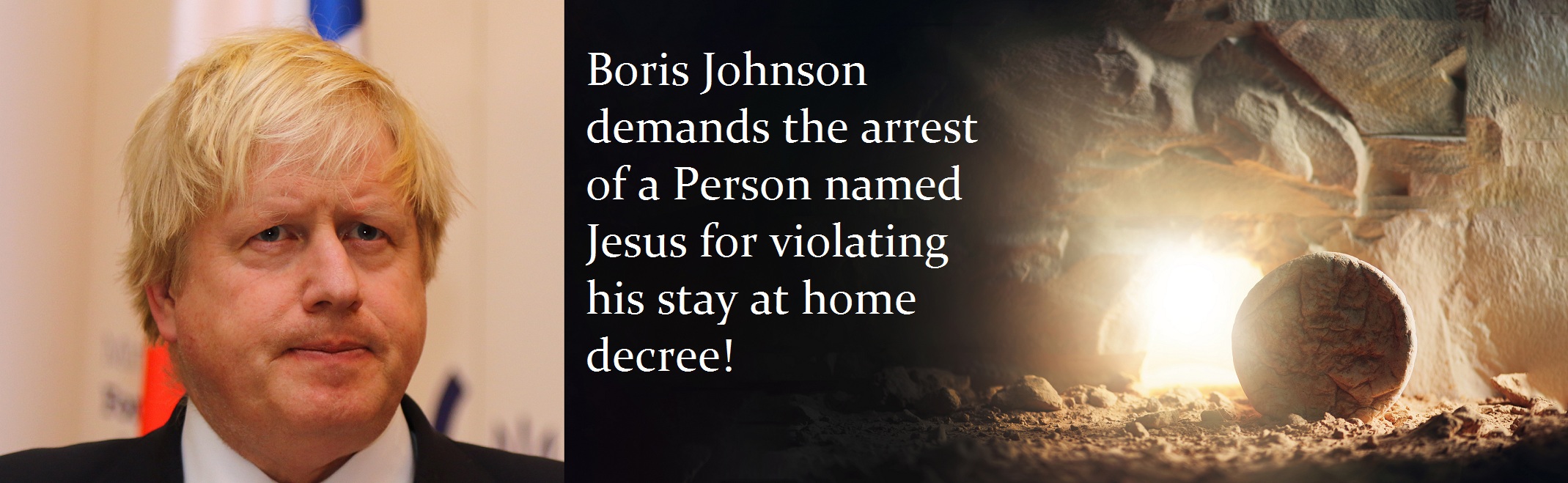
We have to wonder just how long are people going to sit on their hands before rising up? Boris Johnson is no doubt one of the world’s most ruthless heads of state. Please like this have often invoked revolutions and the policies of Boris in Britain are just so outrageous, history will remember him in the long list of absolute tyrants.
On Good Friday, police entered a Polish Church at stood at the altar and instructed worshipers to go home of they would be fined £200 per person. That was absolutely outrageous. On Sunday, the police who are obviously incapable of human thought descended upon a Polish Church once again. Boris believes in no religion other than trying to figure out how to wipe out the majority of the population following his father’s objectives as is Bill Gates. They do not believe in humanity or even that anyone is created by God nor do we possibly have a soul. We are all just biological mistakes he wants to correct so he can play God and Build Back Better because Goid screwed it all up if he even exists.
The real question is simple. When will the Brits say enough is enough?
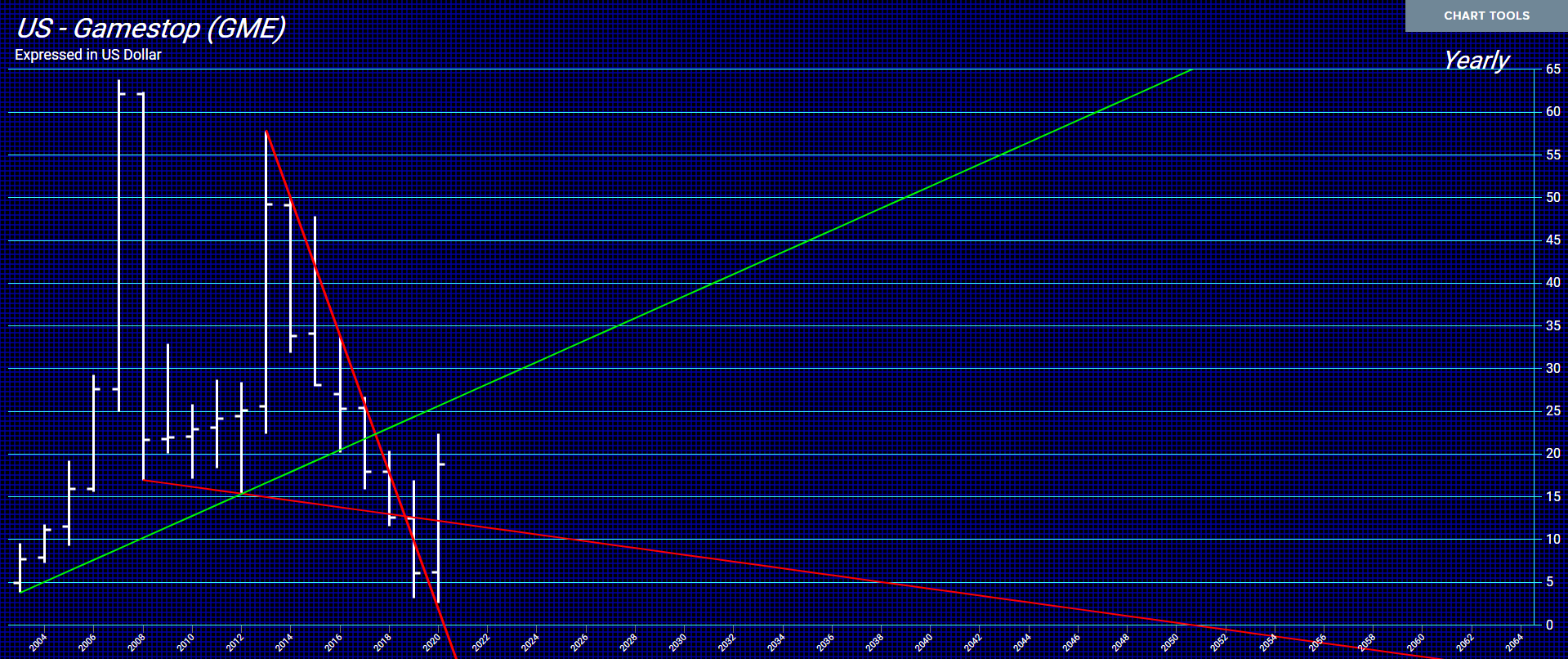
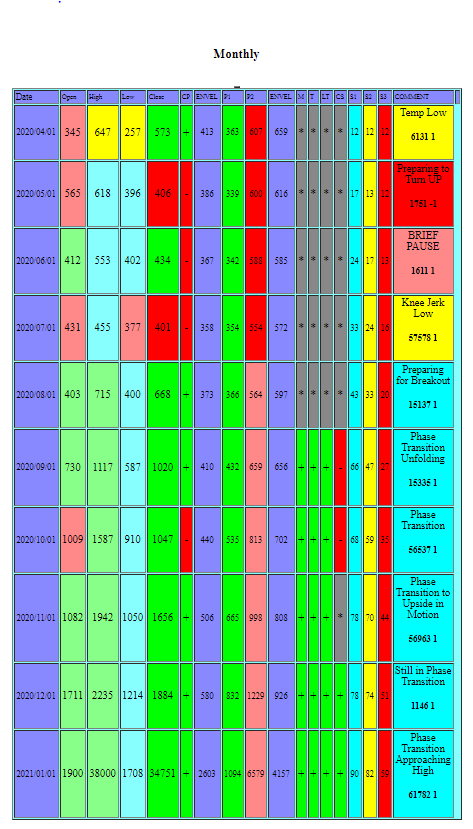
Gamestop has rallied back during the week of March 8th after all the hoopla. Cyclically, it was 13 years down and it was due for a bounce. Even our pattern recognition models picked up the rally starting in August 2020. Quite frankly, this has all the hallmarks of manipulation, but not what you may think. The classic manipulation is to pump up a market touting some player but the pros have already been in the market. This is how the Buffet manipulation of silver was done in 1998 and even the entire Hunt Brothers silver rally back in 1980.
I knew the Hunt Brothers were buying silver from the early 1970s. At the end, their name was attached to silver and the claim was they were taking it to $100. At that time, the exchange pulled the same maneuver and made it a fraction in margin to go short but 10x that to go long. The Hunts were trapped and could not sell anything without everyone jumping in front of them,
Melvin Capital, which was a small hedge fund lost 53% of its capital in January on GameStop. Not sure how that was possible unless the bet was purely a gut-trade rather than quantitative. The four largest asset managers in the world together own 39 percent of GameStop shares, according to regulatory filings. Those stakes, which are mostly held for years in passive index funds, have collectively gained roughly $1 billion in value since the beginning of this year. The hype of a huge short-squeeze seems to be exaggerated. One hedge fund, Senvest Management, recently boasted to clients that it made more than $700 million from a bet on GameStop in September, the Wall Street Journal reported. Certainly, our model was long, not short and I cannot see even a trend-following-model that would have been short. Melvin Capital to lose 53% does not seem to be very professional to lost that much on a single stock. The long-term is not over in this stock.
I have created this site to help people have fun in the kitchen. I write about enjoying life both in and out of my kitchen. Life is short! Make the most of it and enjoy!
This is a library of News Events not reported by the Main Stream Media documenting & connecting the dots on How the Obama Marxist Liberal agenda is destroying America







 Centinel2012