White House Trade Adviser Peter Navarro Discusses G20 Dinner Between U.S. and China…


White House trade adviser Peter Navarro appears on Fox Business to discuss the possibility of trade deals between the U.S. and China.  Navarro explains the Buenos Aires dinner meeting and how Chairman Xi outlined his position on three buckets of U.S. concerns.

Charles Payne is going bananas because he doesn’t understand what happens in the space between two different sets of economic policy benefactors:  Wall Street and Main Street.

Wall Street is going to lose ground; period.  Their financial interests are dependent on retaining the status-quo multinational/global economic systems.  President Trump is supporting Main Street over the interests of Wall Street.  Stocks that are centered on U.S. blue-collar companies, domestic benefits, will grow; all other multinational stocks will not.

Treasury Secretary Steven Mnuchin Discusses China and U.S. Economic Outlook…


Treasury Secretary Steven Mnuchin appears with Fox Business Maria Bartiromo for an extended interview on multiple current economic aspects. Economic Security is National Security. There are three segments.

Secretary Mnuchin discusses: the agreement between President Trump and Chairman Xi for immediate shifts within the U.S-China trade relationship, and the anticipated immediate deliverables; the USMCA agreement; the auto industry and the overall economy.

Segment two and three below:

In segment two Secretary Mnuchin discusses the auto industry. Worth noting today is the day when the German auto leaders are meeting at the White House. Likely POTUS Trump wants to know how they intend to respond to the 75% rule of origin within the USMCA.

.

In segment three Secretary Mnuchin discusses the overall economy and the future outlook.

.

Panda -vs- Dragon: President Trump Tweets The Dynamic…


Within the dynamic of the U.S -vs- China trade confrontation, CTH noted the Wall Street (globalist) multinationals would likely go bananas.  There are trillions at stake and President Trump is confronting three decades of financial influence from the corporate lobbyists.   To the angst of Wall Street, POTUS Trump tweets the dynamic:

President Trump has been brutally consistent for more than three decades on his intent and purpose with the Chinese.  President Trump is the first U.S. President to understand how the red dragon hides behind the panda mask.

Additionally, while carrying out the objectives of the confrontation, Secretary Mnuchin, Secretary Ross, Ambassador Lighthizer and adviser Navarro are well aware of Beijing’s panda mask; POTUS Trump will never let them forget about it.

Some call it ‘Globalism vs Nationalism’, at other times it is best described as “Wall Street -vs- Main Street”; however, the overarching bigger picture is a battle over economics and the financial power structures that oppose President Trump.

CTH has often said ‘everything is about the economics’, because it is. Ask the ‘why’ question five times to any issue and you will find the root issue is money.  Power, greed and control, it is all about the money and the economics.

Opposition to President Trump’s singularly unique and transformational reset of the U.S. economic system boils down to a battle against the ‘Big Club’.

Every political confrontation is a move within this dynamic. The structural battle is not based on party affiliation, it is based on control and ownership of economics. This confrontation represents the biggest challenge; a brief example:

Hundreds of millions were spent on the 2018 election by owners within the ‘Big Club’; at a surface level those expenditures are discussed by punditry thus: “we were outspent” (insert Kevin McCarthy and/or Ronnda McDaniel here). But if you have followed the challenge more closely, over the course of years/decades, you have a more substantive understanding of the dynamic.

Billionaires on one side of the UniParty spend hundreds-of-millions in opposition to the MAGA agenda. That agenda, that economic agenda, is the existential threat to the Big Club’s grip on power.

Here’s the critical aspect: When it comes to the economics, there are no big spending billionaires on the nationalist side of the equation. The interests of Wall Street Democrats and Wall Street Republicans are based on globalism; Wall Street not Main Street.

In the ‘globalist’ multinational, Wall Street dynamic, the Big Club DNC donor base and the Big Club RNC donor base have mutual self interests.  Within this interest, President Trump is their unified opposition.

The only defeating mechanism that can structurally override this dynamic is an independent Billionaire and a massive amount of tax-paying small donors, ordinary middle-Americans, who can supplement the financial arsenal.   Think back to 2015/2016, and you will see the single-successful-reference for this reality at work.

Everything is about the economics.

The Big Club opposition to President Trump is based on financial best-interest.  That opposition is not bound to a political party ideology.  It is an ideology based on economics.  In essence, this is a structural economic battle that is being waged politically.

Decades of financial policy were intentionally structured to the benefit of the BIG CLUB and the multinational Wall Street alliance represented by U.S. Chamber of Commerce President Tom Donohue.  This is not a Republican -vs- Democrat issue; this is a larger confrontation between those who hold financial power and a singular person, President Donald Trump, who is determined to remove that grip.

In headlines: Big Club board member Alan Greenspan declares that President Trump’s tariff policies are “insane” [link].  This expression by Greenspan is directly representative everything noted above.

However, conversely, the outcome of those MAGA tariff policies are EXACTLY what we said they would be.  The BLS released information quantifying inflation across all sectors (emphasis mine).

Food – The food index declined 0.1 percent in October as the index for food at home fell 0.2 percent and the index for food away from home rose 0.1 percent. Three of the six major grocery store food group indexes declined in October. The fruits and vegetables index fell 0.7 percent in October, its third consecutive decline.

The index for fresh fruits fell 1.8 percent, while the fresh vegetables index increased 0.3 percent. The index for cereals and bakery products fell 0.6 percent, and the index for dairy and related products declined 0.4 percent. (link)

Notice how the prices for food are dropping as the MAGAnomic trade policies of President Trump are being carried out.

Notice how the timing of the decline is directly related to the tariff actions, and the counter-actions, by the targeted countries.

President Trump is fracturing the multinational corporate ‘controlled market’, and his trade policies are beginning to reconstitute supply and demand pricing in a nationalist market.

This inflation data, specifically within the fastest sector to show indicators (most perishable = fastest turnover) highlights what we have been explaining for years:

[…] The biggest lie in modern economics, willingly spread and maintained by corporate media, is that a system of global markets still exists.

It doesn’t.

Every element of global economic trade is controlled and exploited by massive institutions, multinational banks and multinational corporations. Institutions like the World Trade Organization (WTO) and World Bank control trillions of dollars in economic activity. Underneath that economic activity there are people who hold the reigns of power over the outcomes. These individuals and groups are the stakeholders in direct opposition to principles of national economics. (cont.)

The process of charging the U.S. consumer more for a product, that under normal national market conditions would cost less, is a process called exfiltration of wealth.

It is never discussed.

To control the market price some contracted product may even be secured and shipped with the intent to allow it to sit idle (or rot). It’s all about controlling the price and maximizing the profit equation. To gain the same $1 profit a widget multinational might have to sell 20 widgets in El-Salvador (.25¢ each), or two widgets in the U.S. ($2.50/each).

Think of the process like the historic reference of OPEC (Oil Producing Economic Countries). Only in the modern era massive corporations are playing the role of OPEC and it’s not oil being controlled, it’s almost everything, including food.

Yes, President Trump, the man and his policy team, is an existential threat to the elitist hierarchy of things well beyond the borders of the DC Swamp. In the era of explaining the complex it’s a planetary economic reset almost too massive and consequential to encapsulate in words.

There are massive international corporate and financial interests who are inherently at risk from President Trump’s “America-First” economic and trade platform. Believe it or not, President Trump is up against an entire world economic establishment.

Macron Blinks – French Prime Minister to Announce Suspension of “Fuel Tax”…


Breaking overnight the French government is attempting to stem the growing civil unrest by announcing they will suspend the plan to implement the upcoming fuel tax.  However, the Yellow Vest protests have grown to personify much more than a new fuel tax.

The protests have morphed into a much larger anger about the influence of a disconnected elite political class, personified by President Emmanuel Macron, over the lives of the ordinary French citizen.  The fuel tax was the last straw, the underlying issues remain.

(Via Associated Press) PARIS (AP) — French Prime Minister Edouard Philippe is to announce a suspension of fuel tax hikes, a major U-turn in an effort to appease a protest movement that has radicalized, French media reported Tuesday.

Both Le Monde newspaper and France Info radio said the planned increase, which has provoked riots, will be suspended for several months. Philippe is also expected to announce other measures aimed at easing tensions, just three weeks after claiming that the government would not change course and remained determined to help wean French consumers off polluting fossils fuels.

Philippe will make an announcement later Tuesday to legislators from President Emmanuel Macron’s party. There was no immediate comment from his office Tuesday morning.

It’s unlikely Philippe’s announcement will put an end to the road blockades and demonstrations, with more possible protests this weekend in Paris.

“It’s a first step, but we will not settle for a crumb,” said Benjamin Cauchy, one of the leaders of the protests.

After a third consecutive weekend of clashes in Paris led by protesters wearing distinctive yellow traffic vests, Philippe held crisis talks with representatives of major political parties on Monday. He also met with Macron and other ministers in order to find a quick solution to the crisis.

Facing the most serious street protests since his election in May 2017, Macron has canceled a two-day trip to Serbia to stay in France this week.  (read more)

Large groups of French civil servants have joined in unity with the overall Yellow Vest movement.  A disconnected President Macron, representing the elite globalist views held by out-of-touch French politicians, is in real trouble….

Brad Parscale Discusses Political Messaging in Era of Fake News and Advanced Social Media…


President Trump’s campaign manager Brad Parscale discusses how the campaign used social media to break through the firewall of MSM control.  Additionally, Parscale confronts the reason why the approach is needed in an era where MSM gatekeepers attempt to manipulate the type of information.

Within the interview Brad Parscale directly confronts the MSM gate-keeping mindset, as advanced by an interviewer who is ideologically predisposed to support control over any content he disagrees with.  The result is a lengthy but very interesting interview.

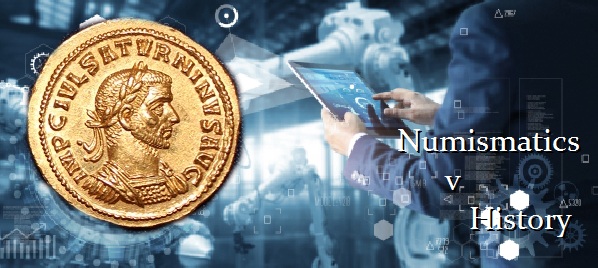
Do Coins Reveal the Futility of our Times?


The study of coins, numismatics, has constantly expanded our knowledge of antiquity in recent decades through new discoveries which have proven so many old theories wrong and turned academics on their head when it comes to their theories. Without the consideration of the coins, many questions of ancient history would never be answered. Nevertheless, many ancient historians still have a great reluctance to deal with this special discipline and to use their often valuable results. Conversely, many numismatists fail to comprehend the vast importance money has played in the history of humankind. It becomes increasingly rare to find the two fields merged to answer important questions from a larger historical context.

I have written before how the academics declared Historiae Augusta fake because it listed people they never heard of such as Gaius Julius Saturninus. Then, two gold coins were discovered in Egypt with his name and suddenly that book was proven to be history. To this day, you will find still notes saying Historiae Augusta is questionable. Academics just hate to admit a mistake even when you prove it to any rational human being.

I have stated many times that we were all taught in school about the Decline & Fall of the Roman Empire. The seminal work by that name was of course written by the English historian Edward Gibbon. However, his work was the assembly of contemporary accounts with no real input from coins. His conclusions were primarily fundamental explanations based upon his opinion. Because of that, his work was highly criticized because of its view on religion since we have the rise of both Christianity and Islam covered in his work.

According to Gibbon, the Roman Empire succumbed to barbarian invasions in large part due to the gradual loss of civic virtue among its citizens of which included the role of Christianity. This certainly provoked an ongoing controversy about the role of Christianity historically. He did, however, also attribute weight to other causes of the internal decline of corruption in addition to external invasions from various barbarians in the north and Persians in the East.

Some have argued that the fall of the Roman Empire should not be a surprise but the question should be how did it last for so long. The military legions enabled the fall of the Republic and then they violated the authority of Emperors. The Emperors, looking to secure their power, in turn, overpaid troops to try to maintain loyalty which like love cannot be bought. This, in succession, reduced the dignity of the military corrupting the discipline which created internal enemies following a general in search of power, money, and the throne of glory. This, Gibbons asserts, enabled the Roman world to be overwhelmed by a deluge of Barbarians. We must keep in mind that Gibbon was influenced by the events of the 18th century as the British had entered a period of intense anti-Catholicism.

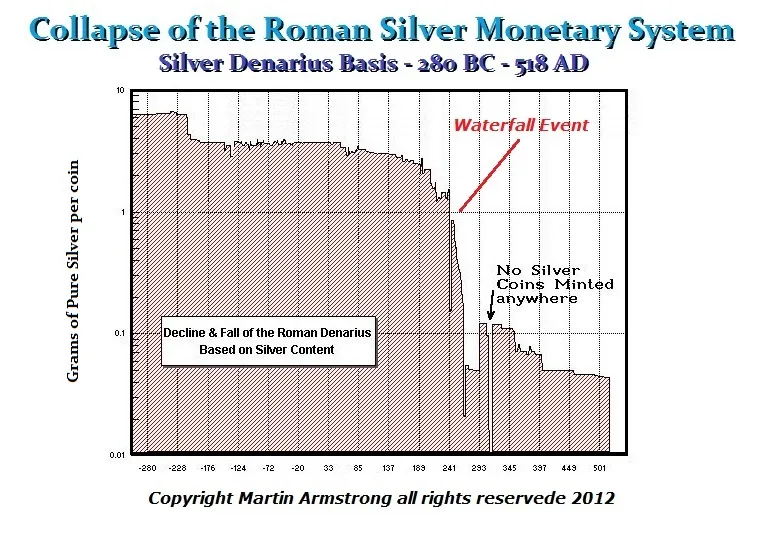
Roman decline silver content monetary system - Armstrong Waterfall effect

What was clearly missing from Edward Gibbon’s work was any bridge between ancient history and ancient numismatics. My work has been directed at eliminating human opinion. Where Gibbon was colored by the intense anti-Catholicism in Britain as a remanent from the Civil War and beheading of the Catholic King Charles I, my efforts are colored by simple economics. The background to the origins of the coinage is essential to comprehend the dynamics in the rise and fall of ALL great empires. The political dimension of the coinage is rarely taken into account. This failure has still left much of history in the dark.

I recreated the monetary history of Rome from the coinage for the simple reason to answer a question: How did Rome Fall? Was it gradual or a crash & burn? The coinage allows us to sort out the fact from the opinion. Gibbon clearly had a bias against religion for he saw how that tore Britain apart. He colored the fall of Rome with that bias. What Gibbon failed to understand was the economics came first and the capture of Valerian in 260AD sent a panic through the Empire. People turned to Christianity AFTER Rome was falling and prayers to their gods failed. The Christian persecutions took place at that time during the 3rd century AD because many took the positions the Empire was failing because the gods were angry at the Christians. The coinage reflects the economic crisis providing us with a timeline rather than just opinion.

The religious conflicts between Puritans and Catholics in Britain during the 17th and 18th centuries was rooted in a completely different mechanism. Even when John F. Kennedy was elected president in the USA, there were many who still took the anti-Catholicism position asserting that the Pope would then be running the United States. This was a divisionary attitude in Christianity (Protestant v Catholic) which was significantly different from the religious conflict in Rome during the 3rd century (Paganism v Christianity), not a question of a Pope usurping power over government.

Reconstructing history from coins provides a timeline that is definitive and not subject to speculation or opinion. In this manner, we can actually determine not just cycles, but why history repeats when given the same economic conditions, humans will ALWAYS respond in the same manner. We have used the coinage to reconstruct the entire monetary history of the world. When we accomplished this research effort, then and there we could suddenly see not merely how the rise and fall of empires, nations, and city-states was reflected in the monetary system, but the consistency across all political systems.


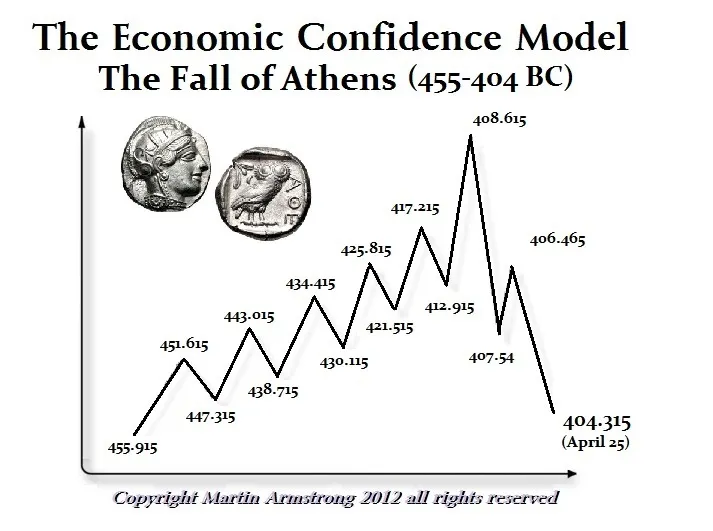
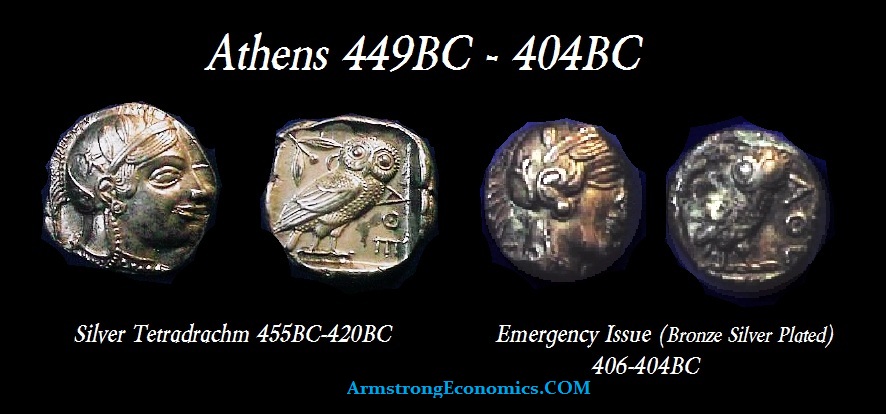
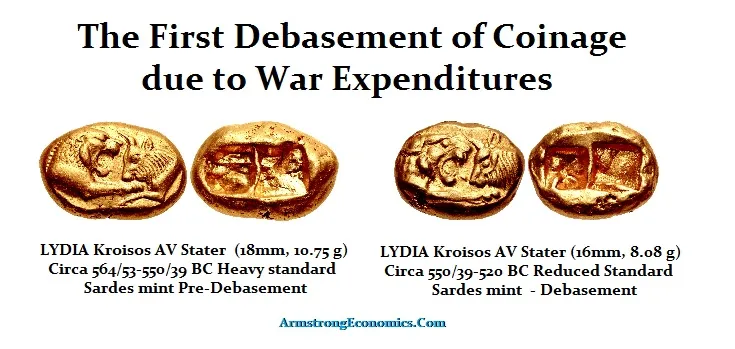
The cost of the Peloponnesian War and the loss of Athens to Sparta was clearly visible in its coinage. Two years before the surrender of Athens, its coinage was debased to bronze silver plated. The coinage stands as a witness to the same patterns of inflation created by war.

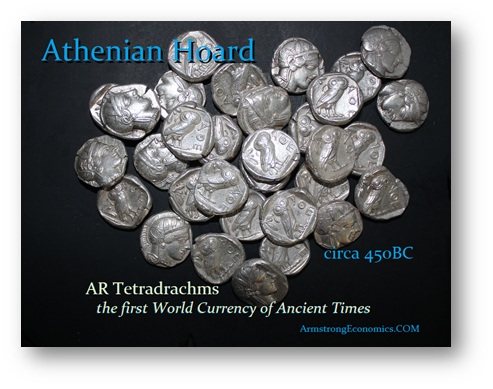
The Hoard of Athenian silver Tetradrachms we have used for study is from the period just prior to or at the beginning of the Peloponnesian War (431–404 BC). They are still of the finest silver and the condition of the coins is really exceptional. They have very little evidence of circulation confirming that they were stashed at the beginning of the war and were hoarded. Many still have underlying luster from recently being struck. Obviously, the person who buried then coins did not survive to reclaim them.

Coins may be purchased in our online store using this link https://squareup.com/store/ae-global-solutions-inc/

The cost of war has historically had always been inflationary. In Lydia, where coins were first invested, we can see the reduced weight as the cost of war increased against Cyrus the Great of Persia. In ancient times, the profits to the victor were often great. But the loss to the vanquished often led to their citizens being sold into slavery. Today, governments wage war more often for the private benefit of select groups rather than the state. The invasion of Iraq made billionaires out of Cheney’s friends and left the American people with endless trillions in debt that will last collecting interest to constantly roll indefinitely until the crash and burn.

Perhaps nobody wants to look at the evidence coins provide us because they do not like the conclusion. The one thing this research has provided is a glimpse of the futility of our situation and how governments will never learn anything from history.

French Police Remove Helmet to Support People Against Macron’s Government


MAGAnomics – ISM Manufacturing Survey Results Easily Exceed Expectations…


The Institute for Supply Management (ISM) released their manufacturing review today highlighting continued expansion of the underlying economy.  The results today from within the overall manufacturing industry emphasize the 27th consecutive month of growth…. and a future-view that seems to be predicting much more.  Much more!

ISM Release […] Manufacturing expanded in November, as the PMI® registered 59.3 percent, an increase of 1.6 percentage points from the October reading of 57.7 percent. “This indicates growth in manufacturing for the 27th consecutive month, led by strong new orders, production output and continued slowing supplier delivery performance,” says Fiore. A reading above 50 percent indicates that the manufacturing economy is generally expanding; below 50 percent indicates that it is generally contracting. (more)

Okay CTH, so take the business wonk-speak out of this – what does it mean?

Here’s the summary: Manufacturers are increasing new orders (making more stuff). Production outputs and employment within the manufacturing sector are still growing. Suppliers are still having a tough time filling material orders, but they are finding new and innovative ways to speed up shipments of raw material. However, despite the speed (increased efficiency in delivering the raw material), the backlog of requests is still growing (new orders exceed supply chain). Customer inventories are too low (hence the backlog for new stuff). Inflationary pressure still exists, but the rate of price growth is slowing (increased supplier efficiency). Manufacturing exports and imports are growing. The economy is expanding.

The story within the manufacturing sector is the story within the middle-class U.S. economy.  This is MAGAnomics at work.

The bad news is, if you can call it bad news, that our America-First economy is so strong we are struggling to produce, secure and ship enough stuff to fuel the underlying demand.  Every nation wishes they had this problem.

The manufacturing sector is trying to find ways to produce more stuff, as the infrastructure for producing more stuff is not yet ready.  When the new production capacity (prior investment) comes on-line, it will be easier to make more stuff.

“Efficiency Drivers” – You are seeing this in a few different ways.  [Transport] Think about tractor-trailers (18 wheel big rigs) on the roads; you are seeing more dual-trailers being hauled.  This is a way to ship more stuff, quicker.  Additionally, Trump’s cabinet is pushing the economic gas pedal with DOT Secretary Elaine Chao allowing younger (18-year-old) apprentice truck haulers; to help fill the insatiable need for truck drivers etc.

The manufacturing expansion shows up in the latest Bureau of Labor Statistics production efficiency third quarter report known as “Productivity”.

BEA – Q3 […] Nonfarm business sector labor productivity increased 2.2 percent during the third quarter of 2018, the U.S. Bureau of Labor Statistics reported today, as output increased 4.1 percent and hours worked increased 1.8 percent. (more)

Economic analysis can get weedy…. so a simple way to look at productivity is to think about baking bread in your kitchen.

If you were going to bake 4 loaves of bread it might take you 2 hrs start to finish. However, if you were going to bake 8 loaves of bread it would not take you twice as long because most of the tasks can be accomplished with simple increases in batch size, and only minor increases in labor time.  Your productivity, measured in the last four loaves, is higher.

Economic Productivity is measured much the same way, within what’s called a production probability equation.  Additionally, if two hours of your time are worth $40, each of four loaves of bread costs $10; but if you make 8 loaves in the same amount of time the labor cost is only $5/per loaf.

From 2007 through 2017 the average rate of productivity increase was 1.3%.  However, in the third quarter of 2018 productivity was strong at 2.2% [Q2 productivity 2.9%].  That means total business output increased significantly as more product was demanded from within the business operation.  Throughout the economy people just wanted more stuff.

Improved gains in efficiency/productivity (more bread needed) supports faster economic growth without generating higher inflation; no need to raise prices because your cost to make each loaf of bread decreases the more you make.  Higher sales and lower per unit cost means more profit for the bread-maker at the same price.  No need to raise prices.  Without inflation, there should be no motive for the Fed to raise interest-rates.

Increases in productivity generally means the economy is generating more stuff.  The more stuff generated the higher the value of all economic activity; this increases GDP growth.

When we see higher productivity in direct alignment with GDP increases, the increased production indicates sustainable GDP growth.

We made 4.1 percent more stuff, and only worked 1.8 percent longer. The net is a 2.2 percent productivity increase:

Manufacturing sector labor productivity increased 0.5 percent in the third quarter of 2018, as output increased 3.4 percent and hours worked increased 2.9 percent. Productivity increased 1.5 percent in the durable manufacturing sector, as output rose 4.9 percent and hours worked increased 3.4 percent. Over the last four quarters, total manufacturing sector productivity increased 1.3 percent, as output increased 3.4 percent and hours worked increased 2.1 percent. Unit labor costs in manufacturing increased 0.9 percent in the third quarter of 2018 and increased 0.9 percent from the same quarter a year ago. (link)

So what do we have?  Low inflation; expanding employment opportunity; record low unemployment; and rising wages – meaning more money in your pocket.

These measures all have a cumulative impact on paycheck-to-paycheck Americans. Prices for durable goods are stable, and wage growth is exceeding inflation. That means more disposable income in the middle-class…. which, when combined with the increased pay from lower middle-class tax rates, is exactly the intended outcome of MAGAnomics.

This creates a situation where the U.S. consumer can fuel the the U.S. economy while President Trump, Secretary Ross, Secretary Mnuchin and Ambassador Robert Lighthizer utilize the leverage within tariffs, to negotiate better America-First trade deals.

That is economic nationalism.

That my friends is MAGAnomics.

Sec. Wilbur Ross

@SecretaryRoss

Sec. Wilbur Ross

@SecretaryRoss

NEC Director Larry Kudlow Discusses Dinner Table Convo With Chinese Delegation…


National Economic Council Director Larry Kudlow discusses some of the key specifics within the dinner table conversation between President Trump and Chairman Xi.  [*note* at the very end of this briefing, Kudlow is asked about the German auto visit tomorrow]

President Trump has been brutally consistent for more than three decades on his intent and purpose with the Chinese.  President Trump is the first U.S. President to understand how the red dragon hides behind the panda mask.  Additionally, while carrying out the objectives of the confrontation, Secretary Mnuchin, Secretary Ross, Ambassador Lighthizer and adviser Navarro are well aware of Beijing’s panda mask; POTUS Trump will never let them forget about it.

.

With a full quarter of trade data to analyze the impacts, the Chinese tariff results are now measurable.  A multinational group studying the outcome (full pdf), identified that approximately 4.5% of the current tariff impact is being carried by American consumers.  The overwhelming cost of the tariff is being paid (20.5% absorbed) by Chinese producers.

There is no doubt in my mind that President Trump has a very well thought out long-term strategy regarding China. President Trump takes strategic messaging toward the people of China very importantly. President Trump has, very publicly, complimented the friendship he feels toward President Xi Jinping; and praises Chairman Xi for his character, strength and purposeful leadership. Trump knows how to play their panda/dragon games.

In June and July last year it became obvious President Trump was going to initiate a full-frontal geopolitical confrontation with China based on their ambitions for economic conquest.  We labeled the confrontation: Eagle -vs- Red Dragon.

Specifically around: intellectual property theft; massive U.S. trade imbalances; imposed tariffs, and ridiculous non-tariff barriers put in place by China, we anticipated the conflict would eventually force Beijing to drop the Panda mask and expose their economic intentions.  Additionally there was clarity within President Trump’s approach for any observer who was willing to accept the history of Mr. Trump’s views on the larger issues. In short, POTUS Trump will not back down.

In March of 2018 U.S. Trade Representative Robert Lighthizer completed a section 301 review of China’s trade practices.  [SEE HERE] Section 301 of the U.S. Trade Act of 1974 authorizes the President to take all appropriate action, including retaliation, to obtain the removal of any act, policy, or practice of a foreign government that violates an international trade agreement or is unjustified, unreasonable, or discriminatory, and that burdens or restricts U.S. commerce.  However, as talks with China progressed, President Trump shelved the 301 action to see where negotiations would end-up.

Due to the severity of communist ideology, and the intransigence of China to make any modification to their global economic plans, Chairman Xi Jinping made the strategic decision to elevate the confrontation in full Red Dragon mode.  The May and June, 2018, negotiations between the U.S. and China provided no progress.  The 301 review of China was pulled back off the shelf in August 2018, and President Trump began executing his trade-war strategy.

When President Trump and Commerce Secretary Wilbur Ross announced tariffs on Steel and Aluminum, in combination with Round #1 tariffs on imported Chinese products, the Wall Street financial media went bananas with dire predictions of inflation.

However, in September, October and November the Bureau of Labor and Statistics (BLS) released the August and Sept measures of inflation in consumer goods.  Despite the doom-and-gloom predictions from the self-interested multinationals, the inflation rate is still below 0.2% the same result as July ’18.  Core inflation, which excludes volatile energy and food components, is hovering between 0.1% and 0.2% overall.

Total nonfarm payroll employment increased by 250,000 in October, following an average monthly gain of 211,000 over the prior 12 months. In October, job growth occurred in health care, in manufacturing, in construction, and in transportation and warehousing. (See table B-1.)

Low inflation; expanding employment opportunity; low unemployment; and rising wages.

These measures all have a cumulative impact on paycheck-to-paycheck Americans.  Prices for durable goods are stable and wage growth is exceeding inflation.  That means more disposable income in the middle-class…. which, when combined with the increased pay from lower middle-class tax rates, is exactly the intended outcome of MAGAnomics.

This creates a situation where the U.S. consumer can fuel the the U.S. economy while President Trump, Secretary Ross, Secretary Mnuchin and Ambassador Robert Lighthizer utilize the leverage within tariffs, to negotiate better America-First trade deals.

President Trump’s economic policy cabinet is the most effective group of individuals every assembled in modern U.S. history; arguably in all of U.S. history.   The economic policy plans are working exactly as projected; and, in combination with the domestic economic strength, this empowers President Trump’s international engagements with a stunning amount of influence and leverage.

Economic Security is National Security.  We are seeing this multidimensional truth being carried out for the first time in our lifetimes, thanks to a blue-collar billionaire.

.

Treasury Secretary Steven Mnuchin Discusses the U.S-China Trade Reset and Initiatives….


One of the less discussed aspects to President Trump’s economic cabinet is the careful selection of specific members who operate above the financial influence of ‘The Big Club’. Commerce Secretary Wilbur Ross and Treasury Secretary Steven Mnuchin are two key positions able to focus on economic nationalism without worrying about undue influence from the globalist lobbying pressure of Tom Donohue and the U.S. CoC.

The baseline of financial independence, and disconnect from self-interest, is unique in our lifetime; and allows the resulting execution of economic policy to focus, very deliberately, on America First objectives.  Secretary Mnuchin discusses the China confrontation: