Upward Bound: Space Elevators


Published on Mar 9, 2017

SUBSCRIBE 347K
In this episode we examine the concept of a Space Elevator, a popular piece of developing technology designed to lift people and cargo into space at a fraction of normal launch costs. We will look at technology as well as many of the misconceptions about Space Elevators which have emerged. “The physics of the space elevator”, P. K. Aravind: https://pdfs.semanticscholar.org/d402… Visit our Website: http://www.isaacarthur.net Join the Facebook Group: https://www.facebook.com/groups/15839… Support the Channel on Patreon: https://www.patreon.com/IsaacArthur Visit the sub-reddit: https://www.reddit.com/r/IsaacArthur/ Listen or Download the audio of this episode from Soundcloud: https://soundcloud.com/isaac-arthur-1… Cover Art by Jakub Grygier: https://www.artstation.com/artist/jak…

AG William Barr Meets AG Advisory Committee, Chairman Richard Moore and Vice-Chair John Huber…


The U.S. Attorney General’s Advisory Committee (AGAC) was created in 1973 and reports to the Attorney General through the Deputy Attorney General. The AGAC represents the U.S. Attorneys and provides advice and counsel to the Attorney General on matters of policy, procedure, and management impacting the Offices of the U.S. Attorneys.

The purpose of the AGAC is to ensure consistent interpretation and application of the Attorney General’s priority throughout the broad U.S. justice system. [28 CFR § 0.10]

As much as possible pay attention to the dates and names (highlighted) as they each play an important role in understanding what has taken place in the past two years.

  • On February 8th, 2017, the Senate confirmed Alabama Republican Senator Jeff Sessions as U.S. Attorney General.
  • On November 13th, 2017, Attorney General Jeff Sessions appointed the first nine U.S. Attorney’s to serve on his Attorney General’s Advisory Committee (AGAC).
  • NOTE:  Why AG Sessions waited nine months to appoint his Advisory Committee members is unknown.

Those November 2017 appointments included: U.S. Attorney for the Southern District of Alabama Richard Moore; U.S. Attorney for the District of Utah John W. Huber; U.S. Attorney for the District of Columbia Jessie K. Liu; U.S. Attorney for the Northern District of Ohio Justin E. Herdman; U.S. Attorney for the Eastern District of North Carolina Robert Higdon; U.S. Attorney for the Northern District of Oklahoma Trent Shores; U.S. Attorney for the Southern District of Indiana Joshua Minkler; U.S. Attorney for the Eastern District of Missouri Jeff Jensen; and Acting U.S. Attorney for the District of Alaska Bryan Schroder.

AG Jeff Sessions appointed Richard Moore (Alabama) as Chairman of the AGAC, and John W Huber (Utah) as Vice-Chairman.

“I am pleased to announce the first members of the Attorney General’s Advisory Committee under this administration. These U.S. Attorneys will play an important role in carrying out the Department of Justice’s mission to reduce violent crime, combat transnational criminal organizations, secure our southern border, end the devastating opioid crisis, and return to the rule of law,” said Attorney General Sessions

Four months later, on March 12th, 2018, Attorney General Jeff Sessions announced the appointment of six additional U.S. Attorneys to serve two-year terms on the AGAC, joining the nine members previously selected on November 13, 2017.

The six additional members were:

U.S. Attorney for the Northern District of Texas Erin Nealy Cox; U.S. Attorney for the Eastern District of New York Richard P. Donoghue; U.S. Attorney for the Middle District of Alabama Louis V. Franklin, Sr.; U.S. Attorney for the Northern District of Illinois John R. Lausch, Jr.; U.S. Attorney for the District of Massachusetts Andrew E. Lelling; and U.S. Attorney for the District of Delaware David C. Weiss. (link)

[Many of you may remember John Lausch was also the AGAC member who Jeff Sessions instructed in April 2018 to act as the facilitator for congressional document demands.]

Sidenote: Three of these AG Advisory Committee members would later play a role in the DOJ issues surrounding potential misconduct, and FISA-gate/Spygate:

♦John Huber was instructed by Jeff Sessions (November 22nd, 2017) to review congressional concerns about DOJ and FBI bias surrounding Hillary Clinton -vs- Donald Trump (election 2016), coordinate with IG Michael Horowitz, and respond with recommendations (if any). [Full stop]

♦John Lausch was instructed by Sessions (April 8th, 2018) to facilitate document delivery to congressional oversight. [That didn’t work out; likely due to Mueller probe control and a combination of departmental embarrassment.]

♦Jessie K. Liu, the U.S. Attorney for the District of Columbia, was assigned the criminal referral of fired FBI Deputy Director Andrew McCabe (April 19, 2018); and was in charge of the impaneled grand jury (Approx. July 2018); [8 months ago]

Likely selected by Attorney General Barr, Ms. Liu is soon going to be promoted, if confirmed, to be the Associate Attorney General; the Justice Department’s No. 3 top official [replacing Rachael Brand].

Hopefully now you can see additional context for why Jeff Sessions requested administrative assistance specifically from John Huber & John Lausch as it pertained to growing congressional demands of the AG.  Both are on the AG Advisory Committee.

Given the distance from the original McCabe grand jury investigation (8 months); and accepting the current high-profile book tour by Andrew McCabe; and considering Ms. Liu is soon to exit as U.S. Attorney for DC; it would appear legal issues around McCabe are no longer looming.  However, McCabe’s lawsuit against the DOJ is still ongoing.

Though I would be remiss in not pointing out the leak of a grand jury looking into the criminal McCabe referral (based on lies to the OIG) might make a great cover story for an ongoing review of McCabe’s involvement in constructing the FISA fraud. {fingers-crossed}

♦ Early in the morning on March 7th, 2019, the U.S. DOJ announced a sweeping operation against multiple entities surrounding “elder abuse”.  More than 260 indictments (link). A few hours later AG William Barr held a press conference (link).  Shortly after the press conference Barr met with victims (link); and mid-afternoon, after meeting with victims, AG Barr met with key tech industry leadership to discuss what they could do to help the DOJ combat “elder abuse” (link).

All of that is the basic background and context for THIS event which took place late in the afternoon on the same day, March 7th, 2019:

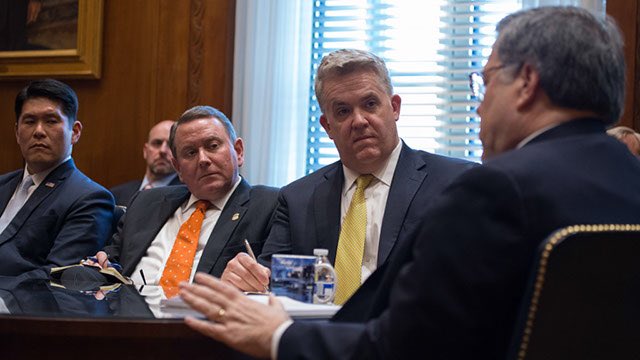
Pictured: On March 7th, 2019, newly confirmed Attorney General William Barr meets with the aforementioned Attorney General’s Advisory Committee (AGAC).  Note AGAC Chairman Richard Moore standing to the left (two hands on chair), as Mr. Barr meets his AGAC Vice-Chairman John Huber.

Late in the afternoon AG William Barr held the first meeting with the AG Advisory Committee. Much speculation is being made around this meeting.  Some have projected a great deal more meaning into this picture than actually exists.

The March 7th meeting was simply the introductory session of the fifteen AGAC members to Attorney General William Barr.  U.S. Attorney John Huber was present for the meeting as Vice-Chairman of the AGAC, nothing more.  Anything beyond that is wild speculation.

Within this meeting, AG Barr is able to meet the Advisory Committee members, assess their skills and competence and lay out his vision for the U.S DOJ under his tenure.  Nothing more purposeful than an assembly of the AGAC should be read into this meeting.

U.S. Attorney Huber

@USAttyHuber

US Attorneys thoroughly enjoyed our time with AG Barr this week. He is a solid, proven leader with a clear vision for the @DOJ. We will move forward with his priorities, hold offenders accountable, and advance the rule of law.

View image on Twitter

US Attorney Utah

@DUTnews

3,681 people are talking about this
Despite CTH being the first to discover the existence of a U.S. Attorney back in February 2018 working with/advising Horowitz; and confirming that discovery in March 2018 before it was publicly admitted; CTH can find absolutely no evidence that John Huber remained attached to any of the investigative outcomes from the OIG reports.

The absence of evidence is not necessarily evidence of absence, but Paul Sperry also did a lot of interviews looking for evidence that Huber was active and supporting the OIG effort. Sperry came away with the same conclusions [read here]. Exactly the opposite is visible, and current witnesses within the IG FISA review have not been interviewed by any U.S. Attorney.

It would appear that after the IG narrowed his investigative field to only the remaining FISA-investigation, there was no longer a direct need for U.S. Attorney Huber and he departed along with U.S. Attorney John Lausch.

Now, keeping the above dates in mind; and sticking to facts without supposition; here’s a factual timeline that tells a story and might help make sense of what’s going on:

♦On January 12th, 2017, the DOJ Office of Inspector General began investigating issues surrounding FBI policy breeches, media leaks, improper conduct by FBI officials and politicization by the FBI and DOJ (link) This initial investigation would result in two OIG reports (April ’18 – McCabe) and (June ’18 – Overall DOJ/FBI conduct)

♦On July 27th and September 26th, 2017, House Judiciary Chairman Bob Goodlatte was demanding Jeff Sessions revisit issues about potential DOJ and FBI corruption during the Obama administration.

♦On November 13th, 2017, AG Sessions responded to congress that the OIG was already looking into it; and he was going to appoint a ‘senior U.S. Attorney‘ to assist. (link)  This AG response is the same day that AG Sessions announced his first nine AG Advisory Committee members, which included John Huber as Vice-Chair (link).

♦On November 22, 2017, Sessions’ chief-of-staff, Matt Whitaker, sends a formal request for administrative review to U.S. Attorney John Huber (link).  Included in the request is the prior AG response to congress so that Huber can see what needs to be reviewed. (link)

♦On March 28th, 2018, IG Michael Horowitz expanded his oversight (link) and opened up a third investigation; this time into possible FISA abuse.

♦On March 29, 2018, again shortly after appointing more AGAC members (which included John Lausch), AG Sessions responds to more congressional inquiry (link) by citing the previous IG Horowitz review, now consisting of three investigations, and a John Huber assist (if needed). (link)

♦On April 13, 2018, the first Horowitz report was published (link).  This report covered mostly the behavior of Andrew McCabe and was followed six days later with a criminal referral to the U.S. Attorney in Washington DC, Jessie Liu (link)

♦On June 14, 2018, the second Horowitz report was published (link).  This report was much more involved and covered the totality of FBI and DOJ conduct and potential political bias throughout 2016.  The report cited “poor judgement” by numerous officials, and poor internal behavior with FBI officials contacting media, but the OIG did not find “direct evidence” of political bias.  There were no criminal referrals. (link)

That only leaves one OIG report remaining.  The one covering potential FISA abuse:

QUESTION: If the DOJ Office of Inspector General found no intentional DOJ and FBI malfeasance in the June ’18 report covering the totality of the 2016 election; and no direct evidence of political bias within the decision-making of the officials being reviewed; what’s the likelihood of the same OIG finding malfeasance as it relates to DOJ/FBI *FISA activity* and the exact same people?

The extensive OIG election-period report found no DOJ/FBI misconduct (only some bad judgement). There were no criminal referrals. There were recommendations for internal improvement, which FBI Director Wray said the FBI would implement (link).

It’s important to note the Office of Inspector General FISA review/investigation of potential FISA abuses (opened March 28th, 2018) was launched three months prior to the “Election Activity” final report in June 14th 2018.  There was obvious investigative overlap; however, the June report said “no evidence of intentional misconduct.”

The time frame covered by the “Election Activity” review (OIG report 2) and the “FISA Activity” review (OIG report 3) are the same. The topics are different (FISA being more specific), but the people under review and time-frame therein are identical.

If the OIG found no intentional corrupt activity in the June ’18 report (only bad judgement); no referrals were made; and time period and people are exactly the same; how can the OIG produce a post-facto FISA review report with substantively different conclusions?  It seems unlikely.

However, that said, there is a narrow window of potential optimism for those seeking some measure of accountability inside report #3.

DOJ Official Bruce Ohr is likely still employed for the same reason the dispatch of Peter Strzok and James Baker was delayed prior to the finalization of IG report #2. The OIG and INSD (inspection division) can only reach those still inside the system.

On the narrow issue of how the DOJ and FBI assembled, handled and used the FISA application (and subsequent Title-1 surveillance warrant), against the Trump campaign and officials therein, Bruce Ohr is a key and central witness for the OIG (link).

Mr. Ohr has testified (transcript here) that he was interviewed by IG Horowitz about his role in assembling the information that was later used in gaining a FISA Title-1 surveillance warrant without following the Woods Procedure.  [Note: Mr. Ohr was never interviewed by John Huber]

Unlike the previous OIG report #2 (Election-era Issues) if the OIG can find direct and intentional “gross misconduct” (by referencing traditional and historic FISA application assembly therein), toward those officials who participated in the FISA assembly, then it becomes possible the OIG report could potentially outline that the FISA application resulted in serious fourth amendment civil rights violations. And that perspective could be a narrow opening toward legal issues for DOJ and FBI officials who participated in assembling an *intentional* and fraudulently-based application to the FISA court.

Unfortunately, that approach is a very high bar for the OIG to reach. Again, the OIG would have to find “direct evidence” of “gross misconduct” resulting in civil rights violations. The defensive arguments by the corrupt group would be filled with legal justification(s) and internal process discussion.  Lots of room for reasonable doubt.

Also unfortunate, any finding of “fourth amendment” FISA-abuse would be adverse to the interests of the larger U.S. intelligence apparatus and institutional participants who rely on the current use of the FISA process.  Current officials would want to protect it.

I suspect the team of DOJ/FBI officials who abused the FISA court, and are now watching things unfold, are also relying upon the institutional necessity of the FISA process to protect themselves from too much scrutiny and sunlight.

An example of that unfortunate reality is found with HPSCI Chairman Devin Nunes advocating for FISA reauthorization on January 11th, 2018 (link); right in the middle of the explosive revelations and discoveries of potential abuse.

As HPSCI Chairman, Devin Nunes knew back in 2017 the FISA process was abused for corrupt political intent.  However, he also knows it is a critical component and tool for the U.S. intelligence system and national security. Currently Mr. Nunes is advocating for a much larger conversation about it before any further re-authorization.

Lastly, assuming Robert Mueller is not impeding the IG’s ability to interview witnesses and gather documents; I would anticipate hearing about the end of Horowitz’s FISA report sometime in April, likely with a media leak surrounding the first draft report being submitted to principles and stakeholders for feedback.

There’s a slight chance leaks about the content therein; or at least the timing thereof;  might be part of Speaker Pelosi’s recent decision to drop the impeachment narrative.

One can only imagine the downstream political chaos if IG Horowitz started cracking open the doors to possible civil rights violations from Obama-era FISA abuse.

There may not be a great deal of legal accountability forthcoming, but there could be a considerable amount of political damage.  Hopefully a looming documentary declassification will deliver a thunderous amount of sunlight in all directions.

Tucker Carlson Outlines Leftist Dependency on “The Mob” Mindset…


Fox News host Tucker Carlson is the latest target for the leftist horde.  In response to their ultimately predictable behavior, Carlson outlines their ‘bigger picture‘ objective.  Those who have followed the arc of leftist-advancement will note that within his counter-punch the remarks by Carlson are almost identical to those expressed by David Mamet.

Mamet famously stated, essentially: In order to advance their objectives, modern progressives, ie. ideological leftists, need to pretend not to know things; for it is only by pretense that leftists can avoid the inherent hypocrisy within their position.

[Recent Example: It is pearl-clutchingly immoral for Trump to call out (ie. ‘attack’) federal judges; meanwhile leftists currently attack the judge over the recent Manafort sentence.]

Ultimately the (im)moral and (non)virtuous professional leftist always accuses his opposition of what he, himself, is inherently guilty of doing.  Good segment:

.

It is worth noting that part of the leftist severity in reaction to President Trump, is because Trump punches back against their politically correct hypocrisy.  That unapologetic push-back triggers them every time. The continued segment with Tammy Bruce is below:

.

January Retail Sales Report: Strong Growth in Building and Home Improvement Sales…


The Commerce Department has released a much anticipated January Retail Sales Reportwhich shows total cumulative spending growth of .02% over prior month, and 2.3% growth year-over-year.  Importantly, a sector review (year over year), comparing January ’19 with Jan ’18, highlights where we are against our anticipated state of the economy:

(source – pdf)

Gas prices are low which are reflected in lower overall sales data (-4.2% year-on-year) within the gasoline station sector.  Additionally, electronic and appliance store sales (-3.3%) reflects American consumers holding on to currently owned durable goods in that sector and not replacing. Both of these sectors were defined within the larger MAGAnomic forecast.

On the strong upside, building materials and home improvement reflect large growth of +8.7% year-over-year and +3.3% over prior month.  Again, when considering how the principles of MAGAnomic policy focuses on ‘blue-collar’ economic improvement, these outcomes are exactly what you would expect to see.

How do these results reflect amid your family and social circle; do you see the same?

The Auto sector took a major drop in January with a decrease of 2.4% over December 2018, and a moderate +.02 percent when compared year-over-year to January 2018.  The auto sales sector looks tenuous, not many people buying new cars. Again, are these results in alignment with your family and friends?

The sectors that most benefit from disposable income, sales at restaurants and bars advanced 0.7 percent for the month and 5.7% for the year-over-year.  Also, purchases at hobby, musical instrument and book stores jumping 4.8 percent for the month, the largest increase since January 2013.  Sales at food and beverage stores gained 3.2 percent year over year, the biggest gain since April 2016.

It would appear consumers are being selective with making large durable goods; extending the life-cycle of the most expensive purchases, including electronics; but also enjoying the benefits of higher wages with expenditures by dining out and enjoying entertainment.

Knowing MAGAnomic policy is focused on the middle-class, these retail sales outcomes would seem to make sense.

Does this overall big picture align with purchases and lifestyle choices amid your family, friends, co-workers and social network?

Failure to Launch – Pelosi and Schiff Announce They are Dropping Impeachment Plan…


Remember: “everyone has a plan until they get punched in the face.” ~ Mike Tyson

The exploitation of Michael Cohen toward the launch of Speaker Pelosi’s impeachment effort backfired bigly.  Not enough people found Cohen credible; and because of the ridiculous way the entire staged performance was carried out by Democrats, and the their media allies, most people saw right through the politicization of it. The plan just failed.

Additionally, some politicians like Jim Jordan, Jody Hice and Mark Meadows started calling out the blatant construct behind Pelosi’s impeachment plan.  HPSCI Chairman Adam Schiff sending his staff to New York four times to prep Michael Cohen before the hearings – was only made more ridiculous by Chairman Schiff trying to deny they coached Cohen.  Schiff looks like a doofus.  So today:

[Nancy Pelosi] “I’m not for impeachment. This is news. I’m going to give you some news right now because I haven’t said this to any press person before. But since you asked, and I’ve been thinking about this: Impeachment is so divisive to the country that unless there’s something so compelling and overwhelming and bipartisan, I don’t think we should go down that path, because it divides the country. And he’s just not worth it.” (link)

UPDATE: Jerry Nadler has also joined in (see below).

Chairman Adam Schiff:

Manu Raju

@mkraju

House Intelligence Chairman Adam Schiff tells me he agrees with Pelosi on impeachment: “If the evidence isn’t sufficient to win bipartisan support for this, putting the country through a failed impeachment isn’t a good idea.”

Manu Raju

@mkraju

Schiff added: “I think given how polarized the country is right now and given how the Republican members of Congress have prostrated themselves right now in front of the president, in the absence of very graphic evidence, it would be difficult to get the support of” the Senate

647 people are talking about this
Chairman Jerry Nadler:

Manu Raju

@mkraju

Manu Raju

@mkraju

Nadler added: “I’ve stated my position: It has to be enough evidence that you think you’ll get substantial support from opposition voters.”

Additionally, listen to how Adam Schiff is now describing the use of the Mueller report.

…”the evidence would have to be pretty overwhelming”…

Manu Raju

@mkraju

Rep Brad Sherman, supporter of impeachment, to me on Pelosi’s Trump isn’t “worth it” comment: “You don’t impeach Trump for him; you impeach Trump for the Constitution.”

“the evidence would have to be pretty overwhelming” is a considerable change in position for HPSCI Chairman Adam Schiff who was previously open to using rumor, innuendo and supposition to launch investigations.

One of the hurdles the Democrats cannot overcome is the strength of the support for President Trump.  Despite the 24/7/365 attacks from their media allies President Trump still has an approval rating of 50%.   And approval of handling the economy over 56%.

Consider this recent analysis CTH completed comparing the current approval rating of G7 Leaders:  Justin Trudeau, Canada (35%); Emmanuel Macron, France (28%); Angela Merkel, Germany (29%); Theresa May, U.K. (28%); Giuseppe Conte, Italy (67%); and Shinzo Abe, Japan (44%).

It is not coincidental the “globalists” (Trudeau, Macron, Merkel and May) are not supported.  Meanwhile the “nationalists” (Trump, Conte and Abe) are very much supported.

I guess we can call this truth: stuff we’ll never see in the media.

Press Secretary Sarah Sanders and Budget Director Russell Vought Hold Press Conference…


Earlier this afternoon White House Press Secretary Sarah Sanders and Acting OMB  Director Russell Vought held a press conference to brief reporters on the president’s fiscal year 2020 budget and answer questions on current political events:

.

[White House] FURTHERING OUR ECONOMIC PROSPERITY: President Donald J. Trump’s budget request will continue our economic resurgence while furthering his vision to reduce spending and invest in America.

  • The Trump Administration’s pro-growth policies have unleashed the American economy, creating millions of jobs and resulting in historically low unemployment.
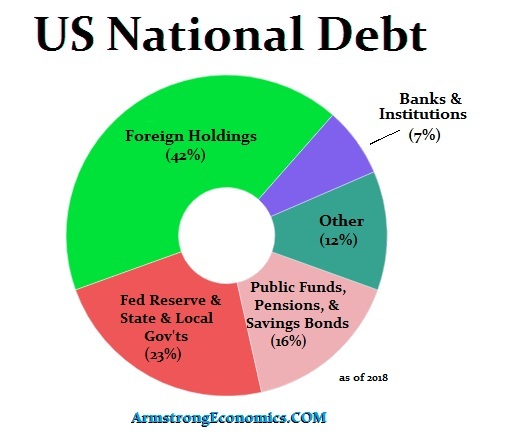
  • However, the national debt – currently more than $22 trillion – remains a grave threat to our economic and societal prosperity.
  • This budget will address the national debt crisis while still investing in critical American priorities that will allow America to further excel in the future.

RESPONSIBLE BUDGETING: President Trump’s budget request promotes responsible Government spending by prioritizing effective programs and cutting waste.

  • The budget reduces nondefense programmatic spending by 5 percent below the 2019 cap level.
  • Proposes policies to shrink or eliminate Federal programs that fail to deliver desired outcomes for the American people.
  • Reduces spending by $2.7 trillion over 10 years, shrinking the deficit from nearly 5 percent of GDP in 2020 to under 1 percent of GDP in 2029.
    • Puts the Federal budget on a path to balance within 15 years.
  • Sticks to the current discretionary spending caps while also providing additional defense resources through investments in Overseas Contingency Operations and emergency funding.
    • Allows us to fund our national security needs while avoiding a costly “cap deal,” which would increase defense and nondefense spending.

INVESTMENT IN AMERICA: President Trump’s budget request reflects his commitment to defending our Nation, ending the opioid epidemic, and building a strong American workforce.

  • $32.5 billion for border security and immigration enforcement activities to help manage the immigration crisis on the United States southern border, including:
    • $8.6 billion for the border wall, funded by Department of Defense (DOD) and Department of Homeland Security (DHS).
    • $478 million to hire 1,750 additional Customs and Border Protection (CBP) and Immigration and Customs Enforcement (ICE) law enforcement officers.
    • $2.7 billion in funding for 54,000 ICE immigration detention beds.
  • $750 billion for national defense – including $718 billion for DOD to pursue the National Defense Strategy.
    • Priorities include: strategic competition with Russia and China, countering rogue regimes such as North Korea and Iran, defeating terrorist threats, and consolidating gains in Iraq and Afghanistan.
  • $80.2 billion to fund Department of Veterans Affairs (VA) medical care requirements in 2020.
    • Fully supports implementation of the historic VA MISSION Act to provide veterans greater choice on where they receive their healthcare, including at a private provider.
  • $330 million for the Department of Justice to aid State and local efforts to fight the opioid crisis.
  • The budget promotes quality education and job training, holds higher education institutions more accountable, and expands Pell Grants to high-quality short-term training programs.

(LINK)

Alexandria Ocasio-Cortez SXSW 2019 (This Woman is Certifiably Insane)


Numerous requests to locate the full and unedited AOC segment from SXSW 2019.

Here it is:

Trade Deficits & the Confusion Caused by the Methods used to Calculate it


QUESTION: Marty, just reported this past week America’s trade deficit hit a record $891 billion while, in the same week, unemployment report fell to 3.8%. Does this refute the conventional economic belief that trade deficits take away jobs and output?

Cheers, TGM

ANSWER: What is reported as trade is not simply trade. The numbers are all screwed up. It tracks actual goods as well as services and that includes capital flows. The accounting system is set up in such a way that capital investment buying bonds, stocks, and real estate go into the Capital Account. However, all dividends and interest earned by a foreigner on US assets then are accounted for in the Current Account. It is the Current Account that people report as trade which is not correct because it also includes interest and dividends. Thus, the more foreigners invest in a country, the more it will erroneously appear to be expanding the trade deficit as interest and dividends flow back on their capital investment.

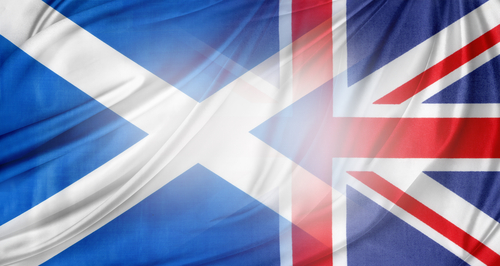
Scottish Independence & BREXIT


QUESTION: Marty,
Big fat question for you regarding the UK and the SNP.
You seemed to support Scotland breaking away from the UK in 2014, but since then you’ve voiced your concern on the socialist policies of the SNP. I share that concern, as do a growing number of people here, in not so sunny Scotland.

Unfortunately, SNP seems to have introduced a few more taxes into the system in the last year. One of which is that the higher tax band in the rest of the UK has been raised to 50K, whilst in Scotland, it has been kept at 43k. The other latest tax is that if the company you work for have parking spaces and you drive to work and park your car there, you can be hit with around £450 per year.

Looking back on the history of UK general elections, the SNP hit a high point in the October 1974 general election, polling almost a third of all votes in Scotland and returning 11 MPs to Westminster. They then dropped to under 6 seats till the 2015 election, where they went from 6 seats (in 2010) to 56 in 2015. You could argue the rise to 56 seats was due to the fact people either wanted independence or voted for them as they were happy to be led by them in Scotland but not wanting to be independent. They dropped to 35 seats in 2017, primarily due to people being fed up with the independence record being regurgitated over and over.

To summarise then, the large rise in ’74 followed by a big drop in its support at the 1979 General election, followed by a further drop at the 1983 election. Will we see this again? Big rise in 2015, followed by a large drop in 2017 and the same again in the next election?

Personally, I think the tax rises will take a big toll on their support and they will get hammered in the next election.

Many thanks for your thoughts and wisdom.

G


ANSWER: I love Scotland. Every time I flew in to Edinburgh to do an institutional conference for a day, I was introduced as a 7th generation Scotsman – never an American. The separatist movement is separate and distinct from the SNP, which is one step to the right of communism. I was living in London when “Braveheart” came out. I remember going to the movies there, and on the way out everyone was saying how some member of their family was Scottish.

That said, the SNP socialist policies are brain dead and this idea that they must remain part of the EU is beyond stupidity even for someone who is dead mentally. There is absolutely no economic validity to remaining inside the EU. The British have NEVER won anything of significance in the European court. What will it take to make the British realize that they are not really welcome in the EU for resentment remains that it was the Brits who saved Europe from both Napoleon and Hitler.

Ann-Medal-Union-Scotland - 2The Scots voted for independence in a referendum which was clearly rigged by London and the EU. But that was the prelude to BREXIT, which the government is doing its best muck up again over this unwarranted fear over trade. The economy will turn down very hard in Europe in 2019 into 2020 before bottoming. This will alter the politics ahead rather significantly. In Brussels, they will be blaming the Brits, while the Italians will begin to voice their opinion that the Brits got it right after all.

Cyclically, the United Kingdom that was first created back on May 1st, 1707, under Queen Anne (1707.331). On the 309.6 year cycle of the Economic Confidence Model, we arrived at 2016.9315. The BREXIT vote took place on June 23rd, 2016 (2016.476). A referendum on Scottish independence from the United Kingdom took place on Thursday, September 18th, 2014 (2014.715). That meant the Scottish vote was 307.384-years from inception. This was cyclically a confirmation that BREXITwould, in fact, succeed in 2016.

However, the true Scottish Separatist/Nationalism Movement actually began back in 1934 during the economic hard times of the Great Depression. It was in 1934 when the Scottish National Party (SNP) was founded, making its primary goal the future independence of Scotland. The party gradually began gaining ground after World War II, which was propelled by the discovery of rich oil resources in the North Sea during the 1970s. Then in 1974, the SNP won 30% of the Scottish vote and 11 seats in Parliament after campaigning on the slogan “It’s Scotland’s oil!”

Of course, the first major step toward Scottish independence came in 1995. The first and greatest reason for creating a Scottish Parliament in 1999 was that the people of Scotland demanded and deserved the human right to democracy. The UK Government’s white paper on Scottish devolution, Scotland’s Parliament, was published in July 1997. It set out proposals for a new Scottish Parliament and drew heavily on the Scottish Constitutional Convention’s 1995 (see the report: Scotland’s Parliament, Scotland’s Right).

A referendum was held on September 11th, 1997 to ask the Scottish people whether they wanted a Scottish Parliament and whether it should have tax-varying powers. In that 1997 referendum, the Scots voted in favor of devolution of powers, which meant that although Scotland remained part of the United Kingdom, its government gained a broad range of new powers. It would have the power to set its own tax rates as well. Among these new powers was also the right to control education and healthcare. This lead to the creation of a Scottish Parliament for the first time since it was dissolved in 1707. At the peak of the economy in 2007, the SNP won an upset victory in the Scottish parliamentary elections, ending some 50 years of Labour Party dominance. Then the SNP leader Alex Salmond became the first elected minister of Scotland. He won a second term in 2011 and was able to use his party’s historic mandate to secure approval for a referendum on independence for Scotland.

It took just two 8.6-year cycles from 1995 to the beginning of the separatist movement in 2012. In 2012, Salmond and British Prime Minister David Cameron signed an agreement to hold that referendum in 2014. Subsequent negotiations lowered the voting age in the referendum for 16 and determined that it will pose a single question: “Should Scotland be an independent country?”

The problem the SNP faces is they have mixed up independence, socialism, and remaining in the EU rather than the UK. In this regard, they have truly lost their way and do not comprehend either trade of the fact that socialism is collapsing right in front of their face.