Federal Reserve members are fleeing the central bank. We saw two Fed presidents resign in October amid scandal. Randal Quarles recently announced that he also plans to resign from the Federal Reserve’s Board of Governors when his four-year term expires at the end of the year. Another position remains vacant as well. A third position for the central bank will open up in January when Vice Chair Richard Clarida’s term expires. Fed Chairman Jerome Powell’s term ends in February, and Biden has not stated whether he plans to renominate Powell. Rumors are swirling that Biden may appoint Lael Brainard as he is the only Democrat on the seven-member board.
Biden could choose to renominate Powell and fill Quarles’ position with Brainard. However, does Powell still want the job? The investigation into potential inside trading among Fed members may have pushed him over the edge. We cannot bring inflation down without reaching maximum employment, and we cannot reach maximum employment under Biden’s authoritarian mandates. The Fed is in between a rock and a hard place.
There is a potential for three to four slots to become available in the near future, which would give the Biden Administration the ability to tip the scales in their favor, despite the Fed claiming to be independent from the government. Sarah Bloom Raskin, a previous Fed governor, could be in the running. William Spriggs, chief economist at the AFL-CIO and an economics professor at Howard University, may also throw his hat in the ring. Lisa Cook, an economist for Michigan State, is also a potential candidate. Senator Sherrod Brown, a Democrat on the Senate Banking Committee that manages Fed nominations, said, “It’s time we had a black woman on the Board of Governors” in reference to Lisa Cook. Would it be possible to appoint the most qualified person rather than making a decision based on race or gender? They likely want to appoint anyone who is on board with the Build Back Better agenda. These people are making decisions that shape the entire world economy. Unfortunately, it seems as if many of the qualified individuals no longer want the job due to Biden’s mismanagement of the economy.
Posted originally on the conservative tree house on November 10, 2021 | Sundance | 75 Comments
On Monday July 19, 2021, the White House occupant declared that inflation was temporary and would be “transitional”. Current economists now refute that claim, as inflation continues to escalate at an alarming pace. In July Joe Biden said (transcript):
“Now, I want to be clear: My administration understands that if we were to ever experience unchecked inflation over the long term that would pose real challenges to our economy. So while we’re confident that isn’t what we are seeing today, we’re going to remain vigilant about any response that is needed.”
Joe Biden was asked a follow-up question after his remarks:
Q Yes, thank you, Mr. President. At what point would you consider inflation unchecked to a point at which you would either consider taking action or you would want to see the Fed take action?
To wit Joe Biden responded:
THE PRESIDENT: “Yeah. There’s nobody suggesting there’s unchecked inflation on the way — no serious economist. That’s totally different”. (link)
Posted originally on the conservative tree house on November 10, 2021 | Sundance | 239 Comments
Yesterday, data on the wholesale “Producer Prices” was released showing an 8.6 percent increase in prices for final demand products {DATA HERE}. That is the increase in cost within the system of bringing products to market.
Today, the “Consumer Price” data was released showing a massive 6.2 percent increase in prices {DATA HERE} for goods that are currently available for sale. The overall rate of inflation is now 6.2% year-over-year.
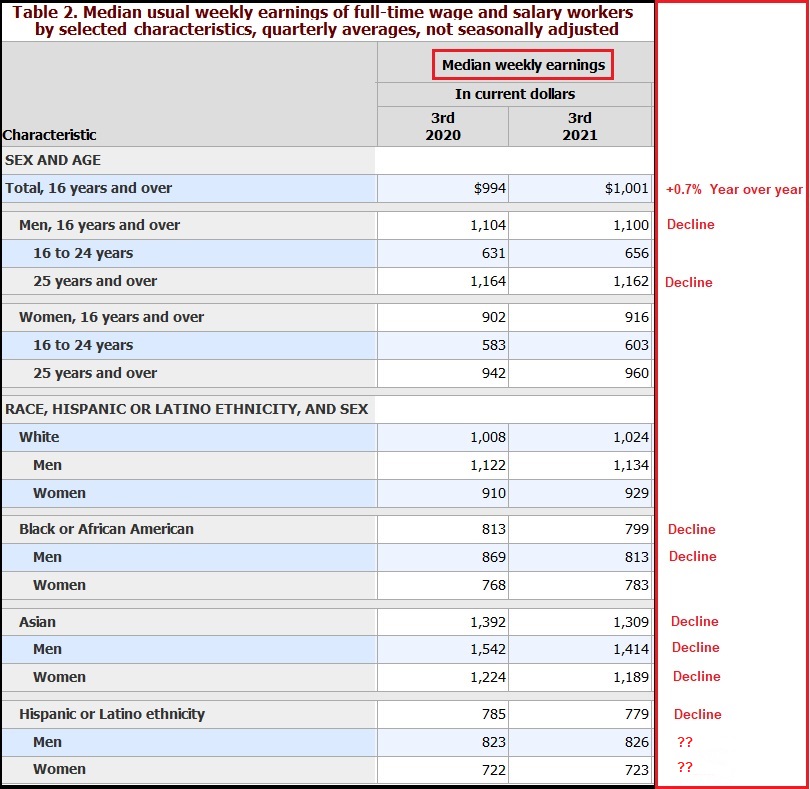
When you overlay inflation atop wage growth, the Bureau of Labor and Statistics (BLS) report now shows a decrease in “real wages” of 1.6 percent {DATA HERE}, which is the increase in weekly pay minus the additional costs to buy stuff. The working class is losing ground rapidly. Things are ugly and they are fixin’ to get uglier.
Before getting to the part where we can explain exactly how much more we can predict to pay for current products in 90 days (yes, that approximation is possible), first lets look at the actual data on the current inflation rate for products we are buying today. [Table 2] is the easiest reference for category specific review.
Overall, the prices for groceries (food at home) went up 1.1% in October and 5.4% for the year. However, several products in the supermarket have jumped massively. Beef jumped 1.9% for the month and is 20.1% higher overall. Bacon went up 2.1% for the month and is now 20.2% higher for the year. All processed foods increased at a rate about four times higher than fresh unprocessed foods.
Fuel oil went up 12.3% in October and is now 59.1% higher for the year. Unleaded regular gasoline went up 3.9% in October and is now 51.3% higher for the year. Piped natural gas went up 6.3% for the month and is now 28.1% higher for the year. Used vehicles are now 26% higher than last year, and new cars went up roughly 10%. You can scroll down Table-2 to see each category (second and third columns show year and monthly increases). It’s unnerving to see the scale of inflation while knowing it will get worse.
One kitchen table way to estimate the current inflation that is already in the system but has not shown up in the retail end is to take the wholesale inflation (PPI 8.6%), deduct the current retail inflation (6.2%), and that gives you an estimated aggregate gap of 2.4% between them. That 2.4% is essentially an inflation lag already in the supply chain at various stages (raw material, intermediate, final). Bear with me…
The 2.4% difference (8.6 – 6.2) is a lag that will show up in approximately 90 days. The difference between the wholesale inflation and retail/consumer inflation will eventually reach the cash register in higher prices. The 2.4 difference is also a good way to approximate how high finished processed goods will go.
The difference between the wholesale rate of inflation and retail rate of inflation (as a percentage) is around 28%. That’s a good generalized way to approximate what the future price will likely be for any given item, call it a widget, in the consumer segment.
• Current widget at $17.00 + 28% gives you an approximate for future widget at $21.76
• Current bread at $4.69 + 28% gives you an approximate for future bread at $6.00
Using this method, you can approximate the upper price likelihood for a heavily processed product. The more an item needs to be processed, the more hands that touch the product in the processing, the higher the end price will be. The more an assembly of individual processed parts is needed in order to generate a finished good, the higher the end price will be, etc. An increase of 28% will be an approximation for the future prices (roughly 90-120 days) of a heavily processed item.
Grocery prices rose 1.1% last month, while the cost of eating out was up 0.8%, the largest monthly gain in 40 years.
MSNBC – Inflation across a broad swath of products that consumers buy every day was even worse than expected in October, hitting its highest point in more than 30 years, the Labor Department reported Wednesday.
The consumer price index, which is a basket of products ranging from gasoline and health care to groceries and rents, rose 6.2% from a year ago, the most since December 1990. That compared with the 5.9% Dow Jones estimate.
On a monthly basis, the CPI increased 0.9% against the 0.6% estimate. (read more)
The National Institute of Health (NIH) has begun quietly covering up Fauci’s unspeakable crimes. The White Coat Waste Project, a non-profit watchdog, blew the whistle on a Fauci funded experiment that tortured beagle puppies in the name of science.
“Our investigators show that Fauci’s NIH division shipped part of a $375,800 grant to a lab in Tunisia to drug beagles and lock their heads in mesh cages filled with hungry sandflies so that the insects could eat them alive,” White Coat Waste Project stated. “They also locked beagles alone in cages in the desert overnight for nine consecutive nights to use them as bait to attract infectious sand flies.” Rep. Nancy Mace (R-S.C.) joined with 24 bipartisan lawmakers to demand answers for Fauci’s “reprehensible misuse of taxpayer funds.”
The National Institutes of Health is no longer listed as a funder for this horrific study. Instead, the following disclaimer has been published that claims the NIH never provided funding to the study in question.
(“Publisher’s Note: The US National Institutes of Health and the Wellcome Trust did not provide any funding for this research and any such claim was made in error.”)
In addition to lawmakers demanding questions, PETA has joined in on the inquiry. PETA Senior Vice President Kathy Guillermo said, “NIH’s denial that Fauci’s agency funded the beagle atrocity is a little too convenient. The published study—like the one on the beagle experiments—clearly listed NIH as the funder,” her statement added. “Then, as now, NIH called it a mistake. Is rewriting history the new defense against complicity in torture? PETA calls on NIH to release the original, unredacted grant document on the beagle experiments to verify its claim.” Sadly, rewriting history is a common practice throughout civilization.
Taxpayers funded this study and deserve to know why the NIH continues to receive government grants to back research that has yet to lead to improvement in human life. Fauci has yet to comment.
Posted originally on the conservative tree house on November 2, 2021 | Sundance | 157 Comments
The gibbering and cognitively disconnected teleprompter reader who currently occupies the White House reads from a script today prepared for him by people who know he is disposable.
That is the most logical reason why Joe Biden could brazenly attempt to claim today that “wages have gone up faster than inflation.” WATCH:
According to the Bureau of Economic Analysis (BEA) in September alone inflation:
“increased 4.4 percent from one year ago. Energy prices increased 24.9 percent while food prices increased 4.1 percent. ” (link)
Posted originally on the conservative tree house on October 28, 2021 | Sundance | 214 Comments
The Bureau of Economic Analysis (BEA) has released the first estimate of Gross Domestic Product (GDP) for the third quarter (July, Aug, Sept). [DATA HERE] The top line number of two percent GDP growth is significantly worse than most economists and financial pundits expected.
The second quarter GDP was 6.7%, so a slow down to 2% is very significant considering the economy should be rebounding and reopening after the COVID-19 impacts. However, when we dig into the details [Table One] you will see how what is happening in your life is actually reflected in the data. None of this should be a surprise, as the data is simply reflecting what is happening in your personal checkbook economics.
First, here’s the media jaw agape, with false explanations and justifications:
.
The drop has nothing to do with the ‘delta variant’, and everything -EVERYTHING- to do with inflation and impacts from Joe Biden’s economic policies.
Let’s take a look at the details, and you will see how the national GDP is simply a reflection on what we are doing to survive the Biden economy.
GDP growth is the measure of what is happening inside the U.S. economy. GDP reflects the value of goods and services produced in the U.S. minus the value of goods and services we import from outside the U.S.
Consumer spending represents two-thirds of our overall U.S. economy. When Americans stop buying stuff, our GDP drops.
A few things to remember about the value of goods and services. Inventories are an asset, increases in the inventories of goods we produce is a positive driver of GDP. Those inventories become sales, and those sales are also calculated in the value of goods we build, like houses. Considering how much housing values have increased; and considering how much more value that should add to the GDP overall; when the economy “decelerates”, as housing values increase, that tells you something is profoundly askew.
Consumer spending represents two-thirds of our overall GDP growth. Now take a look at the data in Table-1
Notice what is highlighted? Massive drops in consumer purchases of Goods (-9.2%), specifically in consumer spending for ‘Durable goods’ -26.2%
That statistic should not come as a surprise to those CTH readers who have followed along in the past few months. That statistic is simply a reflection of what we are doing. We are paying so much more for energy, gasoline, fuel, housing and food (all driven by inflation), that we are not spending on durable goods like cars, trucks, or long term appliances, electronics or other non-essential items.
-26.2% in one quarter is a massive contraction in the purchasing of durable goods. However, it should not be a surprise. Overall inflation increased 5.4% in the third quarter as measured within this first estimate analysis of GDP. However, inflation on food and gasoline was more than four to eight times higher, respectively, than overall inflation. As a result, disposable income has collapsed:
“Disposable personal income decreased $29.4 billion, or 0.7 percent, in the third quarter”, according to the top line first analysis. However, again this is a preliminary estimation and reflects a very skewed data point. With inflation on essential items running much higher than wage growth, the -0.7 percent first estimate for personal income is profoundly generous to the Biden administration. We can expect the second estimate in late November -with more complete details- to be a significant downward revision because disposable incomes have dropped much more than -0.7%.
Purchases for durable goods do not drop by 26% with only 0.7% drops in income. Look at your own checkbook economics. All of us blue-collar and working class folks are hunkering down and prioritizing food, fuel and home heating costs. We are not out buying new stuff.
Private residential sales are down 7.7% in the July, August, Sept, period according to the BEA data. Remember when CTH said at a macro level housing prices peaked in the last two weeks of May and first two weeks of June? There’s another supportive data-point.
Yes, there are regional impacts from relocation that are driving home values up in key regions like Florida and some suburban neighborhoods as people flee the crazy. However, overall home values have peaked, and only institutional investors (not families) are purchasing them now. Those institutional investors are buying property because they need tangible assets…. because their paper assets are extremely vulnerable. Vanguard and Blackrock purchasing houses gives them a tangible asset they can then leverage for pennies on the dollar for more low interest loans from the fed. Those houses are then turned into rental incomes feeding the mothership.
Lastly, exports should be a benefit to GDP, but as you can see in Table-1 exports are -2.5%, we are exporting less value in part because the value of our currency has dropped so dramatically.
The bottom line is this. The first estimate of Q3 GDP growth is merely a reflection of what you know is happening in your life and around your neighborhood. The next revision to this data (late November) will be lower than the first estimate because you can see the first estimate has not yet caught up to the current status as it existed in September.
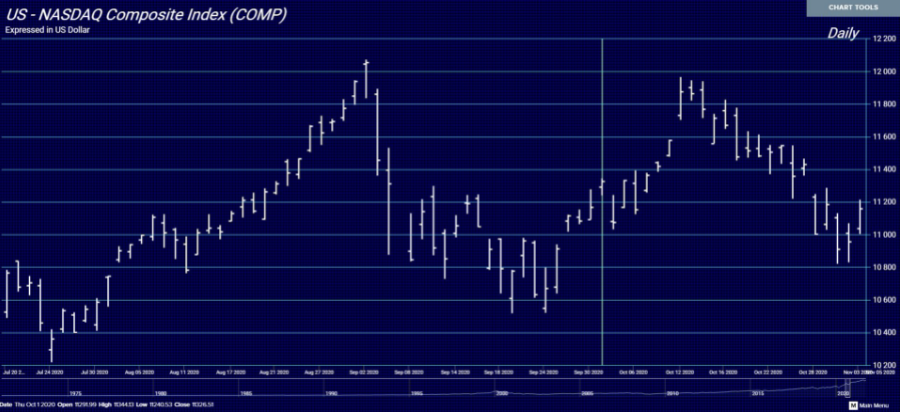
Federal Reserve Chairman Jerome Powell was caught in a lie that may cost him re-election in 2022. The Federal Reserve Chairman, the man with the most insight into future US market policy, sold between $1 million and $5 million from his personal account on October 1, 2020. Not so coincidentally, the Dow decreased by around 6% that month before rebounding, and Wall Street saw its worst month since March 2020. Then, in September 2021, Powell ordered an ethics committee to investigate potential insider trading among central bank members, which he deemed necessary “because the trust of the American people is essential for the Federal Reserve to effectively carry out our important mission.”
However, when we look at these transactions, they do not appear to be inside trading. Had Powell sold ahead of the COVID Crash Jan-Feb 2020, then there would be a question of inside trading, but then again nobody bothers to investigate Bill Gates for his sales ahead of the COVID Crash he was cheering so much. After reviewing the trades, I would not raise any concerns. BTW, I was asked to review the Cattle trades of Hillary Clinton which were, in my opinion, a pay-off by putting the losses in one account at the REVCO and the wins into hers all when she was in a meeting and never traded futures before.
Boston Fed President Eric Rosengren had traded real estate investment trusts that owned the same mortgage-backed bonds that the central bank was purchasing. Dallas Fed President Robert Kaplan earned over $1 million last year trading individual, COVID-sensitive equities such as Amazon, Chevron, and Delta Air Lines. Both men abruptly stepped down from their positions shortly after the information came to light. They declared innocence, with Rosengren citing an early retirement due to health reasons and Kaplan seeking to avoid conflict. “The Federal Reserve is approaching a critical point in our economic recovery as it deliberates the future path of monetary policy. Unfortunately, the recent focus on my financial disclosure risks becoming a distraction to the Federal Reserve’s execution of that vital work,” Kaplan stated at the end of September 2021.
Powell claimed he had no personal knowledge of any insider trader and suggested a revision to the Reserve Bank Code of Conduct. Meanwhile, records show that Powell called Treasury Secretary Steven Mnuchin multiple times on the same day he sold off his equities. Former President Trump met with Mnuchin that day and later tweeted: “Immediately after I win, we will pass a major stimulus bill.” The Dow, which was up 200 points in late-day trading, suddenly dropped 376 points after the tweet was published. Five days later, Powell was urging for additional stimulus and warned of “tragic” consequences. “The expansion is still far from complete … Too little support would lead to a weak recovery, creating unnecessary hardship,” Powell stated. Did he know what was to come in the following weeks?
Fed officials are not permitted to purchase or sell securities during “blackout periods,” which begin the second Saturday of the month before a Federal Open Market Committee (FOMC) meeting and end the following Thursday. Although Powell did not trade during this blackout period, his October 1 sell-off occurred before the Fed’s minutes report was released. “The problem is that the rules and the practices and the disclosure needs to be improved and that’s what we’re working on,” Chairman Powell stated. Are the rules the real problem here? Powell is allegedly worth between $20 million and $55 million. He and other Fed members have every motive to use their inside knowledge for profit. The people in charge of creating future monetary guidelines could alter policies to fit their trading strategies and line their pockets. Most were confident that Biden would reappoint Powell next year, but that option is off the table if he loses the “trust of the American people.”
Posted originally on the conservative tree house on October 27, 2021 | Sundance | 201 Comments
Taxing “unrealized capital gains” sounds like a catchy and obscure way to make wealthy people pay more in taxes, but it doesn’t work. A government that moves in this direction ignores the reality that people are not static. The process also involves “taxing wealth” which then becomes an arbitrary definition.
Unrealized capital gains are not income, they are simply increases in value.
If your home was worth $200,000 last year and $300,000 this year, you have an unrealized capital gain of $100k. A 15% tax bill on that value increase means the homeowner would have to pay $15,000 to the IRS.
Joe Biden is proposing to pay for his multi-trillion expansion in debt through this type of tax upon billionaires. Treasury Secretary Janet Yellen admitted this was part of their thinking to help pay for the Biden budget last Sunday. WATCH:
Proposing a tax on money that does not exist is the peak of government. Sure the proposal applies only to billionaires who have massive gains in their stock portfolios, but billionaires are not esoteric titles. Billionaires are people who can, if needed, move their physical location and avoid any U.S. tax on their wealth.
This is the same reason why corporations move the location of their home offices to countries with lower tax rates, a process called corporate inversion.
If Elon Musk, Warren Buffet or any other multi-billionaire wanted to avoid U.S. taxes on their personal wealth they can (relatively easily) change their official residence to Mexico or any other nation where the value of their yet unrealized wealth would not be taxed. That individual inversion process is an easily predictable unintended consequence.
[…] Biden is suggesting that he will pay for the new spending by taxing people not on what they have earned but what they could earn from selling assets. Most people have assets that increase in value over time. Consider a family home. Over the course of many years, it can easily double in value, but you do not “realize” that money unless you sell it. Biden is suggesting that the government should start taxing you based on any increased value of the things you own, even though you have not actually made that money. It doesn’t matter that the home or stock or art could ultimately go down in value after you are taxed on the higher value. Indeed, if you tax some unrealized gains, you could in extreme cases force people to sell assets like a home to pay the tax on income that they did not make.
The administration has started where few would object: billionaires. (read more)
Additionally, another issue arises if the previously taxed asset goes down in value; an issue where the depreciation or loss becomes a negative tax liability. Meaning if you already paid taxes on an increase in value for an asset, and the following year that asset drops in value, the federal government would then owe you money to recompensate you for a realized loss. If you paid $15k on a $100k increase in the value of an asset, and the following year that asset drops in value by $100k, the $15k you paid would be deducted from the current year tax liability.
There are constitutional issues with the federal government taxing wealth or assets; however, the overarching premise behind every proposal is that all wealth belongs to the government. You hear this ideological perspective when people say “tax expenditures” or spending in the tax code. The idea is that your income is what the government permits you to keep, NOT what your labor has achieved.
The ideology behind taxing “unrealized capital gains” is the same ideology in the premise of “sharing the wealth.” It is an ideology that stems from a belief that your dollar earned comes at the cost of my dollar not achieved.
Beware the voices who would advocate for taxing unrealized gains in wealth as a source of government revenue. Once you start down the path of taxing wealth you set up a process where the U.S. government controls the limits of where that wealth is defined. It will never stop at billionaires….
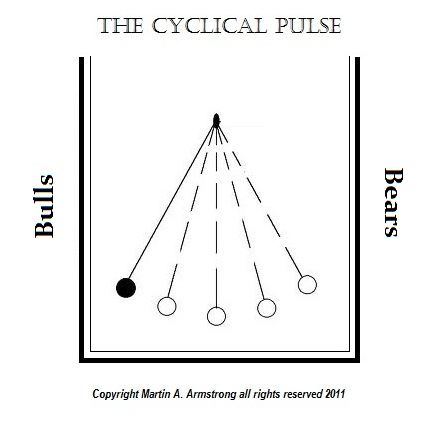
ANSWER: Of course not. If you understand cycles, markets go up, and then they go down. It is NEVER a one-way street. Politics is the same. Sometimes the Democrats are in power, and then it flips to Republicans (Conservative v Labour). If you go to the extreme far-right, you end up at the same place as the extreme far left; the only difference is their reasoning. Both will oppose their opponents.
This is what cycles are about. I would no more support the extreme right as I would the extreme left. Civilization works ONLY when LIBERTY prevails. Once one side demands their opponent must conform to their ideas, the very purpose of civilization no longer exists. If we are not respectful of one another’s rights, then we must also surrender all our rights.
If you understand cycles, we buy in bull markets and sell in bear markets. You will lose everything if you take only one side and ignore the trends. Politics is the same. During the 19th century, the Democrats were the slave owners. Agendas and principles always change with the cycles.
History repeats all the time. With digital currencies, the next war may not be counterfeiting the paper currency of an opponent. This time, they will have to hack the banks and wipe out people’s savings to economically undermine their economy. This means that every bank will become a target to hackers, whereas traditionally in war you simply attack the currency of the sovereign.
There was such a shortage of coinage during the American Civil War that private companies devised postage currency, encasing a postage stamp in a lessor metal that was typically not suited for war and turned that into advertising. Here we see the very same practice that emerged in France following World War I when coins were once again in short supply.
Even going back to the Peloponnesian War between Sparta and Athens we see that Athens itself debased its coinage and silver-plated bronze coins using the techniques of counterfeiters.
Lydia, located in modern-day Turkey, is where coins were invented. The war with Cyrus the Great of Persia, who defeated Lydia, compelled the first debasement in recorded history because of war. The gold stater was reduced in weight from 10.75 grams to 8.08 grams.
I have created this site to help people have fun in the kitchen. I write about enjoying life both in and out of my kitchen. Life is short! Make the most of it and enjoy!
This is a library of News Events not reported by the Main Stream Media documenting & connecting the dots on How the Obama Marxist Liberal agenda is destroying America













 Centinel2012