White House Director of the Trade Counsel and Economic Policy Adviser, Peter Navarro, appears on Fox News with Tucker Carlson to discuss likely import tariffs on Steel and Aluminum.


White House Director of the Trade Counsel and Economic Policy Adviser, Peter Navarro, appears on Fox News with Tucker Carlson to discuss likely import tariffs on Steel and Aluminum.
This evening House Intelligence Chairman Devin Nunes sends a letter to Attorney General Jeff Sessions questioning the protocol and legality of a fraudulent FISA application submitted by the FBI. This approach sets up AG Sessions to defer the legal framework to OIG Michael Horowitz, and establishes the public basis for parallel prosecutors within the DOJ.
However, keep in mind, it’s extremely likely, almost certain, these prosecutors already exist – they are already working with Horowitz. Evidence of this is found in the memo quotes from Bill Priestap, but those not following the granular details are unaware.
In the letter to AG Jeff Sessions (full pdf below), Nunes is requesting the DOJ provide answers to what his committee calls “clear violations of FBI protocols” in obtaining the FISA Title-1 warrant against Carter Page on October 26th, 2016.

Chairman Nunes also wants to know whether guidelines embodied in the latest 2011 version of the bureau’s Domestic Investigations and Operations Guide (DIOG), outlining what the FBI must do when submitting an application for a FISA warrant, was changed to allow the bureau to obtain a warrant with less evidence. “If not, what steps has the DOJ/ and FBI taken to hold accountable those officials who violated those protocols,” Nunes asks Sessions:
.


QUESTION: Mr. Armstrong; I followed your advice and opened an account in the United States. I live in Britain and my daughter lives there in the States so I used her local address. To my shock, it was very easy. You said the USA has become the new tax haven. So the USA is not part of the common reporting that even covers the Middle East?
KL
ANSWER: That is correct. The Common Reporting Standard (CRS) is an information standard for the automatic exchange of tax and financial information on a global level. It was put together by the Organisation for Economic Co-operation and Development (OECD) back in 2014. Its purpose was to hunt down tax evasion primarily for the European Union. They took the concept from the US Foreign Account Tax Compliance Act (FATCA), which imposed liabilities on foreign institutions if they did not report what Americans were doing outside the country.
The legal basis of the CRS is the Convention on Mutual Administrative Assistance in Tax Matters. As of 2016, 83 countries had signed an agreement to implement it. First reporting took place in September 2017. The CRS has many loopholes for countries have to sign the agreement. This has omitted the United States as well as most developing countries. Note that countries that are included are China, Singapore, Switzerland, most tax havens and of course Australian/New Zealand as well as Canada.
As of 2018, the signing nations to avoid are:
Albania, Andorra, Antigua and Barbuda, Aruba, Australia, Austria, The Bahamas, Bahrain, Belize, Brazil, Brunei Darussalam, Canada, Chile, China, Cook Islands, Costa Rica, Dominica, Ghana, Grenada, Hong Kong (China), Indonesia, Israel, Japan, Kuwait, Lebanon, Marshall Islands, Macao (China), Malaysia, Mauritius, Monaco, Nauru, New Zealand, Pakistan, Panama, Qatar, Russia, Saint Kitts and Nevis, Samoa, Saint Lucia, Saint Vincent and the Grenadines, Saudi Arabia, Singapore, Sint Maarten, Switzerland, Turkey, United Arab Emirates, Uruguay, Vanuatu
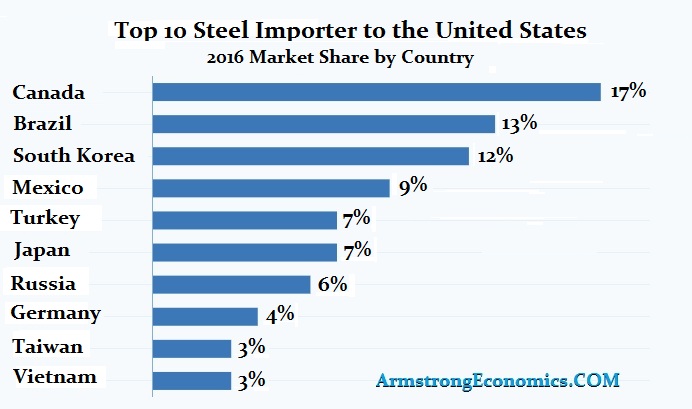
Canada is the largest exporter of steel to the United States. The decline in the Canadian dollar has helped this trend in particular. Trump is clueless when it comes to the impact of currency on foreign trade. If he wants to do tariffs, they MUST be indexed to the currency. Failure to do that will cause serious consequences as the dollar rises on the world financial markets in the years ahead. He will create a trade war globally and politicians on both sides remain ignorant of foreign exchange and its impact upon trade numbers.
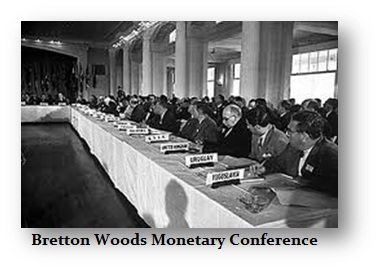 I have stated many times that the entire system of trade is in a state of confusion. Following Bretton Woods, currencies were fixed to the dollar which in turn was fixed to $35 per troy ounce of gold. Therefore, the accounting system ONLY measured the amount of currencies moving back and forth. It was assumed that you imported more goods if the amount of outflow of dollars increased. Consequently, the way we measure trade today has NOTHING to do with the actual amount of product moving internationally. If you spent more dollars but the dollar decline in value by 20%, then even an increase in imports measured in dollars at 20% was no change in the actual product
Trump is implementing tariffs against any country that imposes a tariff of American products. This is a tit-for-tat and will be of a like amount. For years, many countries have imposed tariffs on US products when there has been no tariff on their products. The criticism against Trump at Davos was he should put the world economy first not America. They talk a lot but do not play by the same rules.
His announcement this week that he is imposing tariffs on steel and aluminum was the excuse to justify the consolidation period of the stock market. Trump said his administration would impose a 25% tariff on steel imports and a 10% tariff on aluminum. It was not immediately clear whether Trump would exempt some countries from the tariffs, as his national security advisers have urged him to do to avoid hurting U.S. allies. The big problem is that Trump FAILS to understand how the economy truly functions. Imposing tariffs on foreign imports because they can produce something more efficiently is NOT protecting American jobs – its is imposing higher costs on the American public. If America cannot compete against foreign steel and aluminum, the answer is not tariffs, but TAX REFORM and UNION REFORM. If unions fail to understand that demanding higher wages in an uncompetitive manner will only lead to the loss of jobs, then end result cannot be prevented by tariffs.
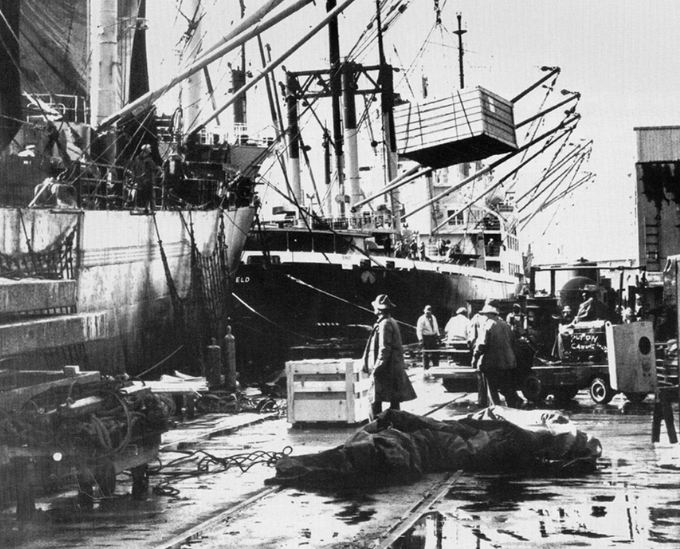
 Once upon a time, New York City was the largest port in the United States. Because of unions and outrageous demands, little by little they killed their own jobs. Shipping moved to New Jersey, Philadelphia, and Virginia. What used to be a viable industry today is just a shadow of what it once was. No matter what the field, everything is subject to competition. Imposing tariffs is simply subsidizing overpaid jobs and higher taxes.
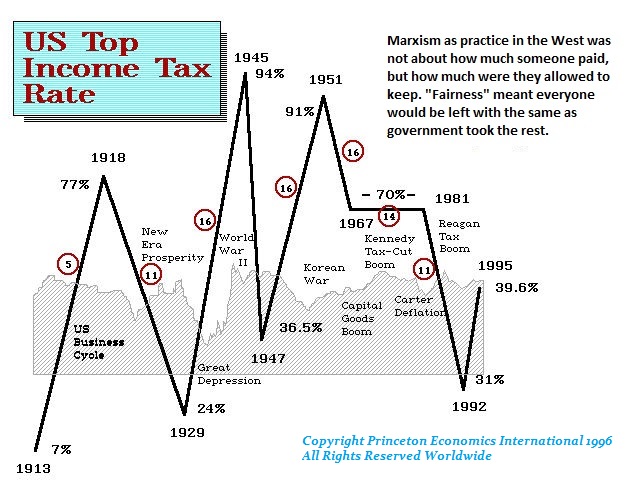
It is not JUST wages that cause companies to move and import goods. The US tax code historically looks like the brainwave of a Schizophrenic. The Democrats come in and taxes rise as high as 94% and the Republicans come in and they go back down. There is absolutely no permanency to the tax code. Consequently, business leaves even when the issue is not wages so much. They leave just to be able to have consistency.
Would you rent an apartment where the lease said the landlord can raise your rent any time he desires if he needs more money to pay something else? This is the entire problem. The Democrats always pitch to tax business and the rich. The biggest shareholder of American public corporations has been the California pension funds (CalPERS) so who actually owns the majority of public companies? It is the people through their retirement funds.
Every time the Democrats raise taxes, they destroy American jobs. So it is NOT entirely the simple matter of wages. First US protective tariffs on washing machines and solar systems were imposed and now on aluminum foil. The US said that aluminum foil from China was being dumped at low prices. Trump imposed measures against some companies from China claiming that American workers and businesses should not be affected by unfair imports.
A professor at UCLA seems surprised that poor people in America don’t vote for more redistributive policies. Maybe they have more moral fiber than intellectuals give them credit for.
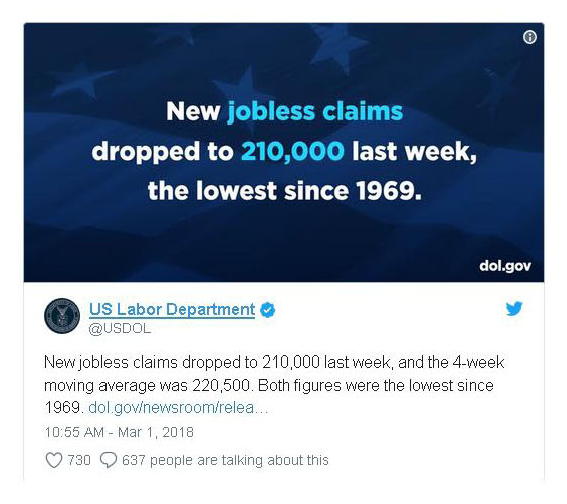
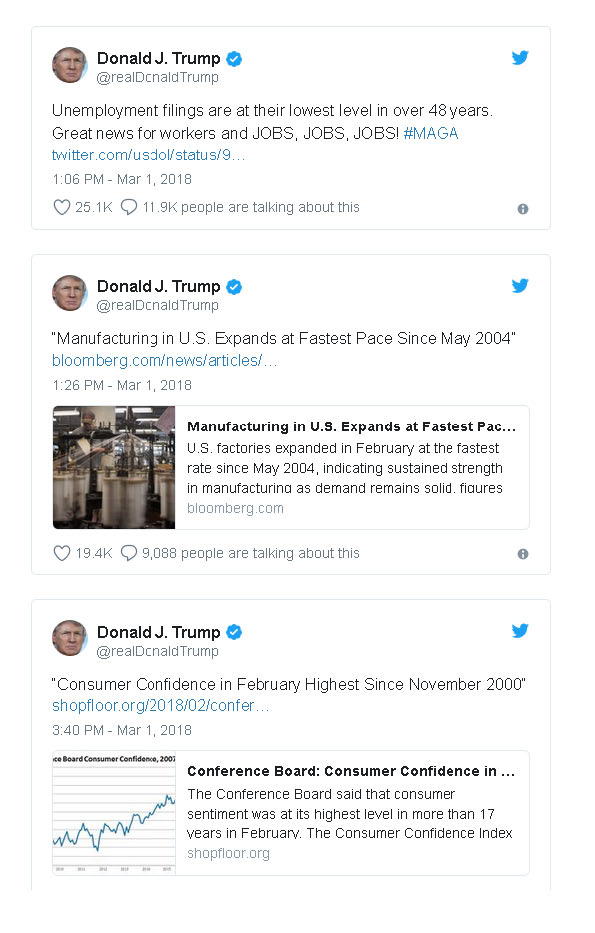
MAGAnomics baby!! Throw dem ju-ju bones out the windows and hold on to your britches… The U.S. Dept of Labor is reporting unemployment claims have dropped to 210,000. That’s the lowest jobless number since December 6th, 1959.

You know what this means right?
…wait for it.
…wait for it.
That’s right. We better grab chin straps for the hard hats, because pay raises and wage rate increases are thundering toward the middle-class like an unstoppable herd of buffalo. Exactly on schedule. Cha-ching & Ka-pow.

This has been the plan within very-stable-genius Trump’s MAGAnomics all along.
Take-home paychecks are already seeing the benefits of lower tax rates for the middle-class. The mid-size employers are simultaneously benefiting from lower corporate tax rates. This means the employers can afford to pay more…. and right on cue, the labor market says ‘show me the money‘.
We timed this out to appear in Quarter #2 2018: More take-home pay, PLUS a pay raise, EQUALS the ability to afford slightly higher consumer prices (Q4) on durables. See how that works?
The January 2018 jobs report showed a gain of 200,000 U.S. jobs, and more importantly, a 2.9% year-over-year growth in wages. –SOURCE– [Biggest wage rate jump since the phoney trillion stimulus-funded growth mid-2009.] We continue to remind of our two-year prediction that stunning wage growth will evidence in Q2 of 2018 (April-July)… these wage and labor reports preview that wage growth cycle.

Construction reported by the biggest gain by sector with 36,000. Bars and restaurants added 31,000 and health care was up 21,000. Manufacturing also showed a gain of 15,000 and durable goods-related industries added 18,000.
“Perhaps the biggest positive surprise on hiring is the continued surge for the goods-producing sector with manufacturing and construction leading the way,” said Mark Hamrick, Bankrate.com’s senior economic analyst. (link)
The Main Street economic engine is fundamentally detached from the drivers of the Wall Street economic engine (monetary policy). While the paper wizards are getting kicked in the teeth, interest rate increases will not diminish Main Street gains because wage increases will remain ahead of price inflation. Interest rate increases will, however, impact Wall Street because interest rates are monetary policy, and a great deal of Wall Street is based on speculation within the paper (false) economy.
Can you see now why we have been saying for two years MAGAnomics will draw out the new dimension in modern economics? There is a distance between Main Street’s economic engine and Wall Street’s economic engine. MAGAnomics operates in the space between them.
The stock market retracts today against fears of: tariffs + inflation = rising interest rates.
Pffffttt… Many on Wall Street have not recognized that monetary policy will not influence Main Street growth until interest rates, and/or inflation, surpasses the rate of wage growth. The parity within that dynamic is still about a year-and-a-half away.
If you pay attention, the economic engine disconnect is visible. Note the market schizophrenia.
February 2018 wage growth will exceed January (driven in part by new tax rates); March will exceed February; April will exceed March…. and so on, and so on, (remember these are year-over-year comparatives). This is the EXACT reversal of prior economic policies from several administrations that were killing Main Street.
At the very heart of America-First, MAGAnomics focuses on U.S. jobs and U.S. companies. Investment growth drives labor demand; labor demand drives wage rates; wage rate growth increases consumer demand for goods and services; that demand drives investment; more investment is expansion of production capacity – ie. need more labor.
There will be natural price inflation to come as an outcome of Main Street’s economy expanding. However, two factors: #1) inflation will creep slow, there’s a natural lag and built in downward price pressure within the gap of unfilled production capacity; #2) Most importantly growth in wages will exceed the inflation rate -for approximately two years- thereby making increases in product costs irrelevant to consumer demands.
Inside this mix, off-shore manufacturers will continue trying to get their products into the hands of Americans who have more disposable income. That unique aspect will continue to keep prices down during the phase of shifts from import manufacturing to domestic manufacturing. Unfortunately, imports might keep GDP growth rates down – but the underlying economy will be expanding as domestic production begins to replace imports.
Ongoing financial results will be solid for companies doing business in the U.S., and actual profit results will gain market weight over speculation. The Titans are rising.
Economic nationalism is winning…. globalism is losing…. multinationals are shrieking… paper weasels are crying…. Middle Class American workers are CHEERING!

Earlier today First Lady Melania Trump and Senior Policy Adviser Kellyanne Conway held a summit on the opioid epidemic at the White House (videos below). At the conclusion of the meeting, President Trump delivered closing remarks:
.
Full video of the summit is below:

.
.
For those who follow closely the strongest argument against the U.S. trade and economic policies of the past 30 years has been the outcome. We don’t need to guess what the pro’s and con’s of the U.S. Chamber of Commerce position is, we are living them. We don’t need to guess what the Wall Street economy delivers, we are living through them.
For the past 30 years the U.S. has lost jobs, wages have been depressed, and the middle-class has suffered through the implementation of economic trade policy that destroyed the U.S. manufacturing base. None of this is in question – the results stare us in the face – yet the Wall Street and multinational corporate club(s) [U.S. CoC chief among them] now demand a continuance of the same.
 The economic and trade policies of the Trump administration are adverse to those interests. As we have shared for several years, candidate Trump, now President Trump is an existential threat to the multinational program.
All opposition to President Trump is about the underlying financial and economic policy of America-First. There are trillions at stake.
Those who have read here will note the media are generally oblivious to America-First economic policies; this includes the financial media.
As an example today they are trying to figure out how Steel/Aluminum tariffs would work. Commerce Secretary Wilbur Ross stated clearly exactly how the Steel and Aluminum policy would be carried out; yet for the financial media they claim to be clueless. The level of intellectual dishonesty is off-the-charts.
The truth is, well, two points: •Point #1 – the media don’t want to know; they are committed to selling the prior policy. •Point #2 – there’s almost no-one within the professional economic punditry class who have ever given thought to what happens during the space between two fundamentally different economic policies as executed.
What happens in the space between taking the U.S. economy off the path of ‘service-driven-globalism’, and reasserting the economy back to a balanced ‘production-based national economy’? None of the key participants within the larger discussion have ever contemplated this dynamic.

CTH is one of the few, perhaps the only source, who has gamed-out MAGAnomics.
Allow me to re-emphasize:
All opposition to President Trump stems from the underlying financial and economic policy. All opposition is about money!
When you ask the “why” question five times you end up discovering the financial motive for all opposition. It doesn’t matter who the group is; the opposition is ultimately about money. There are trillions at stake.
When Main Street economic principles are applied Wall Street will initially lose. There’s no way for this not to happen. Most of Wall Street is built on the Multinational platform of economic globalism. Weaken the grip of the multinational corporations and financial interests on the U.S. economy and Wall Street will drop… this is not difficult to predict. This is also necessary.
U.S. stocks, centered around U.S. domestic companies, will go up. U.S. stocks, centered around multinational companies, will go down.
As Secretary Wilbur Ross, U.S.T.R. Robert Lighthizer and U.S. President Trump have previously affirmed, they are going to restore the U.S. manufacturing and production economy -OR- lose office trying.
The U.S. Steel and Aluminum tariffs are just one component of the larger economic issue. Bringing back U.S. production on those sectors is vital to the infrastructure of a manufacturing and production economy.
Additional steps will come from exits of NAFTA and renegotiated trade deals with ASEAN nations, China and Europe. We either have a stable broad-base economy, or we follow the former path and eventually lose the country.
On the specifics of inflation, we have discussed this issue at great length. As stated three years ago, inflation will happen within this cycle –especially in the space between the policy as constructed– however, it will not affect the larger economic restoration because the growth of U.S. wages will exceed the rising prices of durable goods…. AND simultaneously energy prices and high-consumable goods’ prices (food, fuel) will drop. [Exit NAFTA and U.S. food prices will drop 25% within a year]
In this transitional phase (the space between) wage growth will remain ahead of aggregate inflation. No former economic models have any way to measure or gauge this dynamic. We have never been between two entirely different sets of economic policy before. No amount of immediate fed monetary policy will effect what happens on Main Street in this “space between” the two economies.
President Trump announces he is like to impose global tariffs on imported steel and aluminum – in a broad effort to ensure U.S. national security and manufacturing capacity within a very important industrial sector.
Earlier today President Trump appeared to be accepting Commerce Secretary Ross proposals for 25 percent tariffs on imported steel and 10 percent for aluminum. It is likely the tariffs will apply globally to all imports because targeted national tariffs have not worked. China ships their manufactured steel to another nation first in order to avoid the tariff. As Secretary Ross has previously stated we end up with a whack-a-mole policy. So likely the tariff will apply globally regardless of the nation shipping the product.
.
The usual, the corporate GOPe and Chamber of Commerce politicians will go bananas.
Last year President Donald Trump requested a national security Section 232 trade-investigation, to conducted by the U.S. Department of Commerce and Secretary Wilbur Ross, specifically focusing on U.S. steel and aluminum manufacturing.
The discussion continued last month as President Trump met with a group of republican and democrat members of congress to talk about trade policy and focus attention on the lack of American steel and aluminum production. [The responses from the republican participants was very enlightening and disappointing.]
Commerce Department Recommendations HERE
I have created this site to help people have fun in the kitchen. I write about enjoying life both in and out of my kitchen. Life is short! Make the most of it and enjoy!
De Oppresso Liber
A group of Americans united by our commitment to Freedom, Constitutional Governance, and Civic Duty.
Share the truth at whatever cost.
De Oppresso Liber
Uncensored updates on world events, economics, the environment and medicine
De Oppresso Liber
This is a library of News Events not reported by the Main Stream Media documenting & connecting the dots on How the Obama Marxist Liberal agenda is destroying America
Australia's Front Line | Since 2011
See what War is like and how it affects our Warriors
Nwo News, End Time, Deep State, World News, No Fake News
De Oppresso Liber
Politics | Talk | Opinion - Contact Info: stellasplace@wowway.com
Exposition and Encouragement
The Physician Wellness Movement and Illegitimate Authority: The Need for Revolt and Reconstruction
Real Estate Lending
 Centinel2012