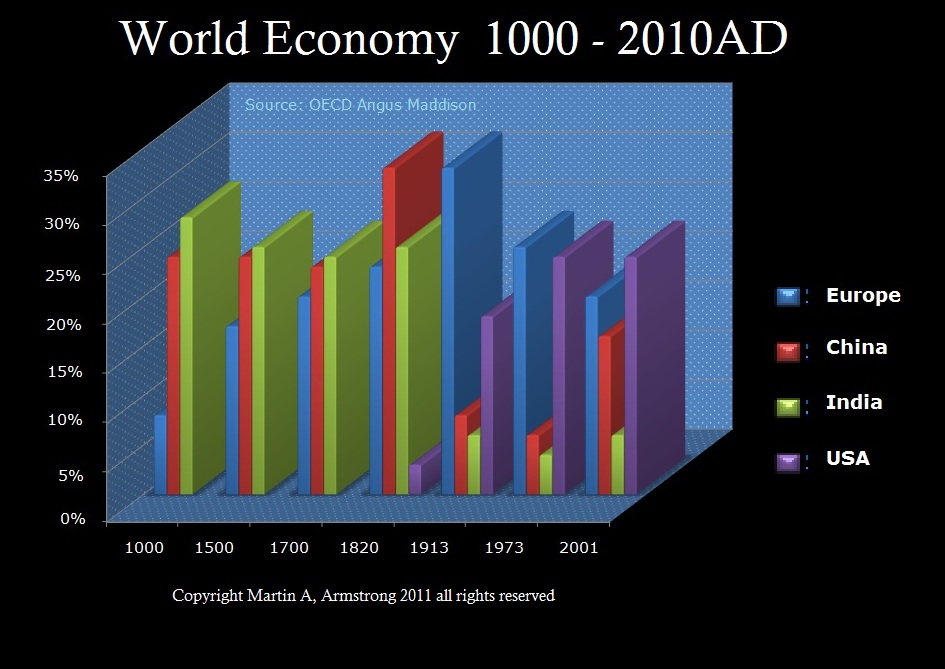
Is There a Cycle to Religion?


QUESTION:

Mr. Armstrong,

 With the rise and fall of civilizations comes the rise and fall of religion. Are we due for a new religion to be born, or to have a rapid growth of popularity? Christianity grew rapidly during the fall of the Roman empire, and with the persecution of believers, where are we today in this cycle?

Thank you for your education. I’ve read your blog since I was in high school and realize how life is governed by cycles. Some weeks are rough, some are fantastic, but it all regresses to the mean eventfully.

CO’C
ANSWER: Oh yes. There is a Cycle of Religion that prevails throughout all cultures. It is clearly tied to economics and the business cycle. I am sure some people will naturally disagree with that one, but it cannot be removed from the business cycle itself. Religion has so often inspired war with some even called Holy Wars. The dominance of a given religion has turned with the economy. The rise and fall of civilizations have been clearly linked to religion. Even if we go back to the Stone Age, we find graves with goods place in there with the deceased with obvious demonstrations of love as well as a belief in an after-life.  Burial rites characterize religion and extend back into the Middle Paleolithic, as early as 300,000 years ago, coinciding with the first appearance human communities.
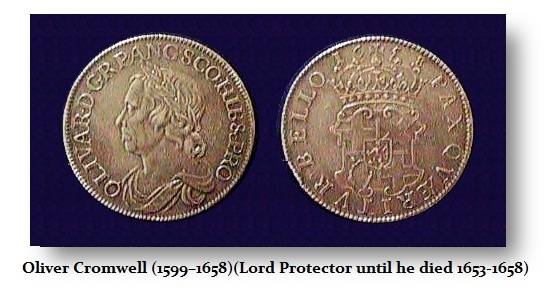
Religion is an integral part of the entire human society. But keep in mind that this goes beyond the simple shifts from Paganism to Christianity and the rise of Islam. There are cycles within each as there are cycles in Asian cultures and religions all tied to the business cycle. The English Civil War was the Protestants against the Catholics which ended up beheading the King. The Puritans seized power under Oliver Cromwell who placed his own portrait on coins wearing a wreath as if he were a Roman Emperor. The Puritans outlawed kissing your wife in public, plays, all sports, and celebrating Christmas. They were so strict that the Protestants rebelled and overthrew the Puritans. It was the Puritans who infected the United States for they were the Pilgrims. This illustrates that there were subcycles within the same religion and the cycle does not always involve Christianity against Islam or Pagans.
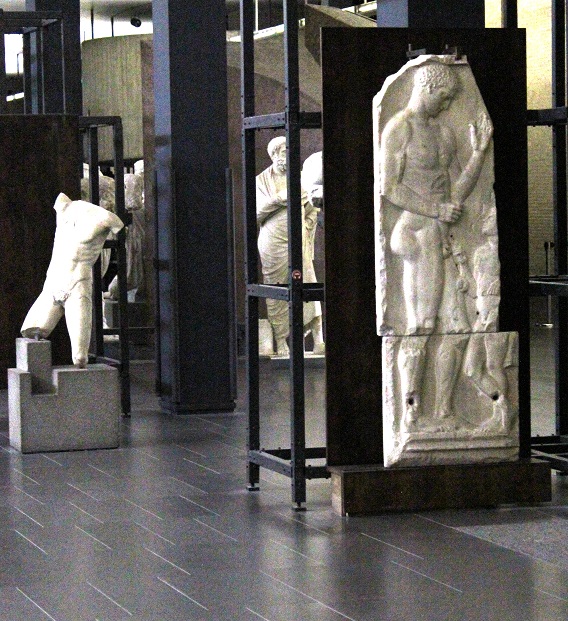
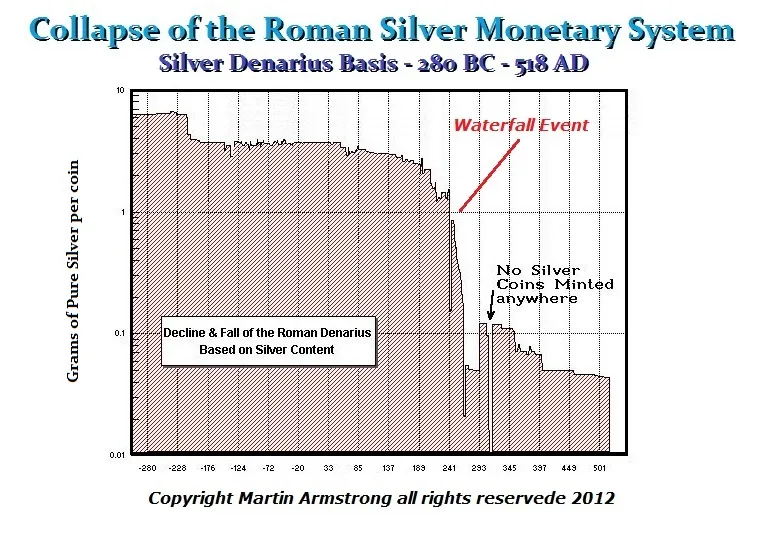
During the 3rd Century, as the Roman Empire was economically imploding and the barbarians were at their gates, this is when the persecutions of the Christians became common. The Pagans believed Rome was being punished because the Christians were not worshiping the gods. When the Christians became the majority inspired by the economic collapse of Rome, then they turned against the Pagans and persecuted them. We see collections of ancient sculptures many are beheaded and defaced. This was the Christians assuming and sculpture was a god.
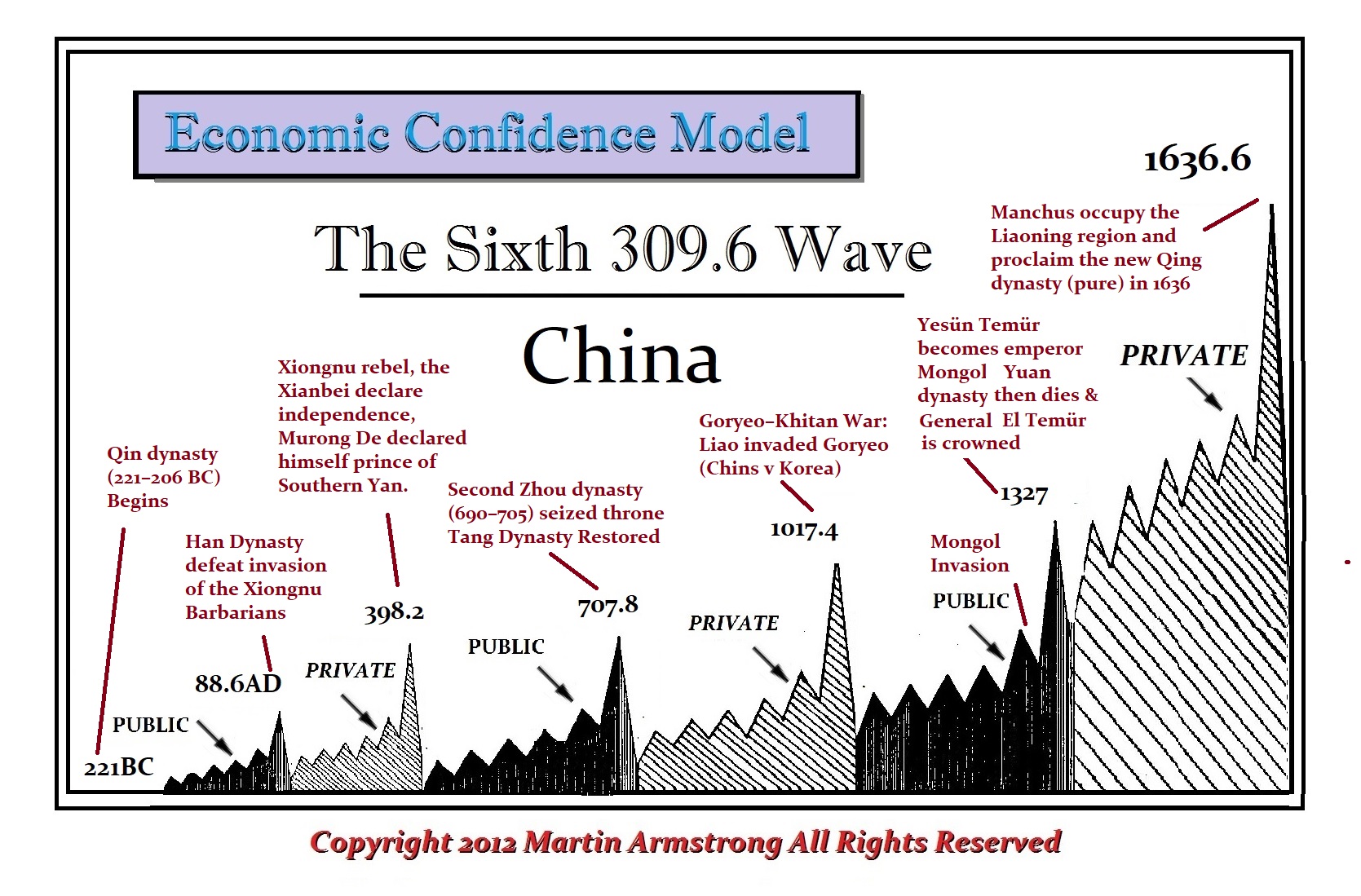
 

If we look at China, we can see quite easily how religion and the business cycle were interlinked even in Asia. The Chinese emperor was seen as being handed the Mandate of Heaven (天, Tian). The Chinese economic, political, and religious doctrine that supported the rule of the Emperor of China was a belief that heaven embodied the natural order and will of the universe. Therefore, it was this natural order that gave the mandate to the ruler of China for he was the “Heavenly Son” of above. In order to maintain that philosophy, if the emperor was overthrown, this was interpreted that the ruler was unworthy, offended the universe, and had therefore lost the mandate. They also believed that natural disasters from earthquakes, famine to floods were all signs from Heaven that the emperor wronged the Heavens and such disaster would often justify revolts of the people.

We see how this belief system interpreted the fall of China to the Mongolian invasion. Genghis Khan began the conquest of China with just raids in 1205 and 1207 across the border. However, by 1279, Kublai Khan had established the Yuan dynasty in China crushing all resistance, which was the first time in history that China came under the rule of a foreign or non-native power.

Most people in the West know little about the history of China. They saw the movie the Last Emperor and assumed that the Emperor ruled until the Communist Revolution in 1946. In reality, following the outbreak of the Wuchang Uprising against Qing Dynasty rule in 1911, the revolutionaries elected Sun Yat-sen as the “provisional president” of the transitional government, with the Republic of China officially established on January 1, 1912. More like the UK, the Chinese Emperor was not eliminated, just the political-economic power. It was against this republican form of government that the Chinese Communist Revolution was launched in 1946 following the beliefs of Karl Marx. Finally, on October 1st, 1949, Mao Zedong proclaimed the establishment of the People’s Republic of China ending the Emperor forever.


There is nothing that is exempt from cycles be it the economy, seasons or even religions. The Hindus believed their religion and gods are invincible not much different from the Romans. Hindus were prosperous, powerful, and became economically very rich and therefore known as was Rome or the United States. They believed that would last forever as every society does. They believed they are special, which is also a common theme. They believed that their gods were in charge of the world as well as the universe. Their culture and community also experienced a very difficult time adjusting to the reality of their collapse. Like the Romans, the Hindus also believed that their gods would bring all good things back and restore them to their former glory. Some resorted to extreme devotion and concluded the same as the Pagans of Rome that their fall was because there was not enough devotion.

In the United States, Rev Jerry Falwell and Pat Robertson came out and said that God was angry and punishing New York allowing the terrorists to succeed on 911. They said God allowed the attack because of “abortion, homosexuality, secular schools and courts, and the American civil liberties union.” (see Guardian). This is the standard reaction when fortune shifts. Many will blame some group that God is punishing the entire community because of these people. This human response was the same in the Hindus as it was among the ancient Romans and Greeks.

Socrates was sentenced to death for corrupting the youth and offending the gods. It is not clear whether he believed in just one God or many. The Greek word Plato used in the original text is “θεός” (theos) which is translated to “God” or “the deity”. Nevertheless, “θεοί” is the plural form of “θεός” and Plato also used this in sections of his Phaedo. Plato does indeed use both the singular and plural forms in the text.


Christianity went through dark periods of the cycle of religion. Because Roman bathhouses were communal and were places one went to even for prostitutes, when Roman fell, bathing was then connected with sin. Mathematics also became associated with the Devil. The entire idea that the Earth was flat and the center of the universe emerged from the idea of heaven and hell and there had to be an up and down. Bruno was burned alive for saying the Earth revolved again the Sun. The Church jailed Galileo (1564-1642) for believing the same concept. The knowledge that came from the fall of Constantinople in 1453 introducing schools brought the West out of the Dark Ages. But this took time. Christopher Columbus had maps that came from the East and set sail to discover America in 1492, about 40 years following the fall of Constantinople.

Every religion undergoes a cycle of change. It does not matter which religion we are talking about. Nonetheless, this is tied to the business cycle. When economic decline hits, we see rising civil unrest as one group blames the other for their ways and non-devotion.

Islam and Christianity preached a level of equality, which provided a flat social structure as distinguished from a class system. This was the foundation of capitalism for people were allowed to change their professions at will and new converts to their religions were welcome. Hinduism, on the other hand, has a rather strict ordered and hierarchical structure of society. This structure was flexible at the beginning and the ancient texts contain examples of people changing their castes. Over time, this flexibility was lost and the caste began to be decided at birth.
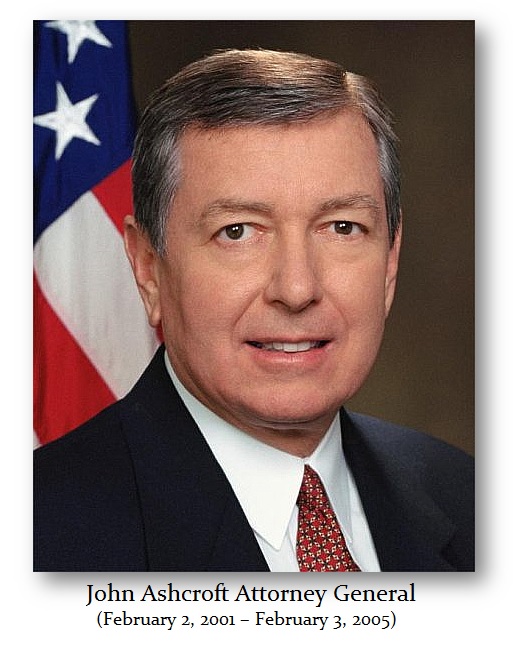
Islam regarded stealing severely where Christianity was more forgiving, but the government and Christain Fundamentalism turned to the unforgiving policies that have led the United States to have almost 25% of the total world prison population when it has only 4.4% of the world’s population. People are imprisoned for any offense whatsoever. If you drive on federal property and do not have your drivers license on you, you MUST go to jail and will be given typically a sentence of 30 days. When John Ashcroft was Attorney General under Bush, Jr., he imposed his unforgiving religious belief system upon the nation. Prosecutors would not get credit for a mere conviction. The defendant MUST do some jail time. It was Ashcroft who has turned the United States into the most anti-Liberty nation on the face of the Earth. Nobody imprisons people for every offense no matter how minor than the US Federal Government.

Islam and Christianity both demand absolute faith in their own version of God. Hindus are much more tolerant of what you should believe, but conversion to Hinduism is more difficult than that to Islam/Christianity. In polytheist Hindu system, if you want to bring in your god, then it is just one more idol in the already crowded temple of Gods. Hinduism offers a rich variety of texts and encourages debate as well as the pursuit of knowledge. Hinduism and most other Eastern religions, tend to believe that humans are part of the environment and that animals and plants should all be respected. Western religions, including Islam and Christianity, tend to accept the principle that humans are created in the image of God and are therefore a superior species on the planet which was created for humans.

So there are differences in philosophy between East and West. In the East, they tend to believe in cycles as part of nature where in the West the core starting point was linear. That said, there are cycles in the belief system but there are also cycles within each religion.

He Has Been Raised; He Is Not Here


GospelMK 16:1-7

When the sabbath was over,
Mary Magdalene, Mary, the mother of James, and Salome
bought spices so that they might go and anoint him.
Very early when the sun had risen,
on the first day of the week, they came to the tomb.
They were saying to one another,
“Who will roll back the stone for us
from the entrance to the tomb?”
When they looked up,
they saw that the stone had been rolled back;
it was very large.
On entering the tomb they saw a young man
sitting on the right side, clothed in a white robe,
and they were utterly amazed.
He said to them, “Do not be amazed!
You seek Jesus of Nazareth, the crucified.
He has been raised; he is not here.
Behold the place where they laid him.
But go and tell his disciples and Peter,
‘He is going before you to Galilee;
there you will see him, as he told you.’”

President Trump Delivers an Easter and Passover Message…


President Donald Trump delivers a message from the Office of the President for Passover and Easter.

Good Friday Reproaches


Were You There


It is Finished. And Bowing His Head He Handed Over The Spirit.


The-Passion-of-the-Christ-001JN 18:1—19:42

Jesus went out with his disciples across the Kidron valley
to where there was a garden,
into which he and his disciples entered.
Judas his betrayer also knew the place,
because Jesus had often met there with his disciples.
So Judas got a band of soldiers and guards
from the chief priests and the Pharisees
and went there with lanterns, torches, and weapons.
Jesus, knowing everything that was going to happen to him,
went out and said to them, “Whom are you looking for?”
They answered him, “Jesus the Nazorean.”
He said to them, “I AM.”
Judas his betrayer was also with them.
When he said to them, “I AM, “
they turned away and fell to the ground.
So he again asked them,
“Whom are you looking for?”
They said, “Jesus the Nazorean.”
Jesus answered,
“I told you that I AM.
So if you are looking for me, let these men go.”
This was to fulfill what he had said,
“I have not lost any of those you gave me.”
Then Simon Peter, who had a sword, drew it,
struck the high priest’s slave, and cut off his right ear.
The slave’s name was Malchus.
Jesus said to Peter,
“Put your sword into its scabbard.
Shall I not drink the cup that the Father gave me?”

st05_gethsemane_torchesSo the band of soldiers, the tribune, and the Jewish guards seized Jesus,
bound him, and brought him to Annas first.
He was the father-in-law of Caiaphas,
who was high priest that year.
It was Caiaphas who had counseled the Jews
that it was better that one man should die rather than the people.

Simon Peter and another disciple followed Jesus.
Now the other disciple was known to the high priest,
and he entered the courtyard of the high priest with Jesus.
But Peter stood at the gate outside.
So the other disciple, the acquaintance of the high priest,
went out and spoke to the gatekeeper and brought Peter in.
Then the maid who was the gatekeeper said to Peter,
“You are not one of this man’s disciples, are you?”
He said, “I am not.”
Now the slaves and the guards were standing around a charcoal fire
that they had made, because it was cold,
and were warming themselves.
Peter was also standing there keeping warm.

The high priest questioned Jesus
about his disciples and about his doctrine.
Jesus answered him,
“I have spoken publicly to the world.
I have always taught in a synagogue
or in the temple area where all the Jews gather,
and in secret I have said nothing. Why ask me?
Ask those who heard me what I said to them.
They know what I said.”
When he had said this,
one of the temple guards standing there struck Jesus and said,
“Is this the way you answer the high priest?”
Jesus answered him,
“If I have spoken wrongly, testify to the wrong;
but if I have spoken rightly, why do you strike me?”
Then Annas sent him bound to Caiaphas the high priest.

Now Simon Peter was standing there keeping warm.
And they said to him,
“You are not one of his disciples, are you?”
He denied it and said,
“I am not.”
One of the slaves of the high priest,
a relative of the one whose ear Peter had cut off, said,
“Didn’t I see you in the garden with him?”
Again Peter denied it.
And immediately the cock crowed.

Then they brought Jesus from Caiaphas to the praetorium.
It was morning.
And they themselves did not enter the praetorium,
in order not to be defiled so that they could eat the Passover.
So Pilate came out to them and said,
“What charge do you bring against this man?”
They answered and said to him,
“If he were not a criminal,
we would not have handed him over to you.”
At this, Pilate said to them,
“Take him yourselves, and judge him according to your law.”
The Jews answered him,
“We do not have the right to execute anyone, “
in order that the word of Jesus might be fulfilled
that he said indicating the kind of death he would die.
So Pilate went back into the praetorium
and summoned Jesus and said to him,
“Are you the King of the Jews?”
Jesus answered,
“Do you say this on your own
or have others told you about me?”
Pilate answered,
“I am not a Jew, am I?
Your own nation and the chief priests handed you over to me.
What have you done?”
Jesus answered,
“My kingdom does not belong to this world.
If my kingdom did belong to this world,
my attendants would be fighting
to keep me from being handed over to the Jews.
But as it is, my kingdom is not here.”
So Pilate said to him,
“Then you are a king?”
Jesus answered,
“You say I am a king.
For this I was born and for this I came into the world,
to testify to the truth.
Everyone who belongs to the truth listens to my voice.”
Pilate said to him, “What is truth?”

When he had said this,
he again went out to the Jews and said to them,
“I find no guilt in him.
But you have a custom that I release one prisoner to you at Passover.
Do you want me to release to you the King of the Jews?”
They cried out again,
“Not this one but Barabbas!”
Now Barabbas was a revolutionary.

2004-passion-christ-floggingThen Pilate took Jesus and had him scourged.
And the soldiers wove a crown out of thorns and placed it on his head,
and clothed him in a purple cloak,
and they came to him and said,
“Hail, King of the Jews!”
And they struck him repeatedly.
Once more Pilate went out and said to them,
“Look, I am bringing him out to you,
so that you may know that I find no guilt in him.”
So Jesus came out,
wearing the crown of thorns and the purple cloak.
And he said to them, “Behold, the man!”
When the chief priests and the guards saw him they cried out,
“Crucify him, crucify him!”
Pilate said to them,
“Take him yourselves and crucify him.
I find no guilt in him.”
The Jews answered,
“We have a law, and according to that law he ought to die,
because he made himself the Son of God.”
Now when Pilate heard this statement,
he became even more afraid,
and went back into the praetorium and said to Jesus,
“Where are you from?”
Jesus did not answer him.
So Pilate said to him,
“Do you not speak to me?
Do you not know that I have power to release you
and I have power to crucify you?”
Jesus answered him,
“You would have no power over me
if it had not been given to you from above.
For this reason the one who handed me over to you
has the greater sin.”
Consequently, Pilate tried to release him; but the Jews cried out,
“If you release him, you are not a Friend of Caesar.
Everyone who makes himself a king opposes Caesar.”

When Pilate heard these words he brought Jesus out
and seated him on the judge’s bench
in the place called Stone Pavement, in Hebrew, Gabbatha.
It was preparation day for Passover, and it was about noon.
And he said to the Jews,
“Behold, your king!”
They cried out,
“Take him away, take him away! Crucify him!”
Pilate said to them,
“Shall I crucify your king?”
The chief priests answered,
“We have no king but Caesar.”
Then he handed him over to them to be crucified.

the_passion_of_the_christ_crucifixion_1_0069So they took Jesus, and, carrying the cross himself,
he went out to what is called the Place of the Skull,
in Hebrew, Golgotha.
There they crucified him, and with him two others,
one on either side, with Jesus in the middle.
Pilate also had an inscription written and put on the cross.
It read,
“Jesus the Nazorean, the King of the Jews.”
Now many of the Jews read this inscription,
because the place where Jesus was crucified was near the city;
and it was written in Hebrew, Latin, and Greek.
So the chief priests of the Jews said to Pilate,
“Do not write ‘The King of the Jews,’
but that he said, ‘I am the King of the Jews’.”
Pilate answered,
“What I have written, I have written.”

When the soldiers had crucified Jesus,
they took his clothes and divided them into four shares,
a share for each soldier.
They also took his tunic, but the tunic was seamless,
woven in one piece from the top down.
So they said to one another,
“Let’s not tear it, but cast lots for it to see whose it will be, “
in order that the passage of Scripture might be fulfilled that says:
They divided my garments among them,
and for my vesture they cast lots.

This is what the soldiers did.
Standing by the cross of Jesus were his mother
and his mother’s sister, Mary the wife of Clopas,
and Mary of Magdala.
When Jesus saw his mother and the disciple there whom he loved
he said to his mother, “Woman, behold, your son.”
Then he said to the disciple,
“Behold, your mother.”
And from that hour the disciple took her into his home.

After this, aware that everything was now finished,
in order that the Scripture might be fulfilled,
Jesus said, “I thirst.”
There was a vessel filled with common wine.
So they put a sponge soaked in wine on a sprig of hyssop
and put it up to his mouth.
When Jesus had taken the wine, he said,
“It is finished.”
And bowing his head, he handed over the spirit.

PassionPhoto1Now since it was preparation day,
in order that the bodies might not remain on the cross on the sabbath,
for the sabbath day of that week was a solemn one,
the Jews asked Pilate that their legs be broken
and that they be taken down.
So the soldiers came and broke the legs of the first
and then of the other one who was crucified with Jesus.
But when they came to Jesus and saw that he was already dead,
they did not break his legs,
but one soldier thrust his lance into his side,
and immediately blood and water flowed out.
An eyewitness has testified, and his testimony is true;
he knows that he is speaking the truth,
so that you also may come to believe.
For this happened so that the Scripture passage might be fulfilled:
Not a bone of it will be broken.
And again another passage says:
They will look upon him whom they have pierced.

After this, Joseph of Arimathea,
secretly a disciple of Jesus for fear of the Jews,
asked Pilate if he could remove the body of Jesus.
And Pilate permitted it.
So he came and took his body.
Nicodemus, the one who had first come to him at night,
also came bringing a mixture of myrrh and aloes
weighing about one hundred pounds.
They took the body of Jesus
and bound it with burial cloths along with the spices,
according to the Jewish burial custom.
Now in the place where he had been crucified there was a garden,
and in the garden a new tomb, in which no one had yet been buried.
So they laid Jesus there because of the Jewish preparation day;
for the tomb was close by.


In my church, on Holy Thursday evening, the Eucharist is removed from the tabernacle, and taken to a place of repose. The altar is stripped. Christ is no longer present in the sanctuary. Good Friday is the one day of the year when mass cannot be said. 


These visible signs of the coming Passion point us toward the Friday that changed everything, for the whole world. Don’t deprive yourself of the day of our Lord’s sacrifice. Stop. Pray. Let your heart break a little. Experience Good Friday, that you may truly be renewed on Easter Sunday.


Germany Arrests Former Head of Catalonia for Spain Confirm the Spanish Constitution Violates Human Rights


One day soon, the world will suddenly discover that the European project is authoritarian because they believe the people as stupid and politicians know better. When that day dawns, the crisis in Europe will erupt in total shock and this will undermine the entire economy which has rapidly fallen to even behind China. At the core of this true European Crisis is the fact that individual human rights come behind the rights of politicians. Make no mistake about it, politicians in the West secretly admire China where some view the model for democracy in the West as crumbling before their eyes.

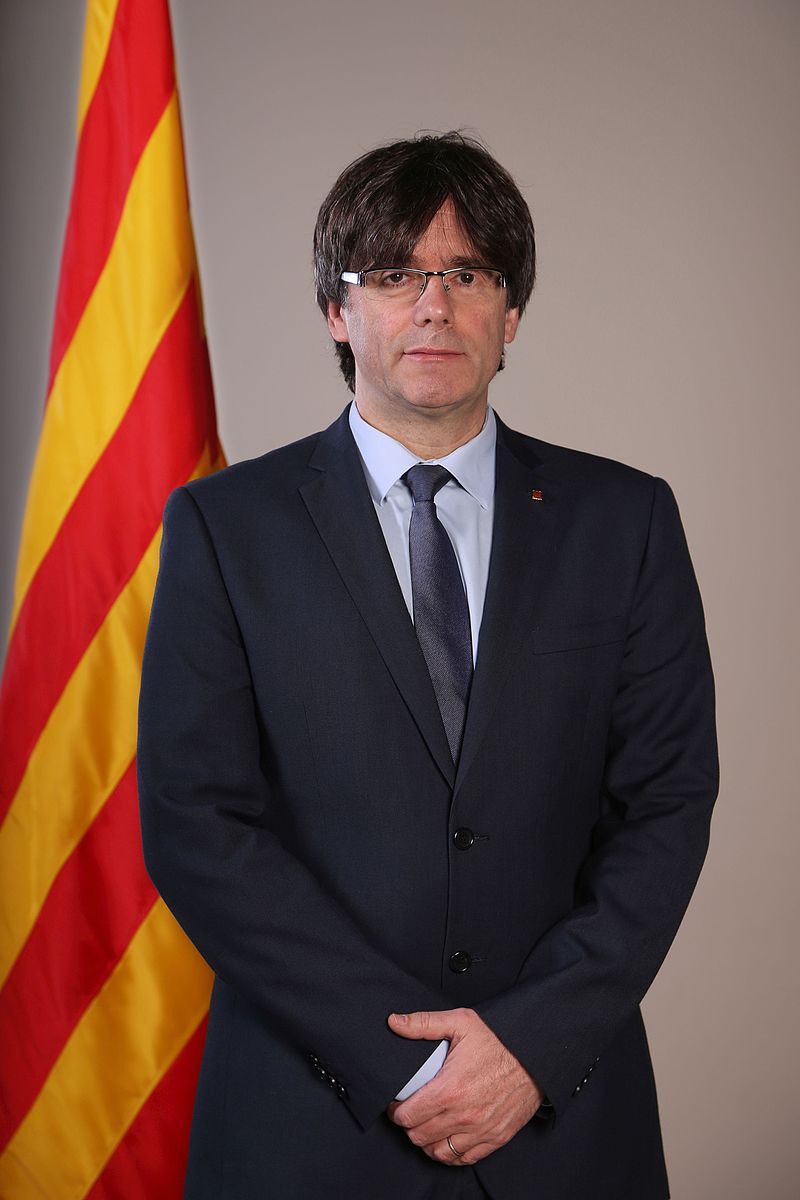
Germany has arrested the former Catalan Prime Minister Carles Puigdemont enforcing Spain’s dictatorship and anti-Democratic government to save the EU. Spain is by NO MEANS a democratic nation and evidence of that statement is the Spanish Constitution. It exempts all politicians and Judges holding them above the law and denies the right of the people to even disagree with the government. Puigdemont was arrested on the German-Danish border traveling from Finland to Belgium. The state police office in Kiel announced that Puigdemont had been arrested and the charge is advocating a democratic vote in Catalonia to separate from Spain. This is the most outrageous legal persecution that has taken place since the Communist Revolution in Russia who imprisoned or killed anyone who opposed them.

Puigdemont proclaimed Catalonia’s independence from Spain in October, that Madrid says violating the constitution. Their interpretation of their Constitution is permanent slavery no different from the positions of France and Britain that justified the French and American Revolutions. Then the Spanis judiciary began investigations into rebellion and charged Puigdemont and other leading separatists who were forced to then flee to Belgium into exile. Clearly, anyone one charges with a political crime MUST leave Europe for the governments will conspire to save the EU.

Puigdemont went to Finland to attend a conference and Spain submitted an application for the arrest of the deposed regional president. Finland then agreed to arrest Puigdemont so he fled to return to Belgium. Germany intercepted him and arrested him and he now faces 25 years in prison where he will certainly die. Spain’s Supreme Court opened criminal proceedings against Puigdemont and other regional politicians. Imprisoning people for their political ideas has been the hallmark of tyranny. It is a sad day to watch the ruthless behavior of the Spanish government and its Judiciary is a disgrace to the nation and the Spanish people.

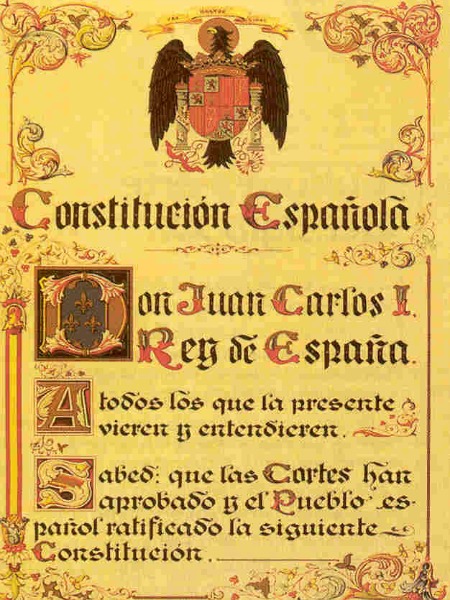
The entire problem underlying this crisis exposes the Spanish Constitution that NEVER truly provided a democratic nation for it did not provide a workable transition from dictatorship to democracy. This Spanish Constitution is a contradictory document that denies any democratic resolution or process and maintains the Franco Dictatorship. In Spain, all members of parliament, including those in regional parliaments, enjoy immunity, judges cannot be dismissed. The Constitution defines political parties as “the main instrument of political participation” (Article 6), giving them a role that goes far beyond the process of public opinion-making, as understood in most democracies.

In Spain, the self-interest of government prevails over the rights of the individual. This is the plain reading of Article 155 (see below). The Franco regime organized the Society around its National Movement and the vertical, professional syndicates. Therefore, it was not even the people as a whole that was considered to be the nation but the party. Following the dictator’s death, Spain did open up to political and trade union pluralism, but there was no real redefining revision of Franco’s means of dictatorship. The citizens do not vote for deputies, but closed lists of a party whose candidates move into Parliament depending on the number of votes. MPs do not have offices in their constituencies.

There is no actual representative form of government when you look closely at the structure. There is no actual accountability for the political party itself and they are isolated from the public opinion and their own base. This is why political corruption runs ramped in Spain – there is no actual direct representation or accountability. The Spanish section of Transparency International called on the parties to abolish the closed lists and publish their campaign budgets no later than three months after the election back in 2014. Nothing has been done.

The entire Spanish Constitution contradicts the European Convention on Human Rights (ECHR) is an international treaty to protect human rights and fundamental freedoms in Europe. Article 10 of the ECHR provides the right to freedom of expression and information, subject to certain restrictions that are “in accordance with law” and “necessary in a democratic society”. This right includes the freedom to hold opinions and to receive and impart information and ideas. However, the Spanish Constitution outright contradicts Article 10 by its Article 155. Clearly, the Spanish Constitution was no more than a compromise between democracy and Francoism. Above all, the fathers of the Spanish Constitution wanted to prevent a civil war by retaining an authoritative clause that allowed dictatorial action. The new constitution was therefore settled between an authoritarian, national Catholic leader system and a democracy and has never actually placed individual liberties in a role of importance violating the very idea of human rights.

The Spanis government will undoubtedly fall. It will be 43 years and ripe for its complete collapse in 2021. The arrest of Puigdemont proves beyond a shadow of a doubt that the Spanish Constitution denies freedom of expression and human rights. Puigdemont did not engage in violence and thus is simply a political prisoner and Germany is endorsing the dictatorship of Spain.

No one in the EU leadership stand for public election either. No wonder they too support Spain.


The Spanish Constitution

PREAMBLE

The Spanish Nation, wishing to establish justice, liberty and security, and to promote the welfare of all who make part of it, in use of her sovereignty, proclaims its will to:

Guarantee democratic life within the Constitution and the laws according to a just economic and social order.

Consolidate a State ensuring the rule of law as an expression of the will of the people.

Protect all Spaniards and all the peoples of Spain in the exercise of human rights, their cultures and traditions, languages and institutions.

Promote the progress of culture and the economy to ensure a dignified quality of life for all

Establish an advanced democratic society, and

Collaborate in the strengthening of peaceful and efficient cooperation among all the peoples of the Earth.

Consequently, the Cortes approve and the Spanish people ratify the . . . Constitution.

ARTICLE 155

  1. If a Self-governing Community [e.g., Catalonia] does not fulfil the obligations imposed upon it by the Constitution or other laws, or acts in a way that is seriously prejudicial to the general interest of Spain, the Government, after having lodged a complaint with the President of [that] Self-governing Community and failed to receive satisfactory response, may, following approval granted by the overall majority of the Senate, take all measures necessary to compel the Community to meet said obligations, or to protect the abovementioned general interest.
    –
  2. With a view to implementing the measures provided for in the foregoing paragraph, the Government may issue instructions to all the authorities of the Self-governing Communities.


Palm Sunday, Holy Week Begins


palm-sundayMK 11:1-10

When Jesus and his disciples drew near to Jerusalem,
to Bethphage and Bethany at the Mount of Olives,
he sent two of his disciples and said to them,
“Go into the village opposite you,
and immediately on entering it,
you will find a colt tethered on which no one has ever sat.
Untie it and bring it here.
If anyone should say to you,
‘Why are you doing this?’ reply,
‘The Master has need of it
and will send it back here at once.’”
So they went off
and found a colt tethered at a gate outside on the street,
and they untied it.
Some of the bystanders said to them,
“What are you doing, untying the colt?”
They answered them just as Jesus had told them to,
and they permitted them to do it.
So they brought the colt to Jesus
and put their cloaks over it.
And he sat on it.
Many people spread their cloaks on the road,
and others spread leafy branches
that they had cut from the fields.
Those preceding him as well as those following kept crying out:
“Hosanna!
Blessed is he who comes in the name of the Lord!
Blessed is the kingdom of our father David that is to come!
Hosanna in the highest!”

set my face like flintIS 50:4-7

The Lord GOD has given me
a well-trained tongue,
that I might know how to speak to the weary
a word that will rouse them.
Morning after morning
he opens my ear that I may hear;
and I have not rebelled,
have not turned back.
I gave my back to those who beat me,
my cheeks to those who plucked my beard;
my face I did not shield
from buffets and spitting.

The Lord GOD is my help,
therefore I am not disgraced;
I have set my face like flint,
knowing that I shall not be put to shame.

What was Jesus doing at the Triumphal Entry?

Pope Emeritus Benedict XVI explains:

Jesus claims the right of kings, known throughout antiquity, to requisition modes of transport.

The use of an animal on which no one had yet sat is a further pointer to the right of kings. Most striking, though, are the Old Testament allusions that give a deeper meaning to the whole episode. . . .

For now let us note this: Jesus is indeed making a royal claim. He wants his path and his action to be understood in terms of Old Testament promises that are fulfilled in his person. . . .

At the same time, through this anchoring of the text in Zechariah 9:9, a “Zealot” exegesis of the kingdom is excluded: Jesus is not building on violence; he is not instigating a military revolt against Rome. His power is of another kind: it is in God’s poverty, God’s peace, that he identifies the only power that can redeem [Jesus of Nazareth, vol. 2].

Read more: http://www.ncregister.com/blog/jimmy-akin/9-things-you-need-to-know-about-palm-passion-sunday/#ixzz3VjXWfUi3

Something to think about. I just saw this in a video. On Palm Sunday, Jesus did something radically different. For the first time, he allowed “people to proclaim him and treat him as king” to quote the video by Father John Sims Baker of of Ashland City, Tennessee. Jesus enters the royal City of David as the royal descendent of that King, the one foretold. It is the only time he allowed himself to be treated as royalty. Very quickly things changed, but for that moment, a few people were allowed to see the long awaited King return to Jerusalem.

He has entered the Holy City, making his claim to Kingship clear.

The partisan gender gap among millennials is staggeringly large


Women born after 1980 favor Democrats 70-23.

Photo by Sam Morris/Getty Images

Women are more Democratic than men, and younger voters are more Democratic than older ones. The former has been true for decades, and the latter is a trend that’s at least 10 or 15 years old. But a new Pew survey using a huge sample to allow for insight into demographic details shows that the intersection of these two trends is staggeringly large.

Among millennials, which Pew identifies as people born between 1981 and 1996, men lean toward Democrats by 8 percentage points — far and away a bigger tilt toward Democrats than older cohorts of men. But millennial women favor Democrats by a staggeringly large 70-23 margin.

That means that even as millennial men are the most Democratic-friendly cohort of men, the millennial gender gap is also by far the largest of any cohort. In the Silent Generation, women are 8 points more favorable to Democrats. Among boomers, it’s 10 points. Among Gen-Xers, it’s 11 points, and among millennials, it’s 21 points.

That’s driven by what seems to be an explosive change in millennial women’s political sentiments over just the past two or three years even while most other groups’ views have stayed relatively stable.

Young people are, of course, notoriously fickle midterm voters. So how much this shift in sentiment is translated into a shift in actual policy outcomes will hinge, critically, on whether this big bloc of younger women shows up in November. But it’s fair to say that while a certain amount of gender polarization is nothing new to the political system, the scale that we are now witnessing among younger people is unprecedented.

Time For a Little Common Census


The Trump administration wants to add back a question on the 2020 census questionnaire: Are you a citizen? Why are the Democrats so up in arms?