It happens every year – the US Congress cannot disagree so they may simply shut down. They’re our public servants but we permit them to throw their hands up and shrug that they cannot work together. One of the hot topic items right now is Ukraine, and with good reason as we are $3.3 trillion in debt but those in charge believe we have unlimited funds for Ukraine.
Senator Rand Paul refuses to continually aid Ukraine in the proxy war. “Today I’m putting congressional leadership & @POTUS on notice that I will oppose any effort to hold the federal government hostage for Ukraine funding,” Paul said on X, the social media platform formerly known as Twitter. “I will not consent to expedited passage of any spending measure that provides any more US aid to Ukraine.” Rand double-downed on his views in front of his peers, saying, “It’s as if no one has noticed that we have no extra money to send to Ukraine,” he said. “Our deficit this year will exceed $1.5 trillion. Borrowing money from China to send it to Ukraine makes no sense.”
We do not have the money to spend on Ukraine – period. The money funneled to the most corrupt European country comes from US taxpayers. Biden asked for another $24 billion for Ukraine last month. Some Republicans scoffed but there are neocons on both sides who want this war. “When will the aid requests, and when will the war end?” Rand asked the Senate. “Can someone explain what victory in Ukraine looks like? President Biden certainly can’t. His administration has failed to articulate a clear strategy or objective in this war, and Ukraine’s long-awaited counteroffensive has failed to make meaningful gains in the east.” There is no victory for Ukraine. The aftermath will be bloody and expensive, and people on both sides of the fight have declared that this will be a long war.
Republicans are a minority in the Senate. Schumer will do what it takes to push through all of Joe’s reckless spending budgets that he always exceeds. Congress needs to be held accountable. A business couldn’t simply say, “Hey, we do not know what to do. Let’s shutdown operations until we figure it out.” The No Pay for Congress During Default or Shutdown Act introduced by Brian Fitzpatrick (R-PA), and Abigail Spanberger, (D-VA), that would prevent members of Congress from receiving a paycheck in the event of a shutdown. Imagine that – having to work for your pay! James Lankford (R-PA) introduced a stricter bill dubbed the Prevent Government Shutdowns Act of 2023 that would forbid these politicians from returning home until a final decision is made. There are numerous measures on the table that should be signed into law to prevent lazy government workers from holding the United States hostage.
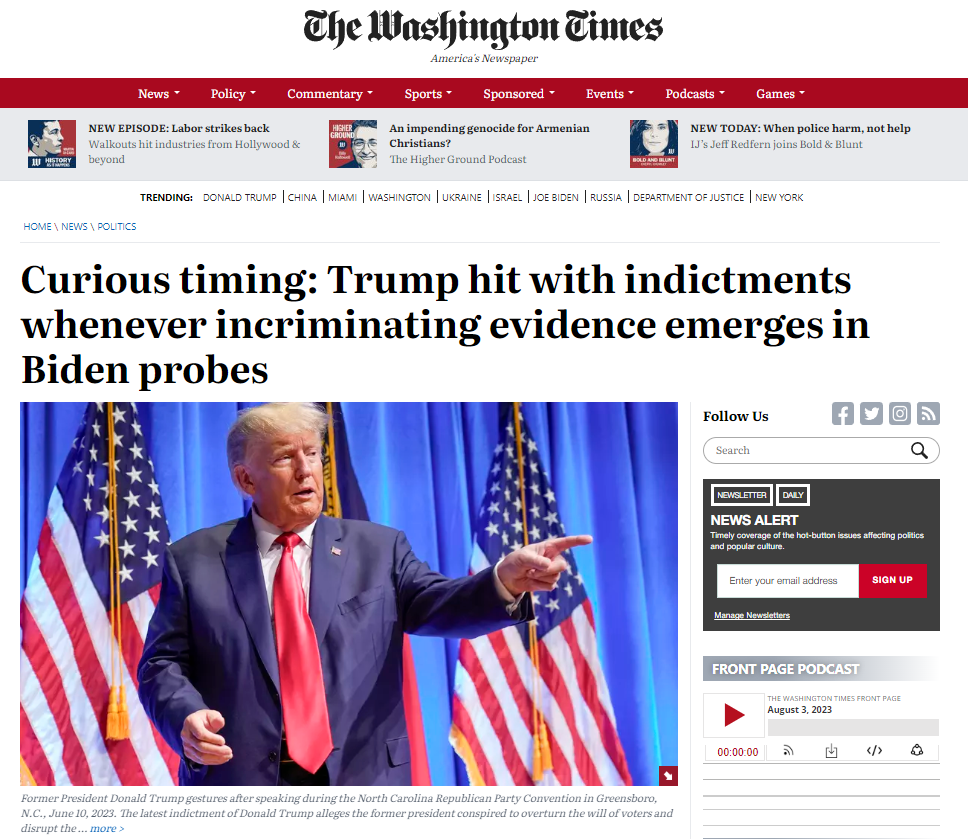
QUESTION: What do you make of the US debt downgrade? Do you think this has anything to do with indicting Trump in three courts? I know many people decided to donate to Trump today, even for the first time, as a sign of disapproval of the Biden Administration and the RINOs.
HJ
ANSWER:
It is time for the Credit Rating Agencies to knock off the BS. Yes, Fitch Ratings downgraded US long-term debt late on Tuesday from AAA to AA+, citing this spring’s debt ceiling standoff as a significant reason. That is nonsense. NO government ever intends to pay off its debts. Historically they ALWAYS default. The global financial system has relied on the promise that the US government will always repay its debts. Some wrongly believe that this is what makes the US dollar the most widely held currency worldwide. The backing behind the dollar is twofold.
Largest Consumer-based economy in the world that everyone needs to sell into
The deepest financial market in the world to park money as well as finance projects and float stocks
This is why the US markets barely reacted to the news in after-hours trading on Tuesday, and US Treasuries were holding steady. Of course, you have the traditional bearish prognosticators who claim the last time there was a downgrade, and the market crashed by 6.5%. The real question is – sell stocks, and the traditional flight to quality is you buy bonds – which were just downgraded. Hm? Many are starting to wake up that the only safe place for wealth will be in tangible assets, for this Biden Administration is completely desperate and out of control. You cannot threaten China and Russia with war and then ask them to buy your debt. China is disinvesting in US government debt ASAP. That is also the reason for the downgrade.
These indictments against Trump, while Biden and Hunter actually could be charged with Treason, have undermined the confidence in the United States government internationally more than anything. They are trying to prevent Trump from running in 2024, for the Neocons know they would be fired if not put on trial for treason themselves. Trump vowed to run for office from prison. RFK should join as the VP and abandon the Democrats, for they will NEVER allow him to gain a toe in their Washington club.
Yes, I have gotten many emails saying people are donating to Trump’s 2024 campaign as a matter of protest against this Biden Administration. All I can hope is that even Democrats wake up before it is too late and stop this hate-Trump nonsense, for what lurks in Washington is so much worse. This judge in Washington will put Trump in prison in the blink of an eye. This judge has been handing out time in excess of the prosecutor’s recommendations. That is unheard of. You are about to witness the complete collapse of the Rule of Law in the United States, and once that goes – it is time to turn out the lights.
The US will eventually descend into civil war at worst, just as China and Russia did when faced with the rise of the LEFT. Some states will separate from this absolutely corrupt government. We cannot rule out the Biden Administration canceling the dollar before the 2024 election, for the Neocons do not care about the economy – only their geopolitical goals. With the Neocons in such a desperate position, they may not wait for the election and connect a dollar cancelation to some geopolitical event. The EU would most likely do the same on a coordinated basis, and both Canada and the UK will follow suit with Japan, Australia, and South Korea.
If the Neocons manufacture a geopolitical conflict before the election, beware of the 2nd quarter next year. That does NOT mean we should lose all hope. You cannot create a new system without purging the old one. Keep your fingers crossed for post-2032, and we get to start anew just as the Founding Fathers overthrew the monarchy and created a new political system.
Posted originally on the CTH on August 2, 2023 | Sundance
Collapse is never a sudden occurrence; it is an outcome of gradual erosion over time. A weakening that takes place almost invisible to those who pass through the construct, until eventually, at an uneventful time in the mechanics of history, the process gives way.
Fitch has joined with the prior position of Standard & Poors to downgrade the USA credit rating. The weight of debt, in combination with reverberations from the continued hammering deep inside the political fundamental change operation, has triggered another flare.
In the bigger picture, this is a self-fulfilling prophecy driven by the latest focus on unsustainable economic policy, aka The Green New Deal. The efforts of the fiscal, monetary and economic policy are all aligned to shrink the U.S. economy, thereby creating the era of “sustainable energy” a possibility. Unfortunately, this is akin to a household intentionally shrinking their income while at the same time taking on credit card debt. The process itself is not sustainable.
(Reuters) – Rating agency Fitch on Tuesday downgraded the U.S. government’s top credit rating, a move that drew an angry response from the White House and surprised investors, coming despite the resolution of the debt ceiling crisis two months ago.
Traders’ immediate response was to embark on a safe-haven push out of stocks and into government bonds and the dollar.
Fitch downgraded the United States to AA+ from AAA, citing fiscal deterioration over the next three years and repeated down-the-wire debt ceiling negotiations that threaten the government’s ability to pay its bills.
[…] “In Fitch’s view, there has been a steady deterioration in standards of governance over the last 20 years, including on fiscal and debt matters, notwithstanding the June bipartisan agreement to suspend the debt limit until January 2025,” the rating agency said in a statement.
U.S. Treasury Secretary Janet Yellen disagreed with Fitch’s downgrade, in a statement that called it “arbitrary and based on outdated data.”
[…] In a previous debt ceiling crisis in 2011, Standard & Poor’s cut the top “AAA” rating by one notch a few days after a debt ceiling deal, citing political polarization and insufficient steps to right the nation’s fiscal outlook. Its rating is still “AA-plus” – its second highest.
After that downgrade, U.S. stocks tumbled and the impact of the rating cut was felt across global stock markets, which were in the throes of the euro zone financial meltdown.
In May, Fitch had placed its “AAA” rating of U.S. sovereign debt on watch for a possible downgrade, citing downside risks, including political brinkmanship and a growing debt burden. (read More)
What do Barack Obama and Joe Biden have in common? They were both in office, executing an identical economic, fiscal and monetary policy, when the USA credit was downgraded.
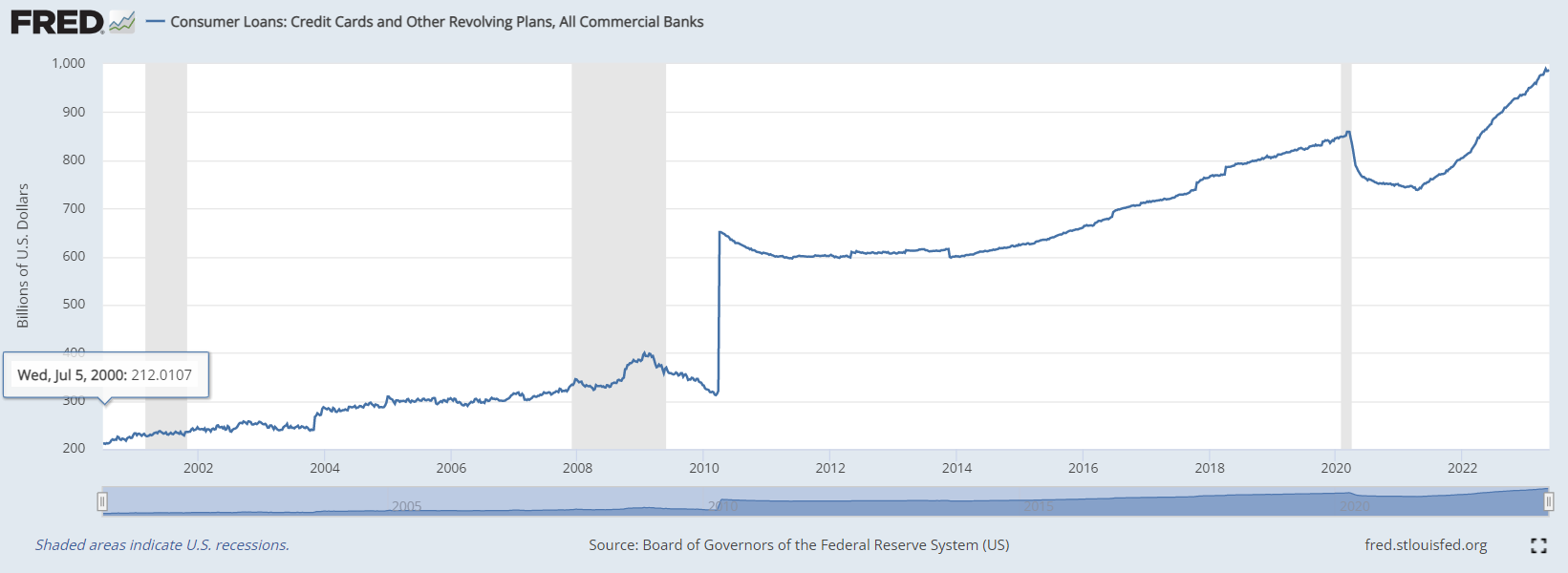
Credit card debt in the US spiked to its highest quarterly level in Q4 2022 after increasing by $85.8 billion. The average American household has about $10,000 in credit card debt, marking an 8.9% YoY increase. Now, Americans are facing $1 trillion in credit card debt due to rising APR and inflation.
The Federal Reserve reported that credit card debt has risen by $250 billion over the past two years amid record inflation. Consumer spending declined during the pandemic, as did credit card debt. However, inflation was nowhere close to what it is today. Credit balances declined by $100 billion from Q1 of 2020 to Q2 of 2021. Consumers were paying off their debts during this time, aided by numerous stimulus packages provided by the government.
Everything changed when Biden took office, killed America’s energy independence, and inflation began to spike. The central bank raised rates right before the war in Ukraine broke out, and have continued to do so at every meeting since. Various data collectors noted that consumers are not using their credit cards for luxury goods – they’re using credit to simply get by and pay for essentials.
Bankrate reported that 46% of cardholders cannot pay off their monthly credit card payments, up 7% from last year. The average APR is around 24% as of May 2023. The US Bureau of Labor Statistics claims that the CPI rose 0.4% in April after increasing 0.1% in March. I reported how the true inflation rate is over 30%; they do not want to scare the public by posting the real data. Food, energy, shelter, and all the essentials to survival have reached historic levels. If nearly half of people cannot pay their credit card balances off each month, and interest is at a record high, consumer debt is guaranteed to rise continually. Nothing is more inflationary than war, and our war cycle is picking up going into 2024. So not only is the US government drowning in debt, but the average American is also struggling to make ends meet.
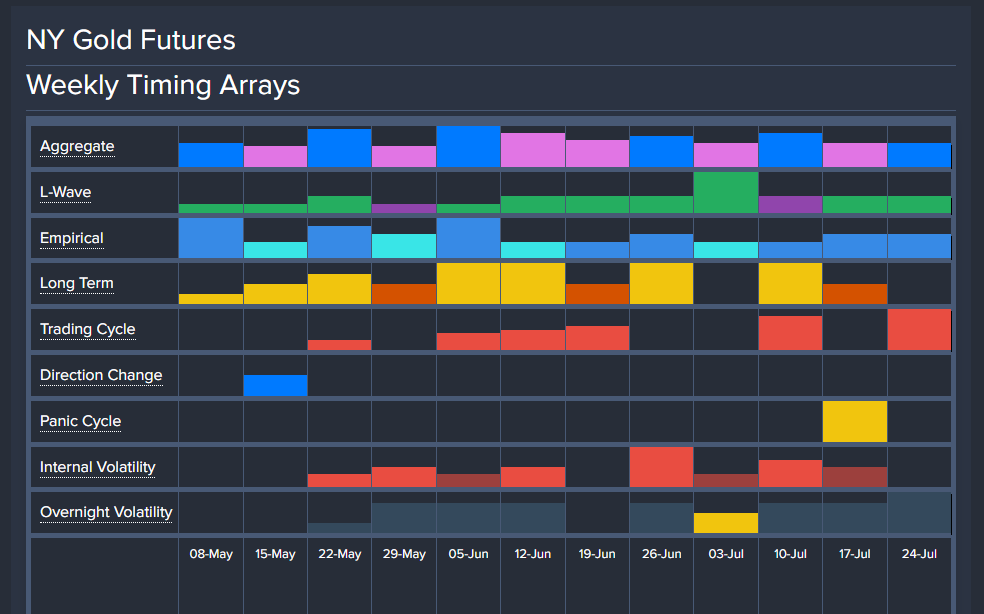
COMMENT: Marty, the Senate passed the Debt Ceiling. It is amazing how Socrates shows there was no debt crisis. As you wrote “When we look at the Array, we do not see a crisis with the debt ceiling.” I do not know how it does this, but what you have created is truly a gift to humankind.
CLB
REPLY: I never expected that linking everything together would predict wars, civil unrest, or financial crises. There is a lot we can learn from Socrates.
COMMENT: Marty; Socrates is absolutely amazing. At the start of the year, you showed April as a key turning point in gold followed by May June. The weekly array projected this was the week for the Directional Change. There is nobody with a system like this, which brings to mind its forecasts for war. Ukrainians are out of their mind to go against the trend. They never even considered what if they lose. It seems like a fool’s bet. This not about just occupying the Donbas which has always been Russian. This is about destroying Russia. They should listen to Socrates to save their own country.
Thank you so much for bringing Socrates to the public rather than just institutions.
HR
ANSWER: I know. These forecasts are not my personal opinion. When you put the entire world together, the trend becomes obvious. Just as I said Ukraine needs to lose to save the world, I also know that we will not all escape the end conclusion. Just as a Serb assassinated the Archduke in Sariavo which began World War I, this entire region is notorious for personal grudges and hatreds that draw in the entire world.
Schwab may have taken our forecast for 2032 and rephrased it as his Great Reset and is hoping to push the falling tree into his direction, that too will fail. But between here and 2032, we are entering a phase of chaos and havoc. I wish I could prevent it, but that is just our fate.
New mortgage originations have reached their lowest level since Q2 of 2014. Inventory remains historically low, shelter costs are historically high, and it makes no sense for most to refinance with current mortgage rates over 6% on the 30-year. Originations, including refinances, came in at $323.5 billion during Q1 of 2023. The NY Fed reported that borrowing in general has reached $17.5 trillion, a $150 billion increase, as families grapple with inflation. The refinance boom in 2020 and 2021 will impact real estate for generations to come.
The NY Fed discusses the COVID refinance boom (Q2 of 2020 to Q4 of 2021) in a recent article. Fourteen million mortgages were refinanced during this period when mortgage rates reached record lows. Mortgage rates plummeted 200 bp from Nov. 2018 to November 2020. The last upticks in refinances occurred in 2003 and again in 2013 when rates also fell 200 bp. However, rates were at their lowest level during the COVID refinance boom, allowing many to take out equity from their homes and reinvest. Home equity reached a record high in the time leading up to the pandemic, and the continued rise in home prices provided numerous owners with additional equity.
One-third of all outstanding mortgages were refinanced over the span of 7 quarters. About 64% of refinances were “rate refinances,” classified as those with a balance increase of less than 5% of the mortgage amount. Those who chose this route saved an average of $220 per month. Cash-out refinancers took out $82,000 on average, increasing monthly payments by $150. Around 5 million borrowers extracted a total of $430 billion during the COVID refinance boom—a significant sum.
The 9 million who did not extract equity reduced mortgage payments by $24 billion annually. These figures are something I do not expect to see again in my lifetime. Those holding their breath for rates to drop under 3% again should come up for air. Homeowners are disincentivized to sell at current rates, not to mention home prices are AT LEAST 36% higher than before the pandemic. Everyone’s investment strategy is unique, but those who were able to use their home’s equity to invest during the bottom of the market made out well. The period between Q2 of 2020 to Q4 of 2021 will be a reference point for years to come.
Honest journalism has become a crime. I have appeared numerous times on Maria Zaric’s program, Zeee Media. Maria is a professional journalist who asks thought-provoking questions to the experts that appear on her show. Her content goes against the grain and traditional narrative. The Australian-based journalist has been questioning COVID, the Great Reset, governments, globalists, the war in Ukraine, and many other topics that are completely taboo in the mainstream media. They attempted to shut down her channel in the past. Now, she has been de-banked with no explanation.
“Do you shut down peoples accounts due to their political views by any chance?” Maria asked the bank representative, only to be met with silence. Maria had been banking with ING Bank for numerous years without issues. Her account was suddenly shut down shortly after releasing a story on domestic terrorism in Australia. ING Bank has been unable to explain why her account was canceled.
Interestingly, ING is a partner of the World Economic Forum. Maria has extensively covered the WEF’s agenda to “enslave humanity.” Is Australia secretly keeping track of journalists’ “social credit scores” to silence skepticism?
The idea of eliminating someone’s ability to bank is essentially eliminating them from society. We saw Canadado the same thing to those protesting the Trucker Convoy. Trudeau took things a step further by also de-banking people who simply donated to the cause. The Canadian government used the premise of money laundering as a way to coerce the banks into reporting any activity that could have been intended to help the protestors. I know of numerous people who were frantically attempting to remove their funds from the bank during this time.
As if the public needed more reasons to lose trust in the banking system. This is not limited to one bank or country. I discussed how banks have the ability to “cancel” someone after JPMorgan Chase de-banked the rapper Kanye West for antisemitic remarks. The bank acts as the jury and judge. Epstein was permitted to hold funds at JPMorgan Chase despite an ongoing pedophile ring trial. Bernie Madoff banked with JPMorgan Chase. The bank has secret ties to the Third Reich and helped the group funnel money through South America during World War II. Again, the bank acts as the jury and judge; anyone can be de-banked anytime for any reason.
Most countries may not openly have social credit scores, but they’re keeping tabs on us. They are keenly aware that resistance to this New World Order is building. So they are now using professional journalists as examples hoping that people will stop asking questions to learn the truth. That is one of the reasons why this blog is free of charge – you deserve to know the truth.
QUESTION: Marty there are a lot of people who seem to be trying to create a panic. Some are claiming the stock market will plunge by 50%. Others are saying nothing will survive other than gold. It seems like none of these people have any sense of what is really unfolding. They were saying the same thing for different reasons before the banking crisis. Can you offer any historical perspective?
Thank you. You seem to be the only real source these days.
Pete
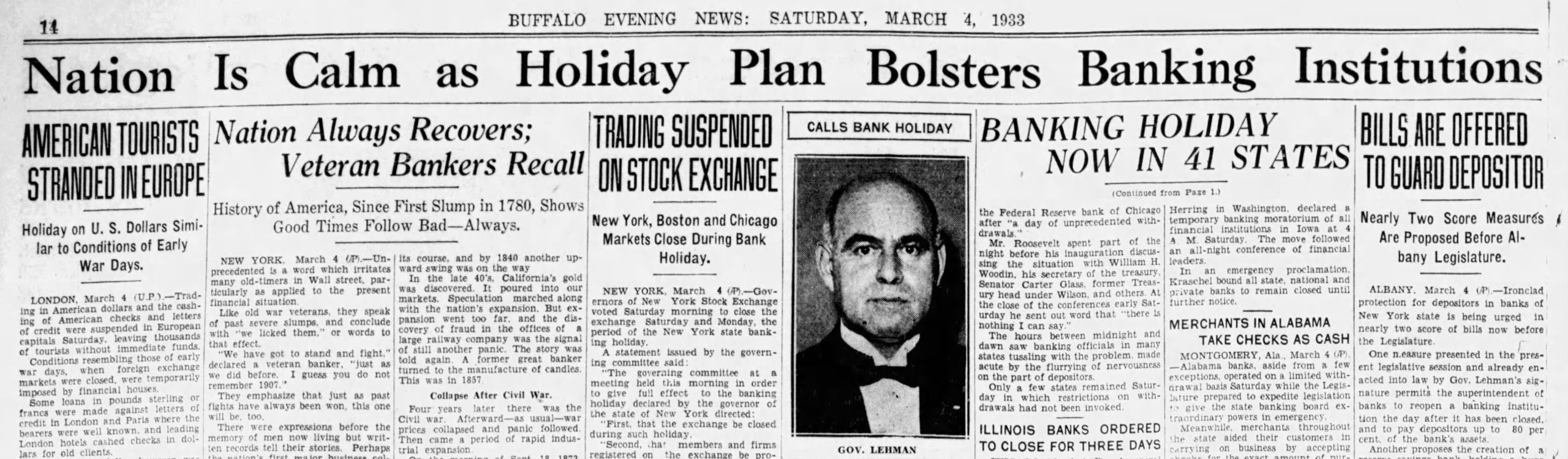
ANSWER: The Bank Holiday took place the first week of March 1933. It began with governors closing down the banks in their states. Once one began, like COVID rules, they quickly jumped on the bandwagon. As reported by March 4th, 1933, some 41 states had already declared a banking holiday. Back then, the president took office in March – not January. Thus, Roosevelt was sworn in on March 4th, 1933. As the new president, FDR delivered what is arguably his best-known speech.
“So, first of all, let me assert my firm belief that the only thing we have to fear is…fear itself — nameless, unreasoning, unjustified terror which paralyzes needed efforts to convert retreat into advance. In every dark hour of our national life a leadership of frankness and of vigor has met with that understanding and support of the people themselves which is essential to victory. And I am convinced that you will again give that support to leadership in these critical days.”
The following day, Roosevelt declared a national banking holiday on March 5th, 1933. Then Congress responded by passing the Emergency Banking Actof 1933 on March 9th, 1933. This action was combined with the Federal Reserve’s commitment to supply unlimited amounts of currency to reopened banks. Back then, they effectively created a de facto 100% deposit insurance and this was before the FDIC was created.
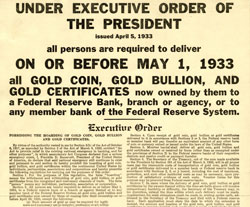
However, what the history books have omitted because it revealed the real reason for the major banking crisis, was the confiscation of gold precisely as Germany did in December 1922 seizing 10% of all assets which unleashed hyperinflation in 1923.
In Herbert Hoover’s memoirs (1951), he documents the fact that Franklin D. Roosevelt (FDR) played a very dirty game of politics. There were rumors that FDR would confiscate gold in 1932 BEFORE the election. These rumors spread and people ran to banks to withdraw their funds. The night before the election in 1932, FDR denied that he would do such a thing. After FDR won the election, the real bank panic began. FDR would not take office until March 1933.
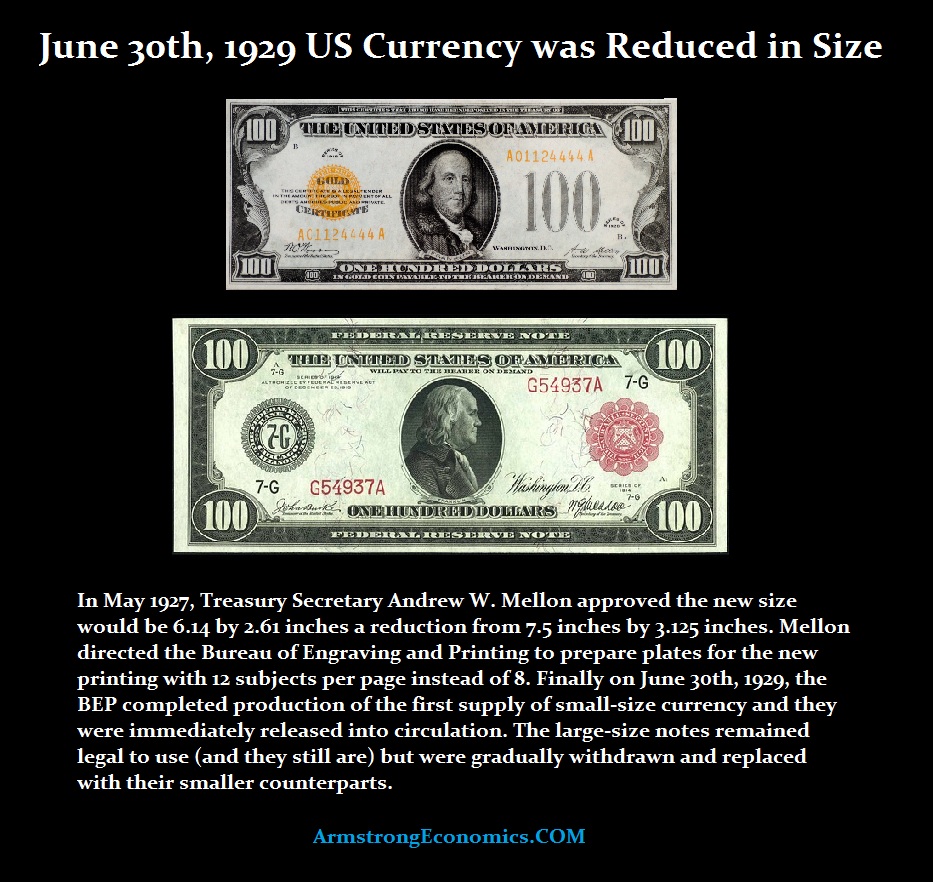
The run on banks began as the Great Depression started. In 1929 alone, 659 banks closed their doors due to mismanagement and speculation. Ironically, to save money on paper, it was also in 1929 when the currency was reduced in size to save money. This time, they want to move to digital and save 100% on printing money. Here in 2023, the failures are due to the WOKE agenda which has deprived the banks of risk management rather than speculation.
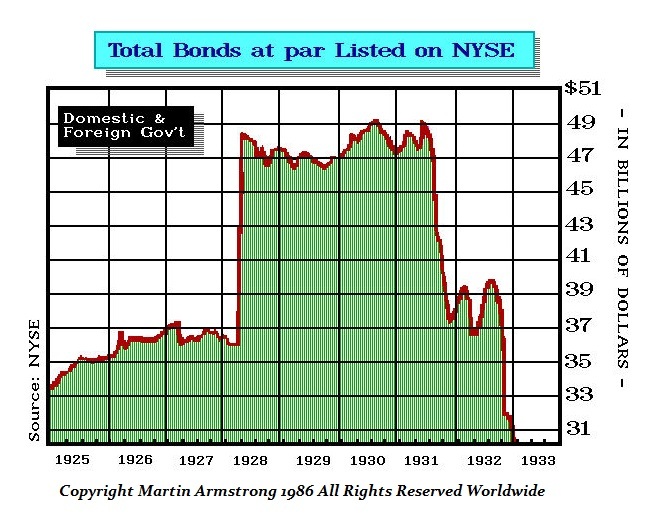
However, as the 1931 Sovereign Debt Crisis hit, the number of bank failures skyrocketed. Goldman Sacks and others were selling foreign bonds to Americans in small denominations., As Europe began to default, US banks holding foreign debt and individuals in need of cash led to a banking panic for external reasons. Here is a chart showing the listing of bonds on the NYSE. We can easily see the collapse in the bond market thanks to the 1931 Sovereign Debt Crisis.
By 1932, an additional 5,102 banks went out of business. Families lost their life savings overnight. Thirty-eight states had adopted restrictions on withdrawals in an effort to forestall the panic. By March 4th, 41 states had declared a bank holiday shutting down banks. Bank failures increased in 1933, and Franklin Roosevelt deemed remedying these failing financial institutions his first priority after being inaugurated.
However, it was actually the election of FDR that started the banking crisis post-1931. Hoover pleaded with FDR to please come out and address the gold confiscation rumors. People had been hoarding their gold coins fearing the rumored confiscation. Despite Hoover’s plea for FDR to come out and deny the rumors after the election, he remained silent. Given FDR’s manipulation of Japan and the attack on Pearl Harbor which he appeared to instigate with sanctions confiscating Japanese assets in the USA, denying the sale of any energy to Japan, and then threatening to use the fleet to block them from buying fuel from anywhere else, They Japanese attacked Pearl Harbor. There were Senate investigations afterward about FDR’s role because the US had already broken the Japanese code and knew in advance about the attack on Pearl Harbor. He did that to force the US into World War II.
It was in his character to remain silent and create the worst banking crisis in history before he was sworn in as president. FDR was a radical socialist and many viewed that he admired Lenin. If it were not for Mr. Jones exposing the truth behind Stalin, even the corrupt New York Times journalist promoting Stalinism was meeting with FDR. The run on the banks became massive when FDR won the election on November 8th, 1932. FDR allowed the banking system to implode with people rushing to withdraw the money in gold coins.
At 1:00 a.m. on Monday, March 6th, 1933, President Roosevelt issued Proclamation 2039 ordering the suspension of all banking transactions, effective immediately. Roosevelt had taken the oath of office only thirty-six hours earlier.
The terms of the presidential proclamation specified:
[N]o such banking institution or branch shall pay out, export, earmark, or permit the withdrawal or transfer in any manner or by any device whatsoever, of any gold or silver coin or bullion or currency or take any other action which might facilitate the hoarding thereof; nor shall any such banking institution or branch pay out deposits, make loans or discounts, deal in foreign exchange, transfer credits from the United States to any place abroad, or transact any other banking business whatsoever.
For an entire week, Americans would not have access to banks or banking services. They could not withdraw or transfer their money, nor could they make deposits. The entire economy ran simply on cash in your pocket.
While the first phase of the banking crisis unfolded after 1929 due to speculation losses (hence Glass–Steagall Act), then the second phase was the 1931 Sovereign Debt Crisis, it was the third phase with the election of FDR that led to thousands of banks failing as there was a mad rush to withdraw your gold coin. But a new round of problems that began in early 1933 placed a severe strain on New York banks, many of which held balances for banks in other parts of the country. About 4,000 banks failed during this period alone bringing the total to over 9,000.
Much to everyone’s relief, when the institutions that could reopen for business on March 13th, 1933 saw depositors standing in line to return their stashed cash to neighborhood banks. Within two weeks, Americans had redeposited more than half of the currency that they had withdrawn post-FDR’s election on November 8th, 1932. This would prove to be a sneaky trick of FDR to get people to redeposit all the gold coins they had withdrawn – as we are about to explore.
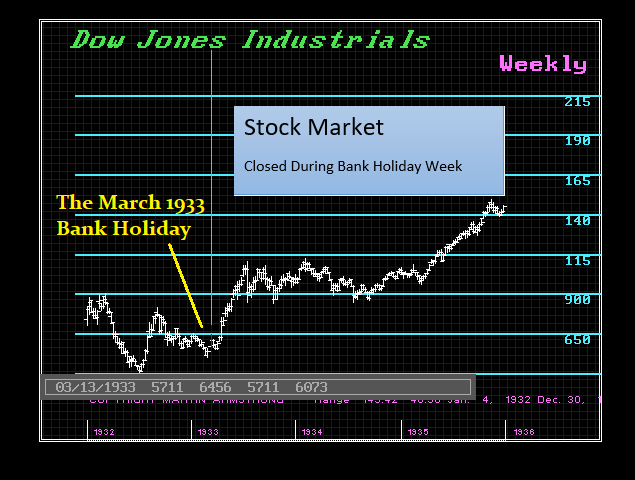
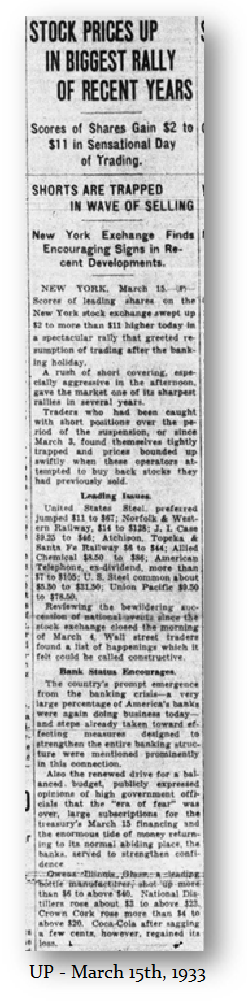
The stock market was also ordered closed when FDR came to power. With the cleverness of a real con artist operating a Ponzi Scheme to gain the confidence of the people, FDR needed the gold coin to be deposited for Phase 4 of the banking crisis. On March 15th, 1933, (The Ides of March), the stock market was allowed to reopen. On the first day of trading, the New York Stock Exchange recorded the largest one-day percentage price increase ever.
The week before the closure, the Dow Jones Industrials fell to 49.68. The week following the closure, the Dow rallied to 64.56 – a percentage gain of virtually 30% over the banking holiday. The shorts who were better on the collapse of the market once it reopened were devastated. It was a major short-covering rally.
With the benefit of hindsight, the nationwide Bank Holiday and the Emergency Banking Act of March 1933, ended the bank runs that had plagued the Great Depression, but it also set the stage for the confiscation of gold. What you have to understand is that Franklin Delano Roosevelt’s (FDR) actions in 1933 were not directed simply at gold. He was embarking on what he called the New Deal, which was a Marxist Agenda that was very popular at the time. His New Deal would end austerity, whereby they were maintaining a balanced budget in the belief that they needed to inspire confidence in the currency.
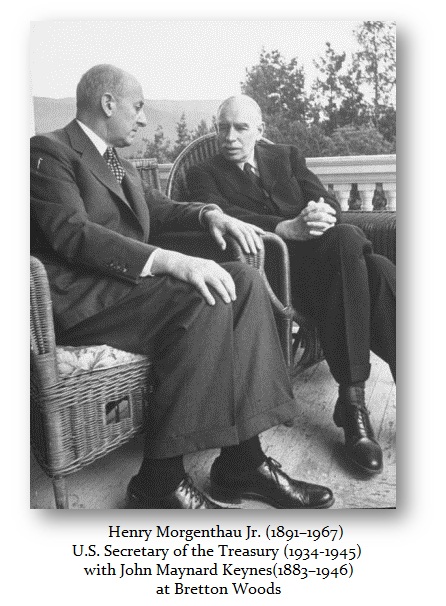
It was this balanced budget philosophy that also inspired John Maynard Keynes who argued that in times of economic distress when the demand has collapsed, that is when the state needs to run a deficit and increase the money supply. There was a simultaneous international flight of capital from Europe to the United States in the face of European sovereign debt defaults. That capital flight lasted for nearly two years until FDR won the election in 1932. There was much concern that Roosevelt would do what Germany did in 1922 in confiscating assets. That was the rumor about the possible confiscation of gold.
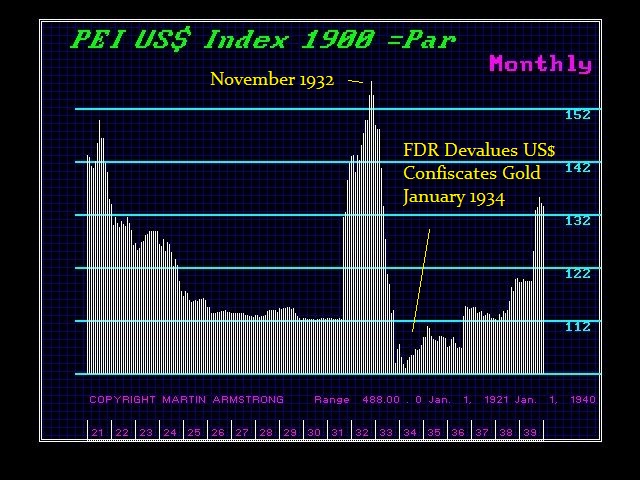
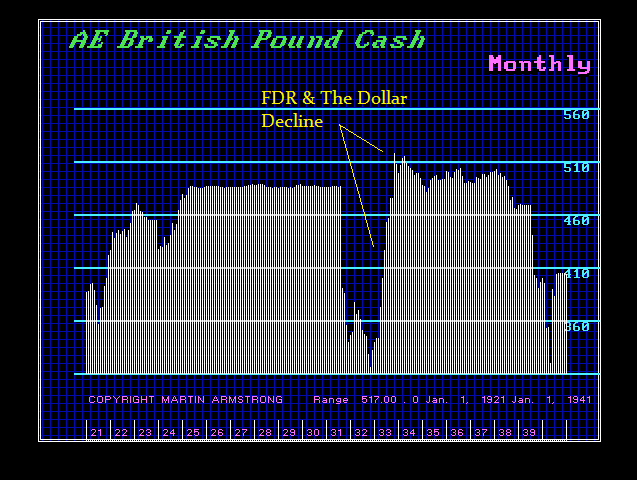
Milton Friedman criticized the Fed because the capital flows poured into the US but they refused to monetize it. We can see that as Europe defaulted on its debts in 1931, the capital rushed head-first into the dollar. Then we see that the dollar peaked in November 1932 with the election of FDR fearing that would weaken the dollar and exploit the economy. All this gold came to the USA pushing the dollar higher, but the Fed refused to monetize it, was Milton’s criticism. The backing of gold behind the dollar doubled in supply between 1929 and 1931.
So, you must separate gold and the devaluation of the dollar to comprehend what the issue was all about. FDR could have simply abandoned the gold standard, as did Britain, and not confiscated gold. However, that would have also been sufficient to end austerity. But the bankers would have profited and sold the gold overseas at higher prices. Roosevelt in his confiscation of gold was intended to deprive the private sector of profiting from his devaluation of the dollar which was rising the price of gold from $20 to $35. You must keep in mind that he even degraded Pierre du Pont (1870-1954) and called him the “Merchant of Death” because he produced arms for World War I and made a profit off of that war demand. Many saw Roosevelt as a traitor to his own class.
The confiscation of the gold was for two reasons. First, FDR was changing the monetary system from one where there was no distinction domestically from internationally to a two-tier system. Gold would freely circulate without restriction only internationally. Therefore, the confiscation of gold was altering the monetary system moving to a two-tier monetary system with gold only used in international transactions.
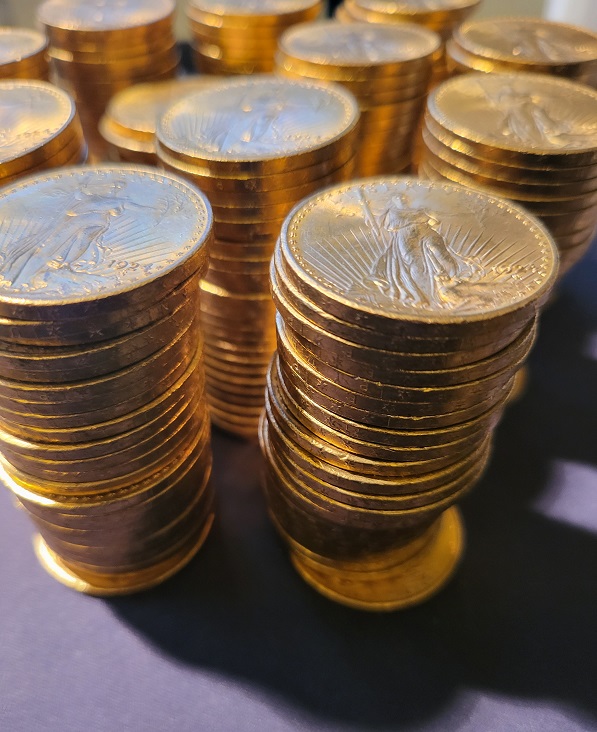
Consequently, FDR confiscated gold to move to a two-tier system and to deprive Americans of any profit from his devaluation. What FDR then did was confiscate gold from all institutions ordering them to turn over whatever they had. Ironically, this move was intended to target bankers rather than the public. FDR did not have people knocking on every door demanding all their gold. That is why there are plenty of US gold coins that have survived. If individuals possessed them rather than an institution, then they kept what they owned
Therefore, Roosevelt was able to seize whatever gold existed in banks. He declared all contracts void that had gold provisions for payment. It was in Perry v. United States – 294 U.S. 330 (1935) that the US Supreme Court ruled that Congress, by virtue of its power to deal with gold coin as a medium of exchange, was authorized to prohibit its export and limit its use in foreign exchange. Hence, the restraint thus imposed upon holders of gold coins was incidental to their ownership of it, and gave them no cause of action. id/P. 294 U. S. 356.
The Supreme Court held that it could not say that the exercise of this power by Congress was arbitrary or capricious. id/P. 294 U. S. 356. They held that even if the Government’s repudiation of the gold clause in the government bonds was unconstitutional, it did not entitle the plaintiff to recover more than the loss he has actually suffered, and of which he may rightfully complain. id/P. 294 U. S. 354. Therefore, the Joint Resolution of June 5, 1933, held:
“insofar as it undertakes to nullify such gold clauses in obligations of the United States and provides that such obligations shall be discharged by payment, dollar for dollar, in any coin or currency which at the time of payment is legal tender for public and private debts, is unconstitutional.” id/P. 294 U. S. 349.
Yet, swapping gold for dollars created no loss that was cognizable even though the taking of gold was unconstitutional. Clearly, the Supreme Court did not consider the loss in terms of foreign exchange. The Court reasoned:
“Plaintiff has not attempted to show that, in relation to buying power, he has sustained any loss; on the contrary, in view of the adjustment of the internal economy to the single measure of value as established by the legislation of the Congress, and the universal availability and use throughout the country of the legal tender currency in meeting all engagements, the payment to the plaintiff of the amount which he demands would appear to constitute not a recoupment of loss in any proper sense, but an unjustified enrichment.”
In my understanding of the law, those who argued before the Court made purely a domestic argument. A dollar was still a dollar in domestic terms so there was no cognizable loss and the Court did not reach the constitutional question. Had they argued that their loss was with respect to some debt owed in British pounds, they there was a loss. Purely domestically, the only loss would have been to inflation and the Court would never rule against the government on such an issue.
All of that said, there does not appear to be any historical precedent for the stock market to collapse by 50%, all tangible assets to turn to dust, and only gold will survive given a banking crisis where Biden and Yellen sit on each other’s hands and do nothing. Trust me. Every major Democratic donor will be screaming. And as for those claiming the Fed will reverse its position, say inflation is suddenly no longer a problem, and monetize everything in sight, this is even too big for the Fed. have to create QE and absorb all the debt, there to things have changed. If the Fed does that, it will also lose all credibility. It squarely understands that inflation comes from handing Ukraine a black check to the most corrupt government in the world. The Fed raised rates yesterday for it cannot back down. It is choreographing the best it can but the bankers do not listen.
If they simply stand behind all the deposits, then there will be no panic. That is what they did in 1933 and the market rallied in confidence thereafter.
I have created this site to help people have fun in the kitchen. I write about enjoying life both in and out of my kitchen. Life is short! Make the most of it and enjoy!
This is a library of News Events not reported by the Main Stream Media documenting & connecting the dots on How the Obama Marxist Liberal agenda is destroying America










 Centinel2012