US Real Estate Market


Armstrong Economics Blog/Real Estate R-Posted Sep 2, 2023 by Martin Armstrong

QUESTION: Mr. Armstrong, You were the only one who forecasted that real estate would continue to rise in conjunction with the rate increases by the Fed. I have been following you only since 2020 and COVID-19. I am impressed with your computer and your analysis, which does not change with every passing headline. Can you elaborate on the real estate market a bit?

Thank you very much for the education.

FH

ANSWER: The traditional forecast on real estate is always one-dimensional. Homeownership has historically been in the top 5 of surveys about what Americans most want in life. Property values have been rising despite rising high prices combined with higher mortgage rates. There is little sign on the horizon before the ECM peaks in May 2024. Analysts have been confused and caught up in this economic conundrum of the continued economic growth that has defied all their recession predictions.

Normally, housing has been one of the sectors that has been the most sensitive to interest rates. Over the past two years, mortgage rates have risen from less than 3% to more than 7%. That means that the median family today faces mortgage payments that have doubled from roughly 14% of monthly household income in 2020 to nearly 29%  by mid-2023. This is the strongest rise since the economic turm on our ECM when it bottomed in 1985.65.

Nevertheless, the conundrum that has baffled traditional analysts has not led to a decline in house prices as they expected. They paused during the COVID-19 lockdowns and fell in the Blue States, which had the most draconian COVID-19 measures. Currently, housing prices during the second quarter of this year rose at an annualized pace of 15% according to the S&P Case-Shiller index.

There is a tight supply in the South, where much of the migration has taken place. I get, on average three calls a week asking if I want to sell my house here in Florida. The annual sales of property nationally have been around $2 trillion.  Smart institutional investors have been shifting from public unsecured debt to private mortgages. The average person does not look at CPI numbers or GDP numbers. They look at the cost of this rising, and the confidence in the Biden Administration has been collapsing. When people no longer trust the government, they shift to the private sector. So add to that the great migration from Democratic states to the southern red states, and you will see collapsing real estate values in places like San Francisco and Chicago in comparison to even Wall Street, have been quietly moving to the Miami region. There are still buyers in the market and a shortage of supply in the Red States like Florida. Thus, sales have declined, but this appears to be more the result of the decline in supply.
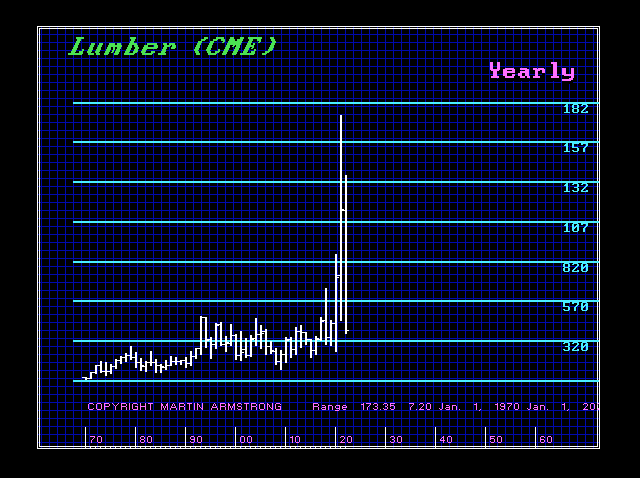
Additionally, the rising inflation in materials means that the replacement cost of homes is often higher than the prices being paid, not to mention the waiting time for construction. The sheer replacement costs of housing have skyrocketed. Even pain was in short supply thanks to the COVID-19 lockdowns. This has impacted the market, and traditional analysis simply never considered that the replacement costs on preexisting houses, in many cases, are 40% to 100% higher. Add to that the shortage in labor. It was very hard to find a contractor in Florida who even was available. Most contractors I talked to were booked beyond 2024.

Newly built homes account for about one-third of active listings in 2023. This was up from an average of 13% over the two decades before pre-COVID-19. Add to all of this is the influx of foreign money looking at US property as a hedge against future wars and destabilization of the monetary system. Then we have had funds like Blackrock buying property and renting them out.
The Cost of Homeownership in the US Spiked 91% in Two Years


Armstrong Economics Blog/USA Current Events Re-Posted Sep 1, 2023 by Martin Armstrong

The US housing market has not been this unaffordable since 1984, a new study finds. Analysts at Black Knight analyzed home prices, income, and interest rates on a monthly basis going back to 1975 and found that the average mortgage today would cost $2,423 per month on a 30-year fixed with 20% down. This marks a 91% increase in housing costs over the past two years alone.

The $2,423 figure represents 38.3% of the median household income, despite home ownership costing only 24% of the median household income for the past 25 years. This study does not take into account that many do not put down the 20% downpayment due to rising closing costs, insurance costs, and taxes. The current 30-year fixed mortgage is around 7.23% at the time of this writing, marking a 20-year high. For housing affordability to reach 24% of the median income, the average household would need to earn 60% more or home prices would need to decline by 27%.

Home prices are at their highest level in 30 of the 50 largest metros. People are continuing to flee to more desirable areas for financial and political reasons, and with historically low inventory, prices will not decline any time soon in those areas.

Worse still, 344,000 US homeowners owe more than their home is worth, which is a 70% uptick from last year. In Florida, insurance rates alone are causing many longtime residents to flee. I will discuss that in more depth in another post. The housing crisis is in full swing, but this is by design. The globalists have said countless times that they want the world to become perpetual renters who own nothing. Never before has the average man had to go to battle with investment firms to own a piece of the American dream.

Freedom Flyers


Armstrong economics Blog/Real Estate Re-Posted Jul 20, 2023 by Martin Armstrong

Have you ever noticed a decorative eagle plaque above a home in America? This was once a popular symbol back in the day to symbolize freedom from mortgage payments. Homeowners would adorn their houses with this symbol to indicate that they were free from the bank and owned their home free and clear. Around 40% of owner-occupied homes have been paid off, further adding to the housing inventory crisis.

The 2022 Federal Housing Finance Agency reported in 2022 that 84% of outstanding mortgages locked in a rate below 5%, while 63% secured a rate at or below 4%. Mortgage rates surpassed 8% last week and those who own are unlikely to sell. While some point to double-digit mortgage rates in the past, it was not difficult for buyers to put down 40% upfront since housing prices were low in comparison to wages. This was also a time when the cost of living supported a traditional lifestyle where only one partner was required to work.

Although COVID and low rates created strong demand, the underlying issue is the Great Reset. Institutions are set to own 40% of all single-family rentals by 2030, precisely on time for Agenda 2030. Regular buyers have been outbid by institutions coming in with cash payments. BlackRock is now the largest landowner in America. This is all by design. They do not want people to afford a home because then there would be no need for 15-minute cities, and forever renters living in ADUs. The inventory issue will not recover because no one can outbid the institutions who do not need to borrow money.

Republicans Fighting Biden’s Mortgage Madness


Armstrong Economics Blog/Real Estate Re-Posted May 3, 2023 by Martin Armstrong

Republicans at the state level are demanding that Biden and the FHFA repeal the asinine new law that punishes Americans with high credit scores by forcing them to subsidize the mortgages of those with low credit scores. The Biden Administration has been attempting to control real estate for some time. In June 2021, Biden forced the Supreme Court to give him the power to fire Mark Calabria as the regulator of Freddie Mac and Fannie Mae. Biden’s team said they were “moving forward today to replace the current director with an appointee who reflects the administration’s values. This was also when shareholders sued the government for the 2012 decision to pay all proceeds directly to the Treasury.

Trump was in favor of Calabria and fought to separate Freddie and Fannie from the government, but the Democrats repealed everything once Joe took over. Florida Chief Financial Officer Jimmy Patronis and 33 other Republicans at the state level are urging Biden and the FHFA to repeal this “hair-brained” policy. “This new policy … will take money away from the people who played by the rules and did things right – including millions of hardworking, middle-class Americans who built a good credit score and saved enough to make a strong down payment,” the group noted. “Incredibly, those who make down payments of 20 percent or more on their homes will pay the highest fees – one of the most backward incentives imaginable.”

Patronis and others argued that owning a home was once the American dream, and the new law will hurt middle-class families who worked and budgeted for their downpayment and credit score. “[T]he right way to solve that problem is not to use the power of the federal government to penalize hardworking, middle-class American families by confiscating their money and using it as a handout. The right way is to implement policies which will reduce inflation, cut energy costs and bring lower interest rates. Doing so will enable more families to save and improve their credit scores. Increased financial literacy efforts must also be part of the solution,” the letter also states. Lowering energy scores and inflation is not part of the Build Back Better agenda.

Providing people with loans who otherwise would not qualify is part of the plan for the Great Reset. Raising taxes on everything imaginable is also part of the agenda. The government wants to tax the middle class out of homeownership, force the working class to default on their mortgages, and move everyone into government-provided smart cities. The hatred toward government is brewing and will soon bubble over.

Only 32% of Lenders Profited on Mortgages in 2022


Armstrong Economics Blog/Real Estate Re-Posted Apr 13, 2023 by Martin Armstrong

The talking heads have been warning of a housing crash, but that is not what Socrates indicated. The 30-year fixed rate is around 6.89% at the time of this writing. Housing costs continue to rise, causing the costs of servicing mortgage debt to rise. Housing inventory is limited, and a recent report explains why we saw mass layoffs in the banking sector. The demand is still there and it is a sellers’ market. Cash is king when it comes to real estate for those who can afford it. Mortgage lenders are in trouble. In fact, only 32% of mortgage companies were profitable in 2022 compared to 98% in 2020.

The Mortgage Bankers Association (MBA) recently announced that independent mortgage banks and subsidiaries of chartered banks lost around $301 for every mortgage they financed in 2022. This marks a 113% decline from the prior year’s average and the first-time banks are seeing losses on mortgage products. This is not 2008 when banks handed out loans to anyone who asked.

“The rapid rise in mortgage rates over a relatively short period of time, combined with extremely low housing inventory and affordability challenges, meant that both purchase and refinance volume plummeted,” said Marina Walsh, CMB, MBA’s Vice President of Industry Analysis. “The stellar profits of the previous two years dissipated because of the confluence of declining volume, lower revenues, and higher costs per loan.” Production costs reached a high of $10,624 per loan last year. Productivity was 1.5 loans originations per production employee, down from 2.5 per employee the year prior, and an indicator of why we are seeing layoffs in the banking sector. No one is refinancing at these rates either and most chose a fixed rate, as we saw what happened in 2008 with adjustable costs.

First-time mortgages reached an all-time high of $323,780 last year, up from $298,324, the largest annual increase since the MBA began collecting data. The increased cost of loans increased the cost of serving mortgages. The MBA expects volume to decline further in 2023 before rallying in 2024 and 2025. The banking crisis may lead to banks and lenders selling off their mortgage debts once they cannot afford to service the debt. Again, the housing crisis today is not relative to the 2008 crash.