Americans Prepared for Lasting Inflation


Posted originally on Aug 6, 2024 By Martin Armstrong 
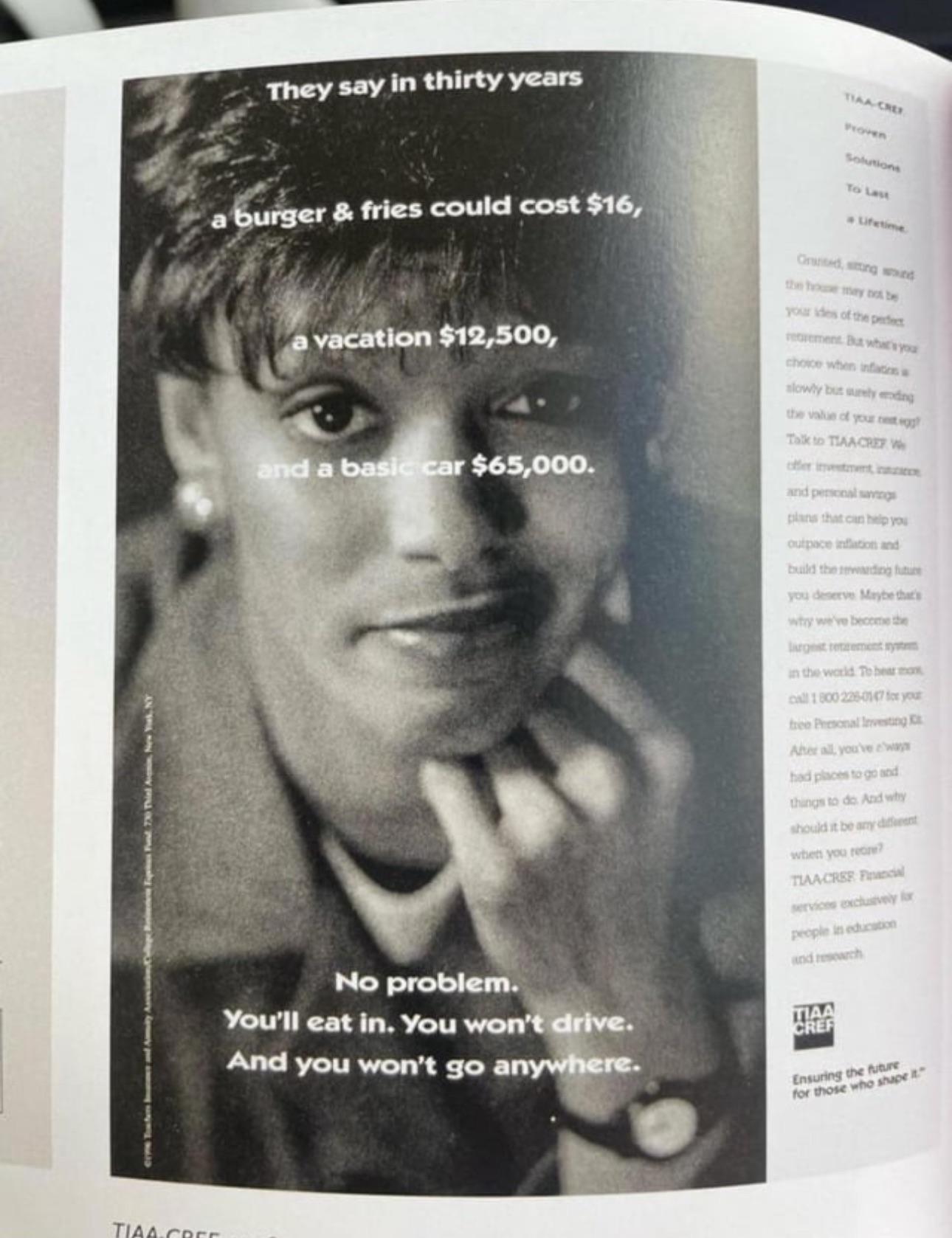
InflationPredictedMagazine

Americans are preparing for a prolonged inflationary period, based on new data from the New York Fed. The New York Federal Reserve’s Survey of Consumer Expectations found that Americans are still pessimistic about inflation waning, with no one now believing it is transitory. The median expectation is that inflation will remain at the 3% level in 2025.

The public does not anticipate inflation tapering off in a meaningful way in the years to come. The Federal Reserve is still honing in on that 2% target but the people have lost confidence in its ability to do so. Most Americans see inflation sitting at 2.9% in three years from now, up from the 2.4% estimate in January 2024. Even in five year’s time, the average consumer believes inflation will be above target at 2.6%.

The central bank believes they can meet that 2% target. Policymakers believe inflation will fall to 2.1% by 2025 before finally reaching 2% in 2026. Amid the sell off this week, Chicago Fed President Goolsbee came out and said that the central bank will simply “fix it” if the economy continues to deteriorate.

“The Fed’s job is very straightforward, maximize employment, stabilize prices and maintain financial stability. That’s what we’re going to do,” Goolsbee told CNBC. “We’re forward-looking about it. So if the conditions collectively start coming in like that on the through line, there’s deterioration on any of those parts, we’re going to fix it.”

Unfortunately, there is not much that the central bank can do to offset government’s suicidal fiscal policy. Remember, inflation was only 1.4% when Joe Biden took office – far beneath the Fed’s target. Inflation has risen as a direct result of fiscal policies under Bidenomics.
FederalReserve 1

The Fed was unable to prevent policies that ended America’s energy independence. They were unable to stop the supply chain issues exacerbated by the pandemic. They cannot alter the weak jobs reports that are propped up by multiplying the public sector, which only detracts from overall GDP. The Federal Reserve cannot maintain diplomatic relations with America’s trade partners or prevent the likes of Japan and China from selling off US government debt. The millions of immigrants now subsidized by the taxpayers cannot be curtailed by Jerome Powell or the FOMC. Worst of all, war is the most powerful driver of inflation. The Federal Reserve can do absolutely nothing to prevent America from steering NATO into three potential battles. Our Treasury Secretary says we can afford numerous wars. The $35 trillion in government debt rises every day and those in the central bank simply KNOW that the government has no intention on paying it off – how could they?

Americans are rightfully pessimistic about the future of the economy. All the talking heads insist that the economy is thriving under Bidenomics, but we the people are living in a different reality. This is what happens when people lose trust in the government entirely.

Fed President Says Americans Would Prefer a Recession to Inflation


Posted originally on Jun 5, 2024 By Martin Armstrong 

Fed Ship in STorm

Federal Reserve Bank of Minneapolis President Neel Kashkari has advised against anticipating near-term rate cuts. While speaking to the Financial Times, the Fed president stated that people would simply prefer a recession to continued inflation.

“I have learned that the American people—and maybe people in Europe equally—really hate high inflation. I mean, really viscerally hate high inflation,” he told the Financial Times’ The Economics Show podcast. Kashkari is speaking as if we are not already in a recession. It is not difficult to understand the “visceral” hatred people around the world feel toward rising prices. The effects of inflation are felt with every purchase, causing the average person to adjust their entire lifestyle.

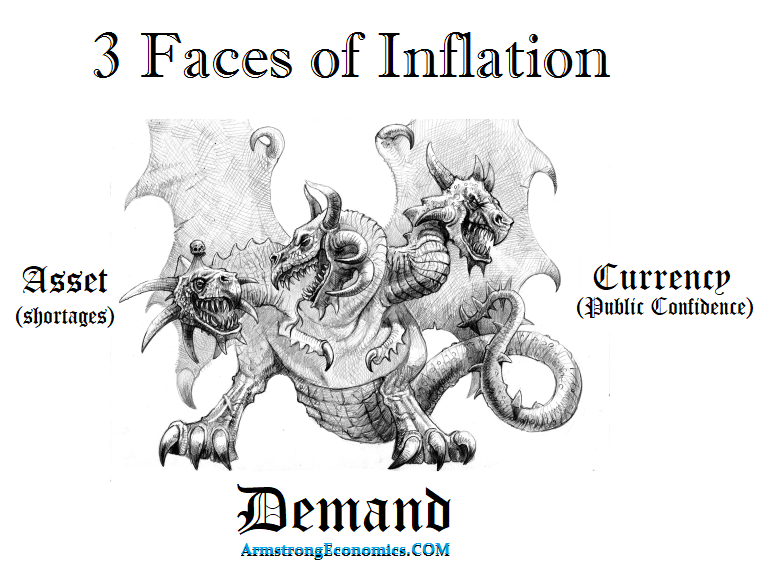
3 faces of Inflation Dragon

Vague issues such as rising unemployment or declining wages do not impact everyone. “I lose my job, I lean on my sister or my parents or my friends, and they help me through it. But high inflation affects everybody. There’s no one I can lean on for help because everyone in my network is experiencing the same thing I’m experiencing,” Kashkari explained. Mass layoffs, for example, would only impact a fragment of the overall population, and people would feel lucky simply to keep their jobs.

“In the US, GDP has been remarkably strong, very strong,” he noted. “The labor market has been resilient. Wage growth has been mostly resilient. And we’re seeing even the housing market has shown signs of resilience. So if I look at this resilience and economic activity, that does not look like an economy that is under pressure of very high, very tight monetary policy.” Yet, inflation is outpacing wage increases and people are watching their savings dwindle while spending less. The average person cares not of the health of the overall economy as they simply want to be able to continue maintaining or improving their standard of living. Most Americans, for example, do not invest and live paycheck to paycheck.

CPI Formula

Real prices have far surpassed anything they calculate in CPI. Everyone understands that prices have risen far more than the arbitrary number the Fed provides us. Taxes are continually increasing for everyone in every tax bracket. The government not only adds to inflationary issues with their spending but then expects their citizens to foot a portion of the bill with taxes, which will simply never be enough.

Then we have Washington telling the masses to blame corporations for price gouging while raising their taxes and making it increasingly difficult to conduct business and maintain a large workforce. It is not that the people would prefer to be in a recession, the real issue is that countless people are entering survival mode. People everywhere want to hold onto whatever they may have out of fear for the future, but they are unable even to hoard as real prices now demand they hand over whatever they have to maintain their lives.

Does an Increase in the Money Supply Lead to Inflation?


Posted originally on May 29, 2024 By Martin Armstrong 

Supply Demand

The old idea that inflation is created by an increase in money supply has distorted the minds of many people. Inflation is caused by numerous factors for it is not a one-dimensional aspect. For example, say a bird flu has rendered half of the egg production to be worthless, which would send egg prices soaring. This would have nothing to do with the quantity of money. So, obviously, a decline in the supply of some service or commodity can also lead to rising prices. Supply and demand.

Then there can be cost-push inflation as we saw during the 1970s due to OPEC. The first OPEC price shock was October 1973 from where we should see the next low in 2016 (43 years later). The sudden rise in oil sent a shockwave through the economy, driving up prices because the entire economy had to readjust to higher energy. This was not the result of an increase in demand nor an increase in the money supply.

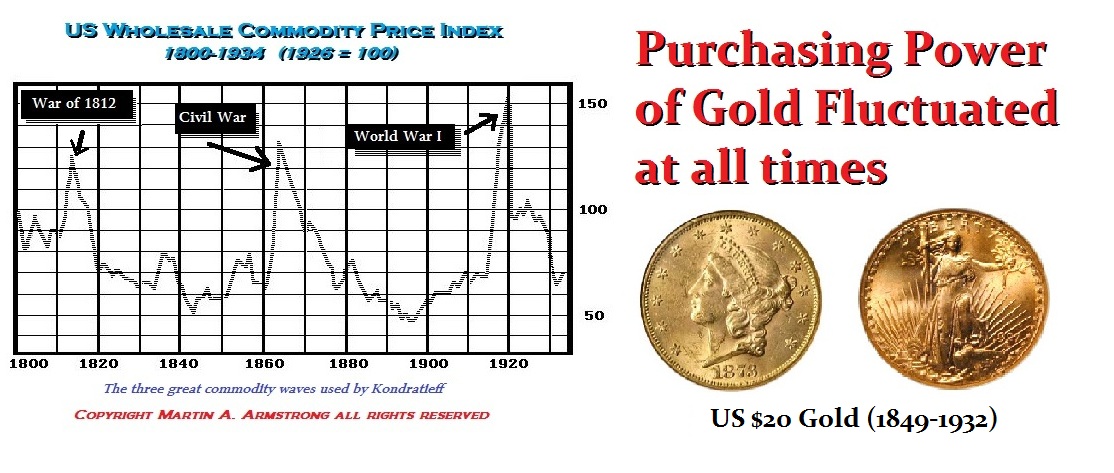
When gold was used for money during the 19th century, it fell sharply in value with each new discovery from California, Australia, and Alaska. Inflation rose because of a dramatic increase in the money supply, which is exactly what took place in Europe when Spain brought back ship after ship of gold from the New World. The sudden dramatic rise in the supply of money unleashed inflation, and during both periods, money (gold) failed to provide a store of value.

Steady, slow growth in the supply of money does not lead to inflationary waves. We find that major waves of inflation are often tied to waves of speculation, which differ with each wave moving from real estate, commodities, stocks, or bonds, constantly rotating over decades within a domestic economy and then this movement of capital takes place internationally.

Inflation is not a single one-dimensional aspect. It moves up and down between the rise and fall in the demand for private assets vs. hoarding and uncertainty.

The Next Supply Chain Crisis?


Posted originally on Jan 8, 2024 By Martin Armstrong 

yemen houthi 770x385@2x

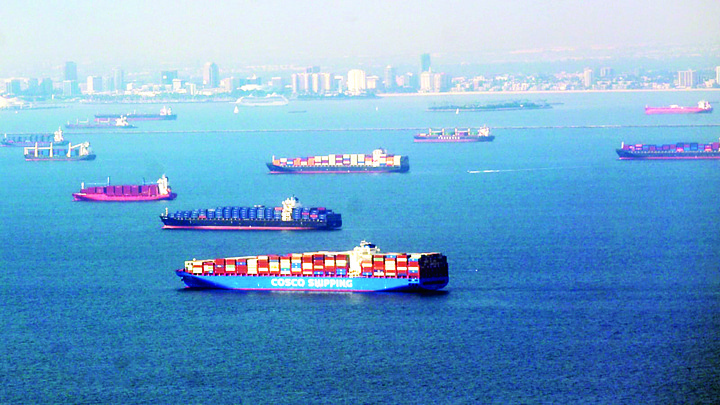
The kids Obama attempted to bomb in Yemen all those years ago grew up fast. They’ve now formed surprisingly efficient militias who hate the West and have become powerful enough to impact global trade. Yemeni Houthi rebels are blocking carriers from passing through the Suez Canal and have created near pandemic-level disruptions to the supply chain.

The militia is currently in route to the Suez Canal via the Red Sea. There has been a 25% drop in commercial traffic through the Suez Canal since November. They were initially targeted shipping liners linked to Israel, but began targeting everyone by December. International shipping liners are doing everything to avoid passing through the Gulf of Aden and South Africa. This has completely altered trade between Europe and Asia as the trip is significantly longer.

cargoshipsportofloasangeles

Longer trips equate to higher shipping costs. The cost to move a 40-foot container from Asia to Northern Europe now costs $4,000 – a 173% increase. The route from Asia to the US have risen by about 55% since December at around $3,900. The Shanghai Containerized Freight Index (SCFI), a different calculation for the cost of goods shipped from China, believes costs have skyrocketed 161% since December 15, 2023.

So far, 18 companies have rerouted their orders to avoid the conflict. Shipping rates are now DOUBLE 2019 pre-pandemic levels. The IMF believes 3.1% of ALL world trade is fleeing the Red Sea.

The price of goods will rise, and that will be passed onto consumers; inflation will rise. Governments will be forced to step in to prevent the Houthis from further disrupting world trade. Lives will be lost. And now the West has a valid reason to begin the Israeli canal that they’ve been envisioning for years. This is only the beginning of what will be a violently expensive situation that will send ripple effects throughout the global economy.

Powell Understands the Inflation was Created by COVID


Armstrong Economics Blog/Inflation Re-Posted Jul 26, 2023 by Martin Armstrong

The True Story of Hyperinflation


Amstrong Economics Blog/Cryptocurrency Re-Posted Jun 12, 2023 by Martin Armstrong

QUESTION: Dear Mr. Armstrong,
could you please explain what happens in technical terms from a capital flow perspective, when confidence is lost and hyperinflation starts to begin?
For example Turkey. When Erdogan was elected i think you wrote that ever since the lira started dropping. So confidence in politics is key. Do you think one day we will see hyperinflation in Turkey?
And another example, is Yugoslavia: what caused the hyperinflation (in technical terms/capital flow perspective)? Are foreign investors getting rid of the dinars? Too many dinars than suddenly rushed back into Yugoslavia causing hyperinflation?
Regards,
Magdalena Š.

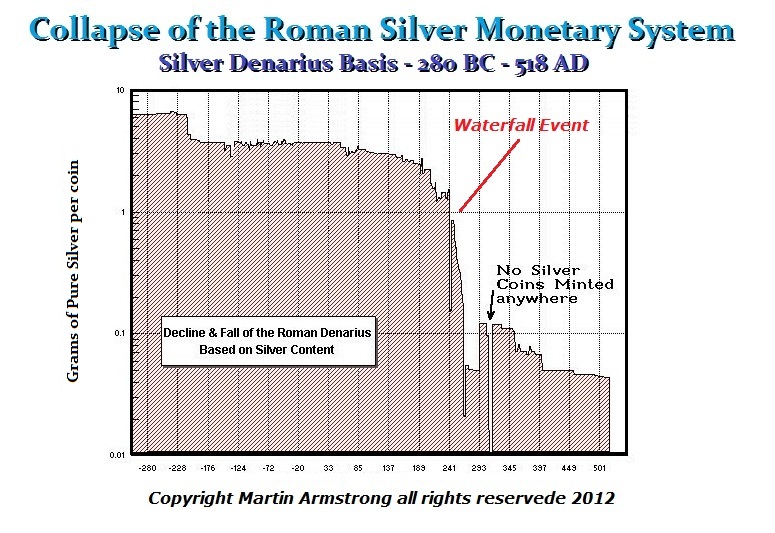
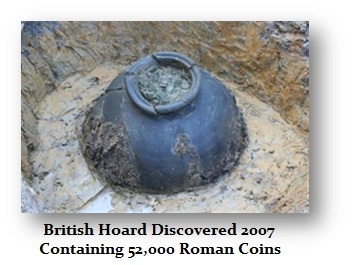
ANSWER: The misnomer about hyperinflation is that it is caused by printing money. It is a RESPONSE to the collapse in the confidence of the government.  If we look at the 3rd century, this is where we find the greatest number of hoards of ancient coins. What began this was the capture of Valerian I by the Persians in 260AD.

Valerian was the first Roman Emperor to be captured and Rome was unable to recuse him. That shook the confidence of the Roman people, but it also was a signal to the barbarian tribes in the North that if the Persians could do it, they could as well. Within 10 years, Emperor Aurelian constructed the great wall around Rome. Never before did Romans have such a defensive wall. That had a powerful army.

There was a trend toward debasing the silver coinage which began with Nero to try to fund the rebuilding of Rome after the Great Fire. But that did not undermine the confidence in the Roman Monetary System any more than our perpetual deficit spending since World War II.

However, a spark is ignited and suddenly that trend turns into what I have called a Waterfall event in the purchasing power of the currency. Such an event has taken various forms. However, the end result is the collapse in the confidence of the government and as a result, that is when you get that waterfall event.

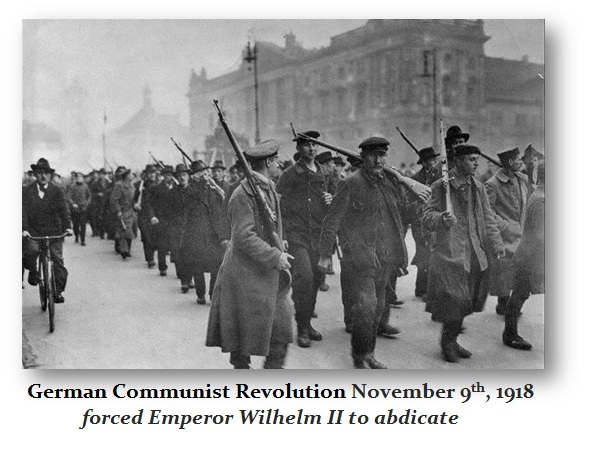
In the case of Germany, Yugoslavia, Hungary, etc, there was a 1918 Revolution where communists seized power and the emperor of Germany lost power. In that case, they actually asked Russia to take Germany after their revolution in 1917. This was the beginning of the Weimar Republic.

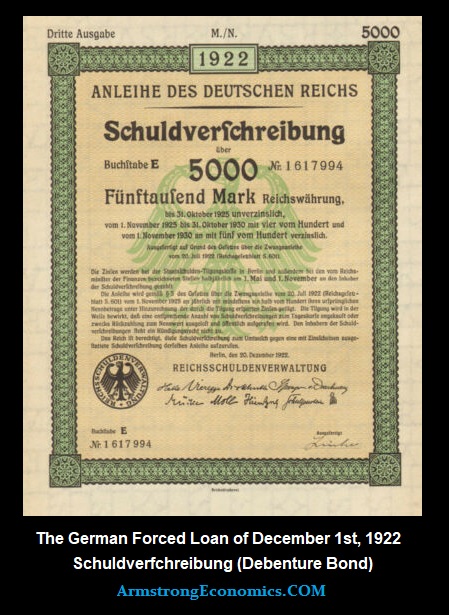
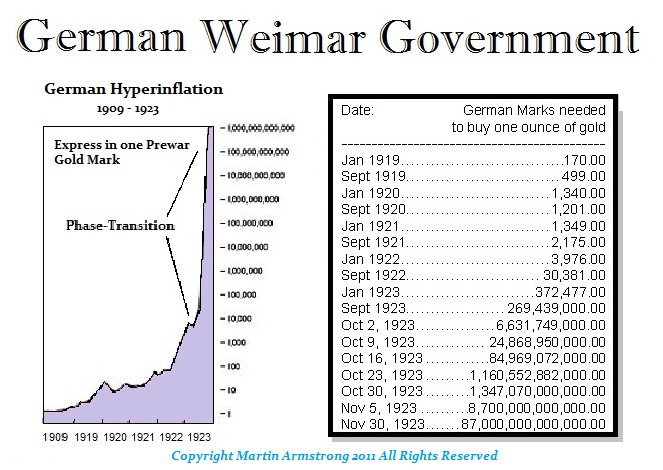
Germany was saddled with reparation payments demanded by France. First, you had a communist revolution and people with capital began to flee to other places in Europe or certainly move their money out of German banks. It was this drain of wealth that forced the Weimar Republic to print money to try to make their reparation payments. Then in December 1922, they seized 10% of everyone’s assets and handed them a bond.

Here you can see that after that December 1922 confiscation, hyperinflation simply took over. It was NOT the printing of money that caused the hyperinflation it was the collapse of confidence FIRST which then compels the government to expand the money supply lacking taxation revenues etc.

I suspect the spark this time may be the Digital Currency and the proposed cancellation of paper currency. This is why people are moving to anything tangible from real estate, gold, silver, ancient coins, and even equities. With DIGITAL CURRENCY they will have capital controls and prevent you from even moving money outside of your country.

The precise day of the ECM was the announcement of the IMF Digital Currency which they intend to replace the US dollar as the reserve currency. This may be timed with the turning point in 2024. It is unlikely that they would cancel paper currencies before the 2024 election. This is all being

Ground Reports – What is Your Experience With Prices of “Processed Goods” at Stores?


Posted originally on the CTH on May 13, 2023 | Sundance 

Recently I went to the supermarket to pick up some general provisions.  Given the nature of previously predicted food price increases, and proactive measures to mitigate the predictable prices, I haven’t needed to purchase basic foodstuffs in a while.   Yikes!  The prices… Wow.

Since we originally warned in ’21 about the waves of food price inflation that were coming, the prices have more than tripled on many food commodities.  That part is not as surprising in current review; however, the prices of processed foodstuffs is, well, quite frankly astounding.

I am left to wonder how working-class people are able to afford the jaw dropping price increases in highly processed food products like condiments (mayo, ketchup, mustard, etc), and even coffee and milk.  I knew the processing costs would drive those prices, but the scale is just astounding.

Beyond the foodstuff, what was truly stunning was the current price of non-food items at the store.  Items like chemical cleaners, soaps, aluminum foil, trash bags, Styrofoam products, ziploc bags, paper goods, etc.   I mean seriously, $8 for a box of trash bags, good grief.

After a review of the non-food item prices, I went back to the recent BLS report [DATA HERE] to look at the producer price index to see if the data reflected the scale of the processing cost that I was reviewing across a broad spectrum of goods.

Are consumers getting gouged by manufacturers who are taking advantage of the price shock inside the ongoing inflation?

Or are the processing costs, mostly driven by energy price increases, really that big a factor in the end product as it is generated?

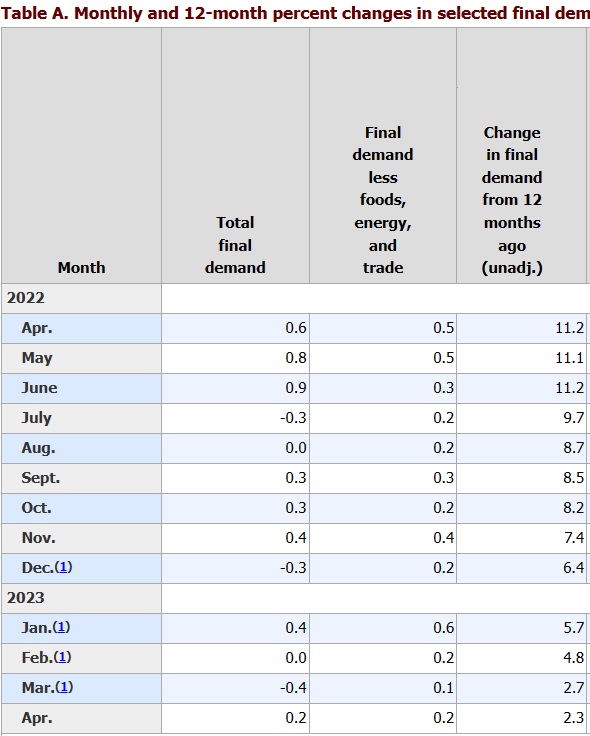
In the topline final demand Producer Price Index [Table A above] you can see how we are cycling through the second wave of inflation that hit in the spring of 2022.  The rate of price increase is lower, but the prices are still rising.  That means the prior massive price increase is now baked into the product, and the current price will never decline. Instead, it will just increase at a slower rate than before.

However, that’s not the full story… and that is not the data I was most curious about.

The intermediate product costs are really where the story is found.

Table B [DATA HERE] Tells us a remarkable story.

Raw materials (unprocessed goods) are essentially in a deflationary status [-19.2% in April].  Meaning demand for the raw material has dropped well below the available supply.  However, look at how much of the deflationary price is consumed in the processing of the raw materials.

A full 16% is consumed by processing cost increases [energy, physical plant, transit, production costs etc]. That is remarkable.

A random example might be citric acid.  The price of the citrus base drops 19.2%, but the processing of the base into the intermediate good phase chews up 16% of the drop in raw material price and exits processing only 3.2% lower in price than a year prior.

Another example might be found in plastics.  The petroleum base, and/or a combination of each material additive, might be 19.2% lower than prior year, but processing negates the lower raw material price, and exits into intermediate essentially even -.04, and then toward the ending +2.3% final demand change in the rate of price increase.

The PPI data is essentially showing the flow of costs of production as reflected in the impact during processing.  We can assume mostly increases in energy, transport and distribution costs to bring the raw material forward to final good status.

Key takeaway, the demand side of the raw material is diminished.  There is less raw material demand.  However, processing costs are continuing to drive the final production price of goods that head into the hands of wholesalers who then bring the product to market.

The outcome of this are the prices of processed goods as noted in the products on the shelves.

QUESTION: Are you noticing rather remarkable price increases in non-food goods during your store visits?

Interview: The Real Rate of Inflation


Armstrong Economics Blog/Armstrong in the Media Re-Posted May 13, 2023 by Martin Armstrong

Tucker Carlson Outlines the Ramification of Trillions in U.S. Treasury Bonds No Longer Needed as Global Securities


Posted originally on the CTH on April 5, 2023 Sundance

For his opening monologue and first interview tonight, Fox News host Tucker Carlson outlined the ramification of non-western nations now trading in alternative currencies to the U.S. dollar.   {Direct Rumble Link Here]  As the dollar diminishes in value, and as an outcome of Biden using U.S. treasury bonds as part of the sanction regime against Russia, various non-western nations now perceive holding dollars as exposing themselves to risk.

Carlson is joined by Luke Gromen who accurately notes the dollar as a global trade currency may continue, but foreign nations holding U.S. treasury bonds as an asset will likely start contracting.  The result of U.S. treasury bonds returning after maturity with no repurchase, would be an inability of the U.S. to borrow against their sale. This could, perhaps likely will, severely diminish the amount of money the U.S. congress can spend.  WATCH:

None of this should come as a surprise to those who have paid attention. Factually, in March of last year, one month after the Russian sanctions were announced, the International Monetary Fund’s (IMF) Deputy Managing Director said the sanctions against Russia are likely to undermine the US dollar’s global dominance as a trade currency.  Everyone could see this coming.

(Inside Paper) – March 2022 – […] “The dollar would remain the major global currency even in that landscape, but fragmentation at a smaller level is certainly quite possible,” Gopinath said in an interview with the Financial Times.  She went on to say that some countries have already begun to renegotiate the currency in which they are paid for trade.

According to Gopinath, the drastic restrictions imposed by Western countries in response to Russia’s military operation in Ukraine may result in the formation of small currency blocs based on trade between individual groups of countries.  Furthermore, the use of currencies other than the dollar or the euro in global trade would result in a further diversification of central banks’ reserve assets. (read more)

The efforts of NATO and the western alliance to crush the Russian currency have failed.  The Russian ruble currency has jumped back from the sanctions and is now even stronger than before the sanctions were put into place.

With China and India supporting ongoing trade with Russia, and with Saudi Arabia responding coldly to the U.S. working on a deal with Iran for nuclear weapons, the geopolitical strategy of NATO, G7 and the proverbial western alliance increasingly looks like it will backfire.

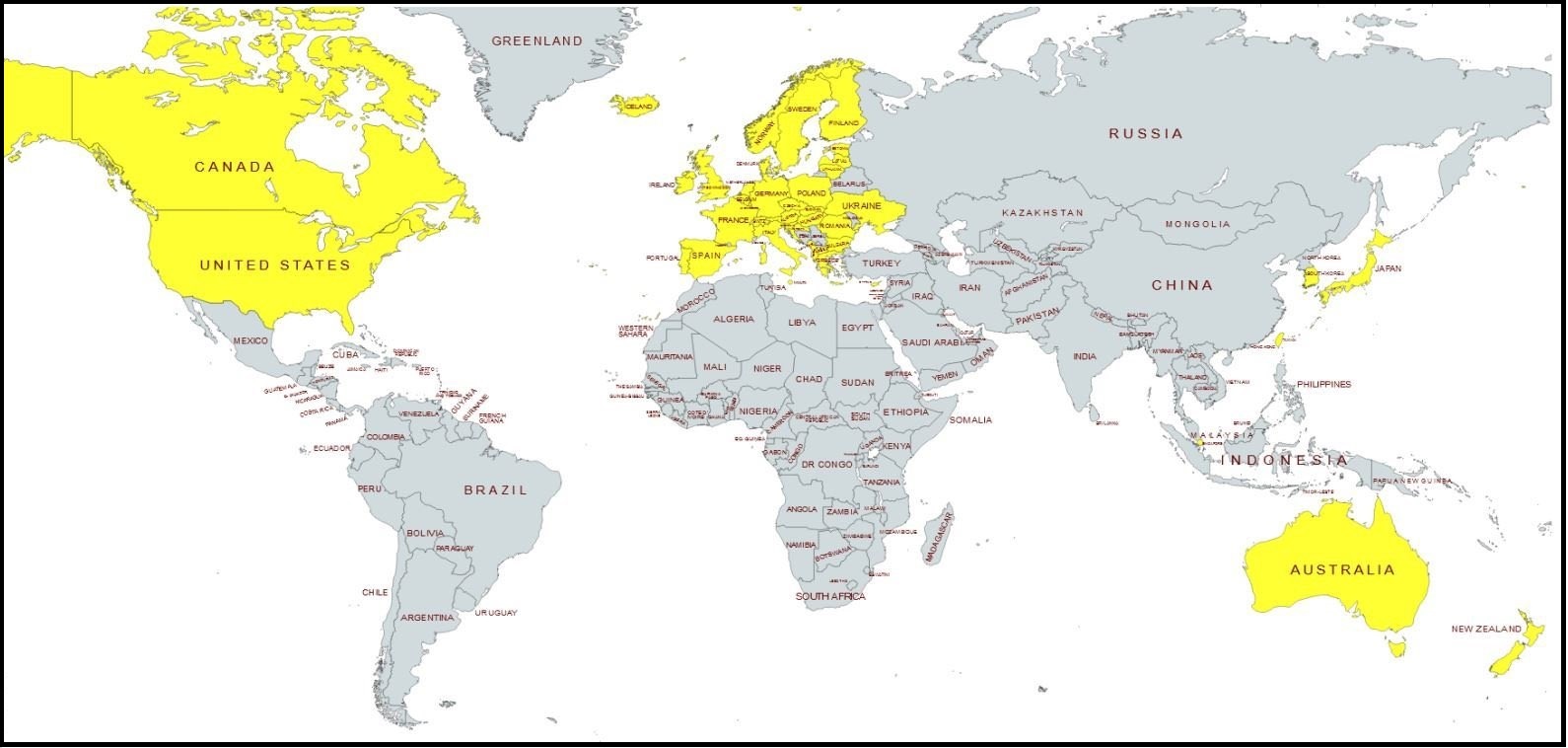
Yellow Team -vs- Gray Team: Remember, China just brokered a deal to lessen hostilities between Iran and Saudi Arabia. The fulcrum of that agreement was economics.

Meanwhile in North America, Mexican President Andres Manuel Lopez-Obrador has said he was not willing to join the energy suicide pact pushed by Joe Biden and Justin Trudeau…. A policy break in the trilateral relationship which suddenly, and not coincidentally, aligns with the timing to make Mexico a pariah to the U.S. vis-a-vis a renewed media push on the drug cartel narrative.

BIG PICTURE NOT BEING DISCUSSED – The western politicians followed the climate change instructions of the WEF multinational corporations and banks (Build Back Better) and post-pandemic immediately started reducing energy development. The central bankers then began raising interest rates to shrink the economies of the same western nations to the scale of the now diminished energy production.

The raising of interest rates is now hitting the national and multinational banks impacted by government policy that was following WEF orders. Now the western politicians are stepping in with the government controlled central banks to backstop the national banks and multinationals. Can you see the dynamic?

Team yellow is suffering the consequences of their own ideological policy as enacted. Team grey is not going to help team yellow get out of a crisis team yellow created, which was intended to hurt team grey.

…. And we continue watching.

FIAT – What is it Really!


Armstrong Economics Blog/Foreign Exchange Re-Posted Apr 2, 2023 by Martin Armstrong

QUESTION: Governments create their own sovereign fiat currency, to facilitate trade, among other reasons. So counterfeit is punishable, in some countries, by death, & at minimum, incarceration. Currency is supposed to be sacrosanct, created under the most exacting conditions. So what to do when your own gov’t engages in what is essentially officially endorsed counterfeit? I mean, the “money” has become almost meaningless, unless you’re on the receiving end. For non-insiders like me…buy PM.

HS

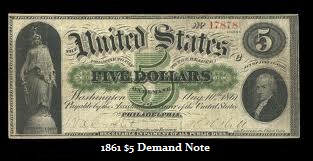
ANSWER: I have trouble with this misinformation always about the only money is gold and paper dollars are worthless fiats, which have rebuilt the world many times over since 1861 and the introduction of the paper dollar.

The propaganda of the goldbugs which has led so many to lose so much has been this nonsense that gold is the hedge against inflation. When the gold coin was money during the 19th century, it rose and fell in purchasing power no different than any paper currency. These people sell fiction like a used car salesman just to sell their product.  It honestly does not matter what money is. It always is just a derivative of barter. I give you this for that. You will accept paper money because you know that others will accept it from you. A woman tried to spend a $20 gold coin at Walmart and they refused to accept it because they did not know what it was. She then took them to the back and exchanged them for $20 bills.

Try going to Starbucks and spending a $20 gold coin and asking for change. Unless the salesperson knows what it is, they will refuse.MONEY has always been nothing more than a belief system. That’s all!

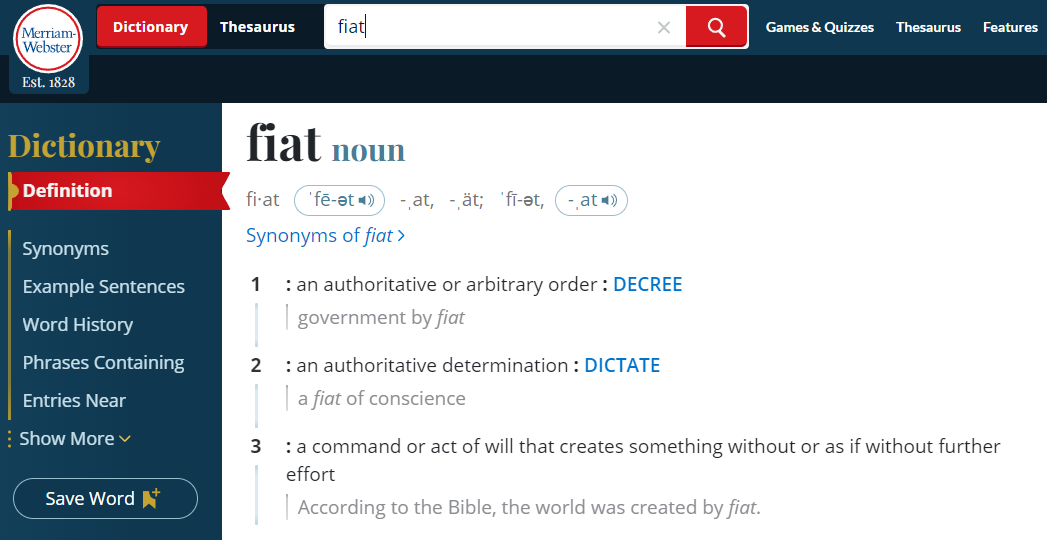
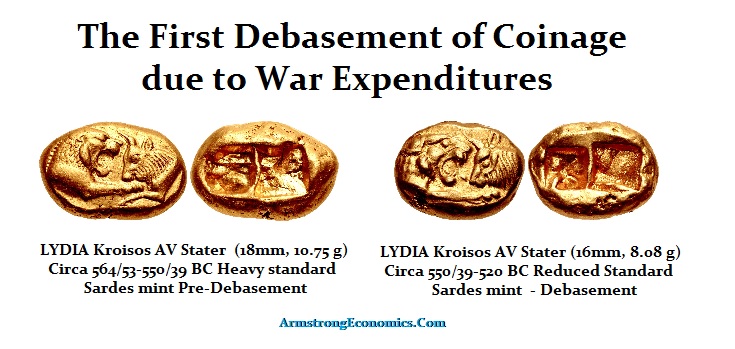
FIAT simply means by arbitrary decree. Just because a currency is gold or even silver, does NOT make its value intrinsic. Governments have debased their coinage and reduced the weight declaring its value shall be whatever they say. I have written about how Japan did that and eventually, the people refused to accept Japanese coins and they stopped minting them for 600 years.

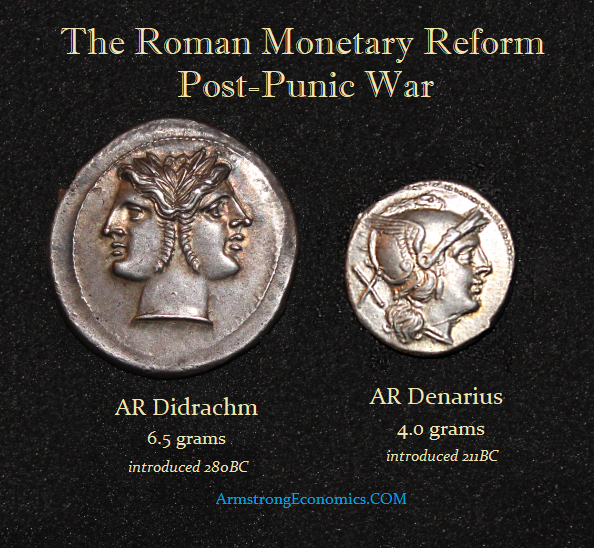
The Romans reduced the weight of their silver coinage from 6.5 grams to 4 grams and only because they defeated the Greeks, the Roman monetary system became standard.

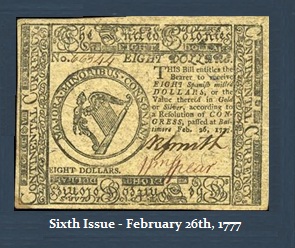
During the American Revolution, people accepted the Continental Currency. Money has always simply been predicated upon what people will accept.

Gold has no value whatsoever unless the other person also believes it has value. Gold or silver has no value intrinsically any more than a paper dollar or a bag of rice unless there is an unspoken agreement among people that it is a valuable medium of exchange.

This is the truth. All else is propaganda. Money has been many things throughout thousands of years from seashells to cattle and even slave girls.

StPatrick-tokens

Saint Patrick in the 5th Century AD upon his arrival in Ireland, found that MONEY was expressed in human slave girls. He wrote in his Confession, “I think that I have given away to them no less than the price of fifteen humans.” This passage shows something very important. First, MONEY is not defined as the Medium of Exchange exclusively. It also serves the purpose of a Unit of Account. This becomes the true function of MONEY even more so than what it is. MONEY is a language of value.

FIAT is when the government dictates what something is and that will be Digital Central Bank Currency. But if everyone accepts it, then it becomes the medium of exchange.