
Tag Archives: Keynesian Economics

SNL Does Theresa May
Armstrong Economics Blog/BRITAIN
Re-Posted Apr 13, 2019 by Martin Armstrong
Germany to Decide if It Can Nationalize Private Property
Armstrong Economics Blog/Germany
Re-Posted Apr 12, 2019 by Martin Armstrong

There has been a real crisis evolving in Berlin. When the Wall came crashing down, East Germany regarded that it owned all the property and thus sold vast tracts of apartments to major investors. Now 20 years later, the socialists are claiming this is not fair and the government should either buy the property back from these investors or confiscate it. There are many people on the left and in the Green Party who see nothing wrong with confiscating private property. Why should they pay for something they cannot afford to buy? Under their reasoning, there is some human right that should allow them to go into a car dealership and drive away with what they want because it is unfair that they cannot afford to buy it.
 Berlin has been toying with the idea of holding a referendum on banning big landlords and expropriating their homes into social housing. This is part of a response to growing complaints in the German capital about the cost of living. The expropriated homes will be some 200,000 units that would then become government property, once again, and could be rented out for below market rates.
The danger of allowing private property to be seized without compensation is that it will be devastating for Germany and Europe as a whole. Real property is critical to confidence. If the state can even allow a referendum where the majority of people will be handed the property of the minority, this is really a return to the days of the Nazis. They could not borrow funds on the open market so they targeted the Jews and expropriated all their property. Of course, in those days they killed them. Today, they won’t kill the investors. They will just take all their wealth. It seems that allowing referendums to retroactively change the law is very dangerous. If anyone wants to know why the euro could collapse to new historical lows, put this one into your thinking cap and ask if you want to invest in something that can be arbitrarily confiscated.
The Treaty of Rome & 2020
Armstrong Economics Blog/European Union
Re-Posted Apr 12, 2019 by Martin Armstrong
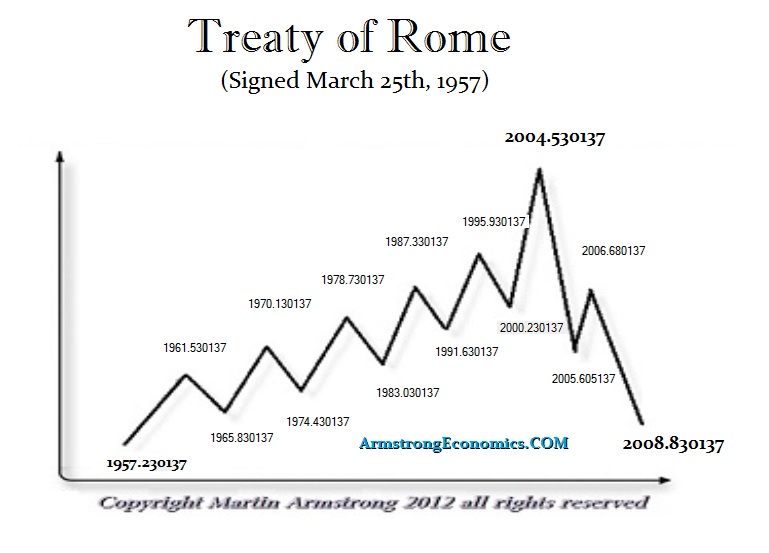
QUESTION: I believe back at your 1985 WEC, if I remember correctly, besides the 2016 target for the first opportunity for a third party type president, you also gave the date 2021 for the potential breakup of the Treaty of Rome. Could you refresh my memory on that one?
See you in Rome
Thanks as always
WN
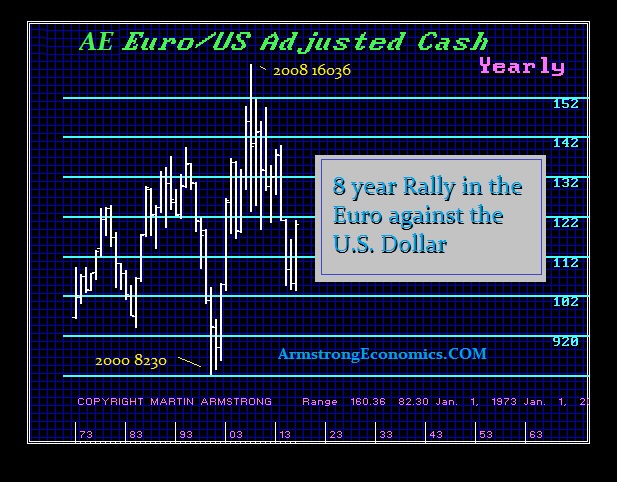
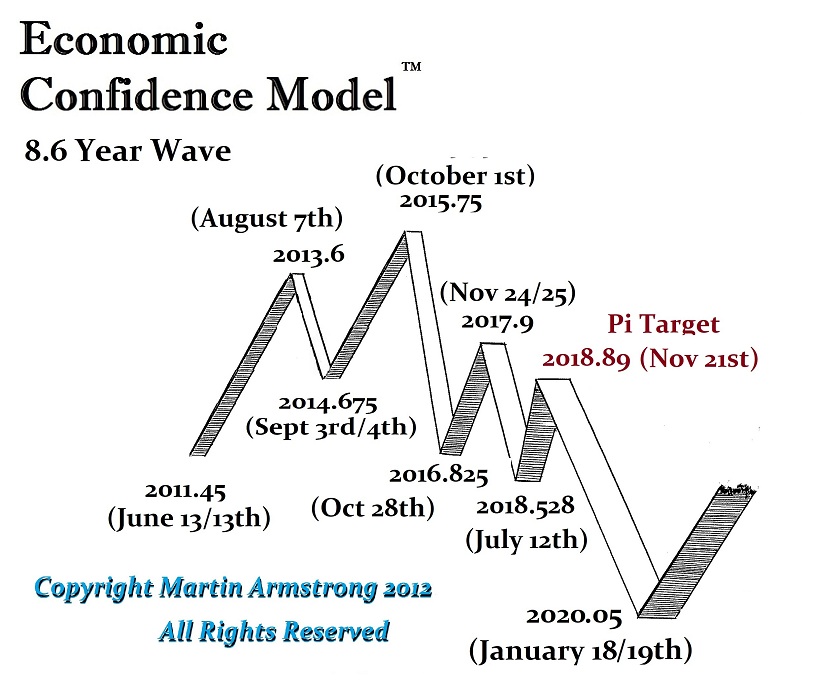 ANSWER: There were two dates for Europe. Economically, the first date was 2008. That was the end of a 51.6-year cycle from the signing of the Treaty of Rome. The second date is 2020.03, which is two Pi cycles of 31.4 years. Now 2020.03 lines up with the end of this particular Economic Confidence Wave that turns 2020.05.
 This is why Rome is going to be an interesting WEC, to say the least. We are preparing an authoritative work entitled “The Fate of Europe.”
We are reaching an extremely important change in trend. You can see the pressure and all that is at stake for the EU itself has set up a site it pretends to be a Fact Checker. This is indicative of the rising tensions.
Then we have total insanity with BREXIT where Prime Minister Theresa May is really working for the EU against her own country. The postponement of BREXIT until October 21st is on the table. May hopes that it will come down to accepting whatever terms the EU demands. She hopes Britain will surrender all sovereignty to Brussels or accept a hard exit, which she thinks everyone would reject. She believes the choice will be a hard exit. She is pitching it as the end of the world or remain and overrule the people and democracy.
In all the years I have worked around the world with various governments and political figures, I have never seen the entire world in such total chaos.
Historically, there was always some bright spot where the sun still shined. Today, it just seems to be gray and overcast everywhere we look. We seem to be on track to fulfill our manifest destiny whichever direction that will be — toward liberty or totalitarianism. There seems to be little other option. It will take us all to push for liberty when the time comes.
Categories: European Union
Roman Coins Wash up on Beach in Florida
Armstrong Economics Blog/Ancient History
Re-Posted Apr 11, 2019 by Martin Armstrong
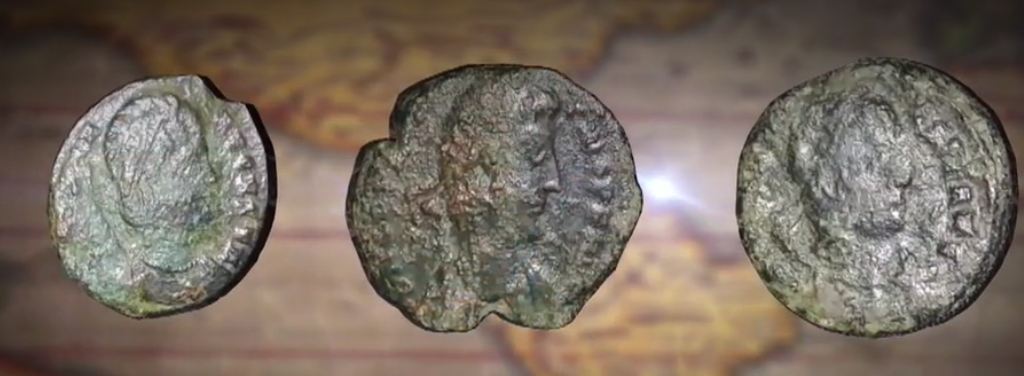
 There have been discoveries of Roman coins in Japan as well as in North America. There has even been the discovery of a Roman sword in Newfoundland. Now, a treasure hunter with a metal detector uncovered seven Roman coins that washed up on a beach here in the Tampa region. This is strong evidence that there must have been a Roman shipwreck off the coast of Tampa or in nearby proximity.
These coins are of the 4th century from the era of Constantine. They are bronze and of no particular rarity. In such a condition, they are really worthless. Nevertheless, there certainly seems to have been Roman ships that crossed the Atlantic long before even the Vikings, no less Columbus.
There are accounts that the Roman Emperor Marcus Aurelius sent diplomats to China around 180 AD. There are no written records from Rome, but there are written records from China confirming that meeting and even a recording of the name of the Roman emperor.
There are no documents that confirm Romans traveling across the Atlantic, yet there is evidence that they were indeed here in North America. This raises the possibility that these were one-way trips, perhaps from a ship caught in a storm and set on its path to America.
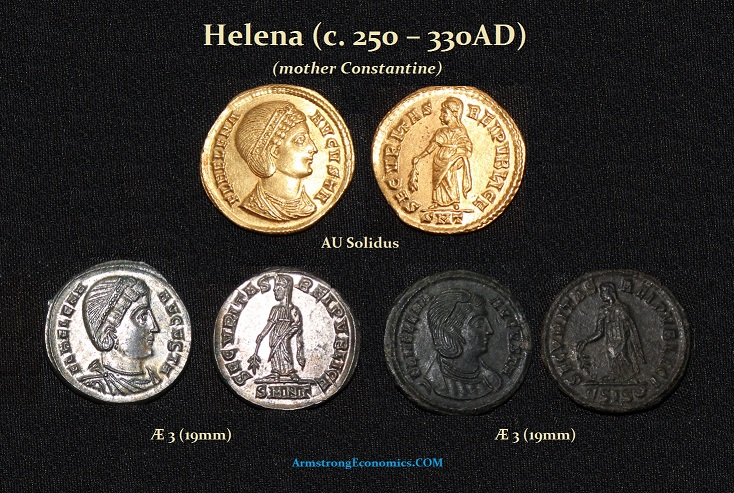
The left coin in this photograph is clearly one of Saint Helena who was the mother of Constantine I the Great. She was a devout Christian who set out to discover the major places in the Holy Land. She built the church in Jerusalem over Calvary and near the tomb of Jesus Christ
Hard Landing
Armstrong Economics Blog/Economics
Re-Posted Apr 10, 2019 by Martin Armstrong

QUESTION: Dear Mr. Armstrong,
I have a question that might interest not just me but also other blog Readers:
In your blog Posts you write that you expect that we will have a hard landing going into 2020.
My question is: What does that mean for the Dow? Do you expect the dow to correct into 2020 more that 20%.
Thank you for your work and best Regards,
A
ANSWER: The hard landing is economic and will have its greatest impact outside the USA. While central banks have sold US Treasuries in an attempt to keep the dollar down, the private sector has been pouring assets into the USA and particularly the Dow. Our capital flows have tracked a significant shift in global capital flows into the USA especially from Europe. That should come as no surprise given the chaos in BREXIT as well as the May elections.
We still do not see a major correction in the Dow. We have been undergoing a shift from public to private assets on a global scale. Therefore, the hard landing will be more economically based and central banks will try to do something, as in lowering rates, but they have run out of bullets. The Fed has tried to back off on rates after buying into the problem of a hard landing outside the USA. The ECB has been on its hands and knees, pleading with the Fed not to raise rates when they will have to continue their QE programs or face sovereign debt defaults.
Preferred v Ordinary Shares
Armstrong Economics Blog/Q&A
Re-Posted Apr 10, 2019 by Martin Armstrong

QUESTION: Hi Martin,
What are your thoughts on preferred shares? Especially the ones with good quality DBRS ratings. Will they survive the downturn or will they fail?
Thx
FS
ANSWER: Ordinary and preference shares are a claim on corporate earnings and assets. Dividends for ordinary shares may be irregular and indefinite, whereas preference shareholders will receive a fixed dividend which will accrue usually if the payments are not made in one term. Ordinary shareholders are in a riskier position than preference shareholders since they are the last to receive their share in the event of liquidation. That may not be a concern in a blue chip company. Nevertheless, they also are open to the possibility of a higher dividend during times when the firm is doing well in contrast to preferred shared with fixed income.
Preferred shares can be looked upon as a hybrid debt where you have a claim on the assets, but like a loan, it has a fixed rate. Ownership of preference shares offers advantages and disadvantages. On one hand, it provides a higher claim on earnings, assets, and fixed dividends. On the other, it limits voting rights and the possibility for growth in dividends in times when the company is financially sound.
The good companies will generally survive. This is a collapse in government – not the private sector
The New Brexit Party in Britain May Be Underestimated
Armstrong Economics Blog/BRITAIN
Re-Posted Apr 9, 2019 by Martin Armstrong

Nigel Farage led the Ukip party to victory in the last EU elections in 2014. They won 24 MEPs and brough BREXIT to the forefront, however, Nigel split from Ukip when it turned a hard right. Seven MPs have followed Nigel and switched to the newly-formed Brexit Party after PM Theresa May refused to listen and turned to the Labour Party to try to keep her deal on the table. This new party was just formed in April and it is seeking to simply exit the EU as the people previously voted.
The Brexit Party is a Eurosceptic, pro-Brexit, political party in the UK. As of April 2019, the party’s representation consists of nine members of the European Parliament, all of whom were originally elected as UK Independence Party (UKIP) candidates. Nigel Farage has announced he would stand as a candidate for the party in any future European Parliament elections in the event the UK has not already left the European Union. The last straw was simply when Prime Minister Theresa May asked Labour leader Jeremy Corbyn for Brexit talks in a bid to reach a compromise on her deal to trump her own party.
The French President Emmanuel Macron is looking to humiliate Britain by demanding that any extension result in Britain forfeiting all rights to vote in the EU. He has also come out and declared that BREXIT could damage Anglo-French relations for years if he forces Britain out of the European Union against the wishes of Parliament.
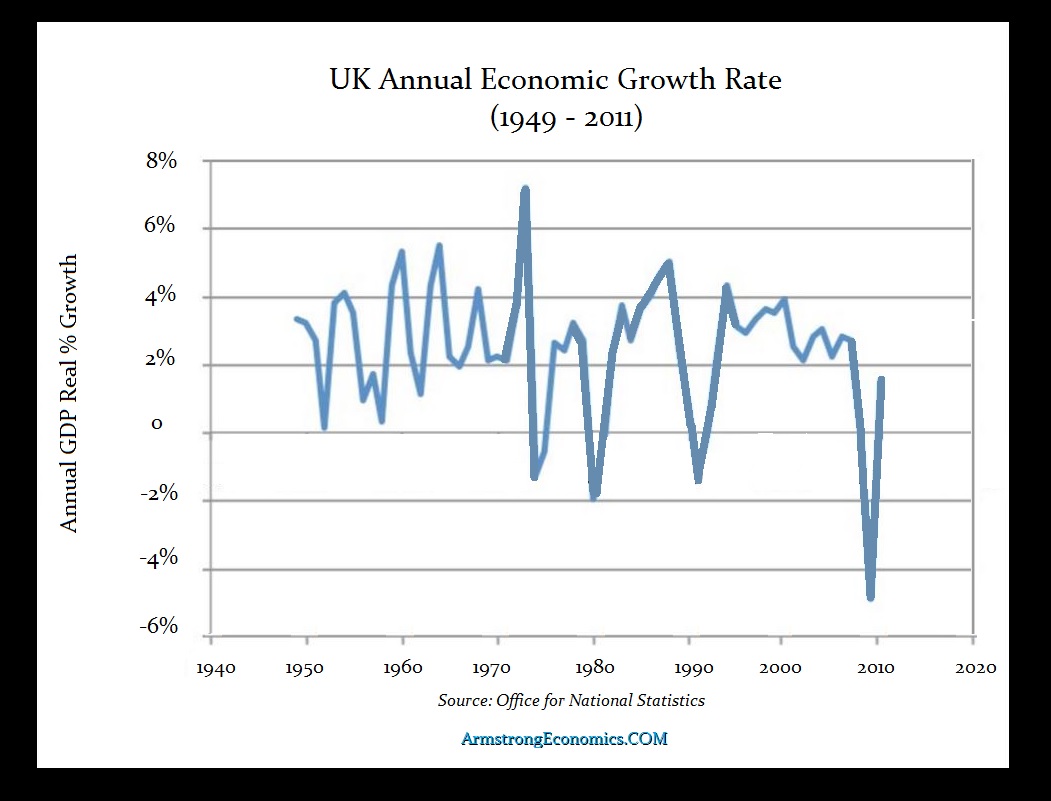
The political chaos in Europe is just off the charts as we head into May. This is seriously altering the capital flows by sending capital fleeing the EU by the billions. We have shown this chart before. This was compiled using the British government’s own statistics. Britain entered a protracted economic decline after it joined the EU. It makes no economic sense to remain.
Fear of Inflation & Sterilization
Armstrong Economics Blog/Economics
Re-Posted Apr 9, 2019 by Martin Armstrong

QUESTION: Mr. Armstrong; you were friends with Milton Friedman. Do you agree with his view that the Great Depression was caused in part by the Fed refusing to expand the money supply? Isn’t Quantitative Easing expanding the money supply yet it too has failed to create inflation. Would you comment on this paradox?
Thank you for your thoughtful insight.
P
ANSWER: Yes, this certainly appears to be a paradox. This results from the outdated theory of economics which completely fails to grasp the full scope of the economy and how it functions. This same mistake is leading many down the path of MMT (Modern Monetary Theory) which assumes we can just print without end and Quantitative Easing proves there will be no inflation. They are ignoring the clash between fiscal policy carried out by the government and monetary policy in the hand of the central banks. This is a major confrontation where central banks have expanded the money supply to “stimulate” inflation. Governments are obsessed with enforcing laws against tax evasion and it is destroying the world economy and creating massive deflation.
In 1920, Britain legislated a return to the gold standard at the prewar parity to take effect at the end of a five-year period. That took place in 1925. Britain based its decision in part on the assumption that gold flows to the United States would raise price levels in Britain and limit the domestic deflation needed to reestablish the pre-war parity. In fact, the United States sterilized gold inflows to prevent a rise in domestic prices. In the 1920s, the Federal Reserve held almost twice the amount of gold required to back its note issue. Britain then had to deflate to return to gold at the pre-war parity. Milton saw that the Fed failed to monetize the gold inflows, fearing it would lead to inflation. So what we had back then was the opposite roles. This predates income tax being applied to everyone so there was no hunt for taxes on the part of the government. The scale was tipped because the Fed was imposing deflation by sterilizing the gold inflows.
Conversely, following World War I, France had counted unrealistically on German reparations to balance its budget. When they did not materialize, it used inflation as a tax to finance expenditures. In 1926, France pulled back from the brink of hyperinflation. Unlike Britain, France’s inflation had put the old parity hopelessly out of reach. Consequently, France returned to gold but at a parity which undervalued the franc. Fearing inflation, France sterilized its gold inflows to prevent a rise in prices declining to monetize the gold.
Therefore, all the theories behind MMT are once again wrong for they are only looking at one side of the equation. Today, simply stashing money in a safe deposit box is illegal and considered to be money laundering. The government can justify itself in confiscating your assets even after you paid your taxes.
Therefore, in the ’30s, Milton’s criticism of the Fed was justified because there was no massive hunt for taxes from the fiscal side. Today, we have the fiscal policies hunting capital resulting in a contraction economically (declining in investment) while you have QE just funding the government – not the private sector. It is a different set of circumstances today v 1930s.
Austria Moves to Tax Online Companies
Armstrong Economics Blog/The Hunt for Taxes
Re-Posted Apr 8, 2019 by Martin Armstrong

The EU has been unable to agree on taxing the internet. As a result, Austria went ahead and passed its own digital tax this week on revenues earned by online companies in their country. The entire problem with this type of taxation is the burden of accounting. This means that the online world will be forced to file taxes in every country with a matrix of tax rates and specifications. Small business will be the ones impacted the most and they will more likely just ban their products for sale in various countries.
Governments are going broke. They will never stop to look at the ramifications their actions have caused within the global economy.
Categories: The Hunt for Taxe

