Difference Between Hyperinflation and Currency Inflation


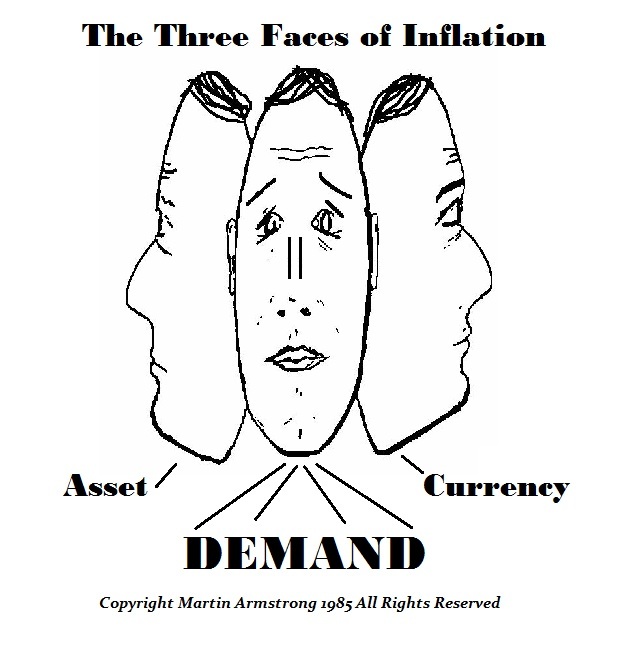
QUESTION: What is the difference between asset inflation and hyperinflation? I believe you are saying that from Jan 2020 we will see inflation which I understand to be asset inflation?
Thanks
FL

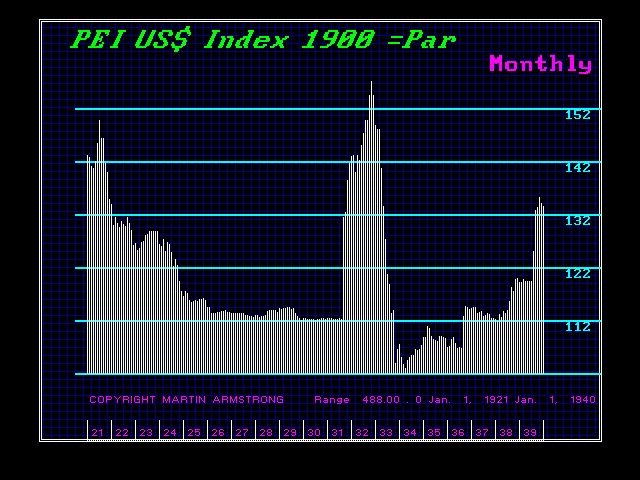
ANSWER: Asset inflation is typically a reflection of a decline in the value of the currency, but this can be 50% over the course of one to two years. Hyperinflation typically occurs when confidence in the government itself completely collapses. This is usually in a peripheral economy or often in times of war or major domestic revolution, as was the case with the Continental Currency in the United States and the Assignats of the Revolutionary government in France. Asset inflation can be also caused by an investment boom concentrated within a single sector such as the Dot.com Bubble. The typical definition of hyperinflation is when prices rise by more than 50% per month over a period of time.

Then there is DEMAND inflation, which is typically one of two aspects. It can come in the form of a hot item like Pet Rocks, Cabbage Patch Dolls, etc. The second aspect is a shortage of something such as wheat or corn and the demand forces the price to rise.

What Makes Currencies Rise & Fall in Value?


House-Testimony

QUESTION: What makes currencies rise & fall in value?

CC

ANSWER: Many people want to reduce this to a logical explanation. It reminds me of when I testified before Congress at the House Ways & Means Committee. They had to put me on a panel with academics. I told them to make me last. The Committee was asking about changes in taxes and the impact upon currency. The academics said there should be no impact. When they came to me, I dealt with the truth.


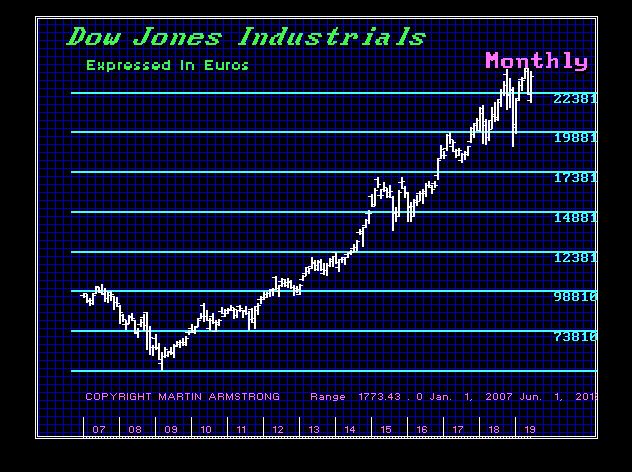
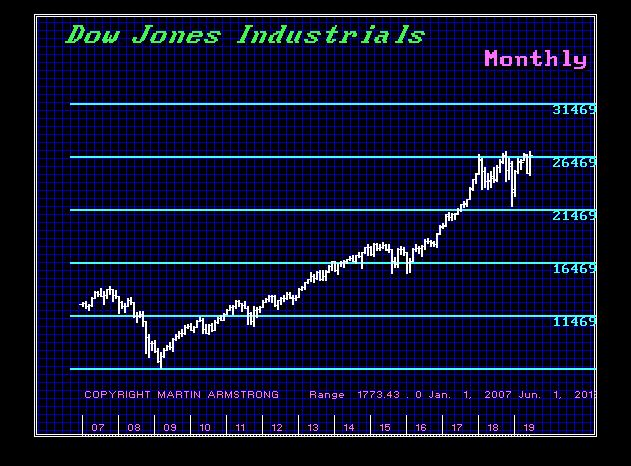
Currencies will rise and fall BECAUSE, first and foremost, this is the way international capital gets to vote on the CONFIDENCE in that political government. You see this in the spreads within the Eurozone such as buying Germany selling Italy or Greece for an example. The dollar has been rising of late BECAUSE the confidence in Europe has been collapsing. This becomes self-evident just plotting the Dow Jones Industrials in dollars v euro. If capital perceives a problem, it will flee from that region to another. The dollar rose during World War I and II, but it declined with the Korean War because the former was a reservoir of capital and the latter was not

Canadian Ethics Commission Concludes Justin Trudeau Violated Oath of Office, Broke Law, Used Position To Influence Attorney General…


The Canadian Office of Ethics completed their investigation of Canadian Prime Minister Justin Trudeau and whether he inappropriately used his office to influence and pressure the Canadian Attorney General to drop criminal charges against a political ally and donor, SNC-Lavalin.  [Backstory Here]

Section 9 of the Canadian Ethics Act prohibits “public office holders from using their position to seek to influence a decision of another person so as to further their own private interests or those of their relatives or friends, or to improperly further another person’s private interests.”

The investigation found:

“Prime Minister Trudeau used his position of authority over Ms. Wilson‑Raybould [AG] to seek to influence, both directly and indirectly, her decision on whether she should overrule the Director of Public Prosecutions’ decision not to invite SNC-Lavalin to enter into negotiations towards a remediation agreement.

Therefore, I find that Mr. Trudeau contravened section 9 of the Act.”

In response to the official finding of the Canadian Ethics Office, Justin Trudeau said he “accepted the findings”, but “disagreed with the decision.”

Additionally, Justin from Canada refused to apologize for interfering in the criminal case, breaking the law and violating the duty of his office, because his goal was to protect Canadian workers who might have been negatively impacted if the company was impacted or was barred from doing business.

In essence, a ridiculous virtue-signalling defense. WATCH:

.

Immediately the leftist Canadian media circled-the-wagons to protect the office of the Prime Minister.  The liberal media in Canada agree that all oaths of office are contingent upon only following laws, rules or governmental policies that advance liberalism.  Any liberal or left-leaning target that runs afoul of the laws of Canada can be excused if their intent is to assist the larger progressive cause.

All Canadian media agree, openly and publicly, that if a conservative prime minister was to engage in similar conduct, to the benefit of a company donating to conservative political candidates, that Prime Minister should be immediately removed from office.  It is the political ideology and intent of the office that determines the application of law.

Within the Canadian media response to the transparently illicit conduct of Prime Minister Trudeau, you discover why Canada has a closed media system, called a “cultural industry”.   By law, policy and regulation, including within trade agreements, the media business in Canada is protected by the government from competition.

The “cultural industry” laws are how the liberal Canadian government keeps control of narratives to ensure no political challenges to their ideology ever reach the electorate.  The closest comparison in media systems would be dictatorial state-run media in China, Iran, Turkey or similar ideologically controlled nations.

As a consequence, Prime Minister Justin Trudeau was just found by the U.S. equivalent of the Inspector General, to have violated the most fundamental principal of his office and the Canadian legal system; yet he will remain in office to advance the progressive agenda.

That’s Canada.

.

Wilbur Ross Discusses U.S. Economy, China Trade, Tariffs and Hong Kong….


Commerce Secretary Wilbur Ross appears (in studio) on CNBC to discuss the current state of the U.S. economy, the ongoing issues with communist China, the ‘next step’ trade tariffs and the situation in Hong Kong.

Stunning Day of Economic Gaslighting – Despite All Positive Data, Corporate Media Cheering For Recession…


A “negative yield curve“;  a pending “economic recession“.  These are the obtuse and ridiculous proclamations of the Mainstream Corporate Media today.  So let’s take a moment to discuss how stunningly -intentionally- disconnected they are.

Always remember, there are trillions of dollars at stake; and these media entities have a vested interest in maintaining the Wall Street position, adverse to Main Street USA.

First the “negative yield curve” aspect; where long-term bond rates (returns on investment) are lower than short-term rates (returns).  As Reuters proclaims:

“A key bond market metric turned negative for the first time since 2007 on Wednesday, sending stocks tumbling”…

I must admit, I actually started laughing out loud when I first read that proclamation. Allow me to introduce a radical concept in economics: “supply and demand” !

The long-term borrowing rate for return on investment dropped momentarily lower than the short-term borrowing rate of return on investment because massive numbers of foreign investors were rushing to buy long-term U.S. bonds.   Wait… what?  Yes, a ‘negative yield curve’ is what happens when everyone wants to buy bonds in your long-term economy.

There weren’t enough long-term bonds to fill the demand of those who wanted to purchase them.  Ergo, the return rate of interest dropped because there was no need to have an incentive to sell them…. everyone wants them.

So the yield drops, because the U.S. doesn’t need to incentivize the sale… because everyone is lined up to buy them.  See how that works?

Do lines of people wrapping all around the world trying to get to the U.S.A Bank and buy U.S. treasury bonds sound like the USA economy (underlying the bond) is weak or in trouble?

It’s OK to laugh out loud.

No, really, it’s ok.

Yes, Alice, it’s true.  The financial media would have you believe that customers lined-up around the building to purchase your products means your business is about to close because of a lack of customers.   THAT my friends is the stupidity of it.

The U.S.A economy is so strong, so healthy, and forecast to remain so with such intensity, that everyone wants to purchase dollars because it is the world’s highest predicted rate of return for investment….. And somehow the media can spin that into a bad thing.

No, really.  That’s the narrative of today.

Now let’s look at the second stupid “A looming recession“:

First, a “recession” is two consecutive quarters of negative GDP growth.  That’s how you define a recession.  So to start a recession you need need one quarter of negative GDP growth right?  Well, duh, it hasn’t happened, and there is not a single economist who is predicting a negative Third Quarter growth rate (July, Aug, Sept., ’19).

First Quarter GDP growth was 3.1%. [Beating all expectations] Second Quarter GDP growth was 2.1%. [Again, beating all expectations]… and somehow the Third Quarter is suddenly going to be negative growth?   It’s OK to laugh again.

So how does CNN et al  “warn of a looming recession” when there’s not a single economist forecasting a negative GDP for the third quarter?   Well, they make shit up that’s how.

Think about it…. if the economy was contracting, people would not be getting hired right?  Employers would be laying people off right?  Businesses would be selling off assets right?  Wages would be dropping right?

Do you see any of these things happening?

No?  Why not?

Because it ain’t happening, that’s what !!!

The U.S. economy is not shrinking.  Main Street is strong, and getting stronger.

Go back to point #1, would the world be rushing to buy dollars if the U.S. economy was on the precipice of collapse?  Think about it.

Now, that said, there are some economies that are shrinking; and they all have something in common.  The manufacturing export dependent nations are in trouble because President Trump is starting to limit their access to their most desired customers, the USA. And President Trump is telling companies that operate in those export nations that it would be in their best interests to come to the United States to make their goods.

Germany, the economic engine for the EU, is a manufacturing export dependent nation, and it is contracting.  China is a manufacturing export dependent nation and their manufacturing is contracting.  But the U.S. is strong, because we are not dependent on exports.  In fact the U.S. consumes more than 80 percent of what we produce; we are a self-sustaining economy.

Our U.S. economic strength is why Asian and European investors are rushing to buy dollars (US Bonds); and why the U.S. treasury doesn’t need to provide high yield rates as incentives to buy them (hence the negative yield curve).

Stop me when any of the U.S. economic data has even the slightest implication of a slowdown, or “looming recession”.

Our last jobs report showed 164,000 new jobs created in July (yeah, like two weeks ago).  In addition 363,000 people moved from part-time to full-time employment… does that sound like a weak economic outcome?  Current blue-collar wage growth is in excess of 3.4%, and current overall U.S. worker income is growing at a rate exceeding 5.4%.

Does any of that sound like what you see just before a “looming recession”?

(BEA Data Source – Link)

Every actual data result exceeds expectations.

Every measurable KPI in the U.S. economy beats every forecast.

Show me data that supports this “looming recession” claim.  Guess what; you can’t because it is a manufactured bucket of nonsense.  Abject stupidity created in the basement of media narrative engineers and pushed into the U.S. mainstream talking points in an effort to create something that doesn’t exist.   You know the word for that? “Gaslighting” !

Why?

Why are the financial pundits doing this?

Because the engine for the U.S. economy is the U.S. consumer.  The Wall St./Media pundit goal is to erode consumer confidence, instill fear, and hopefully get people to sit on those high wages…. thereby creating a self-fulfilling prophecy.

This my friends is the battle behind Wall Street -vs- Main Street.

There are trillions of dollars at stake.

[You Can Read More Here]

Wealth, Poverty, and Politics


Published on Dec 8, 2015

Recorded on September 18, 2015 Hoover Institution fellow Thomas Sowell discusses poverty around the world and in the United States. Poverty in America, he says, compared to the rest of the world, is not severe. Many poor people in poverty in the United States have one or two cars, central heating, and cell phones. The real problem for the poor is the destruction of the family, which Sowell argues dramatically increased once welfare policies were introduced in the 1960s.

Has the “Smart Money” Entered the US Share Market Yet?


QUESTION: Dear Armstrong,
According to Dow, a bull market has 3 phases, the final being the distribution by the smart money to the public.
You stated that retail is still not participating. Could this be why the market appears to be unable to stop going up? Because the smart money continually fail to entice the dumb to jump in?
Cheers
GF

ANSWER: So far, the “smart money” has been more foreign than domestic. We have not even remotely reached that level where the domestic “smart money” is sticking more than their toe in the water. Just look at the Dow in euros compared to US dollars. The Europeans have been making a fortune buying the dips in the US market on a currency play in addition to the market itself.