The President Overtaking the Federal Reserve – BAD IDEA


Posted originally on May 1, 2024 By Martin Armstrong 
Federal Reserve Eagle

I do not agree with Donald Trump’s view of the Federal Reserve. I speak on behalf of sound economic policies that benefit the people. I do not blindly support a political candidate for the sake of being on the right side. Now, I criticized Trump during his presidency for constantly pressuring the central bank to lower interest rates. There are rumors swirling that Trump, if elected, would set the price of interest rates himself without the advice of the Federal Reserve. While this may be an extreme side of the rumor, Trump and every other president would like more power over the Federal Reserve — BAD IDEA!

What we must keep in mind is that the Federal Reserve’s original design, which lasted for about one year, was brilliant. The classic banking model involved borrowing from depositors on a demand basis and lending long-term, making a profit on the spread in interest rates, such as for business loans and mortgages. This was relationship banking, not today’s transactional banking model.

This was fractional banking insofar as about 8% of the money needed to remain free to service demand requirements. The crisis comes during an economic contraction when people run to the bank for a loss of confidence and demand to withdraw their funds. This results in the value of cash rising in purchasing power compared to assets, so asset values collapse.
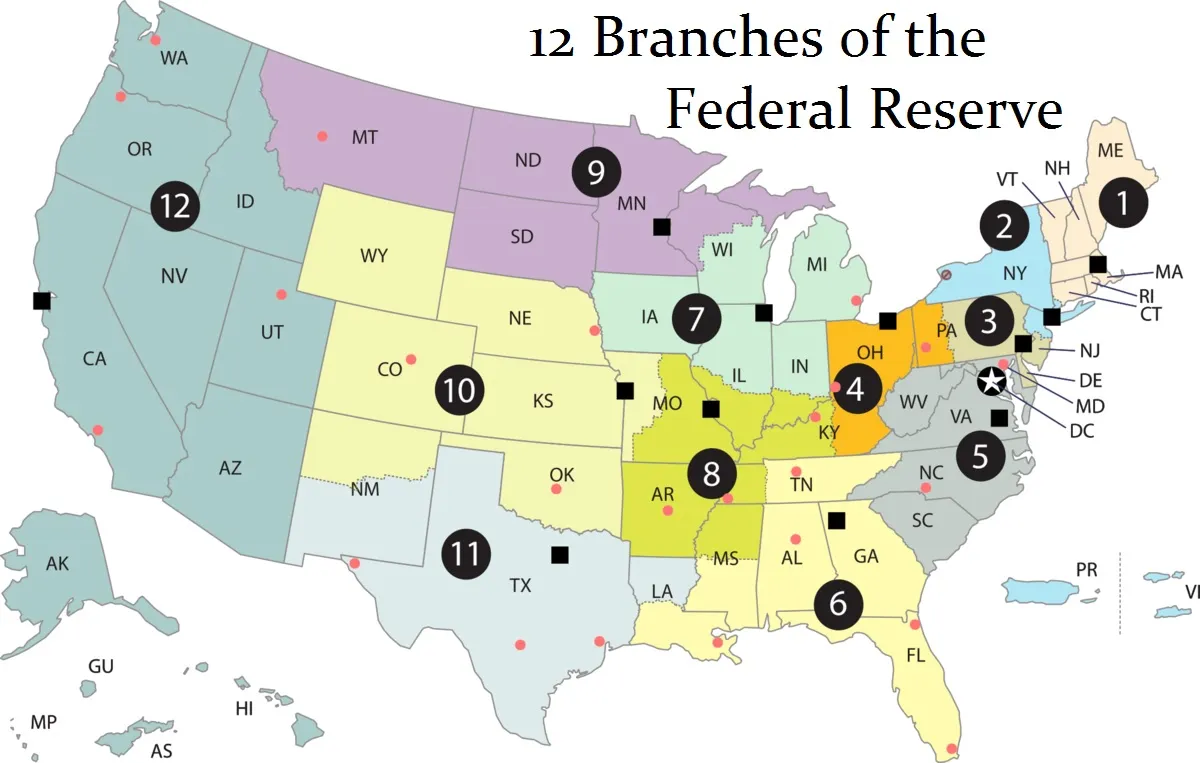
Federal Reserve 12 Branches

The idea of “elastic money” was to increase the supply of cash during such a crisis to meet the demand for withdrawals and that would offset the need to sell assets by calling in long-term debts. By increasing the money supply on a temporary basis, the Fed could offset the contraction in theory smoothing out the business cycle.

This was a brilliant scheme. However, it has been Congress, and not the Fed, that corrupted that mechanism. The banks technically owned the Fed as this was supposed to save the taxpayer money. The banks should contribute to their own bailout fund. Furthermore, the Fed’s design was also about buying in corporate paper when banks would not lend money. This was a mechanism used to offset rising unemployment if corporations could not fund their operations. They supplemented this by the management of regional interest rates to balance the domestic economy. Each branch of the Fed could raise or lower their local interest rate autonomously to attract capital when there was a local shortage or deflect capital when there was too much.

Congress began to manipulate the Federal Reserve for their own self-interest when World War I broke out on April 6, 1917. The alteration to the design of the Fed was to direct it to buy government bonds, not corporate. In this first step, they never reverse this decree after the war. They removed the brilliant design to stimulate the economy directly by purchasing corporate paper during a recession. In the last 2007-2009 crisis, the government wrote a check to TARP and hoped that the banks would lend money, but they did not. Removing this first pillar of the independent Fed distorted the entire system. It then made little sense for bankers to own shares in an entity that was no longer privately controlled.
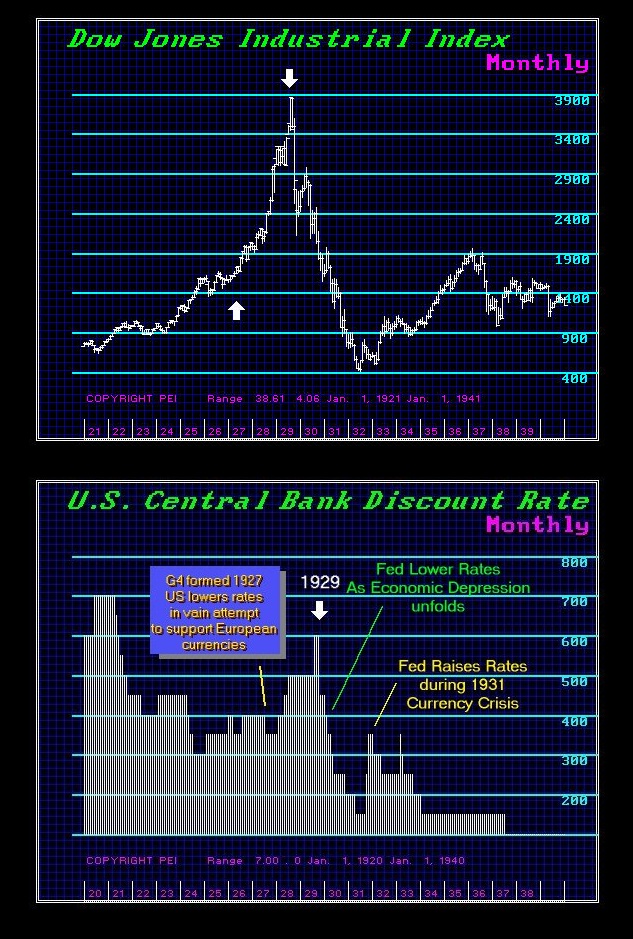
DowIntRates 1929

Banks became traders during the 1929 Boom-Bust Cycle. Goldman Sachs became deeply involved in the bull market, establishing numerous trusts and mergers. Goldman Sachs expanded the leverage going right into the eye of the storm that was about to hit starting on September 3, 1929. The crash wipes our 70% of Goldman’s entire market.

The Glass-Steagall Act, also known as the Banking Act of 1933 (48 Stat. 162), was passed by Congress in 1933 and prohibited commercial banks from engaging in the investment business. Around 5,000 banks failed during the Great Depression largely because banks sold trusts and foreign sovereign government bonds to the public in small denominations. Bill Clinton later repealed Glass-Steagall and handed the power back over to the bankers. Disaster strikes every time the government tries to manipulate the free market.

People believe the Fed has the power to create money out of thin air, yet never explain why the Fed was given that power. You cannot have a fixed money supply as the population increases, then you end up with DEFLATION, which is the rise in the value of money. You can double the money supply, but if the people hoard it, as they tend to do during private waves when the public loses all trust in government, you will never create inflation. There was a huge contraction in the velocity of money during the Great Depression for this very reason.

The Biden Administration, as has the Trump Administration, has come after the Fed. Politicians merely want the economy to appear strong under their reign and fail to see the long-term impact of policies. Politicians have no knowledge of economics or the insight to run the Fed. Not to mention that law does not permit Washington to bark orders at the Fed, although Washington does oversee the Fed and can force the central bank to change its policies to align with government spending or repel debt buyers.
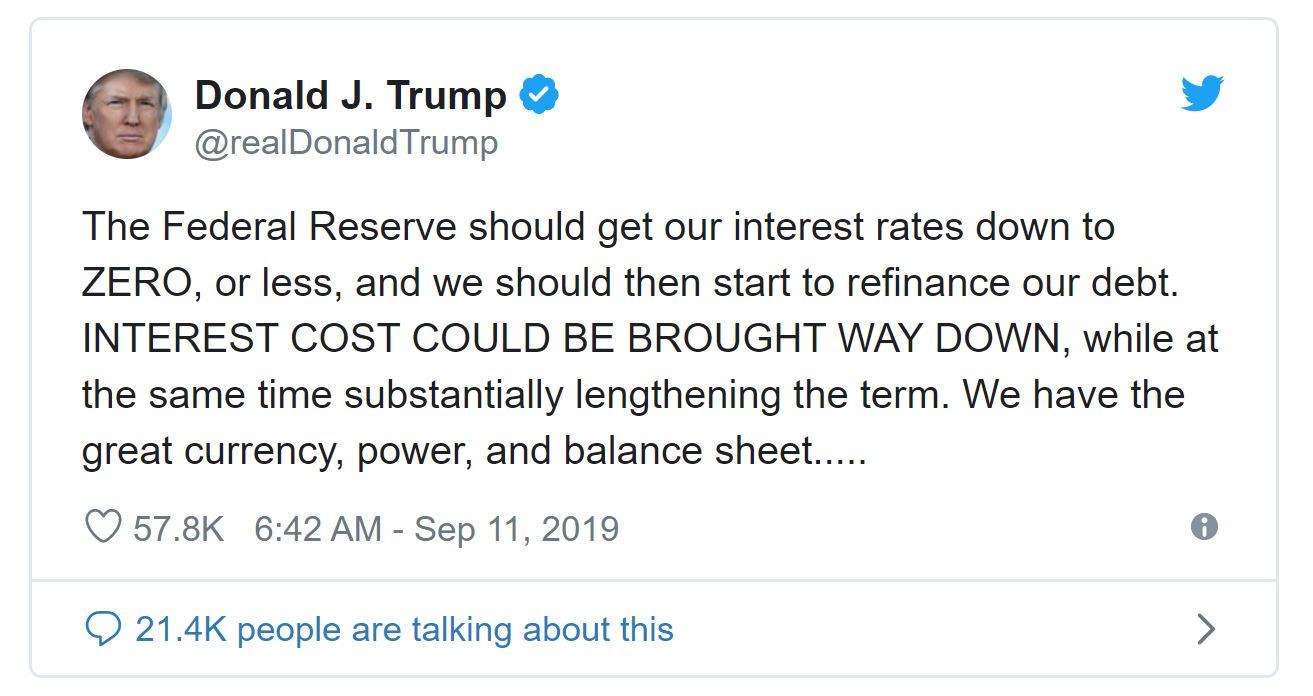
Trump on Interest Rates

Trump is a borrower, not a lender. His bankruptcies were the result of the business cycle and he leverages himself to the hilt so when the recession comes, he gets in trouble and when it is booming he claims to be a fantastic investor. But he is no trader. He could have hedged the business cycle but did not.

Chairman Jerome Powell and Trump clashed repeatedly. Not so coincidentally, Powell and numerous Fed bank presidents have their terms expiring in 2028 – a key year, as indicated by our models. The Biden Administration has already driven the economy off a cliff. The central bank is merely trying to heal an already injured economy with a limited medical kit.

The Fed is INDEPENDENT and will not be bullied by Biden or Trump. The Fed understands that it has become the world’s central bank and its actions in raising rates have had a far greater impact externally particularly in emerging markets because so many other nations issue their debt in US dollars.
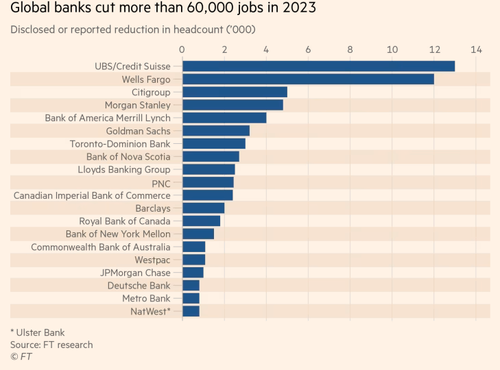
A Feature, Not Flaw – REPORT: Western Banks Drop 60,000 Employees in 2023


Posted originally on the CTH on December 27, 2023 | Sundance

If you followed my research on banking and the reality of the Russian sanction regime, this report takes on an entirely new dimension.  The article is from ZeroHedge, and the topline is not the real story.

ZEROHEDGE – The collapse of three US regional banks – First Republic Bank, Silicon Valley Bank, and Signature Bank – marked some of the largest failures in the banking system since 2008. Central banks contained the “mini-crisis” earlier this year with forced interventions and the mega-merger of Credit Suisse and UBS. Despite the interventions, global banks still axed the most jobs since the global financial crisis. 

A new report from the Financial Times shows twenty of the world’s largest banks slashed 61,905 jobs in 2023, a move to protect profit margins in a period of high interest rates amid a slump in dealmaking and equity and debt sales. This compared with the 140,000 lost during the GFC of 2007-08. (more

Look carefully at the graphic labeled “global banks.”  What do they all have in common?

These are not global banks, they are all “western banks.”  Do you remember a key component of my trip to eastern EU {Password Protected}.   That part of my research trip was specifically to understand the contradiction between what the west says about the Russian financial sanctions, and the reality of the irrelevance of those sanctions in Russia.

I didn’t talk, I watched; I listened.

Here’s how it really looks from the outside looking at the USA.  The same way the Patriot Act was not designed to stop terrorism but rather to create a domestic surveillance system. So too were the “Russian Sanctions” not designed to sanction Russia, but rather to create the financial control system that will lead to a dollar-based western digital currency.

BRICS+ was creating a non-dollar-based currency alternative for trade. Then comes the western financial sanctions, under the auspices of punishment for the Ukraine conflict. However, think “stopgap.” The sanctions didn’t block Russia, they walled-in the WEST.

The sanctions were not designed to keep Russia out of western banking, they were designed to keep us in.  Start thinking from that perspective, and all of the downstream activity, including the aggressive USA govt/banking response to crypto markets, makes total sense.

♦GROUND REPORT – You might ask how I know the Russian sanctions are ineffective – here’s an example.  After doing advanced research, I went to three separate banks as a random and innocuous customer.  I put my reason in the kiosk at each bank, got my ticket number and sat down to listen to the conversations. When my ticket number came up on the digital board, I just ignored it and sat for hours listening to conversations.  No one ever noticed or questioned me – not once.

At every one of the banks, the majority of the customers, at the “new account” desk, were foreign nationals asking about setting up business accounts to trade with Russia. In every bank the conversations were friendly and helpful, with the bank staff telling the customers exactly how to set up their account to accomplish the transactions.  No one was saying no; instead, they were explaining how to do it in very helpful detail.

Within Russia, there are now 3rd party brokers with international accounts, an entirely new industry, which creates a layer of transactional capability for the outside company to sell goods into Russia.  A Samsung TV travels from South Korea to the destination in the RU with the financial transaction between manufacturer and retailer now passing through the new ‘broker’ intermediary. Essentially, that process is what was happening in the banks for small to medium sized companies.

The USA led “western” sanctions against Russian interests were not designed to keep Russia isolated financially, they were designed to keep USA and Western banking customers walled in.  The end goal?  To create a dollar based CBDC for western finance.

In order to accomplish that goal, WESTERN govt/banking needs full control.  Any alternative (BRICS+ currency/trade) is a threat.

The Western sanctions created a financial wall around the USA, not to keep Russia out, but to keep us in.  The Western sanction regime, the financial mechanisms they created and authorized, creates the control gate that leads to a “dollar based” digital currency.

In essence, the Ukraine war response justified a system that creates a digital dollar.

The loss in “western banking” jobs, the downsizing within the banking system, is a feature – not a flaw.

Bank Acquisitions Coming 


Posted Originally on Dec 1, 2023 By Martin Armstrong 

Bank Broken

A recent report by KBW Regional Banking Index (KBW) suggests that Comerica, Zions, and First Horizon are at risk of being acquired by greater competitors. Larger banks with strong returns, such as Huntington, Fifth Third, M&T, and Regions Financial, are positioned to grow by acquiring smaller lenders. Additionally, KBW analysts noted that Western Alliance and Webster Financial could also consider selling themselves. The report highlights that regional banks with assets between $80 billion and $120 billion are facing increasing pressure on returns and profitability, making them potential targets for acquisition by larger rivals.

This analysis underscores the challenges faced by banks in this asset range, as they have the lowest structural returns among banks with at least $10 billion in assets, necessitating growth to help pay for upcoming regulations. The report also mentions that banks with higher returns, such as East West Bank, Popular Bank, and New York Community Bank, could end up as acquirers rather than targets. This analysis reflects the evolving landscape of the banking industry and the potential for consolidation among regional banks.

Three banks have already collapsed in the US this year. New proposed regulations would require banks with over $100 billion in assets to hold onto long-term debt equal to 3.5% of total assets or 6% of risk-weighted assets. Now banks just below the $100 billion mark will potentially face the burden of adhering to these new regulations. Regional bank shares have fallen by over 20% this year. Smaller banks are already struggling to remain profitable, while midsized banks will be forced to join a larger banking organization to stay afloat.

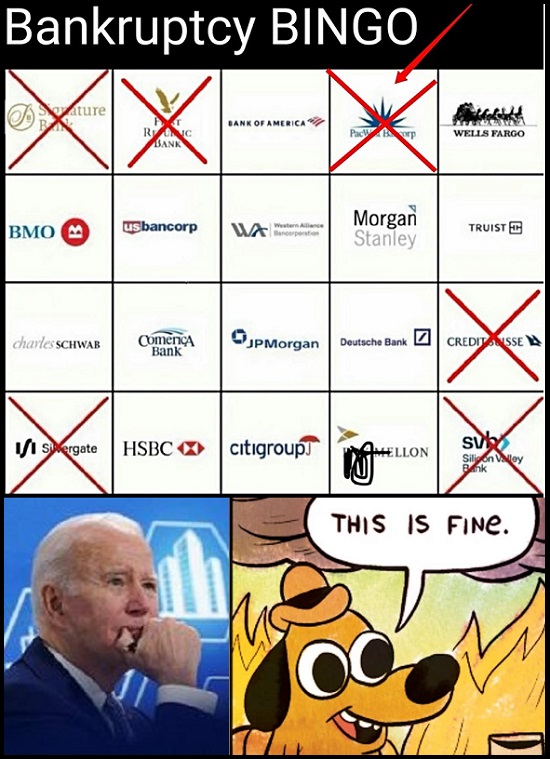
The California Contagion – PacWest Teters on Becoming the Next Regional Bank to Collapse as Regional Banking Stocks Continue Severe Drops


Posted originally on the CTH on May 4, 2023 | Sundance 

According to those who relish the Cloward-Piven strategy, things are proceeding swimmingly.

…”As long as the decisionmakers continue doing the things that are creating the crisis, the crisis will continue.”

Federal Reserve Chairman Jerome Powell said yesterday the “U.S banking system is sound and resilient,” insert uncomfortable snicker here.  However, uncertainty is continuing to pummel the banking industry, despite assurances from the Fed, Treasury, FDIC financial regulators and bankers such as Jamie Dimon who are all saying there is no crisis in the banking industry.

If you want to know the big picture source of the uncertainty, it’s the great pretending.  The average person can sense something is wrong, and the person who pays attention has the experience of institutional lying over the past several years.  The last ten years of lying and pretending has created the biggest collapse in institutional trust in U.S. history.

Russians interfered with the election – trust us. Stick this needle in your arm, it’s safe – trust us.  The FBI are the good guys – trust us. Biden won more votes – trust us. This inflation is merely transitory – trust us.

See the problem?

So, when the same voices shout, “the banking industry is sound, trust us,” well,… yeah, that suspicious cat sense that’s on high alert isn’t buying the chorus.

Reasonably intelligent people who accept things as they are, not as they would have us pretend them to be, can see the core connection to the World Economic Forum, Central Banks, and western globalist policy to change the entire dynamic of economics and finance around the “Climate Change” agenda, or Build Back Better, or Green New Deal.

Overlay that commonsense and pragmatic outlook with the logical consequences of the activity, and this banking collapse issue is a self-fulfilling prophecy.  As long as the decision makers continue doing the things that are creating the crisis, the crisis will continue.

(Via Wall Street Journal) – Regional-bank stocks tumbled Thursday despite assurances from the Federal Reserve that the banking system is on solid footing.

PacWest Bancorp PACW -47.04%decrease; red down pointing triangle, which has been hit hard since the collapses of several banks, dropped by about 40%. The stock started falling in after-hours trading Wednesday evening, after a report that it was considering selling itself.

PacWest said in a statement after midnight Eastern Time Thursday that its core customer deposits were up since the end of the first quarter, and that it hadn’t experienced any unusual deposit flows since the collapse of First Republic.

[…] Investors have been wondering how much further the problems in regional-banking could spread, and whether they will spill over to the broader economy. Some analysts said the decline in PacWest and others reflected the market’s tendency to view news as categorically good or bad, rather than worries about PacWest specifically. Western Alliance, another bank whose stock has been hit hard, fell by about 35%.

[…] Regional banks, as major lenders to businesses and families across the U.S., also tend to fall when investors are expecting a recession. The 10-year Treasury yield slipped this week, and Brent crude hit a 52-week low on Wednesday.

[…] On Wednesday afternoon, the Fed said the U.S. banking system “is sound and resilient,” echoing language from its March statement. Fed Chair Jerome Powell added then that deposit flows at banks had eased and that this week’s seizure and sale of First Republic should further stabilize the industry.

[…] PacWest shares were recently trading around $3.70, putting them on track for their lowest close on record. The stock has now lost some 85% of its value since March 8, the day that SVB spooked bank investors by announcing a loss and a planned capital raise.

Many of PacWest’s customers are tied to technology startups—a tightknit clientele that pulled from high-balance accounts en masse at Silicon Valley Bank before it failed. (more)

Republicans Fighting Biden’s Mortgage Madness


Armstrong Economics Blog/Real Estate Re-Posted May 3, 2023 by Martin Armstrong

Republicans at the state level are demanding that Biden and the FHFA repeal the asinine new law that punishes Americans with high credit scores by forcing them to subsidize the mortgages of those with low credit scores. The Biden Administration has been attempting to control real estate for some time. In June 2021, Biden forced the Supreme Court to give him the power to fire Mark Calabria as the regulator of Freddie Mac and Fannie Mae. Biden’s team said they were “moving forward today to replace the current director with an appointee who reflects the administration’s values. This was also when shareholders sued the government for the 2012 decision to pay all proceeds directly to the Treasury.

Trump was in favor of Calabria and fought to separate Freddie and Fannie from the government, but the Democrats repealed everything once Joe took over. Florida Chief Financial Officer Jimmy Patronis and 33 other Republicans at the state level are urging Biden and the FHFA to repeal this “hair-brained” policy. “This new policy … will take money away from the people who played by the rules and did things right – including millions of hardworking, middle-class Americans who built a good credit score and saved enough to make a strong down payment,” the group noted. “Incredibly, those who make down payments of 20 percent or more on their homes will pay the highest fees – one of the most backward incentives imaginable.”

Patronis and others argued that owning a home was once the American dream, and the new law will hurt middle-class families who worked and budgeted for their downpayment and credit score. “[T]he right way to solve that problem is not to use the power of the federal government to penalize hardworking, middle-class American families by confiscating their money and using it as a handout. The right way is to implement policies which will reduce inflation, cut energy costs and bring lower interest rates. Doing so will enable more families to save and improve their credit scores. Increased financial literacy efforts must also be part of the solution,” the letter also states. Lowering energy scores and inflation is not part of the Build Back Better agenda.

Providing people with loans who otherwise would not qualify is part of the plan for the Great Reset. Raising taxes on everything imaginable is also part of the agenda. The government wants to tax the middle class out of homeownership, force the working class to default on their mortgages, and move everyone into government-provided smart cities. The hatred toward government is brewing and will soon bubble over.

Against Backdrop of Inflation Continuing, Fed Set to Raise Rate Again Before Debating Pause


Posted originally on the CTH on May 1, 2023 | Sundance 

Everything about the process of cutting down energy exploitation, then driving supply side inflation, then raising interest rates to shrink demand (stem inflation) created by a desire to lower economic activity to the scale of diminished energy production, is a game of pretending.

The collateral damage from the rate hikes has been the banking destabilization, which shows the priority of the government officials and central banks to support the climate change agenda.  Into the game of pretending comes the second unavoidable consequence with inflation continuing as a result of the energy policy.

They simply cannot cut energy demand enough to meet the diminished scale of production.  There is no alternative ‘green’ energy system in place to make up the difference. That is the reality.  Now, the fed is scheduled to raise rates again, then begin to debate the collateral damage as they continue the pretending game.

(Via Wall Street Journal) – […] Another quarter-percentage point increase would lift the benchmark federal-funds rate to a 16-year high. The Fed began raising rates from near zero in March 2022.

Fed officials increased rates by a quarter point on March 22 to a range between 4.75% and 5%. That increase occurred with officials just beginning to grapple with the potential fallout of two midsize bank failures in March.

The sale of First Republic Bank to JPMorgan Chase & Co. by the Federal Deposit Insurance Corp. announced early Monday is the latest reminder of how banking stress is clouding the economic outlook.

Fed officials are likely to keep an eye on how investors react to that deal ahead of Wednesday’s decision, just as they did before their rate increase six weeks ago when Swiss authorities merged investment banks UBS Group AG and Credit Suisse Group AG. (read more)

There is no other way to look at the combined policy without seeing a Central Bank Digital Currency (CBDC) in the future.  All of these combined policies are creating a self-fulfilling prophecy.

Stop energy production. [Jan 2021]

Supply side inflation begins.

♦Raise interest rates. [April 2022]

Economic activity slows (but not enough).

♦Continue raising interest rates.

Banks destabilize. [Q1 2023]

Inflation continues.

♦Continue raising interest rates.

Economic activity slows (but not enough).

Banks continue destabilizing. [Q2 2023]

♦Continue raising interest rates.

Evaluate banking pressure. [We are Here]

Banks cannot withstand pressure.

Create CBDC

JPMorgan Chase Acquires First Republic Bank with FDIC Backstopping Deal While Ignoring Current Banking Laws


Posted originally on the CTH on May 1, 2023 | Sundance 

The topline story from the announcement by JPMorgan Chase [SEE HERE] there are no banking rules/laws in the Biden Fed/Treasury system.

The Dodd-Frank laws are still on the books, but the FDIC decision to insure all deposits, regardless of size, now means those laws, rules and regulations are not required to be followed.  Additionally, as a result of JPMorgan gaining another $100+/- billion in deposit assets, the law(s) surrounding the 10% U.S. deposit maximum, within too big to fail banks, no longer exists. Noted in the announcement, “JPMorgan Chase is assuming all deposits – insured and uninsured.”

JPMorgan is also assuming assets consisting of $173 billion in loans and approximately $30 billion in securities.  The FDIC is going to assume risk (with a risk sharing agreement) for current First Republic Bank mortgage and commercial loans acquired by JPMorgan, guaranteeing JPMorgan a 5-year fed fixed rate on $50 billion in mortgage bonds.

The Federal Deposit Insurance Corporation (FDIC) rule requiring the holding of 1.5% of deposits for all depositors up to $250k in all institutions is now essentially moot.  If the FDIC is guaranteeing all deposits, there’s no way for the insurance corporation to capture or hold $1.5% of all banking deposits.  The law is in conflict with the outcome action of the Fed/Treasury and ultimately the FDIC, ergo the law is nulled by the ignoring of it.

Mohamed El-Erian gives his take below, but seemingly missed the part of the announcement where JPMorgan states, “no systemic risk exception was required” in the deal.  This means the FDIC is completely free-range with the agreement, they are not even trying to justify why they would make a too big to fail bank even bigger. WATCH:

.

The only reason the FDIC violated its own rules and banking regulations, was because the FDIC didn’t, likely -almost certainly- couldn’t, take the financial hit from a full takeover of First Republic Bank against the backdrop of the prior terms for Silicon Valley Bank (SVB).

When the FDIC made the (SVB) decision to guarantee all deposits regardless of size, they put themselves in a position of an insurance declaration they could never fulfill.  The FDIC cannot structurally guarantee all of the First Republic Bank (FRB) deposits; they need a structure to avoid the government regulators absorbing the bank.  This reality is also why the FDIC violated their own laws, rules and regulations in allowing JPM to exceed the legal U.S. deposits maximum.

In essence, what the FDIC is saying is they cannot maintain the premise of their charter without the big banks helping them.  The biggest banks now control all of the leverage, with JPMorgan Chase and Jamie Dimon now controlling more financial power than the government that is supposed to regulate them.

FUBAR… All of it.  Everything Biden touches turns to shit.

This is going to be a major hot mess now for Main Street investment and borrowing needs.  The economy is going to feel the ramifications of this in less financing available to maintain domestic investment.

Last point. Look at the big picture, there’s no intervention protocol the legislative branch can trigger as a security against the reckless decisions of the FDIC (Fed and Treasury), without creating even bigger issues that could collapse the banking system.   If the legislative branch forced the FDIC to follow the laws currently on the books, the domino of banks starts to collapse.

Sunday Talks, Gary Cohn Discusses the First Republic Bank Dynamic, and Confirms Something Interesting…


Posted originally on the CTH on April 30, 2023 | Sundance 

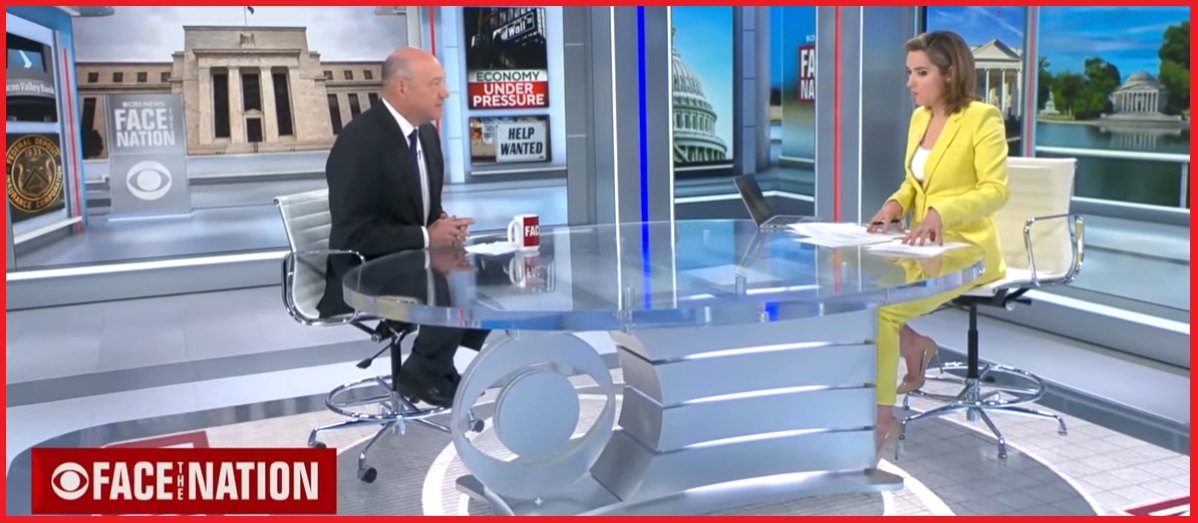
Gary Cohn is connected to the banking and finance industry, well connected.  In this interview with Face The Nation earlier today, Cohn is discussing the current status of First Republic Bank, another big player in the California banking system that is about to collapse.  Cohn notes something at the 1:15 mark that just seems obvious yet is undiscussed in most outlines of the FRB discussion.

Six weeks ago, in an effort organized by the FDIC, $30 billion was pushed into FRB by eleven larger banks to stabilize it.  However, the only thing that infusion of capital did was allow institutional depositors time and ability to withdraw their funds. A complete racket.  Once the at-risk group exits, suddenly the collapse is back on the tee.  WATCH:

[Transcript] – MARGARET BRENNAN: We want to turn now to Gary Cohn, who is the vice chairman of IBM, former Goldman Sachs president and a former Trump administration top economic adviser. Good morning to you. Lots of titles, Gary, Lots of experience. That’s why we like having you here. I want to ask you about what’s happening with First Republic. It’s been under pressure. We know they’ve been looking for a buyer, the FDIC, the government is looking to arrange, moving it into government control and then maybe selling it. What are you hearing about how this would roll out?

GARY COHN: Margaret, thanks for having me. I think you’re portraying the situation as we find ourselves again on a weekend. As we closed business of Friday, the FDIC was in a process of looking for acquirers or bidders for the assets over the course of the weekend. I think the FDIC has asked potentially three banks for their final bids for the entire bank. The FDIC would prefer to sell the bank in its entirety than the pieces. What will most likely happen is the FDIC will seize control and then simultaneously resell the asset to the successful bidder. I think that will happen sometime later this afternoon before the markets open in Asia this evening.

MARGARET BRENNAN: And this will be a faster process than what happened with SVB?

COHN: It will be- it will be a much faster process. Now, we’ve been going down this process for the last two weeks or so as first republics continues to be under pressure and continues to lose deposits. Unfortunately, First Republic reported this week that they had a massive outflow of deposits over the last quarter.

MARGARET BRENNAN: So if First Republic is sold, then the acquirer would take on the deposits. So what do you think about the conversation we had earlier with Congressman Khanna about whether Congress needs to do something here? Because it seems like we’re just going into emergency mode now for three banks.

COHN: Yeah.

MARGARET BRENNAN: Does there need to be a broader change to the regulatory system and to the laws?

COHN: Well, it’s an interesting question. So, look, I don’t agree with Congressman Khanna that we want unlimited FDIC insurance. I think that to me is a bit of a race to the bottom.

MARGARET BRENNAN: You had picked like two, 2 million. 5 million, 10 million.

COHN: Yeah. I mean, there’s got to be some limit. It’s- at some point you have to limit because you don’t want to race to the bottom where you know, the weakest bank with the weakest balance sheet in the world can offer you the highest rate of return on your deposits. And therefore, you take your deposits there because guess what? They’re insured by the federal government. That’s not what we want to see. We want to see some type of discipline in the system. When you talk about more and more regulation, I smiled because if you look at the report that came out that you referenced with Ro Khanna as well, you know, one of the findings in the report is that the regulators did not do a very good job enforcing the existing rules. So if you can’t enforce the rules you already have on the books and by- it’s hard to enforce the rules because there are so many rules, do you want to create more and more rules when you can’t enforce the one you already have? Part of me feels like we need to get a simpler, more coherent set of rules so the bank regulators can actually enforce them and they know what the important rules are.

MARGARET BRENNAN: But the bank regulators here are at the Fed. That’s what we’re talking about here.

COHN: They’re at the Fed and at the States. Remember–

MARGARET BRENNAN: That’s true.

COHN: –we have state regulated banks and federally regulated banks.

MARGARET BRENNAN: Well, that’s a big conversation for California since they just had two banks–

COHN: It is.

MARGARET BRENNAN: –have some big problems. But Fed Chairman Powell is going to face questions from the press midweek.

COHN: Yes.

MARGARET BRENNAN: They- he gives a press conference around the decision on interest rates that he is expected to be making. Do you think these banking problems are going to interfere with his plan?

COHN: I don’t think these problems are going to interfere with his plans. I actually think they’re helpful to his plans.

MARGARET BRENNAN: Because they’re slowing the economy?

COHN: Exactly. What the- what the chair has been trying to do is slow the economy down. He’s been trying to tamp down inflation. Inflation is too many goods chasing too few products. And part of the chasing has been the easy availability of credit. Now that we’ve seen deposits lose- the- leave the system and we’ve seen banks in tighter financial position, they are not offering loans as easily as they were before and the loans have become more expensive. So people are borrowing less money, they have less access to credit, so their ability to purchase is going down. Purchasing power is waning in the United States, which is exactly what the chairman’s been trying to do by raising interest rates. So he’s in essence, getting enormous amount of help out of this banking crisis, not what he wanted to see happen in any way, shape or form, but the unintended consequence is very helpful to slowing down the economy and tamping down inflation.

MARGARET BRENNAN: So does it up the odds of a recession being more than mild?

COHN: It probably ups the odds. Yes. I mean, it definitely ups the odds. It takes control out of the Fed. The Fed is no longer in total control of slowing down the economy. They’ve now got the banking industry playing along with them. But as we’ve seen in the economic data recently, the consumer in the United States still is in relatively good shape. They are starting to run out of savings. The money that they got during COVID, we put an enormous amount of stimulus into consumers bank accounts and that administrations, both administrations, every every administration put enormous amount of stimulus in the bank accounts. We see from the savings data that’s starting to to wear down. It’s starting to run off. So is that runs off further and further. The economy would become more credit dependent to keep thriving. So I think we will see a slowdown. And I still think we’re in a relatively decent shape. We may have a recession, but I still. I think we could muddle through the bottom here without a real deep recession.

MARGARET BRENNAN: The chair of the House Financial Services Committee, Congressman McHenry, called the Fed’s report a self-serving justification of Democrats long held priorities. He may be venting. It doesn’t look like Congress is doing anything to change regulation or laws related to banking. There was an FDIC report on the collapse of Signature Bank, which blamed bad management, but it also said regulators just didn’t have enough staff. In New York. I mean, there’s some pretty damaging bits of information in here. If you put aside the politics, the regulators don’t have enough staff. They didn’t act. So who are they being held accountable by unless it’s Chair Powell?

COHN: Well, it is Chair Powell. And I think- I think when the chairman goes to Congress and remember, he testifies in front of both the House and the Senate a couple of times a year. Historically, all of the questions have been on monetary policy. I think we’re going to start seeing a lot more questions on the regulatory and the regulatory policy. How is regulation working? Are they keeping up to what they need to do? Do they have proper staff or there are issues that are going by that are not being covered? This is a huge finding. I mean, this is a bit of a seismic moment because we believe in the United States and I think the US population believes that the banks where they deposit their hard earned money are well regulated. And we have found out this week in the Fed’s own report that these banks are not well regulated, and they admitted it themselves. I ran a regulated bank. I know that if we would have ever told our regulator that we did not have a enough people to regulate ourselves, they would have shut us down. So we cannot be in a position where the regulators themselves say we do not have enough staff to regulate you properly.

MARGARET BRENNAN: You ran one of the biggest banks. Gary, we’ve got to leave it there. We’ll be back in a moment.

Scheme Finance – FDIC Asks Big Banks for Takeover Proposals and Bids for First Republic


Posted originally on the CTH on April 29, 2023 | Sundance

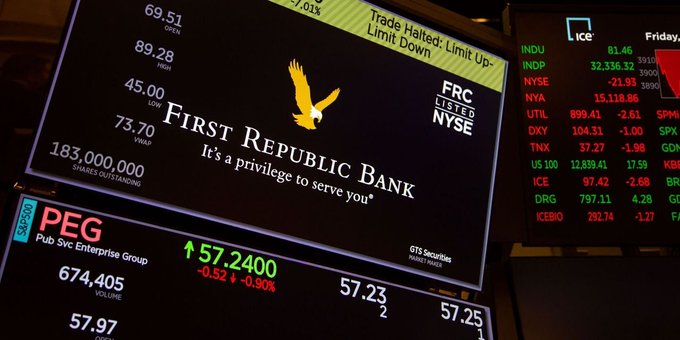
There’s something sketchy afoot in the world of high finance.  Following the collapse of Silicon Valley Bank, the most likely first contagion bank would have been First Republic Bank; both California banks carried similar vulnerabilities.  However, once the Treasury Dept agreed to cover all deposits, even those unsecured deposits over the $250k FDIC insurance protection, suddenly First Republic Bank survived.

After the FDIC announcement, a group of 11 larger banks lent First Republic a tranche of money ($30 billion) to secure its holdings and help stabilize it.  Approximately six weeks passed, suspiciously perhaps the burn rate for the tranche in combination with risk averse exits says I, and suddenly First Republic starts destabilizing again.  [Insert Suspicious Cat here]

The First Republic stock value collapsed further last week, and the FDIC is now trying to get a takeover bid secured before government regulators are forced into a position of receivership.   I’m not dialed in to the banking industry, but it looks to me like the six-week interim phase was an agreement to give the illusion of stability and afford time for highly exposed, ¹likely well connected, stakeholders to exit.

With the Treasury taking the prior SVB position, thereby securing all deposits regardless of scope, the FDIC is now on the hook if the collapse includes a govt takeover.  The FDIC seems to be playing hot potato and looking for a buyer.  Additionally, the FDIC is asking JP Morgan-Chase if they are interested.  JPMorgan holds more than 10% of all deposit funds in U.S. banking.  From a regulatory position, JPM cannot legally take any more institutional deposits.  So, what gives?  It is all sketchy, all of it.

(Bloomberg) — The Federal Deposit Insurance Corp. has asked banks including JPMorgan Chase & Co., PNC Financial Services Group Inc., US Bancorp and Bank of America Corp. to submit final bids for First Republic Bank by Sunday after gauging initial interest earlier in the week, according to people with knowledge of the matter.

The regulator reached out to some banks late Thursday seeking indications of interest, including a proposed price and an estimated cost to the agency’s deposit insurance fund. Based on submissions received Friday, the regulator invited some of those firms and others to the next step in the bidding process, the people said, asking not to be named discussing the confidential talks.

Spokespeople for JPMorgan, PNC, US Bancorp, Bank of America and the FDIC declined to comment. Bank of America is considering whether to proceed with a formal offer, one of the people said. Citizens Financial Group Inc. is also involved in the bidding, Reuters reported, citing people with knowledge of the matter.

The bidding process kick-started by regulators — after weeks of fruitless talks among banks and their advisers — could pave the way for a tidier sale of First Republic than the drawn-out auctions that followed the failures of Silicon Valley Bank and Signature Bank last month. Authorities are stepping in after a particularly precipitous drop in the company’s stock over the past week, which is now down 97% this year.

Unclear to some involved in the process is whether regulators might use a bid for a so-called open-market solution that avoids formally declaring First Republic a failure and seizing it. The stock’s drop — leaving the company with a $650 million market value — has made such a takeover at least somewhat more feasible.

[…] A group of 11 banks that deposited $30 billion into First Republic last month — giving it time to find a private-sector solution — have proved reluctant to band together on making a joint investment. A few proposals that surfaced in recent days called for a consortium of stronger banks to buy assets from First Republic for more than their market value. But no agreement materialized.

Instead, some stronger firms have been waiting for the government to offer aid or put the bank in receivership, a resolution they view as cleaner — and potentially ending with a sale of the bank or its pieces at attractive prices.

But receivership is an outcome the FDIC would prefer to avoid in part because of the prospect it will inflict a multibillion-dollar hit to its own deposit insurance fund. The agency is already planning to impose a special assessment on the industry to cover the cost of SVB and Signature Bank’s failures last month. (more)

¹This is pure speculation on my part, but if you were a well-connected California big fish and you had exposure in FRB, after the SVB collapse you might ask the govt to construct an exit plan to assist you.

$11 billion flows in, you make your quiet withdrawals, and after exit the delayed outcome proceeds accordingly.

The Great De-Dollarization Fraud of a Lifetime


Armstrong Economics Blog/USD $ Re-Posted Apr 24, 2023 by Martin Armstrong

COMMENT: Marty; I was in a board meeting and I just wanted to let you know one guy who is there simply because his family had a stake in the company with zero worldly experience, started ranting about the end of the dollar he probably read on that biased _____________________. I asked this fool, should we then move all our company funds to Russia or China since Brazil is too small of an economy? Should we stop dealing with Americans? He had no response.

Separating a fool from his money seems to be a never-ending fact about humanity.

Cheers

You are the only sane one out there these days

PY

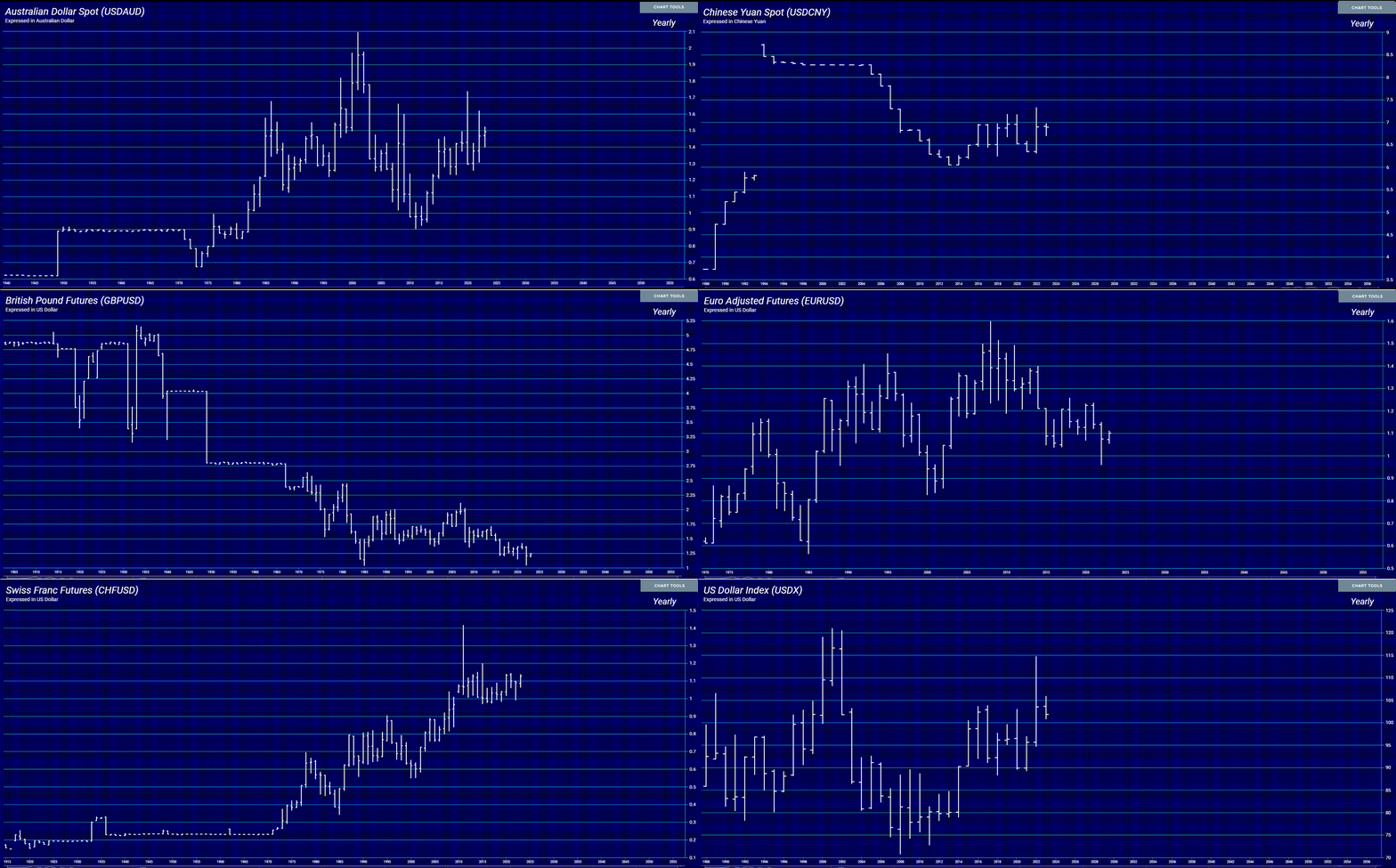
REPLY: I know what you mean. The people promoting this BRICS nonsense have no understanding of the real world. Institutions cannot park billions in Brazil, China, or Russia. Especially in the face of war. The reason the Euro has failed as a serious reserve currency is that there is NO NATIONAL EURO DEBT! Institutions have to still jockey between the various risks of each country and all the Euro did was transfer the foreign exchange risk to the bond market. Sorry, I just do not see where the dollar is in some state of collapse.

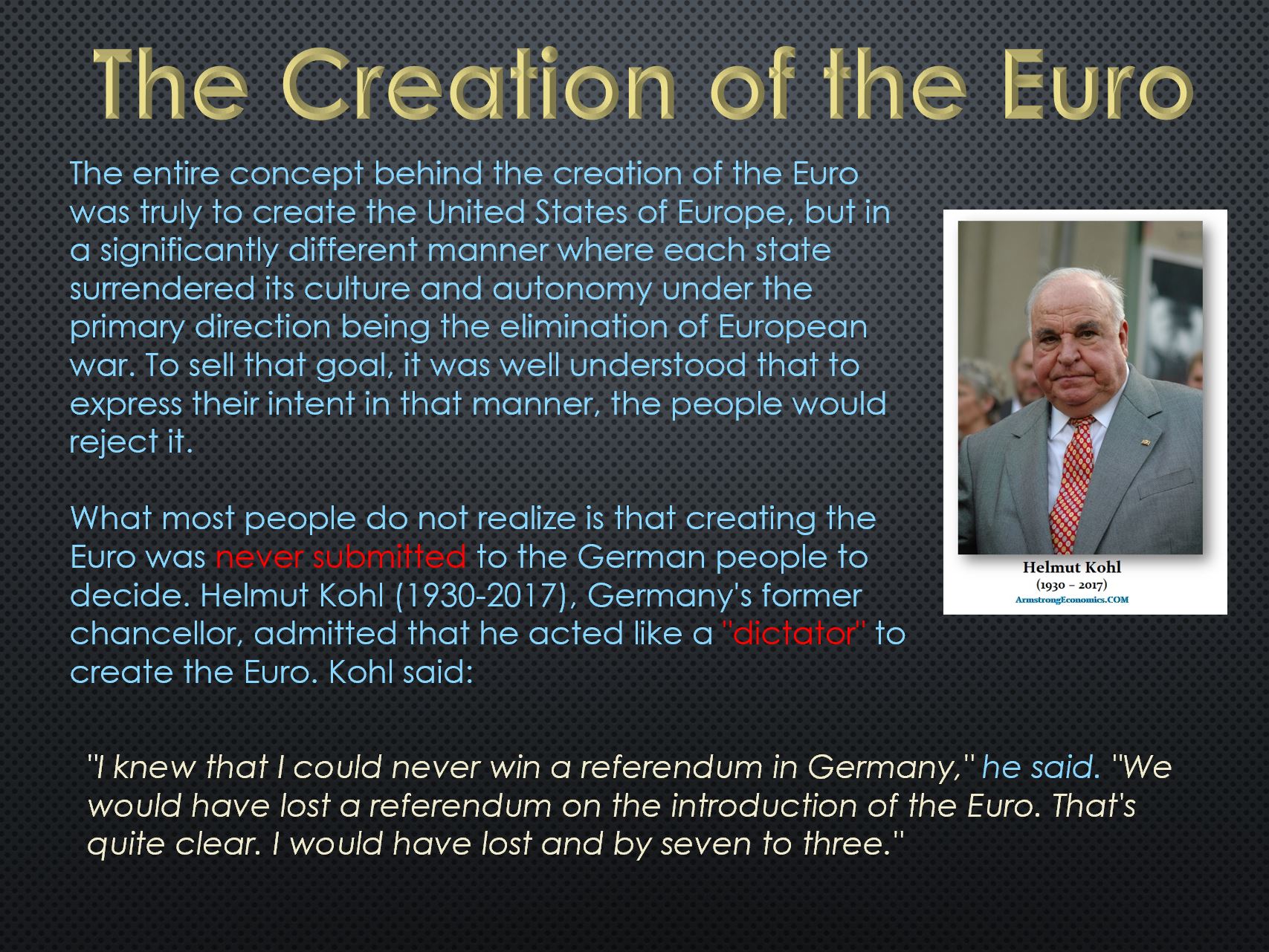
When they came to me to create the Euro, I warned them that there would be no single interest rate without the consolidation of the debt. But Kohl never allowed the German people to vote on joining the Euro, so he would not allow the consolidation of the debt. I was told then that they just had to get the Euro started and they would worry about consolidating the debts later. Of course, that never came. Hence, the volatility in FX simply moved to the debt market. The bottom line – the US dollar is still the ONLY place for major institutions to park money – PERIOD! They are not buying Brazil, China, or Russia.

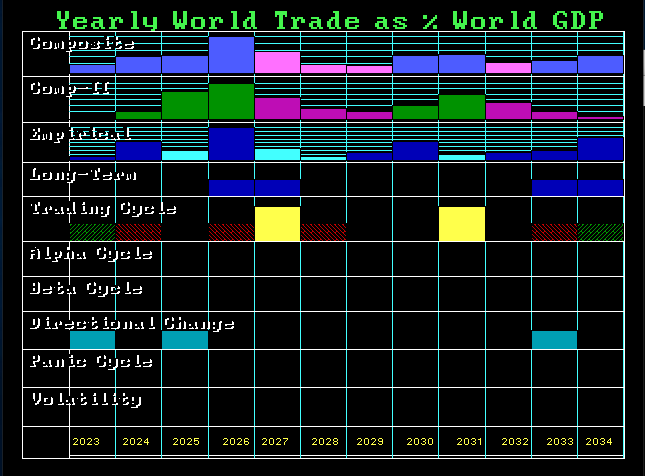
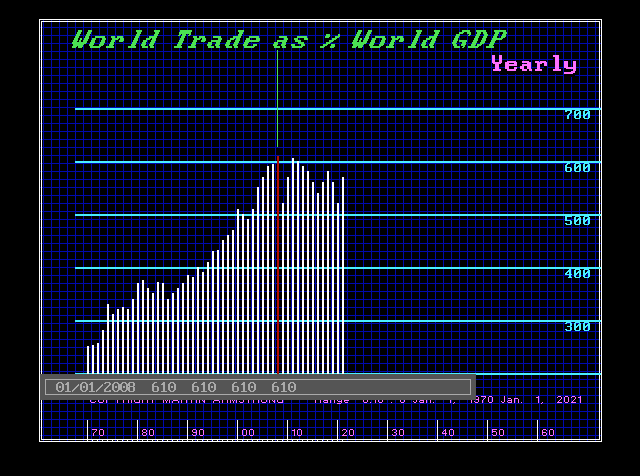
World Trade as a percent of total world GDP PEAKED in 2008 at 61%. It has been in a bear market that will not bottom before 31.4 years taking us into 2040. The sanctions on Russia have divided the world economy and killed SWIFT but it has also ended globalization. To think that the BRICS can replace the dollar with ZERO capacity for international capital to park in such markets is the delusion of absolute fools. China will surpass the USA, but only after 2032.

So here we go again. This nonsense is leading unsuspecting people to follow the piper to divest of dollars and move into what exactly? Most of this is propagated by the gold bugs who will NEVER listen. They hate the dollar because they think gold will rise then. What kind of a world will exist if their doom and gloom were a reality? You might not have any place to spend your wealth. I own gold NOT as an investment, but because of its neutrality.

There is such a major fraud going on with digital currencies with people reporting that the latest scam is using social media to tell people to transfer all their cash to a digital wallet, and BTW – here is the link! If you believe that one, perhaps you would like to buy the Brooklyn Bridge. NYC has a deficit and they will sell it for all the money in your savings. Wake up!

These people remind me of the famous drawing of a fool and his cat.