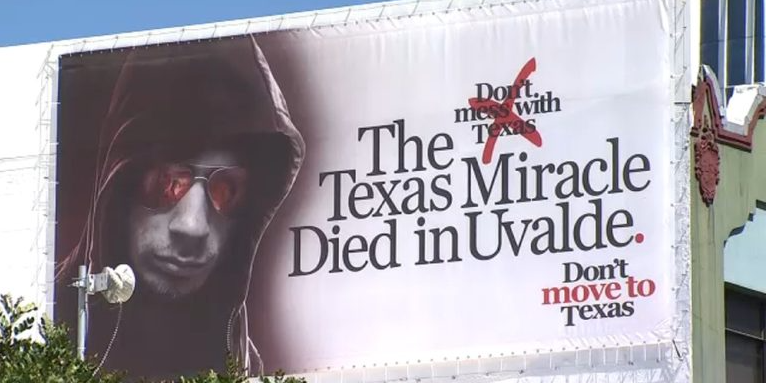
“The Texas miracle died in Uvalde,” the billboards states. It is in bad taste to use a school shooting to promote an agenda. The gunman was apprehended by a Texas resident with a gun. The police failed those children. None of this has anything to do with California’s policies; crime is not as prominent in Texas.
Between 2020 and 2021, over 25,000 fled California to Texas, according to the US Census data. Overall, over 360,000 people left California in 2021. Most cite that California has become completely unaffordable, with the median home price at about $797,470. Companies have fled California since the beginning of the pandemic to tax-friendly states. They lost huge job creators and revenue makers such as Facebook, Twitter, Dropbox, SpaceX, and Tesla, to name a few. Another less discussed reason is the intense woke rhetoric spewed by Newsom and others. Theft has basically become legal. Despite the beautiful scenery and weather, people simply do not want to live in the Golden State for a plethora of reasons.
Posted originally on the conservative tree house on August 29, 2022 | Sundance
The financial pundits are slowly starting to drop the pretending and discuss the bigger economic picture. However, as they tread very carefully, they are being very cautious about admitting too much.
A Reuters discussion of the comments by Federal Reserve Chairman Jerome Powell, starts to dip the media toe in the painful pool; yet they will not admit the Biden energy program is the source of the inflation Powell is targeting with his policy moves to shrink energy demand. Thus, the pretending continues.
If you take the written words and extract the parseltongue, you can see a more fulsome picture of what is being outlined.
JACKSON HOLE, Wyo., Aug 29 (Reuters) – The message from the world’s top finance chiefs is loud and clear: rampant inflation is here to stay and taming it will take an extraordinary effort, most likely a recession with job losses and shockwaves through emerging markets.
That price is still worth paying, however. Central banks spent decades building their credibility on inflation fighting skills and losing this battle could shake the foundations of modern monetary policy.
In other words, the U.S. economy is based on core U.S. energy systems and moving that construct to alternative energy, windmills, electric vehicles and solar panels; along with getting Americans to accept a lowered standard of living; is an “extraordinary effort.”
Yes, they are ‘all-in’ and if they lose “this battle,” the core foundations of modern monetary policy will “shake” along with the economic collapse that follows. The economic energy “transition” is the Biden policy, the federal reserve is trying to support that policy by lowering economic demand.
Yes, they also now admit that people will lose their jobs, their livelihoods and the foundation of their economic stability in the process.
[…] “Regaining and preserving trust requires us to bring inflation back to target quickly,” European Central Bank board member Isabel Schnabel said. “The longer inflation stays high, the greater the risk that the public will lose confidence in our determination and ability to preserve purchasing power.”
Banks should also keep going even if growth suffers and people start to lose their jobs. “Even if we enter a recession, we have basically little choice but to continue our policy path,” Schnabel said. “If there were a deanchoring of inflation expectations, the effect on the economy would be even worse.”
[Energy inflation, the root of all supply side inflation] “is near double-digit territory in many of the world’s biggest economies, a level not seen in close to a half century.”
[…] Deglobalisation, the realignment of alliances due to Russia’s war, demographic changes and more expensive production in emerging markets could all make supply constraints more permanent. (read more)
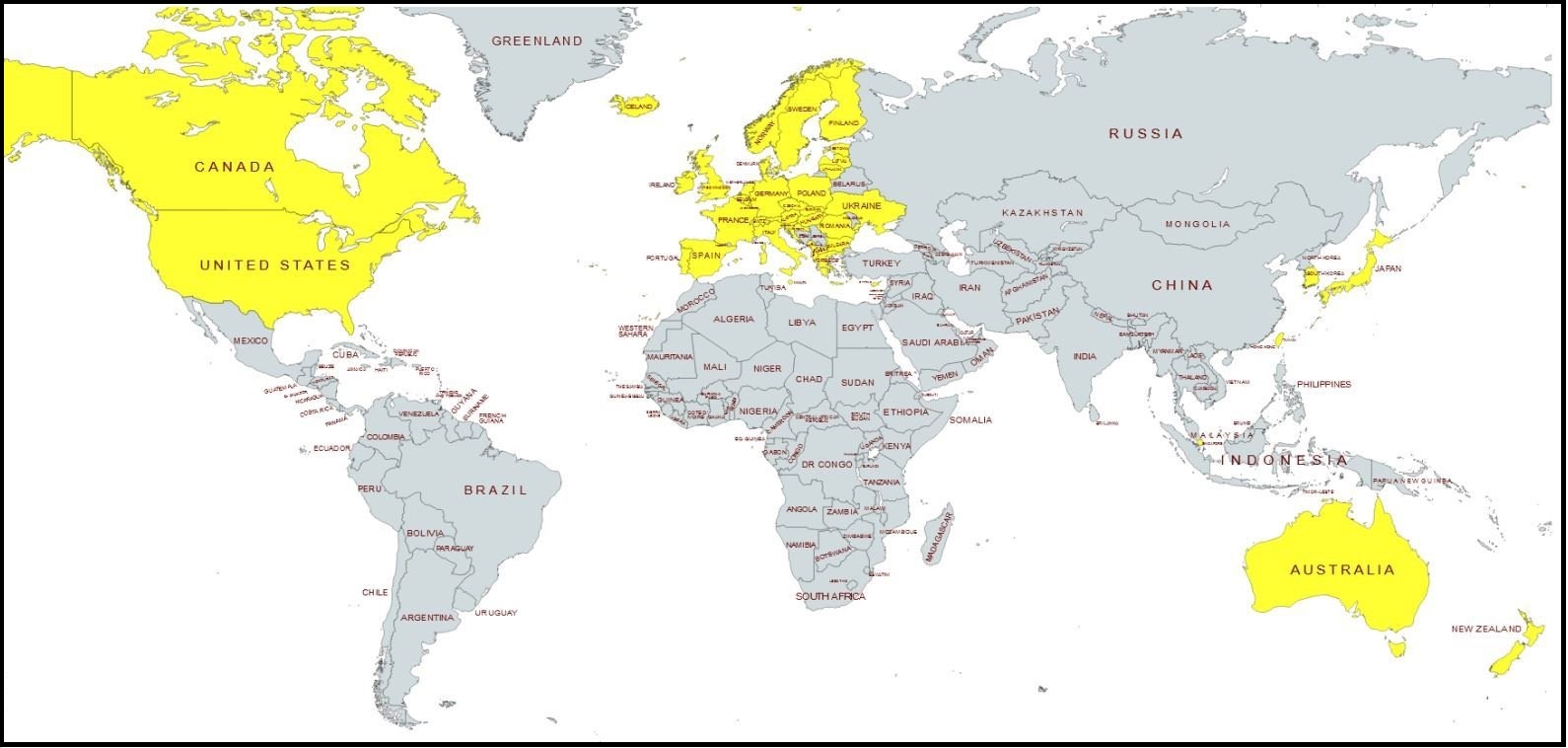
Yes, the “realignment global of alliances,” as an outcome of the western world policy to fracture global markets based on energy use. Notice they are now starting to admit what we have discussed here for over a year?
“The global economy seems to be on the cusp of a historic change as many of the aggregate supply tailwinds that have kept a lid on inflation look set to turn into headwinds,” Agustín Carstens, the head of the Bank of International Settlements, said.
“If so, the recent pickup in inflationary pressures may prove to be more persistent,” said Carstens, who heads a group often called the central bank of the world’s central banks.
All this points to rapid interest rates hikes, led by the Fed with the ECB now trying to catch up, and elevated rates for years to come. (read more)
Indeed, we are only now on the front side “cusp” of the transition which will force the continued lowering of economic activity within the aligned nations for more than a generation or two. All economic activity, essentially all human activity, will have to be stalled and reduced until the levels of sustainable energy production can catch up to the levels of energy needed for the now smaller economy.
With current estimations of 50+ years before sustainable energy can generate 25 to 50 percent of the need, this is going to take a long time, and the bankers & financial control agents are going to have to simultaneously make the economies of the allied nations much smaller.
The planned energy oven is small, the size of the economic pizza must be shrunk in order to fit within it.
My last and important point is this…. The multinational corporations, banks and global finance folks, do not enter into these situations without a carefully planned way to retain their own wealth. The job of a “hedge fund manager” is described in the title, to find a “hedge” against risk to continue increasing wealth.
The billionaire elites that have assembled their wealth on the old economic system will not trust anything to chance as this global cleaving of the world economy takes place. Being reactionary is not how they operate. These groups pre-stage their wealth and assets outside the zone of collateral damage. They are proactive, not reactive to these global financial events.
With the foundation of the western economic system now being changed, look carefully at the political landscape to see what Wall Street risk mitigation maneuvers are taking place. My very strong hunch on this wealth preservation facet leads me back to domestic politics, and suddenlythings make sense. I’m not wrong. I am open to being wrong, but I’m not wrong.
Posted originally on the conservative tree house on August 26, 2022 | Sundance
Buried inside Section 5114(b)(4) of the National Defense Authorization Act for Fiscal Year 2022 was a repeal of 1994 law that required the U.S. State Department to publish an annual list of arms sales to foreign countries. The “World Military Expenditures and Arms Transfers” report (WMEAT) put sunlight every year on what weapons the U.S. was selling to foreign countries.
Conveniently timed with the $60+ billion aid package to Ukraine, the U.S. State Dept, now says the WMEAT report will not be published any longer. If a person was to believe the Ukraine arms deals were essentially money laundering operations, well, this announcement by the State Dept. might be interpreted as a way to hide it. [LINK]
State Dept – WMEAT 2021, which the Department of State published in December 2021, is the final edition of World Military Expenditures and Arms Transfers (WMEAT). Section 5114(b)(4) of the National Defense Authorization Act for Fiscal Year 2022 repealed the 1994 statutory provision that required the Department of State to publish an edition of WMEAT every year. Consistent with this repeal, the Department of State will cease to produce and publish WMEAT.
Copies of all editions of WMEAT dating from 1974 to 2021 remain publicly accessible as Adobe PDF or Excel spreadsheet documents (LINK)
Posted originally on the conservative tree house on August 26, 2022 | Sundance
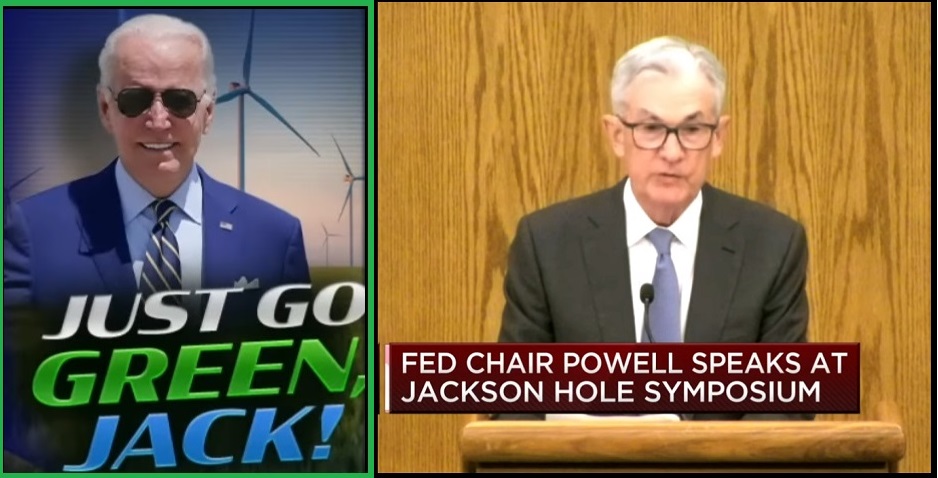
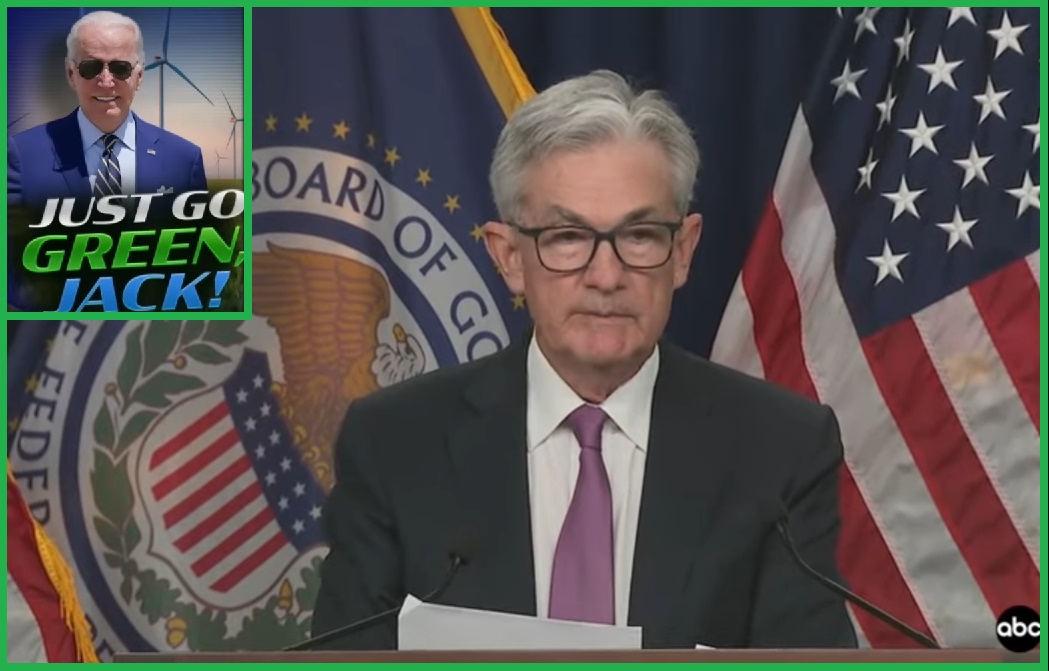
When Chairman Powell says things are really, really going to suck as monetary policy tries to support Biden’s goals to reduce energy supplies, will people believe him?
The agenda of the federal reserve was clearly outlined today in the remarks from Chairman Powell in Jackson Hole, Wyoming. The Fed chair is trying to manage the economic policy transition by reducing economic activity to match intentionally diminished energy supplies. Lowering economic activity drops demand for energy. Unfortunately, as admitted by Powell today, this means a period of “some pain” for Americans as the central banks join together in an effort to lower consumption. WATCH:
What does “some pain” mean? It means lower incomes, higher prices, lowered standards of living and more scarce resources. During this transition to owning nothing and being happy about it, the pain is your wealth being stripped as the economy is intentionally diminished.
We will not be able to afford much; we won’t be able to afford the foods we want; we will not be able to purchase anything except the essentials, and those essentials will cost much more; we won’t be able to vacation, travel, or enjoy recreational activities; we won’t be able to afford any indulgences; but at the end of the process, we will learn to live more meager existences based on lowered expectations needed for sustaining the planet. Pay no attention to the elites who don’t have those concerns, comrade.
[Transcript] – POWELL: “At past Jackson Hole conferences, I have discussed broad topics such as the ever-changing structure of the economy and the challenges of conducting monetary policy under high uncertainty. Today, my remarks will be shorter, my focus narrower, and my message more direct.”
“The Federal Open Market Committee’s (FOMC) overarching focus right now is to bring inflation back down to our 2 percent goal. Price stability is the responsibility of the Federal Reserve and serves as the bedrock of our economy. Without price stability, the economy does not work for anyone. In particular, without price stability, we will not achieve a sustained period of strong labor market conditions that benefit all. The burdens of high inflation fall heaviest on those who are least able to bear them.
Restoring price stability will take some time and requires using our tools forcefully to bring demand and supply into better balance. Reducing inflation is likely to require a sustained period of below-trend growth. Moreover, there will very likely be some softening of labor market conditions. While higher interest rates, slower growth, and softer labor market conditions will bring down inflation, they will also bring some pain to households and businesses. These are the unfortunate costs of reducing inflation. But a failure to restore price stability would mean far greater pain.
The U.S. economy is clearly slowing from the historically high growth rates of 2021, which reflected the reopening of the economy following the pandemic recession. While the latest economic data have been mixed, in my view our economy continues to show strong underlying momentum. The labor market is particularly strong, but it is clearly out of balance, with demand for workers substantially exceeding the supply of available workers. Inflation is running well above 2 percent, and high inflation has continued to spread through the economy. While the lower inflation readings for July are welcome, a single month’s improvement falls far short of what the Committee will need to see before we are confident that inflation is moving down.
We are moving our policy stance purposefully to a level that will be sufficiently restrictive to return inflation to 2 percent. At our most recent meeting in July, the FOMC raised the target range for the federal funds rate to 2.25 to 2.5 percent, which is in the Summary of Economic Projection’s (SEP) range of estimates of where the federal funds rate is projected to settle in the longer run. In current circumstances, with inflation running far above 2 percent and the labor market extremely tight, estimates of longer-run neutral are not a place to stop or pause.
July’s increase in the target range was the second 75 basis point increase in as many meetings, and I said then that another unusually large increase could be appropriate at our next meeting. We are now about halfway through the intermeeting period. Our decision at the September meeting will depend on the totality of the incoming data and the evolving outlook. At some point, as the stance of monetary policy tightens further, it likely will become appropriate to slow the pace of increases.
Restoring price stability will likely require maintaining a restrictive policy stance for some time. The historical record cautions strongly against prematurely loosening policy. Committee participants’ most recent individual projections from the June SEP showed the median federal funds rate running slightly below 4 percent through the end of 2023. Participants will update their projections at the September meeting.
Our monetary policy deliberations and decisions build on what we have learned about inflation dynamics both from the high and volatile inflation of the 1970s and 1980s, and from the low and stable inflation of the past quarter-century. In particular, we are drawing on three important lessons.
The first lesson is that central banks can and should take responsibility for delivering low and stable inflation. It may seem strange now that central bankers and others once needed convincing on these two fronts, but as former Chairman Ben Bernanke has shown, both propositions were widely questioned during the Great Inflation period.1 Today, we regard these questions as settled. Our responsibility to deliver price stability is unconditional. It is true that the current high inflation is a global phenomenon, and that many economies around the world face inflation as high or higher than seen here in the United States.
It is also true, in my view, that the current high inflation in the United States is the product of strong demand and constrained supply, and that the Fed’s tools work principally on aggregate demand. None of this diminishes the Federal Reserve’s responsibility to carry out our assigned task of achieving price stability. There is clearly a job to do in moderating demand to better align with supply. We are committed to doing that job.
The second lesson is that the public’s expectations about future inflation can play an important role in setting the path of inflation over time. Today, by many measures, longer-term inflation expectations appear to remain well anchored. That is broadly true of surveys of households, businesses, and forecasters, and of market-based measures as well. But that is not grounds for complacency, with inflation having run well above our goal for some time.
If the public expects that inflation will remain low and stable over time, then, absent major shocks, it likely will. Unfortunately, the same is true of expectations of high and volatile inflation. During the 1970s, as inflation climbed, the anticipation of high inflation became entrenched in the economic decisionmaking of households and businesses. The more inflation rose, the more people came to expect it to remain high, and they built that belief into wage and pricing decisions. As former Chairman Paul Volcker put it at the height of the Great Inflation in 1979, “Inflation feeds in part on itself, so part of the job of returning to a more stable and more productive economy must be to break the grip of inflationary expectations.”2
One useful insight into how actual inflation may affect expectations about its future path is based in the concept of “rational inattention.”3 When inflation is persistently high, households and businesses must pay close attention and incorporate inflation into their economic decisions. When inflation is low and stable, they are freer to focus their attention elsewhere. Former Chairman Alan Greenspan put it this way: “For all practical purposes, price stability means that expected changes in the average price level are small enough and gradual enough that they do not materially enter business and household financial decisions.”4
Of course, inflation has just about everyone’s attention right now, which highlights a particular risk today: The longer the current bout of high inflation continues, the greater the chance that expectations of higher inflation will become entrenched.
That brings me to the third lesson, which is that we must keep at it until the job is done. History shows that the employment costs of bringing down inflation are likely to increase with delay, as high inflation becomes more entrenched in wage and price setting. The successful Volcker disinflation in the early 1980s followed multiple failed attempts to lower inflation over the previous 15 years. A lengthy period of very restrictive monetary policy was ultimately needed to stem the high inflation and start the process of getting inflation down to the low and stable levels that were the norm until the spring of last year. Our aim is to avoid that outcome by acting with resolve now.
These lessons are guiding us as we use our tools to bring inflation down. We are taking forceful and rapid steps to moderate demand so that it comes into better alignment with supply, and to keep inflation expectations anchored. We will keep at it until we are confident the job is done.” [Transcript End]
President Biden agreed to waste billions on the Democrat-supported Inflation Reduction Act. According to a survey of 1,500 Americans as presented by the Epoch Times, neither Democratic nor Republican citizens believe this expensive act will combat rising prices.
Respondents were asked if they believed that the bulk of the package, the $369 billion set aside for climate change initiatives, would reduce inflation. Only 13% said they believed fighting climate change would combat inflation, while 26% admitted they had no clue. Yet, 38% replied by saying it will increase inflation, and an additional 22% think it will have no impact.
Only 8% of Republicans polled agreed with the act (no voting Republican lawmakers supported the measure), while 23% of Democrats were in favor. Around 68% of Republicans warned that the bill would increase inflation; 40% of Independents agreed, as did 17% of Democrats.
This leads one to believe that the measure would never have passed if the taxpayers had the opportunity to vote on how their money was spent. The Congressional Budget Office admitted that the measure would have a negligible effect on inflation. Currently, American households are paying an additional $717 per month due to inflation. This act will only cause Americans to be treated as criminals by the growing and armed IRS, which is training to use lethal force against civilians. Audits will soar, small and medium businesses will suffer, and no one besides those supporting the Green agenda will benefit from the Inflation [Expansion] Act.
Posted originally on the conservative tree house on August 24, 2022 | Sundance
Long-term CTH readers might remember in 2014 when President Obama claimed U.S. families had been paying too little for electricity for too long. As soon as Joe Biden took office, he began implementing the Green New Deal energy policy that, (a) directly forces higher costs for energy; and (b) is now creating massive problems.
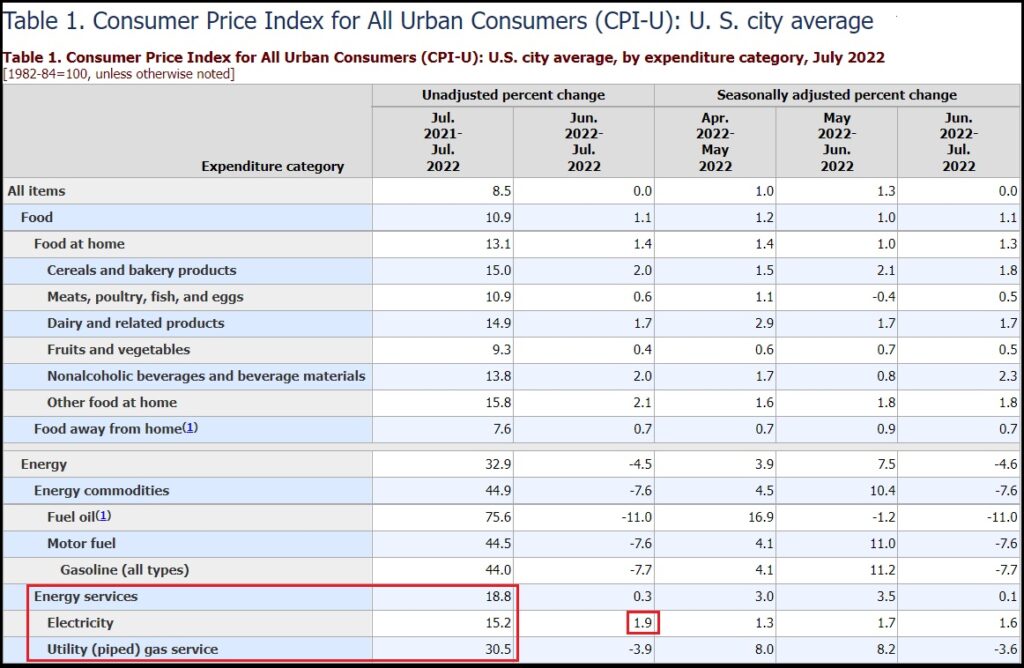
In July I noted my own electricity bill had jumped 28% in a single month. That bill was followed by another almost identical increase this month. A review of the Consumer Price Index (CPI) for July [Data Here] shows that nationally the same thing is happening. The year-over-year electricity price has increased 15.2%. However, worse still, the July increase alone was 1.9%, which figures to an annualized rate of 22.8%.
When the growth rate of monthly increase is exceeding the year-over-year result, that means future higher prices are coming. This is a serious problem that cannot be overstated. Already struggling with a doubling of gas prices, massive food price increases at the grocery store and the pain of all costs for goods far outpacing any rate of wage increase, this type of uncontrollable increase in price of electricity is going to hit the middle class hard.
Steve Cortes calls this the backside of the Biden created inflation hurricane. The backside of a hurricane is the worst because it hits from the opposite direction upon already weakened infrastructure.
The hurricane metaphor is apt because any increase in energy costs will be accompanied by the simultaneous arrival of another wave of food inflation, as the massive increases in field and crop prices start to feed into the food supply chain headed to our forks next month.
Making matters that much worse, Bloomberg is now reporting that 20 million households are now behind in their utility bills, specifically electricity bills, and the moratorium on shut offs has ended. [Paywall Article] Steve Cortes has written about the issue on his substack [Here].
One in six U.S. households, that is tens-of-millions of Americans, are now facing having their electricity turned off due to lack of payment. It is certainly understandable how this horrific outcome would happen. Joe Biden’s energy policies are destroying working class families with unsustainably higher prices.
20 million households is a catastrophic level of utility default. This is a serious issue with major social implications created by the desperation of those families. Middle- and lower-income families cannot survive this level of financial pressure.
.
Rents are behind. Mortgages are behind. Car payments are behind. And now this report on utility bills.
Steve Cortes appeared with Steve Bannon to discuss {Direct Rumble Link} – WATCH:
COMMENT: There has been and is increasing talk in all media of a coming ‘civil war’. Your article ‘Bidenomics & Vilification of Trump’ well explains the intentional polarization of the public and clearly states this will only end very badly.
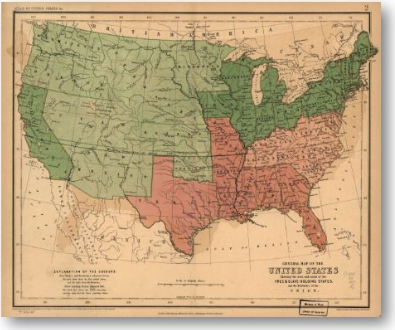
The CW of 1861 Blue vs Grey, North vs South was a war of geography – of brother vs brother if one lived in a Blue state and the other in a Grey state. Armies were formed and deployed based on geography as much as ideology.
Now we have talk of a civil war between ‘patriots’ DJT supporters versus I guess the rest of everyone else, or so it is threatened to be by the media pundents and alarmists. But Martin, this smells like a classic psychological operation employing all of the media and a tiny element of probably paid for) violent extremists who like to dress in all black. But how many Karen and Kens (Ds) are there that would actually take up arms because they don’t like Trump? How many because they love their electric cars? Will they begin shooting neighbors because of global warming?
The D politicians have never been able to provide any positive based reasons why they should be elected – only that they are anti-opponent – that might get a few votes but will not create an army. Your neighbor may be a liberal voter but is he armed and ready to start killing for these reasons? I think not.
Except for the DS/WEF/Globalists gang and probably a number of their armed 3 letter agencies. They control the media, have the jails, and the domestic physical enforcement personnel. They can use the media to try and create chaos, to cause false flag events in their favor, and shape public thought, and intern “create a media based CW”. A Wag The Dog CW.
They are the opposition – the enemy – the real danger. Do their combined numbers who could and actually would take up arms against the pubic even come to 1% of the nation? I doubt it. Have a CW against this 1% and you could call it “the most civilized war a civilized society could possibly have”. IMO, this should be done by the professionals as soon as yesterday. Gitmo and military justice for treason.
Glenn
REPLY: History whispers to us from the past because the one thing that is constant has always been Human nature. It really does not matter whatever the issue might be. Perhaps the most dominant reason has often been religion. Nero used that to blame the Christians for burning down Rome. The Diocletianic or Great Persecution was the last and most severe persecution of Christians in the Roman Empire. This again was not out of personal hatred of Christians. This was after the Monetary collapse of Rome during the 260-268AD time frame. Diocletian (284-305AD) persecuted the Christians because the general belief was that the gods were causing Rome to collapse BECAUSE of the Christians who were disrespecting the gods.
There was another religion rising known as the Manicheans. Diocletian issued an edict in 302AD against them as well for the very same reason – they were offending the gods who were punishing Rome. They were founded in the Persian Empire known as the Sassanid Empire and were followers of the prophet Mani (216-c.276). This became another widespread religion that infiltrated Rome, India, and China. It was based on a dualistic theology in which the theory was that the universe was divided between the divine plane of light and our own material plane of darkness. The Father of Greatness was not omnipotent, but he ruled the realm of light. Its opposite, the material realm, was controlled by the King of Darkness. These two forces did battle on both a cosmic and a personal level. Thus, within each individual soul, there was a battle. Manichaeism was clearly influenced by several other religions including Buddhism, Christianity, and Zoroastrianism.
So, no matter where we look in history, there is this eternal conflict between two ideas – left v right. The media is fueling the hatred of Trump and as we can see the new strategy is to hate Republicans for the November election when Trump is not running. But they are portraying him as evil and he now controls all Republicans so you better vote Democrat. That is the message being sent out all over.
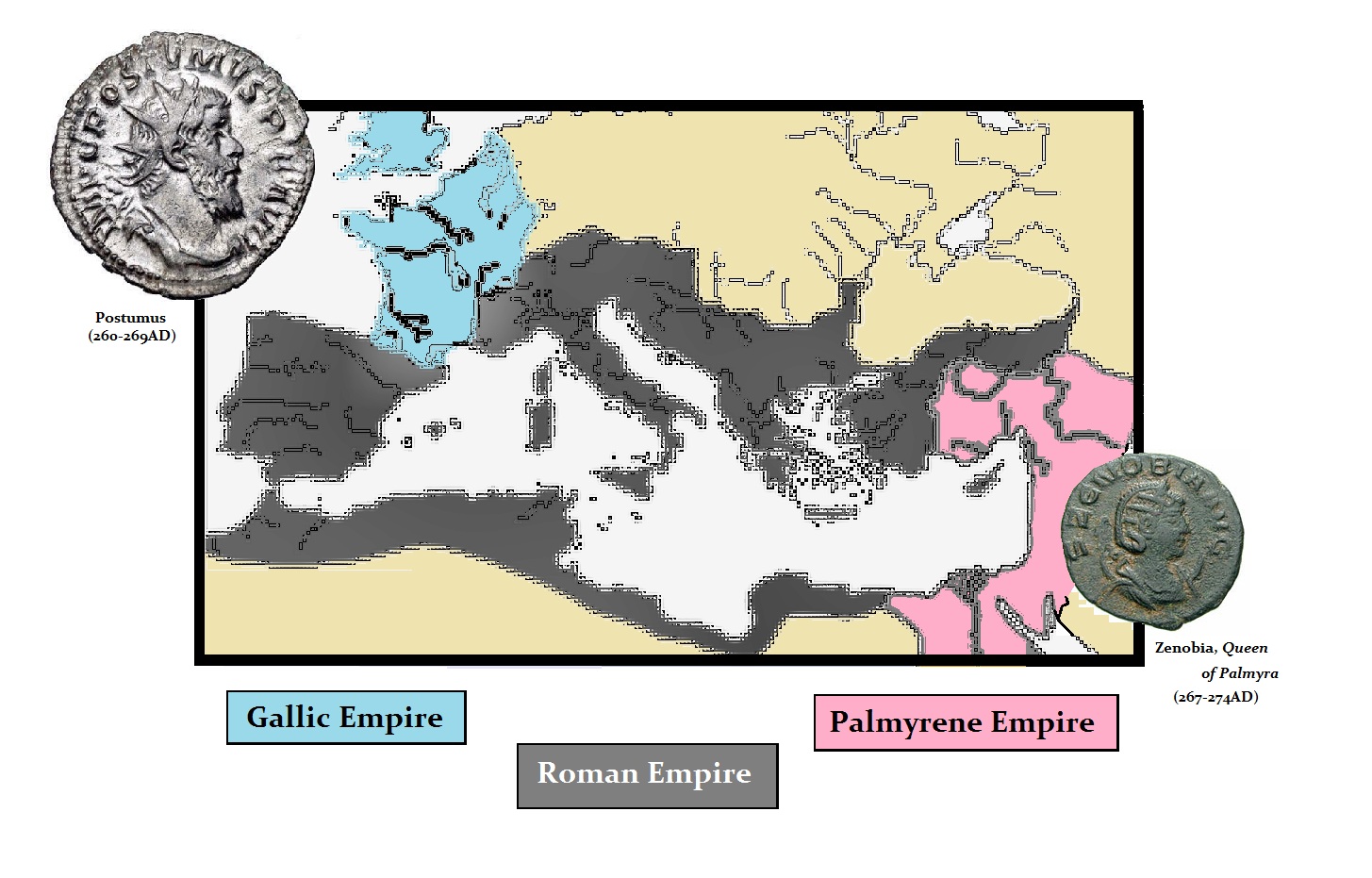
Here is a coin of Postumus who led the separation of Spain, France, and Britain to exist the Roman Empire. First, he was not trying to be another general who conquered Rome. He was pushing for separation and his coinage declare that he was “restoring” the region to sanity and safety. This is the most likely way we will see the United States split as is the case in Europe which will probably precede. I do not see armed armies leading the charge, nor do I see your neighbor picking up a gun and storming your house because you are the evil opposition. They will probably not speak to you and that is how it will begin.
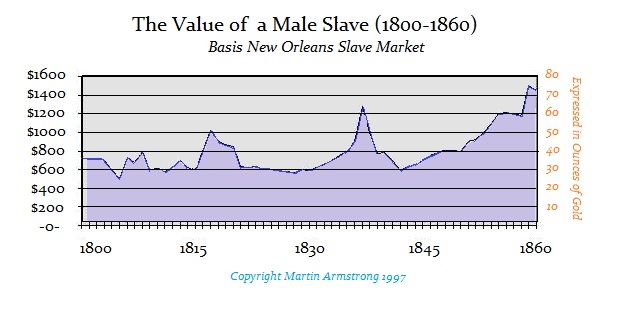
Armies are created by the rulers. They demonize their opponent to get the people to be willing to die on the battlefield for some noble cause. The US Civil War was promoted on religious grounds. There were slave owners who abused their slaves and beat them and the majority did not. The worst part of slavery was they could sell your wife or child. That was different from serfdom where you went attached to the land and could not be sold individually. The South fought over state’s rights which they want to deny today, but economically, slaves were valuable. It all began with indentured servants which were people in England sold to a plantation owner for their sentence of 2 or 5 years for a misdemeanor crime. That is why the Constitution forbids indentured servitude.
Ending slavery was taking away the workforce and it mean economic destruction. The vast majority of soldiers who fought for the South were not slave owners. They fought against Federalism that was dictating what their economy should have been. The vast majority of solider in the Confederate Army did not have the wealth to own slaves. They were very expensive. Historically, the US will split along the same lines. The middle of the country will join with the South up to Montana. This will divide the nation into three parts as what took place in Rome. The Pacific States will be California, Oregon, and Washington. I am surprised that the Washington States has not moved to rename itself Wokeville since GeorgeWashington inherited enslaved people at the early age of eleven and was therefore a slave owner. Thomas Jefferson also inherited slaves with his wife. They have removed his statues in NYC already! The man who wrote the Declaration of Independence.
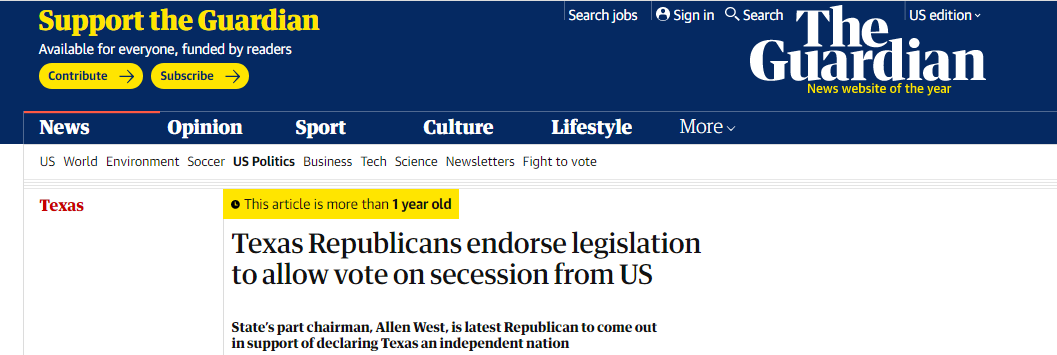
I would not expect the separation to come by force of arms. We will see this rise to a voting issue on both sides. Already on the 2022 ballot will be a question to secede from the United States in Texas and California. There are people talking about it here in Florida. The more Washington tries to impose its dictates on the States, we will see the rise in calling for secession from US. This was to be a union that retained state sovereignty. That was the US civil war and it will be again – just a different issue from slavery to economic slavery, climate mandates, vaccine mandates, and who knows what’s next – chip implants?
Similar to Pete Buttigieg’s braindead suggestion to simply buy an electric vehicle to combat energy inflation, the White House is now offering another solution for Americans crippled by inflation – stop being poor. While they did not say these words verbatim, their ideas behind taming inflation among low and middle-earning Americans are completely out of the realm of reality. Energy Secretary Jennifer Granholm patted the Democrats on the back for passing the Inflation Reduction Act.
“If you are low income, you can get your home entirely weatherized through the expansion from the bipartisan infrastructure laws, a significant expansion — you don’t have to pay for anything,” Granholm said, toting government rebates. Solar panels can run anywhere from $15,000 to $25,000 for an initial setup. Is this something people with little disposable income can afford? How about the growing number of renters who do not have this option even if it were “free.”
Granholm offered more belittling advice for the middle class. “If you are moderate income, today you can get 30% off the price of solar panels. Those solar panels can be financed, so you don’t have to have the big outlay at the front … it’s a significant incentive.” Oh wow, a 30% discount and only a six to 12-month wait for the tax credit! Forget about basic shelter costs and food, go ahead and finance expensive solar panels as your family starves on the streets.
This administration is completely out of touch with the needs of the American people. They have done absolutely nothing to lower energy inflation and are now gas lighting the people to believe WE can do more to combat prices not seen in 40 years.
I have created this site to help people have fun in the kitchen. I write about enjoying life both in and out of my kitchen. Life is short! Make the most of it and enjoy!
This is a library of News Events not reported by the Main Stream Media documenting & connecting the dots on How the Obama Marxist Liberal agenda is destroying America










 Centinel2012