Shortage of Bread Contributed to French Revolution


Armstrong Economics Blog/Agriculture Re-Posted Jan 27, 2023 by Martin Armstrong
Food shortages have historically contributed to revolutions more so than just international war. Poor grain harvests led to riots as far back as 1529 in the French city of Lyon. During the French Petite Rebeyne of 1436. (Great Rebellion), sparked by the high price of wheat, thousands looted and destroyed the houses of rich citizens, eventually spilling the grain from the municipal granary onto the streets. Back then, it was to go get the rich.
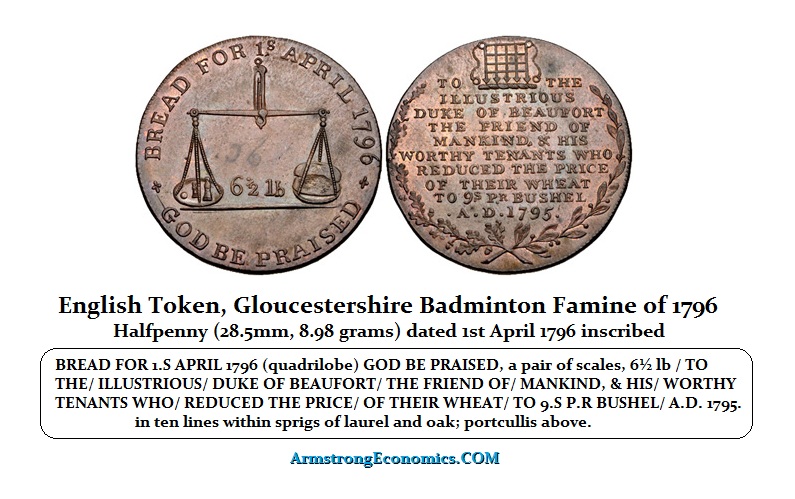
There was a climate change cycle at work and today’s climate zealots ignore their history altogether for it did not involve fossil fuels. The climate got worse at the bottom of the Mini Ice Age which was about 1650. It really did not warm up substantially until the mid-1800s. During the 18th century, the climate resulted in very poor crops. Since the 1760s, the king had been counseled by Physiocrats, who were a group of economists that believed that the wealth of nations was derived solely from the value of land and thereby agricultural products should be highly priced. This is why Adam Smith wrote his Wealth of Nations as a retort to the Physiocrats. It was their theory that justified imperialism – the quest to conquer more land for wealth; the days of empire-building.

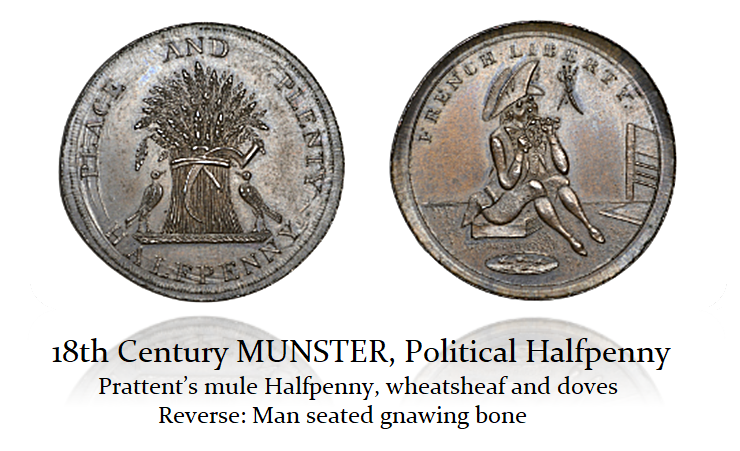
The King of France had listened to the Physiocrats who counseled him to intermittently deregulate the domestic grain trade and introduce a form of free trade. That did not go very well for there was a shortage of grain and this only led to a bidding war – hence the high price of wheat. We even see English political tokens of the era campaigning about the high price of grain and the shortage of food to where a man is gnawing on a bone.

Voltaire once remarked that Parisians required only “the comic opera and white bread.” Indeed, bread has also played a very critical role in French history that is overlooked. The French Revolution that began with the storming of the Bastille on July 14th, 1789 was not just looking for guns, but also grains to make bread.

The price of bread and the shortages played a very significant role during the revolution. We must understand Marie Antoinette’s supposed quote upon hearing that her subjects had no bread: “Let them eat cake!” which was just propaganda at the time. The “cake” was not the cake as we know it today, but the crust was still left in the pan after taking the bread out. This shows the magnitude that the shortage of bread played in the revolution.

In late April and May of 1775, the food shortages and high prices of grain ignited an explosion of such popular anger in the surrounding regions of Paris. There were more than 300 riots and looking for grain over just three weeks (3.14 weeks). The historians dubbed this the Flour War. The people even stormed the place at Versailles before the riots spread into Paris and outward into the countryside.

The food shortage became so acute during the 1780s that it was exacerbated by the influx of immigration to France during that period. It was a period of changing social values where we heard similar cries for equality. Eventually, this became one of the virtues on which the French Republic was founded. Most importantly, the French Constitution of 1791 explicitly stipulated a right to freedom of movement. It was mostly perceived to be a food shortage and the reason was the greedy rich. Thus, a huge rise in population was also contributed in part by immigration whereas it reached around 5-6 million more people in France in 1789 than in 1720.
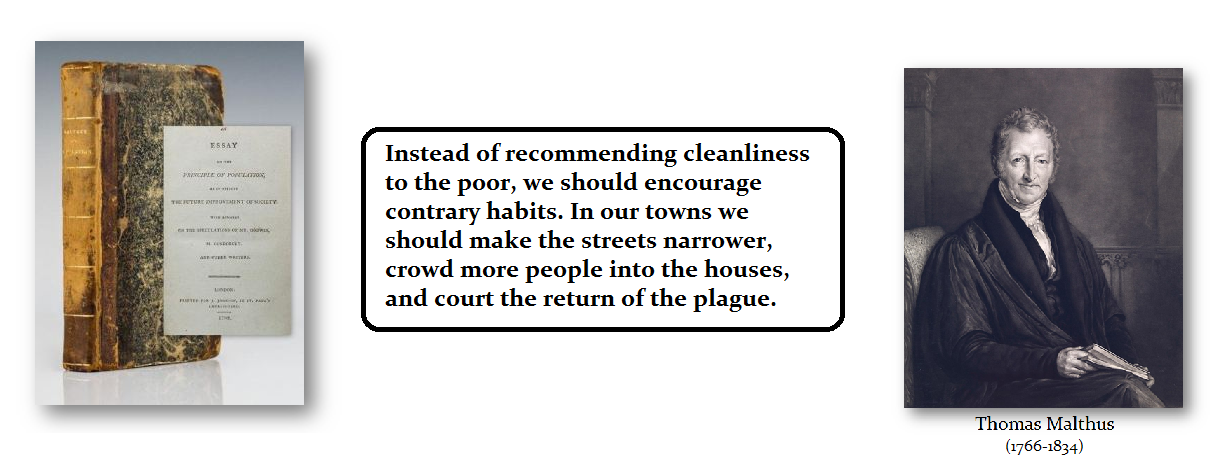
Against this backdrop, we have the publication by Thomas Malthus (1766-1834) An Essay on the Principle of Population was first published anonymously in 1798. He theorized that the population would outgrow the ability to produce food. We can see how his thinking formed because of the Mini Ice Age that bottomed in 1650. All of this was because of climate change which instigated food shortages. Therefore, it was commonly accepted that without a corresponding increase in native grain production, there would be a serious crisis.
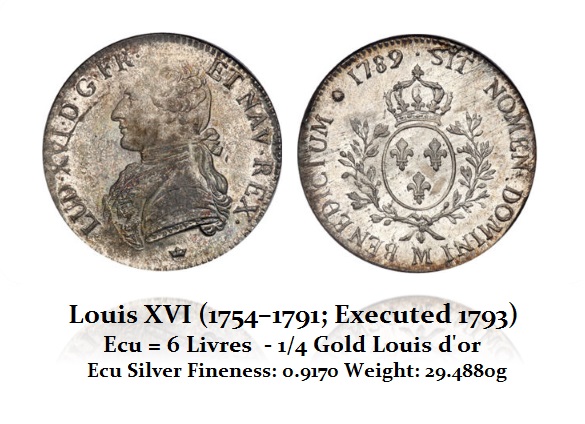
The refusal on the part of most of the French to eat anything but a cereal-based diet was another major issue. Bread likely accounted for 60-80 percent of the budget of a wage-earner’s family at that point in time. Consequently, even a small rise in grain prices could spark political tensions. Because this was such an issue, and probably the major cause of the French Revolution among the majority, Finance Minister Jacques Necker (1732–1804) claimed that, to show solidarity with the people, King Louis XVI was eating the lower-class maslin bread. Maslin bread is from a mix of wheat and rye, rather than the elite manchet, white bread that is achieved by sifting wholemeal flour to remove the wheatgerm and bran.

That solidarity was seen as propaganda and the instigators made up the Marie Antoinette quote: Let them eat cake. . Then there was a plot drawn up at Passy in 1789 that fomented the rebellion against the crown shortly before the people stormed the Bastille. It declared “do everything in our power to ensure that the lack of bread is total, so that the bourgeoisie are forced to take up arms.” 

It was also at this time when Anne Robert Jacques Turgot (1727-1781), Baron de l’Aulne, was a French economist and statesman. He was originally considered a physiocrat, but he kept an open mind and became the first economist to have recognized the law of diminishing marginal returns in agriculture. He became the father of economic liberalism which we call today laissez-faire for he put it into action. He saw the overregulation of grain production was behind also contributing to the food shortages. He once said: “Ne vous mêlez pas du pain”—Do not meddle with bread.

The French Revolution overthrew the monarchy and they began beheading anyone who supported the Monarchy and confiscated their wealth as well as the land belonging to the Catholic Church.  Nevertheless, the revolution did not end French anxiety over bread. On August 29th, 1789, only two days after completing the Declaration of the Rights of Man and of the Citizen, the Constituent Assembly completely deregulated domestic grain markets. The move raised fears about speculation, hoarding, and exportation.
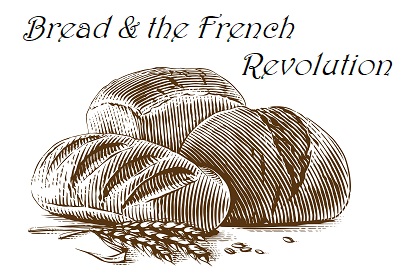
Then on October 21st, 1789, a baker, Denis François, was accused of hiding loaves from sale as part of a conspiracy to deprive the people of bread. Despite a hearing which proved him innocent, the crowd dragged François to the Place de Grève, hanged and decapitated him, and made his pregnant wife kiss his bloodied lips. Immediately thereafter, the National Constituent Assembly instituted martial law. At first sight, this act appears as a callous lynching by the mob, yet it led to social sanctions against the general public. The deputies decided to meet popular violence with force.

So, food has often been a MAJOR factor in revolutions. We are entering a cold period. Ukraine has been the breadbasket for Europe. Escalating this war will also lead to accelerating the food shortages post-2024. It is interesting how we learn nothing from history. Wars are instigated by political leaders while revolutions are instigated by the people.
Hoards Are Vital to our Understanding of History


Armstrong Economics Blog/Ancient Economies Re-Posted Jan 26, 2023 by Martin Armstrong

QUESTION: Why do you buy hoards? It is interesting. Just curious.

JY

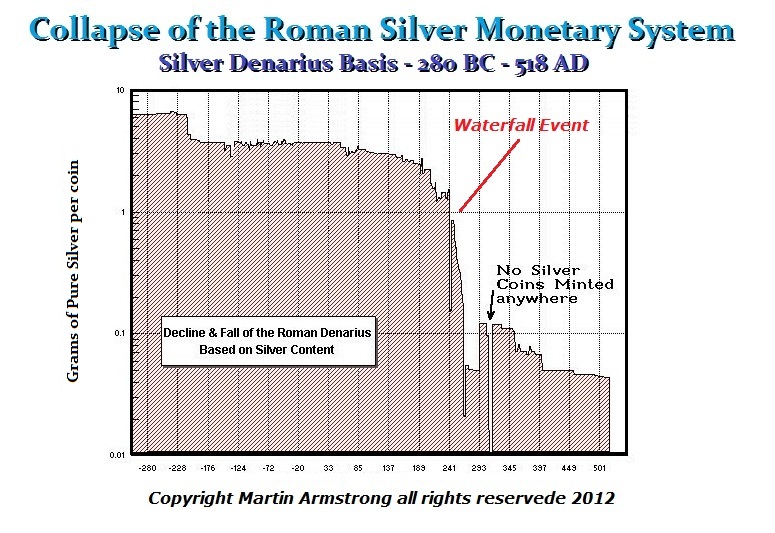
ANSWER: The coinage is the ONLY way to truly confirm the history. Much of the most important periods like the 3rd century AD, the fall of the Republic, or the Revolution during the Debt Crisis of the 1st century BC known as the Social War, can only be properly understood through the coinage lacking really detailed accounts of financially what was taking place. By recreating the monetary system using coinage, I was able to answer the question – How did Rome Fall? Gradually? Or Catastrophically? By assembling all the coinage, and testing it out, I could establish what nobody else could due using documents or archaeological digs. Rome collapsed in just 8.6 years.

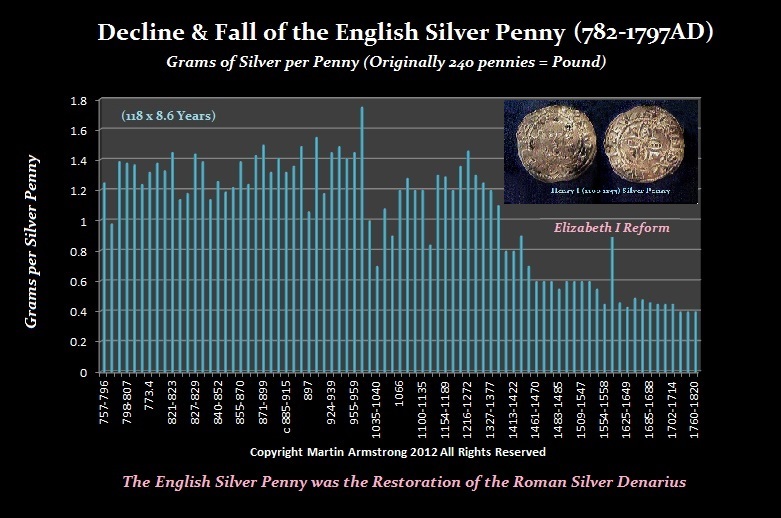
That was then observed in testing and using the same methods around the world. The collapse of the English coinage that inspired Gresham’s Law, bad money drives out good, also took just 8 years.

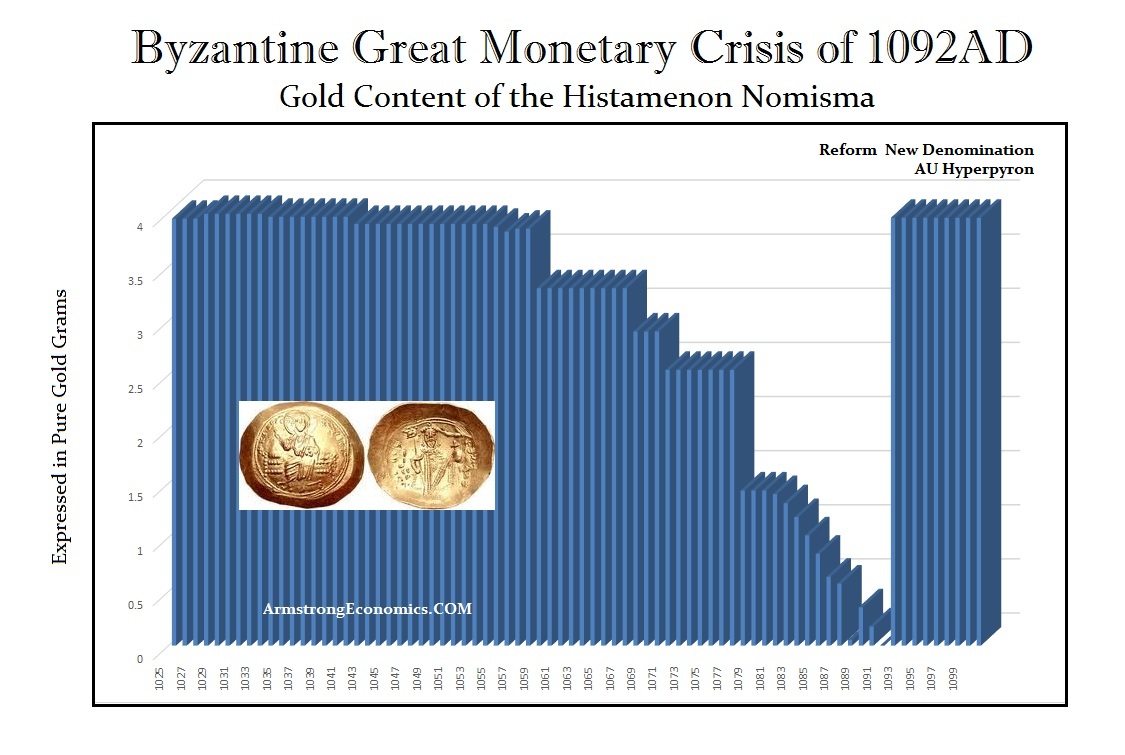
The Great Monetary Crisis of 1092 saw the gold content collapse also in just 8 years. The same pattern has unfolded time and time again. History repeats NOT because of wars or abstract theories. It repeats simply because human nature never changes – on technology.

The computer was about to forecast the fall of Communism in 1989.95 and it spread and took down the Berlin wall a few months after Tiananmen Square. People attributed that to modern communication. That was nonsense, The Roman Republic fell in 509 BC, and in the same few months in Athens, they too overthrew their tyrants, and Democracy was born.

The question is NOT how fast the information spreads. It could have traveled from Rome to Athens in a few days. The real question is how long does it take to filter through society to create political change?

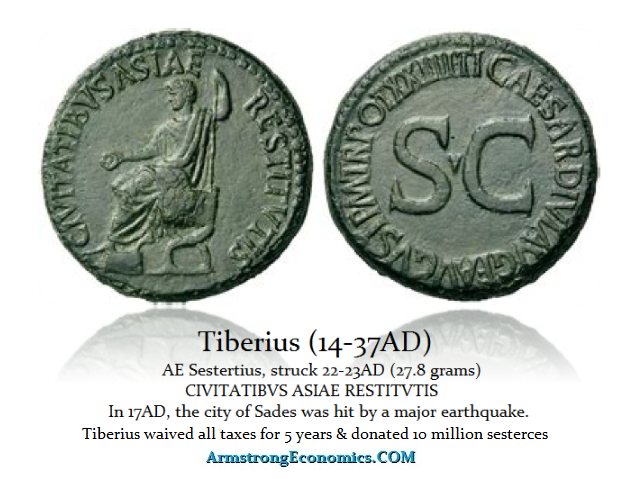
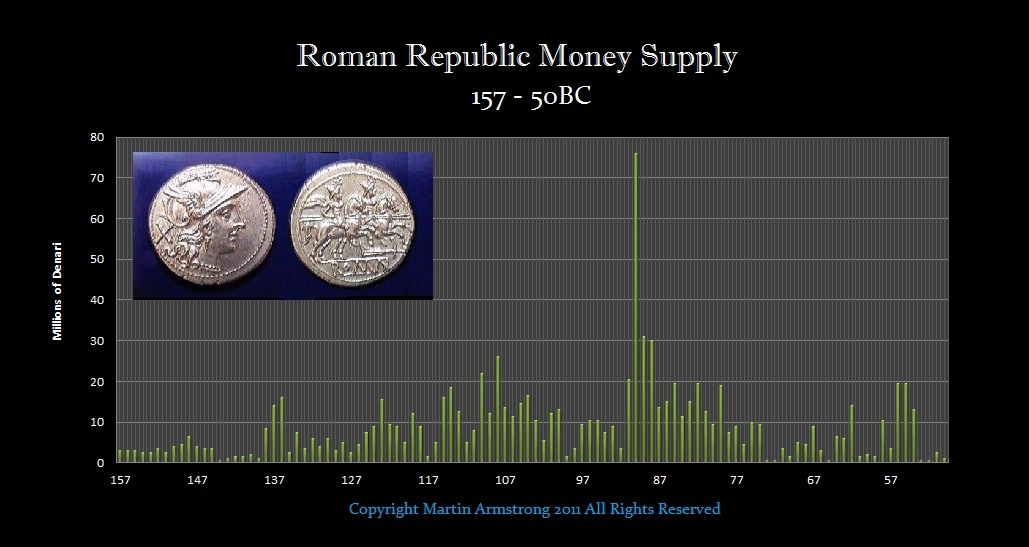
Therefore, assembling the number of coins by examining hoards and the number of different dies multiplied by 15,000 will give us a good idea of the money supply at that time as illustrated above. Granted, this research project cost tens of millions of dollars to produce. Nonetheless, it has yielded a wealth of information that enabled us to see specifically what took place economically. Human nature has not changed. When Rome burned, Nero did visit the victims. Tiberius issued coins for the aid of Asia when a major earthquake devasted the region we call Turkey today.

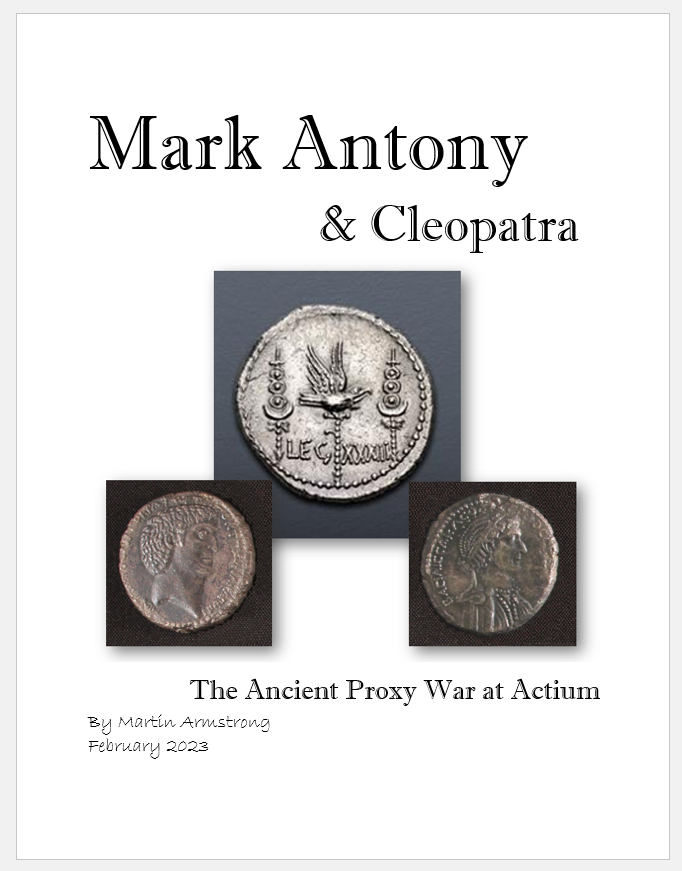
I am finishing a book on the famous Battle of Actium where Mark Antony lost to Octavian giving birth to Imperial Rome. The number of dies and the amount of coins issued by Antony demonstrates that the entire wealth of Egypt was at his disposal and it was really an Egyptian proxy war against Rome. The number of silver denarii struck had to be at least 25 million. The sheer massive amount of the increase in the money supply thanks to Egypt was huge. Antony’s coins remained in circulation for decades, although very work. They were the most common coin found in hoards at Pompeii in 79AD about 100 years later. Hoards enable us to see the cost of that war and how it changed Egypt and Rome.

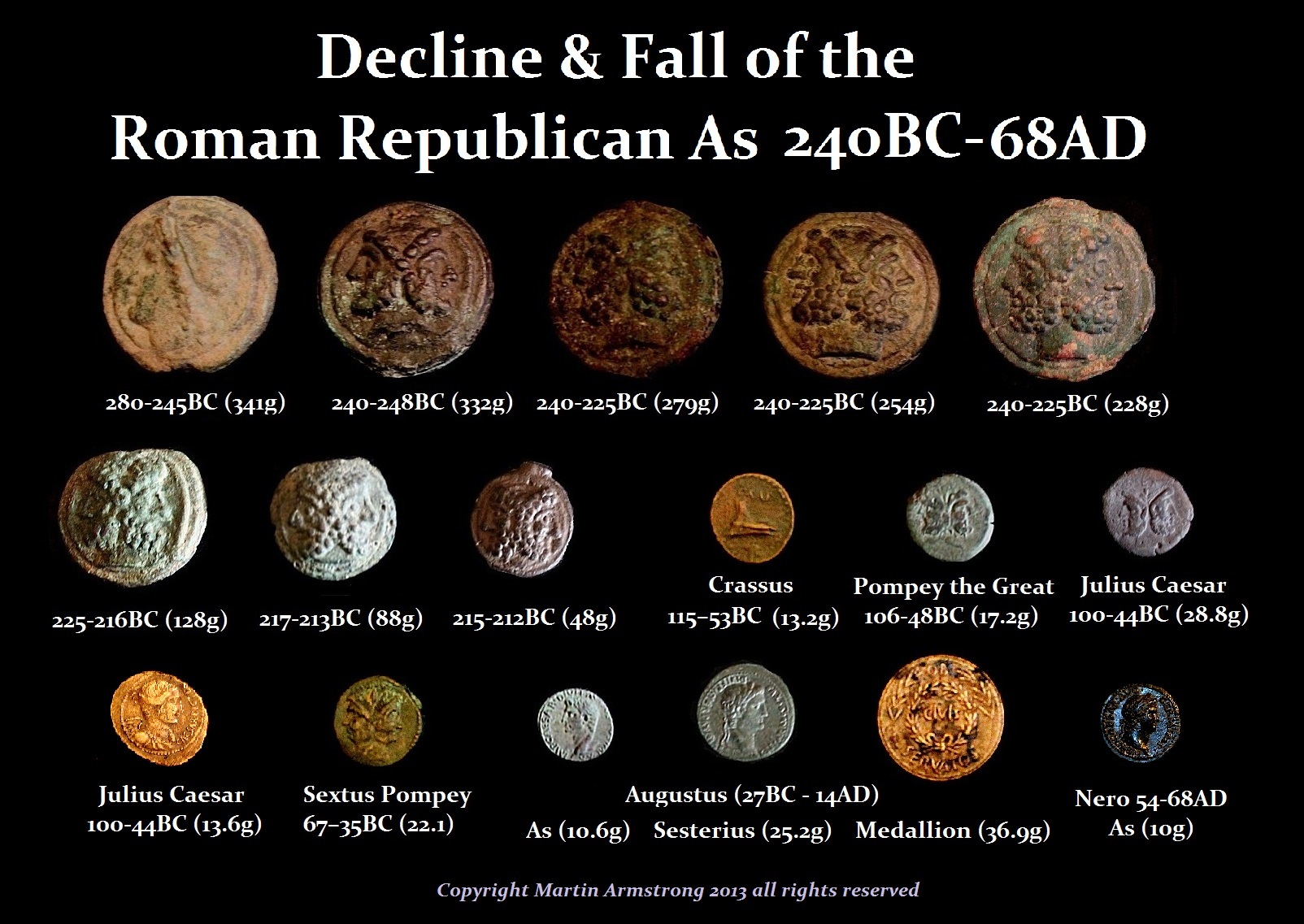
Where Rome began with bronze as its monetary unit and one pound was known as a Roman As, we can see that the price of the Punic Wars as what was one pound of bronze consistently declined. Here we found it was six waves of 51.6 years which are in themselves six waves of 8.6 years,  that produced the major wave of 309.6 years. So if we look from the beginning of the Roman As being 341 grams in 280 BC, by the time we get to Nero in 54AD, the Roman As was about only 10 grams.

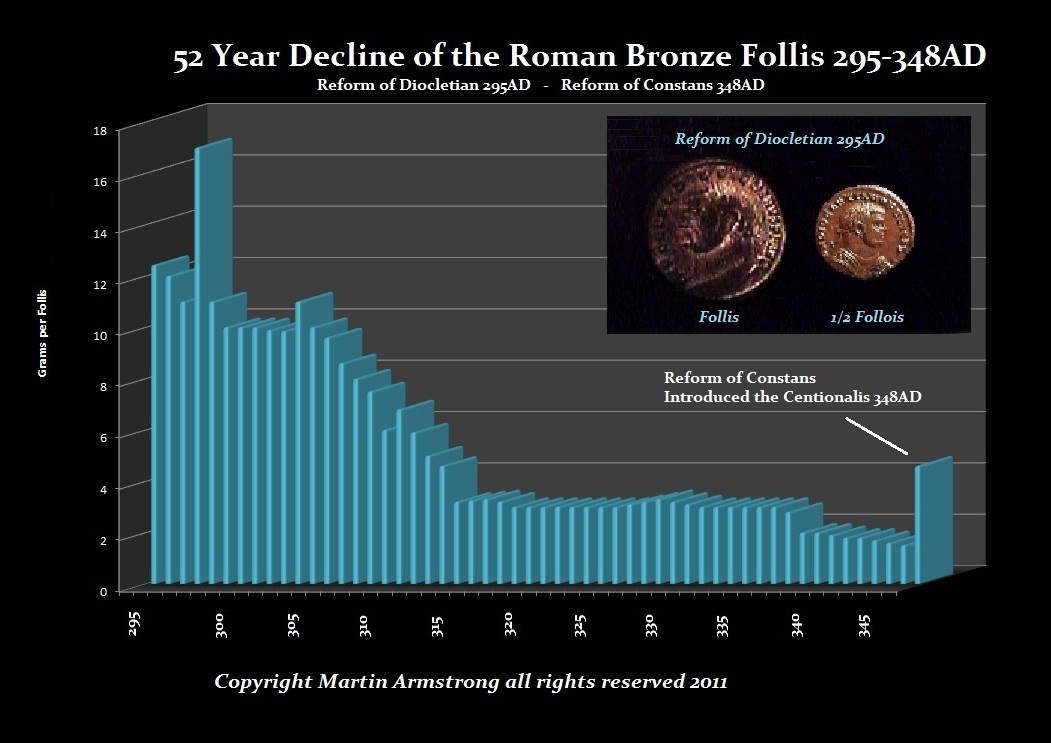
Even looking at the reforms of Diocletian in 295AD, his introduction of the follis declines remarkably also following the six waves of 8.6 years. I have looked at the monetary systems of Asia, the Middle East, Europe, and the Americas. they have conformed to the Economic Confidence Model confirming that this is a cycle that clearly incorporates everything from war to climate change.

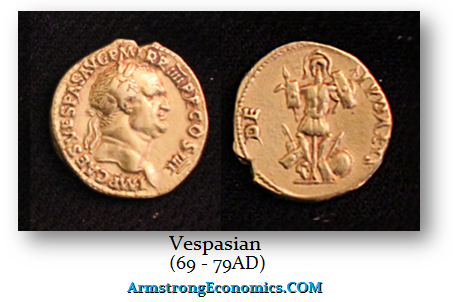
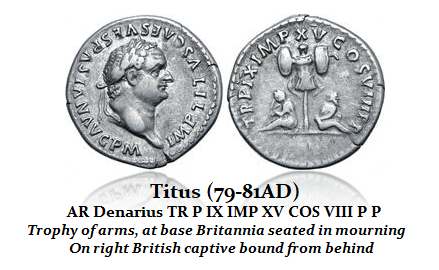
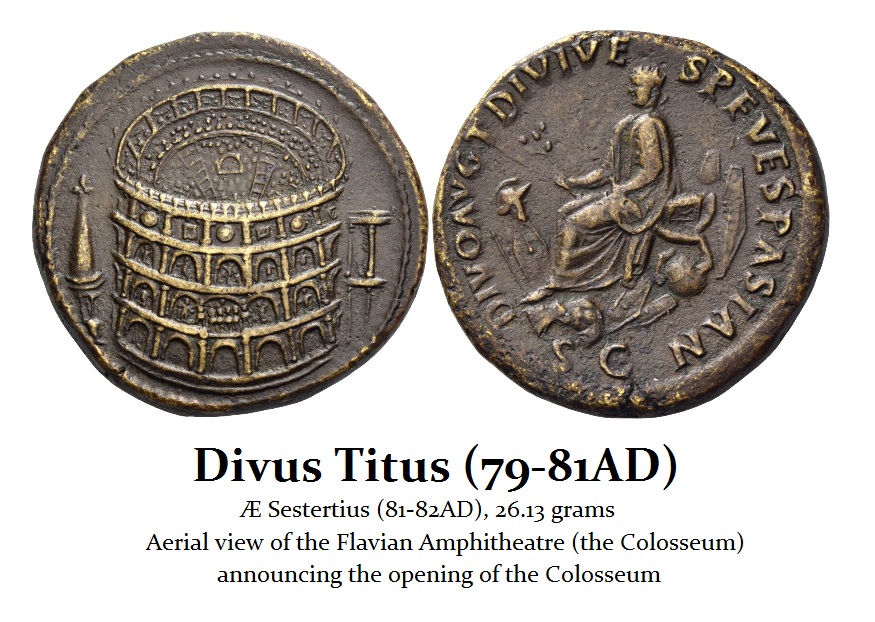
Even though Emperor Titus’ (79-81AD) reign was marked by a relative absence of military and political conflicts after his father, Vespasian (69-79AD) had defeated Judaea was defeated, there were several disasters during his brief leadership. On October 24 in 79 AD, Mount Vesuvius erupted and almost destroyed the cities and resort communities around Naples. The cities of Pompeii and Herculaneum were buried under stones and lava in 79AD shortly after Titus (79-81AD) came to power. Titus made all efforts to help the victims of the volcano and donated large amounts of money from the imperial treasury. The emperor visited Pompeii right after the tragedy happened.

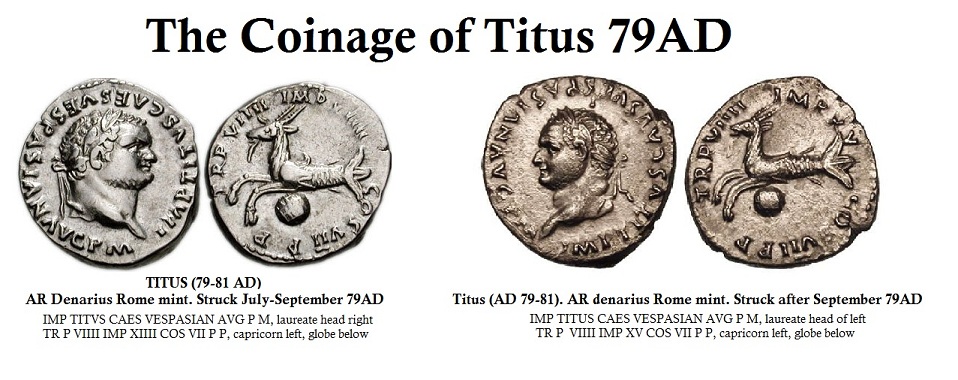
A single silver denarius was discovered in 1974 among the 180 silver coins buried in Pompeii. When it was cataloged, it overturned history. Titus’ father died on June 24th, 79 AD. Therefore, any coin of Titus as emperor would have to have the very first recording of his power “IMP VIIII” or 8th Imperator, which was a title that meant ‘leader of the army’ to the Romans. The coin discovered in Pompeii had the legend “IMP XV,” which was granted to Titus for the war in Britannia. Titus sent Gnaeus Julius Agricola who pushed further into Caledonia and managed to establish several forts there as recorded by Tacitus (Agricola 22). Therefore, Titus received the title of Imperator for the fifteenth time for this event, according to Cassius Dio (Roman History LXVI.20). This took place we know in September 79 AD about 3 months after becoming emperor following his father’s death. Obviously, if any coin was discovered in the ruins of Pompeii with “IMP XV” in its legend, then this provides absolute proof that the date for Vesuvius of August 24th, 79 AD cannot be correct.

Archeologists in Pompeii have discovered a remarkable inscription written in charcoal which has survived the catastrophe confirming that the eruption of Mt Vesuvius indeed took place in October 79AD as confirmed by the coin discovered and ignored by historians.  The charcoal writing, discovered on the wall of a villa during a new phase of excavations, adds weight to a theory that the volcano destroyed the town in October 79AD rather than August of that year in line with Cassio Dio and the denarius of Titus. The date of August 24th, 79 AD, came from a letter addressed by Pliny the Younger to the Roman historian Tacitus, originally written some 25 years after the event.

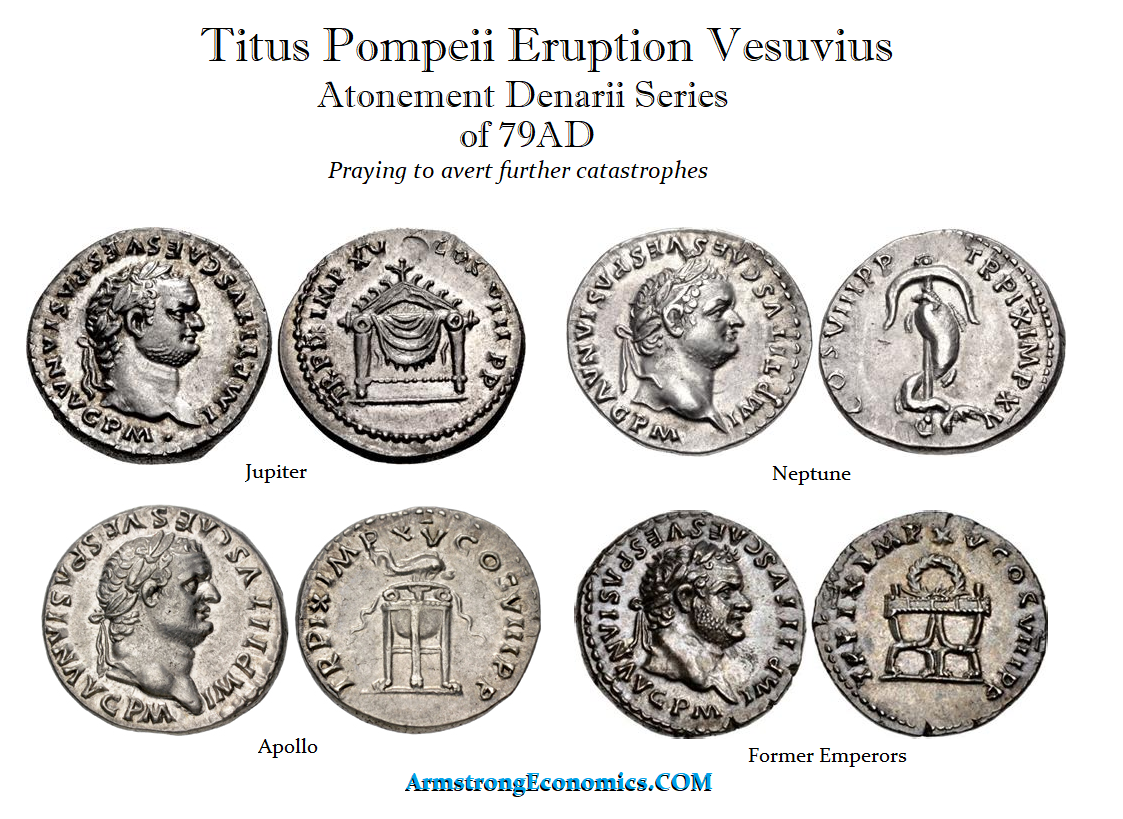
Titus devoted much of his silver coinage of Atonement to the gods for the disaster of Pompeii. There were four main Atonement issues commemorating the services of prayer and propitiation through which the emperor attempted to address the public alarm over the disaster. People often attributed such events to the gods being angry. The coinage showed emblems seeking the approval of Jupiter, Neptune, Apollo, and the deceased former Emperors to watch over the Roman people.
News actually spread rapidly around the Roman Empire. There were formal boards where notices would be posted in which important news and major events would be informed to the people much like such a board in a big company with notices to the employees. These boards were called the Acta Diurna and they were designed to inform the Roman people thereby avoiding fake news. We could call them ancient billboards in modern terms and even government officials would walk up and pin a written notice and the crowds would rush to see what is news. Thus, everyone knew of Pompeii in a matter of days. It did not take long for information to circulate.

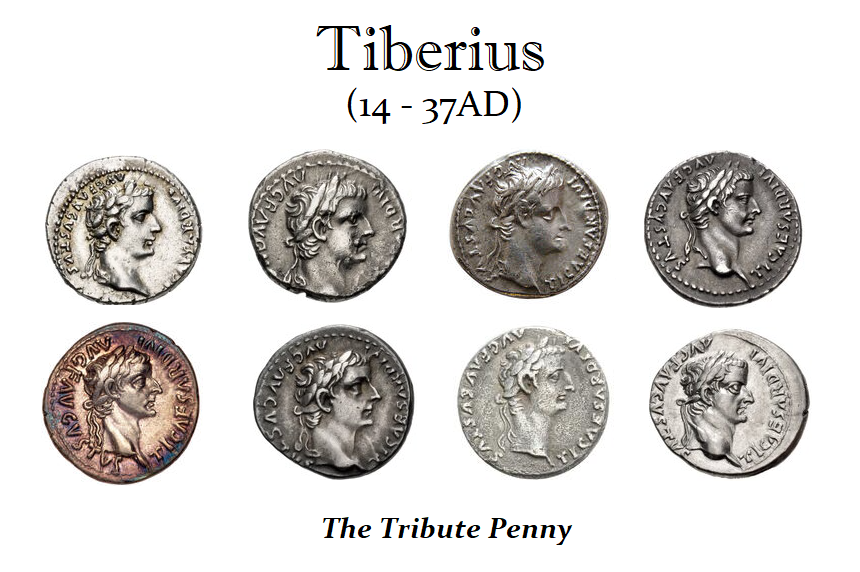
Because the coin dies back then were hand carved, we are able to identify the number of dies in use during a given year because each is unique. Just look at these portraits on the famous Tribute Penny of Tiberius (14-37AD). It all depended upon the artistic ability of the engraver.

The coin itself has taken its name because Jesus, referring to a denarius, which the English translated to “penny” because that was their silver coin, asked: “Whose is this image and superscription?” When answered that the likeness was Caesar, He replied; ”Render therefore unto Caesar the things which are Caesar’s and unto God the things that are God’s” (Matthew 22:20-21). Thus, the coin has been called the tribute penny meaning that was how you paid your taxes.

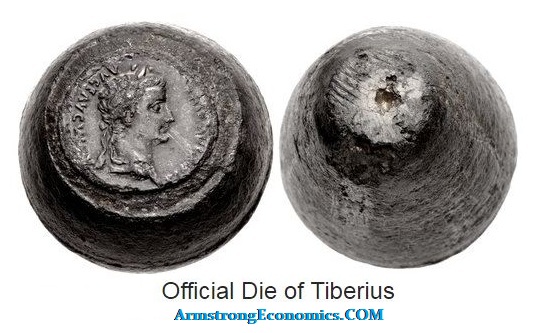
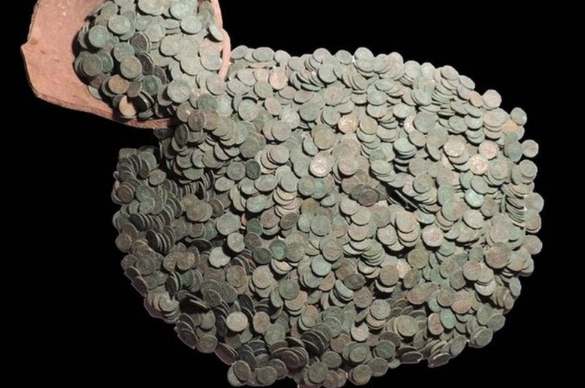
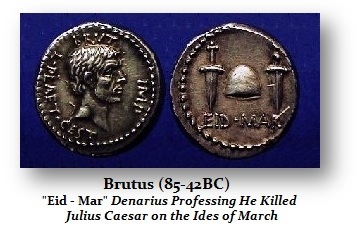
Hoards have enabled me to (1) see what was in circulation at that point in time for the hoard can be dated to around the most recent coin in the hoard. (2) I also have a number of ancient Roman dies like this one of Tiberius. Studies creating modern dies to test how many coins could be struck from such a die before it cracked provides a picture of about 15,000 coins.

By completing die studies quantifying how many were in use, it then becomes possible to estimate the money supply. Here we can see that during the Social War of 90-87BC, there is a drastic increase in the quantity of coinage issued obviously to pay for soldiers. However, conducting metal testing on the coinage of this period, we find that Rome also debased the coinage slightly adding up to 10% copper to the silver. Therefore, studying hoards allows one to actually ascertain the extreme of monetary affairs.

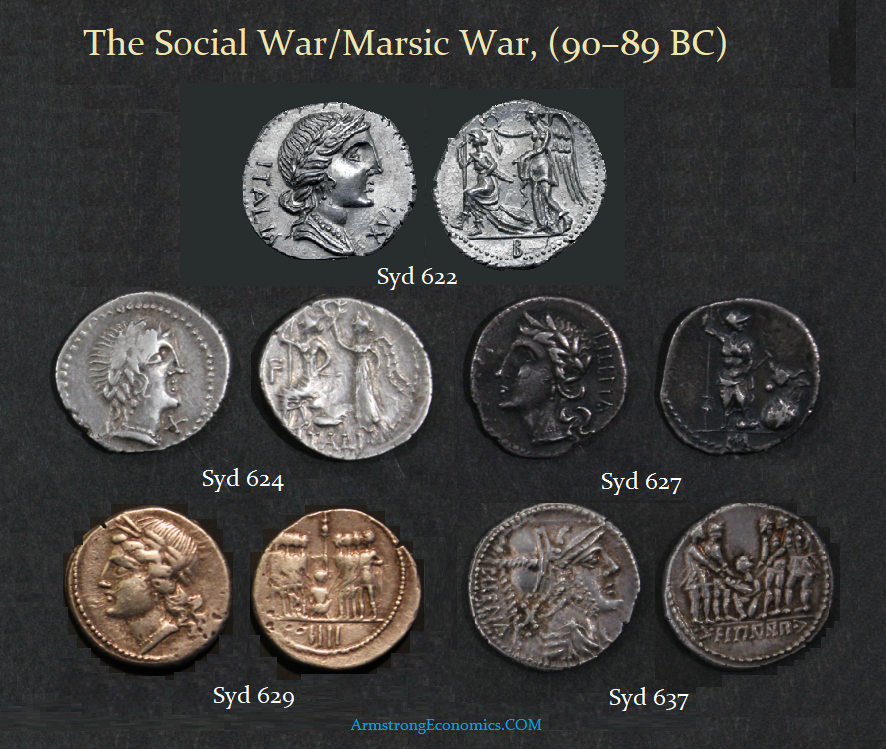
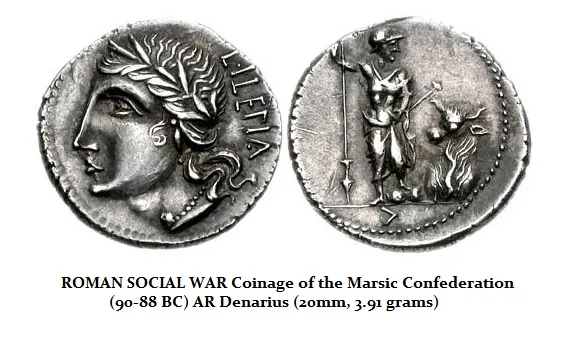
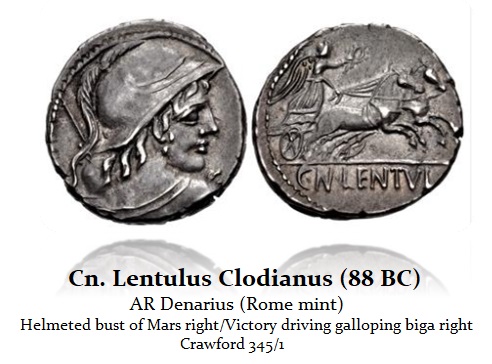
The Social War of the First Century BC was a failed Revolution against the corrupt Republic. The rebellion was waged by ancient Rome’s Italian allies (socii) who were denied equal rights with the Romans, despite the fact that they also fought alongside Romans in battle. They were seeking to separate and thus they fought for independence. Here are the coins of the rebels. They are very rare. You can see the theme celebrating the female head of Italia.
The allies in central and southern Italy had fought side by side with Rome in several wars and had grown restive under Roman autocratic rule, wanting instead Roman citizenship and the privileges it conferred. In 91 BC, the Roman tribune Marcus Livius Drusus proposed granting them Roman citizenship. The arrogance of the Senators erupted into a heated opposition. They went as far as to even Drusus for daring to propose such a decree. That resulted in the revolution.

When I dug deeper, the coinage with the debasement also reveals that there was a financial crisis. In all honesty, it was the Debt Crisis that ended the Roman Republic. There was a Sovereign Debt Crisis during the Roman Republic period that resulted in a dictatorship and a debt default. The Roman Debt Crisis of the 1st century BC has left behind a vivid account of what took place. The volume of gold and silver in Italy had increased dramatically during the late 2nd century BC following the Punic Wars. We have the first real gold coins issued by the Roman Republic at that time.

However, this concentration of wealth, which was akin to the United States after World War I and II, was absorbed by commercial expansion and investment in Gaul and Asia. A period of excessive concentration of money and large profits came to an end with the rise of the Social War of 91-88BC which was a war waged between the Roman Republic and several of the other cities in Italy (no taxation without representation), which prior to the war had been Roman allies for centuries. The war was begun by the Picentes because the Romans did not want to afford them Roman citizenship, thus leaving the Italian groups with fewer rights. The war resulted in a Roman victory and genocide against the Samnites. However, Rome granted Roman citizenship to almost all of its Italian allies, including the Samnites, to avoid another war. Therefore, we find that the debt crisis was correlated with a separatist movement – which we are beginning to see worldwide starting in Europe, but will eventually become a contagion in the United States as the conflict between left and right erupts after the November elections.

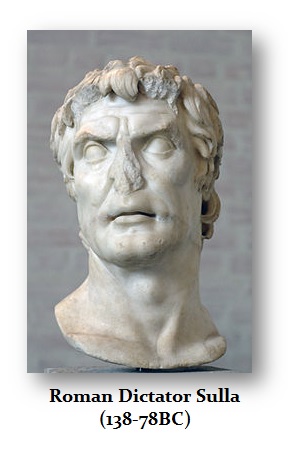
The Social War led to the complete state bankruptcy of the Roman State. We can see the dramatic rise in the money supply created during this time of war. This turmoil was then followed by the dictatorship of Sulla who then imposed an attempt to control the debt crisis capping interest rates at 12%. The previous legal rate was capped at 8.5%, but obviously, the market had exceeded that limit and Sulla had to confront that reality in 88BC. The debt crisis continued and then in 86 BC, the government was compelled into default. This is when the Valerian Law came into play. The State debts were defaulted on and thus reduced to 25%.

The Coming Great Global Default


Armstrong Economics Blog/Economics Re-Posted Jan 25, 2023 by Martin Armstrong

QUESTION: Dear Martin
Could you please describe more in detail what you are expecting when talking about the breakdown of the monetary system?
Will there be differences between countries like Germany and Switzerland for example? Especially regarding pension systems.
I assume, there might be big differences between countries.
Many thanks and best regards,
R.

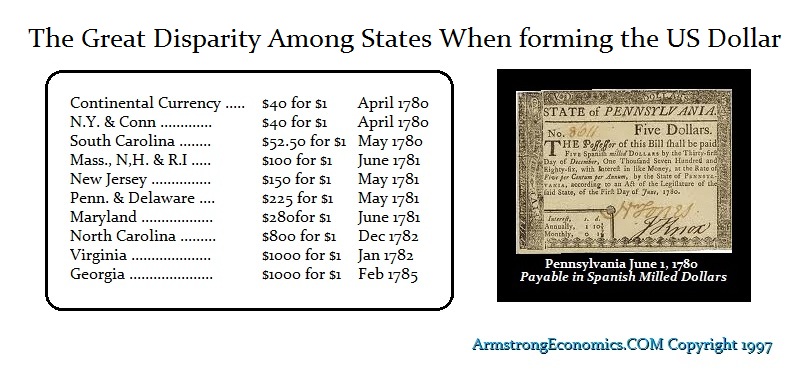
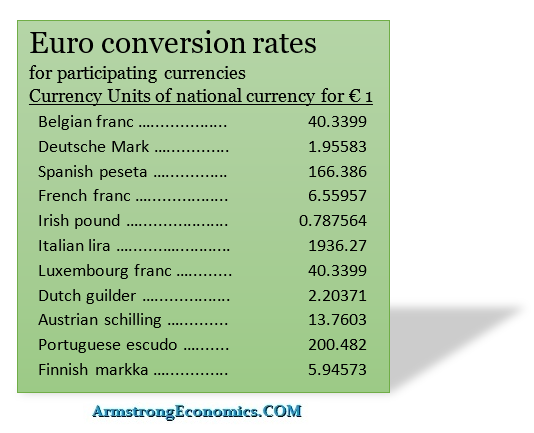
ANSWER: The monetary system collapsed with the winning of the American Revolution. The state currencies and the federal Continental Currency were all exchangeable to the new currency which became the U.S. dollar. There was a great disparity among the states with each being rated by the marketplace for the swap. Even when they created the Euro, there were differences between each currency.

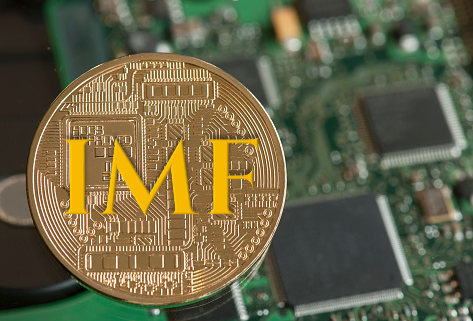
The IMF right now is pushing very hard behind the curtain to replace the dollar with an IMF digital currency that they want to become the reserve currency. This would be EXTREMELY dangerous for the IMF is deep in corruption. The complaint of China, for example, is that the dollar is the reserve currency and they see that as a dangerous power in the hands of an adversary.

I have written much on the real problem of the dollar acting as the reserve currency and that this has thrust the Federal Reserve into the default role of the central bank of the world. The problem is all the propaganda against the Fed that is spun by the goldbugs which totally distorts the real crisis. They try to sell gold only on the quantity theory of money which dates back to the 17th century. It is so antiquated it is laughable. It is entirely domestic-focused to the exclusion of the world economy and international capital flows. Unfortunately, the Federal Reserve is also living in the past and only sees the economy in domestic terms making it Fed Policy v Fiscal Policy, over which they have no control.

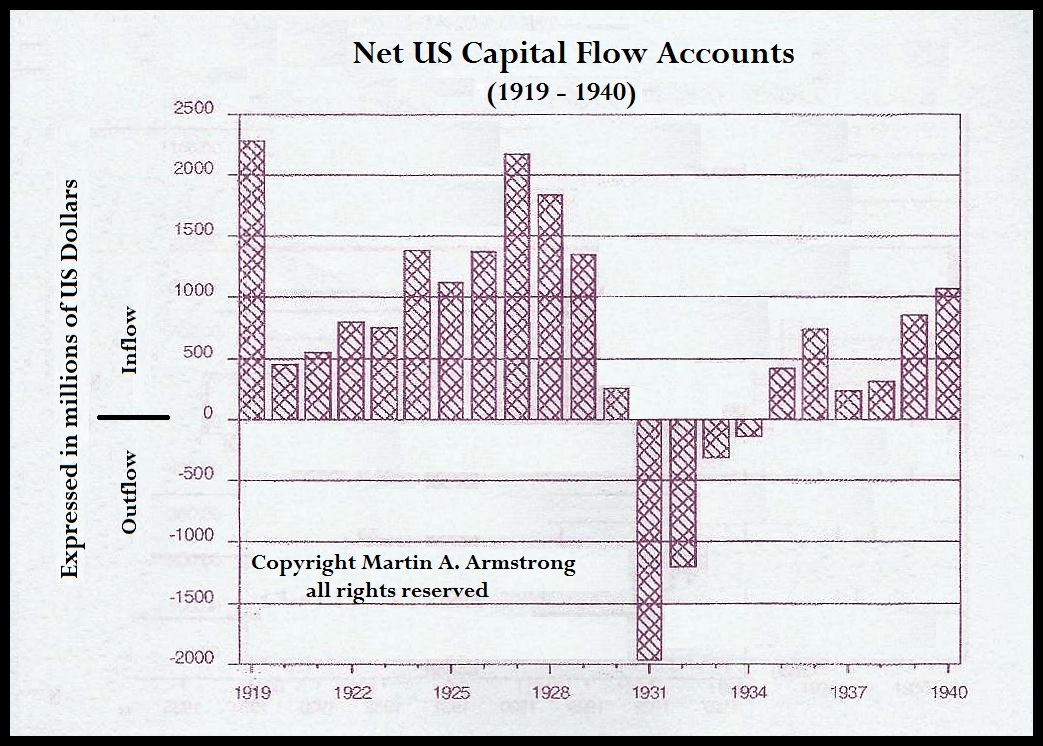
Only when you understand international capital flow movement will you ever even catch a glimpse of the real world. World War I sent the capital fleeing Europe and rushing to America. Because that capital was here, it increased the domestic buying power and the Europeans made the 1920s ROAR. They were participating in the Auto-Stock-Boom.

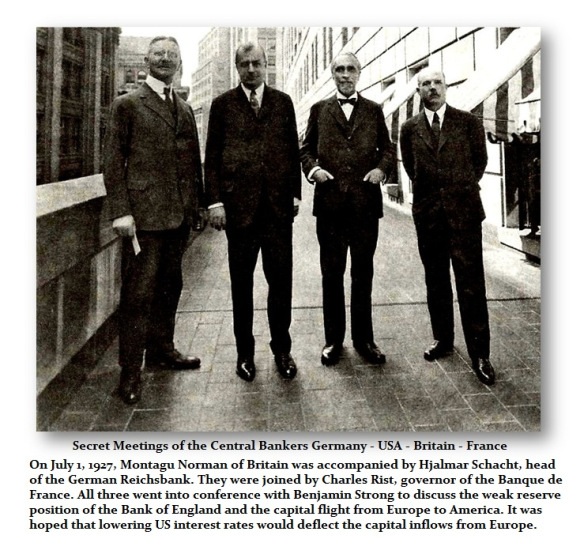
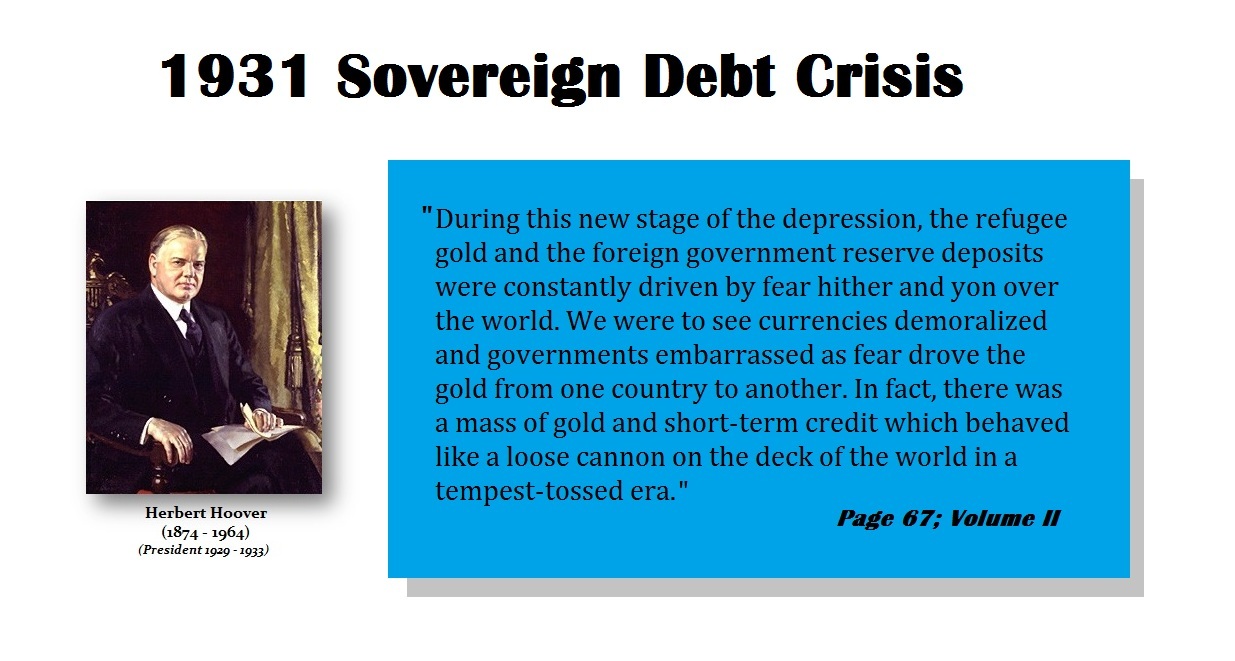
The first G4 took place in 1927 when the other central banks argued that the US had to lower its interest rates to deflect international capital which was needed in Europe to rebuild. Indeed, the capital inflows peaked in 1927 and began to decline. But it was the Sovereign Debt Crisis of 1931 that compelled major capital outflows to cover losses at home.

Hoover explained the crisis in 1931 in his Memoirs. So to answer your question will take a major report which I intend to publish. The subject is highly complicated and there will be major divergences that people must be aware of. The bottom line is that all governments intend to default on their prior debts. That is what unfolded even with the collapse of the Continental Government after winning the American Revolution.

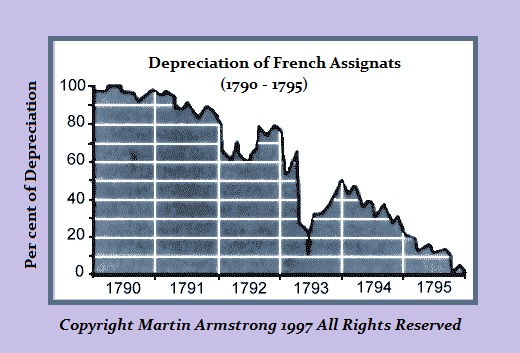
We see similar outcomes also in France with their Revolution. We are staring into the eyes of a major global default in debt and we are on schedule cyclically for the next sovereign default period.

Here We Go Again – Altering the Formula for CPI


Armstrong Economics Blog/Inflation Re-Posted Jan 24, 2023 by Martin Armstrong

There are some who are claiming that the revision of the CPI is to help the Federal Reserve stop fighting inflation. This is typical for Americans who only watch the Fed and nothing else. The formula for the CPI has been routinely altered. Real Estate used to be included but when that was rising too much, they replaced that with rents. When rents started rising, they replaced them with controlled rents.

This is NOT about helping the Fed to lower rates or stop raising rates as the majority seem to be touting. Powell is not that stupid and this will have ZERO impact on Fed decisions going forward. This is all about government spending which is a far greater problem than worrying about the pressure on the Fed. Virtually EVERY government program is automatically INDEXED to CPI. Thus, agencies’ budgets are automatically increased each year based on the CPI. Your taxes are indexed to the CPI. By reducing the CPI, they collect more taxes! There is NOBODY in Congress or at the Bureau of Labor Statistics that gives the Fed a second thought.

Even if we look at inflation using the pre-1980 formulas, the CPI is approaching 10%! When we calculate inflation by eliminating everything that is really irrelevant and focusing on food, energy, transportation, and taxation, which they do not consider at all, the reality of our number came in at 32% for 2022. That is a far cry from the official number. This is simply calculated by Socrates from an unbiased perspective.

What a new wonderful world the Biden Administration has created. Thank you, COVID & the Russian Sanctions. The largest increase we found was obvious fuel between gasoline and diesel used in trucking and homes averaging 65%+ Turning to basic food, eggs were up nearly 50%, flour rose by 25%, cooking oil 23%, butter was up 35%, Chicken by 14%, and Rice by 18%. If we throw in toothpicks, paperclips, etc, then the more we can include the lower the inflation rate. We do not include rent or real estate. Our number is far more accurate to the daily living expenses than the near 10% level of the government. They also do not include sales taxes. The national average rise in rental rates was 7.8%, in Florida it was 8.5%, and in NYC 1.5% when controlled.

When I would buy a desktop IBM XT during the 1980s, it was always about $7,000 for a top-of-the-line. Today, that cost has come down significantly. Obviously, we do not buy computers every week. Should that really be part of a formula? The BLS has made so many revisions to the CPI over the decades it is really a political tool these days.

Back in the ’90s, our staff was dissecting every statistic. We discovered that they were overstating economic growth because they counted government employees twice. The total all personal income, and then government spending. I called the head of the BLS and asked surely this had to be backed out somewhere for hiring government employees to increase GDP rather than the private sector. They reviewed it and finally just said – no comment.

The idea that this latest revision of using one year as a weight instead of two will allow the Fed to stop tightening is really the rantings of people who only look at the Fed for everything as their guidance. There is a lot more incentive behind this revision and the Fed was not a consideration.

2023, The Year of The Great DC UniParty Getting Exposed – Example Coming with Biden and McConnell Making Deal on Debt Ceiling


Posted originally on the CTH on January 22, 2023 | Sundance 

CTH has predicted the most significant political revelation in 2023 will be the exposure of the Washington DC UniParty, and one of the largest moments for this sunlight is going to come with the “debt ceiling” extension.

The background to understand this level of sunlight, comes specifically because 20 House Republicans have taken a stand with bold contrast.  Whenever there is a bold contrast situation, the UniParty is exposed because the lavender hues where red and blue overlay is not possible.  The House20 have created a situation where Speaker Kevin McCarthy cannot hide, and there are enough MAGA Republicans to expose how the conniving UniParty apparatus really works.

Within the CBS political discussion, Robert Costa puts the upcoming ‘debt ceiling’ discussion into context while revealing how the White House is approaching the issue.  Costa is a vested weasel, but what he says in this segment is accurate.  Joe Biden will work with Mitch McConnell in the Senate to subvert the House of Representatives, because the House -as structured by the MAGA coalition- is now viewed as the enemy to both the White House and Senate republicans.

OMG, guys, like how lucky are we right now?

You don’t have to guess if Costa is correct on this, because the evidence is already in place.  What Costa is describing is exactly how and why the 2023 Omnibus spending bill was put together by the White House, Mitch McConnell and Chuck Schumer before the Republican control of the House took place.  Senate Republicans, led by Mitch McConnell, are structurally aligned with Democrats against the House Republicans.

The CBS panel is essentially having a conversation saying, ‘How lucky are we’ that Mitch McConnell is a Democrat right now?   And this is the truest nature of the UniParty in action.

[Transcriptvideo at 02:21] – MARGARET BRENNAN: Well, I’m glad you bring that up, because the other thing that the departure of the chief of staff raises questions about is this looming policy and political conversation about the debt ceiling.

Who runs point on that? Obviously, the Treasury secretary has a huge role. But in terms of talking to the Hill and the negotiations, who’s doing that if the chief of staff is leaving?

ROBERT COSTA: What I’m told from people inside the West Wing is that President Biden himself has a relationship with Mitch McConnell, the Senate Republican leader, of course, with Chuck Schumer, the Senate Democratic leader.

They are in some ways going to try to cut out Speaker Kevin McCarthy and the House Republicans. There’s not an appetite among Democrats to put spending cuts on the table at all. They would like to see a clean debt limit extension. And Jim Clyburn, one of the top Democrats in the House, recently told me he could see a scenario where centrist House Republicans band together with House Democrats for a clean debt limit extension.

[…] ROBERT COSTA: Privately, I’m told President Biden and Senator McConnell have chuckled behind the scenes with longtime friends about how at this stage in divided government, it’s these two men who have long been friends who are being counted upon to perhaps cut a deal.

I remember, when I first started covering Congress a decade ago, I would remember Vice President Biden was the one…

MARGARET BRENNAN: Yes.

ROBERT COSTA: … who came to the Capitol to meet with Senator McConnell to cut a deal on that so-called fiscal cliff way back then.

So, they have that history, and they were recently in Kentucky together, showing at least, not political solidarity, but in terms of a personal relationship, there’s a real rapport.”  Video Prompted:

December Retail Sales Drop -1.1%, November Sales Data Revised Lower to -1.0%


Posted originally on the CTH on January 18, 2023 | Sundance 

There is something predictable about Main Street economics, eventually what you see around you overwhelms the great pretending.  CTH has been outlining the state of the consumer economy in great detail for quite a while, and though it is difficult to note when the outcomes will surface, eventually they do surface. [Reminder Here]

CONTEXT. CTH outlined the moment when the purchasing power of the U.S. middle class actually began contracting.  It was March and April of 2021 when that Rubicon was crossed.  We saw it in the second and third quarter data from 2021, but few were willing to admit.

What changed in those two months back in ’21 was a dramatic drop in the “unit sales” of stuff within the consumer economy.  The drop in unit sales was hidden because it happened simultaneously with the first wave of massive spike in prices.  Prices rose so fast the sales data was giving an artificial impression of sales growth, but in the background the actual unit sales dropped.   Those analysts correcting and adjusting historic data to ‘inflation adjusted terms’ are now noticing.

Additionally, and not coincidentally – because the metrics are connected, you will note this line from the Wall Street Journal review of the producer price index. “The producer-price index, which generally reflects supply conditions in the economy, rose 6.2% in December from a year earlier, the Labor Department said Wednesday, the slowest annual pace since March 2021.”  In essence, the current rate of wholesale price increase on materials is now returning to the rate of price increase that happened in the period when prices spiked.  Again, this is predictable.

Inflation is the measure of the ‘rate’ of price increase over time.  March and April of 2021 were the beginning of the first inflationary spike.

Driven almost entirely by the supply side shock from Biden energy policy, in the subsequent 20 months the rate of price increase skyrocketed, peaked August 2022, and now the rate of increase starts returning.  This does not mean price declines; this means the rate of growth in the price increase is lessening.

This is a cyclical outcome.

After 20 months of dropping unit sales, a result of massive price increases; and as the rate of inflation now starts to moderate created by the cyclical nature of it; what we now see is the inability of the price increases to continue hiding the drop in unit sales.   [Background pdf Data] Total retail sales data is now exposed and that’s why we will see this increasing story about negative sales data as the inflation cycle plateaus.

(Via Wall Street Journal) – Retail spending fell in December at the sharpest pace of 2022, marking a dismal end to the holiday shopping season as rising interest rates, still-high inflation and concerns about a slowing economy pinched American consumers.

Purchases at stores, restaurants and online, declined a seasonally adjusted 1.1% in December from the prior month, the Commerce Department said Wednesday. Sales were also revised lower in November and have fallen three of the past four months.

The decline in retail spending late last year adds to signs that the U.S. economy is slowing. Hiring and wage growth eased in December, U.S. commerce with the rest of the world declined significantly in November, and existing-home sales have fallen for 10 straight months. The Federal Reserve said Wednesday that industrial production slumped in December, led by weakness in the manufacturing industry.

S&P Global downgraded its estimate for fourth-quarter economic growth by a half percentage point to a 2.3% annual rate after Wednesday’s data releases. Economists surveyed by The Wall Street Journal this month expect higher interest rates to tip the U.S. economy into a recession in the coming year.

“The lag impact of elevated inflation weighs heavily on U.S. households, it’s very clear that the median American consumer is still reeling from the loss of wages in inflation-adjusted terms,” said Joseph Brusuelas, chief economist at RSM US LLP. “We’re moving towards what I would expect to be a mild recession in 2023,” he added. (read more)

When the Baghdad Bob economic pretenders say, “mild recession,” anticipate something more akin to a mild nuclear meltdown, something with breadlines and soup kitchens.

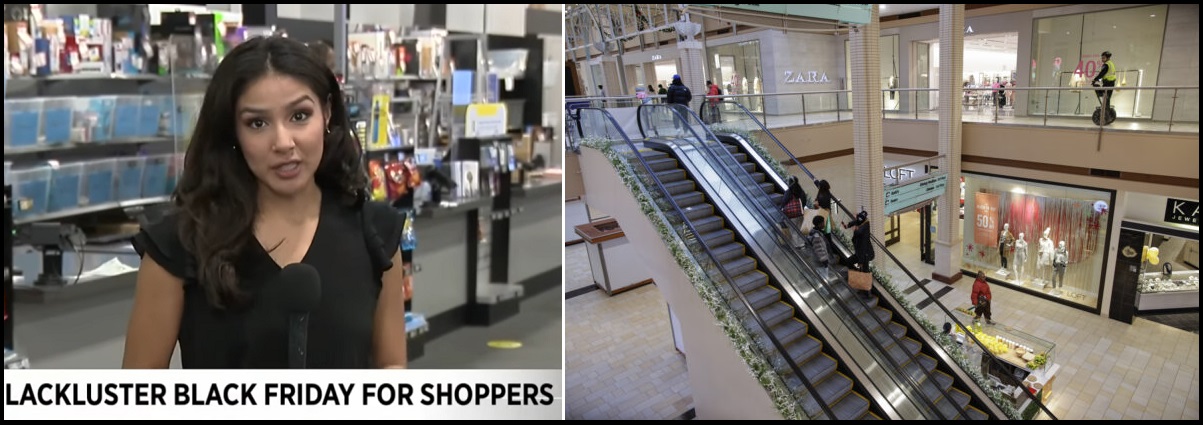
Now, you must keep in mind that almost every financial media outlet used the same Retail Federation talking point about anticipating an 8% increase in holiday sales last year.  [Reminder] Apparently, collective pretenses must be maintained.  Meanwhile, news crews and camera crews were having a desperate time finding any holiday shopping to use as background footage for the claims that sales were strong.  Here we are in January and the pretending has hit reality.

Negative retail sales in November and December when prices are roughly +10% over the prior year, means the unit sales collapse was far more dramatic…. Far more.

Trying to survive policy driven price increases in housing costs, energy costs, electricity costs, home heating, food and fuel costs has forced consumers to reevaluate purchasing decisions.  Consumer demand for non-essential items has collapsed, and Americans are dig deep into their savings just to sustain unavoidable expenses.  Eventually, pretending this is not happening is going to run into the wall of reality.

On one hand the leaders of large multinationals must pretend everything is splendid; after all, the only acceptable position they can articulate is to support interest rates being raised because demand is just too darned high….  pretending.  But on the other hand – those same suppliers and multinationals are furiously trying to calculate how to avoid being stuck with billions worth of unsold inventory and idle industrial equipment.

Who is America’s Enemy? Russia or the other Political Party?


Armstrong Economics Blog/Politics Re-Posted Jan 18, 2023 by Martin Armstrong

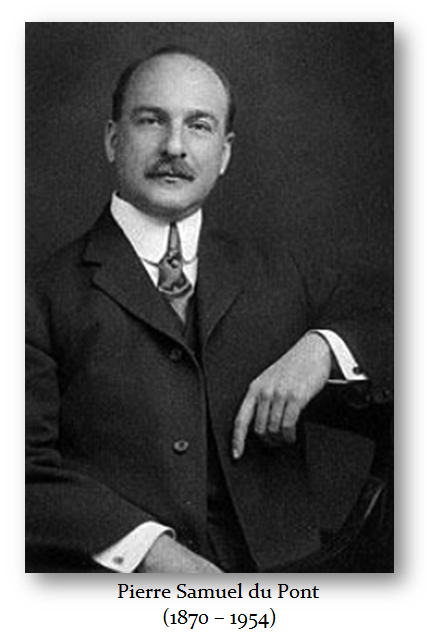
In writing the Greatest Bull Market in History, published in 1986, I had to do all the original research. I read all the newspapers daily year after year to come to the realization that attitudes shift back and forth. It became very obvious that before FDR and the introduction of Marxism to the United States, the focus was on markets. With Roosevelt, he weaponized the Federal Reserve and just about everything else to further his agenda. Roosevelt demonized Pierre du Pont for he made a lot of money providing the weapons for World War I. Roosevelt called him the Merchant of Death, but then suddenly needed him again for World War II.

The nation is dividing significantly. This is why the United States cannot stand divided. The latest poll demonstrates that the forecast made by our computer is unsurpassed. The question presented was who is our enemy?

For Democrats, the top three results named Russia (31 percent) as our “greatest enemy,” followed by Republicans (26 percent) and China (16 percent).

For Republicans, the top three are China (35 percent), Russia (33 percent), and Democrats (12 percent).

We now are starting to see that we have an enemy within – the opposite political party. This is absolutely essential for it confirms the forecasts of our computer that have been common since our 2011 WEC.

In the Before Times….


Posted originally on the CTH on January 17, 2023 | sundance

Be rebellious and have fun doing it.

Live your best life.

Sunday Talks, Maria Bartiromo Interviews Matt Taibbi About the Twitter File Discoveries, DHS and FBI Officials asking Twitter to Unmask Thousands of Users


Posted originally on the CTH on January 15, 2023 | sundance 

Journalist Matt Taibbi appears on Sunday Morning Futures with Maria Bartiromo to discuss his findings within the ongoing review of the Twitter communication files.

As Taibbi notes, the FBI was asking for the unmasking of several thousand accounts to include usernames, use identity, ip addresses, geolocation of the account holders and other personal identification data that would normally require a search warrant.  The Dept of Homeland Security (DHS), the FBI and in some cases the CIA would submit these requests and Twitter was fulfilling, albeit sometimes uncomfortable in the compliance demand.  WATCH:

.

If you have followed the research behind “Jack’s Magic Coffee Shop,” none of this is likely surprising.  However, the ramifications and blatant violations of the fourth amendment are quite stark.   It was not that long ago when you would have been accused of being a conspiracy theorist for making these now provable claims.

Mr Taibbi continues to provide the most pertinent takeaways from his reviews.  And to his credit, Taibbi always notes there is a pre-filter applied to the information he is receiving; so, it’s highly likely the intelligence state is still controlling the scope of public awareness behind the justification of “national security”.