August Labor Report Shows 315,000 Job Gains, Internal Data a Much Bigger Concern


Posted originally on the conservative tree house on September 2, 2022

The Bureau of Labor and Statistics (BLS) released the August Jobs Report [DATA HERE].

The topline is a net gain of 315,000 jobs with an increase in unemployment to 3.7%.  However, the June and July jobs reports were revised down by 107,000 lower than previously reported, and if you look carefully at the data, you can see a serious problem.

Keep in mind, in the background is a release yesterday showing productivity within the economy dropping in the second quarter by 4.1%. [DATA]  Combine the drop in productivity with higher wages of 5.7% and total wage costs per unit of business output are up 10.1%.  Now we turn back to today’s employment release, and look at these three points of data:

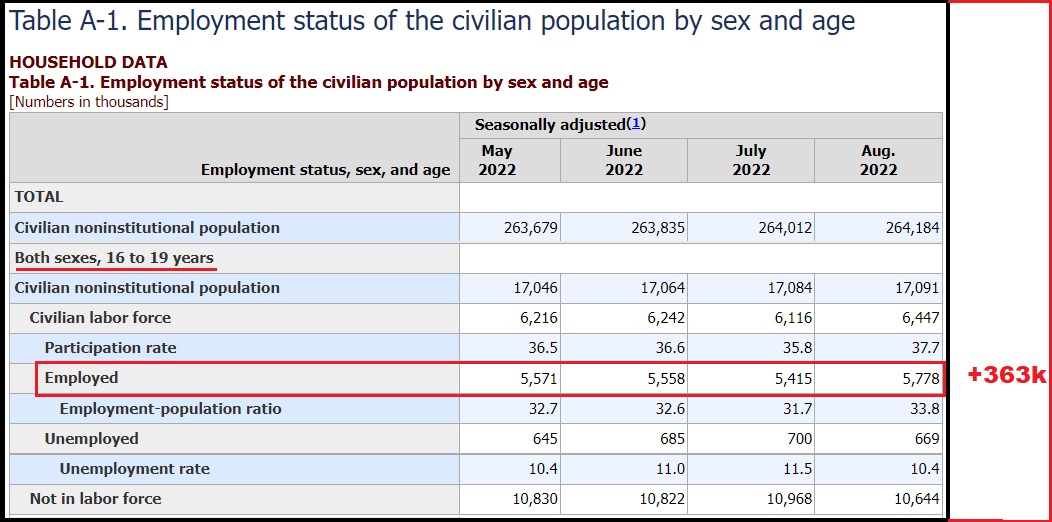
(1) Unemployment for adult men and unemployment for Latinos increased in August.  Adult men and specifically adult Latino men are losing their jobs. (2) The average number of hours worked in August dropped 0.1 hour to 34.5 hours. (3) Total employment amid those aged 16 to 19-years of age increased by 363, 000 in August:

The graphic is modified Table A-1 to focus on ‘age’

 •Total economic productivity drops [biggest quarterly drop since 1948].  •Men and Latinos are losing jobs.  •Average hours worked drops.  •Teenage employment increases. What do these four facts tell you?

A total of 363,000 more teenagers started working in August, yet the total net gain in employment overall was 315,000 jobs.   That should be the headline of the August 2022 jobs report.

(CNBC) […] The unemployment rate rose to 3.7%, two-tenths of a percentage point higher than expectations, largely due to a gain in the labor force participation rate to 62.4%, tied for the highest level of the year. A broader measure of unemployment that includes discouraged workers and those holding part-time jobs for economic reasons climbed to 7% from 6.7%.

Wages continued to rise, though slightly less than expectations. Average hourly earnings increased 0.3% for the month and 5.2% from a year ago, both 0.1 percentage point below estimates. (more)

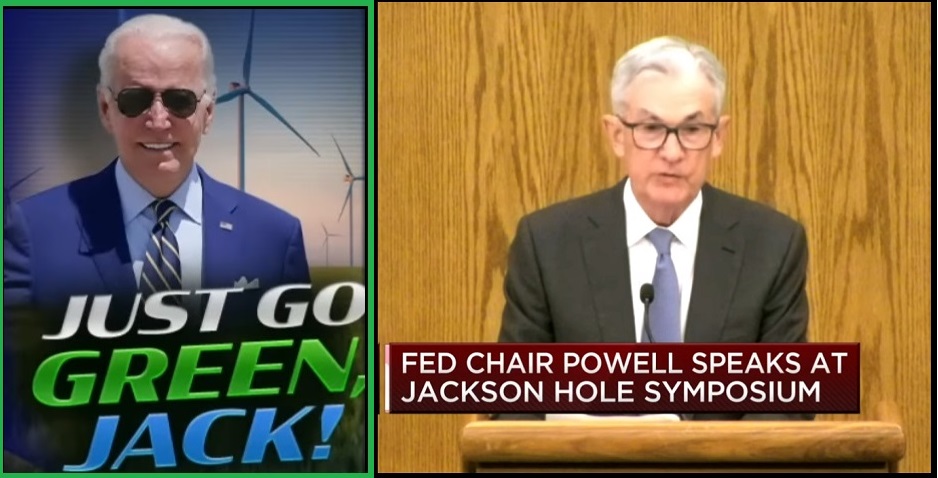
Jerome Powell Says Fed Effort to Make U.S. Economy Smaller Will Create “Some Pain” for Americans During Biden Transition to Clean Energy


Posted originally on the conservative tree house on August 26, 2022 | Sundance

When Chairman Powell says things are really, really going to suck as monetary policy tries to support Biden’s goals to reduce energy supplies, will people believe him?

The agenda of the federal reserve was clearly outlined today in the remarks from Chairman Powell in Jackson Hole, Wyoming.  The Fed chair is trying to manage the economic policy transition by reducing economic activity to match intentionally diminished energy supplies.  Lowering economic activity drops demand for energy. Unfortunately, as admitted by Powell today, this means a period of “some pain” for Americans as the central banks join together in an effort to lower consumption.  WATCH:

What does “some pain” mean?  It means lower incomes, higher prices, lowered standards of living and more scarce resources.   During this transition to owning nothing and being happy about it, the pain is your wealth being stripped as the economy is intentionally diminished.

We will not be able to afford much; we won’t be able to afford the foods we want; we will not be able to purchase anything except the essentials, and those essentials will cost much more; we won’t be able to vacation, travel, or enjoy recreational activities; we won’t be able to afford any indulgences; but at the end of the process, we will learn to live more meager existences based on lowered expectations needed for sustaining the planet.   Pay no attention to the elites who don’t have those concerns, comrade.

[Transcript] – POWELL: “At past Jackson Hole conferences, I have discussed broad topics such as the ever-changing structure of the economy and the challenges of conducting monetary policy under high uncertainty. Today, my remarks will be shorter, my focus narrower, and my message more direct.”

The Federal Open Market Committee’s (FOMC) overarching focus right now is to bring inflation back down to our 2 percent goal. Price stability is the responsibility of the Federal Reserve and serves as the bedrock of our economy. Without price stability, the economy does not work for anyone. In particular, without price stability, we will not achieve a sustained period of strong labor market conditions that benefit all. The burdens of high inflation fall heaviest on those who are least able to bear them.

Restoring price stability will take some time and requires using our tools forcefully to bring demand and supply into better balance. Reducing inflation is likely to require a sustained period of below-trend growth. Moreover, there will very likely be some softening of labor market conditions. While higher interest rates, slower growth, and softer labor market conditions will bring down inflation, they will also bring some pain to households and businesses. These are the unfortunate costs of reducing inflation. But a failure to restore price stability would mean far greater pain.

The U.S. economy is clearly slowing from the historically high growth rates of 2021, which reflected the reopening of the economy following the pandemic recession. While the latest economic data have been mixed, in my view our economy continues to show strong underlying momentum. The labor market is particularly strong, but it is clearly out of balance, with demand for workers substantially exceeding the supply of available workers. Inflation is running well above 2 percent, and high inflation has continued to spread through the economy. While the lower inflation readings for July are welcome, a single month’s improvement falls far short of what the Committee will need to see before we are confident that inflation is moving down.

We are moving our policy stance purposefully to a level that will be sufficiently restrictive to return inflation to 2 percent. At our most recent meeting in July, the FOMC raised the target range for the federal funds rate to 2.25 to 2.5 percent, which is in the Summary of Economic Projection’s (SEP) range of estimates of where the federal funds rate is projected to settle in the longer run. In current circumstances, with inflation running far above 2 percent and the labor market extremely tight, estimates of longer-run neutral are not a place to stop or pause.

July’s increase in the target range was the second 75 basis point increase in as many meetings, and I said then that another unusually large increase could be appropriate at our next meeting. We are now about halfway through the intermeeting period. Our decision at the September meeting will depend on the totality of the incoming data and the evolving outlook. At some point, as the stance of monetary policy tightens further, it likely will become appropriate to slow the pace of increases.

Restoring price stability will likely require maintaining a restrictive policy stance for some time. The historical record cautions strongly against prematurely loosening policy. Committee participants’ most recent individual projections from the June SEP showed the median federal funds rate running slightly below 4 percent through the end of 2023. Participants will update their projections at the September meeting.

Our monetary policy deliberations and decisions build on what we have learned about inflation dynamics both from the high and volatile inflation of the 1970s and 1980s, and from the low and stable inflation of the past quarter-century. In particular, we are drawing on three important lessons.

The first lesson is that central banks can and should take responsibility for delivering low and stable inflation. It may seem strange now that central bankers and others once needed convincing on these two fronts, but as former Chairman Ben Bernanke has shown, both propositions were widely questioned during the Great Inflation period.1 Today, we regard these questions as settled. Our responsibility to deliver price stability is unconditional. It is true that the current high inflation is a global phenomenon, and that many economies around the world face inflation as high or higher than seen here in the United States.

It is also true, in my view, that the current high inflation in the United States is the product of strong demand and constrained supply, and that the Fed’s tools work principally on aggregate demand. None of this diminishes the Federal Reserve’s responsibility to carry out our assigned task of achieving price stability. There is clearly a job to do in moderating demand to better align with supply. We are committed to doing that job.

The second lesson is that the public’s expectations about future inflation can play an important role in setting the path of inflation over time. Today, by many measures, longer-term inflation expectations appear to remain well anchored. That is broadly true of surveys of households, businesses, and forecasters, and of market-based measures as well. But that is not grounds for complacency, with inflation having run well above our goal for some time.

If the public expects that inflation will remain low and stable over time, then, absent major shocks, it likely will. Unfortunately, the same is true of expectations of high and volatile inflation. During the 1970s, as inflation climbed, the anticipation of high inflation became entrenched in the economic decisionmaking of households and businesses. The more inflation rose, the more people came to expect it to remain high, and they built that belief into wage and pricing decisions. As former Chairman Paul Volcker put it at the height of the Great Inflation in 1979, “Inflation feeds in part on itself, so part of the job of returning to a more stable and more productive economy must be to break the grip of inflationary expectations.”2

One useful insight into how actual inflation may affect expectations about its future path is based in the concept of “rational inattention.”3 When inflation is persistently high, households and businesses must pay close attention and incorporate inflation into their economic decisions. When inflation is low and stable, they are freer to focus their attention elsewhere. Former Chairman Alan Greenspan put it this way: “For all practical purposes, price stability means that expected changes in the average price level are small enough and gradual enough that they do not materially enter business and household financial decisions.”4

Of course, inflation has just about everyone’s attention right now, which highlights a particular risk today: The longer the current bout of high inflation continues, the greater the chance that expectations of higher inflation will become entrenched.

That brings me to the third lesson, which is that we must keep at it until the job is done. History shows that the employment costs of bringing down inflation are likely to increase with delay, as high inflation becomes more entrenched in wage and price setting. The successful Volcker disinflation in the early 1980s followed multiple failed attempts to lower inflation over the previous 15 years. A lengthy period of very restrictive monetary policy was ultimately needed to stem the high inflation and start the process of getting inflation down to the low and stable levels that were the norm until the spring of last year. Our aim is to avoid that outcome by acting with resolve now.

These lessons are guiding us as we use our tools to bring inflation down. We are taking forceful and rapid steps to moderate demand so that it comes into better alignment with supply, and to keep inflation expectations anchored. We will keep at it until we are confident the job is done.” [Transcript End]

Coinbase Crackdown


Armstrong Economics Blog/Cryptocurrency Re-Posted Aug 24, 2022 by Martin Armstrong

Comment: I use Coinbase to hold some crypto. They sent me an email saying that my account that I had for years would be limited to withdrawals only if I do not give them updated government ID and download the latest version of the application. I use this on my PC and do not have the application. I worry they’ll take what is left of my failing cryptos. Luckily I only put “play money” into these holdings but I imagine others will experience losses and frozen accounts in the near future. The deadline they gave me was October – not sure if that is for all. I messaged out to Coinbase for help updating my account but cannot fully verify it after many tries.

Reply: Government hates cryptocurrency. They have always been concerned about their ability to squeeze out every last penny in taxes from crypto. I am not surprised that Coinbase is emailing users for additional documentation days after the Inflation Reduction Act was passed. With nearly 88,000 new IRS agents, there will certainly be teams of hundreds or thousands of accountants who will analyze all crypto holdings.

The initial idea behind the creation of crypto has been lost. I warned in March on our private blog on Socrates that cryptocurrencies may be suspended altogether one day. Biden could sign an Executive Order to regulate cryptos because countries like Russia can use it to circumvent sanctions. Not only is Biden authorizing the regulation of digital currencies, but he is also instructing to move forward with a central bank cryptocurrency. Once that is done, all other cryptocurrencies will be seized and folded into the government’s crypto. There will be no competition.

Lockdowns 20X Deadlier Than COVID


Armstrong Economics Blog/Disease Re-Posted Aug 23, 2022 by Martin Armstrong

The International Journal of Environmental Research and Public Health published a study that found the lockdowns were deadly. In fact, the lockdowns were 20 times more deadly than COVID. The lockdowns were a mass human experiment. There was no evidence that indicated this method would be effective. We saw the impact that the lockdowns had on the global economy, but their effects on the human mind are now coming to light.

“The comparative analysis of different countries showed that the assumption of lockdowns’ effectiveness cannot be supported by evidence—neither regarding the present COVID-19 pandemic, nor regarding the 1918–1920 Spanish Flu and other less-severe pandemics in the past. The price tag of lockdowns in terms of public health is high: by using the known connection between health and wealth, we estimate that lockdowns may claim 20 times more life years than they save. It is suggested therefore that a thorough cost-benefit analysis should be performed before imposing any lockdown for either COVID-19 or any future pandemic.”

Forcing people into isolation is a tactic used in prison for punishment. Everyone’s mental health suffered as life as we knew it simply halted. People lost their livelihoods, were unable to see loved ones, and were forced to tip toe around society when they emerged for essentials. Kids fell behind in school and socialization. One of the most deadly aspects, however, was the way healthcare facilities managed COVID patients.

“The lockdown policies had a direct side effect of increasing mortality. Hospitals in Europe and USA were prepared to manage pretty small groups of highly contagious patients, while unprepared for a much more probable challenge—large-scale contagion. As a result, public health care facilities and nursing homes often became vehicles of contamination themselves—to a large extent because of the lockdown-based emergency policy implementation.”

Governor Cuomo of New York tried to hide the deaths that occurred in nursing homes. Over 9,000 infected patients in New York alone were discharged from hospitals and sent into nursing homes. This resulted in thousands of unnecessary deaths. No one was ever held responsible for that decision.

“Another comparison can be made if we remember that the average age of people dying of COVID-19 was around 80, with 3–6 QALY per death lost. Therefore, 500,000 QALY are equivalent to roughly 100,000 COVID-19 deaths. Even if we assume that lockdowns saved 1.5 daily deaths per million [20] for a whole year (365 days), after multiplying by 9.2 million (population of Israel) we arrive at about 5000 lives saved—just about 5% of the lockdowns’ human cost. In other words, it can be estimated that even if the lockdowns saved some lives, in the long term they killed 20 times more.”

There is no evidence to suggest that the lockdowns were effective. Even if the lockdowns worked as intended, they directly caused more deaths than they were intended to prevent.

Is There Another FBI Spy In The Trump Orbit? (Ep. 1828) – The Dan Bongino Show


The Dan Bongino Show Published originally on Rumble on August 11, 2022 

Is there another spy in Trumps friends and associates? Or could this be a Trump set up?

Monkeypox is Not the Next Pandemic


Armstrong Economics Blog/Disease Re-Posted Aug 12, 2022 by Martin Armstrong

The Biden Administration declared a public health emergency over monkeypox. This is not an airborne virus, and it is fairly difficult to catch as skin-to-skin contact is the primary method of transmission. The woke media does not want this fact released, but the Centers for Disease Control and Prevention (CDC) has found that 99% of all cases were found in men, and 94% have had male sexual encounters.

Additionally, nearly 20% of gay men who fell ill admitted to having 10 or more partners in the three weeks before symptoms began. About 40% of those who fell ill reported having two to four partners, while 14% reported having five to nine partners. Around 38% admitted to participating in group sex.

This is more of a sexually transmitted disease and should be presented to the public as such. CDC guidance:

“Public health efforts should prioritize gay, bisexual, and other men who have sex with men, who are currently disproportionately affected, for prevention and testing, address equity, and minimize stigma, while maintaining vigilance for transmission in other populations.”

There is no need to stigmatize people for their sexual preferences or repeat problematic misinformation that spread during the 80s during the AIDS epidemic. However, there is no need to scare the general public into thinking that monkeypox is easily transmissible. If they care about health (they don’t), then they should be honest about the virus and educate the demographic mainly at risk.

Part 3, Why Did the DOJ and FBI Execute the Raid on Trump – A Culmination of Four Years of Threats and Betrayals


Posted originally on the conservative tree house on August 11, 2022 

In Part One we outlined the origination of the modern Deep State {Go Deep}.  In Part Two we outlined the specific targeting of Trump that was carried out through the tools that originate in the modern Deep State {Go Deep}.  Here in part three, we outline how and why President Trump was blocked from releasing the evidence.

The motives of the DOJ and FBI are clear when you have a full comprehension of the background.  However, it’s the threats and betrayals against President Trump that most people have a hard time understanding.  Why he was blocked is clear, but how Trump was blocked is where you realize the scale of the threat that exists within this corrupt system.

In the spring and summer of 2018 everyone became aware of the DOJ and FBI collective effort to target President Trump under the false guise of a Trump-Russia collusion claim.  It must have been extremely frustrating for a sitting president to know there was nothing to the claims yet be constantly bombarded by media and political people in Washington DC who held a vested interest in maintaining them.

By the time we get to September of 2018 the basic outlines of the Trump-Russia targeting operation were clear.  However, the Robert Mueller investigation was at its apex, and anyone in/around Donald Trump was under investigation for ancillary issues that had nothing to do with Russia.

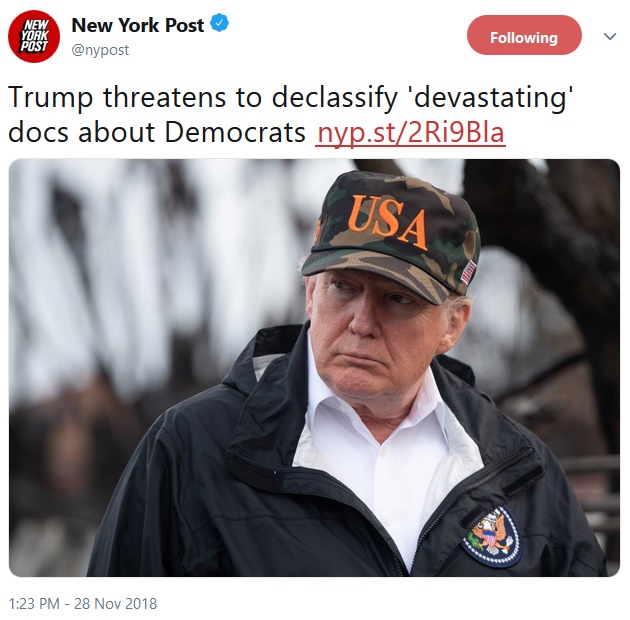
It was into this fray of constant false narratives that President Trump first made statements that he would declassify documents related to his targeting.  It was after Trump made those statements when the real motives of putting Robert Mueller as a special counsel became clear.

With Attorney General Jeff Sessions recused from anything to do with the Trump-Russia investigation, it was Deputy Attorney General Rod Rosenstein who delivered the message to President Trump in September of 2018, shortly before the midterm election, that any action by him to release documents, now under the purview of the Mueller special counsel, would be considered an act of “obstruction” by the DOJ/FBI people charged with investigating him.

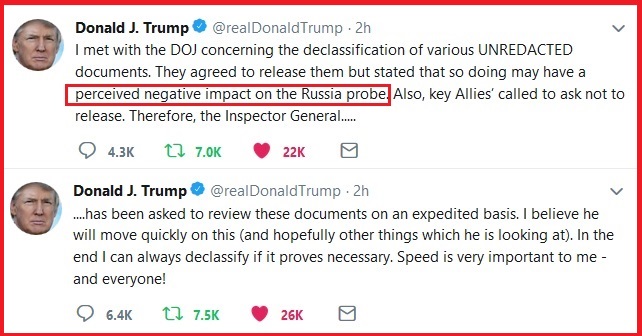
Immediately after meeting with Rod Rosenstein, Trump tweeted:

This was the first act of betrayal by political operatives within Main Justice who did not recognize or accept the concept of the ‘unilateral executive.’   According to Rod Rosenstein, FBI Director James Comey, Deputy FBI Director Andrew McCabe, and even later (including recently) AG Bill Barr, the office of the president cannot exercise unilateral executive authority when he himself is the subject of their investigative power.

In essence the DOJ and FBI, along with white house counsel and a collaborating senate and media, kept President Trump from declassifying and releasing documents by threatening him with impeachment and/or prosecution if he defied their authority.  The threats created a useful Sword of Damocles, and blocked Trump from acting to make documents public.

In the months that followed President Trump frequently made public statements and tweets about the frustration of documents not being declassified and released despite his instructions to do so.  Many Trump supporters also began expressing frustration.

The external debate and consternation surrounded how the Administrative State has seemingly boxed-in President Trump through the use of the Mueller/Weissman counterintelligence probe, authorized by Rod Rosenstein, where President Trump was the target of the investigation.

A widely held supporter perspective was that President Trump could expose the fraudulent origination of the counterintelligence investigation; of which he is now a target; if he were to declassify a series of documents as requested by congress and allies of his administration. This approach would hopefully remove the sword of Damocles.

The core issue within the debate surrounded two contradictory reference points: (1) President Trump has ultimate declassification authority.  Yes; however, in this example President Trump is also the target of the investigation; so, (2) declassification could be viewed by elements within the investigation as ‘obstruction’. Both of these points were true.

Also true was the reality that both laws and politics were in play.

In November 2018 President Trump gave an interview where he discussed the situation as it was visible to him.  Democrats and republican opposition, writ large, were working earnestly to remove him from office.

Here’s a link to the General Principles of declassification [SEE HERE] Yes, the President can declassify anything; however, there is a process that must be followed. Executive order 13526 [Citation Here]

Following that declassification process the Office of the Director of National Intelligence, then Dan Coats, and the FBI Director, Christopher Wray, and the Attorney General, in this example Rod Rosenstein, needed to “sign-off” on the declassification.

The process reasoning is simple in the ordinary (non-corrupt) flow of events.  The intelligence agencies might need to protect part of the information, such as “sources or methods” of intelligence contained within the classified material.

Under ordinary declassification procedures the President would likely not want to compromise the ‘sources’ and ‘methods’ and would defer to the intelligence experts.

President Trump is aware of material that he can use to defend himself from the ongoing ‘impeachment’ plans of Nancy Pelosi and Chuck Schumer.  However, President Trump is also seemingly aware of the issues within the process to gain access to the material and actually use it.  This is where the concentric circle of lawyers around the Office of The Presidency come into play.

We have the constitution, we have laws, and we have politics.

Moving forward there are three background threads that are critical to understanding how this process has unfolded so far:

All three of these issues come into play.

Unfortunately, if you have not already invested the time in those three aspects it is easy, very easy, to get lost.

Because none of the legal linguistics took into account the reality of the actual process for declassifying information, many people were stuck thinking President Trump held sole authority to classify and declassify intelligence without understanding the process.

Declassification of intelligence is a process, and each person -within the executive branch- inside the process must agree to the process.  Making the process even more riddled with issues is the reality that President Trump was the target in a counterintelligence investigation. President Trump was being investigated by Mueller to see if he is under the direct or indirect influence of a foreign power. [In this example, Russia]

The Mueller probe is an originating counterintelligence investigation that ‘can find’ espionage (see Russian indictments) as well as violations of law (Papadopoulos, Manafort, Flynn).  It is critical to remember, the originating probe is not a criminal probe; but Mueller and Weissmann can charge criminality if the investigators encounter interference of their counterintelligence probe; these are the process crimes (perjury, obstruction, lying to congress); or if the probe uncovers direct criminal activity (tax evasion, money laundering, FARA violations etc.).

Yes, technically President Trump can declassify anything. However, it is also true that technically POTUS doesn’t actually declassify anything.  The Office of the President asks for a document to enter into a declassification review process.

Officials within that process (ODNI, DoD, DoS, FBI, DOJ-NSD, CIA, NSA, etc), based on their unique relationship to the interests within the document(s), can approve or refuse to sign-off based on their specific intelligence interests.  This is where compartmented intelligence comes into play.

Any officer who refuses the request for declassification must justify to the intelligence hub; the Office of the Director of National Intelligence (ODNI, Dan Coats). The executive branch intelligence official tells the ODNI (Dan Coats) why they, their unique interests, cannot approve of the declassification request.

DNI Dan Coats then informs POTUS why the document is not cleared for declassification.

If he disagrees with the decision of the intelligence official, POTUS then would have to fire, replace and hope the next person in the chain-of-command would sign-off.  Given the nuance in the example of President Trump declassifying information that would show he was targeted, and considering the President is under a counterintelligence cloud it was unlikely any officer would break ranks.

President Trump would have to fire people, and keep firing people, until he gets to a person, inside that specific agency, who would comply.

Now stop and be reasonable.

Think about the general political ramifications to that decision.  And then think about the ramifications against the reality that President Trump is a target, under the cloud of a counterintelligence probe.

President Trump asks DNI Dan Coats (intelligence hub) to coordinate the declassification of [fill_in_blank].  If he agrees, in November of 2018 Dan Coats then asks all of the compartmented principles with interest in that specific document.  That likely includes the DOJ (after the midterm it’s Matt Whitaker), FBI (Chris Wray), and likely DoS (Mike Pompeo – because of the State Dept aspect to Chris Steele). Also, possibly the NSA and/or Cyber Command.

If FBI Director Christopher Wray refuses to declassify the document(s) because it is part of the current Mueller counterintelligence probe, of which Trump was a target, then President Trump would have to fire Chris Wray; and, while awaiting a replacement (Senate confirmation seriously doubtful), the request then falls on FBI Deputy Director David Bowdich.  [Who would also likely refuse]

As this hypothetical declassification example is unfolding you can imagine the political damage being carried out.  In addition, there’s the looming impeachment process waiting to start. Hopefully, you can see how President Trump could easily be accused of interference or obstruction of justice.  So, he had to wait for Mueller to finish.

Here comes the second betrayal and threat.

Mueller completed his investigation in April of 2019.

Within a few weeks, May 2019, the newly appointed and confirmed Attorney General Bill Barr tells President Trump to remove himself from the declassification issue and give him the authority to declassify and release documents because Barr has an investigator (John Durham) to look into the corrupt activity behind the Trump-Russia collusion hoax.

Ten days before he made the request, Bill Barr had enlisted John Durham to look into all of the issues surrounding the targeting of President Trump and the Clinton campaign involvement in the creation of the Trump-Russia collusion story.

At the time most people thought what Barr was doing was a good thing.  As a result, President Trump agrees to support Bill Barr and on May 23, 2019, delegates the declassification and release to the Attorney General.

The President is trusting his cabinet officer, the highest law enforcement officer in the country, to do the right thing and expose the wrongdoing he has been the subject of for the past two years.

It was an easy sell, because the purpose of declassification was ultimately to facilitate a DOJ review of how the intelligence apparatus was used in the 2016 election.

However, because the DOJ review encompassed intelligence systems (DOJ, FBI, NSA) potentially weaponized in 2016 for political purposes and intents, a strange dynamic existed.

President Trump carries: (a) declassification authority; but also: (b) an inherent conflict.

In the DOJ endeavor using John Durham, candidate Trump would have been the target of corrupt agency activity; and therefore, Trump would be considered the target/victim if weaponization were affirmed by evidence collected by Durham.

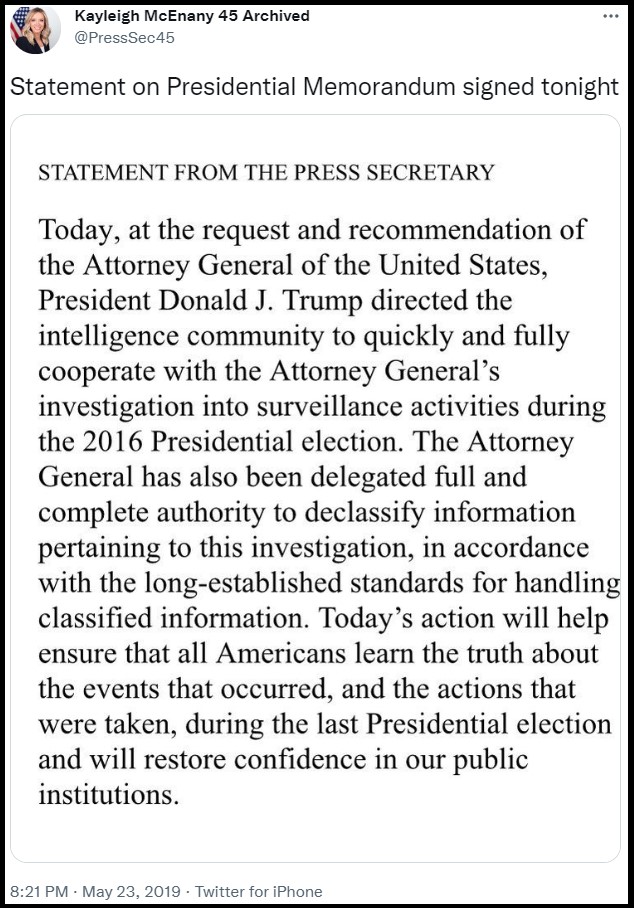
To avoid the conflict President Trump designated the U.S. Attorney General as arbiter and decision-maker for the purposes of declassifying evidence within the investigation:

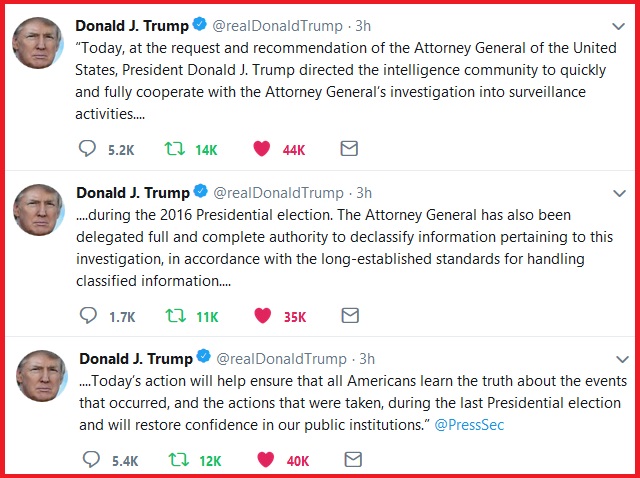
…”The Attorney General has also been delegated full and complete authority to declassify information pertaining to this investigation, in accordance with the long-established standards for handling classified information.

Additionally, AG Bill Barr did not need to assemble the intelligence product for approval by the executive (Trump).  Instead, the office of the president is granting the AG full unilateral decision-making as to each product being considered for declassification.

At the time we noted, this was a huge amount of trust from the President to the Attorney General, and a big responsibility for William Barr:

[Sec 2] …”With respect to any matter classified under Executive Order 13526 of December 29, 2009 (Classified National Security Information), the Attorney General may, by applying the standard set forth in either section 3.1(a) or section 3.1(d) of Executive Order 13526, declassify, downgrade, or direct the declassification or downgrading of information or intelligence that relates to the Attorney General’s review referred to in section 1 of this memorandum.”

The position-designate slightly works around custom insofar as the intelligence hub, the Office of the Director of National Intelligence (Dan Coats), is given conference – but the decision-making was designated to the Attorney General (Bill Barr).

Essentially the DNI will be following the instructions of the AG for this Memorandum.  This is slightly unusual; but given the purpose, necessary and expected.

Following protocol, the 2019 Memorandum was specific to the agencies carrying the documentation to be reviewed by the Attorney General: The Secretary of State (Pompeo); the Secretary of Treasury (Mnuchin); the Secretary of Defense (Shanahan); the Secretary of Energy (Perry); the Secretary of Homeland Security (McAleenan); the Director of National Intelligence (Coats); the Director of the CIA (Haspel), and the Attorney General himself (Barr).

Within the memorandum President Trump did not allow AG Bill Barr to delegate authority.  However, all agencies were required to respond to Barr’s authority.

The purpose of the Declassification Directive, as it was sold to President Trump, also appeared to permit the DOJ Inspector General to include classified material in the body of the (early 2019) pending report on FISA abuse; this memorandum was granting AG Bill Barr the autonomy to make that decision and declassify that content.

While the purpose of the authority was to empower AG Bill Barr to collect, process and declassify intelligence product that was part of the DOJ investigative review, President Trump did not preclude the public release of intelligence information in advance of the 2019 IG report on FISA abuse.

Much of the intelligence information may be collected external to the IG review parameters (FISA process) and may be released independently as part of stand-alone declassification that pertains to weaponized DOJ, FBI and CIA political activity.  Ultimately the decision to release, and the timing therein, was then in the hands of U.S. Attorney General William Barr.

On May 23, 2019, with the Mueller investigation in the rear-view President Trump tweeted:

Unfortunately, as time continued throughout 2019, Attorney General Bill Barr took no action that would declassify any material of interest to the targeting of President Trump.

AG Bill Barr used the “ongoing criminal investigation,” led by the man he appointed, John Durham, as a justification for non-release of documents.

Frustration continues to mount as impeachment efforts against President Trump and the painful reality of the Bill Barr motive starts to settle in.

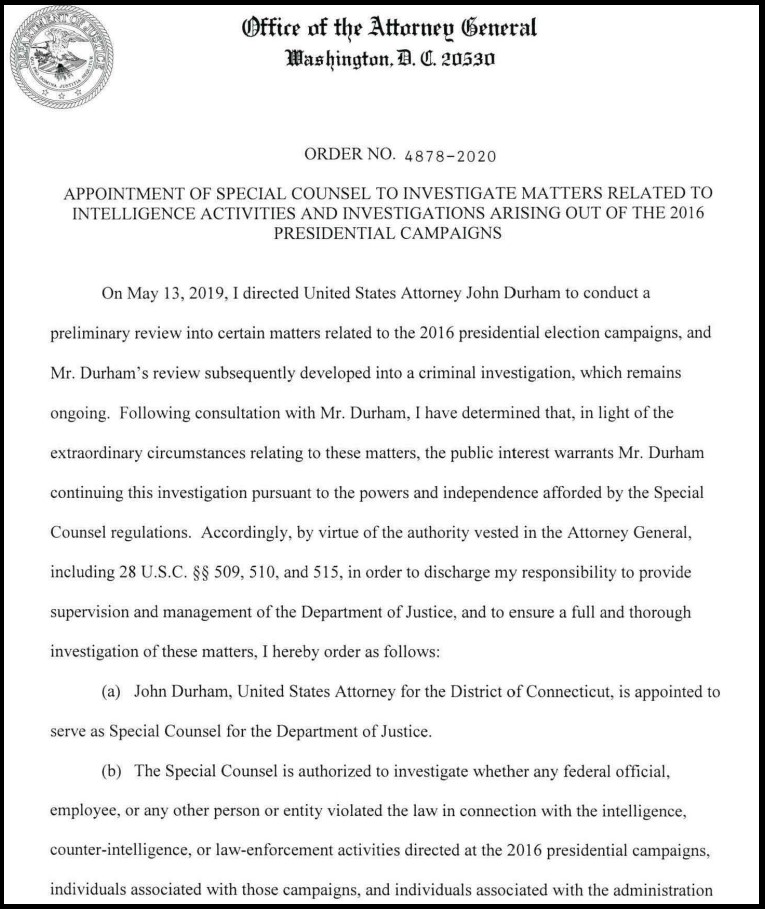
Bill Barr replaced the obstruction and interference threat carried by Mueller special counsel, with the obstruction and interference threat carried by the Durham special counsel.   The ‘ongoing investigation‘ narrative created both swords of Damocles.  One created by Rosenstein/Mueller the other created by Barr/Durham.

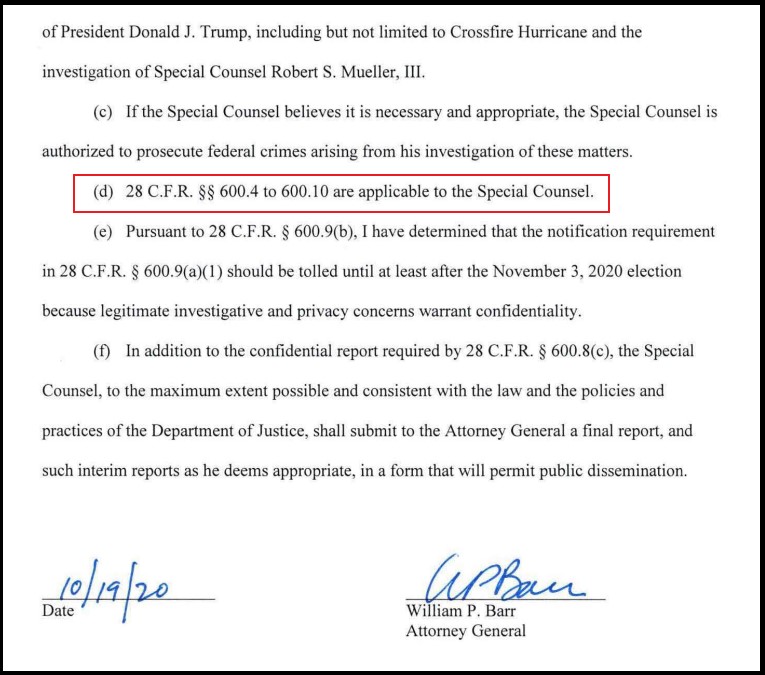
Then Bill Barr did something even worse.  He made sure Donald Trump could never remove it.

The result?

The special counsel block of investigative material continued from May 13, 2019, all the way to today.  The Durham special counsel is an active and ongoing investigation.

This is the dynamic behind the declassification of records.

This is the dynamic where the law is used, structurally weaponized by the institutions who are sworn to uphold it, to protect the interests of the DC Deep State.

This is the dynamic that exposes how the DOJ and FBI are structurally corrupt.

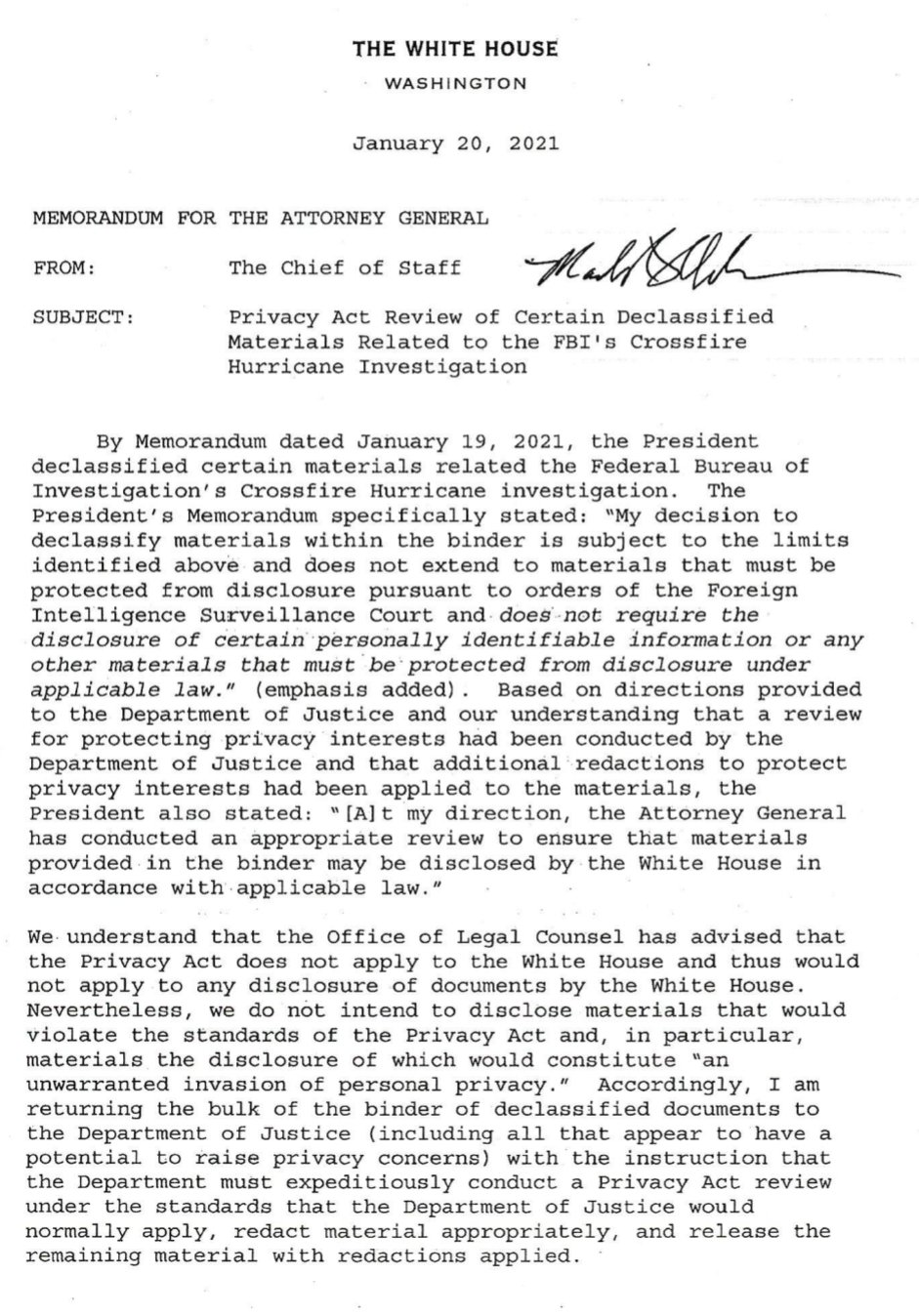
Even as he was departing office, President Trump wanted those documents released.  Documents he declassified and outlined in this memo to the DOJ:

This is the heart of the battle over documents between the current DOJ/FBI and President Trump.

Again, the threats of a corrupt administration of justice are at the heart of the issue.

This four-year sequence of events, including all of the betrayals and threats made against Donald Trump, all intended to keep him from allowing the public to see the full nature of the corrupt Deep State operation that lies at the heart of our current political strife, is ultimately what led to an FBI raid on his home in Mar-a-Lago this week.

This is the scale of the issue.

In the final part four of this series, I will outline what specific documents are the most likely to have been retained by President Trump.

I hope the previous three outlines have provided a solid context for people to understand the scale of our national issue.  The DOJ and FBI will do anything to stop the release of those documents that outline how the system worked to target candidate and President Trump.

If the broader American public understood what tools and surveillance systems were used; if the broad American public knew what the DOJ, FBI, intelligence apparatus and aligned Senate committees have done; if the broad American public became aware of the scale and scope of the corruption in DC as it now exists; entire institutions within that framework would start to collapse.

This is what they are trying to stop.  That is the scale of their zero-sum approach.

Second Quarter Productivity Drops Again, Companies Paying Workers More to Produce Less


Posted originally on the conservative tree house on August 9, 2022 | Sundance 

The previous first quarter productivity drop of 7.4% was the largest quarterly drop in 74 years.  Today the Bureau of Labor Statistics (BLS) reports the second quarter productivity dropped another 4.6% [Data Here].

For July, companies are paying 5.7% higher wages and getting a 4.6% drop in output, resulting in a total unit labor cost increase of 10.8%.  That increase in final output cost will either result in higher prices or lower profits.

With weak consumer purchasing (low demand) already creating an inventory surplus, hence lower outputs, lower profit leads to cutbacks.  The largest company expenses are generally labor and energy costs. The more variable and controllable of those two expenses is labor.  You know what comes next.

(WSJ) – […] Rising productivity is the key to improving living standards; it allows companies to raise wages without raising prices and fueling inflation. Instead, businesses appear to be paying workers more to produce less. The higher unit labor costs suggest companies will either endure lower profits or pass on higher costs to consumers.

“The trend in productivity growth has worsened compared to prior to the pandemic, and the surge in unit labor costs makes the Fed’s challenge of getting inflation back down to its 2% target all the more challenging,” Wells Fargo economist Sarah House said in a research note.

The central bank has increased rates four times this year from near zero in March in an effort to raise borrowing costs, slow economic growth and bring inflation down.

The consecutive negative productivity readings are a reversal from earlier in the pandemic, when the economy was expanding rapidly and businesses appeared to be adopting new technology to cope with worker shortages and limits to face-to-face contact. (read more)

Meanwhile, “U.S. manufacturing output in June was down by 0.4% compared with March though it was still up by 3.6% compared with the same month a year earlier, estimates prepared by the Federal Reserve Board found. Three-month output growth was the weakest since early 2021, and confirms slackening momentum evident in other data on output, orders and jobs.” (Reuters)

This month’s inflation report (reflecting changes in July) will show a large decline in overall inflation. This will provide the White House with a false narrative of confidence that inflation has peaked.  However, food inflation (farm prices not yet realized) will combine with wage inflation (as noted above) sometime around October, and then we enter another round of rising prices.

The prices for durable goods have likely peaked.  If you are in the market for an expense item (appliance, furniture, etc) look for significant incentives to trigger in Sept/October; right around the same time when the layoffs start.  So, sit tight for a few more weeks.

However, the prices for highly consumable products will present a false plateau (Aug/Sept) until they go bananas again just before the Thanksgiving holiday season.

Prepare and time your affairs accordingly.

FBI Raids Trump’s Home – DOJ Planning Indictment – End of the USA As We Have Known It


Armstrong Economics Blog/Civil Unrest Re-Posted Aug 8, 2022 by Martin Armstrong


The Democrats are desperate to win in November and they are taking the United States down the drain in order to forcefully impose their will, or should I say the Great Reset. On the approaching 250th anniversary of the signing of the Declaration of Independence, The Democrats are toying with what will most likely end in a civil war and the destruction of the United States. Never in the entire history of the United States has a former president been indicted for any criminal conduct. This has not been because there was never such an incident. Most importantly, the historic precedent is that post-term indictment is NOT legally allowed.

Americans don’t like the idea of criminalizing politics. Just look at Ukraine. In January 2022, Ukraine’s former president, Petro Poroshenko, landed in Kyiv and was charged with Treason by Zelensky in a case that illustrates the danger of criminalizing politics. So many other banana republics do the same. Once one party gets a hold of power, they try to prosecute the opposition.

Up until now, both political parties, as well as the public, see the prospect of post-term immunity as a guarantee that the country’s politics will remain civil and that power will transition peacefully from one party to the other. All of that is now crumbling before our eyes. That very percedent is what drove President Gerald Ford to pardon Richard Nixon. It was also the reason why the Office of the Independent Counsel decided not to indict former President Bill Clinton for perjury.

Former U.S. President Donald Trump said on Monday that his Mar-A-Lago estate in Palm Beach, Florida, was been raided by FBI agents. “After working and cooperating with the relevant Government agencies, this unannounced raid on my home was not necessary or appropriate,” Trump announced in a statement.

NEVER in the history of the United States has the FBI ever carried out such a raid. Trump publicly stated that his home was “under siege, raided, and occupied by a large group of FBI agents.” He also said that: “They even broke into my safe.”

Our computer has warned that 2022 would be a Panic Cycle in Politics and 2023 will be a violent year for civil unrest and war. The computer pinpoints these events that we cannot even begin to imagine the fundamentals behind them. But the Democrats have crossed the line. They are now trying to transform the United States into a banana republic of oppression and a direct assault on the very foundation of democracy. The nation has been polarized to the extreme. This is just going to put it over the top.

Greece’s Public Debt Reached 193% of GDP


Armstrong Economics Blog/Greece Re-Posted Aug 9, 2022 by Martin Armstrong

Greece’s debt problem has been unrelenting. The European Union refuses to consolidate member state debt, and Greece’s money woes have only multiplied since joining the euro. The global economic downturn is hitting the Mediterranean nation hard.

Inflation reached 11.6% in June, a rise from May’s reading of 10.5%. The Greek Statistical Service (ELSTAT) collected data noting a €13.417 billion increase in public debt from the first quarter of 2021 to the second quarter of 2022.

Fitch Ratings somehow gave Greece a positive BB rating. However, the agency warned that the nation’s debt ratio will likely triple other BB rated countries by 2024.

Greek’s public debt has reached 193% of GDP and has surpassed €357 billion. This is cause for concern, to say the least.

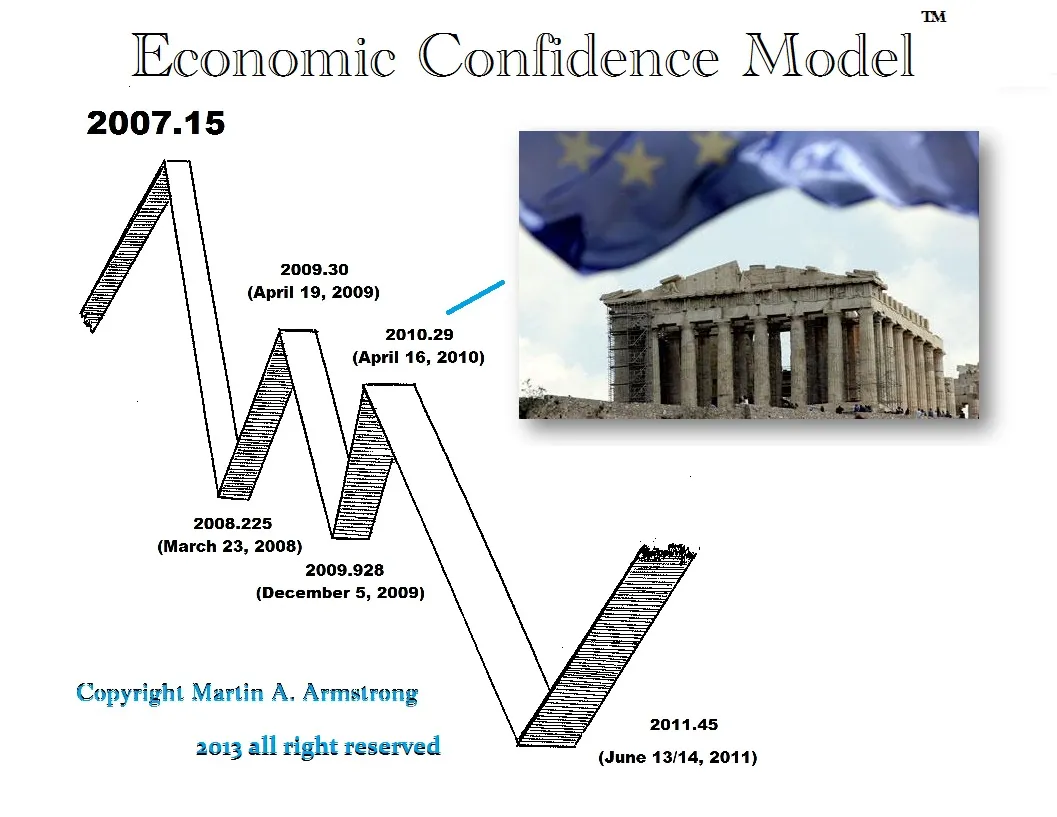
The EU crisis began on schedule with the political pi turning point from the major high that formed in 2007. Precisely on the day of the ECM turning point, April 16, 2010 (2010.29), Greece notified the International Monetary Fund (IMF) that it was on the verge of bankruptcy. The euro fell to year-low levels by April 22, 2010, prompting the IMF to provide Greece with €45 billion the following day. Greece’s debt woes only worsened over the years, and the IMF decided that Greece’s debt was simply too high to support and urged for it to be forgiven. Brussels refused, and now Greece is in a situation from which it cannot possibly recover.