Straight Economic Data from Bartiromo


Posted originally on the conservative tree house on July 28, 2022 | Sundance

There is less pretending in this segment, but the core of intent is still missing.   As soon as Ms. Bartiromo can admit the monetary policy is specifically designed to create lower economic activity, she will be able to reconcile the policy conflicts which she still views as hypocrisies.

While not outlining the motive, in the segment beginning at 1:07 Ms Bartiromo does a good job outlining the current state of the economy. WATCH:

Comrades, prior to the Joe Biden economy the average American worker was earning 29 onions per hour.  After, the Biden economic policies were put into place, the average American worker is now earning 11 onions per hour.

Pretending Continues, However El Erian Admits U.S. Economy Weakening Faster Than Expected


Posted originally on the conservative tree house on July 28, 2022 | Sundance 

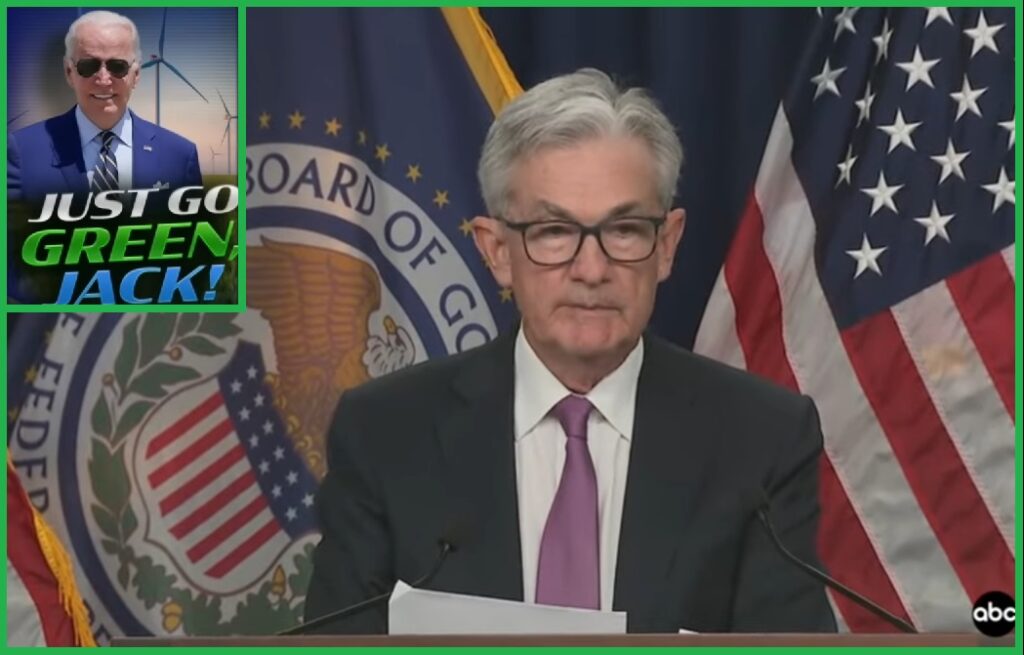
The great pretending continues in order to protect the Federal Reserve from sunlight upon them.  Central banks (U.S. Fed Reserve included) are raising interest rates into a recession, which is specifically against their legislative mandate. Therefore, in order to protect the bankers, the pundits and politicians must deny a recession exists.

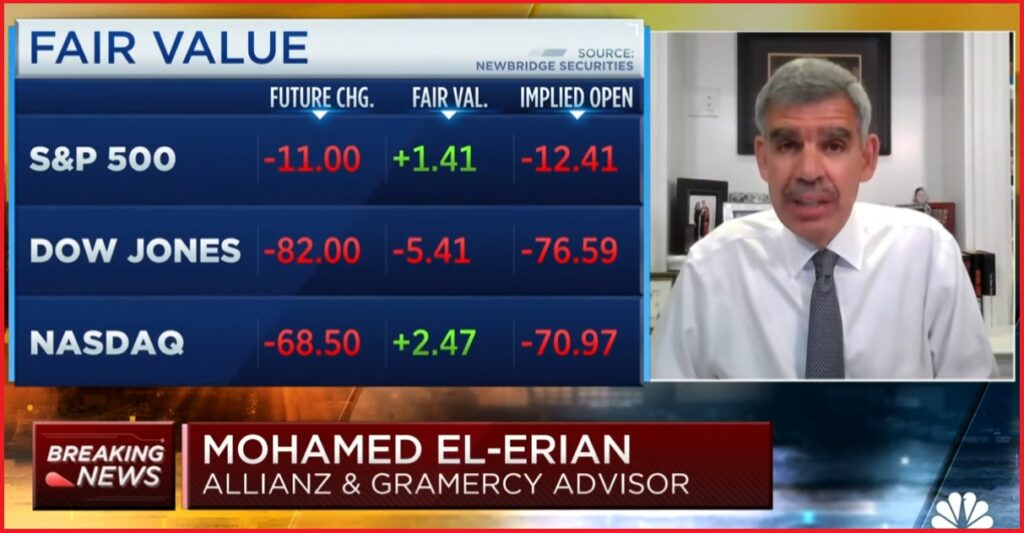
Pundit Steve Liesman spins the data, says we need to wait longer, and circles the wagons to protect the policy makers, specifically the White House.  Mohamed El-Erian tries to split the baby (02:00 video); while not admitting directly that the economy is in a recession, he states the “economy is weakening much faster than expected.”  WATCH:

At a certain point all of this pretending and denial is going to come crashing down.  The “economic transition” to a new “green future” they are all pretending not to see as the root cause of the economic collapse, has unavoidable consequences.

The dam is breaking around them and they are running out of fingers and toes to stop the inevitable collapse.  Meanwhile the Davos crowd has purchased all the scuba gear and awaits the final outcome.

By claiming there is not a recession, the Federal Reserve can continue taking action that lowers economic activity.  The lowering of economic activity drops the use of energy inside the economy.  They are managing the economic transition inside the Build Back Better or Green New Deal agenda.  They are managing a purposeful decline in economic activity in order to support the energy transition.

The only way the Federal Reserve and central banks can raise interest rates into a recession, is if they deny a recession exists.

That is why they are denying a recession exists.

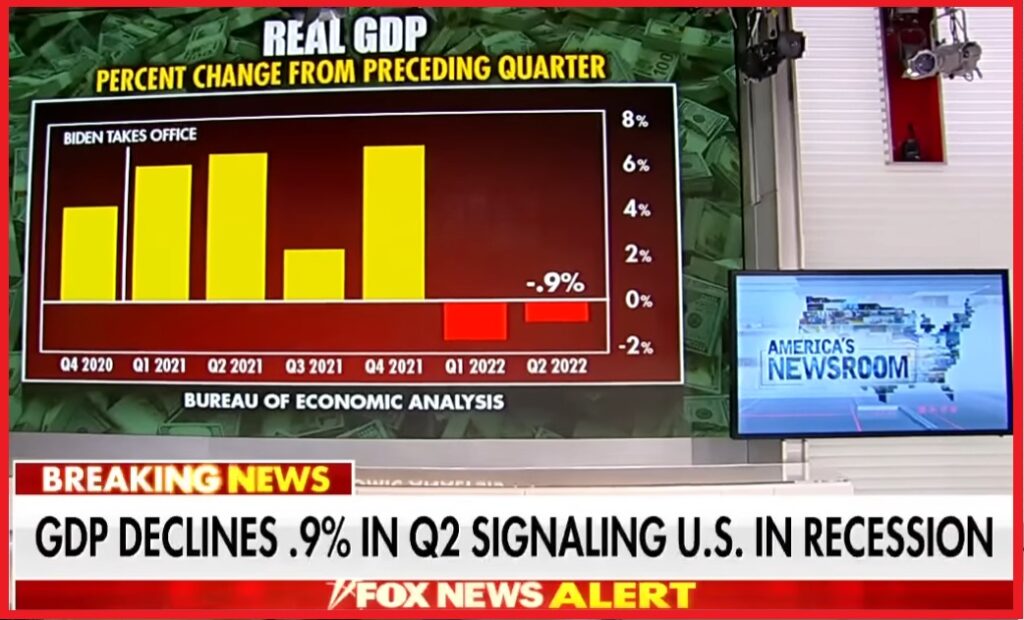
FUBAR, Second Quarter GDP Contracts 0.9%, The U.S. Economy is Officially in Recession


Posted Originally in the conservative tree house on July 28, 2022 | Sundance 

Jumpin’ ju-ju-bones, CTH did not expect the BEA to admit the U.S. economy was in recession.  CTH originally predicted the BEA would use lower import data as the primary tool to modify the GDP result.

Factually, in this report, import data -in combination with lower consumer spending- was the primary sector that led to the result.  However, even with drops in the valuation of imports which lift GDP calculations, the economy still contracted.

Things must be much worse than officially admitted (details below), if the BEA is going to admit things are bad.

Gross Domestic Product (GDP) is the dollar value of all goods and services produced in the economy, minus the dollar value of goods and services we import. The percentages discussed are percentages of change over time.

The Bureau of Economic Analysis (BEA) released their first estimate of the second quarter GDP [Data Here] reflecting a 0.9% drop in U.S. economic activity. The second quarter contraction follows a 1.6% drop in the first quarter, which means we now have two consecutive quarters of declining economic activity, the technical definition of a recession.

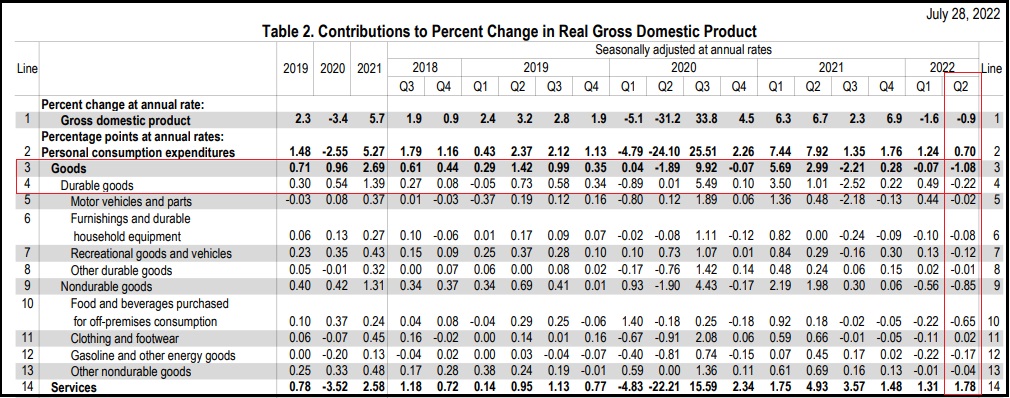
The two primary data points which show the economic contraction are: (1) Lowered consumer spending; and (2) much lower imports as a result of lower consumer spending on durable goods and non-essential items.  High Q1 inventories of goods were also flushed out by companies and not replaced.  Starting with the consumer spending, here’s the data [Table-2, BEA report]:

Consumer spending, also called “personal consumption expenditures” declined 1.08% for goods overall in the second quarter.

Consumer spending represents two-thirds of all GDP in the United States.  Americans buy lots of stuff, and when Americans stop spending on goods the economy stalls.  As you can see in Table-2, consumer spending on goods dropped 1.08% and spending on services increased 1.78%.  The net difference is 0.70%, a massive drop in consumer spending compared to prior quarters/years.

The next component with major impact is the result of the drop in spending.

The Power of Siberia


Armstrong Economics Blog/China Re-Posted Jul 28, 2022 by Martin Armstrong

Sanctions strengthened Putin and caused “unfriendly nations” to form a closer alliance against the West. As the West suffers from an energy crisis with no solution in sight, Russia is benefitting from this in more ways than one. You may have heard of the China–Russia East-Route Natural Gas pipeline or the Yakutia–Khabarovsk–Vladivostok pipeline. Construction was approved in 2007, and in 2012, Putin ordered Gazprom to begin construction and renamed the project “Power of Siberia.” China and Russia signed a 30-year deal for $400 billion in 2014, and by December 2019, the pipeline was functional.

The mainstream media focuses on the failure of the Nord Stream 2 Pipeline at the hands of German politicians but forgets that Russia has alternative options for exporting fuel. Deliveries through the Power of Siberia have only reached $3.81 billion since December 2019, but China and Russia have plans to ramp up distribution. China received 16.5 billion cubic meters of gas from the pipeline in 2021. The deal has become so lucrative that Beijing and Moscow created a second pipeline – the Power of Siberia 2. This could double exports from Russia to China with a pipeline that would pass through Mongolia as well.

In the first six months of 2022, Gazprom exported 7.5 billion cubic meters of gas to China, marking a 63.4% uptick in volume. Prior to the invasion of Ukraine in early February, China and Russia agreed to ramp up distribution by 10 billion cubic meters. Reuters believes this could increase sales by $37.5 billion in the next 25 years, but this could increase given the high demand and low availability.

The West, namely Europe, needed Russian energy; Russia did not need Europe. President Biden admitted long ago that sanctions do not work, but in this instance, they completely backfired and have left the West with no leverage over Russian energy.

Domestic Exodus from US Cities


Armstrong Economics Blog/Real Estate Re-Posted Jul 28, 2022 by Martin Armstrong

The US Census Bureau reported that 8.4% of Americans moved in 2021, beneath the 9.3% who moved at the height of the pandemic panic in 2020. Numbers for 2022 may show an uptick in migration to the suburbs or rural areas. Our models indicate that overheating in the housing market will be less prevalent in less populated areas as we are not merely dealing with housing inflation but also mass domestic migration.

Housing may be cheaper in rural areas, but there are additional costs associated with living in the country. There is no public transportation, and people must travel longer distances for work, groceries, shopping, health care, and more. Energy prices are sky-high, and simple trips cost significantly more. Iowa State University professor Dave Peters, as reported by the AP, has been studying the impact inflation has had on rural America. Peters estimates that rural households pay $2,500 more per year for gas alone compared to those living in cities.

Still, prices for housing in the country v the city more than makeup for increased energy costs. Remote work has made rural living a prospect for many Americans. The National Association of Realtors found that rural areas saw a 54.6% uptick in inbound moves in 2021, followed by micropolitan areas (i.e., small towns) at 53.8%.

In January, the Association of Equipment Manufacturers (AEM) said that certain remote workers were enticed by rural life after pandemic burnout. They found that people were seeking to abandon the hustle and bustle of city living, citing lower living costs, safer environments, fewer people, no traffic, lower housing prices, different cultures, and politics.

Gone are the days of people flocking to the cities for opportunities. As long as there is an internet connection, the modern American can work from anywhere. As the average potential buyer is priced out from their hometown, the prospect of rural or small town life is increasingly enticing.

The Drought Cycle & Climate Change


Armstrong Economics Blog/Climate Re-Posted Jul 28, 2022 by Martin Armstrong

QUESTION: Hello Martin and Team,

My question is related to a gentleman I watched on Greg Hunters Watchdog News that Martin goes on with from time to time. Greg interviewed —- —–. The discussion was around chemtrails and the gov’t messing with the rain patterns, also lake Mead and the Las Vegas drain plug which I do know is real. The main question is there a real likely hood of the S.W. United States to experience very serious drought in short order? I live in Phoenix and this interview was scary and I would be curious to know (along with millions of others) if Dane’s information is credible and if folks living in the S.W. US should really consider trying to move to another part of the country. I wondered if Socrates would be able to give us any insight into what was discussed in the interview.

Thank you so much for your efforts, I have been following Martin since 2008 and I have yet to see Socrates be wrong. We need your efforts more than ever with the complete disaster of the world we are living in.

Regards. DGB

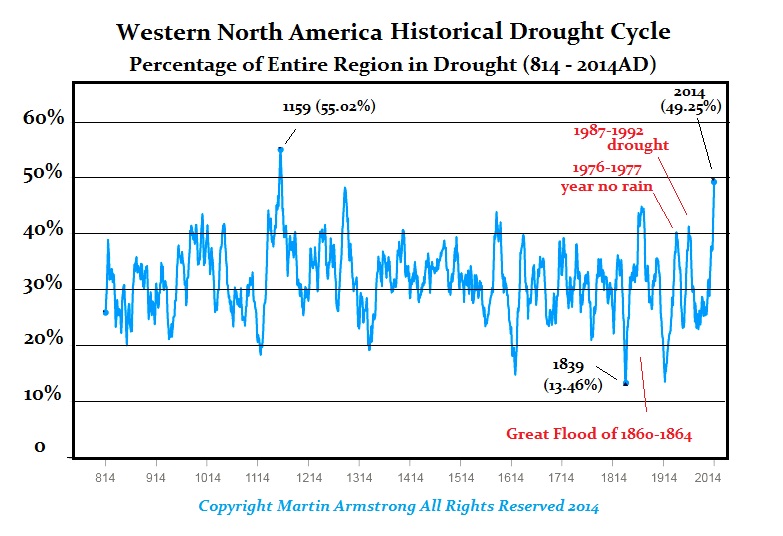
ANSWER: I have no data on the chemtrail issue. My opinion would neither add nor detract from the subject. I prefer not to comment on things I have no experience in or information I cannot confirm. What I can say, rooted entirely in our database on weather, is that like stock markets or economies, there are cycles to droughts and will tend to last for 37 months. Curiously, this is also fractal being 8.6 x 4.3. Even during the 1930s drought episode that produced the Dust Bowl, the average longest stretch was also 37 months, peaking in March 1935.

There was a cycle inversion that took place during the 1950s, which caused a 19-year extension bringing the average drought to the longest stretch of 56 months, peaking in February 1957. While that drought was longer, it was not as intense as that of the 1930s Dust Bowl. The typical short-term events are reactions, and they are typically maxed out at three months.

That said, I can only look at the data. I do not see any alternation to the cycles insofar as altering their length. If the proposition of the chemtrail argument is valid, then I would assume from the data that, at the very best, it could possibly impact the “volatility” as we experience in a market that changes the intensity.

However, as of June 19, 2022, 51.87% of the lower 48 states are in a drought. We have not yet exceeded the high of 1159 AD. So much for fossil fuels creating global warming.

Tucker Carlson Outlines Dueling Insurrections and Two Tiers of Justice


Posted originally on the conservative tree house on July 27, 2022 | Sundance 

Tucker Carlson used his opening monologue to compare and contrast the different responses from the DOJ to Donald Trump vs Joe Biden.  Carlson outlined the different response from the DOJ/FBI toward the pro-violence statements by various democrat politicians to the DOJ/FBI response currently underway to target Donald Trump.

Essentially, what this boils down to is a system of two-tiered banana republic style justice.  All efforts are exhausted to avoid targeting democrat politicians, and all DOJ/FBI efforts are exhausted to manipulate the targeting of republicans.  The same selective targeting and investigating holds true based on the geographic venue for criminal conduct. WATCH: 

.

Joe Manchin and Chuck Schumer Strike a Deal, $370 Billion for Green New Deal Energy Transition, Tax Increases to Pay for it and More IRS Agents


Posted originally on the conservative tree house on July 27, 2022 | Sundance

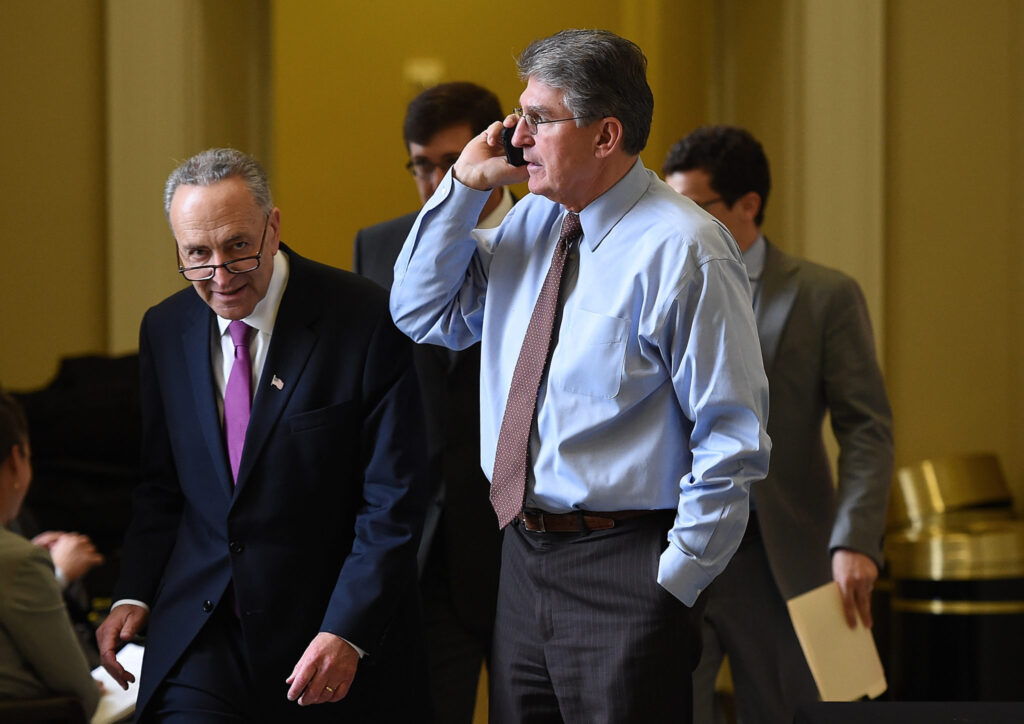
Two weeks ago, CTH warned everyone that Joe Manchin’s torpedoing of the $500 billion Green New Deal senate spending program was a head fake; he was always going to sign up to expand the control of the federal government over energy use.  Today Manchin and Chuck Schumer made it official.

The people operating the “energy transition” levers will get $370 billion to spend on bigger windmills, more solar panels and new energy programs to eliminate coal, oil and natural gas.  They will pay for it by raising taxes and hiring a new army of IRS enforcement officials.  In exchange for his vote, the federal government will pay increased health insurance subsidies for West Virginians and pass out lower priced medications.

There you go. Exactly as predicted.  Energy inflation will continue as the energy transition becomes a permanent feature.  Ironically, Joe Manchin made them change the name to “The Inflation Reduction Act,” and pushed the effective dates for all renewals past the 2024 election (where he plans to be a candidate against Gavin Newsom).

WASHINGTON – Joe Manchin and Senate Majority Leader Chuck Schumer on Wednesday reached a deal on a bill that includes energy and tax policy, a turnaround after the two deadlocked earlier this month in talks on Democrats’ marquee party-line agenda. In a joint statement, the two Democrats said the legislation will be on the Senate floor next week. It includes roughly $370 billion in energy and climate spending.

[…] The duo said their bill, dubbed “The Inflation Reduction Act of 2022,” would “fight inflation, invest in domestic energy production and manufacturing, and reduce carbon emissions by roughly 40 percent by 2030.” Moreover, as part of the agreement announced Wednesday, Schumer and Speaker Nancy Pelosi agreed to pass legislation governing energy permits.

[…] Democrats will raise revenues for the legislation by imposing a 15 percent corporate minimum tax, increasing IRS enforcement, reducing drug prices and closing the so-called carried interest loophole. Notably, the legislation also extends the Affordable Care Act subsidies through the 2024 election and the first term of Joe Biden’s presidency, taking a big political headache off the table for Democrats. (more)

Look deeper into the people in Joe Manchin’s life that are tied to the healthcare industry.  There you will find the familial beneficiaries of the deal. “Besides being Joe Manchin’s daughter, Heather Manchin Bresch, born 1969, spent several years as the CEO of Netherlands-based pharmaceutical company Mylan. She held the post from 2012, but stood down in November 2020, as a result of the company’s merging with Pfizer’s Upjohn outfit. Upon assuming the role, Heather Mamchin became the first woman to run a Fortune 500 pharmaceutical company.” LINK

The scheming strategery of Joe Manchin is as predictable as the scheming strategery of Mitch McConnell.

The two wings of the UniParty duck seem still on the surface.  This type of ploy is exactly how DC is able to operate, paddling forward furiously, just below the surface; and almost no one can see what is happening.

Once you see the strings on the political marionettes, you can never return to that moment in the performance when you did not see them.  However, because too few people see them, almost everyone congregates in the lobby during the mid-term intermission asking, “hey, when did Texas become dependent on windmills?

Here We go Folks, U.S. Trade Imbalance Shrinks as Imports Plummet


Posted originally on the conservative tree house on July 27, 2022 | Sundance

Imports are plummeting… should be a good thing… trade imbalance shrinks…. that lifts GDP calculations…. but the problem is…

…. Consumer Demand Has Collapsed.

The state of the U.S. economy is not as difficult as the ‘experts’ always claim.  Simple business and checkbook economics always, always, tell you the future. You just have to be willing to accept things as they are, not as you would wish them to be.  Let’s have an honest chat. We need it.

Remember, it was November 2021, and no one was paying attention but retail hiring was negative.  The month before the 2021 Christmas holiday, when historically businesses would be adding people to their payrolls to support the increase in shopping, and retail businesses did no hiring. In fact, 20,000 retail jobs were LOST the month before Christmas.  Retail sales had plummeted. That was a major flare, no one paid attention. Everyone was distracted with the Supply Chain crisis.

Then the fourth quarter 2021 GDP result came in at 6.9%, massively higher than the visible reality on Main Street.  The reasoning was identified as a major increase in the value of inventories. While the Biden administration liked the GDP figure, the existence of the unsold inventory was another major flare.  Add unsold inventory units to the massive inflationary value of those units (+8%) and you quickly see the +6.9% was bad news, not good news.  Major increases in the value of goods have no value unless people are purchasing them.  It wasn’t happening.  Again, no one (except us) was paying attention.

Then the first quarter of 2022 GDP result came back with a negative 1.6% result.  With high inflation those inventories were stagnant.  The eight-percentage point GDP swing from the fourth quarter of 2021 to the first quarter of 2022 was another warning flare.  Again, no one was truly paying attention.  Retail sales -as measured in units purchased- had been in a contracting position since June of 2021, when the stimulus ran out.  However, skyrocketing inflation was hiding lower unit sales.

With inventories stagnant, purchase orders to manufacturers stopped. Orders for non-durable consumer goods dropped.

Due to lengthy supply chains, including trans-pacific shipments, the process to stop deliveries in the electronic goods sector takes around 90-days before the drop in retail sales reaches the manufacturer to stop production.  Here is the announcement from Samsung: “Samsung Electronics is temporarily halting new procurement orders and asking multiple suppliers to delay or reduce shipments of components and parts for several weeks due to swelling inventories and global inflation concerns, sources have told Nikkei Asia.” 

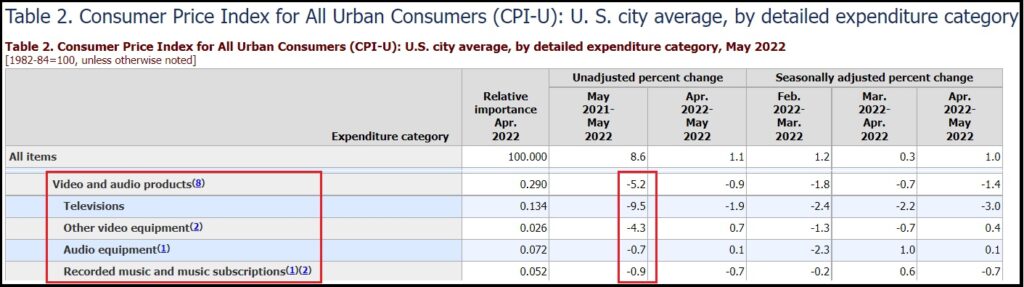
Pay attention to the dates.  Prices were dropping because consumers were not spending:

If the USA economy was really in the shape that appeared statistically, you would see it on Main Street.  We did see it on Main Street.  Consumer purchases of non-essential goods had stalled and contracted.  Everyone was paying more for food, energy, housing and fuel.  There was/is no room in the household budget to spend on non-essential purchases.  People are hunkering down.  That was very visible.

When the U.S. consumer stops purchasing goods, the overseas suppliers of those goods need to stop manufacturing and sending them here.  As a result, if the economy was in really bad shape, we would expect that imports would drop dramatically.  This drop in imports would obviously impact the trade deficit.  Well….

WASHINGTON, July 27 (Reuters) – The U.S. trade deficit in goods narrowed sharply in June as exports surged, while business spending on equipment remained strong, reducing the risk that the economy contracted again in the second quarter.

The better-than-expected reports from the Commerce Department on Wednesday left economists scrambling to upgrade their gross domestic product estimates for the last quarter, which had ranged from negative to barely growing. The data were published ahead of the release on Thursday of the advance second-quarter GDP estimate.

[…] The goods trade deficit shrank 5.6% to $98.2 billion, the smallest since last November. Goods exports increased $4.4 billion to $181.5 billion. There were strong gains in exports of food and industrial goods. But fewer capital and consumer goods as well as motor vehicles and parts were exported.

Imports of goods fell $1.5 billion to $279.7 billion. They were pulled down by imports of motor vehicles and food.

[…]  The Commerce Department also reported on Wednesday that wholesale inventories increased 1.9% in June, while stocks at retailers rose 2.0%. Retail inventories were boosted by a 3.1% jump in motor vehicle stocks.  Excluding motor vehicles, retail inventories increased 1.6%. This component goes into the calculation of GDP.

And here comes the kicker….

[…] According to a Reuters survey of economists, GDP likely increased at a 0.5% annualized rate in the second quarter. The survey was conducted before Wednesday’s data. The economy contracted at a 1.6% pace in the first quarter.  Investors have been nervous about another negative quarterly GDP reading, which would mean a technical recession. (read more)

Does that 0.5% look familiar?  It should.

From CTH in June: “We can see no political scenario where the Bureau of Economic Analysis (BEA) will report a negative second quarter GDP number, despite the reality of a contracted economy.” … “CTH predicts the BEA is likely to generate a statistical report somewhere in the +0.5% range. Just enough positive GDP to avoid the literal definition of a recession.  The BEA report will be issued at the end of July and if they follow recent patterns, they will likely underestimate the inflation rate as well as under-calculate the import data.”

From CTH in July: “CTH has predicted the people within the BEA research group, ie those who make the determinations of GDP, will circle the statistical wagons and generate something akin to a positive 0.5% GDP figure for Q2.

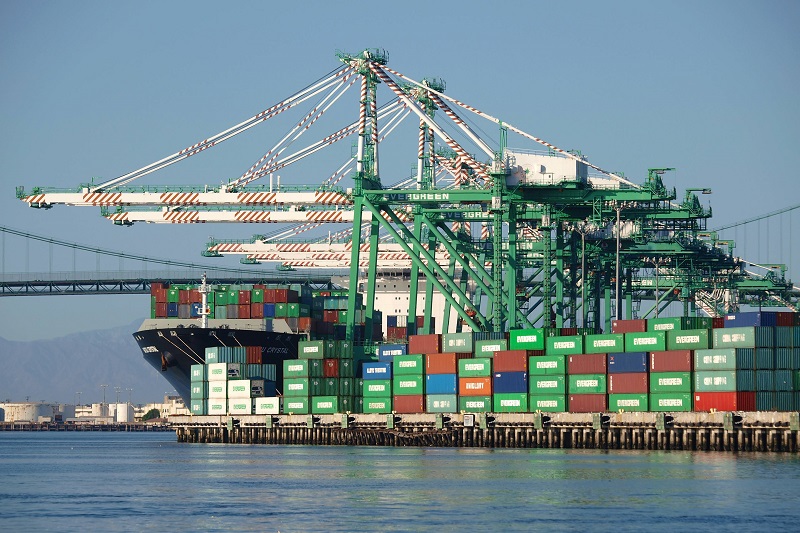
Three other factors also impact the import data. (1) Operation hide the ships continues (CA regulation issue). (2) There is an ongoing labor dispute with the west coast longshoreman union, and shippers trying to avoid issues are rerouting to Gulf of Mexico and East coast. And (3) There is an ongoing independent truckers strike and protest happening at California ports.   All of these provide convenient justifications for lower port data, which, conveniently for the Biden administration, inflates GDP.

The Bureau of Economic Analysis is likely to attribute a 0.5% calculation of GDP (release tomorrow) to the lowering of imports (a deduction to GDP) and then apply a liberal dose of inflation to the value of goods and services created by the economy.

A +0.5% BEA result avoids the pesky technical definition of a recession.

IMF Data, Global Output Contracted in Second Quarter


Posted originally on the conservative tree house on July 27, 2022 | Sundance 

According to the International Monetary Fund (IMF) global economic activity, as measured by economic outputs, contracted in the second quarter.  However, when it comes to identifying the cause of the issue, the IMF joins western financial leaders and central banks in playing the game of pretending.

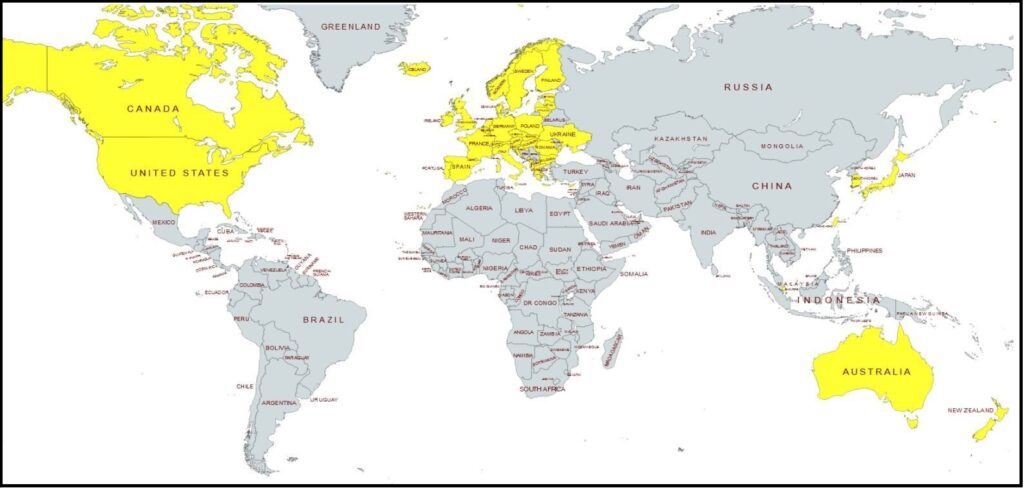
The radical new energy program contained within the Build Back Better agenda, is the root cause of the supply side inflation.  The drop in the production of oil, gas and coal in the same western nations that are following the BBB agenda is origin of the massive spike in energy prices.

Inflation is a major issue, geographically consistent and virtually identical in all the nations who are following the Build Back Better climate change agenda, which is the justification for the energy ‘transition.”  However, not a single leader, central bank or multinational financial institution -including the IMF- will admit the energy policy is the cause of the issue.

(IMF) – The world’s three largest economies are stalling, with important consequences for the global outlook. Inflation is a major concern.

The global economy, still reeling from the pandemic and Russia’s invasion of Ukraine, is facing an increasingly gloomy and uncertain outlook. Many of the downside risks flagged in our April World Economic Outlook have begun to materialize.

Higher-than-expected inflation, especially in the United States and major European economies, is triggering a tightening of global financial conditions. China’s slowdown has been worse than anticipated amid COVID-19 outbreaks and lockdowns, and there have been further negative spillovers from the war in Ukraine. As a result, global output contracted in the second quarter of this year.

[…] In the United States, reduced household purchasing power and tighter monetary policy will drive growth down to 2.3 percent this year and 1 percent next year. In China, further lockdowns, and the deepening real estate crisis pushed growth down to 3.3 percent this year—the slowest in more than four decades, excluding the pandemic. And in the euro area, growth is revised down to 2.6 percent this year and 1.2 percent in 2023, reflecting spillovers from the war in Ukraine and tighter monetary policy. (read more)

Notice the IMF does not generate a single word about the western industrialized nations using the climate change issue to justify their Build Back Better energy programs.

The global pretending continues.

It is very weird to keep seeing all of these global institutions ignoring the origin of the global economic issues.  The World Bank will not say it directly, the EU central bank will not say it directly, the U.S. Federal Reserve will not say it directly, the U.S Treasury Dept will not say it directly, nor will the Australians, U.K. or E.U. Central Commission.

Everyone knows what is happening; everyone knows the root causes; yet no one will say it directly.  Instead, they blame ancillary issues and Russia.  It’s all just weird.

Move along folks, pay no attention to over there…. move along, move along…. Look, shiny things….