This is rather unusual. One would think a governor would be aware that seven blocks in his largest city have been taken over by armed occupiers who have formed an encampment called the Capitol Hill Autonomous Zone. However, when questioned about it, an apparently clueless Washington State Governor jay Inslee says “that’s news to me.”
Note Inslee is not alone in being, well, a little odd. Apparently the bouncy sign language interpreter needs to go pee. WATCH
The activists have barricaded the streets and will not let any journalists or city officials inside their declared zone of control. The region expands across six or seven blocks as outlined by the occupying groups.
The designated zone is located in the city’s Capitol Hill district and surrounds the Seattle Police Department’s East Precinct. Police opened the area to protesters on Monday after previously closing the streets following violent demonstrations that took place following the death of George Floyd in Minneapolis. UPDATES HERE
Natalie Evans@natalierenaee
CHAZ road signs have successfully been installed. #seattleprotest
Former U.S. Ambassador to Germany and former Acting Director of National Intelligence Richard “Ric” Grenell appears for a discussion with Lou Dobbs about the echo-chamber within Washington DC and the internecine relationship to the intelligence apparatus.
Ric Grenell makes a really good point when he connects how the DC political resistance would not attend the Trump inauguration, and how that same attitude just continued throughout. President Trump’s outsider status made him a risk to the interests of the administrative state. The DC system will not accept a ‘people’s president’, they demand approval authority permitting only one of their UniParty tribe.
.
When Democrats won the White House in ’92 Republicans helped the transition.
When Democrats lost the White House in ’00 they created chaos. They destroyed the telephones and computers, punched holes in the walls, spray painted and cut the furniture, and the Clinton’s even stole the furnishings down to the dishes.
When Democrats won the White House in ’08 Republicans helped the transition.
When Democrats lost the White House in ’16 they weaponized the intelligence apparatus to destroy the incoming administration. Leaked intelligence to the media; and unmasked incoming officials to create chaos and fabricate lies.
Earlier this afternoon President Trump held a roundtable discussion on the topic of race relations with black leadership. Participating administration members included Ja’Ron Smith, Deputy Assistant to the President and Deputy Director of the Office of American Innovation and Secretary Ben Carson, Department of Housing and Urban Development.
Joining the administration team was: Wayne Dupree, Host, The Wayne Dupree Show; Raynard Jackson, President and CEO, Raynard Jackson & Associates, LLC; Sonnie Johnson, Host, Sirius XM’s Sonnies Corner; Lawrence Jones, Host and Contributor, Fox News; Pastor Darrell Scott, Chairman, Urban Revitalization Coalition, Inc; and Kareem Lanier, Co-Chairman, Urban Revitalization Coalition, Inc. [Video Below]
.
It’s an excellent conversation.
[Transcript] – THE PRESIDENT: Well, thank you very much. We’re with friends of mine and members of the African American community, and we’re going to be talking about law enforcement, education, business, health, and various other things.
As you know, tomorrow, we’re going to Dallas. We’re going to start our rallies back up now. We’ve had a tremendous run at rallies. I don’t think there’s been an empty seat in — since we came down in the escalator with the First Lady. That was with the future First Lady, at that point. It’s been an amazing thing to behold.
And we’re going to be starting our rallies. The first one, we believe, will be probably — we’re just starting to call up — will be in Oklahoma — in Tulsa, Oklahoma. A beautiful, new venue — brand-new. And we’re looking forward to it. They’ve done a great job with COVID, as you know, in the state of Oklahoma. We’re going to be coming into Florida — do a big one in Florida, a big one in Texas. They’re all going to be big. We’re going to Arizona.
We’re going to North Carolina at the appropriate time. The governor is a little backward there. He’s a little bit behind. And unfortunately, we’re going to probably be having no choice but to move the Republican Convention to another location. That’ll be announced shortly. But we’ll have no choice. We wanted to stay in North Carolina very badly. We love it. It’s a great state. A state I won. Many, many friends. Many relatives, frankly, that live there. And we’ll see how it all works out, but the governor doesn’t want to give an inch.
And what he’s lo- — doing is losing hundreds of millions of dollars for his state. But we’ll probably have no other recourse but to move it to another state. We have a lot of states that want it: Texas, Georgia, Florida. We have many, many states that want it. But we’ve given them everything we can — North Carolina, a special place — but I think we’re going to probably end up giving you an announcement pretty soon.
We are doing well in so many ways. You see what’s going on with Nasdaq; we just broke another record yesterday. Some good news came out of the Federal Reserve today, I think — some very good news. We’re really doing a financial comeback. The jobs numbers were fantastic.
Now, we’ll have some other job numbers come up over the next few weeks, and we’ll see how that goes. But I think it’s really good, and we’re on our way to a very big comeback.
I’d like to ask some of the folks that I’m with today to say a few words. They’ve been really supporters and friends of mine. They understand life. They understand, I think, the black community better than anybody I know. And I will tell you, Ben Carson is an example of exactly what I’m talking about. He’s been my friend from the first day we met, I think.
SECRETARY CARSON: Yeah.
THE PRESIDENT: And we met — we were opponents, but we were never really opponents. Ben is a very exceptional guy. He’s done a fantastic job at HUD. But I’d like to maybe start with Ben to say a couple of words, and go to Darrell and the rest of us.
Let’s say a few words to the press, if you would, please. Ben.
SECRETARY CARSON: Thank you, Mr. President. We’re here obviously to talk about some of the concerns in the black community that have risen to a point that, you know, people all around the world are making their voices heard.
This is an opportune time to do something about it because this administration has already established a record of actually solving problems — problems that other people just talk about and then talk about for many years.
And I am delighted, Mr. President, that you have made it a priority to solve this problem. And we’re all going to be helping with that process. There are many others out there — people of goodwill. You know, there are some who just wait for anything to criticize it, but there are actually some people who actually want to see a solution. And I’ve had a chance to talk to many of them. We’ll continue to do that — put forward the kinds of programs that actually get people out of poverty, not things that just keep people stable in poverty and happy in poverty. We want to change that whole dynamic.
And I think some of the things that have already been done, we will get back to those quickly. You know, this was an intentional stopping of the economy — of an amazing economy. The fundamentals of that economy are still in place. We will recoup that and we will move further on.
And your philosophy, of course, has been that a rising tide floats all boats. And that’s why you don’t spend a lot of time with identity politics. We want everybody to be successful.
THE PRESIDENT: That’s right.
SECRETARY CARSON: And we’re going to do everything we can to help you do that.
THE PRESIDENT: Well, as I’ve been saying, Ben, I think that the economy will be — next year, will be maybe the best it’s ever been. You can already see it with the stock market, how it’s been going up, because you have a lot of smart people that are betting on exactly what I’m saying. The stock market is almost as high as it was prior to the plague floating in from China.
It was a plague that floated in from China. Now they’re learning that it may have been much earlier, which bears out exactly what I’ve been saying. You saw that word yesterday — that it may have come in a lot sooner than we were told.
A friend of mine is Darrell Scott. And he’s a great guy and he’s got a tremendous heart. At the same time, he’s a tough cookie. I think that’s what maybe attracted me to him, unfortunately. I didn’t get attracted to the good parts, but that’s a good part, too. (Laughter.)
Darrell, say a few words, please.
PASTOR SCOTT: We’re here today — and thank you, Mr. President, for allowing us to come — our nation is at a juncture where we’re facing another challenge, but this administration has become used to challenges. It’s been one challenge after another. And we’ve pressed pause, but we’re ready to press play now and continue in the positive initiatives regarding the black community.
You know, Mr. Trump called me in November of 2016, right after the election, right after he won. And he said to me, “What do you want?” And I said, “What do you mean?” He said, “Well, I mean, you’ve been working real hard. Is there anything that you want?” And I said, “I want to be a liaison from the black community to the Trump administration and a liaison to the black community from the Trump administration.”
Since then, we’ve worked on criminal justice reform, we’ve worked on urban revitalization, prison reform, a number of initiatives that are — HBCUs — a number of initiatives that are proactive towards the black community.
And here we are now, and we’re facing another challenge, and we’re going to come up with some great solutions to these problems that are confronting this country. And I’m just glad to have a seat at the table and to have my input received.
THE PRESIDENT: Well, your input has been very important, Darrell.
PASTOR SCOTT: Thank you.
THE PRESIDENT: You know that. And it is true: I’ve known Darrell a long time. He didn’t want anything. What he wanted was just to have a voice so he can make certain positions known. And he’s done that very well — better than anybody I can think of.
Another great voice in the black community is Wayne. Wayne, you’ve been my friend for a long time. Wayne Dupree. His show is a phenomena. It’s a great success. And people listen, and they respect what you have to say.
Go ahead, please.
MR. DUPREE: Well, my name is Wayne Dupree. I met President Trump when he was a businessman. As a matter of fact, he — he’s given me five interviews: two of them in person, three on the phone. And when you’re talking about somebody who is not with the mainstream media — somebody who just has a small voice but has a desire to make changes with his voice — to reach out to a billionaire in New York, and without hesitation, he gave me those interviews. And I think he’s a natural leader.
And I — I mean, honestly, I have supported him ever since he decided to run for President. As a matter of fact, we interviewed him the month before he came down the escalator, and he said, “Well, Wayne, you know, we’re going to have a big announcement next month.” And I said, “Well, you know, you can do it here on the show if you really want to.” (Laughter.)
But, I mean, I’m glad that he has changed things here in D.C. I just — but my daughters and my son and my family, they want to see a lot more positive things coming from the White House. They — they want to see your leadership, and they also want to see things change for the better in this country. I know you can do it. I know you can do it.
THE PRESIDENT: We’ll do it. We’ll do it, Wayne.
Go ahead, please.
MR. JACKSON: My name is Raynard Jackson. And thank you, Mr. President; thank you, Darrell, for inviting us to this roundtable here. I’m from St. Louis originally, and live in Virginia.
But what I’d like to say to you, Mr. President, is kind of
off the beaten path. I’d like to say to all the media assembled here that I wish they would quit lying about what you’ve done, specifically for the black community.
So you got radical liberal journalists, like Joy Reid from MSNBC, Don Lemon from CNN, Roland Martin, who are putting more poison into the black community than any drug dealer, who are killing more black folks than any white person with a sheet over their face. How are they doing it? Spreading these lies about the economy you had, Mr. President, before the virus, was the continuation of Obama. That’s just factually not true. I have a degree in accounting. I keep up with the economy. They’re lying.
So to all these folks on MSNBC, CNN, Roland Martin: What? Are you afraid to have real black Republicans who know what the hell they’re talking about? If you want to know the truth, if you want us to dissect the Obama economy, let’s do it. And I think, Mr. President, your record would win the debate.
Thank you.
THE PRESIDENT: Thank you very much. And, you know, it’s interesting you say that, but you go down the list of criminal justice reform and all of the things we’ve done — Opportunity Zones; the best unemployment rate in the history, just before the plague came in. And it’s going to be back again soon. I think it’s going to be back again, a lot sooner than people think. I think last week was a reflection of that — the jobs numbers.
But you look at all of the things we’ve done. We’ve now worked on prison reform — so important — and so many other things.
But when you look at the economics, when you look at how well the black community has been doing under this administration, nobody has done anything like we’ve done.
And a big thing is criminal justice reform. I keep hearing about, “Oh, criminal justice reform,” and everyone is trying to take the credit. And that one, I will say, we will take the full credit because they couldn’t have done it without us. And I’m not sure, frankly, that the previous administration tried. They may have, but they certainly couldn’t get it done.
And the people that came into my office really — really asking very nicely for help. These people that are supporters of mine. But once we got it, they took the full credit for themselves, and that’s okay too. But we got done criminal justice reform and all of the other things.
I think that one of the — one of the elements that people aren’t talking about are the Opportunity Zones that we did with a great senator. Your friend from South Carolina, right? We did it with Tim. And it was his idea. And it was a big idea, it was a bold idea, and it’s worked much better than at our wild — in our wildest dreams, we couldn’t have thought that that was going to happen.
So we did many, many things, and we’re going to continue to do many things. One of the elements that I talk about is — and I was telling this to Darrell before — that 42, 44 people would come to see me every year: the heads of the historically black colleges and universities. And they would come up here, and I got to actually know them.
And the first year they came, I thought it was a normal meeting. They were asking for a lot of money, which they were having a hard time getting from previous administrations, and we got it for them. The next year they came back, I said, “Oh, what are you guys back for?” He said, “Well, we want the money again.” I said, “Aren’t we working long-term deals?” “No.” And you got the money. And then the third time, I said, “I see. You come…” So they made you for years — many years — for decades, they had to come back, keep coming back, keep coming back. Not like a lot of others. “Will they get it?” And they kept coming back and asking for money.
And I said, “What’s this all about? Why do you have to come every year? Why don’t we make a longer-term deal?” And we made, I think, a 10-year deal. And they were all funded up, and they were all set. And that’s historically black colleges and universities. And they play a tremendous function.
I got to be friendly with some of them. I won’t tell you what some of them said — how bad it was about the past administration and past administrations. But they were treated very, very badly, and I treated them very good.
So they don’t have to come back. I said, “The only bad thing is I won’t see you people anymore, maybe for a long time.” (Laughter.) And they were okay with that. You know, they can — now they can focus on what they really do, which is education.
So we’ve done a lot for the black community, and we’ve done a lot for all communities. And it’s a great honor to have you folks with us. And thank you very much.
Did you have anything to say, by the way, fellas?
Please, go ahead.
MS. JOHNSON: So, my name is Sonnie Johnson. I’m the host of “Sonnie’s Corner.” I am probably the most Trump-ish out of everybody in this room, so you’re — you’re going to have to forgive me. The black community is not doing okay. Like, I understand the perspective and the desire to put out this talking point, but it’s not. Okay?
And I can do it in a simplistic way of just saying: What are the first things you did when you first came into the presidency? The very first things you did was, like, remove regulation and taxation at high levels. Think about the black community that has been under Democratic rule, progressive rule for 60 years. How many rules, how many regulations, how many different forms of taxation are on the books in those areas that are preventing our communities from actually being able to see sustainable growth that we can keep and get ourselves out of this (inaudible) of generational poverty?
We are not okay when it comes to thing like education because we are not able to get quality choice into our communities because we don’t have any position or power within our school boards to be able fight for those things, and not just to get charters in, but to also bring some kind of reformation to the public school system as it stands too.
So, yes, as well as criminal justice reform, and a lot of other things, as well as health and things we can put down on the list. All of these things have been under Democratic control for 60 years. And they are not going to change until you — we have a Republican Party that is willing to go into these communities and actually offer a choice to these people about how we can do things differently. Because the way it is structured now, the only choice that we get is “left” or either “further left,” and we’re not getting the opportunity to actually vote on what we look at as “conservatism,” equally applied.
The very basic economic principles that we, on the right, say are significant in our success and seeing the success in our country — those are not being offered at the local level in black communities.
So, basically, we’re asking to grow out of concrete because we don’t have the fertile soil in these areas to make everything flourish and bloom the way my generation would like to see it.
So I think the numbers and statistics about my generation are not going to be out for 20 years. You’re not going to see that we have started to change the dynamic within families, we have started to change the dynamic within marriage, we have started to change a lot of the negative dynamics that are still brought up in statistics today, involving us.
Our generation is working on making sure those things change. And nobody looks at us and sees the power we have to be effective in making change, this generation, and not just waiting for the next layer of statistics to come out.
So until we can actually get honest dialogue, on the right, out into the ether, then you’re going to keep on having, you know, the fake-news media spread lies because we aren’t there giving another choice as to how these things can be done. And it’s going to continue to go left if we aren’t there, given an option to make it go right.
And that’s, like, the biggest thing that we are having trouble with on the right, is, like, understanding how government works. We are a republic. That means local government has the most power over citizens’ lives, as well as how to take that and put it into a cohesive message that can be spread to the black community that will already engage upon what we already know.
And we looked at, like, the photos of you before you became President. And you were taking pictures with Snoop, and you taking pictures with all of the icons of hip hop. You did that, I think — and you can tell me if I’m wrong — but you did that because you saw capitalists, you saw branders, you saw entrepreneurs. You saw people that were willing to take a chance and make things grow. That is — that is us. That is the black community.
And I would like to see a challenge from you to see how many in the black community can put their names on the side of a building coming out of this. If we’re really going to reshape and reform the way that we do this, issue that challenge, because that’s what we need more now than ever. And we need it to be focused and centric on the black community, not into letting people come in and gentrify areas that are traditionally ours.
THE PRESIDENT: And you don’t need closed police departments.
MS. JOHNSON: No.
THE PRESIDENT: Do you agree with that?
MS. JOHNSON: No, we — we need the police. But if you take a take a (inaudible), if you take a look at what happened in Ferguson — because Ferguson is, like, where Black Lives Matter really came out. I ain’t going to say it was born because, you know, people will fight about that. But if you go back and you look at Ferguson, the DOJ did a report on Ferguson, and what came out of that report was that the mayor’s office was using the police force as a taxation unit. So they were forcing interactions between police and the citizens as a way for them to raise money and bring money into the mayor’s office. That was causing over-policing.
So it is not the fault of the police, nor is a part — the fault of the citizenry what the legislator and the executive branches of city government are putting — are putting into legislative practice.
THE PRESIDENT: Very good. Well — well stated.
Wayne, what do you think? Good job?
MR. DUPREE: (Inaudible.)
THE PRESIDENT: I think a very good job. Good job. Thank you. Thank you, Sonnie. Appreciate it.
Fellas, go ahead. Please.
MR. SMITH: Well, you know, she — she said a lot of the things that — (laughter) —
THE PRESIDENT: She said a lot. (Laughter.)
MR. SMITH: — I don’t know if I can say it any better than that, but just that a lot of these things are systemic. I think what we’ve done, through your leadership, is start to break down that system and fight back. You know, Opportunity Zones, HBCUs, criminal justice reform, those are reversing some systemic issues.
vAnd — and through your leadership now, we’re looking at other layers of that, because we just saw what’s — what COVID shined a spotlight on: on access to capital. It shined a spotlight on health disparities. And then, recently, with the — the protest, how can we create better police and community relations.
But one thing we’ve — we’ve done over the last couple of weeks is listen to individuals, and now we have solutions. And those are things we’re going to continue to work through as an administration, because it’s about results. And I think a lot of people are leaning on you because you’re result-oriented. It’s not about just us talking here; it’s about what we’re going to produce out of this meeting.
MR. DUPREE: And you know what? That’s the thing: A lot of people that listen to the show, or calling on the show, they want to see those results. If you go into the black community and you tell — tell people a type of statistics, they go, “Oh, okay — yeah, great.” But if you show ground-moving, ground-shaking, things — things growing up from the bottom, you know, that — those Opportunity Zones, or more jobs — or more jobs than what they are right now — but if you start showing those things and, you know, a little friendly drive-through, “Hey, President Trump here,” they — believe me, there are many people that are on these online boards and, like I said, the call-ins and whatnot — they do support President Trump. They know what happened in the — in the Obama administration. They know what you’re doing. They also see what the media is doing to you. So don’t think that you are alone. It’s just that they need to hear more from you.
THE PRESIDENT: I agree with that. That’s true. It’s the only way you get through the media because the media is almost 100 percent negative. It’s incredible.
MS. JOHNSON: But that’s not the only thing that’s impeding the progress of the legislation that you put out. So let’s take Opportunity Zones: If the Opportunity — Opportunity Zones pass from a federal level, they then go down to the state and then are allocated on a local level.
So for us as black people to actually access the Opportunity Zones, I have to go talk to Democrats. And I have to be willing to do what they want to do under their agenda, how they want it done, for me to be able to have access to the Opportunity fund — Opportunity Zone funds.
So that’s where, when you see in our communities, instead of getting young blacks to invest and become entrepreneurs and become owners, you’re getting gentrification, because outside forces with more money and connections to these Democrats are able to come in and get this money a lot faster than the black people that it was actually intended to help.
And so you’re seeing this changing of our community, where at no point in time are we allowed in the process to become a part of it and maybe be the innovators of what the future could look like.
Because that is what you really have coming out of a black community: a desire to be an innovating force about what our communities look like in the future, where we have been handed policy or we have been handed government for so long, and now you now have a population that says we want to use the government as a republic, localized government to invent what our — reinvent what our communities look like.
And, yes, it will include police. It will include schools. It will include all the necessity of civilization, but it will also include more investment, ownership, and entrepreneurship from the citizens in those communities.
SECRETARY CARSON: You’ll be happy to know that this administration has recognized that problem. The community development, financial institutions, the credit unions, the local banks have been excluded from a lot of the dissemination of the funds previously. That’s been recognized —
THE PRESIDENT: That’s right.
SECRETARY CARSON: — and is in the process of being corrected right now.
THE PRESIDENT: Okay.
MS. JOHNSON: And that goes a long way.
MR. LANIER: Mr. President, you’ve been nothing short of historic for black America. I don’t say that because I have to, because I can say whatever I want to say as a free citizen here in the U.S. You’ve been nothing short of historical. Criminal justice reform was historical. We were getting locked up at unprecedented rates. You undid the 1994 crime bill, and we are forever thankful for that. Even the Opportunity Zones, we can be critical of a lot of things, but the Opportunity Zones — incentivizing people that have money to put the money where we needed most, which are in these urban and rural neighborhoods. HBCUs. The whole — I can go down thing after thing.
The current issue that we’re having right now is police reform, which is so much needed. We did criminal justice reform, but police reform is the gateway to what we see as an unjust criminal justice system sometimes. Meaning, if a crooked cop, doesn’t do a terrible, corrupt thing with an individual, we never get into that bad system.
This administration has been marred by a crooked cop like James Comey, and others going after you, and creating — creating things that just were not there. The impeachment was — it was — it’s just not real, but they can do that. And our community has been affected by that in a way that it’s hard to explain.
I tell people this all the time, this whole situation with this policing, it’s not new to black people. We’ve been used to it. As a kid, I got harassed by the police all the time and I was a good — I was — I think I was a good kid. (Laughter.) But it was a part of — it’s a part of our community.
And so we do need some things to happen on the police-reform side, which will connect with the great things you’ve already done historically with criminal justice reform. And we know that you’re the President to get it done.
We know that we need some banking reform so that we can get more access to capital. We do also understand that we need some holistic approaches to create this ecosystem. Voting rights: Blacks have to go to get voting rights every 25 years or something.
These are things that are historic, and we believe that you are the President to get these things done for the black — the black community. You’ve done some great things for us already, and we’re relying on you, and we appreciate everything you’ve done, Mr. President. You’ve been amazing.
THE PRESIDENT: Thank you. Thank you very much.
MR. LANIER: You’re welcome.
THE PRESIDENT: That’s beautiful. Well said.
vYour friend, right?
PASTOR SCOTT: Yeah.
THE PRESIDENT: He’s a good — he’s a good man, too. For a long time we’re known him.
Okay, thank you all very much. And we’ll see you tomorrow. We’ll see you tomorrow in Dallas. Thank you.
(Cross-talk.)
Q I wanted to ask you about tomorrow.
THE PRESIDENT: Yeah, we’re going to a place called Dallas tomorrow. I think it’s going be a great trip. Meeting some very good friends. And we’ll come back tomorrow night.
We’re going on Saturday, as you know, to West Point. We’re giving the commencement address, which will be very exciting. The cadets wanted that very much. So we’re going to have them a little bit separated, a little social distancing, but we have the full class at West Point. And it was postponed because of the problem. It was supposed to be a month ago. We’re going to do it. And that’ll be on Saturday.
So that’ll be very exciting. And I think a lot of you are going to be with us. And we’re going to pay honor, really, to those incredible students and cadets. And they’re going to be the future military leaders of our country.
Thank you all very much. Thank you.
Q When are you going to Tulsa, sir?
THE PRESIDENT: Friday night. It will be Friday — Friday night.
The COVID shutdown was an exceptional event. The consequences from the shutdown do have ripple effects; however, the strength of the underlying economic foundation is now coming back into focus as the rebound starts taking shape.
Last week most economic analysts were stunned by the 2.5 million jobs added to the economy in May. As we shared earlier, the result wasn’t so surprising when you consider the framework of the Paycheck Protection Program (PPP) worked exactly like President Trump and Treasury Secretary Mnuching planned. The incentives within the PPP program did what they were intended to do; small and mid-sized businesses retained or rehired their employees.
Inside the foundation of the Trump Main Street economy, the cement that binds the America-First policy, are a series of pre-established economic policies that specifically targets middle-class workers. The foundation is made strong by net wage gains and earnings amid mid-tier workers; those wage gains are made more important by policies that keep inflation in check.
Blue-collar workers, on average, were fortunately positioned to ride-out the COVID shutdown. With the shutdown over; Main Street now quickly fires back into action.
The demand for mortgage applications rose five percent last week, resulting in year-over-year growth over 13 percent. Again, this result stuns the experts. Demand for home purchases remains high and people are confident in their income security to make big decisions on home financing. The visible strength of Main Street cuts against the naysayers and doomsayers who thought the COVID shutdown would collapse the economy. It didn’t.
It did not, because (a) the shutdown was an exceptional event; and (b) the underlying foundation is stronger than the blow it took from the COVID sledgehammer.
(Via CNBC) “The recovery in the purchase market continues to gain steam, with the seasonally adjusted index rising to its highest level since January,” said Joel Kan, an MBA economist. “Purchase activity increased for the eighth straight week.”
Pent-up demand from the spring market, along with low interest rates are fueling a surprisingly quick recovery in home buying. As local economies open up, so do open houses, but there is still a severe shortage of homes for sale. (read more)
President Trump’s Main Street policies are directly responsible for the strength in the middle-class. The media apoplexy over stunningly positive economic news is directly related to how much damage a positive economy does to the Antifa/BLM strategy to divide our nation through class warfare. A thriving Main Street economy is antithetical to the objective.
A thriving Main Street means an expanding U.S. middle-class. As the middle-class expands it becomes more difficult to organize outrage based on division.
The ruling elites deny this fundamental truth, but the rust-belt did not create itself.
The erosion of the U.S. manufacturing base -and Main Street- was an outcome of policy. Both Republicans and Democrats participated in this process. Democrats claim, falsely, to be champions of the middle-class; but their narrative is refuted by the actual results of their policy. Both parties are deep in the pockets of Wall St multinationals.
Many people call for a third party in politics without realizing President Trump represents the first second party DC has seen in decades. That’s why he is opposed by both wings of the same legislative bird.
Through dependency the political elites begin their role to decide who gets what part of their limited and controlled economic pie. Economic intervention, supported by both wings, in the spending process is what has allowed political interests to retain control.
Main Street and the freedom within the free market is a problem for command and control economic systems. Wall St global financial systems, controlled by a limited number of large institutional multinationals, are much easier to control.
Remember the catch phrase “too big to fail” in the banking system? The DC ruling class said a small group of banks controlled too much wealth. So they instituted ‘banking reform’. The result was even fewer banks that were even bigger. The outcome was the exact opposite of what they said was the purpose. Their policy made the problem worse.
President Trump’s America First agenda is specifically a benefit to Main Street and the middle class. In the banking sector treasury policy and targeted deregulation focused on creating more community banks and credit unions to benefit Main Street. That’s exactly what happened. By focusing on Main Street, Trump and Mnuchin fixed what the uniparty congress did not. [Arguably, congress purposefully and willfully did not.] Smaller, more nimble, banks are now positioned to assist small and medium Main Street businesses.
President Trump’s domestic and global political opposition recognize that his trade and economic policies have reversed much of their control. There are trillions at stake, that’s the financial motive for the opposition. However, a lack of control over the economic outcome; meaning President Trump creating more pies; means not only do they lose control over the money, they also lose control through diminished political power.
America-First is a program focused on Main Street and it expands the middle class. That is why during President Trump’s first term the wealth gap actually started to narrow for the first time in decades. The wage growth for line-level or blue collar workers was/is rising faster than the supervisory wages. This is a uniquely trumpian effect from a return to economic policies that benefit Main Street USA workers.
More jobs means the value of labor to do those jobs increases. This economic path is against the interests of coastal elites and the politicians they pay to retain the wealth gap.
When the economy was shut-down by the COVID virus, it was an unnatural economic event. Everything inside the U.S. economy including: the number of workers; the growth in wage rates; the availability of jobs; the lack of inflation; the expansion of investment, was the strongest in our history. However, when everything was stalled all of that positive architecture, the policy that created the outcome, did not go away.
U.S. economic conditions were being driven by internal economic activity that was no longer as dependent on global drivers. When the underlying economic strength is domestic, it makes sense the economy can restart much faster because the activity is not dependent on outside global stimulus. In essence, the USA can rebound much faster because we are NOT dependent on the restart of other global economies. Again, another uniquely positive attribute that is enhanced by ‘America-First’ policies.
China, Obama, Pelosi and Schumer can, and did, attempt to throw a COVID wrench in the expanding U.S. economy. However, they cannot undo the foundation President Trump had already established. Those America-First policies will again work in our favor; and yes, when President Trump says he “can do it again” his confidence is based on that underlying foundation.
Trump may not articulate it, but he knows the U.S. economic independence he has already achieved through three years of advanced policy to benefit Main Street. He knows the trade agreements, the cutting of regulation, the unleashing of energy development and the weight of tariffs on imports all mean the best place for investment is inside the U.S.A.
That fundamental structure did not change, and is not going to change.
A recent example – Remember the previously mentioned policy focus on deregulated community banks and credit unions to assist Main Street? Perhaps a sidebar is important:
SIDEBAR: Trump and Mnuchin viewed the entire U.S. banking system as too monolithic and generally positioned to the benefit of Wall Street and not Main Street. As such their approach toward regulation was to split the regulatory financial system into two segments according to the size of the bank (or financial entity).
Big institutional banks (more than $10 billion) retained comprehensive regulation over their practices; however, smaller banks do not have the same level of regulatory and compliance mandates. This approach is the modern era financial outlook that, like MAGAnomics, is entirely new and bold.
“we do not support a separation of banks from investment banks, we think that would have a very significant problem on the financial markets, on the economy, on liquidity; and we think that there is proper things that potentially we could look at around regulation, but we do not support a separation of banks and investment banks.”
~ Treasury Secretary Steven Mnuchin testifying to the Senate Banking Committee, May 18th 2017
At first blush that statement from Secretary Mnuchin might seem to run counter to the Trump administration’s prior policy statements outlining a preference for a reinstatement of some form of “Glass-Steagall” regulatory separation between commercial banking and investment banking. However, it doesn’t.
When combined with the totality of Mnuchin’s testimony before the Senate Finance Committee, Mnuchin was saying the “too big to fail” (‘too big to succeed’) issue has created a problem for lending liquidity. Specifically, if divisional separation is required – the banks’ best interests would naturally put the investment division ahead of commercial lending and the liquid capital within the overall U.S. economy would shrink.
Back in July 2010 when Dodd-Frank banking regulation was passed into law, there were approximately 12 to 17 banks who fell under the definition of “too big to fail”.
Meaning 12 to 17 financial institutions could individually negatively impact the economy, and were going to force another TARP-type bailout if they failed in the future. Dodd-Frank regulations were supposed to ensure financial security, and the elimination of risk via taxpayer bailouts, by placing mandatory minimums on how much secure capital was required to be held in order to operate “a bank”.
One large downside to Dodd-Frank was that in order to hold the required capital, all banks decreased lending to shore-up their liquid holdings and meet the regulatory minimums.
Without the ability to borrow funds, small businesses had a hard time raising money to modernize or create new business. In the big picture, growth in the larger economy is hampered by the absence of capital.
Another downstream effect of banks needing to increase their liquid holdings was exponentially worse. Less liquid large banks needed to purchase and absorb the financial assets of more liquid large banks in order to meet the regulatory requirements. Indeed this is exactly what happened.
In 2010 there were approximately twelve “too big to fail banks”, and that was seen as a risk within the economy, and more broad-based banking competition was needed to be more secure.
Unfortunately, because of Dodd-Frank, by 2016 those twelve banks had merged into only four even bigger banks that were now even bigger risks; albeit supposedly more financially secure in their liquid holdings. This ‘less banks’ reality was opposite of the desired effect.
The four to six big banks (JP Morgan-Chase, Bank of America, Citigroup, Wells Fargo, US BanCorp and Mellon) now control $9+ trillion (that’s “TRILLION). Their size is so enormous that small number of banks now control most of the U.S. financial market.
Because they control so much of the financial market, instituting a Glass-Steagall firewall between commercial and investment divisions (in addition to the Dodd-Frank liquid holding requirements), would mean the capability of small and mid-size businesses to get the loans needed to expand or even keep their operations running would stop.
2010’s “Too few, too big to fail” became 2016’s “EVEN FEWER, EVEN BIGGER to fail”.
That’s the underlying problem for a Glass-Steagall type of regulation now. The Democrats created Dodd-Frank which:
•#1 generated constraints on the economy (less lending),
•#2 made fewer banking options available (banks merged),
•#3 made top banks even bigger.
This problem is why President Trump and Secretary Mnuchin created a parallel banking system of smaller community and credit union banks that are external to Dodd Frank regulations and can act as the primary commercial banks for small to mid-sized businesses, ie. “Main Street”.
This intended banking design of smaller, more connected to Main Street lending, is why President Trump and Secretary Mnuchin did not support the CFPB banking rule that allowed lawsuits against all financial entities.
The goal of “Glass Steagall”, ie. Commercial division -vs- Investment division, is actually being achieved by generating an entirely new system of banks under different regulation. The currently remaining ten U.S. “big banks” operate as “investment division banks” per se’, and are subject to larger regulatory requirements. However, the lesser regulated community banks/credit unions operate as the “Commercial Side” benefiting Main Street.
Instead of fire-walling an individual bank internally within its organization, the Trump/Mnuchin plan actually created a fire-wall the banking ‘system’ within the U.S. internally. Hope that makes sense. SIDEBAR ENDS –
The success and efficiency of the Paycheck Protection Program for small and medium business was a direct result of that earlier banking regulation and policy change. Brilliantly, Mnuchin used the architecture of the FDIC system to guarantee the loans so the small nimble banks could move quickly. The FDIC was used an an underwriter of sorts for the affiliated lenders; and removed any risk.
PPP borrowers who use small to mid-sized banks or local credit unions were able to get fast access to the funds and retain or re-employ their workforce. Those businesses who operate through the big banks, did not get the same responsiveness. [Again, a good lesson for small business owners…. keep your banking as local as possible.]
The rapid response rate for PPP loans by smaller banks is specifically and directly responsible for the May jobs result of 2.5 million gains. Even in crisis the America-First foresight pays dividends.
The far left is hoping to curtail the strength of the economy; that’s why the blue state governors are fighting against reopening. However, the organized protests of thousands of people gathering together have made their best COVID shutdown arguments moot.
We must not allow the media and politicians to demand keeping restrictions on the economy when we know the underling control mechanism, the social distancing effort, was entirely based on politics. Their support for the protest crowds proves that point.
During strong testimony today in congress, representative Jim Jordan addressed the “Defund the Police” movement being pushed by radical democrats. WATCH:
The DC circuit court of appeals has oral arguments scheduled for this coming Friday as the DOJ and Flynn defense both request intervention. In the interim the underlying case continues in Judge Emett Sullivan’s court. Part of that underlying case activity was a request by Sullivan for an Amicus briefing by court appointed lawyer John Gleeson.
John Gleeson is essentially filling an assignment by the judge to assume the role of prosecutor and inform the court through an amicus briefing. That brief was filed today [pdf available here and below]. Within the brief, and counter to the position of the DOJ with new information, Gleeson claims the predicate for the investigation of Flynn was valid and sets out to launch his argument from that foundation.
In essence Gleeson is defending the origin of Spygate/Obamagate and all the downstream consequences from that originating decision; one of those origination issues was an investigation of Michael Flynn; and one downstream consequence was an interview of Flynn under the guise of the dubious originating investigation authority.
Assuming the role of “Spygate” defender is an interesting effort by John Gleeson; considering that Gleeson should have little knowledge about new discoveries into the DOJ and FBI predication activity in 2016. The discoveries by USAO John Durham (Spygate in total) and USAO Jeff Jensen (Flynn case specific) should be unknown to Gleeson as he attempts to frame his argument.
When you read the brief, it does make you wonder if Gleeson might be attempting to frame the current Flynn argument from the perspective of justifying the total Spygate operation. This approach would be of benefit to the corrupt DOJ and FBI small group who are viewed to have purposefully weaponized their agencies for political intents. From that perspective Gleeson (Lawfare) would be using his Amicus role to build the small group defense.
By taking this approach Gleeson opens himself up to the collapse of his position, right out of the gate, if the valid predicate he is assuming does not exist. Of course this assumes the DOJ might be willing to highlight the specifics on why the Gleeson predicate is invalid, in the counter to his Amicus brief.
The predicate is critical. The DOJ has dropped the case specifically by saying the predicate to investigate General Michael Flynn was invalid; ergo all consequences from that corrupt investigation, including the questioning of Flynn on January 24, 2017, are materially and fundamentally flawed. Gleeson must maintain the investigative predicate if he is to argue a false statement within the Flynn interview was a material lie. This is a tenuous approach if Gleeson doesn’t know the most recent evidence that may have destroyed the predicate.
From that position John Gleeson then argues that Michael Flynn perjured himself in front of the court by admitting to a lie he now says did not take place. Of course Gleeson omits any aspects to the plea being coerced under duress as the special counsel threatened his family (Flynn Jr.) with arrest if he didn’t take the plea.
Instead Gleeson’s argument is that Flynn’s guilty plea now represents a violation of law, perjury, because the defendant is now saying his guilt admission was false testimony.
Gleeson, argues Flynn should be punished at sentencing for lying about crime he was coerced to plead guilty to, and which he did not commit. Madness.
It’s an interesting read and there are likely several people who held interest in the careful way John Gleeson constructed his argument. However, it may all be a moot point depending on the outcome of the DOJ DC circuit appeal, and the possibility the superior court may just tell Judge Sullivan to stop the games and accept the withdrawal.
Buildings alone were not the only things set ablaze during the “George Floyd Protests”—social media torched free expression and demanded renunciations.
An America that once revered disagreement and debate has fallen into imposing mandatory silence upon differing viewpoints. Those who do not bow (kneel?) to political correctness face “re-education,” in the same way that the old Soviet Union arrested opponents and exiled them to the Gulag. Today, in the Gulag’s place, we have social media hate and condemnation.
Cancel Culture Crowd
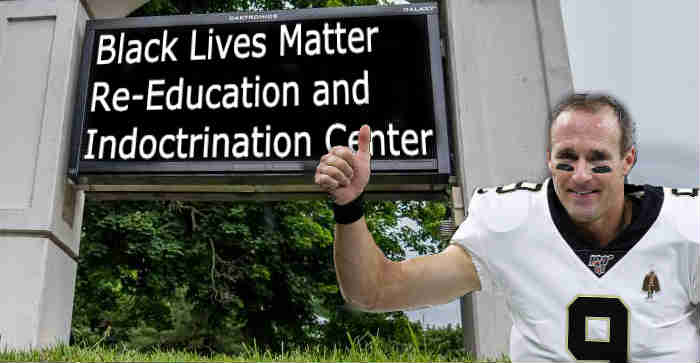
After earlier sharing a message of unity, New Orleans Saints quarterback Drew Brees attracted a backlash last week, when he reiterated his stance that he will “never agree with anybody disrespecting the flag of the United States of America.” The full quote: “I love and respect my teammates, and I stand right there with them fighting for racial equality and justice. I also stand with my grandfathers, who risked their lives for this country, and countless other military men and women who do it on a daily basis.”
The second episode of social media excoriation involved “progressive” Minneapolis Mayor Jacob Frey being met with a chorus of boos for not being radical enough when he told a group of Black Lives Matter demonstrators on Saturday that he did not support abolishing the city police department. Frey was promptly asked to leave by the crowd, and the ironic, delicious moment occurred in which his destructive political career ended. Of course, Frey will be given the chance to recant, and denounce himself, and the weasel carpetbagger mayor will be welcomed back into the good graces of the “Cancel Culture” crowd.
What amazes about Brees’ apology was the lengths he went to beg forgiveness of his black teammates and the city for which he plays professional football and that has a significant African American population.
In eight paragraphs on Instagram, Brees acknowledged he had made a mistake to show respect to everyone, and not exclusively black people.
Among his comments, Brees said,
“it breaks my heart to know the pain I have caused.”
“I made comments that were insensitive and completely missed the mark.”
“They lacked awareness and any type of compassion or empathy. Instead, those words have become divisive and hurtful.”
“I acknowledge that…. (I) have not done enough to fight for that equality or to truly understand the struggles and plight of the black community.”
One would think denouncing himself would satisfy the mob, nevertheless he felt the need to lambaste the country that made him wealthy because of his ability to throw a tight spiral.
“I stand with the black community in the fight against systemic racial injustice and police brutality. I condemn the years of oppression that have taken place throughout our black communities and still exists today.”
The political indoctrination on college campuses with “safe spaces,” and in government public schools is now bleeding into mainstream America
Minneapolis Mayor Jacob Frey experienced his own sudden whiplash with the Far Left. Frey, who grew up in a Washington, D.C. suburb, ran for city council in 2013 and won. He pushed for “affordable housing” and promised to address climate change, obviously a key issue in frigid Minnesota. According to reports, there has not been a Republican on Minneapolis City Council for more than 50 years, so obviously Democrats have presided over a half century of police brutality and racism before Frey flipped.
The political indoctrination on college campuses with “safe spaces,” and in government public schools is now bleeding into mainstream America. Brees committed the “sin” of being “politically incorrect,” and under pressure “repented” of his “thoughtcrime.” In his classic book, 1984, George Orwell coined the word ‘thoughtcrime’ to describe a person’s unapproved, unspoken beliefs that contradict the government and the Party’s control of the citizenry.
Black Lives Matter and Antifa will not accept that America and no place really save Heaven is perfect. In the Preamble to the United States Constitution, the Founders wrote, “We The People, of the United State of America, in order to form a more-perfect union.” So, from the very beginning, Americans believed their country could do better. Slavery was ended after the Civil War. We had a Civil Rights movement in the 1950s and 1960s because the promise of equality eluded black Americans. Dr. Martin Luther King Jr., by non-violence, won a national debate, arguing that America must pay black Americans the promissory note of equal rights, but not special rights.
Now ordinary, silent Americans are guilty, too. Silence means “complicity,” and the Left’s “cure” is “re-education” and “denunciation.”
Americans once peaceably debated the nature of freedom and liberty, and how we ought to govern ourselves. This was America’s defining glory. But over the last 70 years, we have lost the ability to disagree with each other and have our own opinions, much less talk politics to our friends and family.
Drew Brees was silenced, but even that was insufficient; he had to renounce his patriotism. Now ordinary, silent Americans are guilty, too. Silence means “complicity,” and the Left’s “cure” is “re-education” and “denunciation.”
Calling someone a racist is the ultimate silencing. This pernicious word is a political weapon designed to create division and stifle debate. And who is a racist? Anyone who opposes the Left’s “radical transformation” of the United States into a socialist paradise. Here are some examples of this type of racism: Anybody who wants to secure America’s borders and limit immigration. Anybody who wants only U.S. citizens to vote in American elections. Anybody who opposes free health insurance for illegal aliens. Anybody who opposes “defunding the police.”
Dr. King’s standard of trying to love everybody and judging people on the “content of their character, rather than the color of their skin” looks about right.
In July of last year, I offered a perspective in an article entitled ‘The Value of Agreement and Cooperation in the Coming War’. There are many in America who are aware we are in a war, and then there are many who are clueless with regard to such a perception. Such a statement is not intended to be judgemental of the clueless. But, for those still unaware of the war, recent events are good indications of major tremors or disruptions of the relative cultural calm and social fabric. But, it may be that only now, after all of the violence that has torn communities and the nation apart, more people are becoming fully cognizant of ‘the war.’ Nevertheless, there are also many who remain in denial, and for some it is on purpose, not because of cluelessness.
Hypocrisy is easy to identify and it reeks: COVID-19 & George Floyd Riots
The United States has just been ravaged by the COVID-19 Pandemic, but possibly less due to the disease and more due to reactions based on theories of the potential harm to the society from a highly contagious and deadly disease. Now, citizens are witnessing an odd phenomenon of the protests and rioting dissipating the fears over COVID-19. Outbreaks of coronavirus should have occurred across the nation since the end of May. At least, this would have been the outcry if the protestors were Christians, conservatives or patriots marching in the streets and demanding momentary attention.
Hypocrisy is easy to identify. Children can detect hypocrisy when their parents prohibit them from doing any activity that the parents engage in themselves. Teenagers who have parents who smoke can detect the hypocrisy when they are told not to take up smoking. It is the “do as I say, not as I do” phenomenon. Democrat officials and politicians were observed in the act of supporting the demonstrations and protests against the unjust killing of George Floyd. Yet, the week before they were condemning Christians for wanting to congregate. Even some of the Democrat authorities had churchgoers who violated their lockdowns fined and had some ministers arrested.
Hypocrisy is easy to identify and it reeks. But, this latest round of obvious hypocrisy is over the top—more than simple hypocrisy or truly blatant double standards being employed. COVID-19 set the stage for mild resistance to the lockdown orders, but people who engaged in various types of protests across the nation were respectful of the laws, and to some extent even willing to agree to the mandated social distancing and wearing of protective masks. Even then, several Democrat leaders were sharply critical of these people ‘endangering the society’ at large. They were trashed by Democrat leaders and their sycophants as being selfish and irresponsible. Yet, ‘Do as I say, not as I do.’ It does not matter what the justification may be – it’s Hypocrisy!
End funding or reduce funding of the police forces: This is now the political move that Leftists, Progressives, Socialists, and especially anarchists agree with
Hypocrisy is obvious, but it has no meaning to people who have no values. The demonstrations that started out peaceful were hijacked by the lawless elements within various cities. In fact, it even appears that the Democrat leaders and their sycophants support the violence. The basic justification is that police brutality and cops killing blacks must end. And one of the latest calls by Democrat leaders and their sycophants is to end funding or reduce funding of the police forces in cities all across America. This is now the political move that Leftists, Progressives, Socialists, and especially anarchists agree with. It fits right alongside taking away guns from law-abiding citizens. Both initiatives have the intent of rendering regular citizens helpless or defenseless against the lawless.
Hypocrisy is one thing, but enabling those who obey no law is an entirely different dimension of white collar crime in America. Elected officials who would be willing to expose those law-abiding citizens to those who obey no law have little regard for the Constitution and the civil society it is intended to ensure. Stripping citizens of proper protection from the lawless transforms elected officials who advocate such measures into criminals in their own right. Citizens pay the salaries of elected officials through the taxes they give to the federal, state, and municipal governments. So, rendering law-abiding citizens defenseless in such a toxic political environment is criminal. It justifies stealing from the citizens for personal or political power, and such actions aid and abet criminals. Maybe that is the whole point.
Domestic enemies have no true values. Those who are aware of this war, should understand. It matters not whether the criminal is elected or a street thug—breaking the law reveals that both have little respect for the law and few real values. This is because American values are actually at the heart of this war. What American citizens value, or do not value, is one of the most crucial factors that will determine the outcome of this war.
Do Americans still care enough to keep the Republic for which so many gave their lives?
Today, it is American soil that has been occupied, and never before in our history has such a truly formidable enemy been arrayed against our Republic
On Saturday, Americans remembered those who gave their lives on beaches in Normandy to liberate France from Nazi occupation. D-Day on June 6, 1944, was the beginning of the end for the tyranny that had swept across Europe in that time. Yet through dedicated agreement and absolute cooperation between the Allies, D-Day was the beginning of the end for tyranny’s grip on Europe. Today, it is American soil that has been occupied, and never before in our history has such a truly formidable enemy been arrayed against our Republic.
While President Trump is capable of doing a lot, he can do only so much without support from the people. He is actually the principal target of domestic enemies—he has been since before his victory in 2016.
Americans must rise up in this time to work together in a D-Day-like cooperative assault to fight back and reclaim our Republic from criminals. Agreement on all genuine threats to the Republic is “essential” in working together. Genuine agreement between true allies in this war is also vital. American citizens are not each other’s enemies. Working in agreement and cooperation creates unity. And, unity has to be at the core of the efforts of the Christian, conservative, and patriotic groups fighting for the values that our forefathers were willing to fight for and die to secure. Unity is an “essential” objective to counter all domestic threats, and unity will create a foundation for victory in the battles of 2020.
I have received a lot of emails from Britain asking if Boris is the new reason for the collapse of the pound. Fundamentals always emerge to support the projected trend. Boris is approving contract tracing which will undermine the economy dramatically. This is a plot by the socialists to realize their Marxist dreams. The press is so intensely keen on keeping COVID as a national security threat that it is really hopeless.
The British pound appears to be still destined to break the 1985 low. However, we first need the false move with the dollar down to trap everyone into short-dollars and then this will flip around. Contact tracing and certificates to prove you do not have COVID will end tourism for Europe. No Americans will be traveling there if they have their way. The stupidity of Boris and other European world leaders is beyond description. I think I have seen London for the last time already.
We are in a battle with the socialists on an unprecedented scale. They are deliberately destroying businesses under the pretense of the New Green Deal.
I have created this site to help people have fun in the kitchen. I write about enjoying life both in and out of my kitchen. Life is short! Make the most of it and enjoy!
This is a library of News Events not reported by the Main Stream Media documenting & connecting the dots on How the Obama Marxist Liberal agenda is destroying America


 Natalie Evans@natalierenaee






 Centinel2012