Posted originally on the CTH on January 5, 2023 | Sundance
That slow grinding creak you hear in the background; that’s the U.S. economic engine running without oil and beginning that slowdown phase just before it stutters and stalls completely. Alas, the pretending continues…
As noted by the Wall Street Journal, an economic gaslighting institution with a central mission to maintain pretenses, “business surveys show U.S. factory activity declined in December, the Institute for Supply Management and S&P Global both said this week. Separately, S&P Global said Thursday that U.S. services-sector businesses reported a decline in output for the third month running in December.” This comes as “U.S. imports dropped more, by 6.4% on the month, as Americans cut back on holiday-related purchases, including items from other countries such as computers and autos.”
Keep in mind, November retail sales—which included consumer spending at stores, online and at restaurants—fell 0.6% from the prior month for their biggest decline of 2022, according to the Commerce Department. Manufacturing output declined in November as well, the Fed reported, while U.S. home sales fell for a record 10th straight month.
Into this mix of economic metrics, driven by a collapse in disposable consumer income and high energy prices, now we begin to see the number one business expense being curtailed.
(Market Watch) […] Amazon.com Inc layoffs will affect more than 18,000 employees, the highest reduction tally revealed in the past year at a major technology company as the industry pares back amid economic uncertainty.
The Seattle-based company in November said that it was beginning layoffs among its corporate workforce, with cuts concentrated on its devices business, recruiting and retail operations. At the time, The Wall Street Journal reported the cuts would total about 10,000 people. Thousands of those cuts began last year. (more)
Amazon is not alone, “Vimeo said Wednesday that it will cut its workforce by 11% as part of a broader effort to reduce costs, citing deteriorating economic conditions” (link). Additionally, Salesforce Inc. is laying off 10% of its workforce and reducing its office space in certain markets, extending a brutal period for tech job cuts into the new year.”
We can anticipate more reports like this from Reuters, “Samsung Electronics Co Ltd’s quarterly profit will likely plunge 58% to its lowest in six years as a global economic downturn saps demand for electronic devices and clouds the outlook for the memory chip industry. With consumers and businesses reducing spending and investment in the face of high inflation and climbing interest rates, smartphone makers and other clients held back memory chip orders, while smartphones sold for less as demand suffered, analysts said.”
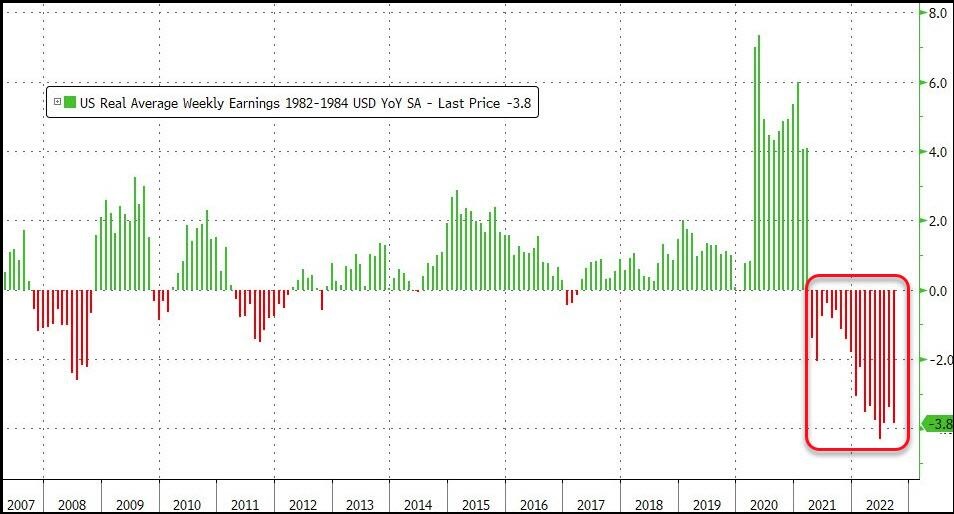
Electronics, cars, furniture, durable goods of all types and varieties are plummeting in sales. Consumers are being squeezed by inflation, housing, energy and food costs, and spending priorities are being reevaluated yet again. Compare the impact on ‘real wages’ -vs- the 2007/2008 economic crisis.
From a purely fraudulent accounting perspective, however, the drop in U.S. imports will help boost calculations of U.S. economic growth in the fourth quarter because trade deficits subtract from overall output, or gross domestic product.
U.S. consumers not purchasing imported goods makes the health of the U.S. economy look less bad; but it’s an illusion akin to smiles in the bread lines.
In other economic news, I did some real estate analysis over the past several days and it’s safe to say there is a steep downward trajectory in the data I use. Again, home values are nuanced on a regional level, but my model is pretty close in averaging.
If buyers do not absorb the seller’s loss in equity (which no one should ever do), in my SWFL area a $450k home listing is going to sell around $380k at the high side (actual value based on economic indicators and buyer ability). That rough estimate, while slightly offset due to general inflation, should trend nationally over the next 12 to 18 months. That means macro home prices dropping around 15 to 20% nationally over the next 12 months.
If you are a home buyer, put your offers around 15 to 20% below current asking price without any emotional attachment to it. Don’t flinch, remain ambivalent and walk away if refused. The recovery to current price will take around a decade. If you are a seller and get an offer within -10% of asking, consider yourself lucky and jump on it.
Posted originally on the CTH on January 4, 2023 | Sundance
In the aftermath of the 2020 election House democrats led by Nancy Pelosi directed a national pantomime from Washington DC that extremists were running amok and terrorizing congress. The January 6 Committee was intended to further establish that narrative.
Pelosi called up the national guard, put fences and barbed wire around congress then installed metal detectors, all as part of the theater for manufacturing the domestic violent extremist narrative. The media engineered the supportive narrative and the ridiculous pantomime continued throughout the past two years. However, as congress now changes hands and republicans take control, the fences are taken down and the metal detectors are being removed.
Colorado Representative Lauren Boebert highlights the return of normalcy. {Direct Rumble Link} WATCH:
However, against the backdrop of revelations from the Twitter Files where the intelligence apparatus, Dept of Homeland Security and FBI were part of the government operation to influence public opinion, the possibility of an FBI inspired and coordinated attack against the Capitol is now more likely than previous.
QUESTION: Didn’t gold decline from 1980 to 1999 because of all the dumping of gold by central banks?
WV
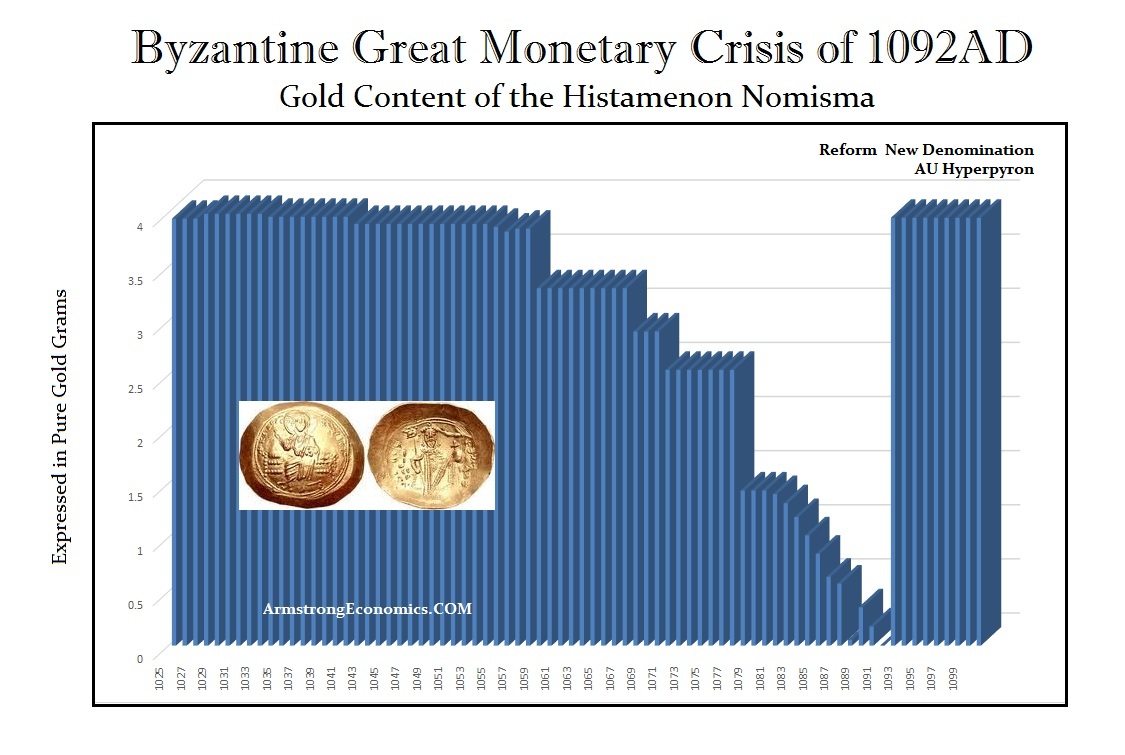
ANSWER: I understand that the quantity rise, in theory, makes sense that the price would decline. But historically, there is no evidence that supports that theory on a consistent basis. There are times when the supply has increased and so has the price. During the Byzantine Empire, confidence in the government began to collapse especially during the monetary crisis of 1092. As people hoarded their gold, the government was forced to debase the coinage even more. When people do not trust the future, they will hoard their wealth. You must understand that all things NEVER remain equal.
This is also why the silver-to-gold ratio fluctuates. NOTHING is ever permanent. We must remember that because it is when the collapse in government takes place, an increase in supply will never satisfy the demand.
Posted originally on the CTH on January 1, 2023 | Sundance
This is an interesting interview in that International Monetary Fund Globalist Director Kristalina Georgieva seems to be laying the landscape for some truthful economic news to surface on the geopolitical level; albeit keeping up the globalist pretenses around western collective energy policy.
One of the more important points Mrs. Georgieva hits on is the reopening of China, from district level COVID bubbles as a containment feature, and the likely impact it will have on global supply chains. Mrs. Georgieva is correct on this issue.
China continued operating their industrial manufacturing base (despite COVID) because they built strict covid isolation bubbles around their industrial sectors geographically. However, with China lifting those isolation bubbles, there is a great potential for the manufacturing sectors to be hit hard by short to medium term virus outbreaks. This could/will have the potential ripple effect of global supply disruptions.
In an ironic twist, ‘deglobalization’ is now a 2023 catchphrase as various nations realize having their supply chains both dependent and interconnected is not good when there are interruptions. A new discussion centering around being dependent on China is the specific issue now being raised. However, the globalists are isolating their viewpoints only to raw material resourcing and development. WATCH:
[Transcript] -MARGARET BRENNAN: I want you to take us around the world and kind of us give us that global view. Let’s start in China. China has been this hub of cheap manufacturing for the world, we are all so dependent on it but right now it looks like COVID cases are exploding as they start pulling back those zero COVID restrictions. What will that mean for the global economy Longterm and short-term?
GEORGIEVA: In the short term, bad news. China has slowed down dramatically in 2022 because of this tight zero COVID policy. For the first time in 40 years China’s growth in 2022 is likely to be at or below global growth. That has never happened before. And looking into next year for three, four, five, six months the relaxation of COVID restrictions will mean bush fire COVID cases throughout China. I was in China last week, in a bubble in the city where there is zero COVID. But that is not going to last once the Chinese people start traveling.
MARGARET BRENNAN: Because they also- they don’t have an effective vaccine right now.
GEORGIEVA: The- the vaccinations fall behind. They have not worked on anti-viral treatments and how that can be offered to people, and so they will go through this tough time. If they stay the course, and this is our advice, stay the course, over time they would be able to catch up with the rest of the world, both in terms of focusing their vaccinations, bringing mRNA vaccines into China, expanding antiviral treatment, and the economy would function. But for the next couple of months, it would be tough for China, and the impact on Chinese growth would be negative. The impact on the region would- would be negative. The impact on global growth would be negative.
MARGARET BRENNAN: Because this is the second-largest economy in the world, and we’ve learned how dependent the world is on the Chinese supply chain. So do you expect then, a domino effect? Will inflation get worse, because all of a sudden there aren’t workers healthy enough to go to factories in China?
GEORGIEVA: We expect that there would be counterweight from the sheer opening of the economy, because up to now, the biggest impact on global value chains came from restrictions due to COVID. When you close down a big city or a big port, the repercussions for the economy is- are significant. Now, we would have the impact of people getting sick, not going to work, but the economy would be open. So the expectations we have for China is to gradually move to a higher level of economic performance, and finish the year better off than it is going to start the year. But you’re absolutely right, the world has relied on China’s growth for a long, long, long time. Before COVID, China would deliver 34, 35, 40% of global growth. It is not doing it anymore. It is actually quite a stressful for the- for the Asian economies. When I talk to Asian leaders, all of them start with this question, what is going to happen with China? Is China going to return to a higher level of growth?
MARGARET BRENNAN: You’ve said that you fear that we are sleepwalking into a world that is poorer and less secure because of a split in the global economy between the US and China. What do you mean by that? Do you see efforts here in Washington to stop it?
GEORGIEVA: It is very easy to reflect on the benefits of the world being more integrated. When we look back over the last three decades, the world economy tripled because of this reliance on an integrated world economy. Who benefited the most? Emerging markets and developing economies, they quadrupled. But rich countries also benefited, they doubled in size of the economy. So we have to be careful not to throw the baby out with the bath water. Yes, the way we have operated created excessive dependency in global chains. We were too focused on costs, how can we make products cheaper. And COVID and then the senseless war Russia started against Ukraine has shown that this is not enough. We cannot just concentrate on what is cheaper. We have to think of the security of supplies and that means diversify the sources of products that make the economy function well, lifting up the level of cost. That economic logic is not only appropriate, it is a must to follow. But we shouldn’t go beyond. We shouldn’t say, okay, we break the world into blocks, one works here, the other one works there because the costs are very, very high. We calculated that just trade, limiting trade into two blocks, would chop $1.5 trillion from the global GDP year after year after year.
MARGARET BRENNAN: If you tried to separate the US and China?
GEORGIEVA: You separate- you separate them, there is an excessive cost. So the logic should be where for security reasons there has to be careful recalibration of supply chains, do it, but don’t go beyond- don’t go into benign areas of products that have no strategic significance but they benefit the US consumer, they benefit the world economy. And this is what we are arguing for, don’t go in a direction in which this separation would make everybody poorer and the world less secure.
MARGARET BRENNAN: So you’re telling Beijing and Washington, figure it out. You can’t be in conflict.
GEORGIEVA: What we have seen in Bali is an indication that this rationale–
MARGARET BRENNAN: You’re talking about the G20 meeting–
GEORGIEVA: The G20 meeting in Bali, when the two presidents, President Biden and President Xi Jinping, met, they spent three and a half hours discussing exactly that. Where is the point of contact that makes both countries better off? And where is that- that there are differences that cannot be bridged and therefore we have to keep them–
MARGARET BRENNAN: The US is trying to block some Chinese technology companies from doing business here. They’re taking measures that are drawing some pretty bright lines between the US and China. Is that tolerable?
GEORGIEVA: We always prefer countries to seek their common interest in economic integration. And when you start breaking the interactions that are based on fair trade, you harm your own people, you not only harm the- the Chinese and therefore it has to be thought through very carefully. Again, I want to be very clear, some diversification of supplies for the security of supply chains is necessary. COVID taught us this lesson, the war taught us this lesson. So the U.S. is right to look into some areas where strategically they need to guarantee the functioning of the U.S. economy without interruptions. But do that keeping in mind the interests of the American people that would like to still have prices moderating, and actually, when we think about prices, one good news we have for 2023 is that towards the end of the year, we do expect inflation to trim down. So don’t take actions that may be contrary to that trend.
MARGARET BRENNAN: But you are predicting inflation to slow to six and a half percent from about 7%. Is that right?
GEORGIEVA: Well, towards the end of the year, we- we project it would go even further down towards the end of 2023, provided central banks stayed the course. Our big worry is that with the economy slowing down globally, we are projecting global growth to go down to 2.7%, maybe even lower next year. Remember, 2021, it was 6%. It dropped to 3.2 this year, 2022. And it will continue to drop down if central banks get the cold foot and say, ‘oh, my god, growth is slowing down, let’s slow down the fight against inflation.’ We risk then inflation to be more persistent. So our message is to central banks, you have to see credible decline in inflation and only then you can think about re-calibrating rate policy.
MARGARET BRENNAN: One of your IMF researchers gave a pretty dire prediction. Overall this year, shocks will reopen economic wounds that were only partially healed post-pandemic. In short, the worst is yet to come and for many people, 2023 will feel like a recession. What do you need to brace for?
GEORGIEVA: The- this is- this is what we see in 2023. For most of the world economy, this is going to be a tough year, tougher than the year we leave behind. Why? Because the three big economies, U.S., E.U., China, are all slowing down simultaneously. The US is most resilient. The U.S. may avoid recession. We see the labor market remaining quite strong. This is, however, mixed blessing because if the labor market is very strong, the Fed may have to keep interest rates tighter for- for longer to bring inflation down. The E.U. very severely hit by the war in Ukraine. Half of the European Union will be in recession next year. China is going to slow down this year further. Next year will be a tough year for China. And that translates into negative trends globally. When we look at the emerging markets in developing economies, there, the picture is even direr. Why? Because on top of everything else, they get hit by high interest rates and by the appreciation of the dollar. For those economies that have high level of that, this is a devastation.
MARGARET BRENNAN: And I want to- I want to come back to you on that. And just to explain that for some of our listeners, a stronger dollar, it’s good for Americans when they go shopping abroad. It’s not good for poor countries who have taken out loans, for example, and borrowed money in dollars. And according to the IMF, 60% of low income countries are in distress because of this- this debt. So what does that look like? Do you- do you see governments collapsing with defaults? Does that bleed into the global financial system? I mean, how much of a contagion does this become?
GEORGIEVA: So far the countries that are in that distress are not systemically significant to trigger a debt crisis. Let’s just look at the map, which are these countries? Chad, Ethiopia, Zambia, Ghana, Lebanon, Surinam, Sri Lanka, very important for their people that we find the resolution to the debt problem, but the risk of contagion is not as high. However, if that list continues to grow, and let’s remember, 25% of emerging markets are trading in distressed territory, then the world economy may be for a bad surprise. And this is why at the IMF, we are working very hard to press for debt resolution for these countries and we have engaged the traditional creditors, the Paris Club, the non-traditional creditors, China, India, Saudi Arabia. I would call this very simple: urgency, we have to act. When I look at the- the debt of the world. Yes, we have to be concerned. During COVID, what did we do? Everywhere governments borrowed, rightly so, to help their people.
MARGARET BRENNAN: Money was cheap.
GEORGIEVA: Money was cheap, and we prevented a collapse of the world economy. That was the right thing to do. But once Russia invaded Ukraine and that added impetus to inflation, money is not- not cheap anymore. So what is the advice we give to governments? Focus on your budgets, make sure that you have sufficient revenues to collect and that you spend very wisely.
MARGARET BRENNAN: That’s good advice, but it’s not always easy politics to follow that advice, as you know–
GEORGIEVA: Of course it is not.
MARGARET BRENNAN: And so that’s why I want to- if- if you can explain for our viewers. You know, we spoke to the CEO of JPMorgan Chase, Jamie Dimon, recently, and he said he sees the global risk as explosive right now. He was saying things like migration, energy, national security, liquidity in the banking system, war, these are all the knock on effects of a government not being able to pay its bills and not being able to deliver for its people. Is that what you are seeing too?
GEORGIEVA: Well, what we’re seeing is the world has changed dramatically. It is a more shock prone world. The lessons we learned from the last couple of years are that no more we operate with relative predictability of what the future would bring. And these shocks COVID, the war, costs of living crisis, they compound their impact. What does that mean for governments? First and foremost, it means that we need to change our mindset towards more resilience, more precautionary actions. And at the IMF, this is what we tell our members. Act early, don’t wait until the problems deepen. And for those who need help, this is why we exist for the developing countries. The fund is a source of resilience and I am- I am very pleased that many of our members are coming to us. Just since the war started we got 16 countries coming for programs to the IMF, $90 billion in support for these countries. And right now we have 36 requests. So that acting early, when you see trouble, look for ways to strengthen your fundamentals, to have buffers to protect you and your people. This is the advice we give to governments. For those who don’t know the IMF, we were created from the ashes of the Second World War to stabilize the world economy. And at a moment like this, we come strong to help our members. My message, don’t think that we are going to go back to pre-COVID predictability. More uncertainty, more overlap of crises wait for us. Rather than crying for the time we had, we have to buckle up and act in that more agile, precautionary manner I described.
MARGARET BRENNAN: I want to make sure I get to Ukraine because I know we’re running out of time. You’ve said- excuse me- you’ve said the single most negative factor in the global economy is the war in Ukraine. And Vladimir Putin says this is going to go on for some time. President Zelensky said they need $55 billion in foreign support next year. He expects $20 billion from the IMF, is he going to get it?
GEORGIEVA: We are working on providing support for Ukraine. So far, out to the international financial institutions, we have provided the largest amount of financing for Ukraine, $2.7 billion in emergency financing, and we are working for 2023 to be a significant part of the support for Ukraine. I expect that sometime early in the year we will go to our board with the request. We have assessed the needs of Ukraine to range somewhere between three and five billion dollars a month. What Putin did with destroying critical infrastructure in Ukraine, this is horrific, and it means that in the next months the country would be more on the high end of this range because it is put in an awful position to have to restore access to electricity, to heat, to water. I have relatives in Ukraine. What I- what I know from them is it is cold, it is dark, and it is scary. Bombardments of civilian areas continue. What I also want to say is that Ukraine has proven to be remarkably resilient. Ukrainian economy is functioning. Pensions are being paid. When there is bombardment, restoration of energy, water, heat is done very quickly and we see revenues collected in Ukraine in a very disciplined manner to support the functioning of the country.
MARGARET BRENNAN: So the government’s not going to collapse?
GEORGIEVA: The government is very well functioning under incredibly difficult circumstances. No, they’re not going to collapse. And then the other thing that is so remarkable is actually the world has proven to be more resilient than we feared, a year in the beginning of the year. We look at the response to the energy shock in Europe, and Europe is moving towards independence from Russia decisively. Yes, there will be a tough winter, maybe the next one would be even tougher, but freedom from dependence on Russia is coming. It is going to be there.
MARGARET BRENNAN: I want to ask you two questions before we go. How do you describe the state of U.S. economics and politics?
GEORGIEVA: The US economy is remarkably resilient. Decision making in the US because of the way the political set is at the moment, it is more difficult. But nonetheless the US has taken some very important steps that are helping to the US economy. Like the child tax-
MARGARET BRENNAN: The tax credit. It expired.
GEORGIEVA: The credit that is it. It is contributing so significantly to reducing poverty in the US, like the infrastructure bill, like the Inflation Reduction Act. These are things that are bringing more dynamism in the US. Good for the US, good for the world. And of course staying on that course is going to be more challenging. But I do hope that the US is not going to slip into recession despite all these risks. We expect one third of the world economy to be in recession. And yes, as you said, even countries that are not in recession, it would feel like recession for hundreds of millions of people. But if that resilience of the labor market in the US holds, the US would help the world to get through a very difficult year.
MARGARET BRENNAN: And as I let you go, my final question is what leaves you hopeful in 2023?
GEORGIEVA: What leaves me hopeful is that I know when we work together, we can overcome the most dramatic challenges. In 2020, the world came together in the face of tremendous threat and was able to overcome this threat. In 2023 we have to do the same. And in this world of ours, of more frequent and devastating shocks, we have to hold hands, we have to work together. And my institution is there to bring together economic policymakers so we can be wise and persistent in the face of truly dramatic challenges we face.
MARGARET BRENNAN: Madam managing Director, thank you for your time this morning.
Posted originally on the CTH December 31, 2022 | sundance
If 2022 was not the apex year for the era of great pretending, then we remain sitting in a handbasket – destination, full speed ahead.
When asked for the topic of a ‘big picture‘ podcast this 2022-year ending, the obvious answer from me was We Need to Quit Pretending.
For the past two years I can only encapsulate the entire social, political and socioeconomic dynamic that surrounds us by saying we are living in an era of great pretending. Why? Because nothing else adequately explains it.
A recession is no longer two negative quarters of economic growth. Elections are no longer defined by votes cast, but by ballots counted. Meanwhile, women are claimed to have penises and people will argue -strenuously and with commitment- that men can give birth to babies.
Simultaneously, vaccines are no longer about medicines to avoid viruses, and Americans have some moral obligation to fund the administrative salaries, pensions and expense accounts for a nation of European politicians, in a country that few taxpayers could find on a map.
We must pretend the occupant of the oval office is not a dementia patient, at the same time we must pretend the Dept of Homeland Security and FBI is not telling online speech platforms that identifying the dementia patient, as a dementia patient, means you are a domestic violent extremist. The absurdity of the pretenses are off-the-charts.
However, on the upside, we now see even blissfully ignorant people starting to realize something is wrong when their electricity and heating bills quadruple, while the same system of governmental caretakers are telling us to embrace a new earth friendly normal of $12 dollar eggs. We been knew, but more are now knowing – thank God.
History provides reference points, and prolonged pretending never ends up in a good place. So, there is room for optimism on a couple of points.
First, there is more support than ever for the ‘burn it all down‘ approach. Whereby we keep the basic U.S. Constitution in place and shred every other institution created that has nothing whatsoever to do with it.
This includes both the DNC and RNC wings of the UniParty apparatus. I mean, really, at the core of it, what do we have to lose? Why not just get rid of the dysfunctional systems that abuse us.
Second, in a weird way, we are in a rare space where we can feel the history around us. Normally we would have to look in retrospect at the events as they unfolded to recognize the inflection point historians would use – not now. We can look around us right now and have full confidence the most influential voice in the next two decades will be the man, woman or entity that starts openly and publicly calling out this ridiculous pretending.
How messed up does society have to be, and how low to the ground does the actual bar have to rest, in order to realize the most important and influential person in our lifetime will simply be the one who stops pretending? Ultimately, this is the source of my optimism for the future.
When it becomes so easy to deconstruct the madness simply by pointing out the reality, eventually anyone can do it. In an era of great pretending, when you speak factual and pain truth, people thirsting will come for the sanity. Yes, there’s only so much hypocritical nuttery that can possibly fit into the social fabric of a nation, and we’re full.
I see that dynamic starting to play out now. Mainstream media are openly mocked everywhere for being the Baghdad Bob’s they are. The MSM credibility and influence essentially destroyed by the Potemkin villages and Eco-chambers they built around themselves.
The congressional J6 committee is yet another example of a proclaimed thermonuclear ICBM missile that ended up delivering a contrasting reality. The fading whistle & pop akin to a dysfunctional bottle rocket.
There’s no help on this pretending issue coming from the political side of the American spectrum; sneeze that thought into a tissue and flush it.
The big movement that will end this era will come from ordinary people laughing, mocking and belittling the pretenders.
I do genuinely believe this phase is well underway, albeit we are in the beginning phases of the great mocking.
Whenever possible, we should do all we can to fuel both mocking and shame when discussing the great pretenders. There’s only so much ridicule they can take before they must change course. Ridiculing is another way to throw sand in the machinery. Again, I think we are beginning to see that pendulum shift taking place right now.
Evidence for my optimism can be found in the most obscure places, including this paragraph from a recent NPR article:
…[…] “Only 15% of people eligible for the Covid booster shot that targets the omicron variant have gotten it — a rate that is even lower than the perennially disappointing rates for flu vaccine uptake. Vaccine fatigue seems to have spread to other shots, too — including those to prevent measles and polio — according to a recent poll by the Kaiser Family Foundation.”
Think about it. “Eligible for the Covid booster” means that 85% of those who took the COVID-19 “vaccine” are not taking the booster. Eighty-five percent of the people who took the shot have stopped pretending the covid shot had anything to do with public health. That’s 85 out of 100 people who took the shot, not taking the booster. That’s a lot of simultaneous pretense quitting.
Yes, 2022 was another year in this great pretending era, but along with it comes a new enlightenment for a whole bunch of people. From where we sit at the end of this year, it looks like the pretending has apexed.
Eyes are wide open; people are starting to be intellectually honest and more curious.
Yes comrade rebels, slowly, albeit painfully slowly, there is hope emerging.
COMMENT: I can see what your model is predicting. It is just becoming in your face. I had a one time friend who is so consumed with his hatred of Donald Trump he is incapable to seeing anything else. The country is so divided we are no longer friends and I am middle-of-the-road and not a Trump worshiper.
GD
REPLY: We must understand that those who are just consumed with hatred for Donal Trump are victims of physiological warfare the very same tactics employed by Hitler. It is very true that Hitler was an extremely gifted speaker. He would mesmerize and totally captivate many people with his beating of the lectern symbolizing how the German people were wronged. Hitler’s primary tactic was to tap into people’s emotions and this became his inspirational tactic to win over the people. Hitler would praise Christian heritage as well as the German Christian culture. He would tie himself to a belief in Jesus Christ.
Hit was a master at getting people to hate. Hitler used Christianity as a central motivation for his anti-Semitism and this was how he managed to get so many people to view Jews as the enemy. Hitler’s strategy was to create the conception that Jews were in fact the enemies of all civilization. His speeches were emotional and in so doing, he used Christianity to support his policies as if this were a Holy War. In Hitler’s public speeches, he influenced others using their emotions by recasting that Jesus was a fighter against the Jews.
He became exceptionally adept at telling people what they wanted to hear just as we see unfolding today with demonizing Trump and in the process, extending that to all Republicans dividing the country just as Hitler learned how to do. Hitler used the theme that this was a Jewish-Marxist plot to conquer the world. The Reichstag Fire he blamed on a communist which he linked with the Jews thanks to Karl Marx. He exclaimed that this was a betrayal of everything German culture stood for.
They have demonized Trump and as soon as Biden took office, he went out of his way to do whatever Trump had done, which had to be reversed despite the fact that it was reasonable for the country. They have opened the borders, but only to South America hoping to flood the country with immigrants who they are counting on will vote Democrat against those who actually produce. I met with the former head of Australia, Paul Keatings, and tried to negotiate on behalf of Hong Kong to buy land to allow them to migrate. He declined, When I asked WHY? Is this Racist? He said not. They were fleeing communism so they would vote conservative and Keating was a Labour Government fearing that an influx would change the demographics.
The Democrats are using that strategy. They believe all these people are coming for a free handout. If they had assets, they would not come. So they want the poorest of the poor to change the politics of the United States.
As long as they keep people blinded but their hatred of Trump, they get to do whatever they want. It is the Hitler strategy all over again.
One reader from Texas wrote:
QUESTION: What does Socrates say about immigration? I can’t believe the hordes of people coming into Texas, but no one in Washington cares. Our governor is seen as a terrible human being by the media because he sends busloads of immigrants to “blue” cities, but those people would freeze to death in El Paso where people are crammed into civic centers, schools, churches, and the airport. They have run out of blankets and clothing to give to them and their volunteers are exhausted. Smaller border towns have even greater problems because they have fewer resources. The immigrants only shot at survival is to leave El Paso. Why don’t people in other states see what is happening? Why do they think Texas has a place for all these people? And why do they think Texas has received money to take care of these people when it is charity organizations who picks up the tab?
For people who believe that immigrants add value—Texas has been educating immigrant children for years and we have very high school taxes. Immigrants appear at hospital ERs and expect treatment, which has resulted in the closing of many rural hospitals. They drive without insurance and often don’t follow traffic laws. Our insurance rates go up.
If Texans complain we are called racist, however, a plurality of Texans are Hispanic. The border counties are 90-95% Hispanic. People who live along the border are tired of the invasion and are increasingly voting “red.” It’s really hard to see what Washington is trying to accomplish unless they want to see Texas leave the union.
JBM
ANSWER: This will be a major factor on the separatist movement building in the United States. This is part of the destruction of society and we would expect that post-2024.
I have created this site to help people have fun in the kitchen. I write about enjoying life both in and out of my kitchen. Life is short! Make the most of it and enjoy!
This is a library of News Events not reported by the Main Stream Media documenting & connecting the dots on How the Obama Marxist Liberal agenda is destroying America












 Centinel2012