Stunning News in Canada – Economy Loses 71,200 Jobs, Unemployment Jumps to 5.9%…


Elections have consequences.  On the same day the U.S. economy reports astoundingly successful jobs growth of 226,000 jobs and a drop in the unemployment rate to 3.5 percent; the Canadian state economic minister reports surprisingly terrible jobs losses of 72,200 jobs and a jump in unemployment from 5.5 to 5.9 percent.

The Canadian economy is roughly one-tenth the size of the U.S. So in equivalent terms the results from Canada reflect a comparative loss of 720,000 jobs on the same day the U.S. revises all figures upward to over 300,000 gains.  A stunning economic contrast:

OTTAWA (Reuters) – The Canadian job market lost a surprise 71,200 net positions in November while the unemployment rate rose to 5.9%, the highest in more than a year, data showed on Friday, as analysts said a repeat of the weak numbers could force the Bank of Canada to rethink its monetary policy.

Analysts in a Reuters poll had forecast a gain of 10,000 jobs and had predicted the unemployment rate would hold steady at 5.5%. […] November’s numbers followed a weak report in October, when the labor market unexpectedly shed jobs despite a likely boost from hiring related to the federal election.

[…] Canada’s goods-producing industries saw a decline of 26,600 net jobs, largely on manufacturing. The services sector lost 44,400 net jobs.

November’s unemployment rate was the highest seen since the 6.0% reported in August 2018. 38,400 full-time jobs and 32,800 part-time jobs were lost in November. (read more)

It is worth remembering that Canada does not allow competition in their media sector.  The Canadian government considers the news media a protected “cultural industry”; and through a process of subsidizing broadcast all news media is essentially state run media.

Why is this important?  Well, when the expressed priority of the government is controlling broadcast information if you are intellectually honest you should apply that same ideological outlook toward any information from the government in a general sense.

The Canadian election was held on October 21st, 2019.  The central control government of Justin Trudeau would likely hold-back any negative economic information in an effort to support the ideology of the central government and maintain public opinion in advance of the voting.  However, with the election over the economic books need to be reconciled.

I strongly suspect the Canadian November jobs report encompasses some of that state run reconciliation effort.  Meaning the Canadian economy was in much worse shape in the months leading up to the election than state media were broadcasting.  The reality is now catching up….

Secondly, it was obvious in July of this year that Speaker Nancy Pelosi and Justin Trudeau entered into an agreement of mutual benefit.  Trudeau would hold back submission of the USMCA for parliamentary ratification, and left-wing political ideologues in the U.S. would help Trudeau win re-election.

At the time CTH forewarned of what this type of political arrangement really meant.

In essence Prime Minister Justin Trudeau was willing to compromise the health of his own economy for stunningly political reasons.  There was a perfect storm of negative economic dynamics clearly visible on the horizon…. but few were paying attention.

In combination with leftist economic policies on energy development that strangles economic growth through excessive regulation, the leftist government of Trudeau has dismantled the natural underpinnings of a market-based economy.  The manufacturing base of Canada is compromised, perhaps to the point of no return.

For two decades liberal (left-wing) Canadian policy essentially transformed their economic model from manufacturing to “assembly“.   The goods-based production within the Canadian economy was structured to take advantage of the NAFTA loophole.

Goods production in Canada was reduced from full manufacturing to a process of assembling parts brought in from overseas and then selling them into the U.S. market.   This process exploited the NAFTA loophole allowing foreign companies to ship parts to Canada and then assemble for transport into the U.S. without tariffs.

Over time the Canadian economy became more and more dependent on this system of brokering goods, while Canada simultaneously dismantled their heavy industry at the request of extreme environmentalists.

The Canadian assembly system for durable goods was always at risk of the NAFTA loophole being closed.  When President Trump renegotiated the USMCA, primarily with Mexico, the loophole was closed.  The USMCA rules on origination now require the parts to come from inside the North American manufacturing system.

Importing parts from Asia and simply assembling them in Canada is no longer permitted under the USMCA agreement.  The majority of the parts -which require heavy industry to produce- must originate from North America.  Canada has little capacity to take advantage of this economic opportunity because they dismantled their heavy industry.

As a consequence, if any multinational company wanting to invest in a manufacturing system, that avoids tariffs, to bring their end product to the massive U.S. market… well, Canada is no longer a viable option for that investment.

The multinational banks and investment groups who fund corporate manufacturing investment; and who are now no longer willing to underwrite Asian investment due to the impact of Trump tariffs; are focusing on where that investment can support the economic activity.

As with this latest report, when we see: “Canada’s goods-producing industries saw a decline of 26,600 net jobs, largely on manufacturing” leading the headline, this is a direct consequence of the economic dynamic identified above.

Elections have consequences; and those economic consequences are extraordinarily impactful in the era when U.S. President Trump is dismantling global supply chains; focusing on bringing high-wage manufacturing industry back to the U.S; and driving a process of profound consequence through economic nationalism.

Economic Security is National Security” ~ President Trump

The Rising Tide of Civil Unrest Globally


QUESTION:

Dear Marty , what do you’re models say about the unrest in South America (Chili, Peru, Bolivia, Colombia, Venezuela, Argentinia) .

It looks like the whole continent is on flames.

All the best,

ciao G

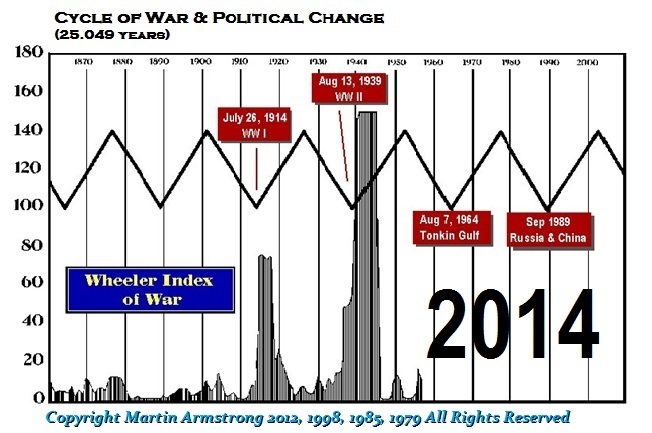
ANSWER: I will update the Cycle of War in 2020. As I have stated many times, the computer has correlated both the international war among nations as well as the civil unrest which leads to revolutions. Normally, these two separate models move at different times. When they align, we get the most dramatic changes. This is what is taking place right now on a global scale. We have rising civil unrest around the globe. There is no place that is exempt.

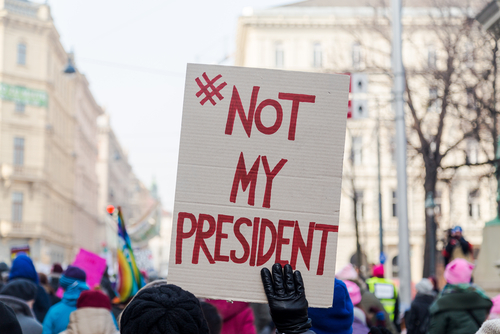
We will see even the US 2020 elections become much more violent. It will be similar to the 1960s, but this is not over race. This time economics is driving the cycle which is being articulated in the battle between socialism v capitalism. Never before in history do we see the losing side simply refuse to accept their loss and move on. This nonsense that Trump is “#NotMyPresident” reflects the rising discontent which will turn to violence next year.

Then the socialists are out to destroy capitalism using climate change. This is also a cleverly orchestrated movement that is political beneath the surface. Shutting down fuel, ending cars and air travel — people have no idea that the agenda is to send society back to the Stone Age and end, not just industrialization, but capitalism.

This is not going to end well. The stupidity of people to ascribe to climate change without looking closely at the proposals is just an illustration of how easily the mob can be fooled. They are being convinced to surrender all their freedoms on the pretense that we face extinction in 12 years.

The Big Bang and the Process Unfolding into 2025


QUESTION:  Hi Martin, I am a long time follower and devoted to your blogs. It’s something that goes well with that first cup of coffee in the morning. In your responses to some people regarding an alternate place to escape from government tyranny, I would suggest that it is not easy for many who have a spouse, family or grandchildren (if if you have the means to do so). Another aspect is how does one assess whether the place they are moving to will have a stable government five years from now or longer, because there is always the threat from another country wanting your resources, workers, strategic land, etc. I don’t think it is easy for anyone to up and move away from family and friends whom they would leave behind – and contact via social media, well, that’s doesn’t work for me.

Thank you.

PP

ANSWER: The cracks in the system will begin to appear next year. This is part of the Big Bang that began 2015.75, and was the PEAK in government confidence. As this unfolds, it will become clearer as to where to go. Keep in mind that the collapse in governments is predominantly in the West. There will be rising separatist movements, so we will see varying pockets of political unrest. We are just too far away from that for me to speak without guessing. It does appear that Asia will be the better place in general. They are not embracing socialism or this insane climate change agenda

Socrates Project – Best Kept Secret


QUESTION: Marty; A friend of mine is an analyst at one of the major banks in New York. He said they are not allowed to forecast some things as you said. He used to work for a European bank and did say it was much worse.  He said everyone who is anyone reads you. He also said that none of the mainstream media will ever report on Socrates because you will put all analysis out of business. Is this why you intend to go public?

Thanks so much for your insight in creating Socrates.

MH

ANSWER: Mainstream press in the USA has never been interested in really covering our analysis. They are not interested in reporting that a computer can actually write reports and forecast the entire world. You have to understand, we remain the best-kept secret. Even when Nigel Farage was our guest speaker in Rome, he said he had to come after we forecast BREXIT. Now, not a single British newspaper ever reported our forecast before or after. Nonetheless, those in power and in strategic institutions and corporations, all know what our forecasts were. So it is an interesting paradox. We are the best-read, but the most under-reported.

Nobody wants to report there is a computer that forecasts the world for it at the same time exposes the true trend of the economy and all the interconnections, including climate change. In the summer when the Inverted Yield Curve was taking place, all the newspapers were forecasting Trump would lose because the economy was headed into a recession. That was their typical biased war against Trump. Our model showed there would be a moderate decline in the expansion into the ECM for January, but that we did not see a major correction or a major recession.

These types of forecasts are not luck nor are they based upon what “I think” for we are all human and thus we are subject to making mistakes. We need a dispassionate analysis of a computer to provide an objective outlook. People keep trying to compete with me personally which is often quite funny to me.

Socrates will only be recognized when (1) we go public, and (2) after my death. That is just how things work. Even in the Bible, Jesus said that a prophet has no honor or is recognized in his own country’ (John 4:44). That is the way it has ALWAYS been in every field. Not exactly sure why it is that way. It just is! I have always been covered more by the press outside the USA than inside.

Italy & the Euro


QUESTION: Dear Mr Armstrong,
When will the Euro begin the final drop against the USD?
My second question is property in Italy seems to be rising. Is this what you referred to a currency inflation?

CDP

ANSWER: The decline in the euro since 2008 has been steady, but gradual to some extent. The EU government has been warning banks not to accept short positions and they have done their best to try to hold the currency. The final blow comes ONLY when the general public realizes that there is a problem with all central banks. They cannot support the economy while the fiscal side makes no effort at reform. That is more likely in the 2021-2022 time period.

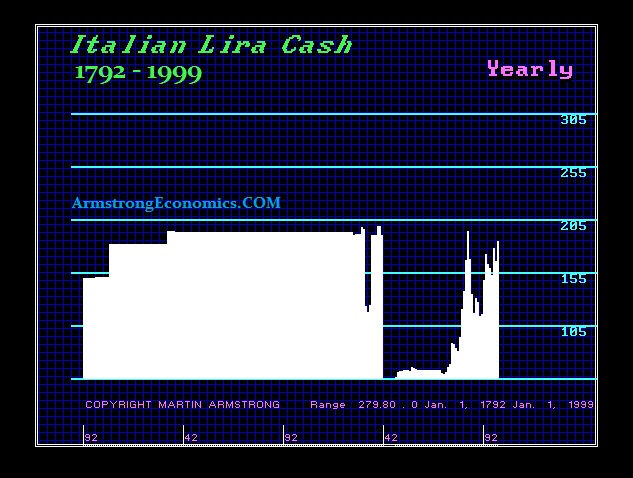
As far as property in Italy is concerned, Italians have a cultural attachment to property. Many have more than one place. They have traditionally sought to park money in property because the Italian lira was in a perpetual decline.

Pension funds on a global scale will become a major crisis. Japan has the worst aging population. However, the same problem exists in Europe and America. This is a long-term issue rather than instantly, right now

German Politics


QUESTION:

Hi Martin,

It can not be said enough: thank you for everything that you do.

I have a question that has been bothering me for some time now. I haven’t had the time to compose it until now.

You often talk of the fact that Hitler was elected with only 30% of the vote, and was allowed to propagate because of it. This changed the face of Europe and the world.

Was this the same for Merkel? Was she allowed, with only 30% of the vote, to open the borders and so change the face of Europe for decades to come?

If so, then Germany, with all its preoccupation about hyperinflation, has misread history and so should have focused on electoral reform rather than austerity.

Thanks, from a dedicated daily reader,

D

ANSWER: Yes, political reform in Germany is really essential. At the very least, it should adopt the French system where the first round of voting reduces the multi-party factions to two. Then the people have to vote between them. In the case of Germany, they form governments from groups to form coalitions. This means there must be compromises in what the people voted for. It is wrong that those compromises are then decided by politicians rather than the people. The next result, someone with only 30% can change the face of Germany and Europe

Artificial Intelligence v Sophisticated Analytics


QUESTION:

Socrates vs Aladdin

I would like to start by saying thank you for all the knowledge in an altruist way you provide to the world. Reading your blog is part of my daily activities for years now. And what i difference it has made in opening my mind.

I would like if you could comment in which way is different Socrates’ capabilities to Blackrock Aladdin. Since they state exactly what Socrates stands for, unbiased worldwide analysis.

On another topic, read a far fetch theory the other day, that are about 8 to 8.5k people worldwide that control the BIS, making them the lords of all this chaos and nonsense of economic imbalances we live in (life of constant debt). If you find convenient, could you please elaborate on your words of knowledge on the topic.

Many thanks and best regards

PG

ANSWER: Blackrock Aladdin® is only an operating system for investment managers. It does provide information which is the typical standard money management tool. It involves the standard array of sophisticated risk analytics used in portfolio management. It is not Artificial Intelligence that writes an analysis on its own. It is a platform with tools where the manager must still make informed decision-making and use effective risk management.

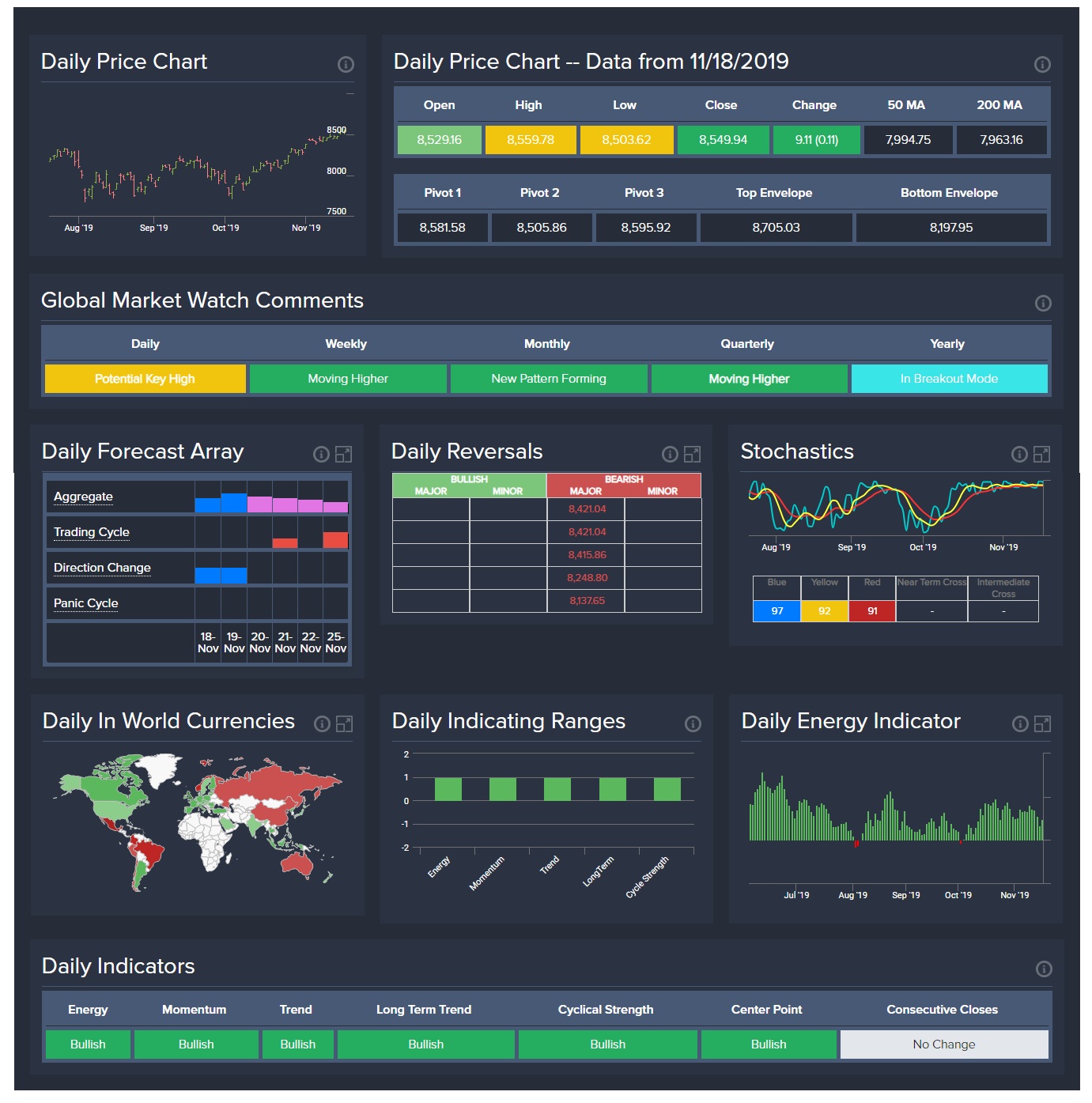
Here is the screen on the NASDAQ. What you see is a number of tools you can look at. The Global Market Watch pinpointed the 18th as a “Potential Key High,” which was based upon true AI. The difference is the computer is providing its conclusion. The rest of the tools are there for your personal informed decision-making. Then Socrates writes a report on each level of the market as well and provides a summary overview. This, again, is AI.

Providing an algorithm that is a tool like a stochastic is standard in the world. We have the standard risk models you can look at as well. All of that is NOT Artificial Intelligence for you are making the decision based upon a standard tool. The tool is not telling you its conclusion. There is nothing out there that writes a report after analyzing the entire world.

As far as the BIS is concerned, that is just a conspiracy theory. Even the Kenneth Rogoff told Bloomberg: “A joke, which I have been telling since the last meeting in Davos, culminates in the fact that the predictions made in Davos are always wrong… No matter how unlikely, the most likely event is the one that is the opposite of the Davos consensus.” In fact, he may have said it was a joke, but it is true. They have never made a single forecast that was correct at any of these gatherings. They lack the tools of the global economy and ONLY someone who has actually traded in the markets can possibly understand the true capital flows.

Lagarde – ECB – Euro


The central banks are keenly aware that they cannot stimulate economic growth, although they will not state that publicly. The wheel of fortune has completed its revolution. The central bankers are quietly lobbying the political side of the aisle to swing back to Keynesian fiscal policy and reverse austerity.

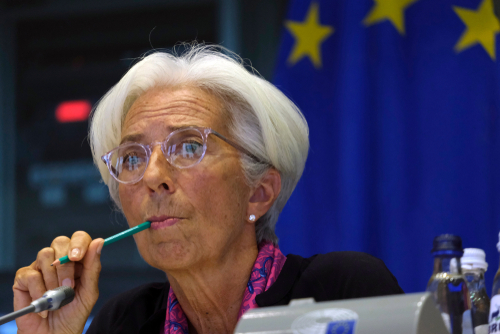
The 63-year-old Christine Lagarde was supported among members of the ECB who disagreed with Draghi. This resulted in a deadlock among Eurozone policymakers that began behind closed doors, but toward the end it began to spill out onto the streets. What I was hearing 2 years ago behind the curtain was starting to leak out. The Eurozone’s faltering economy was creating a huge divergence in ideas with Draghi. This resulted in a serious clash when it came time to the ECB’s rate-setting committee with departing President Mario Draghi’s negative interest rates and never-ending QE. If such policies were to work, it should have done so quickly within a year or two, and not 5 years of negative rates and 11 years of QE.

Lagarde was providing hints that she would seek consensus among politicians in the Eurozone for fiscal policy changes. She knew that the ECB could not win the fight to support the economy by itself. Publicly, Lagarde implied she would follow Draghi’s path and keep monetary policy ultra-loose to lift euro-area inflation. She really had no choice in that regard. Nevertheless, she is aware Draghi’s policy has been a failure but the ECB is trapped. Monetary policy at the ECB is doomed despite the fact she has said that the tools to tackle a downturn are available to the ECB and they must be ready to use them if needed.

Lagarde is steeping into a growing confrontation at a time of rising challenges for central bankers when the economy is turning downward despite all the stimulus and inflation remains subdued. At the same time, interest rates remain artificially low and there are questions over what policymakers have that could do anything to combat a more serious downturn. Lagarde has begun lobbying governments and arguing they need to step in with fiscal stimulus to fill the gap. Central bankers have lost their ability to control inflation or steer the economy while politicians are anything but united in the face of rising political separations and unrest.

Lagarde realizes the economy faces downside risks with inflation in a deflationary position. She has stated it’s “therefore clear that monetary policy needs to remain highly accommodative for the foreseeable future.” While she pretends that the ECB can cut interest rates further despite already being at a record-low -0.4%, she also realizes it is causing massive problems. It has become a deterrent for the euro to be considered a reserve currency. There have been other side effects from keeping rates well below zero for too long, such as promoting a pension crisis nobody wishes to address publicly for fear of creating a panic. She acknowledged these problems stating that the “ECB has hit the effective lower bound on policy rates, it is clear that low rates have implications for the banking sector and financial stability more generally.” Lagarde further acknowledged that “it will be essential to closely monitor whether adverse side effects may emerge in the future, the longer low interest rates are in place

North Korea – Famine & Civil Unrest


One of the reasons North Korea has such a large army is not patriotism. Those in the army are fed before everyone else. North Korea has always had a major problem — growing food. From a timing perspective, 72 years from the birth of the 38th parallel brought us to 2017. The War Cycle involving North Korea brings us to 2020.92. The 38th parallel of latitude was established on September 8, 1945 (1945.68). This arrangement proved to be the indirect beginning of a divided Korea that would lead to the Korean War (1950–1953). The war resulted in the Korean Demilitarized Zone (DMZ) and subsequent Cold War. However, the collapse of the Soviet Union in 1991 deprived North Korea of its main source of economic aid. Without Soviet aid, North Korea’s economy went into an economic freefall in 1992, which was pretty much in line with the Economic Confidence Model calculated from the birth of the 38th parallel.
Kim Jong-il was already conducting most of the day-to-day activities of running the state. His father, Kim Il-sung, died from a sudden heart attack on July 8, 1994. He became the General-Secretary of the Korean Workers’ Party. Kim Jong-un’s power lies in his secret police force, exactly as the Stasi held power in East Germany.

When Korea was split in 1945 into Communist North against the South, the terrain has always dictated the situation. About 65% of Korea’s heavy industry was located in the north, but, due to the harshness of the terrain, only 37% of its agriculture existed in the North. This is why the North often has bouts of famine. The crops are failing in North Korea exactly on time. The BBC has reported that the harvest is expected to be worse than usual, which is going to increase the already severe food shortages in the country and may result in a military crisis. I explained on March 29, 2018:

“The entire world is going to go nuts 2031/2032. There will not be a country that is spared from political and economic events. The risk a serious famine in North Korea which could result in the people rising up will arrive in 2023. That pressure will begin here this year 2018.70 – which will be September 13th, 2018. This appears to the turning point that is not just concerning North Korea. It is appearing around the world in many markets. The risk for political change in North Korea comes into play as soon as 2019/2020.”

We are looking at conditions that would normally lead to a revolution in North Korea. There will be a rise in civil unrest. The question becomes whether the army will stand behind Kim and increase international war tensions or divide to overthrow him. There is nothing like famine to force political change.

Germany to Separate North v South by 2030


QUESTION:

Martin,

Following the recent State elections in Saxony, Brandenburg and Thuringia which reflected voter disillusionment and discontent with the CDU and SPD how do you view the German political scene to the 2021 Federal election?

JR

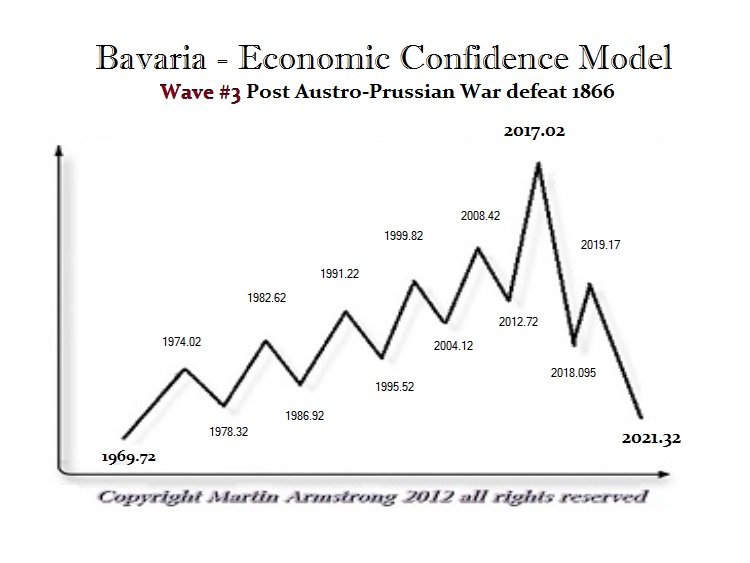
REPLY: Bavaria came into existence in 1806 when Napoleon abolished the Holy Roman Empire. It was at this time that Bavaria’s land area was greatly expanded. Our cyclical model on Bavaria suggests that it will separate from northern Germany by 2030. This will be inspired by the austerity policies that have devastated the local economy. However, this will only be augmented by the difference in religion between Protestant v Catholic. That was also a factor in why Bavaria joined with Austria, which was also Catholic, in the Austro-Prussian War that resulted in Bavaria’s defeat in 1866. Bavaria had to cede several Lower Franconian districts to Prussia.

The Bavarian conservative party, the CSU, lost its absolute majority once the Economic Confidence Model turned in 2017 during the subsequent election in 2018. Meanwhile, the Greens emerged as the second-largest political force in southern Germany. Additionally, the Eurozone sovereign debt crisis is impacting the municipal level and the austerity policies imposed by the north continue to brew civil discontent. The loss of the CSU in Germany undermined the survivability of Merkel which instigated her demise.

The civil unrest will turn upward sharply when this current wave concludes 2021.32. The eventual separation of Germany will most likely unfold by 2030 at the earliest.