NSA DOCUMENTS PROVE SURVEILLANCE OF DONALD TRUMP & HIS FAMILY


Trump was right!

GLOBAL WAR APPROACHES: NORTH KOREA WARNS: “IF A SINGLE BULLET IS FIRED WE WILL NUKE THE UNITED STATES”


We had better take them out before they can actually do it!

Brexit begins: Date Article 50 will be triggered to start process of UK leaving EU now confirmed


The beginning of the end for the EU.

Analysis of Global Temperature Trends, February, 2017, what’s really going on with the Climate?


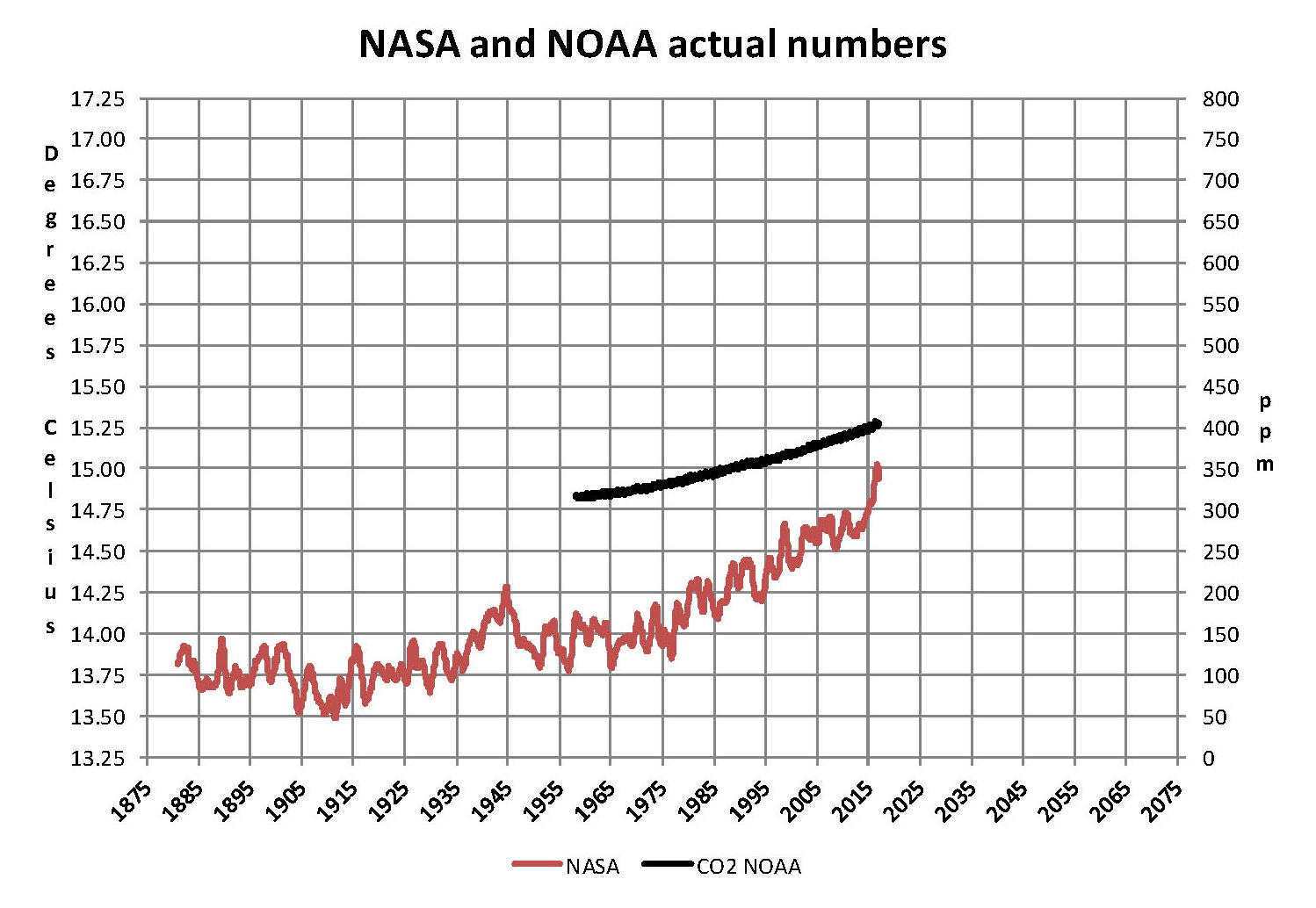
The analysis and plots shown here are based on the following two data series. First NASA-GISS estimates of a global temperature shown as an anomaly (converted to degrees Celsius) as shown in their table Land Ocean Temperature Index (LOTI) and shown in the following Chart as the red plot labeled NASA. This plot is shown as a twelve month moving average to minimize the large monthly swings and better show trends; the scale for the temperatures is on the left. Second NOAA-ESRL Carbon Dioxide (CO2) values in Parts Per Million (PPM) which are shown in the following Chart as a black plot labeled NOAA. This plot is shown exactly as the data from NOAA is presented and there is no need for a moving average the scale for CO2 is shown on the right.

NASA published data as stated in the first paragraph is shown as an anomaly, but what is a temperature anomaly?  An anomaly is a deviation from some base value normally an average that is fixed. There were two problems with the system that NASA picked which were number one there is no “actual” global temperature and two since climate is a variable there cannot be a real base to measure from. NASA known for its science and engineering expertise back in the day thought it could get around these issues and created a system to do so. First they developed a computer model which took readings from all over the planet and made significant adjustments to them called homogenization and came up with the estimated global temperature. Second they picked the period 1950 to 1980 (30 years) and averaged the values and came up with 14.00 degrees Celsius and make that their base.  Then they took the calculated temperature and subtracted the base from it which gave them the anomaly. The problem is that both the base and the anomaly are arbitrary.

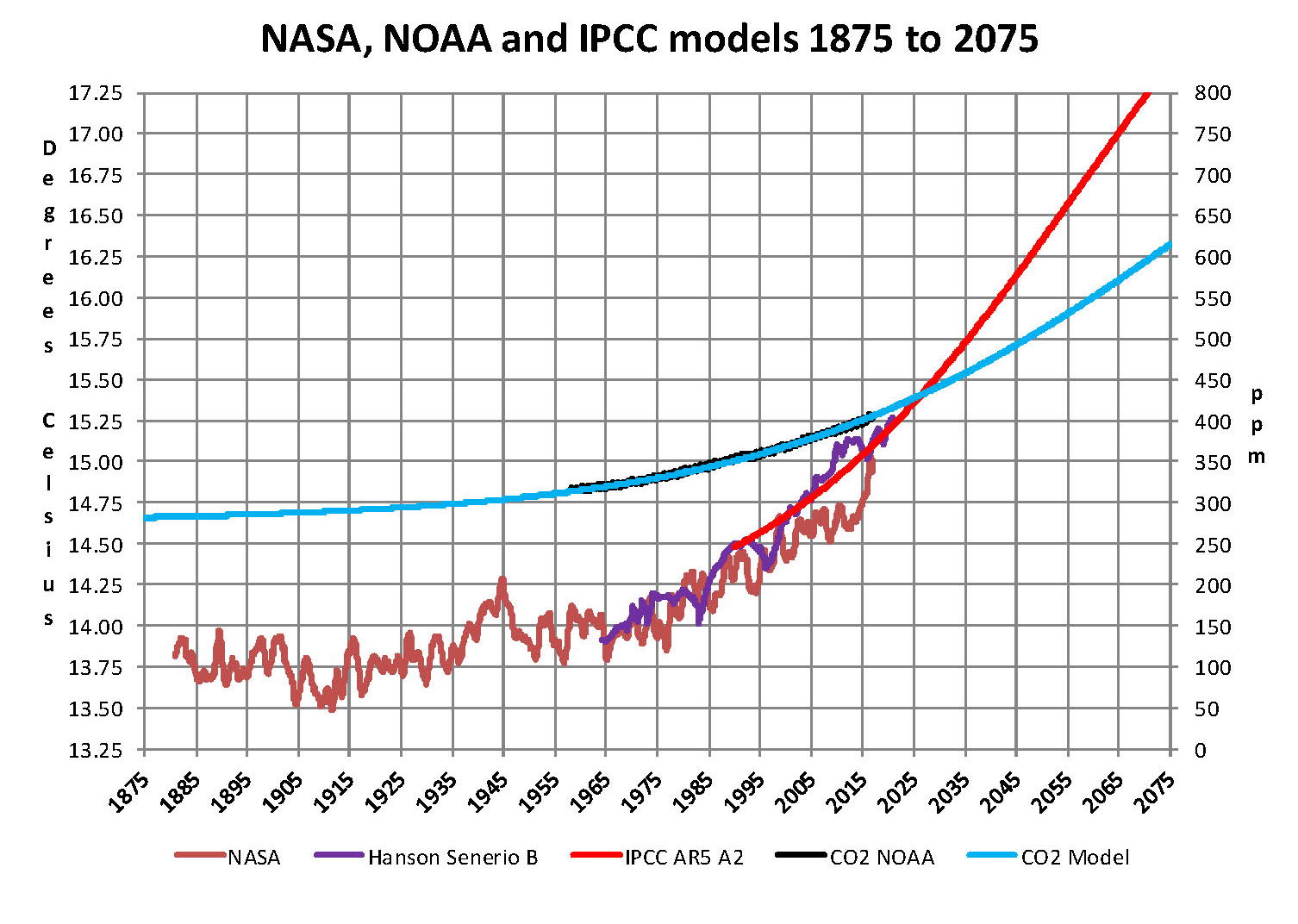
Now that we have a base to work with we are going to add to the previous Chart three things. The first is a trend line of the growth in CO2 since that is the entire basis for climate change according to the government through NASA and NOAA. That plot is superimposed over the black plot of the actual NOAA CO2 values as the cyan line labeled as the CO2 Model and one can see there is a very good fit to the actual NOAA values so there should be no dispute about its validity.  This plot allows us to make projections as to future global temperatures according to the level of CO2. The second added item is James E. Hansen’s Scenario B data, which is the very core of the IPCC Global Climate models (GCM’s) and which was based on a CO2 sensitivity value of 3.0O Celsius per doubling of CO2. This plot is shown here in lavender and is part of a presentation that Hansen showed to congress in 1988 when the UN was about to set up the International Panel on Climate Change (IPCC) and this plot is labeled as Hansen Scenario B which Hansen stated was the most likely to happen based on his theories’.  The third item is the current plot of the most likely temperature of the planet based on the growth of CO2 published by the IPCC. This plot is shown in Red and is labeled as IPCC AR5 A2 as that is the table where the data was found. This plot is a GCM computer projection of the planets temperature based to the complex relationships developed on the levels of CO2 by the IPCC through NASS and NOAA.

It can be seen in this Chart that the lavender plot and the Hansen plot are very close from 1965 to around 2000 after that, from 2000 to 2014, there is a very large and growing deviation reaching close to .5 degrees Celsius in 2014, which is not an insubstantial number.  Also of note is that there doesn’t seem to be a good correlation between the growth in CO2 and the increase in the planets temperature. The CO2 is going up in a log function and the Temperature was going down in a log function until recently where it reversed and is now going up in a log function. That major change in direction that occurred between 2013 and 2014 is the subject of this paper.

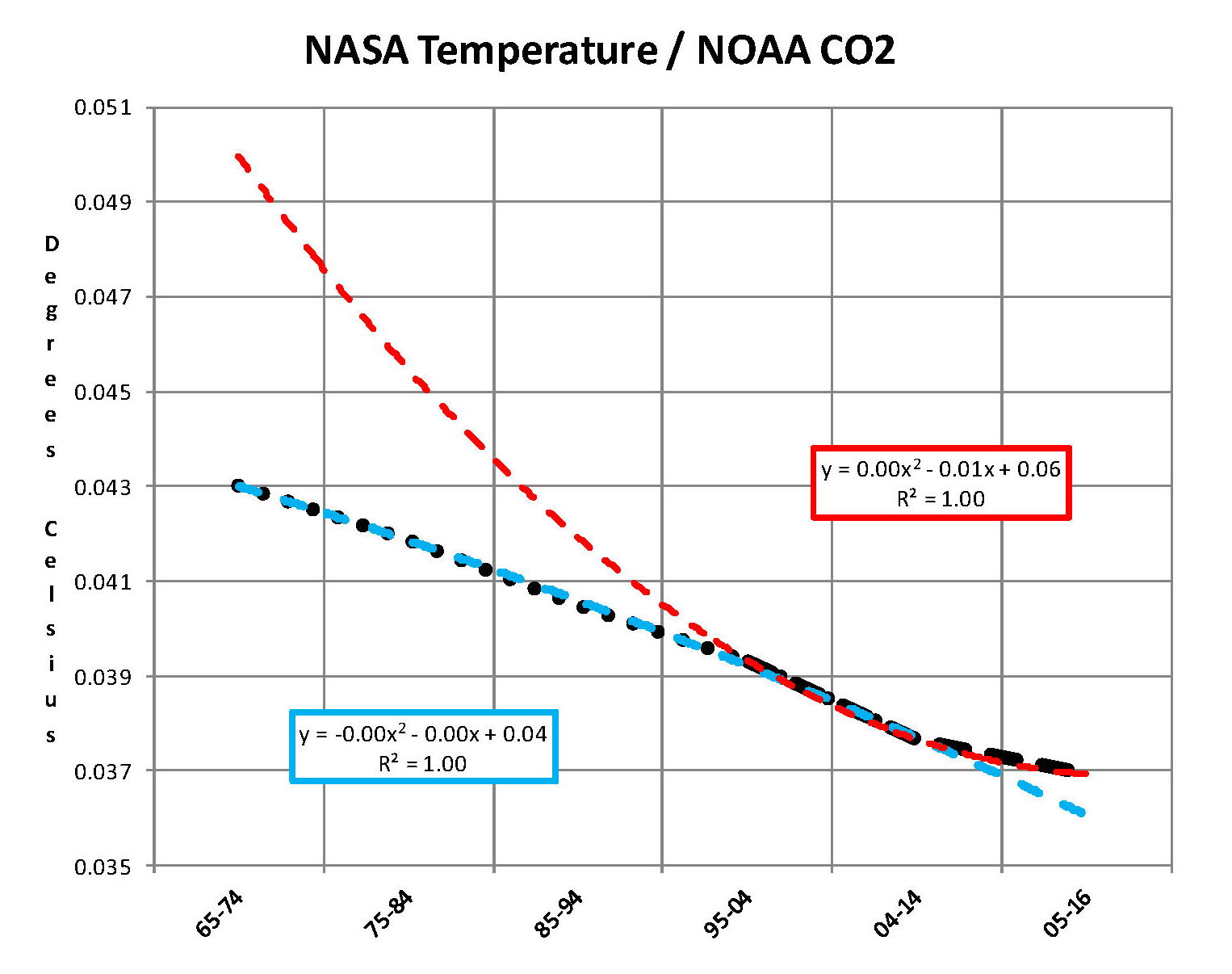
The next Chart is developed from the raw data from NASS and NOAA as shown in the first Chart.  This plot was made first by adding ten years blocks of temperature and CO2 as indicated in the Chart and diving by 120 to give an average for each.  Then the average Temperature was divided by the average CO2 to give degrees of temperature increase per PPM of CO2. After that was plotted it appeared that there were two different curves the first was from block 1965-1974 through block 2004-2014 shown as Black Dots and the second was from block 1995-2004 through block 2005-2016 shown as Black Dashes. When trend lines were added they were both almost perfect fits to the raw data and so you cannot see the data points very well on the Chart.  These blocks were picked to represent the entire period of time where we had both NASA temperature data and NOAA Co2 levels.

On the following Chart are two sets of color coded information. The first is Cyan plot and the Cyan box with the equation in it along with the R2 value 0f 1.0 are for the first series from block 1965-1974 through block 2004-2014. The other is the Red plot and the Red box with the equation in it along with the R2 value of 1.0 which are for the first series from block 1965-1974 through block 2004-2016. We can speculate on how this change has happened but it cannot be said that the plot change is not real; however additions data over the next few years will be required to actually prove that something has changed.

In summary the Cyan data set indicates a diminishing effect of CO2 on global temperature for about 54 years and the Red data set represents an increasing effect of CO2 on global temperature for the past 2 years. Since both data sets have an R2 value of 1.00 the trend lines cannot be in question.

Before we get into a possible explanation to the drastic change from the Cyan data to the Red data that occurred in 20014 we need to consider other factors than CO2 on Climate change.  The fault that occurred in the work that was done in the 1980’s was in assuming that there was an optimum or constant global temperature and therefore any change that was being observed was from the increasing amount of CO2 in the atmosphere.  There may have been correlation but it was never proved that there was causation (high R2 value) between CO2 and global temperatures. With that assumption, which limited options, we moved from true science into the realm of political science.  True science has an open mind and finds relationships that work in matching observations with predictions.  Political science changes history and/or facts to match the desires of the politicians. Since the politicians control the money political science is what we get; which means that what we get may not be technically correct.

A decade ago when I started looking at “climate” change the first thing I did was look at geological temperature changes since it is well known that the climate is not a constant; I learned that 52 years ago in my undergrad geology and climatology courses in 1964. The next paragraph explains currently observed patterns in climate related to this subject.

Ignoring the last Ice Age which ended some 11,000 years ago when a good portion of the Northern hemisphere was under miles of ice the following observations give a starting point to any serious study on the subject. First, there is a clear up and down movement in global temperatures with a 1,000 some year cycle going back at least 3,000 to 4,000 years; probably because of the apsidal precession of the earth’s orbit of about 20,000 years for a complete cycle. However about every 10,000 years the seasons are reversed making the winter colder and the summer warmer in the northern hemisphere. 10,000 years from now the seasons will be reversed. Secondly, there are also 60 to 70 year cycles in the Pacific and the Atlantic oceans that are well documented. These are known as the Atlantic MultiDecadal Oscillations (AMO) in the Atlantic and as La Nina and El Nino in the Pacific. Thirdly, we also know that there are greenhouse gases such as carbon dioxide that can affect global temperatures. Lastly the National Academy of Sciences (NAS) estimated that carbon dioxide had a doubling rate of 3.0O Celsius plus or minus 1.5O Celsius in 1979 when there were only two studies available and one for sure and maybe both were not per reviewed.

The result of looking objectively at the three possible sources of global temperature changes was a series of equations based on these observations that when added together produced a sinusoidal curve that seemed to follow NASA published temperatures very closely.  Since this curve was based on observed temperature patterns it was called a Pattern Climate Model (PCM) which has been described in previous papers and posts on my blog and since it is generated by “equations” many assume it is some form of least squares curve fitting, which it is not. It does seem to be related to ocean currents.

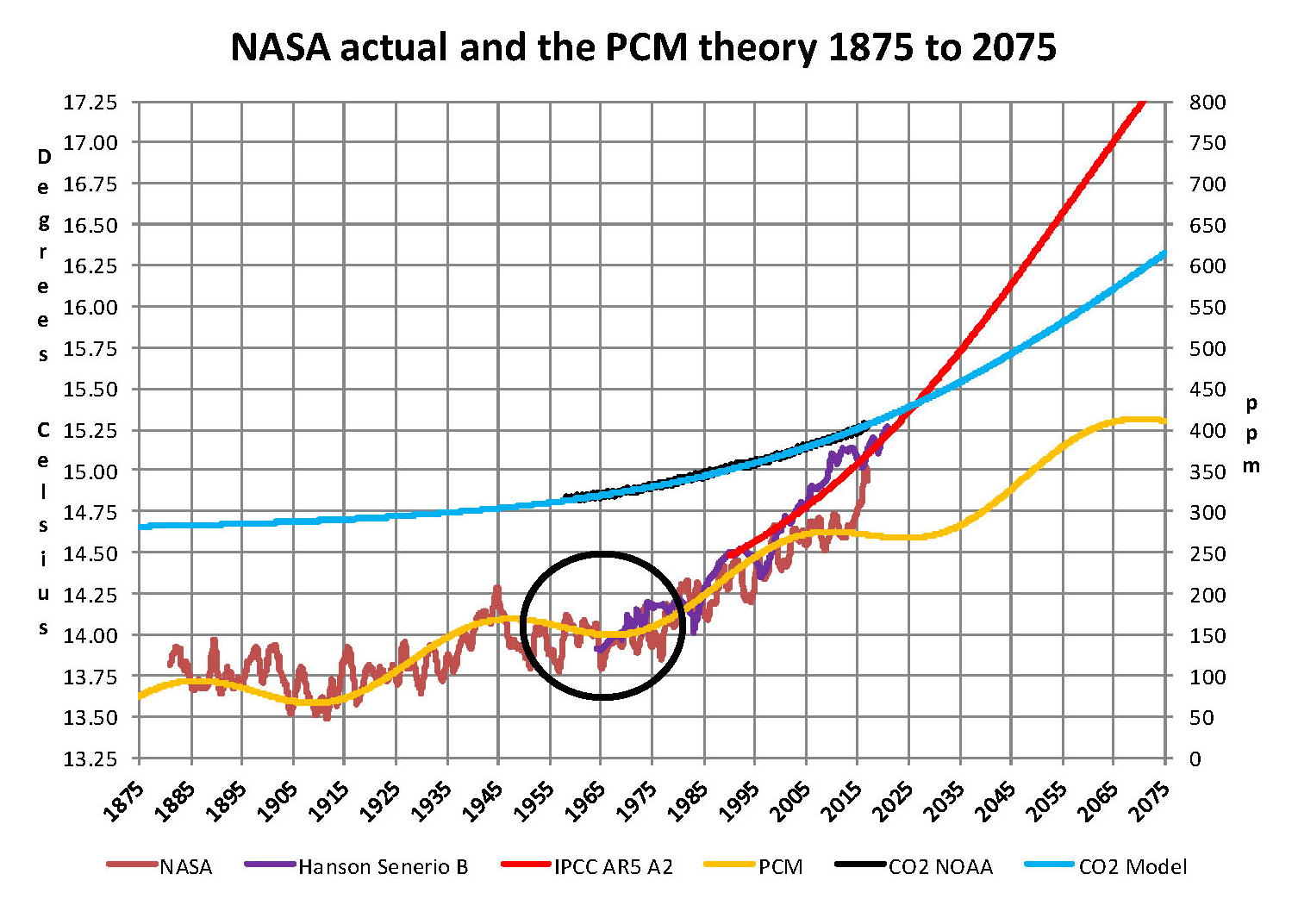
As can be seen in the following Chart the PCM there is a 69.1 year cycle that moves the trend line up and then down a total of 0.29O Celsius and we are now in the downward portion of that trend (-.01491O C per year) which will continue until around ~2035.  This short cycle is clearly observed in the raw NASA data in the LOTI table going back to 1880. Then there is a long trend, 1036.7 years with an up and down of 1.65O Celsius (.00396O C per year) also observed in the NASA data. Lastly, there is CO2 adding about .0079O Celsius per year so currently they all basically wash out at -.0039O C per year, which matches the current holding pattern we are experiencing. After about 2035 the short cycle will have bottomed and turn up and all three will be on the upswing again.  Note: the values shown here are only representative as the actual model uses many more places than what are shown here.

When using the 12 month running average for global temperatures up until 2014 the PCM model was within +/- .01 degrees of what NASA was publishing in their LOTI table since the early 1960’s as shown in the next Chart. Further the back projection of the PCM plot matched historical records and global temperatures going back past the time of Christ. It should also be consider that geologically CO2 levels have reached levels many times that of the current 400 ppm without destroying the planet so the current hysteria over the current small numbers can only be explained by political science not real science.

The nest step in this analysis is to put all of the known data and projections into one Chart which will contain: NASA’s table LOTI global temperature estimates, NOAA’s actual CO2 values, the CO2 model projections, the PCM model global temperature plot, Hansen’s Scenario B 1988 global temperature plot, and lastly the IPCC AR5 A2 global temperature plot. With that done we can look at the results and try to make some sense of what is going on with the various arms of the federal government that are promoting that carbon based fuels be eliminated since they are responsible for the global temperature level  going up.  As previously started when the government pours money into the sciences the sciences respond with technical papers the support the governments views, this is what I call political science verses real science as was done prior to the 1980’s; money talks and BS walks as everyone on the street knows.  This Chart views a good overview of the current situation showing all the facts and all the projections.

This Chart contains no manipulation of the data and the only change that was made was to convert the NASA anomalies back to degrees Celsius to make it more readable to lay people.  This is only a change in units and has no bearing on the look.  A subject not broached here is that of the NASA homogenization process itself and the base period from 1950 to 1980. The portion in the black circle contains the NASA base period of 14.00 degrees Celsius and the reason it’s brought up here is that the Homogenization process causes the global temperatures to move around since the entire data base all the way back to 1880 is recalculated each month.  But since the base has to stay at 14.00 degrees Celsius the program must be set to not allow changes in that period of time. I’m sure the programmers have fun with that. Prior work here has shown how this creates a teeter totter effect with the data plots, some of which have recently been significant.

The next Chart will be a look at the period from 2010 to 2020 so we can see the detail of the past few years where a change in CO2 of only a few ppm has caused a major change in the global temperature way beyond anything previously shown in any published NASA data. There are two black ovals on the Chart one at the top of the Chart which is a black oval around the CO2 levels for 2012, 2013, 2014, 2015 and part of 2016 and it’s very obvious that there has been very little change, maybe 7 ppm or about 1.9%. Then at the bottom of the Chart is another black oval around the NASA global temperature levels for 2012, 2013, 2014, 2015 and part of 2016 and its very obvious that there has been a very large change, almost .45 degrees Celsius or about 3.1%. There has never been such a large increase in temperature from such a small increase in CO2.

By contrast the previous comparable period of the last part of 2010 through 2013 shows about the same increase for CO2 at 1.1% but no increase for global temperature but actually small decrease. Worse it appears that this current strange upward trend will continue as the values shown here are based on a 12 month moving average and the current values being published by NASA have been very high for the past 7 months and therefore I would expect the NASA plot to be well over 15.00 Celsius within a few months and certainly before the end of 2016. After COP21 the need for Fake Warming was no longer needed and so we are seeing a downward trend developing. With the new administration we may see the end of data manipulation from NOAA and NASA and a return to real science political science.

In summary, the IPCC models were designed before a true picture of the world’s climate was understood. During the 1980’s and 1990’s CO2 levels were going up and the world temperature was also going up so there appeared to be correlation and causation. The mistake that was made was looking at only a ~20 year period when the real variations in climate all move in much longer cycles of decades and centuries.  Those other cycles can be observed in the NASA data but they were ignored for some reason.  By ignoring those trends and focusing only on CO2 the models will be unable to correctly plot global temperatures until they are fixed.

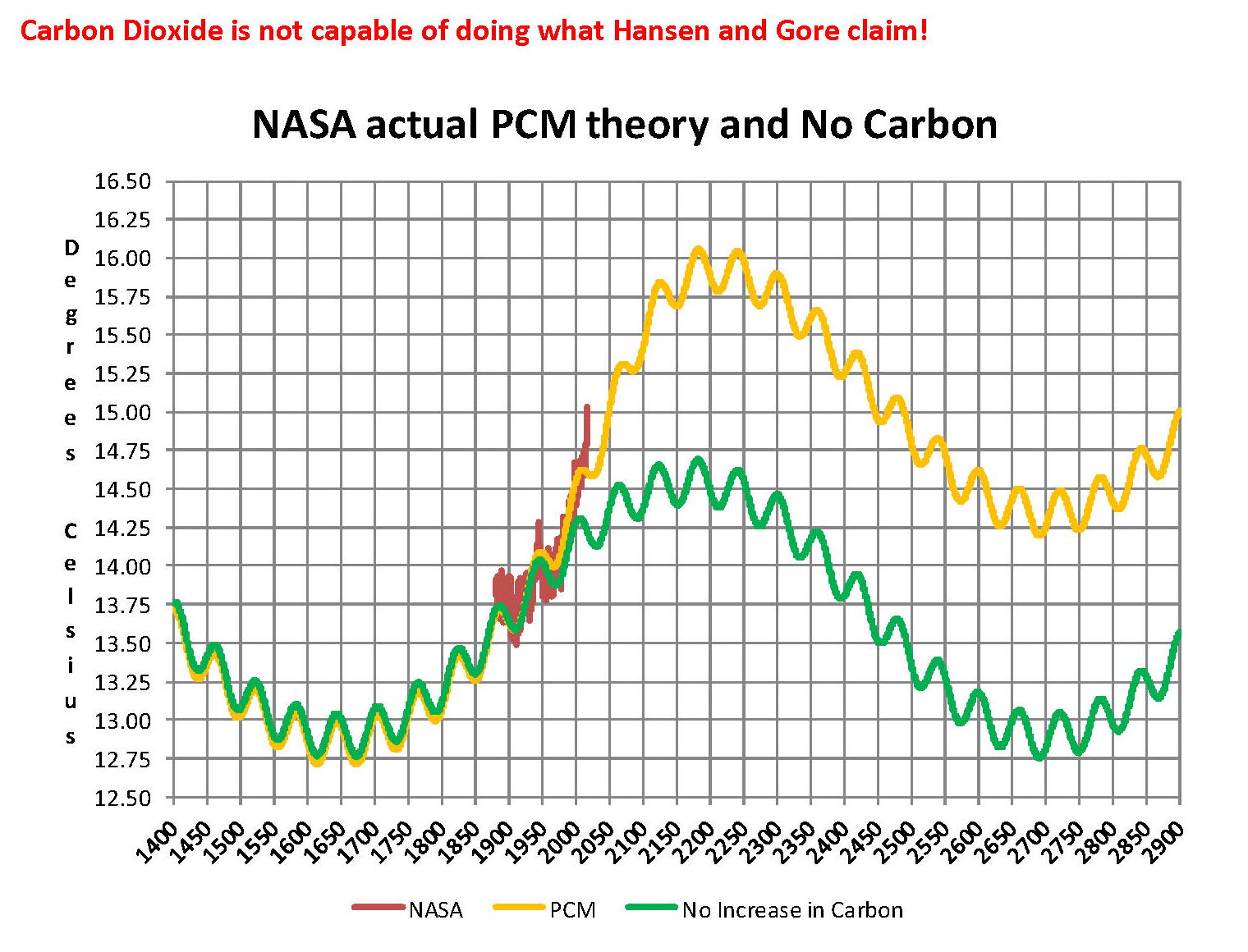
Lastly, the next chart shows what a plot of the PCM model, in yellow, would look like from the year 1400 to the year 2900. This plot matches reasonably well with recorded history and fits the current NASA-GISS table LOTI data, in red, very closely, despite homogenization.  I understand that this model is not based on physics but it is also not true curve fitting. It’s based on observed reoccurring patterns in the climate. These patterns can be modeled and when they are, you get a plot that works better than any of the IPCC’s GCM’s. If the conditions that create these patterns do not change and CO2 continues to increase to 800 ppm or even 1000 ppm than this model will work well into the foreseeable future.  150 years from now global temperatures will peak at around 15.750 to 16.000 C and then will be on the downside of the long cycle for the next ~500 years.

The overall effect of CO2 reaching levels of 1000 ppm or even higher will be about 1.50 C which is about the same as that of the long cycle.  The Green plot on the Chart shows the observed pattern with no change in CO2 from the pre-industrial era of ~280 ppm. CO2 cannot affect global temperatures more than 1.500 C +/- no matter what the ppm level of CO2is. The reason being that the CO2 sensitivity value is not 3.00 per doubling of CO2 but under 1.00 C per doubling of CO2 as shown in more current scientific work.

The purpose of this post is to make people aware of the errors inherent in the IPCC models so that they can be corrected. 

The Obama administration’s “need” for a binding UN climate treaty with mandated CO2 reductions in Europe and America was achieved as predicted at the COP12 conference in Paris in December 2015. To support this endeavor NASA was forced to show ever increasing global temperatures that will make less and less sense based on observations and satellite data which will all be dismissed or ignored.  Within a few years the manipulation will be obvious even to those without knowledge in the subject, but by then it will be to late the damage to the reputation of science will have been done.


Sir Karl Raimund Popper (28 July 1902 – 17 September 1994) was an Austrian and British philosopher and a professor at the London School of Economics. He is considered one of the most influential philosophers for science of the 20th century, and he also wrote extensively on social and political philosophy. The following quotes of his apply to this subject.

If we are uncritical we shall always find what we want: we shall look for, and find, confirmations, and we shall look away from, and not see, whatever might be dangerous to our pet theories.

Whenever a theory appears to you as the only possible one, take this as a sign that you have neither understood the theory nor the problem which it was intended to solve.

… (S)cience is one of the very few human activities — perhaps the only one — in which errors are systematically criticized and fairly often, in time, corrected.

EU Taxpayers Brace As Deepening Banking Crisis Means Euro-TARP Looms


Tyler Durden's picture

Authored by Don Quijones via WolfStreet.com, 

If the ECB scales back stimulus, banks face even greater risk of collapse. But now there’s a new solution

Events are moving so fast in Europe these days, it’s almost impossible to keep up. While much of the attention is being hogged by political developments, including the election in the Netherlands, Reuters published a report warning that the European banking sector may face even higher bad loan risks if the ECB begins to scale back its monetary stimulus programs, something it has already begun, albeit extremely tentatively.

The total stock of non-performing loans (NPL) in the EU is estimated at over €1 trillion, or 5.4% of total loans, a ratio three times higher than in other major regions of the world.

On a country-by-country basis, things look even scarier. Currently 10 (out of 28) EU countries have an NPL ratio above 10% (orders of magnitude higher than what is generally considered safe). And among Eurozone countries, where the ECB’s monetary policies have direct impact, there are these NPL stalwarts:

  • Ireland: 15.8%
  • Italy: 16.6%
  • Portugal: 19.2%
  • Slovenia: 19.7%
  • Greece: 46.6%
  • Cyprus: 49%

That bears repeating: in Greece and Cyprus, two of the Eurozone’s most bailed out economies, virtually half of all the bank loans are toxic.

Then there’s Italy, whose €350 billion of NPLs account for roughly a third of Europe’s entire bad debt stock. Italy’s government and financial sector have spent the last year and a half failing spectacularly to come up with a solution to the problem. The two “bad bank” funds they created to help clean up the banks’ toxic balance sheets, Atlante I and Atlante II, are the financial equivalent of bringing a butter knife to a machete fight. So underfunded are they, they even strugggled to hold aloft smaller, regional Italian banks like Veneto Banca and Popolare di Vicenza, which are now pleading for a bailout from Rome, which in turn is pleading for clemency from Brussels.

What little funds Atlante I and Atlante II have left are hemorrhaging value as the “assets” they’ve been used to buy up, invariably at prices that were way too high (often at over 40 cents on the euro), continue to deteriorate. The recent decision of Italy’s two biggest banks, Unicredit and Intesa Sao Paolo, to significantly write down their investment in Atlante is almost certain to discourage the private sector from pumping fresh funds into bailing out weaker banks.

Which means someone else must step in, and soon. And that someone is almost certain to be the European taxpayer.

In February ECB Vice President Vitor Constancio called for the creation of a whole new class of government-backed “bad banks” to help buy some of the €1 trillion of bad loans putrefying on bank balance sheets. Constancio’s idea bore a striking resemblance to a formal proposal put forward by the European Banking Authority (EBA) for the creation of a massive EU-wide bad bank that, in the words of EBA president Andrea Enria, would “make it much easier to achieve critical mass and to create a well functioning market for (impaired) assets.”

Here’s how it would work, according to Enria (emphasis added):

The banks would sell their non-performing loans to the asset management company at a price reflecting the real economic value of the loans, which is likely to be below the book value, but above the market price currently prevailing in illiquid markets. So the banks will likely have to take additional losses.

The asset manager would then have three years to sell those assets to private investors. There would be a guarantee from the member state of each bank transferring assets to the asset management company, underpinned by warrants on each bank’s equity. This would protect the asset management company from future losses if the final sale price is below the initial transfer price.

One of the biggest advantages of launching an EU-wide bad bank is that it would avoid the sort of public “resistance” that would occur if it was done at a national level, says Enria. Italian lenders would presumably be able to continuing pricing bad loans at or around 40 cents on the euro on average, even though their real value — i.e. the current value priced by the market — is often much lower. The difference between the market price, if any, and the price the banks end up receiving for their bad debt will be covered by Europe’s taxpayers.

If given the green light, the scheme would pave the way to the biggest one-off bail out of European banks in history. It would be Euro-TARP on angel dust, with even fewer checks and balances and much less likelihood of ever recovering taxpayer funds. According to a banker source cited by Reuters, while Germany has not yet endorsed the EBA plan, the EU documents describe the development of a secondary market for NPLs as a priority. According to Enria, the EBA hopes to finalize matters “at the European level” in the Spring.

The documents also include proposals for a wider “restructuring of banking sectors” as states address the NPLs problem. This “could lead to mergers among EU banks after they offload their bad loans,” a banking industry official said.

In other words, EU taxpayers would have to spend potentially hundreds of billions of euros saving yet more banks from the consequences of their own acts and bail out their bondholders and potentially their stockholders too, with funds desperately needed in other areas. Those banks, once saved and their balance sheets cleansed, would then be handed on a platter to much bigger banks. In return, taxpayers would end up with an even more concentrated, consolidated, interconnected financial system that is even more prone to abuse, corruption, and excess.

The ECB’s policy isn’t about creating inflation but about keeping a financial system and a currency union from collapsing upon each other. Read…  ECB Trapped in its Own “Doom Loop” as Inflation Surges

Budget Director Mulvaney Admits No Hope “To Balance The Budget This Year”


Tyler Durden's picture

Appearing on Meet the Press earlier this morning with the always condescending, well at least if he’s interviewing a Republican guest, Chuck Todd, the Director of the Office of Management and Budget, Mick Mulvaney, said there’s no hope of achieving a balanced budget this year.  Of course, that should hardly come as a surprise to almost anyone other than the suddenly fiscally conservative Chuck Todd.

“No, we won’t be able to balance the budget this year, but we’re working on trying to get it to balance within the ten-year budget window, which is what Republicans in the House and the Senate have traditionally done the last couple of years.”

A smirking Chuck Todd also pressed Mulvaney regarding his thoughts on raising the debt ceiling with a series of ‘gotcha’ questions:

Todd:  “Debt ceiling.  We hit it on Friday.  Extraordinary measures by the Treasury Secretary will mean a couple more months.  You were a tough nut to crack on the debt ceiling when you were Congressman Mulvaney.  Why should people who were like minded with you who basically said ‘hey look, I’ll give you that debt ceiling but I want real cuts, I want real deficit reduction, I want a real plan.’  I think at one point you said I’ll raise the debt ceiling in exchange for a balanced budget.  You’re not going to be making that ask this time, are you?”

Mulvaney:  “I have voted to raise the debt ceiling before as most people in Congress have.  Traditionally, you go back to the 1920’s and 1930’s, the debt ceiling debate has been used to try and step back and say ‘why do we have a deficit problem, why do we have a debt problem and how can we fix it.’  So we’ll be coming forward with ideas to raise the debt ceiling but at the same time try to address some of those long-term reasons that we have the debt in the first place.”

Meanwhile, Mulvaney took a shot of his own saying that Trump’s vision for the budget is consistent with his comments on the presidential campaign trail and that “He’s trying to do something that politicians are not very famous for, which is actually following through on his promises.” For those who missed it, here is our previous summary of Trump initial “skinny budget” proposal:

Today at 7am, Trump released his “skinny budget”, his administration’s first federal budget blueprint revealing the President’s plan to dramatically reduce the size of the government. As previewed last night, the document calls for deep cuts at departments and agencies that would eliminate entire programs and slash the size of the federal workforce. It also proposes a $54 billion increase in defense spending, which the White House says will be offset by the other cuts.

“This is the ‘America First’ budget,” said White House budget director Mick Mulvaney, a former South Carolina congressman who made a name for himself as a spending hawk before Trump plucked him for his Cabinet, adding that “if he said it in the campaign, it’s in the budget.”

In a proposal with many losers, the Environmental Protection Agency and State Department stand out as targets for the biggest spending reductions. Funding would disappear altogether for 19 independent bodies that count on federal money for public broadcasting, the arts and regional issues from Alaska to Appalachia. Trump’s budget outline is a bare-bones plan covering just “discretionary” spending for the 2018 fiscal year starting on Oct. 1. It is the first volley in what is expected to be an intense battle over spending in coming months in Congress, which holds the federal purse strings and seldom approves presidents’ budget plans.

Trump wants to spend $54 billion more on defense, put a down payment on his border wall, and breathe life into a few other campaign promises. His initial budget outline does not incorporate his promise to pour $1 trillion into roads, bridges, airports and other infrastructure projects.  The budget directs several agencies to shift resources toward fighting terrorism and cybercrime, enforcing sanctions, cracking down on illegal immigration and preventing government waste.

The White House has said the infrastructure plan is still to come.

That said, Congress controlled by Trump’s fellow Republicans, is likely to reject some or many of his proposed cuts with some republicans calling the budget “dead on arrival.” Some of the proposed changes, which Democrats will broadly oppose, have been targeted for decades by conservative Republicans. Moderate Republicans have already expressed unease with potential cuts to popular domestic programs such as home-heating subsidies, clean-water projects and job training.

Trump is willing to discuss priorities, said Mulvaney. “The president wants to spend more money on defense, more money securing the border, more money enforcing the laws, and more money on school choice, without adding to the deficit,” Mulvaney told a small group of reporters during a preview on Wednesday. “If they have a different way to accomplish that, we are more than interested in talking to them,” Mulvaney said.

The defense increases are matched by cuts to other programs so as to not increase the $488 billion federal deficit. Mulvaney acknowledged the proposal would likely result in significant cuts to the federal workforce. “You can’t drain the swamp and leave all the people in it,” Mulvaney said.

A visual summary of the proposed budget changes is shown below, courtesy of Reuters:

The biggest losers:

Trump asked Congress to slash the EPA by $2.6 billion or more than 31 percent, and the State Department by more than 28 percent or $10.9 billion. Mulvaney said the “core functions” of those agencies would be preserved. Hit hard would be foreign aid, grants to multilateral development agencies like the World Bank and climate change programs at the United Nations.

Trump wants to get rid of more than 50 EPA programs, end funding for former Democratic President Barack Obama’s signature Clean Power Plan aimed at reducing carbon dioxide emissions, and cut renewable energy research programs at the Energy Department. Regional programs to clean up the Great Lakes and Chesapeake Bay would be sent to the chopping block.

Community development grants at the Housing Department – around since 1974 – were cut in Trump’s budget, along with more than 20 Education Department programs, including some funding program for before- and after- school programs. Anti-poverty grants and a program that helps poor people pay their energy bills would be slashed, as well as a Labor Department program that helps low-income seniors find work.

Long reviled by conservatives, the Internal Revenue Service would get a $239 million cut, despite Treasury Secretary Steven Mnuchin’s request for more funding. The Education Department would receive $1.4 billion to invest in public charter schools and private schools, even as its overall budget is cut by 14 percent. But other numbers appear to contradict some of Trump’s top priorities. One of his campaign pledges was to work to cure diseases, but the National Institutes of Health will reportedly see $5.8 billion slashed from its budget.

Trump calls for a 13 percent cut to the Transportation Department, which would ostensibly play a big role in Trump’s promised infrastructure overhaul. That includes $500 million from the TIGER grant program, which provides funding for road and bridge projects.

Trump’s rural base did not escape cuts. The White House proposed a 21 percent reduction to the Agriculture Department, cutting loans and grants for wastewater, reducing staff in county offices and ending a popular program that helps U.S. farmers donate crops for overseas food aid.

And the winners

White House officials looked at Trump’s campaign speeches and “America First” pledges as they crunched the numbers, Mulvaney said. “We turned those policies into numbers,” he said, explaining how the document mirrored pledges to spend more on the U.S. nuclear weapons arsenal, veterans’ health care, the FBI, and Justice Department efforts to fight drug dealers and violent crime.

The Department of Homeland Security would get a 6.8 percent increase, with more money for extra staff needed to catch, detain and deport illegal immigrants. Trump wants Congress to shell out $1.5 billion for the border wall with Mexico in the current fiscal year – enough for pilot projects to determine the best way to build it – and a further $2.6 billion in fiscal 2018, Mulvaney said.

The estimate of the full cost of the wall will be included in the full budget, expected in mid-May, which will project spending and revenues over 10 years. Trump has vowed Mexico will pay for the border wall, which the Mexican government has flatly said it will not do. The White House has said recently that funding would be kick-started in the United States.

The voluminous budget document will include economic forecasts and Trump’s views on “mandatory entitlements” – big-ticket programs like Social Security and Medicare, which Trump vowed to protect on the campaign trail.

“There is no question this is a hard-power budget,” said Mulvaney. “It is not a soft-power budget.”

The budget requests $1.5 billion to detain and remove undocumented immigrants, and $314 million to hire 500 new Border Patrol officers and 1,000 new Immigration and Customs Enforcement officers.

Dutch Election Results Confirm ‘Far Right Populism’ Still On The Rise In Europe


Tyler Durden's picture

Authored by Alex Gorka via The Strategic Culture Foundation,

Those who support the idea of globalism and strive for closer European integration believe the results of the Dutch election indicate the tide has been stemmed, with Eurosceptics and «populist» forces on the defensive. The buck stops here. This is the end of domino effect. The reshaping of Europe has been prevented. The pro-NATO, pro-EU establishment elites are to see glory days again.

Is it really so if you get to the bottom of it?

The future of Europe remains to be at stake, including the UK, Germany and France. Will the concept of United Europe exist in one form or another? Will Scotland stay in the United Kingdom? Will Germany and France distance themselves from the United States? Some of these questions could be answered sooner than expected.

This year may become a turning point with the votes to take place in Germany, France and, probably, Italy. In a month, France will have a new president and Germans will have a new parliament elected in September. The example of the Netherlands may have little influence on the votes.

Let’s look at the facts. Geert Wilders’ Party for Freedom made a substantial gain. It won 20 seats (of 150) according to the preliminary results, which is 5 seats more than in the previous election in 2012. The two governing parties got half as many seats as at the last election in 2012. The prime minister’s Party for Freedom and Democracy lost 8 seats and its coalition partner, the Labor Party (PvdA), lost 29 – an impressive defeat!

Actually, it’s a significant loss for those who ruled the country and a big gain (not big enough but still) for the right wing Eurosceptics led by Wilders. Many key points of the Party for Freedom’s program were «borrowed» by PM Mark Rutte’s People’s Party for Freedom and Democracy (VVD) and Christian Democrats. The popularity was raised due to the tough stance taken in the conflict with Turkey – something Wilders had been calling for. Actually, Prime Minister Rutte was riding to power on a wave of anti-migrant, anti-Islam sentiments.

The Sybrand Buma’s Christian Democratic Appeal (CDA) is all but certain to participate in the next governing coalition with 19 seats won (12, 5%) – an increase of 6 seats. The party has gained ground by adopting a tough line similar to Rutte’s on immigration, adding a focus on communal values and a touch of nationalism to tap voter concerns about Dutch identity. It has proposed introducing singing the national anthem in schools and mandatory community service. According to Sybrand Buma, Her Majesty Queen Máxima should renounce her Argentine citizenship (she was born in Buenos Aires). The CDA presence in government would ensure a conservative stamp on any coalition.

Media rarely mention the fact that another right wing anti-EU and anti-migrants party – the Forum for Democracy – took part in its first election to win 2 seats (1,8%) – not a bad start for a party created only in September 2016. It calls for restoring ties with Russia among other things.

The main result is opposite to what it appears to be at first glance. The outcome of the Dutch election conforms to the current trend – Euroscepticism is on the rise across Europe. The winning forces are often called populist but in reality they are anti-establishment movements which emerged as a result of voters being fed up with left or right windbags. People want them gone and the entire political landscape in Europe fundamentally changed.

Socialists have few chances in France and the chances of Angela Merkel becoming Chancellor again are dim enough. Martin Schultz is a serious rival to reckon with.

Newly founded or old anti-establishment parties continue to make gains. Perhaps not today, but they will come to power. In a couple of months Marine Le Pen may become President of France to radically reform European politics. Even if she loses, Le Pen will remain the most popular politician in the country who is able to win the presidential election in 2022. Artificial creations designed by experts for a particular task, like Emmanuel Macron, for instance, can’t stop it. Nothing can prevent the new wave of politicians from coming to power.

The Dutch election has not changed anything. It has failed to turn the tide. The EU continues to fall apart. The European integration will never be the same. More and more EU members challenge the existing pattern.

The March 16 vote in the Netherlands is far from being a harbinger of Eurosceptics’ movements fading away. Quite to the contrary, it has confirmed the trend – the Old Continent is going through changes. We’ll never have the EU we once knew. The process may temporarily slow down but it’s too late to stop it.

Israel Threatens To Destroy Syrian Air Defense Systems


Tyler Durden's picture

Two days after Syria claimed it had shot down an Israel jet over its territory on Friday morning, an incident Israel denied even if it admitted violating Syria’s sovereign airspace by engaging in an air raid near Palmyra, the Israeli defense minister threatened to destroy Syrian air defenses after they shot (but allegedly did not down) at Israeli warplanes, which violated Syrian airspace and bombed targets on Syrian soil.

Next time, if the Syrian aerial defense apparatus acts against our planes, we will destroy it,” Avigdor Lieberman told Israeli Public Radio on Sunday, in a statement which seemed to lend credence to the Syrian contention that it had taken down an Israel jet.

It was not exactly clear why Israel was so offended by Syria “acting against” its planes which were located above Syrian airspace at the time of shooting. In any case he warned that “we won’t hesitate. Israel’s security is above everything else; there will be no compromise.”


An Israeli F-15 fighter jet

The minister was referring to the previously reported morning raid of the Israeli Air Force, the latest of several reported over the past few years, in which Israel claimed it targeted weapons bound for the Lebanese militant movement Hezbollah. Israel says it has to protect itself from advanced weapons which the militants try to obtain from the Syrian government. Syria shot surface-to-air S-200 missiles at the Israeli planes as they were flying back from the night mission. As noted above, Damascus claims it shot down one of the planes, although Israel still denies.

The Israeli media said one of the Syrian missiles was intercepted by Israel’s Arrow air defense system. According to RT, it was the first time Israel officials have confirmed combat use of the advanced anti-missiles, which are originally meant to intercept heavy long-range ballistic missiles. The Israeli military is investigating whether the decision to fire Arrow interceptors against the Syrian anti-aircraft missiles was justified, according to Haaretz.

The former prime minister and defense minister, Ehud Barak, said Saturday that the involvement of the system forced Israel to acknowledge cross-border military activity. “It could be that with more thorough thought, it wasn’t worth firing,” Barak said at a community lecture in Be’er Sheva. “We have usually tended to reserve what would be called ‘room for denial’ for Syrian President [Bashar] Assad,” he added.

While Israeli acknowledgment of an intervention in Syria is rare, it is not unprecedented. Last April, Prime Minister Benjamin Netanyahu confirmed for the first time that an attack on dozens of Hezbollah targets in Syria was indeed conducted by Israeli warplanes, as speculated by the media.

And, perhaps to give Syria just the opportunity to “provoke” it, on Monday morning, according to several media reports Israel has again bombed a Hezbollah convoy in Syria. It was unclear as of publication time if Syria had retaliated

Why The Press Is Hated…


Tyler Durden's picture

Authored by Eric Peters via EricPetersAutos.com,

The press wonders – or pretends to wonder – why it’s held in contempt by more than just a small handful of  people. Maybe the pressies should read what they publish.

The other day, Automotive News published the following:

“Dozens of U.S. cities are willing to buy $10 billion of electric cars and trucks to show skeptical automakers there’s demand for low-emissions vehicles, just as President Trump seeks to review pollution standards the industry opposes.”

This slurry of dishonest or simply idiotic “reporting” is stupendously revealing – all the more so because it is representative of the norm. Where to begin?

Let’s work from the back, since the worst lie – and that is exactly the correct word – squats toward the end of this vile dreck:

“…to review the pollution standards the industry opposes.”

Utter falsehood. I mean, other than the industry opposing part. Which of course is portrayed as all-but-demonic, with sulfurous undertones that practically waft off the page.

The lie worthy of Dr. Goebbels at his best, though, is this business about carbon dioxide being a “pollutant.” In which case – uh oh! – it is time to put giant cones on top of volcanoes and catalytically converting muzzles on cows and for that matter us, too. Carbon dioxide is a “pollutant” in the same way that di-hydrogen monoxide (water) is a “pollutant.”

It does not foul the air. Even slightly.

It does not cause cancer or respiratory problems or acid rain.

Or even acne.

The Automotive News story is despicable because it purveys without comment or qualifier the package-dealing of an inert, non-reactive gas – C02 – with the byproducts of internal combustion engines that do foul the air, contribute to the formation of smog, irritate people’s lungs, create public health problems and cause acid rain.

Those compounds which are pollutants, properly (scientifically) speaking.

Carbon dioxide is a natural constituent component of the atmosphere, like water vapor and nitrogen and oxygen. To characterize C02 as a “pollutant” is either a titanic imbecility or a purposeful attempt to mislead.

It is of a piece with the progagandizing the media performed for the government when it decided it was time to conflate those who (so they said) attacked America on 9/11 with the Iraqi government. You may recall. One minute, it was al Qaeda and the Taliban in Afghanistan. Then – as if a batch fax had been sent to every media organ in the country – it was non-stop Saddam. Just as C02 isn’t a “pollutant,” Saddam didn’t attack America. But the press did its best to purposefully confuse the issue, aiding and abetting a Nuremburg-worthy high crime – aggressive war – that went unpunished. Reichsmarschall Goring is smiling cynically, somewhere above . . . or below.

The new Fake News is that carbon dioxide is something like carbon monoxide, or unburned hydrocarbons, oxides of nitrogen, or particulates – a danger that must be regulated and controlled. Not only is the untrue (see above) but unlike the actually harmful compounds classified (accurately) as pollutants, carbon dioxide can’t be “cleaned up” because of course it’s not “dirty” to begin with. The only thing that can be done – here it comes – is to reduce the volume produced and the only known way to do that is to . . . burn less fuel.

In other words, it’s a fuel efficiency fatwa masquerading as an anti-pollution measure. And the object is not to increase fuel efficiency. It is to reduce the size of engines (and so, cars) and make them expensive – so that fewer people can afford to buy them. This is not spoken of openly, but it is the end goal. It must be; a single fool or demagogue could be dismissed as aberrant; this is systematic, organized.

The government – which is a bunch of people – calculated, drew up ad then decreed (in the waning days of Obama’s presidency, knowing his successor might be  . . . skeptical)  that henceforth carbon dioxide would be considered a ”pollutant.”

The media lapdogged that up. No “excuse me, but…”

Nada.

Just willing, complicit, lazy regurgitation. Or something much worse . . .

The reaction of anyone reading the Automotive News pabulum who is in possession of junior high school-level chemistry knowledge will – rightly – be one of outrage. Unfortunately – deliberately – a working majority of the public is not in possession of junior high school-level knowledge of chemistry.

Next item up for dissection:

“Dozens of U.S. cities are willing to buy $10 billion of electric cars and trucks to show skeptical automakers there’s a demand for low-emissions vehicles.”

God, my teeth ache.

Firstly, it’s not not “dozens of cities” who will be buying these force-produced electric Edsels. It is the taxpayers of these cities who will be forced to buy them (but not own them) via the extorted funds they are compelled to provide, so that government workers can drive around in the electric Edsels.

This isn’t supply and demand, market forces. It is make-work and wealth transfer. To characterize it as “demand for low-emissions vehicles” is another despicable upchuck of putrefying propaganda that depends upon the stupefaction (or enstupidation) of the reader, who will only allow the morsel to pass by if he is utterly in the dark about basic economic laws.

And “low emissions”?

Seriously?

How many times must this be whack-a-moled? Electric vehicles do produce emissions, just not at the tailpipe. Does the source of pollution matter? Or just that it is produced?

Bingo, if you picked the latter.

First of all, the raw materials necessary to make the hundreds of pounds of batteries per electric car are not gently taken from Gaia’s willing bosom – and the batteries themselves are mini-Chernobyls of toxic waste. Oh, but they’ll be recycled! Except when they’re not. What then? Out here in The Woods, decrepit olds cars abound, left to rot in the backyard. The same fate awaits even shiny six figure Teslas. Which – one day – will be paint-blotched old hoopties left to rot – and leak – in someone’s back yard. Only instead of one roughly 45 pound led acid battery leaching into the earf, it’ll be 400-plus pounds of life-unfriendly compounds.

Does anyone care? Shouldn’t “environmentalists”?

Electric cars, by the way, also produce C02. In fact, they produce more “climate changing” C02 than a conventional car. Not at the tailpipe, perhaps.

At the smokestack.

At the “tailpipe” of the coal and oil-fired utility plants that generate the electricity which powers electric cars. If hundreds of thousands – if millions – of these electric cars are put into circulation, the demand on the grid will be great and the output of C02 even higher.

What then?

The press does not ask such questions. Instead:

“Demonstrating demand” . . . so reads the subhead in the Automotive News propaganda piece.

And yes, again, propaganda.

Words matter. Using certain words conveys a certain meaning. People who deal in words professionally know this, instinctively. As the hawk knows how to dive.

“Demonstrating demand” is a statement, as if of fact, that an entirely fictitious and fraudulent thing is the same thing as the real thing.

Government buying things isn’t “demand” anymore than one is a “customer” of the IRS.

Whatever “demand” is created, is artificial – dependent on wealth transfer, on the coercive power of the government. It is the same sort of “demand” that built the Volga canal in Stalin’s Soviet Union.

Automotive News quotes – without comment – a statement made by a Seattle bureaucrat named Chris Bast, who is a “climate and transportation policy adviser” to the city of Seattle:

“If you build it, we will buy it.”

He means: If the government forces car companies to build electric cars, the government will force taxpayers to buy them. This, of course, is not translated thusly.

The loathsome “news” article concludes:

“Tailpipe fumes (my italics) are crucial in the fight to stop global warming.”

The illiteracy is almost as striking as the dishonesty – or the imbecility, you decide which.

Note the conflation – the inert, non-reactive gas (C02) is now a fume. And it is “crucial” in “the fight to stop global warming.”

Not the galloping unchecked assumptions; the blithe acceptance, as of gravitation, of the political “science” of “global warming.”

The awful construction would be enough to make my teeth feel loose. But the oily proselytizing is just too much.

And they ask me why I drink . .

The Exchange Stabilization Fund – What Is It?


US Treasury Bldg

Apparently, some people have discovered the Exchange Stabilization Fund and are now touting this as some major power in manipulating the world economy. This is simply an emergency reserve fund of the US Treasury Department, which is typically used for foreign exchange intervention. This arrangement really goes back to the birth of the G5 and is the alternative to having the central bank intervene directly in foreign exchange. This is a Treasury function, which allows the US government to try to influence currency exchange rates without affecting domestic money supply created by the Federal Reserve.

Unlike those who are trying to sell newletters touting this as the new great manipulator, it holds less than $125 billion in funds which includes special drawing rights (SDR) from the International Monetary Fund. Trust me, there is no such great power that can manipulate the world economy. They have done their best to try to prevent the dollar from rising. They will fail as they did in 1987 and every other attempt to peg currencies. They are INCAPABLE of altering the capital flows.