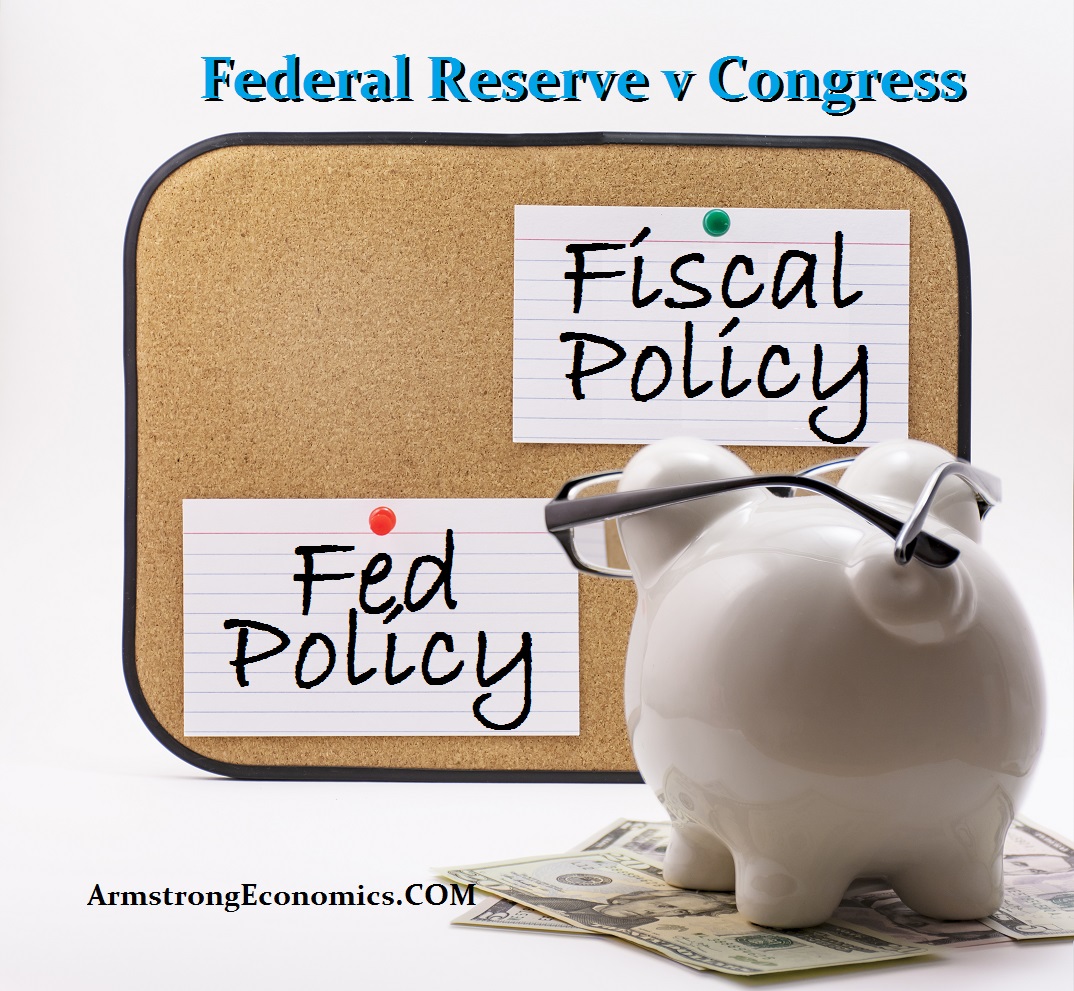
Fed Chair Jerome Powell was notably frustrated when pressured about the Fed’s role in inflation. During his Q&A session this Wednesday, Powell plainly stated that the Federal Reserve alone could not combat inflation. It is far more complex than simply raising rates and hoping for the best. The Federal Reserve cannot increase the supply to meet demand. They have no say over clogged ports and closed factories. The Federal Reserve cannot reverse Biden’s policies that have made America energy-dependent, nor can it reserve sanctions against countries that hold essential supplies. As an independent entity, the Federal Reserve has no control over tariffs or diplomatic relations with regard to trade. Notably, the Federal Reserve cannot combat excessive government spending.
The US just sent another billion to Ukraine and plans to continue funding another endless war that does not support any domestic policy objectives. Jerome Powell has no control over the promises politicians make on the campaign trail to distribute free money to the public in exchange for votes. At any moment, lawmakers can implement policies that completely throw the entire economy off track. They had no say in the lockdowns or restrictions that crippled the economy in 2020.
The Federal Reserve miscalculated the situation by artificially lowering rates for a long time. They failed to look at other clear examples, such as Japan, and realize what has and has not worked historically. Powell admitted long ago that he misjudged the severity of inflation and was wrong to call it “transitory.” Unfortunately, when people in power make mistakes, the repercussions cause global shockwaves. Although separate entities, the White House needs to help the Federal Reserve tame inflation by re-evaluating its policies that are directly causing prices to rise.
The various handouts and moratoriums during the pandemic drove the personal savings rate down to World War II levels. Everything was closed – there weren’t many opportunities to spend. US consumers paid off a record $83 billion in credit card debt during the pandemic, but that has all come crashing down.
The Federal Reserve reported that revolving credit card debt in April reached $1.103 trillion, surpassing pre-pandemic levels and spiking 20% from the year prior. Credit card balances reached an alarming $841 billion in the first three months of this year alone, and the Fed expects that figure to continue rising due to the unsustainable price of living. In addition, household debt is now close to $16 trillion after consumer debt spiked 1.7% in Q1.
Unfortunately for those already behind, the rising interest rates will only cause them to carry a higher balance of debt. Once the prime rate rises, credit card companies will follow. The APR on credit cards is already 16.61%, nearing the high of 17.87%, on average, but is expected to rise. Debt can easily become a vicious cycle from which there is little escape for the average person. Those who budgeted in the belief that Biden would actually cancel their student debt were misled if not gullible. As housing, food, gas, and other necessities rise, those who are already void of liquid assets will find themselves in a dire situation.
QUESTION: Marty, Socrates is worth its weight in something far more valuable than gold. I want to congratulate you for you are the ONLY adviser who nailed not just the cryptocurrency bloodbath, but that the dollar would rise when everyone else kept predicting it would crumble to dust. Then you warned that emerging markets would move into crisis defaulting on their debt. You said even China was in the same crisis because many borrowed in dollars since the interest rates were cheaper.
Is the dollar behind the banking crisis in China and with all the AI systems claiming a new world order, why are they failing when Socrates succeeds?
I am so grateful. I cannot tell you how much.
BME
ANSWER: I will answer the AI issue tomorrow. The dollar crisis is emerging because people do not understand capital flow analysis. They keep harping on the quantity theory of money. They assert that the more money the Fed creates, the more the dollar bust decline, and typically gold must rise. They do not understand that capital flows like water. It will always move to the lowest risk.
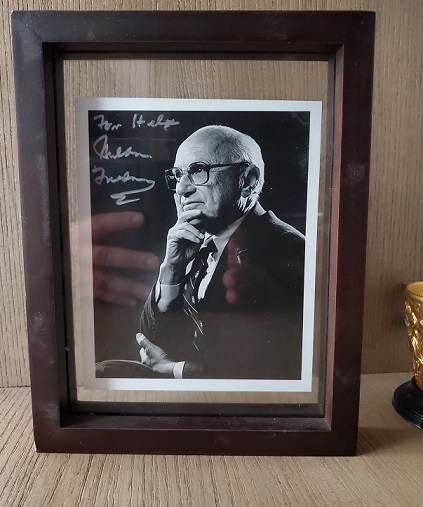
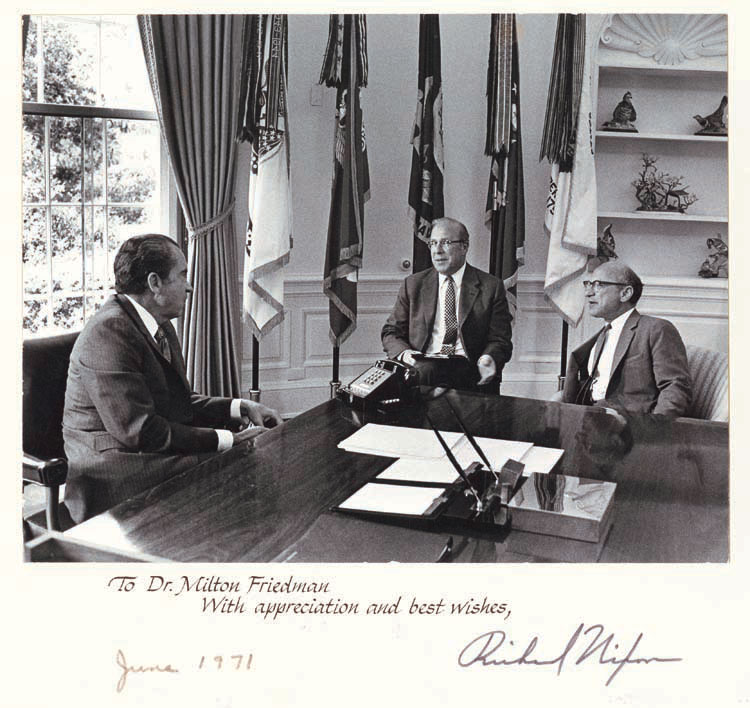
Milton Friedman came to listen to my lecture on foreign exchange in Chicago. We became friends and he explained to me that I was doing what he had only dreamed about. Yes, it was Milton who had advised Nixon on shutting down Bretton Woods and adopting a floating exchange rate system.
While many criticize Milton, they did not really understand what he saw. In 1953, he saw that a floating exchange rates system would provide a natural check and balance against the government policies. That is why he came to listen to me. I had developed capital flow analysis which was what he envisioned would happen under a floating exchange rates system. He theorized that in 1953.
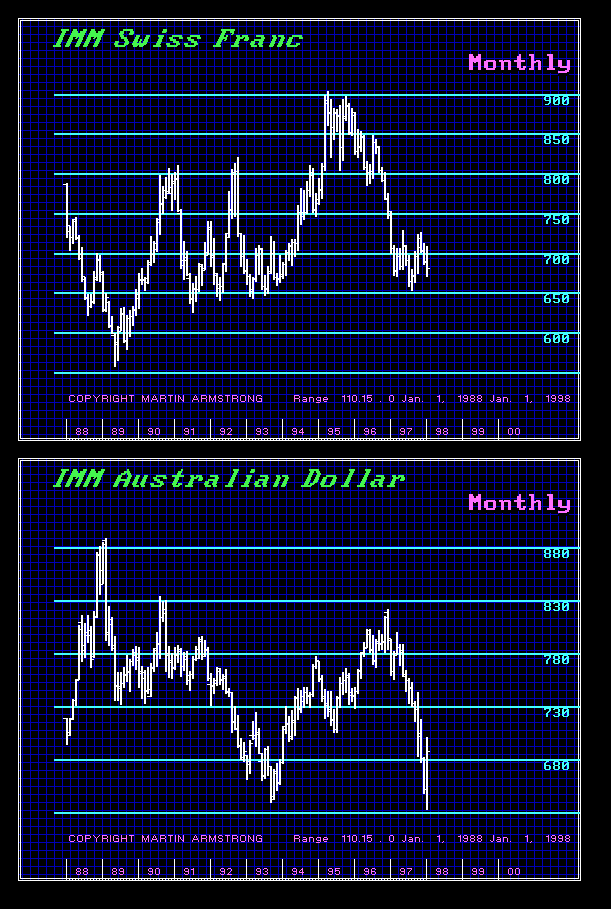
I have been called in on so many FX crises it is amazing. They were selling Swiss loans to Australians in the 1980s to save on interest rates. They never considered what would happen if the exchange rate changed and the Swiss franc rose against the A$.
Just look at these two charts. The A$ was crashing and the Swiss franc rose. The default rate on mortgages exploded and small businesses who listen to bankers pitching Swiss loans to save money lost a fortune. The same crisis took place following the Swiss/Euro Peg when that broke.
Once again, the bankers were selling mortgages in the Swiss franc in Europe to lower interest rates. I cannot tell you how many times were have been called in on major financial crises around the world all for the very same reason. People make a loan in a foreign currency to save money on the interest rate. They have NO CONCEPT that the currency can swing even 40% in a short period of time.
The Chinese Central Bank warned its provinces and corporations NOT to borrow in dollars. They understood our model and understood what happens under such a currency crisis. Nevertheless, provinces and private corporations did not listen. They succumbed to the lure of the cheap interest rate.
I had even spoken with a major company and warned them the dollar would rise and there was a serious risk in emerging markets. They were new and as you say, they listened to the majority of opinions that took the opposite forecast. Now we see bank runs in China and serious problems in emerging markets.
The Biden Administration reiterated that its $1.9 trillion 2021 American Rescue Plan awarded “resilience” to the US economy. The remarks come after the plan, and the administration’s overall spending, came under harsh criticism from economists on both sides of the political spectrum. Senior advisor Gene Sperling stated that the plan would actually help to bring down prices in the long run. On the contrary, Steven Rattner, who served as counselor to the Treasury secretary under Obama, believes the plan was the “original sin” that contributed to the price hike.
“The American Rescue Plan saved our country from economic catastrophe, helped get millions of Americans back to work, and helped make sure American families had money in their pockets from tax cuts and rising wages,” a White House official reiterated. Global supply chain issues and pandemic restrictions caused inflation to rise in nearly every nation. However, inflation rose much faster in the US last year, even when excluding volatile energy and food prices.
The Federal Reserve Bank of San Francisco analyzed the situation and determined: “Estimates suggest that fiscal support measures designed to counteract the severity of the pandemic’s economic effect may have contributed to this divergence by raising inflation about 3 percentage points by the end of 2021.” There is no doubt that the large spending package contributed to inflation, but it was not the sole cause. It did, however, give the people a taste of the beginnings of socialism and free government handouts, and that may be the most detrimintal result of the package.
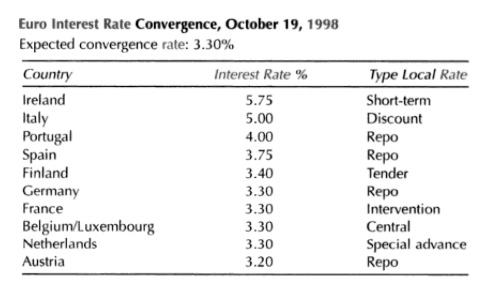
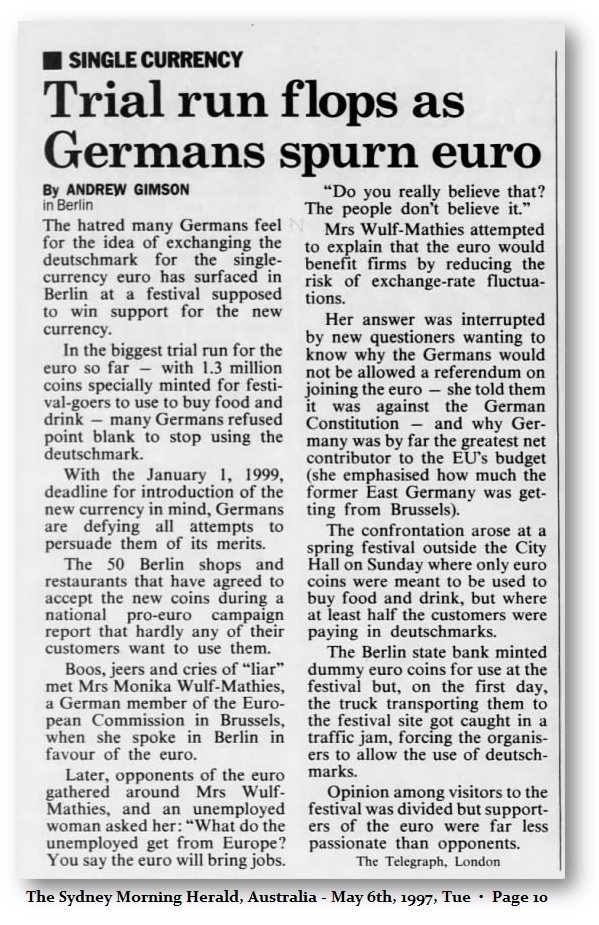
The European Central Bank (ECB) has a major crisis beginning. The free markets always win, and the spreads on the interest rates among the member of the EU are widening for Greece and Italy. Fools are telling Lagarde to use stronger language to signal that divergences among the member states will not be allowed to take place. The borrowing costs of more vulnerable countries such as Italy and Spain cannot be contained.
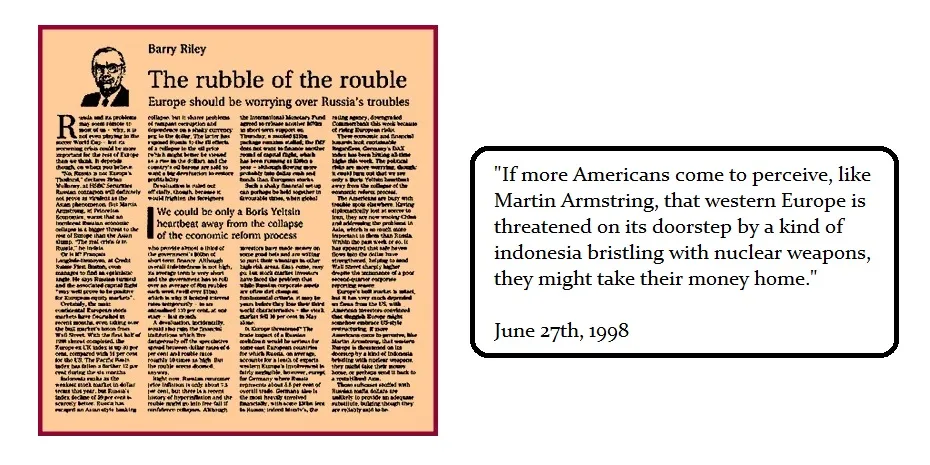
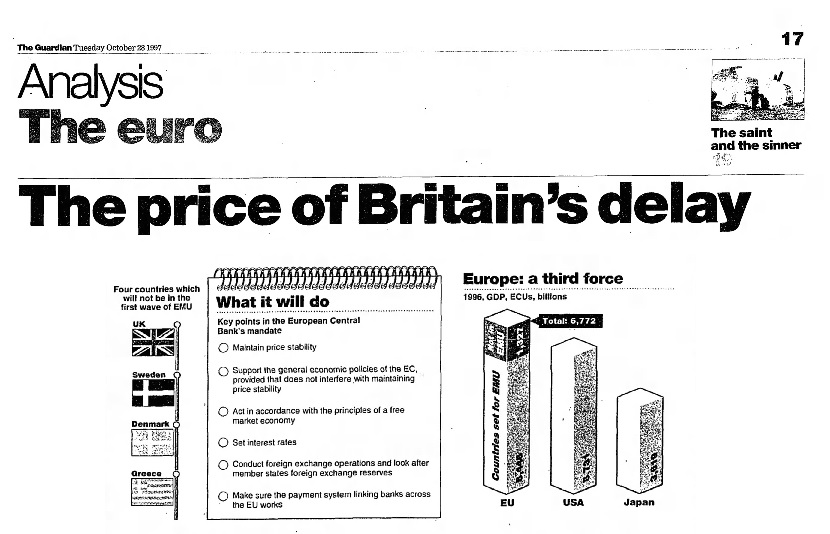
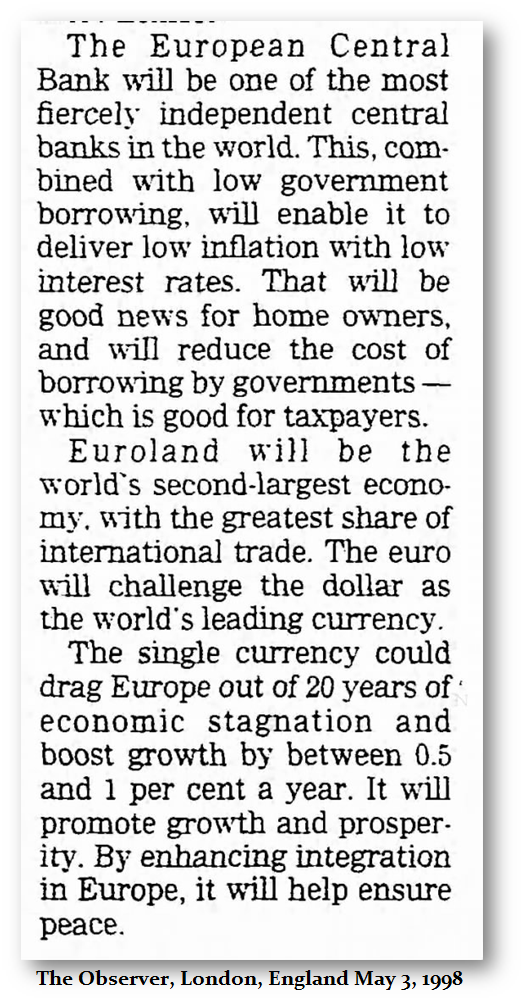
When they were creating the euro, the Commission attended our 1998 London Conference — the same one when I warned that Russia was about to collapse. It was then when I had a discussion with them, warning that a single currency WOULD NOT produce the same interest rate for all.
All the talk was that a single currency would set a single interest rate. I tried in vain to explain that would never happen. They were comparing it to the US federal government and I made it clear that they were not consolidating all the national debts and this meant that there could be no single interest rate and the difference in the currency would be transferred to the bonds instead. They simply refused to listen because that was one of the selling points to get the euro going.
It did not matter, they just wanted the euro at all costs. Now we see the widening of the spread and one central bank cannot impose a single interest rate any more than the Federal Reserve can control the interest rates all 50 states must pay to borrow money. In the United States, Massachusetts has the highest debt per capita in the country at about $11,130 with a AA rating while Tennesse has the lowest at about $875 and has a AAA rating.
The ECB knows it is facing a nightmare. The ONLY possible solution is to consolidate all the national debts of the member states and that would then become federal. Only then could it possibly be on the same footing with the dollar. Back then, the Bundesbank was against the euro. They were feeding us all the notes of the meetings because they really could not come out and speak. The Bundesbank understood the potential long-term crisis, and they opposed the merger of national debts.
So here we go again. COVID set off the fuse; Ukraine is the time bomb about to explode. As the soothsayer warned: Caesar beware!
The Securities and Exchange Commission (SEC) is warning investors against popular “meme stocks.” Yet, they have gone too far by offering direct trading advice. Specifically, the SEC produced a video (see below) about GameStop (GME) that has retail investors reeling.
GameStop was certainly trading in volatile territory during Q1 2021. A group of online retail investors promoted the stock and allegedly were partially responsible for causing Melvin Capital hedge fund to lose 53% of its capital in January. The short squeeze seems to be highly exaggerated and the four largest asset managers in the world owned 39% of GameStop at the time. Those who traded properly, or simply got lucky, profited off of the volatility, but, obviously, that is not recommended for the amateur investor.
The problem here is that the SEC is trying to deter the retail investor to protect the hedge funds. The SEC should not be telling the public which stocks to avoid and I do not believe the shareholders of GME or other “meme stocks” will be happy with this advice.
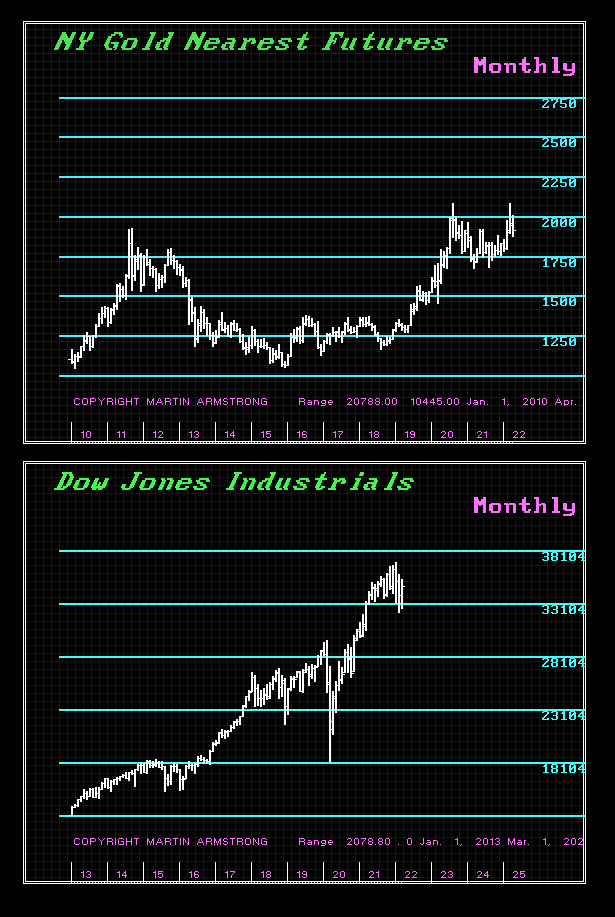
COMMENT: I just wanted to comment on your “Endless Propaganda Behind the Dollar.” I attended your 2011 WEC in Philadelphia. I bought the stock market using the Dow stocks when it was 12,500. Gold was about 1600 and your forecast that the high was in place was amazingly correct as it fell to nearly 1000 after that.
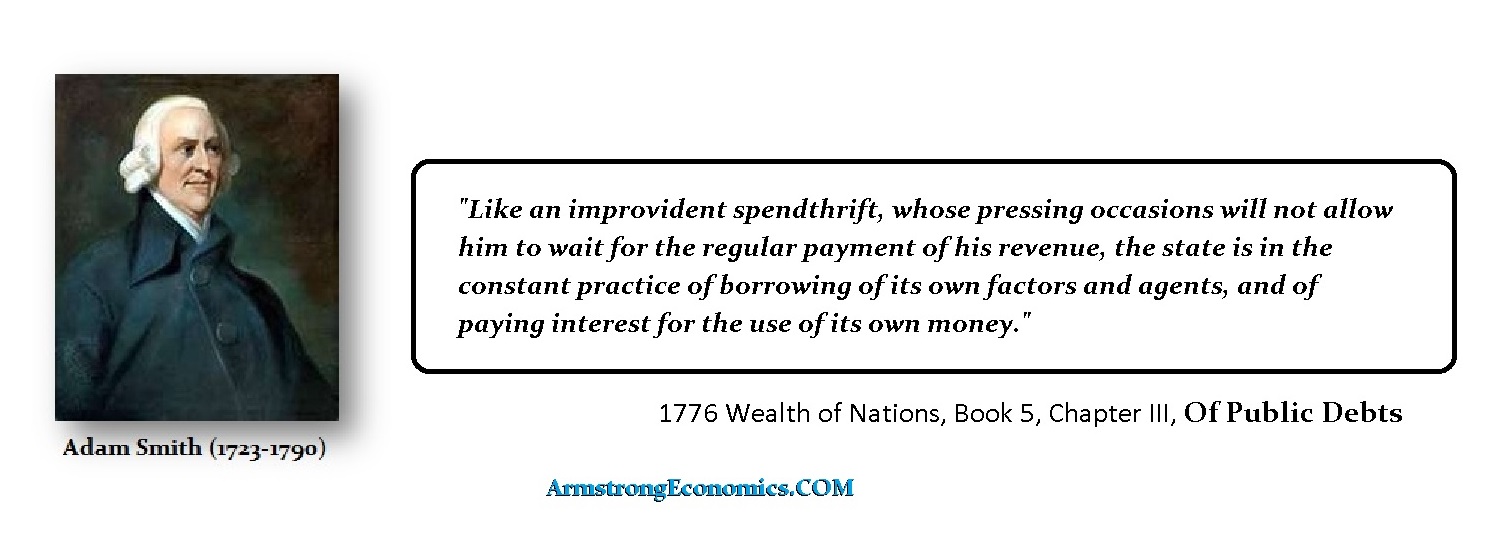
You have opened my eyes to the real meaning of Adam Smith and the wealth of a nation is the productive capacity not this archaic view of commodity-based money. I know friends who even lost their marriages over gold.
Some of us goldbugs do listen.
Thank you so much.
JE
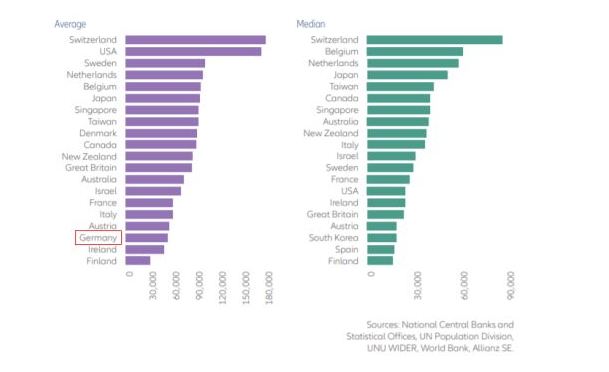
REPLY: The wealth of a nation is its people and their productive capacity. Russia is the wealthiest nation in raw materials, it does not make them the #1 economy. Germany has kept its old-world economic model of export which is also a throwback to the olden days. Germany has been obsessed with the Quantity Theory of Money because of the hyperinflation they totally misunderstood. As a result, they keep their taxes very high and the German people are among the poorest in Europe despite the fact they are the #1 economy in the EU.
It’s not just the goldbugs who have lost, but these theories have screwed up the world economy. The central banks employ them to stimulate or suppress our demand, which has also failed. We have had negative interest rates in the EU since 2014 and economic decline. They have increased the money supply with NO impact on inflation at all post-2008. The inflation wave now is ONLY because of the lockdowns and shortages. It is not DEMAND driven and the dollar is rising, so it’s nothing to do with these old theories.
It does not matter. There are people who will fight what I say until the end. On the close of January 1980, the euro equivalent was 12285 and on the close of January 2022, it was 11236 so the dollar has risen not declined. Gold was $653 at the close of January 1980 and $1796 at the close of January 2022 which was a gain of about 175%. Crude oil closed in January 1980 at $20.18 and in January 2022 it was $88.15 which was about a 340% gain. Wheat for the same period was up 65%. But the Dow Jones Industrial Index was 875 at the close of January 1980 and 35,131 at the close of January 2022 posting a gain of 3914%.
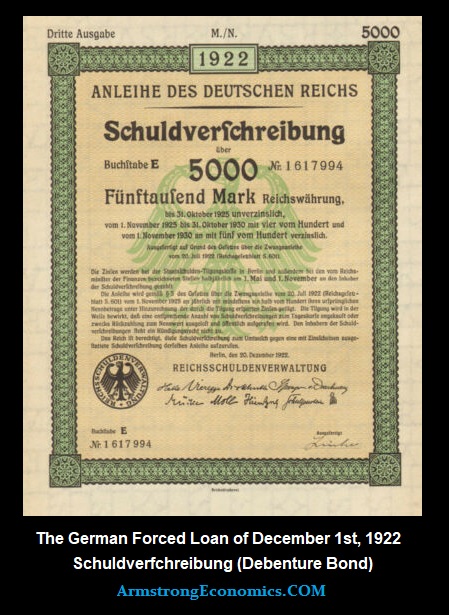
Facts mean nothing to the diehards any more than facts mean anything to the climate change zealots. Will gold rise? Yes! Does it have a place in one’s portfolio? Yes. Silver coins may be better for small transactions when there is no power. But what will happen is that governments, in a desperate act of self-survival, will shut down communications, seize the internet, and seek to oppress the people before the government falls in the end. The German Hyperinflation had nothing to do with the quantity of money. In December 1922, the government seized 10% of everyone’s wealth and issued bonds that they defaulted on. That “forced loan” began the hyperinflation. People kept tangible assets anything but cash – coins, stamps, art, real estate. That is what 2032 is all about. We get to redesign a new government from the ground up.
The Democrats claiming that Blacks are too poor and too stupid to have ID to vote is all about creating fake votes so they can win. Even in Mexico to vote everyone has a voter ID with a photo and a fingerprint with a hologram to prevent forgery. So Mexicans are smarter people than American blacks? You can not travel without an ID. You can’t say gee, I’m poor and black, but I need to get on this plane even if I have no ID. This is all total BS and it is a desperate act by the Democrats to rig the game to ensure they can stuff the boxes with fictitious people who vote for a living and probably do not exist otherwise. I have blacks who work for me and it is a matter of law they too must have a SS# so the government gets their taxes from them.
So, welcome 2032 – We get to start all over again.
QUESTION: Marty, Your forecast for the Panic Cycle here in Australian politics was correct and it beat all the polls as you did in BREXIT. Our new leader is a full-on board with the WEF climate agenda and will have all cars electric by 2030. As you say, in war you take out the power grid first. I guess this makes the power grid even more of a first-strike target.
I want to thank you for Socrates. It is great to have something that provides a non-emotional forecast. The forecasts you publish on so many things around the world are amazing and accurate.
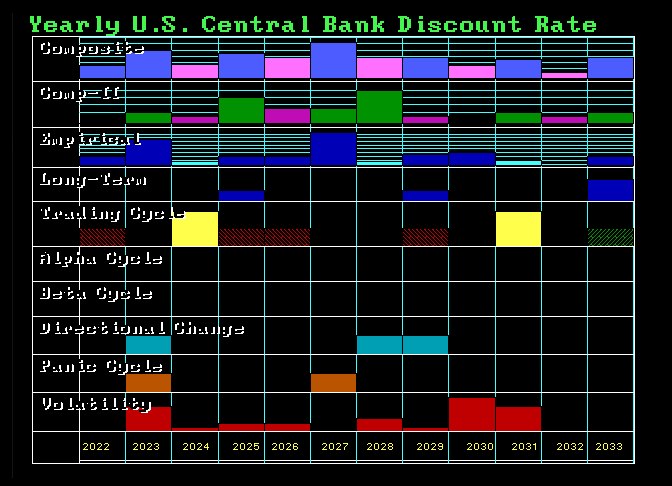
So my question is this. You were correct that rates would rise, or Socrates was, and you said that there would be shortages with a commodity cycle mixed with war rising and civil unrest. So now that the central banks are in a state of panic, what do you expect with the panic cycle in 2023 in the Fed?
ANSWER: You are correct. Too many people attribute everything to just me as if I have a crystal ball. The forecasts are from the model. Nobody could be forecasting so many things for 40 years on a gut feeling and be correct. The odds of humanity are against that.
People tend to forecast what they want to happen. It is just an inherent human flaw. But it is also what drives markets. The majority of people are influenced by the direction of the trend. So a rising market makes people feel bullish and a declining market makes people more pessimistic. That is just a fact of life. So the ONLY hope for an accurate forecast MUST come from a non-emotional source. Staring into 2023 just looks like total chaos.
I do get the occasional email asking me how I cope with my own forecasts. I look at it this way. If I said here comes my fist, I’m going to punch you in the face. Do you just stand there and smile or do you dodge the punch, or defend against it? Isn’t it better to know something is coming to prepare?
It is more like an out-of-body experience for me personally because these forecasts are the computer and I have to stand here and watch as well as live through them. It is a different experience to forecast these events years in advance and live through them myself.
I am concerned that when you look around the globe, so many things have serious targets and panic cycles in 2023. Even in the war cycle, the computer has the highest aggregate bar for 2023. The central banks are unable to prevent inflation because this is a shortage crisis, not a speculative boom where raising interest rates will reduce the buying.
While the Central Bankers think this is clear sailing, they have entered uncharted waters. The risks of the markets discovering they cannot control the economy anymore will raise the crisis to extreme levels as we head into 2023.
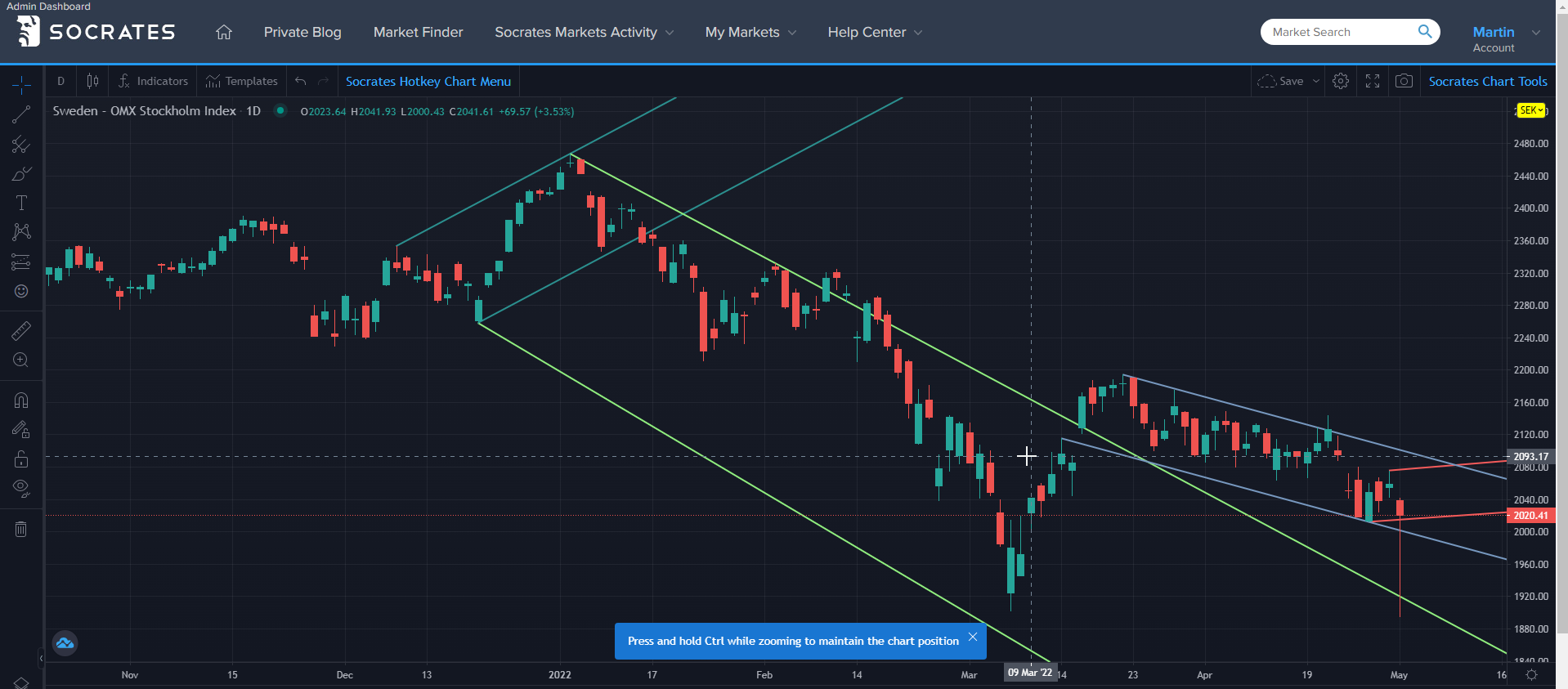
QUESTION: Marty, Socrates correctly projected the claimed Citibank manipulation of Monday in Sweden. It wrote: “The strongest target in the Daily array is Mon. 2nd for a turning point ahead, at least on a closing basis. There are 4 Daily Directional Change targets starting from Mon. 2nd to Fri. 6th suggesting a choppy coiling period for 3 Days. I”
How did Socrates project this and then showed it would bounce with another Directional Change? Was it really a manipulation? Citigroup did confirm that it played a role in yesterday’s flash crash. They released a statement: “This morning one of our traders made an error when inputting a transaction. Within minutes, we identified the error and corrected it.” The exchange refused to cancel the trades. This is confusing for it was not beyond the parameters that Socrates laid out including the technical analysis.
Any clarification would be interesting.
All the best
JM
ANSWER: I understand that the common definition of manipulation is simply a big move. To me, this was NOT a manipulation. My definition is moving a market COUNTER-TREND which this was not. Yes, Socrates projected that Monday the 2nd would be a low and that the Directional Changes back to back suggested it would be more of a knee-jerk reaction rather than a change in trend. The array showed the biggest target would be Monday, May 2nd.
There had been low volume. Thus, if it was a mistake, a smaller amount of selling could have a greater impact. However, it still did not move beyond the parameters of the trend as pre-defined by Socrates. Even the technical analysis that the computer does itself showed that this was NOT outside the norm. I appreciate that everyone will jump on this as a “manipulation” but that is just not the case. Manipulation is something that MUST simply be COUNTER-TREND. Making a market move in the direction of the trend in a spike manner is NOT a manipulation. At best, this is ENHANCING a move within its trend. But it is not a manipulation.
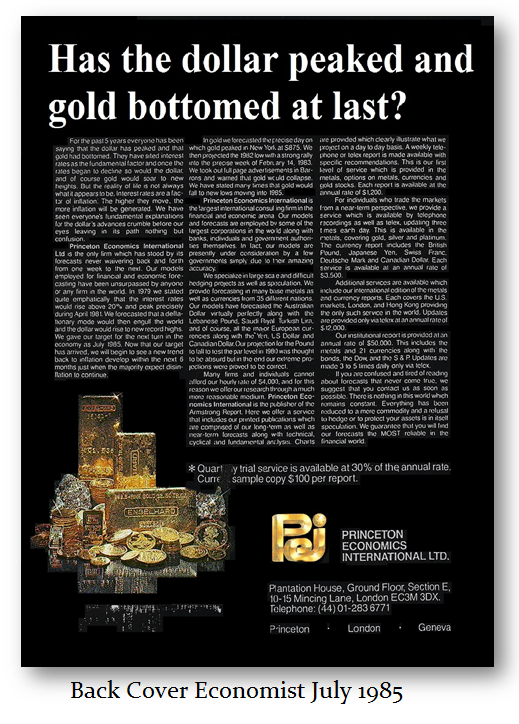
Once upon a time, I use to respect The Economist. I even took the back cover in July 1985 to announce that the Economic Confidence Model was beginning a new 51.6-year Cycle that was a Private Wave that would ultimately peak in 2032. I boldly announced the bottom in gold and the peak in the dollar taking the back cover every week in July 1985.
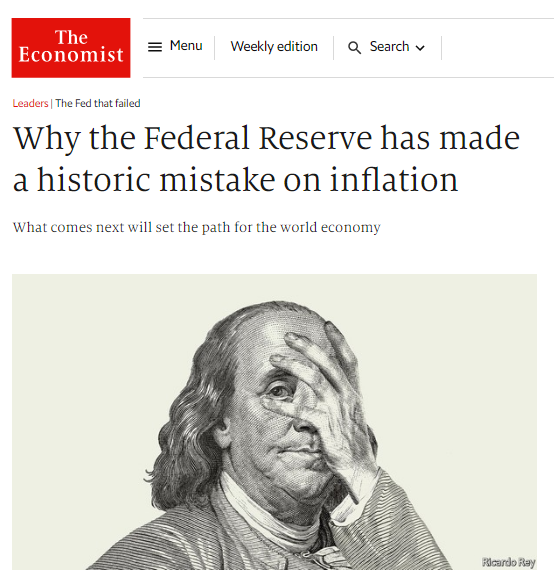
The Economist just released its cover article sadly demonstrating that the publication remains in the Dark Age of economics. They began:
“Central Banks are supposed to inspire confidence in the economy by keeping inflation low and stable. America’s Federal Reserve has suffered a hair-raising loss of control. In March consumer prices were 8.5% higher than a year earlier, the fastest annual rise since 1981. … It is the Fed, however, that had the tools to stop inflation and failed to use them in time.”
To say I am shocked at their reporting that is no better than a first-semester student in Economics 101. It reflects a complete lack of comprehension of how the economy even functions and adopts the politician view that they are NEVER responsible for inflation – it is always the central bank.
Clearly, they have not bothered to take notice that something major took place with the fall of Bretton Woods in 1971. Previously, the theory was if you borrowed, that was less inflationary rather than printing more money. Of course, that was a throwback to the days of Gresham’s Law when currencies traded in Amsterdam were based not on political-military power, but on the pure metal content. The debasement of the coinage by Henry VIII led to (1) the higher-based coinage being hoarded and (2) the decline in the value of English coinage trading in Amsterdam.
That theory became the Quantity of Money Theory which today is totally obsolete yet that is what we hear all the time when the Fed increased its balance sheet and therefore it should have been inflationary following 2008 but the Fed and other central banks could not create 2% inflation. That even led to some claiming MMT (Modern Monetary Theory) proves that the creation of money is NOT inflationary.
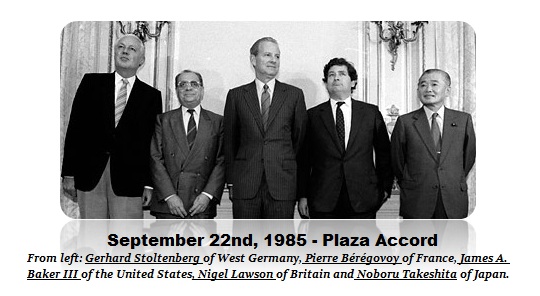
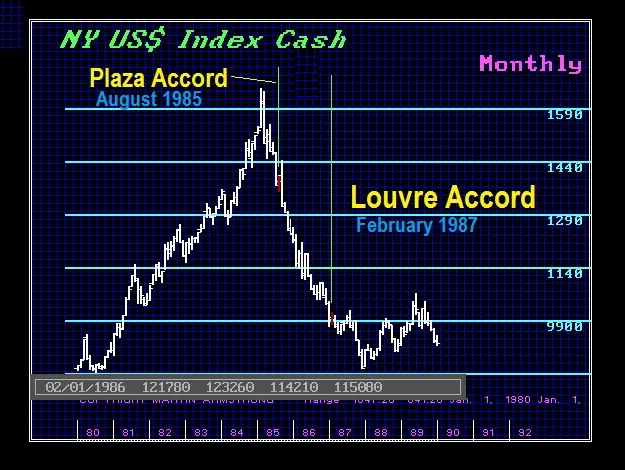
It was barely two months after we announced the beginning of a Private Wave in the Economist in July 1985 that in September 1985, the central banks were all called together and formed the G5 and then proclaimed that they wanted the dollar lower by 40%. This was James Baker’s brainchild that manipulating the dollar lower would reduce the US trade deficit and create jobs.
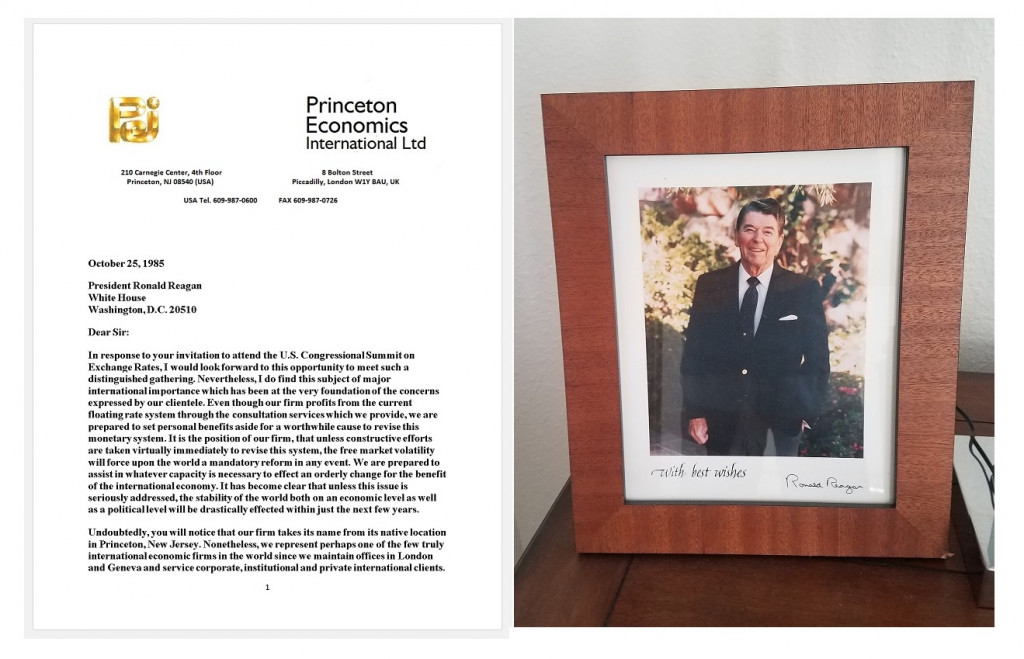
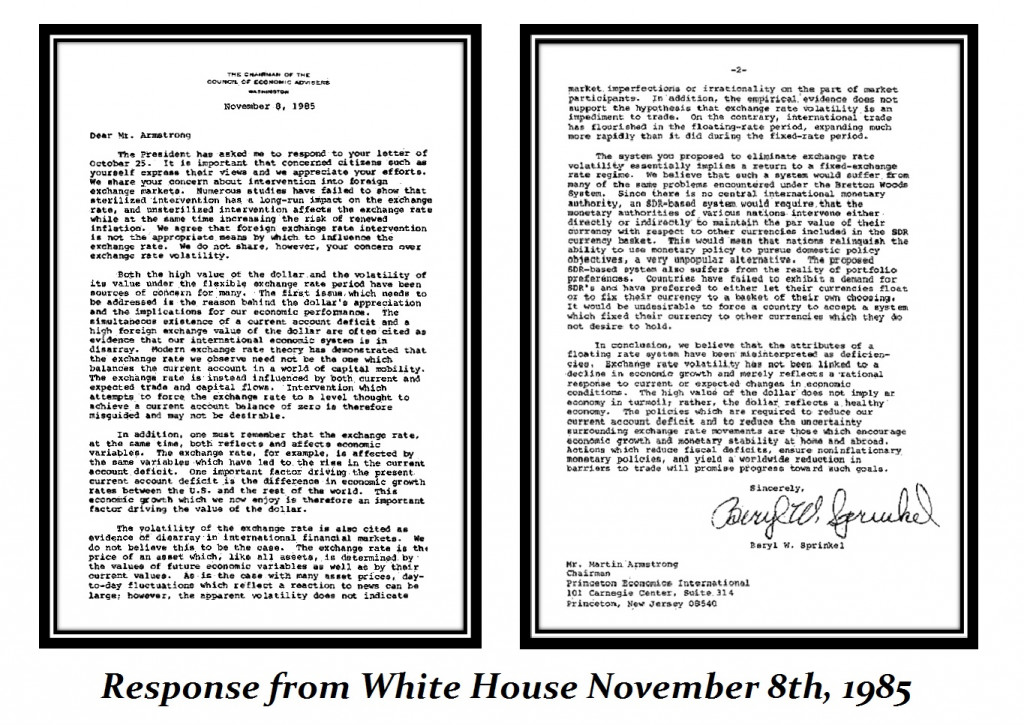
I was summoned to be among the global experts who solicit advice but never listen. It is always a dog & pony show so they can pretend they summoned the top experts in the world and then announce what they intended to do anyhow. Of course, it is always pretended to be based on independent advice. However, that is just not how Washington or any government functions. So I wrote to President Reagan and warned that devaluing the dollar to reverse the trade deficit would lead to a crash.
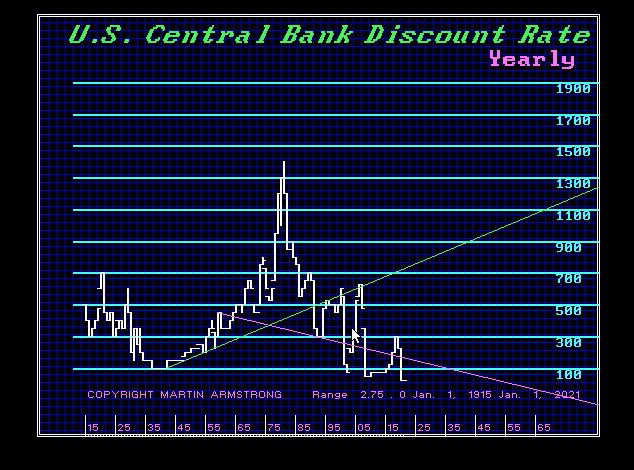
The present ordered Beryl Sprinkel who was the 14th Chariman of the Economic Advisers to the President (1985-1989) to respond. It had been the rise in interest rates to 14% under Paul Volcker to reduce inflation that led to the Deflation. Capital poured into the dollar for the high-interest rates which peaked precisely with the previous ECM wave in March 1981. Thereafter, the dollar soared driving the British pound down to $1.03 in 1985.
Clearly, the entire theory that the Economist is still clinging to currently is unsupported by the historical evidence. The raising of interest rates to stop inflation led to the explosion of the national debt thanks to the servicing costs. In 1980, the national debt stood at $907.7 billion. By 1989, the debt reached $2.857 trillion. The raising of interest rates created deflation near-term but expanded the inflation longer-term.
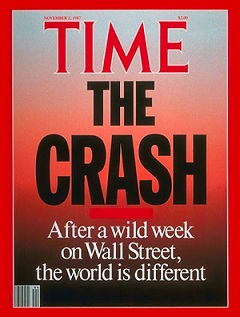
The Plaza Accord set in motion the 1987 Crash. They failed to understand that lowering the value of the dollar may have made US goods appear cheaper overseas to reduce the trade deficit, but at the same time, it also devalues all the US assets in the eyes of foreign investors. After selling more than one-third of the US national debt to the Japanese, the lowering of the dollar by 40% would mean a 40% loss on their holding of US debt.
As the dollar began a free-fall, the central banks began to realize this was a mistake. The Louvre Accord was an agreement, signed on February 22, 1987, in Paris, that aimed to stabilize the international currency markets and halt the continued decline of the US Dollar caused by the PlazaAccord. The agreement was signed by France, West Germany, Japan, Canada, the United States, and the United Kingdom. Italy declined to sign the agreement. The Group of 5 became the Group of 7 – G7 (now G20).
The G7 meeting of central bankers and finance ministers in Paris announced that the dollar was now “consistent with economic fundamentals.” They announced that they would only intervene when required to ensure foreign exchange stability. The objective was then to manage the floating currency system.
Democrats gained control of Congress in 1986 and immediately called for protectionist measures. The dollar depreciation agreed to in 1985 at the Plaza Accord, failed to really improve the trade perspective. In 1986, the trade deficit actually rose to approximately $166 billion with exports at about $370 billion and imports at about $520 billion. The object of manipulating currency to try to create jobs and alter trade flows proved to be completely false.
My concerns warning the White House that volatility would increase made back in 1985 were materializing. What they did not understand was that lowering the dollar in value also led to a shift in capital flows and the selling of US assets. Foreigners were suffering losses by financing U.S. trade by purchasing United States Treasury bonds in an attempt to ease the trade deficit criticism. We were advising the Japanese to buy gold on the New York COMEX, export it, and then resell which would also make it appear that the US exports were increasing. However, the lower dollar was then resulting in the importation of inflation into their own nations.
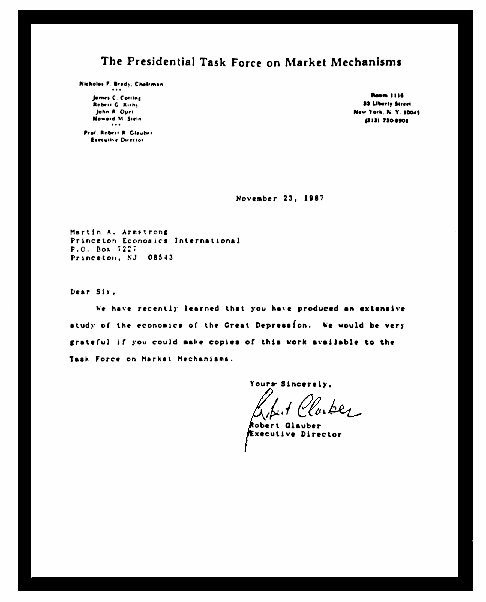
The press back then never understood the crash. I was called in by the Brady Commission charged with investigating the causes of the Crash. Of course, they would not blame the government. The best I could do was to prevent a witch-hunt on Wall Street and the final report casually mentioned that they believed foreign exchange had something to do with it.
There is probably nobody else who has dealt with more central banks than me from China to Switzerland and into the Middle East. To read this cover story by the Economist was indeed shocking. They are obviously still under the impression that inflation is the result of the rise and fall of the money supply that dates back to the days of Henry VIII. I dare say, things have changed slightly.
Today, governments have borrowed relentlessly. But the debt is acceptable now as collateral so national debts are simply money that pays interest. That is completely out of the scope of the central bank so it DOES NOT have the tools to prevent or create inflation. The politicians always want to spend whatever it takes to win the next election and then blame the central bank if it resulted in inflation. It is a sad day that the Economist is so out of touch its rambling and that of someone serious out of touch with reality.
I have created this site to help people have fun in the kitchen. I write about enjoying life both in and out of my kitchen. Life is short! Make the most of it and enjoy!
This is a library of News Events not reported by the Main Stream Media documenting & connecting the dots on How the Obama Marxist Liberal agenda is destroying America







 Centinel2012