The Fate of Europe


QUESTION: Marty; Your capital flow models have been remarkable. Do you see Europe as ever getting its act together? We need support to get decisions approved as you know. Will you provide that for us to present to the men above?

Thanks.

Nice to see you in Europe. Rome should be great at this time of year.

PDC

ANSWER: I have covered that is a special report for attendees. It took me a month to write this one. I have tried to cover every aspect so we can deal with the forecasting at the conference rather than all the supportive history. I understand that institutions need the support to justify their decisions. This is the report everyone needs for their files to CYA as the say for decisions.

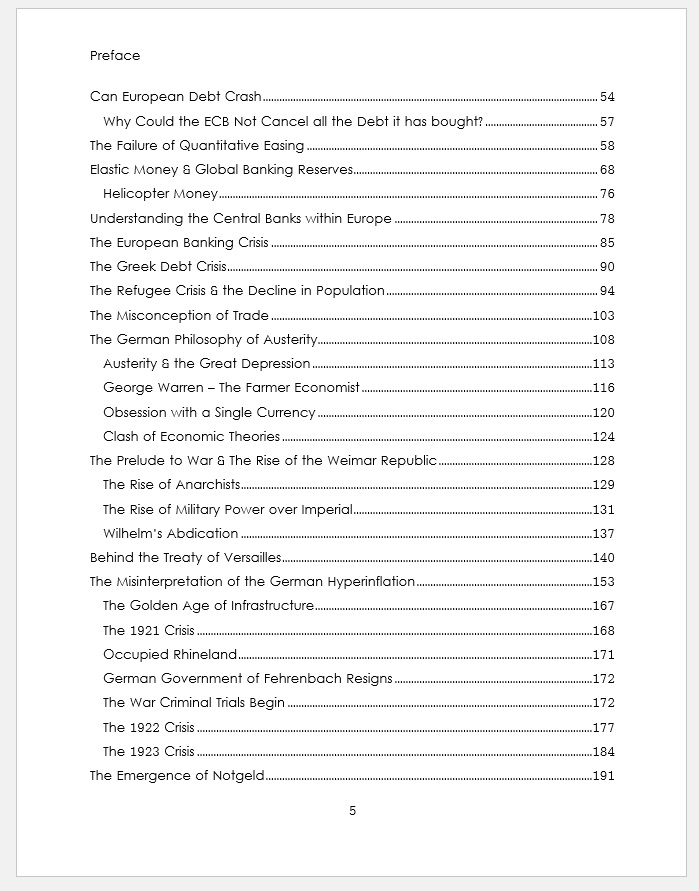
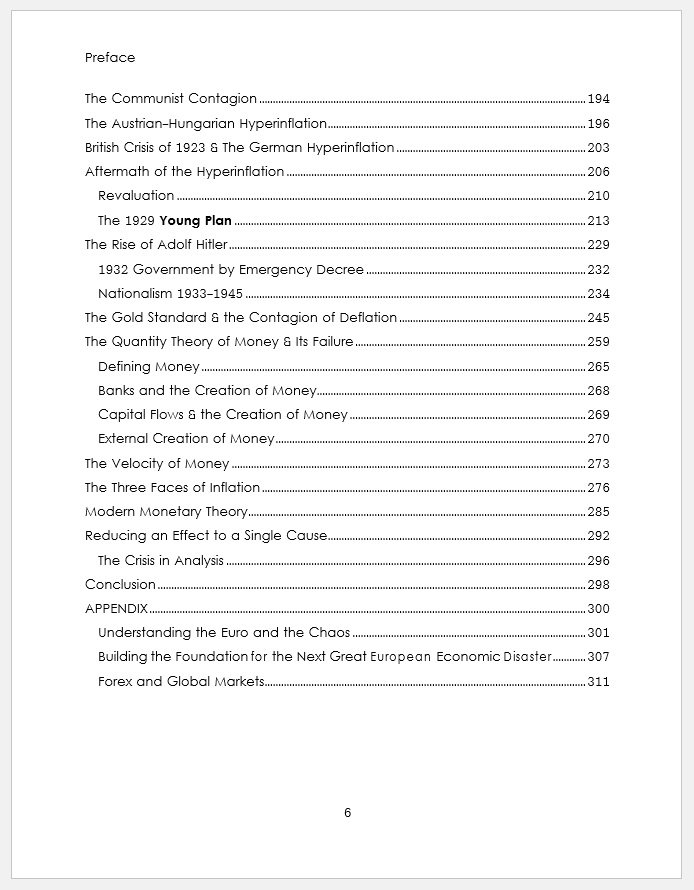
Things look very dicey for Europe and this will be a very interesting WEC. Here is the Index of the Report. I believe this will answer all questions and provide the backup you need to present to any board of directors.


The Consequence of War that Led to the German Hyperinflation


QUESTION: Everyone has a chart of the German DAX postwar. I have never seen a chart of the German stock market before the war. Do you have any?

HVS

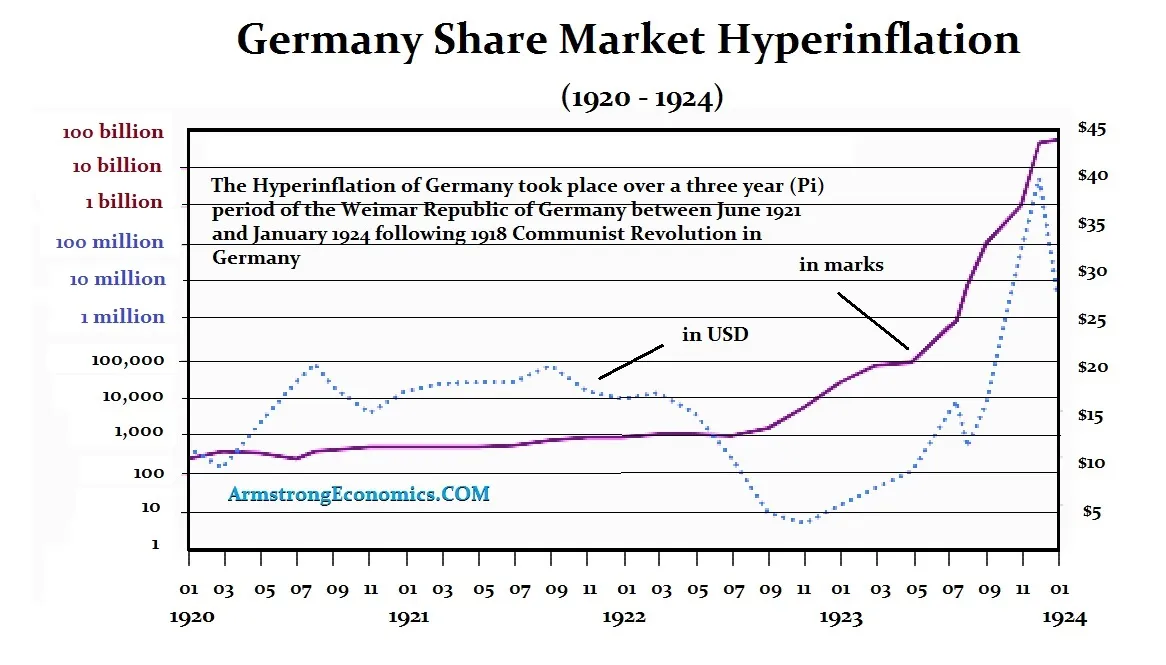
ANSWER: Yes. However, you must understand that because the world was on a gold standard, the arbitrage volatility was reflected in the bond and share markets when the currency was fixed. This is why the German share market closed in August 1914, along with just about everyone else. Here is a chart that show the performance of the German share market during the hyperinflation period. We have the DAX also extended back in time. But don’t forget, the DAX is a total return index. If we plot just price, you will see that the German share market looks very much like France.

The primary stock exchange in Germany was in Berlin. However, there were 21 exchanges in total. The origins of the Frankfurt Stock Exchange date back to medieval trade fairs during the 11th century. By the 16th century, Frankfurt developed into a wealthy and busy city with an economy based on trade and financial services. Annuities in particular were the hot items back then. It was in 1585 when the bourse was established to trade in fixed currency exchange rates. Currencies actually led to exchanges rather than shares. Eventually, Frankfurt developed into an early share market, competing with London and Paris. Mayer Amschel Rothschild and Max Warburg became very influential in the financial trade of Frankfurt.

The Frankfurt Stock Exchange had been a major international center. It was completely wiped out by World War I and its consequences. Back then, foreign shares and bonds traded on cross exchanges since money was fixed. German investors at the start of World War I dumped foreign bonds and shares, fearing that their capital would be restricted or confiscated. This is also why all the exchanges simply closed in Europe. Any capital they managed to free up from the sale of foreign investments was reinvested mostly in German government bonds. They were patriotic and believed in their government. However, by the end of the war, the Frankfurt Stock Exchange lost all foreign securities listings for bonds or shares. Frankfurt lost its standing as an international stock exchange entirely, and that would only begin to resurface in 1949.

In Europe, the fear of catastrophic declines in stock prices was met with controls at first. Overall, stocks and bonds were not allowed to trade below the price they had been trading at on July 31, 1914. Restrictions were also placed on capital. Money movement was highly restricted to preventing any large outflows of capital, forcing many into black markets. One means was to buy collector stamps and coins. They would then export especially rare stamps and then sell them in America. After two world wars, most of the rare stamps happened to be in America and gradually returned to Europe during the late 1960s.

With these restrictions in place, markets reopened in Europe. The London Times began printing stock prices for London and Bordeaux on September 19th and for Paris on December 8, 1914. In January 1915, all shares were allowed to trade on the London Stock Exchange, though with price restrictions. The St. Petersburg exchange reopened in 1917, only to close two months later due to the Russian Revolution. The Berlin Stock Exchange did not reopen until December 1917.

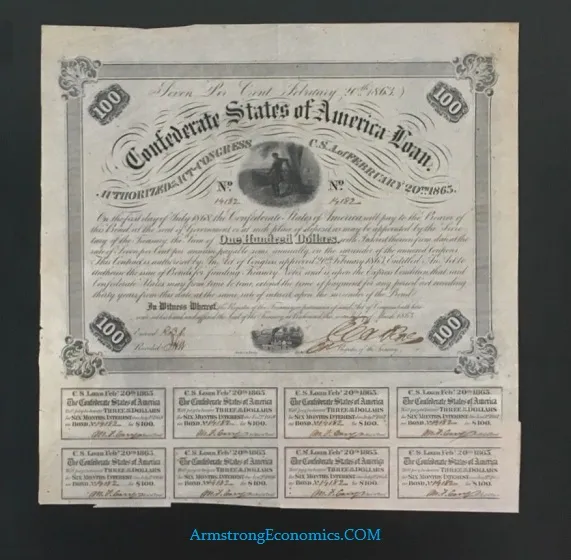
The loss of the war meant those who had invested in German bonds suffered the same fate as those Americans who invested in Confederate bonds. Indeed, to fund World War I, Germany relied more on raising money by selling bonds than imposing taxes. This had the net effect of wiping out the savings of the middle class and upper class. During the hyperinflation going into 1923, the losses in bonds were devastating, but in contrast, equities became a prized object among speculative investors. The Frankfurt stock exchange saw unprecedented losses in the bond markets and shares became the speculation objects that rose sharply going into 1923.

The German war costs covered by taxation, including state and federal combined, was only 13.9% which was lower than 18.2% taxation imposed in Great Britain for the war effort. German debt exploded after 1916. That is when the federal government’s short-term floating debt grew relentlessly, and by the end of the war it accounted for nearly one-third of the German national debt. The seriousness of the German debt crisis, which led to the postwar hyperinflation, was the fact that after 1916 German banks began to purchase more of the government’s floating debt. Government debt dominated the market and banks took on more public debt than private. When the public debt was marginalized by hyperinflation, it also wiped out the banking system.

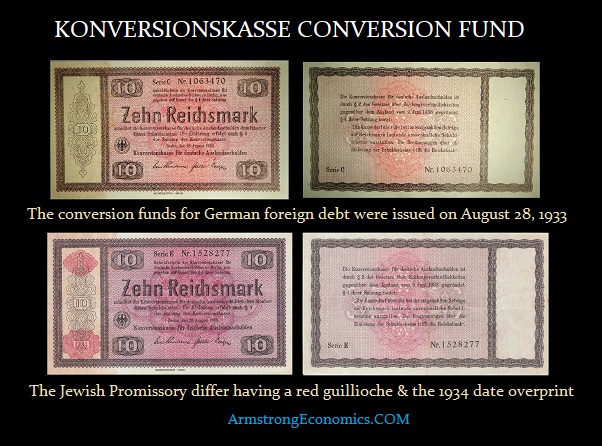
By the end of the war, the international contacts of the Frankfurt Stock Exchange had been lost. Inflation set in and reached its first peak in 1923. In October 1929, the Germany stock exchange prices crashed dramatically on the 25th. The world economic crisis ruled the following years. The economy only began to stabilize in 1932. The following year, the Nazis took over and centralized the nation’s economic policy. The Frankfurt Stock Exchange was merged with the Mannheim Stock Exchange and the number of exchanges nationwide was reduced from 21 to nine. Under the stringent Nazi economic regime, free trade was suffocated as Hitler defaulted on external debt. The majority of capital assets was directed to benefit the war economy. He even issued conversion fund certificates that were exchanged one for one with German marks if you sought to leave the country. This was part of the currency controls but they were worthless once you left the country.


Suicide Rate Doubles in France Among Police


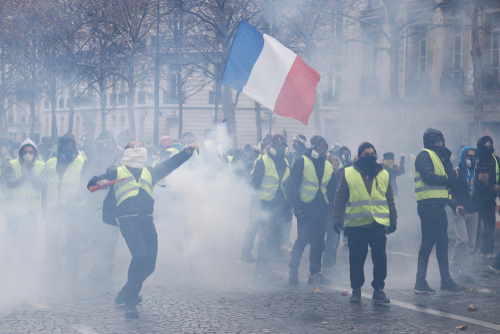
The Yellow Vest movement is turning into a major confrontation demanding Macron leave office. The French police are now protesting after 28 officers have committed suicide so far in 2019. This is double the amount recorded at the same time last year. While the press tends to focus on complaints of a lack of resources, unpaid overtime, and inefficient management, they are not speaking about the social isolation the police are starting to experience as they defend the government against the people.

I have written before about the Nika Revolt of 532AD where the local police and troops refused to defend the emperor Justinian. He almost fled Constantinople until his wife directed him to call in an army which was not Greeks. They came into the city and slaughtered some 30,000 protesters. What the French police are experiencing is this very same conflict. This is why Brussels wants a European Army for they would have no conflict with the French people if they are not French. The police may yet turn against the French government and if that happens, then we have a French Revolution. The revolution in Ukraine turned when the police saw that Yanukovich brought in Russians to defend himself. Then and only then did the Ukrainian police turn against Yanukovich and he had to flee. This is standard developments throughout all historical civil unrest movements defining the line when crossed it becomes a revolution.


Book on Economics, Written in 1994


From The introduction to my book …

I first had the idea of writing a book such as this about ten years ago. It seemed to me that each of us learns something of value as we go through life, but most of us do not succeed in passing along our knowledge to others before we die. This, then, is my attempt to pass on to others what I, over my fifty-odd years, have come to believe are the truths of life and what I believe may be a path into a better future. Much of what I write about involves economic issues, since I am an economist by training. Economics, however, is a social science, and my excursions into other areas of the social sciences are therefore not totally out of line.

I have had a great deal of “life” experience (both educational and professional) and this book thus covers many subject areas. While analyzing these subjects, I have tried to be logical and objective (as I have tried to be all my life), and hopefully this proclivity is reflected herein. You, the reader, will probably disagree with some or much of what I have written. That’s fine if your disagreement is based on fact; it’s unacceptable, however, if your disagreement is the result of prejudice and preconceived ideas.
Throughout this book, I have included editorial writings, which I felt were astute, and which help to illuminate my ideas. In each case, I have credited the author and distinguished his/her writing from my own.

Much of what I write about could be construed as anti-religious; it is not. It has not been my intention to support or deny the existence of God or a Supreme Being.
A thought that should be kept in mind when reading this book is that virtually nothing we do today is done as it was in the past. By this I mean the “near past”–remember that radio was invented only ninety-nine years ago, and it has been only ninety-one years since the first powered flight. Most of the technology that we now take for granted has been developed in the past fifty years. The corollary to this is that our ideas and attitudes must also be different from those of the past. Try to imagine how people will regard the “absurdly primitive” last decade of the twentieth century in the year 2045 (when all that we know today will have been gone for fifty years). The point is to keep an open mind, don’t pre-judge, and don’t be too certain about anything.

We live in a world of fantastic ideas if only we can keep an open mind!

The link below will allow you to download the book, if you want, and at no cost.

Power Economics

Netherlands Objects to France’s Attempt to get EU Funding in a Crisis


The Prime Minister of the Netherlands, Mark Rutte, is objecting to France’s desired changes to the EU budget. France wants aid with the inclusion of the objective to “stabilize” the economies within the Eurozone, whereby the Netherlands wants all funding to be limited to furthering “competitiveness and convergence.” The Netherlands contributes the most to the EU, and far more than it receives. This only illustrates once more that the Eurozone is far from one big family. The cultural differences remain and always will. They will not vanish as a matter of law. The only thing that will allow that to happen over time will be a common language, as took place in the United States. Then and only then did all the various cultures begin to integrate

Common Sense Canadians Crush the Moonbats in Alberta…


A massive defeat for the left-wing loons in Alberta Canada now means half the Canadian provinces are aligned against Justin’s rainbow-socks coalition and disastrous climate agenda.  Apparently having a common sense approach now means ‘right-of-center‘.

CALGARY, Alberta (Reuters) – A right-of-center party swept to power in Canada’s main oil-producing province of Alberta on Tuesday and attacked Prime Minister Justin Trudeau’s efforts to fight climate change, raising tension just months ahead of a federal election.

The United Conservative Party (UCP) of Jason Kenney, which had led in the polls for months, crushed the left-leaning New Democratic Party (NDP) government of Rachel Notley amid frustration over the economy and a beleaguered energy industry.

Kenney’s victory means governments in five of the 10 provinces now oppose Trudeau’s plans to combat global warming, which look set to be a major theme of the October election. (more)

The real-world effect of having an anti-business outlook is starting to have a real impact, and not just on massive corporations.  As Manny from Ottawa points out, even the smaller Canadian firms are giving up and heading to the more pro-business U.S.A.  In this example 240 Canadian jobs are moving…

(Truro, Nova Scotia) […] “Earlier today, we informed our employees that Tarkett North America will be closing our manufacturing plant in Truro, Nova Scotia, effective July 16, 2019,” the company said Tuesday afternoon in an email to Mills, Colchester County Mayor Christine Blair and other stakeholders.

“As one of our valued stakeholders, we wanted to share that this was not an easy decision and it is not a reflection of the caliber of work done by our Truro team,” the company said in a statement issued through the National Consulting Group.

“A business decision has been made and our manufacturing operations will be relocating to Dalton, Georgia.”

The company has sister operations in Georgia and Mills said one of the reasons he has heard for the move is to improve operational efficiencies. (more)

Manny_Ottawa@manny_ottawa

We hear of the big auto manufacturers and Steel moving to USA. But equally there are many small companies moving to USA. is only interest in his narcissist self. @realDonaldTrump creating conditions to attract Canadian businesses. https://www.trurodaily.com/news/local/truro-carpet-plant-moving-operations-to-us-302536/#.XLczn-GZhAV.twitter 

The carpet plant in Truro, which has been opened in 1964, is moving its operations to the United States, eliminating approximately 240 jobs.

Truro carpet plant moving operations to U.S. | Truro News

Shutdown to eliminate 240 jobs

trurodaily.com

Do Border Walls Work?


COMMENT: Skeptics who believe a border wall will not stop illegals from entering the United States may want to look at what’s happening in Hungary.

On the day its border fence was completed, the influx of illegals entering Hungary went down from 6,353 per day to 870 the next day. For the remainder of that month, illegal border crossings were steadily below 40 per day, officials said.

“They don’t even try,” a local border guard told The Daily Caller News Foundation. “We haven’t had a single Muslim migrant in six months.” Prime Minister Viktor Orban’s pledge to stop illegals from flowing into the country appears to be a spectacular success.
Hungary’s 96-mile long, 14-foot-tall, double-line fence includes several layers of razor-wire capable of delivering electric shocks. The barrier features cameras, heat sensors, and loudspeakers ready to tell migrants they’re about to break Hungarian law if they as much as touch the fence, the DC report said.

Nearly every police officer in Hungary is part of a rotation to monitor the border fence at all times. Temporary military bases house the police while they do their rotation. Additionally, Hungary will train and pay more than 1,000 volunteers to deploy as “border hunters”.

Illegals who are caught are arrested and dropped off on the Serbian side of the fence. They don’t get a chance to apply for asylum unless they do so at a “transit zone” where they are held in housing containers while their cases get processed, the report said.

In September 2016, thousands of migrants streamed across the border every day as they made their way north to Austria, Germany, and Scandinavia. “It was an invasion,” Laszlo Toroczkai, the mayor of Asotthalom, told the Daily Caller. “Illegal immigration is a crime in a normal country. It’s not a normal thing to break into a country.”

“By mid-year, it was well beyond 100,000 people who came across”, said Zoltan Kovacs, a spokesman for the Hungarian government. “You should at least have the ability to handle what’s going on.” Kovacs added, “You might not like it, it’s not a nice thing, but… the only way to stop illegal border crossings is first building a fence, man it, equip it, and also, in parallel, build up your capabilities in terms of legal confines, legal circumstances to be able to handle what is coming.”

It’s no surprise the mainstream U.S. media refuses to report this story to the American public Can you imagine how support for a Southern border wall would spike?

REPLY: The people who claim Trump’s wall will not work just listen to the propaganda to defeat Trump. The entire objective is to be able to say he failed in 2020. He made a campaign promise to build the wall, and for that reason the Democrats must defeat the wall regardless of the truth. Romans built a wall between England and Scotland to prevent the Scots from raiding Roman settlements. The world’s earliest known civilization was also one of the first to build a defensive wall during the 21st century BC. The ancient Sumerian rulers constructed a massive fortified barrier to keep out the Amorites, who were a group of nomadic tribesmen who were pillaging their settlements.

The “Great Wall of Gorgon” was a 121-mile rampart that extended from the southern coast of the Caspian Sea to the Elburz Mountains in what is now Iran. It is often called the Great Wall of Alexander the Great or “Alexander’s Barrier” that prevented the barbarians from invading from the north. It was most likely constructed by the Sasanian Persians sometime around the 5th century AD, and remains one of the longest walls of antiquity.

Of course, there is China’s legendary Great Wall which stretches from the Gobi Desert to the North Korean border. It was constructed on the fortifications that began during in the 3rd century BC, and it was intended to keep the Mongols out. The completed wall was once the largest manmade object in the world. The Mongol leader Altan Khan bypassed the wall and raided Beijing in 1550.
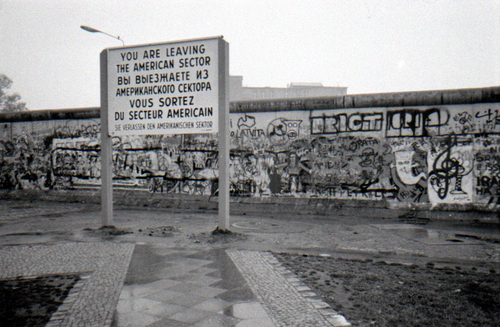
Naturally, we should not forget the Berlin Wall, modern history’s most infamous wall, which was erected in 1961 to keep people in rather than out. More than 100 people were eventually killed while trying to escape through the maze of 12-foot walls, guard towers, and electrified fences. It stood for almost 29 years before East German authorities finally opened it on November 9th, 1989.

There are many examples of walls throughout history and the world.

France v Netherlands


Armstrong Economics Blog/European Union

COMMENT: I had to laugh your comment that the EU pretends to be a happy family but they are still nationalistic no matter what they say. The Dutch bid to buy Air France is just the tip of the iceberg as you say.

Thank you

HS

REPLY: You are absolutely correct. The Dutch government’s bid to buy a stake in Air France-KLM provoked an amazing outrage in Paris from the government. French Economy Minister Bruno Le Maire called it “incomprehensible and unprecedented.” His statement on that issue reveals everything I have been saying about the nonsense going on in Europe. No matter what they say about federalizing Europe, deep down the politicians themselves show the inherent resentment that still lingers and will never die. The EU must abandon this idea that one government will prevent a European war. It is actually encouraging it. It should remain simply as a federation, consolidate the debts, let that be the Eurobond, and then abandon the ECB’s one policy fits all and let each nation function with their own budgets as the states do in the USA.

How the Rule of Law is Always Political


The British Parliament is exposing itself and how corrupt the real rule of law has become. They had no problem extraditing Julian Assange to the USA for exposing the corruption in the US government, but when Bill Browder was sought by Russia for criticizing Putin, suddenly it is political. Westminster has demanded the head of Interpol appear before them and explain if they are being manipulated by Putin to allow Russia to see the extradition of Bill Browder on various charges. There is no rule of law. If the Brits hand over Assange while protecting Bill Browder, it illustrates that the government is just not trustworthy on anything.

Turkey & the Real Risk of a Debt Crisis


The Treasury and Finance Ministry of Turkey announced that the country’s net external debt stock totaled $286.2 billion going into the end of the 3rd quarter of 2018. The country’s net external debt stock to its gross domestic product (GDP) ratio was 34.4% at the end of the third quarter of 2018. However, Turkey’s gross external debt stock amounted to $448.4 billion at the end of the 3rd quarter, bringing the debt/GDP ratio to 53.8% according to the official figures.

Interestingly, because of the fear of the Turkish lira, Turkish corporations have been often compelled to borrow in dollars. Therefore, the private sector’s share in the country’s gross external debt stock was 68.2% ($305.9 billion), while some $215.9 billion of this amount consisted of long-term debts with a maturity of more than one year. The Turkish public sector’s share of this debt was 30.6% in the country’s total foreign debt, which is about $21.4 billion in short-term (under one year) with $115.7 billion in the long-term (over one year). The banking sector’s (lenders and the central bank) external debt stock was $176.99 billion at the end of the 3rd quarter.

When we break this down further, 58.5% of the total gross external debt is denominated in U.S. dollars with only 32.3% denominated in euros. The amount denominated in Turkish lira among the external debt stock was a trifling 5.9%. This illustrates the crisis that will emerge with a change in the currency values.