Posted originally on CTH on August 18, 2025 | Sundance
President Trump holds a summit with President Volodymyr Zelenskyy and various EU leaders. At the beginning of the meeting, President Trump allowed the press pool to have access to the opening statements. WATCH:
Posted originally on CTH on August 18, 2025 | Sundance
President Trump, President Zelenskyy and various self-ascribed EU stakeholders take a family photograph at the White House summit for peace in Ukraine.
Posted originally on CTH on August 18, 2025 | Sundance
President Trump and Ukraine President Volodymr Zelenskyy hold a press availability in the Oval Office before going into a HIGH STAKES bilateral discussion and later meetings with European leaders.
President Trump notes that immediately following the discussions, he is scheduled to call Russian President Vladimir Putin to give him an update on the discussion and potentially schedule a trilateral meeting between Putin, Zelenskyy and Trump.
Posted originally on CTH on August 18, 2025 | Sundance
I have been asked to recap some of my research into cited formats of what I believe to be criminal conduct, with specific statutes against them. This is the fourth.
DNI Tulsi Gabbard is not a lawyer. While I may be wrong, I find Tulsi Gabbard to be a patriot. Mrs. Gabbard is focused on providing evidence to the DOJ that essentially forces action. I support Tulsi Gabbard’s efforts.
If there is one corrupt DC player who has escaped scrutiny for her corrupt endeavors, it would be Mary McCord.
More than any other Lawfare operative within Main Justice, Mary McCord sits at the center of every table in the manufacturing of cases against Donald Trump. {GO DEEP} Mary McCord’s husband is Sheldon Snook; he was the right hand to the legal counsel of Chief Justice John Roberts.
When the Carter Page FISA application was originally assembled by the FBI and DOJ, there was initial hesitancy from within the DOJ National Security Division (DOJ-NSD) about submitting the application, because it did not have enough citations in evidence (the infamous ‘Woods File’). That’s why the Steele Dossier ultimately became important. It was the Steele Dossier that provided the push, the legal cover needed for the DOJ-NSD to submit the application for a Title-1 surveillance warrant against the campaign of Donald J. Trump.
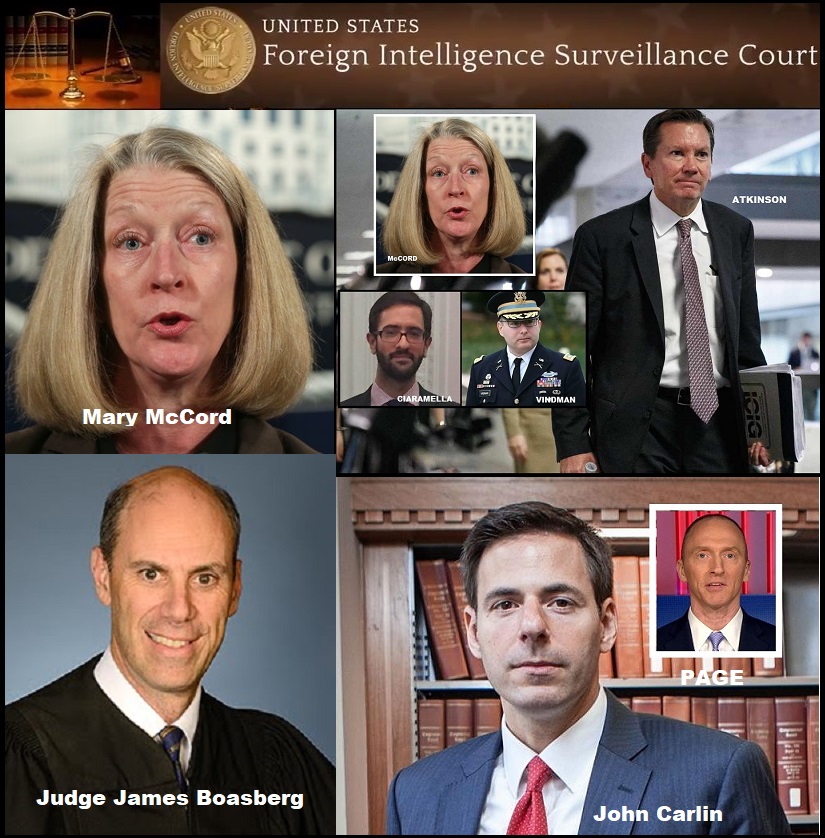
When the application was finally assembled for submission to the FISA court, the head of the DOJ-NSD was John Carlin. Carlin quit working for the DOJ-NSD in late September 2016 just before the final application was submitted (October 21,2016). John Carlin was replaced by Deputy Asst. Attorney General, Mary McCord.
♦ When the FISA application was finally submitted (approved by Sally Yates and James Comey), it was Mary McCord who did the actual process of filing the application and gaining the Title-1 surveillance warrant.
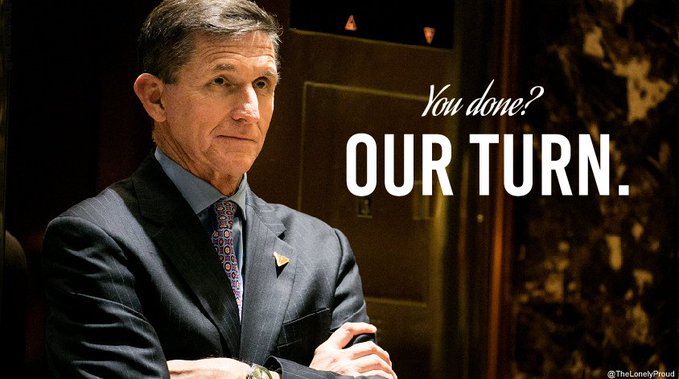
A few months later, February 2017, with Donald Trump now in office as President, it was Mary McCord who went with Deputy AG Sally Yates to the White House to confront White House legal counsel Don McGahn over the Michael Flynn interview with FBI agents. The surveillance of Flynn’s calls was presumably done under the auspices and legal authority of the FISA application Mary McCord previously was in charge of submitting.
♦ At the time the Carter Page application was filed (October 21, 2016), Mary McCord’s chief legal counsel inside the office was a DOJ-NSD lawyer named Michael Atkinson. In his role as the legal counsel for the DOJ-NSD, it was Atkinson’s job to review and audit all FISA applications submitted from inside the DOJ. Essentially, Atkinson was the DOJ internal compliance officer in charge of making sure all FISA applications were correctly assembled and documented.
♦ When the anonymous CIA whistleblower complaint was filed against President Trump for the issues of the Ukraine call with President Zelensky, the Intelligence Community Inspector General had to change the rules for the complaint to allow an anonymous submission. Prior to this change, all intelligence whistleblowers had to put their name on the complaint. It was this 2019 IGIC who changed the rules. Who was the Intelligence Community Inspector General? Michael Atkinson.
Yes, after she left main justice, Mary McCord took the job of working for Chairman Jerry Nadler and Chairman Adam Schiff as the chief legal advisor inside the investigation that led to the construction of articles of impeachment. As a consequence, Mary McCord received the newly permitted anonymous whistleblower complaint from her old office colleague Michael Atkinson.
KEY: Michael Atkinson was forced to testify to the joint House impeachment committee about the CIA whistleblower rule change and the process he authorized and participated in as the Intelligence Community Inspector General. Adam Schiffsealed that deposition, and no one has ever discussed what Atkinson said when questioned.
House Speaker Mike Johnson can unseal that testimony, and Tulsi Gabbard can declassify his deposition.
Moving on…
♦ During his investigation of the Carter Page application, Inspector General Michael Horowitz discovered an intentional lie inside the Carter Page FISA application (directly related to the ‘Woods File’), which his team eventually tracked to FBI counterintelligence division lawyer, Kevin Clinesmith. Eventually Clinesmith was criminally charged with fabricating evidence (changed wording on an email) in order to intentionally falsify the underlying evidence in the FISA submission.
When John Durham took the Clinesmith indictment to court, the judge in the case was James Boasberg.
♦ In addition to being a DC criminal judge, James Boasberg is also a FISA court judge who signed-off on one of the renewals for the FISA application that was submitted using fraudulent evidence fabricated by Kevin Clinesmith. In essence, now the presiding judge over the FISA court, Boasberg was the FISC judge who was tricked by Clinesmith, and now the criminal court judge in charge of determining Clinesmith’s legal outcome. Judge Boasberg eventually sentenced Clinesmith to 6 months probation.
As an outcome of continued FISA application fraud and wrongdoing by the FBI, in their exploitation of searches of the NSA database, Presiding FISC Judge James Boasberg appointed an amici curiae advisor to the court who would monitor the DOJ-NSD submissions and ongoing FBI activities.
Who did James Boasberg select as a FISA court amicus? Mary McCord.
♦ SUMMARY: Mary McCord submitted the original false FISA application to the court using the demonstrably false Dossier. Mary McCord participated in the framing of Michael Flynn. Mary McCord worked with ICIG Michael Atkinson to create a fraudulent whistleblower complaint against President Trump; and Mary McCord used that manipulated complaint to assemble articles of impeachment on behalf of the joint House Intel and Judiciary Committee. Mary McCord then took up a defensive position inside the FISA court to protect the DOJ and FBI from sunlight upon all the aforementioned corrupt activity.
You can clearly see how Mary McCord would be a person of interest if anyone was going to start digging into corruption internally within the FBI, DOJ or DOJ-NSD.
What happened next….
November 3, 2021 – In Washington DC – “Rep. Bennie Thompson (D-Miss.) and the House Jan. 6 Select Committee has tapped Mary McCord, who once ran the Justice Department’s National Security Division, for representation in its fight to obtain former President Donald Trump’s White House records. (read more)
Yes, that is correct. After seeding and guiding all of the Lawfare attacks against candidate Donald Trump, then President-Elect Donald Trump, then President Donald Trump, Mary McCord took up a key legal position inside the J6 committee to continue the Lawfare against President Trump after he left office.
But wait,…. Remember the stories of the J6 investigative staff going to work for Jack Smith on the investigation of Donald Trump, that included the raid on Mar-a-Lago? Well, Mary McCord was a member of that team [citation]; all indications are that her efforts continued as a quiet member of the Special Counsel team
That’s the context; now I want to go back a little.
First, when did Mary McCord become “amicus” to the FISA court? ANSWER: When the court (Boasberg) discovered IG Michael Horowitz was investigating the fraudulent FISA application. In essence, the FISA Court appointed the person who submitted the fraudulent filing, to advise on any ramifications from the fraudulent filing. See how that works?
Now, let’s go deeper….
When Mary McCord went to the White House with Sally Yates to talk to white house counsel Don McGhan about the Flynn call with Russian Ambassador Kislyak, and the subsequent CBS interview with VP Pence, where Pence’s denial of any wrongdoing took place, the background narrative in the attack against Flynn was the Logan Act.
The construct of the Logan Act narrative was pure Lawfare, and DAG Sally Yates with Acting NSD AAG Mary McCord were the architects.
Why was the DOJ National Security Division concerned with a conflict between what Pence said on CBS and what Flynn said about his conversations with Kislyak?
This is where a big mental reset is needed.
Flynn did nothing wrong. The incoming National Security Advisor can say anything he wants with the Russian ambassador, short of giving away classified details of any national security issue. In December of 2016, if Michael Flynn wanted to say Obama was an a**hole, and the Trump administration disagreed with everything he ever did, the incoming NSA was free to do so. There was simply nothing wrong with that conversation – regardless of content.
So, why were McCord and Yates so determined to make an issue in media and in confrontation with the White House?
Why did the DOJ-NSD even care? This is the part that people overlooked when the media narrative was driving the news cycle. People got too stuck in the weeds and didn’t ask the right questions.
Some entity, we discover later was the FBI counterintelligence division, was monitoring Flynn’s calls. They transcribed a copy of the call between Flynn and Kislyak, and that became known as the “Flynn Cuts” as described within internal documents, and later statements.
After the Flynn/Kislyak conversation was leaked to the media, Obama asked ODNI Clapper how that call got leaked. Clapper went to the FBI on 1/4/17 and asked FBI Director James Comey. Comey gave Clapper a copy of the Flynn Cuts which Clapper then took back to the White House to explain to Obama.
Obama’s White House counsel went bananas, because Clapper had just walked directly into the Oval Office with proof the Obama administration was monitoring the incoming National Security Advisor. Obama’s plausible deniability of the surveillance was lost as soon as Clapper walked in with the written transcript.
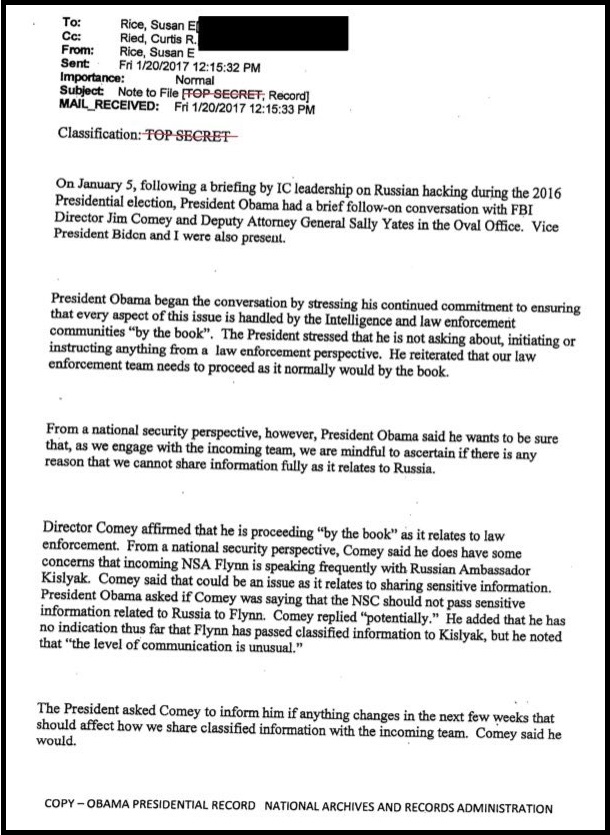
That was the motive for the 1/5/17 Susan Rice memo, and the reason for Obama to emphasize “buy the book” three times.
It wasn’t that Obama didn’t know already; it was that a document trail now existed (likely a CYA from Comey) that took away Obama’s plausible deniability of knowledge. The entire January 5th meeting was organized to mitigate this issue.
Knowing the Flynn Cuts were created simultaneously with the phone call, and knowing how it was quickly decided to use the Logan Act as a narrative against Flynn and Trump, we can be very sure both McCord and Yates had read that transcript before they went to the White House. [Again, this is the entire purpose of them going to the White House to confront McGhan with their manufactured concerns.]
So, when it comes to ‘who leaked’ the reality of the Flynn/Kislyak call to the media, the entire predicate for the Logan Act violation – in hindsight – I would bet a donut it was Mary McCord.
But wait, there’s more….
Now we go back to McCord’s husband, Sheldon Snook.
Sheldon was working for the counsel to John Roberts. The counsel to the Chief Justice has one job, to review the legal implications of issues before the court and advise Justice John Roberts. The counsel to the Chief Justice knows everything happening in the court and is the sounding board for any legal issues impacting the Supreme Court.
In his position as the right hand of the counsel to the chief justice, Sheldon Snook would know everything happening inside the court.
At the time, there was nothing bigger inside the court than the Alito opinion known as the Dobb’s Decision – the returning of abortion law to the states. Without any doubt, the counsel to Chief Justice Roberts would have that decision at the forefront of his advice and counsel. By extension, this puts the actual written Alito opinion in the orbit of Sheldon Snook.
After the Supreme Court launched a heavily publicized internal investigation into the leaking of the Dobbs decision (Alito opinion), something interesting happened. Sheldon Snook left his position. If you look at the timing of the leak, the investigation and the Sheldon Snook exit, the circumstantial evidence looms large.
Of course, given the extremely high stakes, the institutional crisis with the public discovering the office of the legal counsel to the Chief Justice likely leaked the decision, such an outcome would be catastrophic for the institutional credibility. In essence, it would be Robert’s office who leaked the opinion to the media.
If you were Chief Justice John Roberts and desperately needed to protect the integrity of the court, making sure such a thermonuclear discovery was never identified would be paramount. Under the auspices of motive, Sheldon Snook would exit quietly. Which is exactly what happened.
The timeline holds the key.
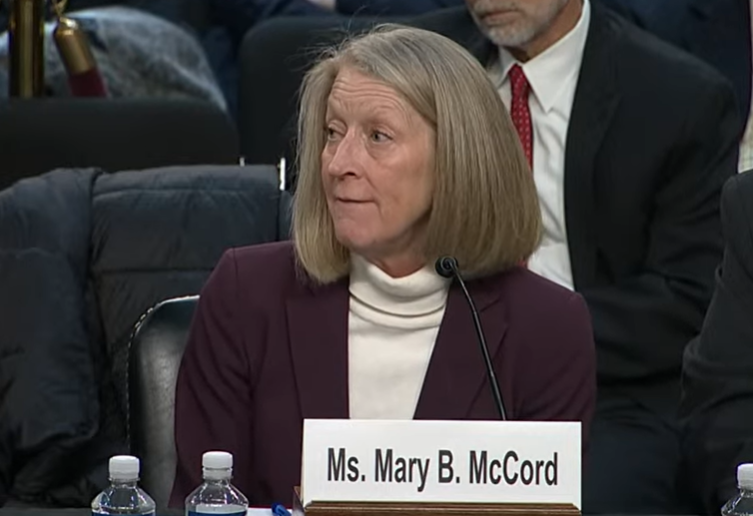
BACK TO MARY in 2025 – During the question session for Attorney General Pam Bondi’s nomination, Adam Schiff asked Mary McCord about whether AG Bondi should recuse herself from investigating Adam Schiff and Mary McCord. It’s a little funny if you understand the background.
I prompted the video to the part at 01:36:14 when Schiff asks McCord, and Mrs. McCord responds with “yes, Pam Bondi should recuse.” WATCH:
Mary McCord says Pam Bondi must recuse herself from any investigative outcome related to the first impeachment effort.
Who was the lead staff working for Adam Schiff and Jerry Nadler on the first impeachment effort?
Mary McCord.
Now, triggering that first impeachment effort… Who worked with ICIG Michael Atkinson to change the CIA whistleblower regulations permitting an anonymous complaint?
Yep, that would be the same Mary McCord.
In essence, the woman who organized, structured, led and coordinated the first impeachment effort, says Pam Bondi must recuse herself from investigating the organization, structure, leadership and coordination of the first impeachment effort.
If all that seems overwhelming, here’s a short recap:
♦ McCord submitted the fraudulent FISA application to spy on Trump campaign.
♦ McCord helped create the “Logan Act” claim used against Michael Flynn and then went with Sally Yates to confront the White House.
♦ McCord then left the DOJ and went to work for Adam Schiff and Jerry Nadler on Impeachment Committee.
♦ McCord organized the CIA rule changes with Intelligence Community Inspector General Michael Atkinson.
♦ McCord led and organized the impeachment effort, in the background, using the evidence she helped create.
♦ McCord joined the FISA Court to protect against DOJ IG Michael Horowitz newly gained NSD oversight and FISA review.
♦ McCord joined the J6 Committee helping to create all the lawfare angles they deployed.
♦ McCord then coordinated with DA Fani Willis in Georgia.
♦ McCord was working with Special Counsel Jack Smith to prosecute Trump.
♦ McCord is now coordinating outside Lawfare attacks against Donald Trump in term #2
♦ McCord also testified that AG Pam Bondi must recuse herself from investigating McCord.
Posted originally on CTH on August 18, 2025 | Sundance
Amid all the banter, opinion, negotiations and high-brow conversations about what should happen to end the Ukraine-Russia conflict, one element remains undiscussed: What do the Ukrainian People want?
Current ‘President’ Volodymyr Zelenskyy, installed as an outcome of western influence operations, extended his term in office by cancelling Ukraine elections. His elected term ended 18 months ago, and he has not left office. The various EU/NATO stakeholders did not want the authentic voice of the Ukrainian people to impede on the proxy war against Russia, and so they supported the election cancellation.
Now, the element never discussed by WEF/NATO or EU officials is what the citizens of Ukraine want. From the position of Russian President Vladimir Putin, this non-democratic ‘democracy’ paints Zelenskyy as illegitimate – one of the baselines that affirms the position not to negotiate with him.
Within Ukraine,there are very visible signs the citizens no longer support Zelenskyy; however, that would be an inconvenient factor to introduce to the conflict equation, so it is simply avoided in the discussion. Western media avoid it.
As an outcome, a lot of people watching things unfold do not understand the context that Zelenskyy is in a weak position domestically with sentiment within Ukraine turning sharply against ongoing war. The MSM won’t report on it, and the neocon “influencers” won’t either. The focus is on Russia bad.
From both past and present comments by President Trump, the intransigence of Zelenskyy, in combination with his strict authoritarian, some would say ‘Nazi’-like sentiments, positions the Ukranian leader as somewhat of a difficult person to deal with. However, in the most visible sense, Zelenskyy is an amalgamation of interests that float in the background.
Beyond the civil war that existed in Ukraine long before Vladimir Putin stepped in, the USAID operation in Ukraine installed Zelenskyy. The Intelligence Community apparatus, as deployed by the U.S. State Dept., was the tool to manipulate popular public opinion.
This is the tenuous ground upon which Zelenskyy stands. Propped up originally by leftist American government intents, he was then increasingly supported by European leaders once President Trump took efforts to withdraw the U.S. proxy status.
With President Trump openly wanting to withdraw U.S. support, the beneficiaries of the funding -specifically the U.S. Congress, Senate Foreign Relations and Intelligence Committees- went bananas. These are the same entities who originally supported the USAID/CIA operations within Ukraine.
NATO, the EU, The United Kingdom, the global intelligence apparatus, the leaders of U.K, France, Germany et al. – all use the narrative that Russia must be feared in order to justify their position for more war and hostility.
In the background, the financial companies/banks who fund political leadership also do not want resolution without security guarantees for their lucrative financial investments. European Commission President Ursula von der Leyen, German Chancellor Friedrich Merz, French President Emmanuel Macron, Italian Prime Minister Giorgia Meloni, U.K. Prime Minister Keir Starmer and Finnish President Alexander Stubb are set to join Monday’s conference, to ensure those financial stakes are maintained.
Yet the question needs to be asked again…
Who is representing what the Ukrainian people want?
Posted originally on CTH on August 17, 2025 | Sundance
Special Envoy Steve Witkoff is interviewed by Furrowed Brow. Within the first question, Tapper asks for an example of a concession that Russia agreed to. Witkoff outlined a major set of concessions, leaving surprised Furrowed to say “huh.”
Posted originally on CTH on August 17, 2025 | Sundance
Secretary of State Marco Rubio appears with Maria Bartiromo to discuss the big picture of what is possible and what challenges remain as President Trump tries to negotiate a peace deal between Ukraine and Russia.
Keep in mind as we watch all these interviews by Rubio, it was only about six months ago when the U.S Secretary of State admitted the Ukraine conflict was a proxy war between the U.S and Russia. With President Trump extracting the U.S. from that entanglement, NATO and the EU have stepped in to retain the conflict. WATCH:
Posted originally on CTH on August 17, 2025 | Sundance
Secretary of State Marco Rubio appears on CBS to debate the ever-insufferable Margaret Brennan. The dramatic acting by the newscaster is off-the-charts. Both the video and the transcript are below.
.
[Transcript] – MARGARET BRENNAN: We begin with Secretary of State, Marco Rubio, who attended those talks in Anchorage. Good morning to you, Mr. Secretary.
SECRETARY OF STATE MARCO RUBIO: Good morning. Thank you.
MARGARET BRENNAN: Vladimir Putin did not give President Trump the ceasefire he sought. And now Putin says the root causes of the conflict have to be resolved in a peace agreement. Isn’t the root cause the fact that Russia invaded in the first place?
SEC. RUBIO: Well, ultimately, yeah. But I mean, what he means by root causes is this long historical complaints that we’ve heard repeatedly. This is not a new argument, he’s been making this for a long time, and it’s the argument that it’s Western encroachment. I don’t want to get into- it’s just so long. But the bottom line is that all of- you know, we’re not going to focus on all of that stuff. We’re going to focus on this: are they going to stop fighting or not? And what it’s going to take to stop the fighting. And what it’s going to take to stop the fighting, if we’re being honest and serious here, is both sides are going to have to give, and both sides should expect to get something from this. And that’s a very difficult thing to do. It’s very difficult because Ukraine obviously feels, you know, harmed, and rightfully so, because they were invaded. And the Russian side, because they feel like they got momentum in the battlefield, and frankly, don’t care, don’t seem to care very much about how many Russian soldiers die in this endeavor. They just churn through it. So I think what the President deserves a lot of credit for is the amount of time and energy that his administration is placing on reaching a peace agreement for a war that’s not a war that started under him. It’s half, you know, it’s on the other side of the world. That said, I mean, it’s relevant to us. But there are a lot of other issues he could be focused on. So tomorrow, we’ll be meeting with President Zelenskyy. We’ll be meeting with European leaders. We just met with Putin. He’s dedicated a lot of time and energy because he has made it a priority of his administration to stop or end war- stop wars or prevent them. And right now, this is the biggest war going on in the world. It’s the biggest war in Europe since World War Two. We’re going to continue to do everything we can to reach an agreement that ends the dying and the killing and the suffering that’s going on right now.
MARGARET BRENNAN: You know this well, how long these kind of diplomatic negotiations often take. President Trump was telling European leaders what was discussed was Putin demanding control of Donetsk, a region in the east that his forces do not fully hold, and the UK estimates that taking that full area could be as long as another four years. Putin also is demanding Russian be an official language in Ukraine, and something regarding Russian Orthodox churches. Did the U.S. accept all of what Putin laid out at that table?
SEC. RUBIO: The United States is not in a position to accept anything or reject anything, because ultimately, it’s up to the Ukrainians. They’re the ones that Russia has to make peace with, Ukraine with Russia–
MARGARET BRENNAN: –Well, the President said he did come to some agreement–
SEC. RUBIO: –It’s up to the Ukrainians to make these conditions. Well, the agreements were that we were going to try to do things like, for example, get a leader- a leaders meeting. We have to make enough progress so that we can sit down President Zelenskyy and President Zelenskyy and President Putin in the same place, which is what President Zelenskyy has been asking for, and reach a final agreement that ends this war. Now, there were some concepts and ideas discussed that we know the Ukrainians could be very supportive of in that meeting. I don’t think it’s- we’re not going to negotiate this in the media. I understand that everybody wants to know what happened. But ultimately, there are things that were discussed as part of this meeting that are potentials for breakthroughs, that are potentials for progress. We’ll be discussing that more in depth tomorrow, with our European allies, with the Ukrainians that are coming over. We’ll be discussing all of these things, because ultimately, we do need to find areas where we’re making progress and try to begin to narrow the gap between the two sides. But there’s a reason why this war has been going on for three and a half years, and that is, when it comes to the big issues here, there are still some big differences between both sides. Let’s see how much progress we can continue to make. It’s- it’s- it’s not been easy, but it’s something the President’s made a priority. Peace. And he deserves a lot of credit for that.
MARGARET BRENNAN: But ultimately, if- if Vladimir Putin is going to be offered land that he has not seized yet, but negotiates his way into, doesn’t this set a dangerous precedent that the United States now accepts this concept that it is okay to seize land by force?
SEC. RUBIO: Well, Putin has already seized land by force, and that, in and of itself, is not a positive precedent. This whole war is a negative precedent–
MARGARET BRENNAN: — Are you demanding withdrawal?–
SEC. RUBIO: –precedent. Well, again, here’s the- in order to have a deal here to end- to reach the end of this conflict, both sides are going to have to make concessions. That’s just the facts–
[CROSSTALK]
MARGARET BRENNAN: But does that mean accepting–
SEC. RUBIO: –in any negotiation–
MARGARET BRENNAN: –where Russian forces are now?
SEC. RUBIO: No, no, but, if- But this is not about acceptance. This is about what Ukraine can accept. And what Russia can accept. They both have to accept it, otherwise there won’t be a peace deal. Okay. If there aren’t concessions, if one side gets everything they want, that’s called surrender. That’s called the end of the war through surrender. And that’s not what we’re close to doing, because neither side here is on the verge of surrender or anything close to it. So in order for there to be a peace deal, this is just a fact, we may not like it, it may not be pleasant, it may be distasteful, but in order for there to be an end of the war, there are things Russia wants that it cannot get, and there are things Ukraine wants that it’s not going to get. Both sides are going to have to give up something in order to get to the table, in order to make this happen. That’s- that’s just the way it is. And I mean, the sooner we accept that, that’s the reality. Now, what those things are is going to be up to both sides. There’s no conditions that can be imposed on Ukraine. They’re going to have to accept things, but they’re going to have to get things too. And so, for example, Ukraine is a sovereign country. They have a right, like every sovereign country does in the world, to have- to enter into security alliances with other countries to prevent an invasion in the future, to prevent threats to their national security. That’s not an unreasonable request. That’s something needs to be worked on. Territories will have to be discussed. It’s just a fact, and there are things that maybe Russia is holding now that they’re going to have to give up. Who knows? The point is, we need to create a scenario where that becomes possible, and that’s why this has been so hard, because neither side, up to now, has been willing to give on some of these things. But we’ll see if that’s possible. It may not be, but we’re going to try, and we’re going to do everything we can to try to achieve a peace.
MARGARET BRENNAN: I understand you, you can’t get into specifics in a public conversation, but we’re looking at Russian troops and strikes intensifying. Did you hear anything from Vladimir Putin that indicated he is willing to make a single concession?
SEC. RUBIO: Well, I think there are a couple. I mean, there were- not enough for Ukraine, if not we would be announcing a peace deal this morning, right? But- but certainly, there are some things we notice changes. There are some changes that I think are possible. I think there’s some concepts that were discussed that could potentially lead to something. But again, all these things have to be verifiable. We- it isn’t real until it’s real. I mean, you- one thing is what you say you might be willing to consider, another thing is your willingness to do it. And it always becomes a trade off in all of this. But you talk about the intensifying strikes on the Russian side, yeah, I mean, they’re a full-time war machine. I mean, that’s what’s happening. The Russian economy has basically been turned into a full-time wartime economy. They have a lot of people. It’s a big country. It’s not just large geographically. It has huge populations. It continues to churn through people. You know, they lost- 20,000 Russian soldiers were killed last month, in July, in this war. That just tells you the price they’re willing to pay. Not saying any of this is admirable, I’m saying that this is the reality of the war that we’re facing. It’s become attrition, in some ways. It’s a meat grinder, and they just have more meat to grind.
MARGARET BRENNAN: Well, let me ask you about the security bit you just mentioned there, because Italy’s Prime Minister says that President Trump revived the idea of security guarantees inspired by NATO’s Article Five and a collective security clause that would involve the United States. How does that work? Are these U.S. troops? Are these U.S. monitors?
SEC. RUBIO: Well, what we’re going to be working on. That’s why- that’s one of the reasons why, you know, I talked yesterday to all the national security advisors, a bunch of them from the different European countries, or European leaders coming here tomorrow, heads of state coming tomorrow, along with President Zelenskyy, to discuss this in more detail. I mean, the constructs of something like this needs to be built out once it- concept is one thing. The reality, you know, how it’s built and how it would work, is another. But those are the kinds of talks that we’re going to be having with them, along with some of the other issues that are at play. But, that-that is one of the-if you were to break this thing down, I mean, there are, obviously, there needs to be an agreement on territories and where the lines are going to be drawn. That’s not going to be very easy. That’s going to be tough. I think there has to be some discussion about security guarantees for Ukraine, because they don’t want this war to–none of us want to see this war in the future. They’re a sovereign country. They have a right to have security agreements with other countries and security alliances with other countries. And then there’s the whole issue of reconstruction–
MARGARET BRENNAN: — Including the United States?–
SEC. RUBIO: — How do you rebuild the country? Well, potentially, like I said, that’s what we’re going to be having a conversation about, and that’s what we’re going to be meeting. That’s why they’re all coming here tomorrow, and-and that’s why we’ve been talking on the phone for the last 48 hours with them, and even leading up to it throughout the week there were various meetings just to sort of build out some of these ideas. So all of these right now are ideas, they are concepts that require some more specificity. We’ll need to work with our partners to see what that looks like. And I think that’s an area where potential progress is real, but that alone won’t be enough. There’s a bunch of other things that have to be worked through here.
MARGARET BRENNAN Yea, well, Russia claims it has rescued 700,000 children. I know you know that the warrant out for Vladimir Putin’s arrest is for the state-sponsored abduction of kids. I’ve seen estimates there are something like 30,000 Ukrainian children who have been abducted. Is the United States demanding, or at least, even just as a statement of goodwill here, that Russia return these children?
SEC. RUBIO: Yeah, I mean, we’ve repeatedly raised that issue on- in every forum possible, and those have also been, by the way, topics of discussion, not just in our meetings with the Ukrainians, but in the negotiations and talks that were going on between Ukraine and Russia at the technical level. These talks were going on in Turkey, as an example. Turkey over the last few months–
MARGARET BRENNAN: –Yeah, nothing so far from the Russians —
SEC. RUBIO: –that’s been a topic of discussion as well —
SEC. RUBIO: Well, it’s unfortunate. Children should be returned to their families. We- on that position, I don’t think there’s any ambiguity on our side. And they shouldn’t even be, you know, a bargaining chip in regards to a broader negotiation. But it’s just one more element of how tragic this war is. After three and a half years, this war is getting worse. It’s not getting better. You’ve made the point about the uptick in strikes. This is a war. It’s going to get worse. It’s not going to get better, and that’s why the President is investing so much time in bringing this to an end. And, by the way, everyone is begging us to be involved in this. The Europeans want us involved. The Ukrainians want us involved. Obviously, the Russians want us involved because the President is the only leader in the world- if this is possible, he’s the only one that can help make it happen.
MARGARET BRENNAN: Well, he’s got the leverage over Vladimir Putin if he wanted to crush his economy or at least do more damage to it, but you have held off on those secondary sanctions. President Trump told Fox News his advice to President Zelenskyy is make a deal, Russia’s a very big power and they’re not. You know there is concern from the Europeans that President Zelenskyy is going to be bullied into signing something away. That’s why you have these European leaders coming as back up tomorrow. Can you reassure them?
SEC. RUBIO: No, it isn’t. That’s not why they’re coming as back- that’s not true. No but that’s not, why, that’s not true. They’re not coming here tomorrow to keep Zelenskyy from being bullied. They’re not coming- in fact —
[CROSSTALK]
MARGARET BRENNAN: Well that February Oval Office meeting in front of television cameras, where President Zelenskyy was dressed down —
SEC. RUBIO: — Do you know how many meetings we’ve had since then?
MARGARET BRENNAN: Oh, no, I know. And I was just up in Alaska —
SEC. RUBIO: Yeah, but we’ve had a bunch of meetings since then.
MARGARET BRENNAN: — watching the one with Vladimir Putin where a red carpet was rolled out for the Russian leader. It was very different–
SEC. RUBIO: — No, but it wasn’t Zelenskyy. We’ve had more meetings, we’ve had, we’ve had, we’ve had one meeting with Putin and like a dozen meetings with Zelenskyy. So that, but that’s not true. They’re not coming here tomorrow to keep Zelenskyy from being bullied. They’re coming here tomorrow because we’ve been working with the Europeans. We talked to them last week. There were meetings in the UK over the following, the previous weekend —
MARGARET BRENNAN: — And they said the President Trump was going to demand a ceasefire —
SEC. RUBIO: — The President’s talked to these leaders as early as Thursday. No, no, but you said that they’re coming here tomorrow to keep Zelenskyy from being bullied. They’re not coming here tomorrow- this is such a stupid media narrative that they’re coming here tomorrow because the- Trump is going to bully Zelenskyy into a bad deal. We’ve been working with these people for weeks, for weeks on this stuff. They’re coming here tomorrow because they chose to come here tomorrow. We invited them to come. We invited them to come. The President invited them to come.
MARGARET BRENNAN: But the President told those European leaders last week that he wanted a cease fire. The President went on television, said he would walk out of the meeting if Vladimir Putin didn’t agree with him. He said there would be severe consequences if he didn’t agree to one. He said he’d walk out in two minutes. He spent three hours talking to Vladimir Putin, and he did not get one,so–
SEC. RUBIO: –Because obviously something, things happen during that meeting, well, because obviously things,look our goal here is not to stage some production for the world to say, oh how dramatic he walked out. Our goal here is to have a peace agreement to end this war. Okay? And obviously we felt, and I agreed, that there was enough progress, not a lot of progress, but enough progress made in those talks to allow us to move to the next phase. If not, we wouldn’t be having Zelenskyy flying all the way over here. We wouldn’t be having all the Europeans coming all the way over here. Now understand, and take with a grain of salt, I’m not saying we’re on the verge of a peace deal, but I am saying that we saw movement, enough movement to justify a follow up meeting with Zelenskyy and the Europeans, enough movement for us to dedicate even more time to this. You talk about the sanctions. Look, at the end of the day, if peace is not going to be possible here, and this is just going to continue on as a war, people will continue to die by the thousands, the President has that option to then come in and impose new sanctions. But if he did this now, the moment the President puts those additional sanctions, that’s the end of the talks. You’ve basically locked in at least another year to year and a half of war and death and destruction. We may unfortunately wind up there, but we don’t want to wind up there. We want to wind up with a peace deal that ends this war so Ukraine can go on with the rest of their lives and rebuild their country and be assured that this is never going to happen again. That’s the goal here. We’re going to do everything possible to make that happen if it’s doable. It will require both sides to make concessions. It will require both sides to get things they’re asking for. That’s how these deals are made, whether we like it or not.
MARGARET BRENNAN: Before I let you go, quickly, why did the State Department just announced that they’re halting visitor visas for all Gazans coming here for medical aid? Why would some of these kids, for example, who are coming to hospitals for treatment be a threat?
SEC. RUBIO: Well, first of all, it’s not just kids, it’s a bunch of adults that are accompanying them. Second, we had outreach from multiple congressional offices asking questions about it, and so we’re going to reevaluate how those visas are being granted, not just to the children, but how those visas are being granted to the people who are accompanying them. And by the way, to some of the organizations that are facilitating it. There is evidence, it’s been presented to us by numerous congressional offices, that some of the organizations bragging about and involved in acquiring these visas have strong links to terrorist groups like Hamas. And so we are not going to be in partnership with groups that are friendly with Hamas. So we need to- we’re going to pause those visas. There was just a small number of them issued to children, but they come with adults accompanying them, obviously, and we are going to pause this program and reevaluate how those visas are being vetted and what relationship, if any, has there been by these organizations to the- to the process of acquiring those visas. We’re not going to be in partnership with groups that have links or sympathies towards Hamas.
MARGARET BRENNAN: Secretary of State, Marco Rubio. We have to leave it there for this morning. Thank you for joining us.
SEC. RUBIO: Thank you.
MARGARET BRENNAN: ‘Face the Nation’ will be back in one minute. Stay with us.
I have created this site to help people have fun in the kitchen. I write about enjoying life both in and out of my kitchen. Life is short! Make the most of it and enjoy!
This is a library of News Events not reported by the Main Stream Media documenting & connecting the dots on How the Obama Marxist Liberal agenda is destroying America








 Centinel2012