Posted originally on Jan 8, 2024 By Martin Armstrong
The kids Obama attempted to bomb in Yemen all those years ago grew up fast. They’ve now formed surprisingly efficient militias who hate the West and have become powerful enough to impact global trade. Yemeni Houthi rebels are blocking carriers from passing through the Suez Canal and have created near pandemic-level disruptions to the supply chain.
The militia is currently in route to the Suez Canal via the Red Sea. There has been a 25% drop in commercial traffic through the Suez Canal since November. They were initially targeted shipping liners linked to Israel, but began targeting everyone by December. International shipping liners are doing everything to avoid passing through the Gulf of Aden and South Africa. This has completely altered trade between Europe and Asia as the trip is significantly longer.
Longer trips equate to higher shipping costs. The cost to move a 40-foot container from Asia to Northern Europe now costs $4,000 – a 173% increase. The route from Asia to the US have risen by about 55% since December at around $3,900. The Shanghai Containerized Freight Index (SCFI), a different calculation for the cost of goods shipped from China, believes costs have skyrocketed 161% since December 15, 2023.
So far, 18 companies have rerouted their orders to avoid the conflict. Shipping rates are now DOUBLE 2019 pre-pandemic levels. The IMF believes 3.1% of ALL world trade is fleeing the Red Sea.
The price of goods will rise, and that will be passed onto consumers; inflation will rise. Governments will be forced to step in to prevent the Houthis from further disrupting world trade. Lives will be lost. And now the West has a valid reason to begin the Israeli canalthat they’ve been envisioning for years. This is only the beginning of what will be a violently expensive situation that will send ripple effects throughout the global economy.
The banking crisis continues and it is impacting funds that have been buying bonds. Allianz, a subsidiary of Pimco, is writing off countless millions with Credit Suisse bonds. The banking crisis has been the result of artificially low-interest rates for far too long and banks were used to free money and buy long-term bonds all because they were making their money on the spread. Now that rates are rising, their risk management was effectively nonexistent, and thus the losses and widespread.
The Allianz subsidiary Pimco is one of the largest asset managers in the world. They have to now write off a loss in Credit Suisse bonds and it’s ain’t over yet as we head into April 10th.
Posted originally on the CTH on February 28, 2023 | Sundance
It’s not just the United Kingdom, but as we await the latest figures from monthly U.S. data, the statistics from the U.K. are hitting the newswires. According to Reuters, food inflation in the U.K. is currently 17.1% The primary driver of the skyrocketing food costs is the energy cost associated with the fast turnover categories.
With prices increasing 17.1% yet net sales only increasing 8.1%, there is a substantial impact in unit food sales. British customers are buying much less to offset the fact they are paying much more. This trend is not just in the U.K. we have seen the same trend in U.S. data as families are being squeezed at the grocery store.
The prices on name branded products like Kraft and Heinz are leading the escalating food prices. Just last week I noticed 6oz Kraft Philadelphia cream cheese was $6.99, and a 24 oz. bottle of Heinz ketchup at over $8. Dairy products are leading the way with the most rapid increases in price. It appears that we are entering the fourth wave of food inflation currently.
LONDON, Feb 28 (Reuters) – British grocery inflation hit 17.1% in the four weeks to Feb. 19, another record high, dealing the latest blow to consumers struggling with a cost-of-living crisis, industry data showed on Tuesday.
Market researcher Kantar said prices are rising fastest in markets such as milk, eggs and margarine. It said UK households now face an additional 811 pounds ($978) on their annual shopping bills if they don’t change their behaviour to cut costs.
“This February marks a full year since monthly grocery inflation climbed above 4%. This is having a big impact on people’s lives,” Fraser McKevitt, head of retail and consumer insight at Kantar, said.
He said its research found that rising grocery prices are the second most important financial issue for the public behind energy costs. Also a quarter of people say they’re struggling financially, versus one in five this time last year.
[…] Kantar said that sales of own label products were up by 13.2% in February, well ahead of growth in branded products, which are generally more expensive, of 4.6%.
Kantar said UK grocery sales increased 8.1% over the 12 weeks to Feb. 19, masking a drop in volumes when accounting for inflation. (read more)
The last estimate for U.S. data (January ’23) is in the chart below. We should get the February data the first week in March.
Posted originally on the CTH on February 6, 2023 | Sundance
John Boyd Jr., President of the National Black Farmers Association appears on Newsmax TV to discuss the ongoing issue of higher farm input costs. Energy costs, fertilizer costs, fuel costs as well as all packing and distribution costs that are associated with petroleum manufacturing, are continuing to drive farm costs throughout the supply chain.
After a review of the current farm output status, there is a very strong possibility we will see the fourth wave of food inflation hit this spring, in combination with several manufacturing and production facilities. Again, the lack of consumer spending on durable goods has moderated the price in hard goods (supplies up, demand down); however, the highly consumable products like food, fuel and energy continue to experience upward price pressure as a direct result of Biden energy policy. WATCH:
.
If consumers could eat missiles and weapons, the U.S. government would be offsetting the costs. Unfortunately, for actual farming products, there is no government attention, policy or support. Apparently, food is still not considered a national security issue.
The Federal Reserve raised the benchmark by 25 bps, as expected. The Fed fully understands that the manipulation of the CPI is a necessary aspect both for containing government benefits and understating inflation also results in high tax revenues. The market loves hope, and as a result, they focused on the warning that we’ll be in restrictive territory for just a bit longer. Most still believe that there will be a slowdown in inflation just ahead.
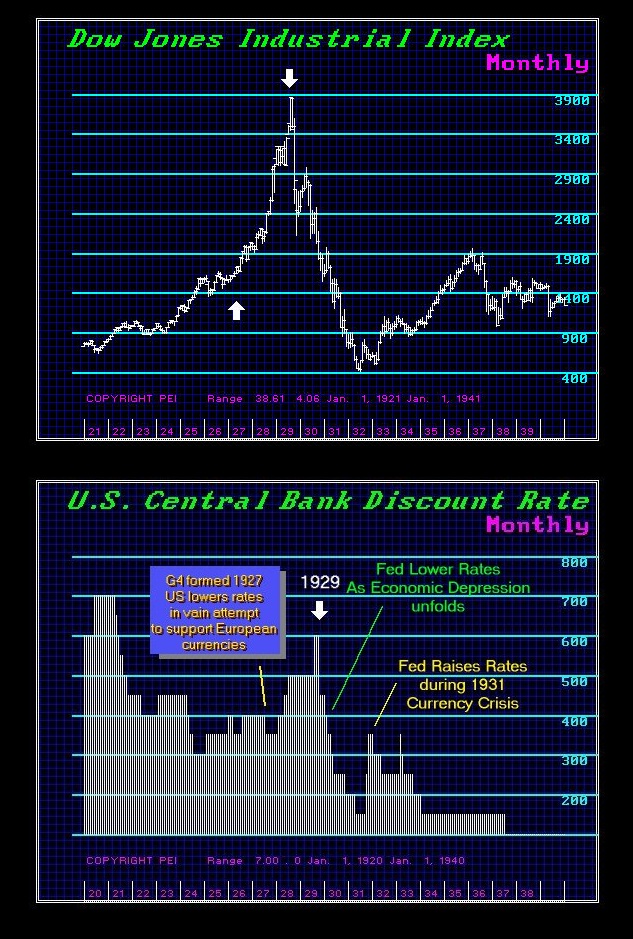
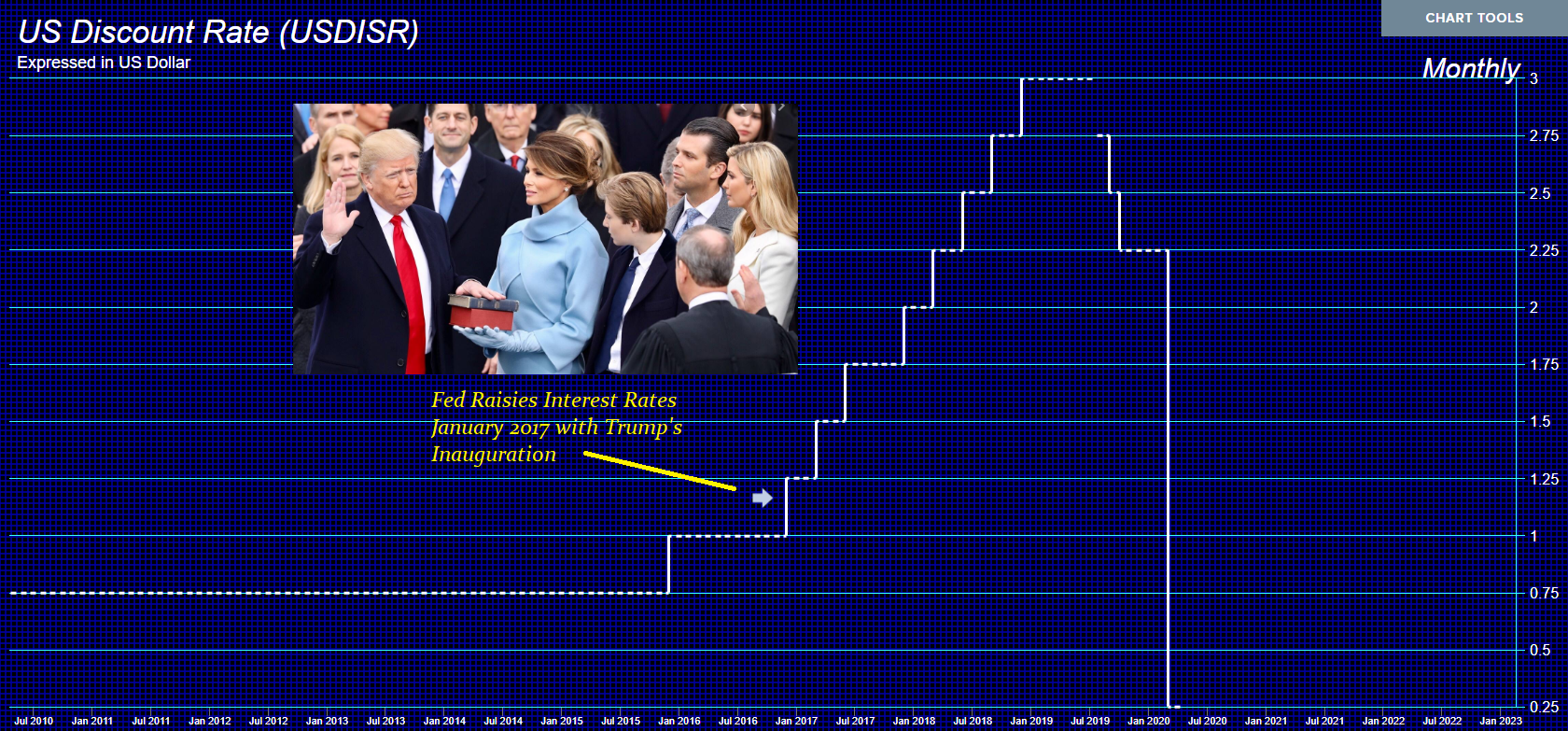
The Fed’s cautionary commentary saying that the “disinflation process” has started triggered shares to jump ending up 1%. This shows how insane the analysis had become that they cheer a recession and think that lower interest rates are bullish for the stock market. Obviously, they just listen to the talking heads on TV and have never bothered to look at reality. When interest rates decline, so has the stock market. Interest rates rose for the entire Trump Rally, and they crashed during the Great Recession of 2007-2009. For the life of me, I just shake my head when the talking heads cheer lower rates and spread doom and gloom with higher rates.
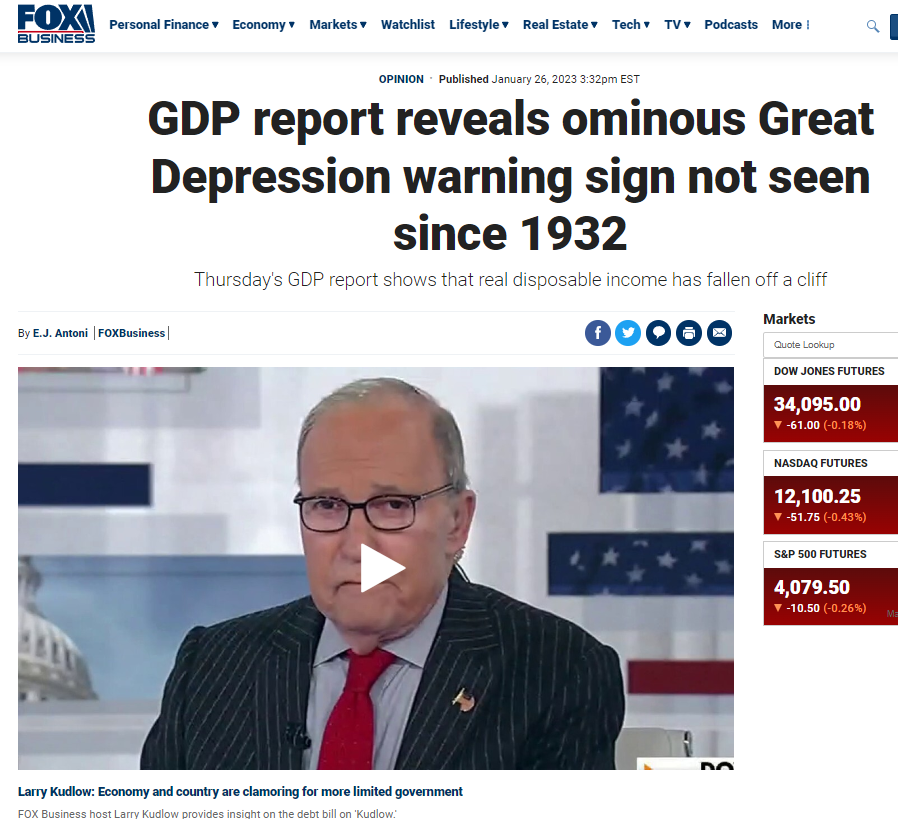
Fox Business is reporting that economic conditions are much worse than you are being told. Unfortunately, this is the conclusion when you have ZERO understanding of the historical trends and economic conditions. It is true that the shortages of COVID have caused prices to rise faster than economic growth and most incomes. Therefore, they conclude that our standard of living has been rapidly declining. The number reveals that more than one-third of all U.S. young adults are being supported in part by their parents. Thanks to COVID, this disrupted society far greater than anyone is reporting. In addition to the shortages because of the lockdowns, by the end of 2020, more than half of young adults in America were living with one or both parents. That statistic actually exceeded the record high of the Great Depression.
Here is the worst part of this analysis. Many are jumping on the bandwagon claiming that the decline in real disposable income has been the largest since 1932 and therefore, this is a warning sign of a Great Depression is coming. They seem to be focused on the fact that the GDP report showed a significant decline in real disposable income, which fell over $1 trillion in 2022. Now let’s look closer!
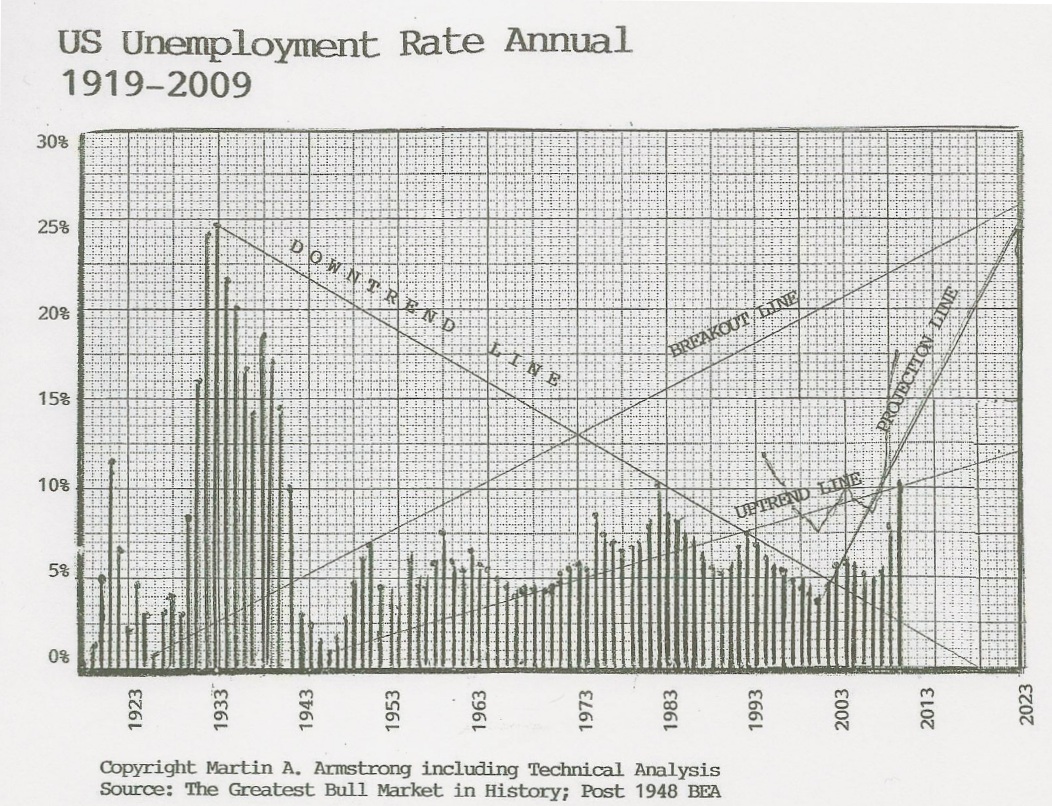
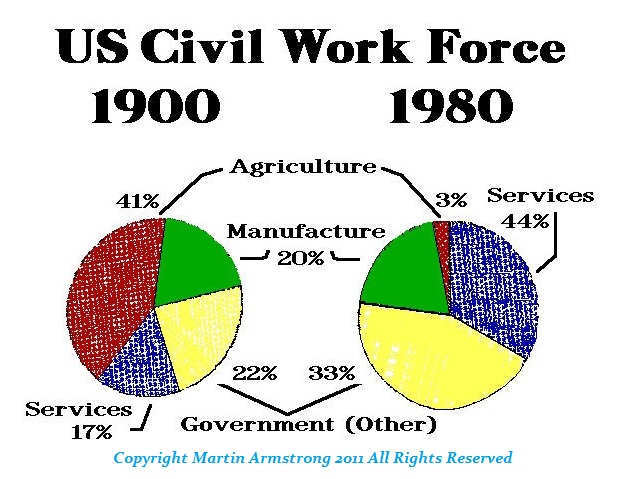
First of all, the entire reason why unemployment rise to 25% during the latter part of the Great Depression was the Dust Bowl. Why? At that time, about 40% of the civil workforce was still agrarian. The Dust Bowl meant job loss. If you could not even plant crops, there was no need for people to pick crops.
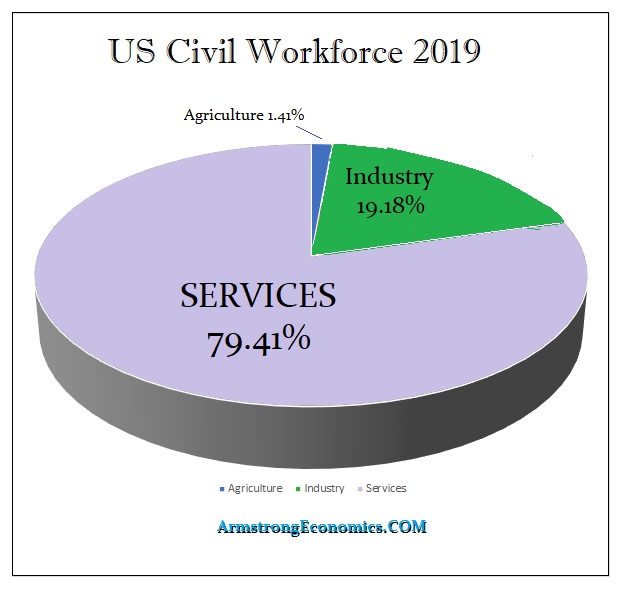
Service during the Great Depression accounted for 17% of the workforce compared to 44%+ today. Government, federal, state, and local, was 22% of the civil workforce during the Great Depression compared to 33% by 1980. Things have continued to evolve and by 2019, services represent 79.41%. Agriculture is now a tiny fraction of what it once was – 1.41%.
In the USA, at the state level, their share of the civil workforce varies greatly. Florida is at about 11.3% compared to New Mexico which is 22.5% – a government employee’s paradise. The lowest is Michigan at 10.1%.
During the Great Depression, the entire reason for the collapse in disposable income was the collapse in agriculture which created a collapse in income due to massive unemployment. That is totally different from the crisis we have today.
Here we have rising prices due to shortages and then central banks raising interest rates in a fool’s quest to stop inflation when it is not based on speculation. Moreover, the biggest borrower is the government, and rising interest rates will only increase their exposure to keep rolling over the debt. Therefore, governments have been borrowing year after year. What happens when the public no longer buys their debt? Real disposable income has been collapsing for completely different reasons since 1932. Here we have the costs of everything rising and then these people want war with Russia and China. Every war since the start of recorded history has resulted in inflation. Add to this, the total insanity of trying to end climate change by outlawing fossil fuels at a time when the climate is prone to getting colder.
We are already witnessing riots around the world BECAUSE of inflation. During the Great Depression, people were suffering from DEFLATION. So comparing just that statistic of a decline in personal income and projecting we now face a Great Depression, does not even qualify to be classified as analysis. That is no different from someone warning that carrots must be lethal because everyone who has ever eaten a carrot has obviously died.
There is a rising tide around the world who see what our world leaders are doing and they are doing their best to create World War III. I would like to think enough people will start screaming at our leaders, but our computer makes it clear there is no gain, without the pain.
Food shortages have historically contributed to revolutions more so than just international war. Poor grain harvests led to riots as far back as 1529 in the French city of Lyon. During the French Petite Rebeyne of 1436. (Great Rebellion), sparked by the high price of wheat, thousands looted and destroyed the houses of rich citizens, eventually spilling the grain from the municipal granary onto the streets. Back then, it was to go get the rich.
There was a climate change cycle at work and today’s climate zealots ignore their history altogether for it did not involve fossil fuels. The climate got worse at the bottom of the Mini Ice Age which was about 1650. It really did not warm up substantially until the mid-1800s. During the 18th century, the climate resulted in very poor crops. Since the 1760s, the king had been counseled by Physiocrats, who were a group of economists that believed that the wealth of nations was derived solely from the value of land and thereby agricultural products should be highly priced. This is why Adam Smith wrote his Wealth of Nations as a retort to the Physiocrats. It was their theory that justified imperialism – the quest to conquer more land for wealth; the days of empire-building.
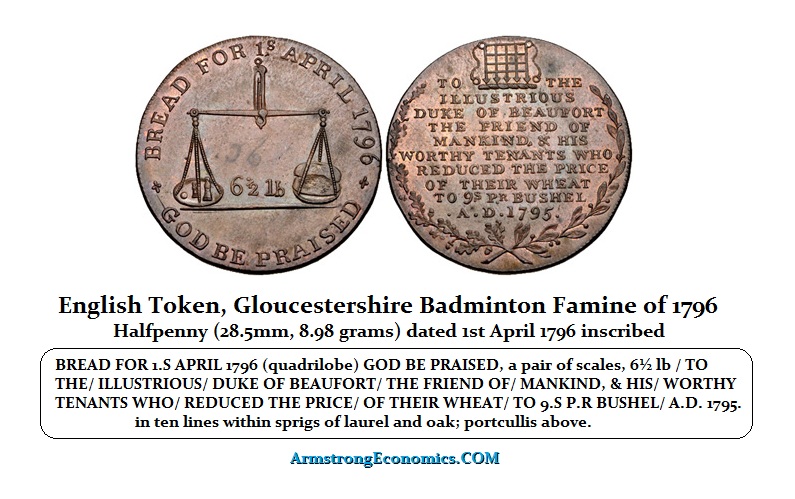
The King of France had listened to the Physiocrats who counseled him to intermittently deregulate the domestic grain trade and introduce a form of free trade. That did not go very well for there was a shortage of grain and this only led to a bidding war – hence the high price of wheat. We even see English political tokens of the era campaigning about the high price of grain and the shortage of food to where a man is gnawing on a bone.
Voltaire once remarked that Parisians required only “the comic opera and white bread.” Indeed, bread has also played a very critical role in French history that is overlooked. The French Revolution that began with the storming of the Bastille on July 14th, 1789 was not just looking for guns, but also grains to make bread.
The price of bread and the shortages played a very significant role during the revolution. We must understand Marie Antoinette’s supposed quote upon hearing that her subjects had no bread: “Let them eat cake!” which was just propaganda at the time. The “cake” was not the cake as we know it today, but the crust was still left in the pan after taking the bread out. This shows the magnitude that the shortage of bread played in the revolution.
In late April and May of 1775, the food shortages and high prices of grain ignited an explosion of such popular anger in the surrounding regions of Paris. There were more than 300 riots and looking for grain over just three weeks (3.14 weeks). The historians dubbed this the Flour War. The people even stormed the place at Versailles before the riots spread into Paris and outward into the countryside.
The food shortage became so acute during the 1780s that it was exacerbated by the influx of immigration to France during that period. It was a period of changing social values where we heard similar cries for equality. Eventually, this became one of the virtues on which the French Republic was founded. Most importantly, theFrench Constitution of 1791 explicitly stipulated a right to freedom of movement. It was mostly perceived to be a food shortage and the reason was the greedy rich. Thus, a huge rise in population was also contributed in part by immigration whereas it reached around 5-6 million more people in France in 1789 than in 1720.
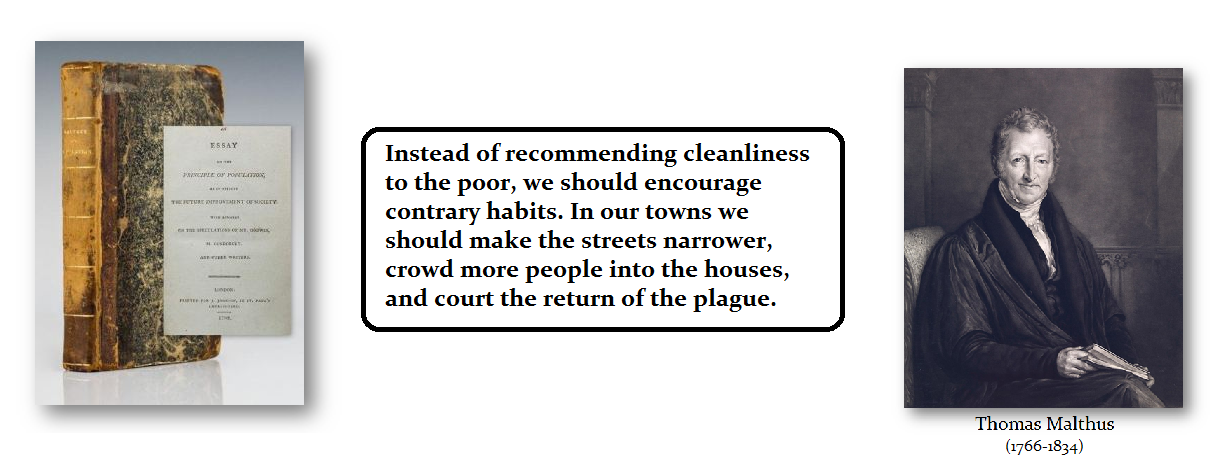
Against this backdrop, we have the publication by Thomas Malthus (1766-1834) An Essay on the Principle of Population was first published anonymously in 1798. He theorized that the population would outgrow the ability to produce food. We can see how his thinking formed because of the Mini Ice Age that bottomed in 1650. All of this was because of climate change which instigated food shortages. Therefore, it was commonly accepted that without a corresponding increase in native grain production, there would be a serious crisis.
The refusal on the part of most of the French to eat anything but a cereal-based diet was another major issue. Bread likely accounted for 60-80 percent of the budget of a wage-earner’s family at that point in time. Consequently, even a small rise in grain prices could spark political tensions. Because this was such an issue, and probably the major cause of the French Revolution among the majority, Finance Minister Jacques Necker (1732–1804) claimed that, to show solidarity with the people, King Louis XVI was eating the lower-class maslin bread. Maslin bread is from a mix of wheat and rye, rather than the elite manchet, white bread that is achieved by sifting wholemeal flour to remove the wheatgerm and bran.
That solidarity was seen as propaganda and the instigators made up the Marie Antoinette quote: Let them eat cake. . Then there was a plot drawn up at Passy in 1789 that fomented the rebellion against the crown shortly before the people stormed the Bastille. It declared “do everything in our power to ensure that the lack of bread is total, so that the bourgeoisie are forced to take up arms.”
It was also at this time when Anne Robert Jacques Turgot (1727-1781), Baron de l’Aulne, was a French economist and statesman. He was originally considered a physiocrat, but he kept an open mind and became the first economist to have recognized the law of diminishing marginal returns in agriculture. He became the father of economic liberalism which we call today laissez-faire for he put it into action. He saw the overregulation of grain production was behind also contributing to the food shortages. He once said: “Ne vous mêlez pas du pain”—Do not meddle with bread.
The French Revolution overthrew the monarchy and they began beheading anyone who supported the Monarchy and confiscated their wealth as well as the land belonging to the Catholic Church. Nevertheless, the revolution did not end French anxiety over bread. On August 29th, 1789, only two days after completing the Declaration of the Rights of Man and of the Citizen, the Constituent Assembly completely deregulated domestic grain markets. The move raised fears about speculation, hoarding, and exportation.
Then on October 21st, 1789, a baker, Denis François, was accused of hiding loaves from sale as part of a conspiracy to deprive the people of bread. Despite a hearing which proved him innocent, the crowd dragged François to the Place de Grève, hanged and decapitated him, and made his pregnant wife kiss his bloodied lips. Immediately thereafter, the National Constituent Assembly instituted martial law. At first sight, this act appears as a callous lynching by the mob, yet it led to social sanctions against the general public. The deputies decided to meet popular violence with force.
So, food has often been a MAJOR factor in revolutions. We are entering a cold period. Ukraine has been the breadbasket for Europe. Escalating this war will also lead to accelerating the food shortages post-2024. It is interesting how we learn nothing from history. Wars are instigated by political leaders while revolutions are instigated by the people.
I have created this site to help people have fun in the kitchen. I write about enjoying life both in and out of my kitchen. Life is short! Make the most of it and enjoy!
This is a library of News Events not reported by the Main Stream Media documenting & connecting the dots on How the Obama Marxist Liberal agenda is destroying America











 Centinel2012