Elections have consequences. On the same day the U.S. economy reports astoundingly successful jobs growth of 226,000 jobs and a drop in the unemployment rate to 3.5 percent; the Canadian state economic minister reports surprisingly terrible jobs losses of 72,200 jobs and a jump in unemployment from 5.5 to 5.9 percent.
The Canadian economy is roughly one-tenth the size of the U.S. So in equivalent terms the results from Canada reflect a comparative loss of 720,000 jobs on the same day the U.S. revises all figures upward to over 300,000 gains. A stunning economic contrast:
OTTAWA (Reuters) – The Canadian job market lost a surprise 71,200 net positions in November while the unemployment rate rose to 5.9%, the highest in more than a year, data showed on Friday, as analysts said a repeat of the weak numbers could force the Bank of Canada to rethink its monetary policy.
Analysts in a Reuters poll had forecast a gain of 10,000 jobs and had predicted the unemployment rate would hold steady at 5.5%. […] November’s numbers followed a weak report in October, when the labor market unexpectedly shed jobs despite a likely boost from hiring related to the federal election.
[…] Canada’s goods-producing industries saw a decline of 26,600 net jobs, largely on manufacturing. The services sector lost 44,400 net jobs.
November’s unemployment rate was the highest seen since the 6.0% reported in August 2018. 38,400 full-time jobs and 32,800 part-time jobs were lost in November. (read more)
It is worth remembering that Canada does not allow competition in their media sector. The Canadian government considers the news media a protected “cultural industry”; and through a process of subsidizing broadcast all news media is essentially state run media.
Why is this important? Well, when the expressed priority of the government is controlling broadcast information if you are intellectually honest you should apply that same ideological outlook toward any information from the government in a general sense.
The Canadian election was held on October 21st, 2019. The central control government of Justin Trudeau would likely hold-back any negative economic information in an effort to support the ideology of the central government and maintain public opinion in advance of the voting. However, with the election over the economic books need to be reconciled.
I strongly suspect the Canadian November jobs report encompasses some of that state run reconciliation effort. Meaning the Canadian economy was in much worse shape in the months leading up to the election than state media were broadcasting. The reality is now catching up….
Secondly, it was obvious in July of this year that Speaker Nancy Pelosi and Justin Trudeau entered into an agreement of mutual benefit. Trudeau would hold back submission of the USMCA for parliamentary ratification, and left-wing political ideologues in the U.S. would help Trudeau win re-election.
At the time CTH forewarned of what this type of political arrangement really meant.
In essence Prime Minister Justin Trudeau was willing to compromise the health of his own economy for stunningly political reasons. There was a perfect storm of negative economic dynamics clearly visible on the horizon…. but few were paying attention.
In combination with leftist economic policies on energy development that strangles economic growth through excessive regulation, the leftist government of Trudeau has dismantled the natural underpinnings of a market-based economy. The manufacturing base of Canada is compromised, perhaps to the point of no return.
For two decades liberal (left-wing) Canadian policy essentially transformed their economic model from manufacturing to “assembly“. The goods-based production within the Canadian economy was structured to take advantage of the NAFTA loophole.
Goods production in Canada was reduced from full manufacturing to a process of assembling parts brought in from overseas and then selling them into the U.S. market. This process exploited the NAFTA loophole allowing foreign companies to ship parts to Canada and then assemble for transport into the U.S. without tariffs.
Over time the Canadian economy became more and more dependent on this system of brokering goods, while Canada simultaneously dismantled their heavy industry at the request of extreme environmentalists.
The Canadian assembly system for durable goods was always at risk of the NAFTA loophole being closed. When President Trump renegotiated the USMCA, primarily with Mexico, the loophole was closed. The USMCA rules on origination now require the parts to come from inside the North American manufacturing system.
Importing parts from Asia and simply assembling them in Canada is no longer permitted under the USMCA agreement. The majority of the parts -which require heavy industry to produce- must originate from North America. Canada has little capacity to take advantage of this economic opportunity because they dismantled their heavy industry.
As a consequence, if any multinational company wanting to invest in a manufacturing system, that avoids tariffs, to bring their end product to the massive U.S. market… well, Canada is no longer a viable option for that investment.
The multinational banks and investment groups who fund corporate manufacturing investment; and who are now no longer willing to underwrite Asian investment due to the impact of Trump tariffs; are focusing on where that investment can support the economic activity.
As with this latest report, when we see: “Canada’s goods-producing industries saw a decline of 26,600 net jobs, largely on manufacturing” leading the headline, this is a direct consequence of the economic dynamic identified above.
Elections have consequences; and those economic consequences are extraordinarily impactful in the era when U.S. President Trump is dismantling global supply chains; focusing on bringing high-wage manufacturing industry back to the U.S; and driving a process of profound consequence through economic nationalism.
“Economic Security is National Security” ~ President Trump
National Economic Council Director Larry Kudlow appears on Fox Business news to discuss the November jobs report, economic growth and the China trade discussions.
Kudlow highlights the primary point that President Trump has reestablished Main Street USA as the primary focus of policy. U.S. companies invested in the U.S. economy are doing exceptionally well and receiving the majority benefit. U.S. multinational companies who are invested overseas are not benefiting as much. Wall St -vs- Main Street.
.
Director Kudlow is correct, if the House can ratify the USMCA trade deal, North America will see a massive influx of investment.
In essence Titan Trump is winning the economic battle by: (a) repatriating wealth (trade policy); (b) blocking exfiltration (main street policy); (c) creating new and modern economic alliances based on reciprocity (bilateral deals); and (d) dismantling the post WWII Marshal plan of global trade and one-way tariffs (de-globalization).
Earlier today President Trump hosted a luncheon with international ambassadors representing permanent members of the United Nations Security Council. The president delivered remarks on the NATO summit this week, and took a few questions from the media. [Video and Transcript Below]
.
[Transcript] – THE PRESIDENT: Okay, thank you very much. I just returned from London, where we had a tremendous success with NATO. The relationship we have with other countries is very, very good. It has to be good; otherwise, they wouldn’t have done what they’ve done.
As you know, NATO was suffering very badly from depletion of funds, and it was going down like a rollercoaster goes down. Not up, but down. And I was able to, over the last couple of years, increase their contribution — not the United States, because we were paying far more than anybody else, to put it mildly. It was really getting ridiculous.
And over the last couple years, I had them increase by $130 billion. And then, over the next couple of years — and this was done largely over these last two days, but also set up time before that — they had to now contribute $400 billion more. So it’s a total of $530 billion other countries will be putting into NATO. And NATO now is very financially sound. It’s very strong. Far greater than anybody ever thought.
If you look at Secretary General Stoltenberg’s remarks, he was very generous in his remarks about what I’ve done for NATO and what our country has done, but what I’ve done in terms of getting other countries to put up money — because they weren’t putting up money, and now they put up money at a level like has never been seen before, actually. It’s actually never been seen.
So I want to thank everybody that was there, and maybe especially Mr. Stoltenberg, who’s really a terrific man. I think he’s done a fantastic job at NATO. So the Secretary General has my great thanks. That was a tremendous success.
And I have to say — you know, it wasn’t reported accurately, but that’s okay — but the relationship I have with other countries is really good. Now, they can’t totally love me when I say, you know, “You’re not putting up your money, you’re not putting up your fair share, you’re not spending the kind of money that you’re supposed to be spending — because we’re giving you protection. You’re getting the protection of the U.S. and the greatest military force in the world, and you’re not paying. You’re delinquent.”
So I tell some people they’re delinquent. Not everybody can love that. You can’t say in too nice a manner, otherwise they’re going to be just like they’ve been for the last 15 years and not pay, and certainly not pay up to the 2 percent level — which, frankly, isn’t even that high. Frankly, 2 percent isn’t that high.
But I had a lunch yesterday that was great with, I call them, the “2 percenters.” These are the people that were at that level. There’s a total of nine countries. And we had the lunch, and a lot of countries are close and getting closer. And some are really not close. And we may do things having to do with trade. It’s not fair that they get U.S. protection and they’re not putting up their money, and they’re — really, I call them — I used that term, “delinquent.” That’s exactly what they are.
But we had a tremendous success in London. And NATO is in very, very good shape. And the relationships with other countries are really extraordinary.
Today, I’m honored to host the working lunch with ambassadors representing countries on the United Nations Security Council. I want to thank our U.S. Ambassador to the U.N., Kelly Craft, for joining us and doing an extraordinary job at the United Nations. Thank you very much, Kelly. You’re doing fantastically well.
The United States holds the rotating presidency of the U.N. Security Council for the month of December. During our lunch, I will outline America’s priorities and ask our distinguished guests from other nations how we can best work together. They have a lot of great ideas. We’ve done this before. We’ve learned a lot. And it’s been really quite an interesting time for me.
Today, our nations face a range of shared security threats, including terrorism, drug trafficking, illegal migration, cyberattack, and the spread of nuclear, chemical, and biological weapons. And we’re working very hard on those problems, especially the last three. There can be nothing more important.
The Council must take action to confront these and other dangers facing the world. That also includes the behavior of the Iranian regime, which has killed hundreds and hundreds of people in a very short period of time. They’re killing protestors. They turned down their Internet system. People aren’t hearing what’s going on.
I would like to see the media get involved in that and go in and see what’s happening, because it’s not a good situation. It’s a horrible situation. It’s something that is going to be a big scandal throughout the world very soon. They’re killing a lot of people. And they’re arresting thousands of their own citizens in a brutal crackdown in recent weeks because they’re protesting. And I think the media should get involved in that. I don’t know that they will because they have their own reasons, but the media should absolutely get involved in that.
America will always stand with the Iranian people in their righteous struggle for freedom. They’re not being treated properly. All of that money is being wasted on weapons and on other things, and they’re not treating their people properly. And there are people in — all over the country, they’re rioting and they’re protesting, and they’re very unhappy.
We also call on Security Council members to join the United States in our vital efforts to promote religious liberty around the globe. The world is more secure when people have the right to follow their convictions and to worship in peace. And we’ve been very strong on that.
And getting back to Iran, I do have to say that I think the Iranian situation could be fixed very quickly and very easily, and it could become really something special, as it was at certain points of time. There are certain points of time where it was doing very well. But for quite a long time, it’s been doing very poorly, but it could be — it could be fixed very quickly. But we have people that just don’t want to do that. For some reason, they just don’t want to do that. They don’t get it.
But I want to thank everybody for attending the lunch today. I think what I’m going to do is go around. These are very important people. These are people, in their own countries, that are at the top level and really have great ideas. I learn a lot about their countries.
And I’d like to just maybe — we’ll start with Kelly, and she’ll introduce herself and just say a couple of words. And then we’ll go around the room and introduce the representatives from these very important countries.
Please, Kelly.
AMBASSADOR CRAFT: Thank you. Thank you, Mr. President. And, you know, it is such an honor for anyone to serve a President. But for me to serve a personal friend, and this particular President, is such a great thrill — so much so that I felt like today I was bringing home all my boyfriends and the girlfriends — (laughter) — to meet my family. So I was just so — so very excited.
And he has taught me well the importance of being a business leader first when you’re putting your country first. Because I think within the Security Council, to be transparent, as the President has made very clear to countries, and accountable and being efficient — and just with NATO and demanding the 2 percent — I think that’s very important that we hold people accountable.
And as the Security Council, we all have the same values, and that is uplifting people that have less than we have. And that’s something that the President has taught us well in the United States. So people that elected him are those very people that didn’t have a voice. And that’s what we are all about in the Security Council.
And I’m very proud to introduce you to perhaps the strongest Council that I believe the United Nations has ever had.
THE PRESIDENT: That’s very good. Thank you very, Kelly.
Please.
AMBASSADOR CRAFT: Marc?
AMBASSADOR PECSTEEN DE BUYTSWERVE: I’m Marc Pecsteen. I’m the Ambassador of Belgium.
THE PRESIDENT: Good.
AMBASSADOR PECSTEEN DE BUYTSWERVE: So it’s a privilege to be here, Mr. President. Thank you very much. Thank you also to Kelly for organizing this. I think it’s really a great moment for us. Thank you.
THE PRESIDENT: And I just met your representatives over the last two days, as you know. So, it was very good. Thank you very much. Please.
AMBASSADOR ZHANG: Mr. President, I’m Zhang Jun, the Permanent Representative of China. Thank you for inviting us to the White House. We have made a tour around this — a number of rooms — the green one, the red one, and also the China Room.
THE PRESIDENT: Good. (Laughter.)
AMBASSADOR ZHANG: And we were very much impressed.
THE PRESIDENT: That’s true.
AMBASSADOR ZHANG: And we were very much impressed by the decorations, and do wish you and your family and all colleagues a Merry Christmas and a Happy New Year.
THE PRESIDENT: Good. Thank you very much.
AMBASSADOR ZHANG: And we are very happy to be here. And we have listened to your remarks very carefully. Yes, indeed, the Security Council is entrusted with a huge mandate in maintaining peace and security. For that purpose, it needs our cooperation, needs our unity. And we are happy to see that Kelly Craft is leading us in December.
THE PRESIDENT: Yes.
AMBASSADOR ZHANG: She’s really doing a great job. She asked me to say so. (Laughter.) No, not really. (Laughs.) But we are very much impressed by the way she’s really leading the Security Council.
THE PRESIDENT: Good.
AMBASSADOR ZHANG: And, indeed, it’s our really common responsibility to work together, to stay united, to make the United Nations strong, and to maintain world peace and promoting security and development. Thank you.
THE PRESIDENT: Thank you. That’s beautifully stated. And we’re having meetings and discussions with your representatives right now, as you know. So it’s going along very well. Thank you very much. Appreciate it.
AMBASSADOR ADOM: My name is Léon Adom, the Ambassador and Permanent Representative of Côte d’Ivoire, Ivory Coast. We were not in the NATO meeting — (laughter) — but we followed everything you did there, and you did well. Thank you very much. We thank you very much for welcoming us here. And thank you, Kelly, for your leadership in the Security Council. You represent America and President Trump in the best ways possible. Thank you very much.
THE PRESIDENT: That’s true. Thank you very much.
AMBASSADOR SINGER: My name is José Singer. I’m Ambassador and Special Envoy to the Security Council for the Dominican Republic. I thank you for this lunch. I thank Kelly for convening this. You have a great representative in Robin Bernstein in the Dominican Republic. She’s a great ambassador.
THE PRESIDENT: Good.
AMBASSADOR SINGER: And wish you Merry Christmas and Happy Hanukkah.
THE PRESIDENT: Good. Robin is doing a very good job.
AMBASSADOR SINGER: She is great.
THE PRESIDENT: She’s fantastic. Thank you.
AMBASSADOR DE RIVIÈRE: Nicolas de Rivière, I’m the Permanent Representative of France. Thank you very much, Mr. President, for your hospitalities. It’s a privilege to be here. And thank you also for sharing Kelly with us. Thank you.
THE PRESIDENT: Good. That’s very nice. Thank you very much.
AMBASSADOR HEUSGEN: Mr. President, I’m Christoph Heusgen, the Ambassador of Germany. And I was just wondering who you meant when you spoke about NATO and the delinquent. (Laughter.)
THE PRESIDENT: That’s a very interesting conversation we had yesterday with Angela. She’s a terrific woman. She’s really a terrific woman. But we did have that conversation, actually. Good. Thank you very much. Very much.
AMBASSADOR HEUSGEN: Thank you. And I wanted to thank also for Kelly Craft. We work very closely together — for instance, on religious liberties. And Germany is chairing the Sanctions Committee on North Korea, where we believe that the U.N. plays a very important role to keep the sanctions in place to make the policy that you conduct on North Korea a successful one.
And with regard, coming back to the budget, we of course hope that you also think the U.N. is very important —
THE PRESIDENT: That’s true.
AMBASSADOR HEUSGEN: — and the U.S. also pays its dues there. Thank you.
THE PRESIDENT: I think the U.N. has tremendous potential, actually, as an organization. And it’s doing well. Good leadership right now. Thank you very much.
Please.
AMBASSADOR DJANI: I’m Dian Triansyah Djani. I am the Ambassador, Permanent Representative of Indonesia. We also — we’re not a member of NATO, but we’re working closely with you on G20.
I also would like to second colleagues to have Kelly there. You have appointed Nikki Haley from the south and then Kelly from the south. I studied in the south, in Nashville. So I’m very happy we have an ambassador from the southern part of U.S.
THE PRESIDENT: That’s right.
AMBASSADOR DJANI: So, thank you very much for having us here.
THE PRESIDENT: And say hello.
AMBASSADOR AL-OTAIBI: My name is Mansour al-Otaibi. I’m Ambassador of Kuwait. First, I’m really honored to be here, Mr. President. Thank you —
THE PRESIDENT: Thank you.
AMBASSADOR AL-OTAIBI: — for hosting us. And we are very grateful to Kelly, our colleague. She came only three months ago and she’s now presiding over the Council for the month of December. We wish her all the best.
Our bilateral relationship between the United States and Kuwait is excellent.
THE PRESIDENT: Yes, it is.
AMBASSADOR AL-OTAIBI: And we will work also to (inaudible).
THE PRESIDENT: Say hello.
AMBASSADOR AL-OTAIBI: I will.
THE PRESIDENT: Thank you very much.
AMBASSADOR POPOLIZIO: Good afternoon, President. My name is Néstor Popolizio. I am the Ambassador of Peru at the U.N. And I would like to thank you for receiving us, for inviting us to this important lunch.
And I would like to say that we support fully the program presented by the Ambassador, Kelly Craft, for the presidency of the United States during this month on the Security Council. It’s a very good program. Thank you for your leadership.
THE PRESIDENT: Well, thank you very much. A great country.
AMBASSADOR WRONECKA: Joanna Wronecka. I am the Permanent Representative of Poland to United Nations.
THE PRESIDENT: Sure. I just met with somebody you know very well.
AMBASSADOR WRONECKA: Yes.
THE PRESIDENT: Right?
AMBASSADOR WRONECKA: And I am so honored because, for me, it’s already for the second time that I am here in the new — in White House. Allow me, Mr. President, to say how lucky we are to have a very — a very kind and human leadership of Kelly in the Security Council, not only madam president is very professional, but also she try already in a few days to be the good spirits.
THE PRESIDENT: Good.
AMBASSADOR WRONECKA: So we are very enthusiastic.
And for Poland, we are so privileged to work closely, of course, with the NATO. Not only we share the same values. And Poland will very soon be out of the Security Council, but we always pay attention to the values, and not only —
THE PRESIDENT: Good.
AMBASSADOR WRONECKA: — freedom of religious, but also how to uphold the standards of international law.
So again, I am so privileged to be here.
THE PRESIDENT: Thank you very much.
AMBASSADOR WRONECKA: All the best, and thank you so much.
THE PRESIDENT: We had a great meeting yesterday, I have to say. And he was a member of the 2 percenters. That means Poland — (laughter) —
AMBASSADOR WRONECKA: (Inaudible.)
THE PRESIDENT: So that was very good. So we happened to have lunch also. Thank you very much.
AMBASSADOR NEBENZYA: President, I’m Vasily Nebenzya, the Permanent Representative of Russia in the Security Council.
THE PRESIDENT: Good.
AMBASSADOR NEBENZYA: We will not be out of the Security Council anytime soon. (Laughter.)
THE PRESIDENT: I don’t think so. I hope not.
AMBASSADOR NEBENZYA: Thank you for hosting us and for your fantastic hospitality. Thank you for the tour of the White House.
THE PRESIDENT: Right.
AMBASSADOR NEBENZYA: We saw the China Room, but we didn’t see the Russia Room yet.
THE PRESIDENT: Oh, well, we’ll have to take care of it.
AMBASSADOR NEBENZYA: Maybe it’s the one —
THE PRESIDENT: We’ll take care of it. (Laughter.)
AMBASSADOR NEBENZYA: — which is top secret here. We couldn’t discover it.
But we’re — I thought I would be the first one to compliment and to thank you for having Kelly with us, but I was taken over by my colleagues. But we fully share — we really enjoy her company at Security Council. And I think we can do a lot of things together.
THE PRESIDENT: I agree. And you’re doing a good job, too. I’ve heard from a lot of people. Great job. Thank you very much.
Please.
AMBASSADOR MATJILA: President, I’m Jerry Matjila from South Africa. Very grateful for you to invite us to the White House. We are so happy about it. And thanks for giving us our friend. Kelly is a friend. And we coalesce with the Council, together, to South Sudan. We get together on African issues and we followed your Africa strategy. And thank you so much for the programs you have in Africa.
And next year, South Africa will be chairing the African Union. And I hope we can work together —
THE PRESIDENT: Oh, very good. Yeah.
AMBASSADOR MATJILA: — on peace and security of Africa. But thank you so much, President.
THE PRESIDENT: Thank you.
AMBASSADOR MATJILA: And thanks for sending Lana Marks to South Africa.
THE PRESIDENT: Yes.
AMBASSADOR MATJILA: She’s doing a great job already. She’s all over the (inaudible).
THE PRESIDENT: That’s great. I hear that. Thank you very much. Appreciate it.
AMBASSADOR PIERCE: Mr. President, I’m Karen Pierce from the United Kingdom. It’s a real honor, sir, to be here and to have the tour of the White House and to have lunch with you.
I hope the little matter of 1812 might now be laid to rest. (Laughter.) This is the most wonderful building, and we are deeply honored to be here.
I wanted to thank you as well, sir, for your support for the United Nations by sending us two inspiring appointments: first, Nikki, and now Kelly, as all my colleagues have said.
THE PRESIDENT: Right.
AMBASSADOR PIERCE: There’s a lot to do together.
Another colleague mentioned DPRK. But 2020 will be the anniversary of the U.N. And I know, sir, that when you came to the U.N. the first time, I think you said we needed a better United Nations. And I think we can support you in that, absolutely.
THE PRESIDENT: Good. I think so. Thank you very much. Appreciate it.
AMBASSADOR JÜRGENSON: Thank you. I am Sven Jürgenson, Ambassador of Estonia. And it’s a pleasure and privilege of being here. And thank you so much for having us here.
You mentioned the lunch in London. Just driving here, I read an article in one of Estonian newspapers with a funny headline: “The Two Percenters Got a Free Lunch.” (Laughter.)
THE PRESIDENT: That’s right. (Inaudible.) I paid for it. (Laughter.)
AMBASSADOR JÜRGENSON: (Inaudible.) So, thank you.
THE PRESIDENT: Thank you very much.
AMBASSADOR KING: Mr. President, it is indeed a great honor for me. Rhonda King is my name. I represent the smallest country ever to be elected to the Security Council, St. Vincent and the Grenadines.
And I think you are familiar with one of the islands in the Grenadines: Canouan. You once had some business interests there.
THE PRESIDENT: Yes. Absolutely.
AMBASSADOR KING: Yes. And my Prime Minister sends his greetings because —
THE PRESIDENT: Good.
AMBASSADOR KING: — I spoke with him yesterday and told him I was coming here. So he asked me to remind you —
THE PRESIDENT: Right.
AMBASSADOR KING: — of our beautiful island.
THE PRESIDENT: Sure.
AMBASSADOR KING: And I would be remiss if I also didn’t join Karen in complimenting you for appointing two — if you look around the table, you would see that there are only four women, and only three will be sitting on the Council. And we are on our way in. So it was — it’s a wonderful thing that you have appointed two very great women —
THE PRESIDENT: That’s right. Thank you.
AMBASSADOR KING: — during your tenure. So I congratulate you on that.
And I wish to also compliment Kelly, because already she has brought — restored a sense of civility and dignity and grace to diplomacy. So I congratulate Kelly. I’m looking forward to working with her over the next two years.
THE PRESIDENT: That’s very nice.
AMBASSADOR KING: Once again, it’s an honor for me.
THE PRESIDENT: Great job.
AMBASSADOR KING: Thank you.
THE PRESIDENT: Thank you very much. Appreciate it.
AMBASSADOR BAATI: Mr. President, I’m Moncef Baati. I am the Ambassador of Tunisia. For me, it’s a big honor and privilege to be here with you. Thank you for the invitation.
THE PRESIDENT: Thank you.
AMBASSADOR BAATI: And also, I share the views of my colleagues. You sent us a talented professional and great lady. She is doing a wonderful job. Thank you for that.
THE PRESIDENT: Thank you very much. Appreciate it.
AMBASSADOR ĐẶNG: Yes, I am the last one, and there from Vietnam. And I have chance to see you the first time in Da Nang —
THE PRESIDENT: Right.
AMBASSADOR ĐẶNG: — in 2017, in APEC meeting. So this is my great honor to be here today at the White House. And I hope that you will visit our region again. But next year, Malaysia will be the heart of APEC Summit, and Vietnam the heart of ASEAN, EAS. So please come again. Thank you very much.
THE PRESIDENT: Thank you very much. Thank you. And say hello, by the way. We had some great meetings in Vietnam. Very successful meetings.
AMBASSADOR ĐẶNG: Thank you.
THE PRESIDENT: And the trade is doing very well with Vietnam. Thank you very much.
So thank you all very much. Again, this last two days have been really amazing. The success of the days, the amount of money raised was a number that nobody could even believe. And if you add it up again, it’s $530 billion over a very short period of time. Much of it is already coming in by other nations, some of whom are represented here today. So that was really something special.
And this will be great, and we’re going to learn a lot. And we’re going to give some ideas. And we’re going to have lunch, and a lot of good things will happen. But I appreciate you all being here.
And, Kelly, congratulations on doing a fantastic job.
AMBASSADOR CRAFT: Thank you.
THE PRESIDENT: Thank you all very much.
Q On China, sir? (Inaudible) on China?
THE PRESIDENT: Moving along well.
Q Moving along well?
THE PRESIDENT: It’s moving along very well.
Q Will the tariffs go into effect next week, Mr. President?
THE PRESIDENT: Well, we’ll have to see. But right now we’re moving along. We’re not discussing that, but we are having very major discussions on December 15th. Something could happen, but we are not discussing that yet. We are having very good discussions with China, however.
Q Are you worried, sir, about the stain that impeachment might have on your legacy?
THE PRESIDENT: No, not at all. No, not at all. It’s a hoax. It’s a hoax. It’s a big fat hoax.
Q Mr. President, on Iran?
THE PRESIDENT: Yes, go ahead?
Q Mr. President, on Iran, the Pentagon officials are saying that you’re all considering possibly sending more troops to the Middle East because there’s a threat situation —
THE PRESIDENT: We’ll announce — whatever we do, we’ll announce. But certainly, there might be a threat. And if there is a threat, it will be met very strongly. But we’ll be announcing whatever we may be doing — may or may not be doing. Okay?
Q What would you like to see the U.N. in regards to Iran and the crackdown vis-à-vis human rights?
THE PRESIDENT: Well, the U.N. has actually been involved very much with us. We’re already dealing with the U.N. and dealing very well with the U.N. So they’re very much involved with respect to Iran and other things with us.
Thank you all very much. Appreciate it. Thank you. Thank you very much.
Bilat #4 was a private meeting between President Trump and Denmark Prime Minister Mette Frederiksen and closed to public. [Greenland purchase?…]
Prior to Bilat #5 President Trump and Italian Prime Minister Giuseppe Conte’ hold a media availability prior to their meeting. [Video and Transcript Below]
.
[Transcript] – PRESIDENT TRUMP: Thank you very much. We just met with the Prime Minister of Denmark. Had a great meeting and discussed a lot of things, including trade.
And now we’re meeting with a friend of mine — a good friend of mine, the Prime Minister of Italy. And we have many things to discuss, including trade and military and all sorts of different things that we’re working on together. And he’s done a terrific job, become very popular in Italy. A very popular man, as — I’m not surprised to say that.
But — so this will be actually my last meeting. And I guess, there’s not a reason to have press conferences because we’ve had about eight of them, so I can’t imagine you’d have any more questions. But it’s been a very successful day and a very successful two days. We made tremendous progress.
We’ve raised $130 billion from outside of the United States — other countries putting up that money. And that’s on a yearly basis. That’s $130 billion a year. In three years, that will be $400 billion a year extra. Not just dollars — extra dollars. And that’s unthinkable.
And I will tell you, Secretary General Stoltenberg was extremely generous in his remarks, but it was not good what was going on with NATO, which is very important. NATO is very important. It was not good, and now it’s gone to a very, very strong positon — the strongest, I think, it’s ever been.
And speaking to the President of France — yesterday, we had a good meeting, and he’s taken back his comments very much so on NATO. And I think he feels strongly. He sees what’s happened and what’s going on and how other countries are stepping up.
So we had a really good day today and a good day yesterday, and a lot of positive things have happened. And again, Mr. Prime Minister, it’s an honor to be with you. Thank you very much.
PRIME MINISTER CONTE: Thank you.
PRESIDENT TRUMP: Thank you. Please.
PRIME MINISTER CONTE: Thank you, Mr. President. Thank you for —
PRESIDENT TRUMP: Thank you very much.
PRIME MINISTER CONTE: — for (inaudible). We already met yesterday.
PRESIDENT TRUMP: Yes, right.
PRIME MINISTER CONTE: And now we have a good location to — an exchange of views —
PRESIDENT TRUMP: Right.
PRIME MINISTER CONTE: — about trade (inaudible), about defense, and other issues. It will be a pleasure.
PRESIDENT TRUMP: That’s good. Thank you very much. Thank you.
PRIME MINISTER CONTE: Thank you.
PRESIDENT TRUMP: Okay, thank you very much. I’ll see you guys — some of you on the plane and some of you elsewhere. We appreciate you. We had a great — this was a great two days.
Q Since it’s —
PRESIDENT TRUMP: Steve, go ahead.
Q Since it’s our last opportunity to ask you questions, do you want to comment on the House Democrats impeachment report that came out last night and the hearing today?
PRESIDENT TRUMP: Well, I did. I saw it, and it’s a joke. Everybody is saying it. And I watched reviews. I watched Hannity — Sean Hannity. I watched Laura Ingraham. I watched Tucker Carlson. I watched a lot of other legal scholars, frankly. I watched some people of great legal talent and highly respected — Alan Dershowitz, and many more. Many more.
I watched a very terrific former special prosecutor; you know Ken. And Ken is a talented man and a smart man. And I will tell you, it is a uniform statement — I think pretty much — pretty much right down the road. But what they’re doing is a very bad thing for our country. It’s of no merit.
And the Republican Party has never been more unified ever. They’ve never been as unified as they are right now. I’ve never seen anything like it, where you have 197 to oh — to zero, where the Senate is very angry about it. I think the Senate, I can say, is angry and the Republican Party is angry.
A recent poll came out: Ninety-five percent approval rating for me in the Republican Party, which is a record. Ronald Reagan was at 87. He was the second.
So, I mean, it’s going good. I’ve never seen anything like it where the Party has come together. And it’s going to stay that way for a long time. I think we’re going to have a tremendous 2020. I’m sure you’ve all seen the polls that have come out, especially in the swing states. We’ve gone way up in the polls.
And I think it’s — you know, it’s a disgrace. You have a loser like — the guy is a stone-cold loser and has been all his life — Adam Schiff. And then you have Nancy Pelosi who agreed with what he said, which puts her into real jeopardy. Agreed on a certain show, “Stephanopoulos.” And, frankly, it’s a bad thing for the country.
I’m over here with NATO. We’re meeting with, in this case, Italy, but we’re meeting with great countries, very important countries. We’re doing a good job. And they scheduled it — same thing happened a number of months ago when they put the United Nations, the UNGA, they put — the United Nations situation; they had a hearing with somebody on the same day. And now they do it with NATO. These people, you almost question whether or not they love our country. And that’s a very, very serious thing — do they, in fact, love our country.
So they scheduled that during the United Nations. I’ll never forget — I’m walking into the United Nations, and I start hearing all of the things that they were talking about exactly at that time. Literally, I’m walking through the front door, and you folks start screaming out to me about whatever. You know what you were screaming.
And now I do NATO — this was scheduled for a year — and the same things happens: They schedule a hearing. It’s a hoax. It’s a total hoax.
We had a great call with the President of Ukraine. It was a great call. Not just a good call; it was a perfect call. In fact, it was two perfect calls. And everybody knows it. And, by the way, the President of Ukraine was a hundred percent honest. All you have to do is listen to the call or read the call. We had it transcribed perfectly. But he was — he said, no pressure, no nothing. There was no nothing. In fact, they don’t even understand what you people are talking about. And I think they probably consider it disgraceful. I think it’s a disgrace that we can be wasting time.
In the meantime, USMCA, the greatest trade deal of them all, is sitting on Nancy Pelosi’s desk. It’s drawing dust. It’s been there for many, many months. And farmers, manufacturers, union, non-union, everybody — everybody wants it. And nothing happens. It’s a very sad thing for our country.
The word “impeachment” is a dirty word, and it’s a word that was only supposed to be used in special occasions: high crimes and misdemeanors. In this case, there was no crime whatsoever. Not even a little tiny crime. There was no crime whatsoever, and they know it. And they go into those rooms and they close those doors down in the basement, and they say — I’ll tell you what they say; they just laugh, because it’s a — to them, it’s a joke. They think they’re doing well, but now they’re not doing well. Now they’re saying, “How do we get out of this?” Because their poll numbers are way down, and they’re going to have a tremendous loss in 2020. And that’s what’s going to happen.
No matter how you cut it, it’s been very interesting. But to do it on a day like this, where we’re in London with some of the most powerful countries in the world, having a very important NATO meeting, and it just happened to be scheduled — this was set up a year ago — just happened to be scheduled on this date, it’s really, honestly, it’s a disgrace.
So, that’s it. Thank you. Thank you very much.
Q Do you still have confidence in Rudy Giuliani?
PRESIDENT TRUMP: I don’t know anything about it. Rudy is a very good lawyer. He’s a great crime fighter. He was the best mayor in the history of New York City, I think, by far. He stopped crime in New York City. As a U.S. attorney, he was incredible. He’s highly respected.
So somebody said he made a phone call into the White House. What difference does that make? I don’t know. You know, is that supposed to be a big deal? I don’t think so. Rudy is a great gentleman, and they’re after him only because he’s done such a good job. He was very effective against Mueller and the Mueller hoax. That whole thing was a hoax.
First we had Mueller and we had — before we had — before I even got elected, this was going on. Now, the IG report, which is coming out, will be very, very interesting. We’ll see what that’s all about. And then, of course, as you know, the big one that’s going to come out is the Durham report. And I don’t know Mr. Durham. I’ve never spoken to him. But he’s one of the most respected law enforcement or U.S. attorneys anywhere in the country. He’s a tough guy. He’s had an incredible track record. He’s actually sort of non-partisan, I guess, from what I hear.
But the big one that everyone is waiting for is that, and the IG report. So the IG report, they say, is coming out on Monday, Tuesday, maybe — whatever. But they say Monday. I think it’s going to be a very big thing. And we’ll see what happens.
But this should never happen to a President again. For me, it’s okay. But this should never happen to a President again, what’s happened here. It’s a disgrace to our country. It’s an absolute disgrace to our country. It’s sad, actually. And it’s done by, you know, frankly, losers. You look at the people; look at the cast of characters between Nadler and Schiff and Pelosi — Nervous Nancy. It’s an absolute disgrace to our country.
And I think a lot of Democrats, by the way, are going to vote against it. I think that, you know — because, if they don’t know, they’re going to lose their race, because people are putting — and they went back to their districts and they are getting hammered by their districts. And if they don’t, they’re going to lose their race. So, in many ways, I hope they don’t. Okay? And we’ll get a fair shake in the Senate. Assuming that whatever happens happens, we’ll get a very fair shake in the Senate.
And — but we’ve already been given — if you just take a look, today, I understand — I haven’t — obviously, I’ve been with all of these world leaders and done conferences with the world leaders, so I haven’t been able to watch. But think of it: They get three constitutional lawyers, and we get one. What’s that all about? Just that little statement — they get three, we get one. We had no representation. We couldn’t call witnesses. We couldn’t do anything. It is the most unfair thing that anybody has ever seen. They would have done much better if they gave us equal representation, because the public gets it.
But just look at today. Now, I don’t think too many people are going to watch because it’s going to be boring, all right? In fact, you’re here. I guess you’re here and we’ll supersede it, right? But not a lot of people are going to be watching today.
But just think of this: Constitutional lawyers, they get three and we get one. What kind of a deal is that? Now, you don’t need a constitutional lawyer because there was nothing done wrong. Zero done wrong. And I say it, and I’ll say it again: Read the transcript and then listen to what the President of Ukraine said. He said there was no pressure whatsoever. Listen to what the Foreign Minister of Ukraine — a highly respected man. Both of them, very respected. Listen to what the Foreign Minister said. And he said there was no pressure whatsoever. That’s the only one that counts.
But then listen to all of their witnesses, and not one of them said anything that was meaningful, other than positive for me. Like, the one said there was no quid pro quo. That’s what he said. And he said that I actually told him that there will be no quid pro quo. I said that. And I said other things that were even stronger than that.
And, you know, it’s a disgrace that they are doing this. And they’re doing it because they think they can’t win in 2020. They’re doing it because you take a look at their candidates, and their candidates are not doing too well. And they figure this is their only shot. And it’s a disgrace because this process was not supposed to be used that way.
Okay. Any other questions?
Q Yes, Mr. President, why do you feel like there is a need for a separate “2 percenters” event?
PRESIDENT TRUMP: Because the 2 percenters, they’re good friends of mine. They’re countries that paid their full amount. The 2 percent is 2 percent of their GDP. They’ve paid their full amount, and I’m proud of them. And we had a total of nine. And when I first came here, we had virtually none.
If you look at NATO today compared to NATO three years ago, when I started, we built up NATO. And Stoltenberg will tell you, it was because of Trump. Because I said, “You got to pay.” Other Presidents came and they’d sit for two hours and they’d leave, and that would be it. I said, “No, you got to pay.” And because of that, NATO has become strong again. Much stronger. I think your President of Italy would tell you that. Much stronger than it has ever been.
And with that money, they’re buying new equipment. I mean, these countries are going out and buying great airplanes and great everything. It’s a good thing to have. Hopefully, we never have to use it. And I don’t think we will have to use it. But the stronger we get, the less likely it will be that we have to use it.
Thank you all very much. I’ll see you back in Washington. Thank you.
Q Did you convince Erdoğan to get rid of the S-400?
PRESIDENT TRUMP: Say it?
Q Did you convince Erdoğan to get rid of the S-400?
PRESIDENT TRUMP: We talked about it a little bit. You’ll be hearing about it. Thank you.
Earlier today President Trump hosted a luncheon at the NATO summit for nine nations’ who are living up to their pledges of two-percent of GDP financial support for the NATO military alliance: United States, Bulgaria, Greece, United Kingdom, Estonia, Romania, Lithuania, Latvia and Poland. [Video and Transcript Below]
.
[Transcript] – PRESIDENT TRUMP: Well, thank you very much. These are eight countries, plus us — plus the United States — that are fully paid. They met the goal of 2 percent. We call them the “2 percenters.” Someday, we’ll raise it to 3 percent and 4 percent, maybe. But, right now, we have it.
But these are countries that have not been delinquent. They’ve been, in some cases, even more than 2 percent, because they feel so strongly about what we’re doing. And that’s really a sign of respect for the United States.
And one of the gentlemen — I won’t mention who — but said it’s so important to have the United States as a part of NATO because of what we’ve done. And just to make you all feel good, we will have spent, under what I’ve done, $2.5 trillion on the military. Two and a half trillion. So that pales in comparison when you look at what we’re talking about, right? So it’s — but it’s two and a half of the greatest equipment in the world. Every form of equipment known to mankind or womankind.
So I just want to thank these great countries. And they are great. They’ve become friends of mine, in many cases. And they’re very respected within their own countries. But these are countries that have met the goal of 2 percent.
We have, unfortunately, a large number that haven’t met the goal. Some are very close, and they will be. We’ve received an additional $130 billion a year. And, I guess, if you go back three years, it’s perhaps even more than that. But I’ve been doing this for three years.
And the Secretary General will tell you, in a few seconds; he’s going to say some — a little bit about it. But when I first came, it was like a rollercoaster down, not up. Down. It was all the way down at the lowest point ever. And since then, we’ve gone up massively. And now we’ll be, by far, the highest point ever.
So it’s a great organization. And we — we owe a lot to the Secretary General. He’s been fantastic. He’s done, really, a fantastic job.
We think it’ll be up — within three years, it will be up to $400 billion more. And — but, in the meantime, these are the countries. I said, “I want to take the 2 percenters to lunch.” We call them, affectionately, “Those 2 percenters.” But I want to take them to lunch. So this is a lunch that’s on me.
And I want to thank you all. And if you’d like to say something to the press, you can. But, in the meantime, I’ll ask our great Secretary General to say a few words.
SECRETARY GENERAL STOLTENBERG: Thank you so much, Mr. President. And thank you so much for hosting this lunch with nine countries — or the eight plus one, the United States — that are spending 2 percent of GDP on defense.
And just a few years ago, this would have been a few small group of countries. Because, a few years ago, there were only three countries. And so this is actually more than twice as many countries just since a few years ago.
So this demonstrates the progress we are making on defense spending. We still have much to do, and more Allies have to meet the 2 percent guideline. But it demonstrates that we are making real progress.
It also demonstrates that your leadership on defense spending, Mr. President, is having an impact, because more Allies meet the 2 percent guideline. All Allies have started to increase. The majority of Allies have plans in place to meet the 2 percent guideline by 2024. And the European Allies and Canada have added $130 billion to the defense budget since 2016. And this number will be $400 billion by 2024.
So this is significant progress. This is making NATO stronger. This is unprecedented. So, again, it’s great to be together with countries which are really investing in our shared security and showing that NATO is adapting, NATO is flexible, NATO is able to change when we need to respond to more demanding security environments.
So once again, thank you so much, Mr. President.
PRESIDENT TRUMP: Well, thank you. Great job you’re doing. Thank you very much.
How about Poland? Would you like to say something representing the group?
PRESIDENT DUDA: Mr. President, thank you very much for this —
PRESIDENT TRUMP: Thank you.
PRESIDENT DUDA: — for the kind invitation. And we are very glad that we are in this group of countries who feel responsibility for — not only for our own security, not only the security of our border, but also security of the whole Alliance.
And this approach, “NATO 360 degrees,” is one of the crucial elements of our Alliance and unity. As we had very good discussion today, and we have, in my opinion, very important decision. And this meeting today was the next step. And it shows that we are united and we are together, and that the NATO Alliance is still alive and still in very good shape.
PRESIDENT TRUMP: It is, indeed. I think he would get fantastic television ratings with that — with the way he made that presentation. (Laughter.)
How about my friend? You want to say something?
PRESIDENT IOHANNIS: Yes, thank you so much for — for inviting us. I think this is an important sign for NATO, because we are — except for you, we are not the richest countries and, still, we believe in NATO. We believe in the unity of NATO. And we believe that NATO is extremely important for all of us. So instilling this idea of burden sharing is extremely important, and I think our colleagues will follow our lead. So thank you.
PRESIDENT TRUMP: They will, actually. And if they don’t, we’ll get them on trade. One way or the other, they’re paying, folks — that, I can tell you.
Thank you all very much. Appreciate it. Thank you. Thank you very much.
Q Just to clarify, sir, did you cancel the news conference? You’re going to — you’re still going to do it?
PRESIDENT TRUMP: Say it, Steven?
Q Did you cancel the news conference? We weren’t clear.
PRESIDENT TRUMP: Oh, yeah, I’ll cancel the news — I’ve done so many. And I’m doing, I think, two more. We’re meeting with Italy and Denmark. So, I’m doing two more. I think that’s enough. There would be nothing to say. So I won’t be — you’ll let the word out. We’re doing — but we are doing Denmark and Italy right after this. So we’re staying for two more bilats, and the press will be invited, okay?
QUESTION: Marty; A friend of mine is an analyst at one of the major banks in New York. He said they are not allowed to forecast some things as you said. He used to work for a European bank and did say it was much worse. He said everyone who is anyone reads you. He also said that none of the mainstream media will ever report on Socrates because you will put all analysis out of business. Is this why you intend to go public?
Thanks so much for your insight in creating Socrates.
MH
ANSWER: Mainstream press in the USA has never been interested in really covering our analysis. They are not interested in reporting that a computer can actually write reports and forecast the entire world. You have to understand, we remain the best-kept secret. Even when Nigel Farage was our guest speaker in Rome, he said he had to come after we forecast BREXIT. Now, not a single British newspaper ever reported our forecast before or after. Nonetheless, those in power and in strategic institutions and corporations, all know what our forecasts were. So it is an interesting paradox. We are the best-read, but the most under-reported.
Nobody wants to report there is a computer that forecasts the world for it at the same time exposes the true trend of the economy and all the interconnections, including climate change. In the summer when the Inverted Yield Curve was taking place, all the newspapers were forecasting Trump would lose because the economy was headed into a recession. That was their typical biased war against Trump. Our model showed there would be a moderate decline in the expansion into the ECM for January, but that we did not see a major correction or a major recession.
These types of forecasts are not luck nor are they based upon what “I think” for we are all human and thus we are subject to making mistakes. We need a dispassionate analysis of a computer to provide an objective outlook. People keep trying to compete with me personally which is often quite funny to me.
Socrates will only be recognized when (1) we go public, and (2) after my death. That is just how things work. Even in the Bible, Jesus said that a prophet has no honor or is recognized in his own country’ (John 4:44). That is the way it has ALWAYS been in every field. Not exactly sure why it is that way. It just is! I have always been covered more by the press outside the USA than inside.
QUESTION: Dear Mr Armstrong,
When will the Euro begin the final drop against the USD?
My second question is property in Italy seems to be rising. Is this what you referred to a currency inflation?
CDP
ANSWER: The decline in the euro since 2008 has been steady, but gradual to some extent. The EU government has been warning banks not to accept short positions and they have done their best to try to hold the currency. The final blow comes ONLY when the general public realizes that there is a problem with all central banks. They cannot support the economy while the fiscal side makes no effort at reform. That is more likely in the 2021-2022 time period.
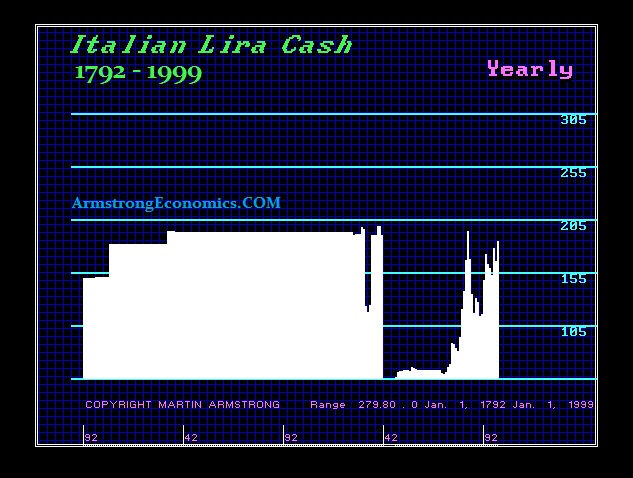
As far as property in Italy is concerned, Italians have a cultural attachment to property. Many have more than one place. They have traditionally sought to park money in property because the Italian lira was in a perpetual decline.
Pension funds on a global scale will become a major crisis. Japan has the worst aging population. However, the same problem exists in Europe and America. This is a long-term issue rather than instantly, right now
It can not be said enough: thank you for everything that you do.
I have a question that has been bothering me for some time now. I haven’t had the time to compose it until now.
You often talk of the fact that Hitler was elected with only 30% of the vote, and was allowed to propagate because of it. This changed the face of Europe and the world.
Was this the same for Merkel? Was she allowed, with only 30% of the vote, to open the borders and so change the face of Europe for decades to come?
If so, then Germany, with all its preoccupation about hyperinflation, has misread history and so should have focused on electoral reform rather than austerity.
Thanks, from a dedicated daily reader,
D
ANSWER: Yes, political reform in Germany is really essential. At the very least, it should adopt the French system where the first round of voting reduces the multi-party factions to two. Then the people have to vote between them. In the case of Germany, they form governments from groups to form coalitions. This means there must be compromises in what the people voted for. It is wrong that those compromises are then decided by politicians rather than the people. The next result, someone with only 30% can change the face of Germany and Europe
According to multiple media report U.S. Attorney General Bill Barr was already planning a visit to Mexico prior to a massive cartel gun battle near the U.S. border that has left 21 people dead. .
MEXICO – More than a dozen armored trucks filled with Los Zetas cartel gunmen rolled into a small rural town in the border state of Coahuila. The gunmen spread terror as they attacked the city hall building. The incursion turned into a fierce shootout and several chases where at least 14 cartel gunmen, three civilians, and four police officers died. Preliminary reports point to six additional people sustaining gunshot injuries.
The violence began on Saturday morning. More than a dozen armored trucks, some with machine guns mounted on top, left the border city of Nuevo Laredo, Tamaulipas driving towards the state of Coahuila. The gunmen are members of a faction of Los Zetas called Cartel Del Noreste.
Once in the town, the gunmen drove to the plaza square where they fired several machine guns at the city hall building in a brazen attack that spread terror among local residents. During their attack, several municipal police officers from Villa Union tried to fight off the attackers, however, the gunmen pushed them back and torched several police vehicles.
Authorities called for help leading to a massive deployment of state police officers from various units, and municipal police officers from Piedras Negras, Allende, and several other municipalities who rushed to the scene and clashed with the dozens of Los Zetas gunmen. The cartel gunmen wore body armor and tactical vest emblazoned with the CDN-Los Zetas logo. The armored vehicles that the cartel gunmen used also had similar decals identifying them as members of CDN-Los Zetas. (source)
After President Trump met with North Korean Chairman Kim Jong-un to stop a region headed toward military crisis, the President was asked about the Nobel peace prize for his efforts with South Korean Moon Jae-in. President Trump responded: “Peace is the prize“.
Yesterday U.S. President Donald Trump secretly flew to Afghanistan to spend time with U.S. troops on Thanksgiving day. While he was there President Trump met with Afghanistan President Ghani to discuss the groundwork for renewed discussions with Taliban leadership in an effort to construct a peace agreement in the highly tribal nation. [Video and Transcript Below]
.
[Transcript] – PRESIDENT TRUMP: Well, thank you very much. It’s great to be in Afghanistan with our troops. And we had a wonderful Thanksgiving lunch. It was abbreviated a little bit, but we served lunch and had lunch. And these are great people, and it’s also wonderful to be with the President of Afghanistan. And, President Ghani, thank you very much. It’s an honor.
We have a lot of things to talk about — many, many things. We’ve had tremendous success in the last few months with our military, as you know. ISIS has been very — very badly hit, very severely hit. We had al-Baghdadi down in a different part to the world, and we took him out. That was the father of ISIS — the founder. And he was trying to rebuild it, and that didn’t work out too well for him.
But we had tremendous success with ISIS over the last three to four months, and we’re down to a very small number. And likewise, with al Qaeda, we’re down to a very small number. And the Taliban wants to make a deal. We’ll see if they make a deal. If they do, they do. And if they don’t, they don’t. That’s fine. But we’ve had tremendous success.
And I think what I’d like to do — and perhaps, General, if you could say just a couple of words before President Ghani. Tell him about how we’ve literally decimated ISIS in Afghanistan, also al Qaeda in Afghanistan, if you would.
GENERAL MILLEY: Sure, absolutely, Mr. President. And, President Ghani, good to see you again. And we had a great meeting earlier today.
And as you know, Scott Miller and the troops here, and Afghan troops and international troops, have all put a significant amount of pressure on ISIS, particularly in Nangarhar. And they’ve been hurt bad. Their numbers have been treaded and dwindled significantly. Organizationally, they have not been destroyed but they have been severely hurt. And that pressure will continue.
And as the President mentioned, there’s ongoing talks with the Taliban, and hopefully those will be successful. And hopefully we’ll — that will lead to Afghan-to-Afghan dialogue in the not-too-distant future.
So I think there’s been some significant progress, Mr. President. And I thank Scott Miller and the Ambassador. And the entire team of U.S. forces here, in combination with the Afghan National Security Forces, has done a great job.
So thanks for your support.
PRESIDENT TRUMP: Good. Thank you very much, General.
And, Scotty, do you want to just mention how much — what we’re left with? You’re down to very small numbers with ISIS, and also you’re down to very, very small with al Qaeda. Do you want to mention that?
GENERAL MILLER: Mr. President, with the Afghan forces, particularly over the last 30 days of this — although it’s been a long fight — we’ve seen a — quite a few surrenders by Daesh/ISIS fighters, as well as their families, coming out of southern Nangarhar, which, as everybody knows, that’s a — been a tough set of terrain for the United States of America and Afghanistan.
Since 2001, it was a safe haven for bin Laden in the early days, and been a pretty remarkable military operation, as well as the following operations with the Afghans.
PRESIDENT GHANI: It (inaudible) al Qaeda South Asia.
PRESIDENT TRUMP: We made that tremendous progress though over the last, I would say, six months. And we’ve really, with respect to ISIS and al Qaeda. And we’ve hit them very, very hard. And they’re down to literally hundreds as opposed to thousands. They had many thousands a short while ago, and now they’re down to hundreds. Probably 200 left. And we’re scouting them out. So we’ll be down to very little, if anything, in a very short period of time.
Great job, by the way. Great job.
GENERAL MILLER: Thank you, sir.
PRESIDENT TRUMP: Appreciate it, Scotty.
Mr. President, please.
PRESIDENT GHANI: Well, Mr. President, it’s a great honor and pleasure to welcome you. Let me first pay tribute to the Americans who paid the ultimate sacrifice.
From 2001, 2,298 Americans — might be one or two difference — paid the ultimate sacrifice. We salute their courage and their determination for your security and our freedom.
Since you’ve been President, the number has been 52. So it’s been a tremendous change. Afghan Security Forces are taking the lead now in most of operations. I would like to pay tribute to General Miller and to Ambassador Bass for their remarkable partnership with their problem solving and our security forces. Our team is here; has gone from strength to strength.
I’d like to thank you for your leadership and for your determination both on the South Asia strategy that made this possible and on your very principled decisions regarding putting limits on the type of peace that would ensure the gains of the past years and ensure your security and our freedom.
PRESIDENT TRUMP: Right. Well, as you know, for a period of time, we’ve been wanting to make a deal and so have the Taliban. Then we pulled back. We were getting close and we pulled back. We didn’t want to do it because of what they did. It was not a good — it was not a good thing they did with the killing a soldier. They knew he was a soldier, but he was a solider — an American soldier from Puerto Rico. And they killed him. They killed a United Nations soldier. And they also killed — they killed a total of 12 people. They thought that was good negotiating power. I said, “No, that’s bad negotiating power.” That was not good what they did.
And since then, we’ve hit them so hard, they’ve never been hit this hard. In the history of the war, they have not — never been hit hard.
And they want to make a deal. So we’ll see what happens. If they make it, fine. If they don’t make it, that’s fine.
We’re going to be able to do everything we’re doing, and actually more. And at the same time, we’re bringing down the number of troops substantially. But we’re able to because of the weaponry and all of the things that we have in place. We can do, actually, more damage with even fewer troops.
So we’re going to — we’re bringing it down very substantially. And we’ll be down at a number that’s very — it’s a good number. And we’re going to stay until such time as we have a deal or we have total victory. And they want to make a deal very badly.
So we’re dealing with — this is really for the media, I guess, more than anybody, because the President knows what I’m saying. The Taliban wants to make a deal. And we’re meeting with them, and we’re saying it has to be a ceasefire. They didn’t want to do a ceasefire, but now they do want to do a ceasefire, I believe. And it will probably work out that way. And we’ll see what happens. But we’ve made tremendous progress.
But the thing I’m most proud of — because you could look at Taliban and say they’re fighting for their land; you could look at, you know, others and say they’re fighting for other things. But we know what ISIS is fighting for and we know what al Qaeda is fighting for. And we have them down to a very small number of people. So — and that won’t be — that will not be a long-lasting fight. That will be over with very soon.
So we made a lot of progress, and, at the same time, we’re drawing down our troops. And, by the way, the same thing in Syria. I have to tell you, there was false reporting in the New York Times and some of the others, yesterday.
We — as you know, we did withdraw from Syria, except we kept the oil. And we’re doing a little scattered fighting because we had some areas where ISIS was a little prevalent and gaining some traction. And we sent some troops in and pretty much wiped it out. But we have left — for the most part, we’ve left, but we’ve kept the oil. And by keeping the oil, we don’t have the enemy getting the oil. And the oil is what fueled the enemy. In this case, it was ISIS.
And so in addition to — in addition to what we did two weeks ago, which was pretty remarkable, the — what that group of young people was able to do very rapidly and very surgically, we are only in an area where we’re keeping the oil and knocking out certain small groups of ISIS as it reforms. We don’t want to — as it — as it reforms, it gets back, it tries to get back.
But we’ve also knocked out — Mr. President, as you know, we knocked out the number-two person who became the number-one person. And now we have our sights on the number-three person, who’s going to be the number-one person, if he wants it. You know, it’s not a good job. I don’t think he wants it. Maybe he doesn’t want it so badly. He’s not acting too quickly.
So we’ve had tremendous success. And we’ve had tremendous success here, especially over the last period of six months to a year. So it’s very — very nice to be with be with you.
PRESIDENT GHANI: It’s a pleasure.
PRESIDENT TRUMP: Very, very nice. Thank you.
PRESIDENT GHANI: Thank you, Mr. President.
PRESIDENT TRUMP: Okay, thank you very much everybody.
Q Mr. President, will you withdraw without a deal? Will you withdraw if there is no deal?
Q Has the U.S. restarted peace talks with the Talban?
PRESIDENT TRUMP: Say it?
Q Has the U.S. restarted peace talks with the Taliban?
PRESIDENT TRUMP: No, we’re talking to the Taliban. Yeah.
Q Are you prepared to withdraw even without a deal?
Q And will you include the Afghan —
PRESIDENT TRUMP: I would never say a thing like that. You wouldn’t want me to say a thing like that. But I could just say this: We haven’t had so much success in this — in this country, in this area. We haven’t had success like this probably from the beginning, certainly as it relates to ISIS and al Qaeda, which is a very primary aim. But we’ve had very good success in talks with the Taliban.
Q You said that you’re, at this point, pulling out troops. How many troops are currently in Afghanistan? And what is the plan for —
PRESIDENT TRUMP: Well, we’ll give you those numbers later, but we’ll get down to a certain number. I’m not sure I want to give you that number, to be honest. But it’s a very big difference. But because of new weaponry and technology, we’re able to do actually more with fewer troops.
Q You had mentioned 8,600. Is that not the number anymore, sir?
PRESIDENT TRUMP: It’s a number that people are talking about, yes.
Q And is that the number you’re talking about?
PRESIDENT TRUMP: Yeah, it is, for now. And then we can do much better than that.
Q Would you like to get it lower, sir?
PRESIDENT TRUMP: We can go much further than that. But we’ll have it all covered.
You know, this is a country where, for whatever reason, they reform, they regenerate. And we don’t want that to happen. And we also have the support of a lot of other countries, by the way. We have a lot of help from a lot of other countries. But don’t let anybody tell you that’s it’s anybody else, because we’re leading it all the way.
And frankly — and frankly, that’s one of the thing. We — look, we’re in an area of the world — we’re 8,000 miles away. Some of us — I guess, most of us came here together. We want other players in this area to help. They don’t like ISIS either. They don’t like al Qaeda either. And they have to help also. You have countries that are right nearby that are very big, that have power, and they should be doing some of the work too, not just the United States.
I have created this site to help people have fun in the kitchen. I write about enjoying life both in and out of my kitchen. Life is short! Make the most of it and enjoy!
This is a library of News Events not reported by the Main Stream Media documenting & connecting the dots on How the Obama Marxist Liberal agenda is destroying America

 The Canadian economy is roughly one-tenth the size of the U.S. So in equivalent terms the results from Canada reflect a comparative loss of 720,000 jobs on the same day the U.S. revises all figures upward to over 300,000 gains. A stunning economic contrast: