Elon Musk Revoking Ukrainian Aid


Armstrong Economics Blog/War Re-Posted Oct 17, 2022 by Martin Armstrong

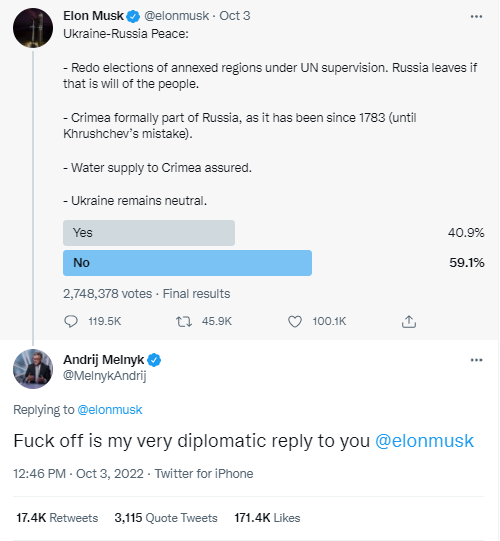
Don’t bite the hand that feeds you. SpaceX founder Elon Musk came to Ukraine’s rescue when they lost access to the internet. Musk’s sent Ukraine 20,000 Starlink satellite units at the cost of $80 million. After Elon Musk posted a poll regarding allowing the Ukrainian people to vote on the matter of joining Russia and upholding the referendum, Ukrainian diplomat Andri Melnyk publicly tweeted, “Fuck off is my very diplomatic reply to you.”

So now, Elon is considering doing what Melnyk proposed. Musk was concerned about the cost of operations long before Melnyk’s insult. “We are not in a position to further donate terminals to Ukraine, or fund the existing terminals for an indefinite period of time,” SpaceX said in a letter to the White House dated September 8. The company was urging the Pentagon to fund the project, which they estimate will cost $120 million for the remainder of 2022 and $400 million for the next 12 months. Ukrainian General Valeriy Zaluzhnyi, meanwhile, is requesting 8,000 additional Starlink terminals.

Now Musk is considering back peddling and removing his funding to Ukraine. He stated that his company could no longer afford the costs to fund this endless war. When he received negative feedback online, he replied, “We’re just following the recommendation,” and replied directly to Andri Melnyk. This is what happens when you bite the hand that feeds you.

Biden Begs OPEC+ to Delay Vote Until After Midterms


Armstrong Economics Blog/Corruption Re-Posted Oct 17, 2022 by Martin Armstrong

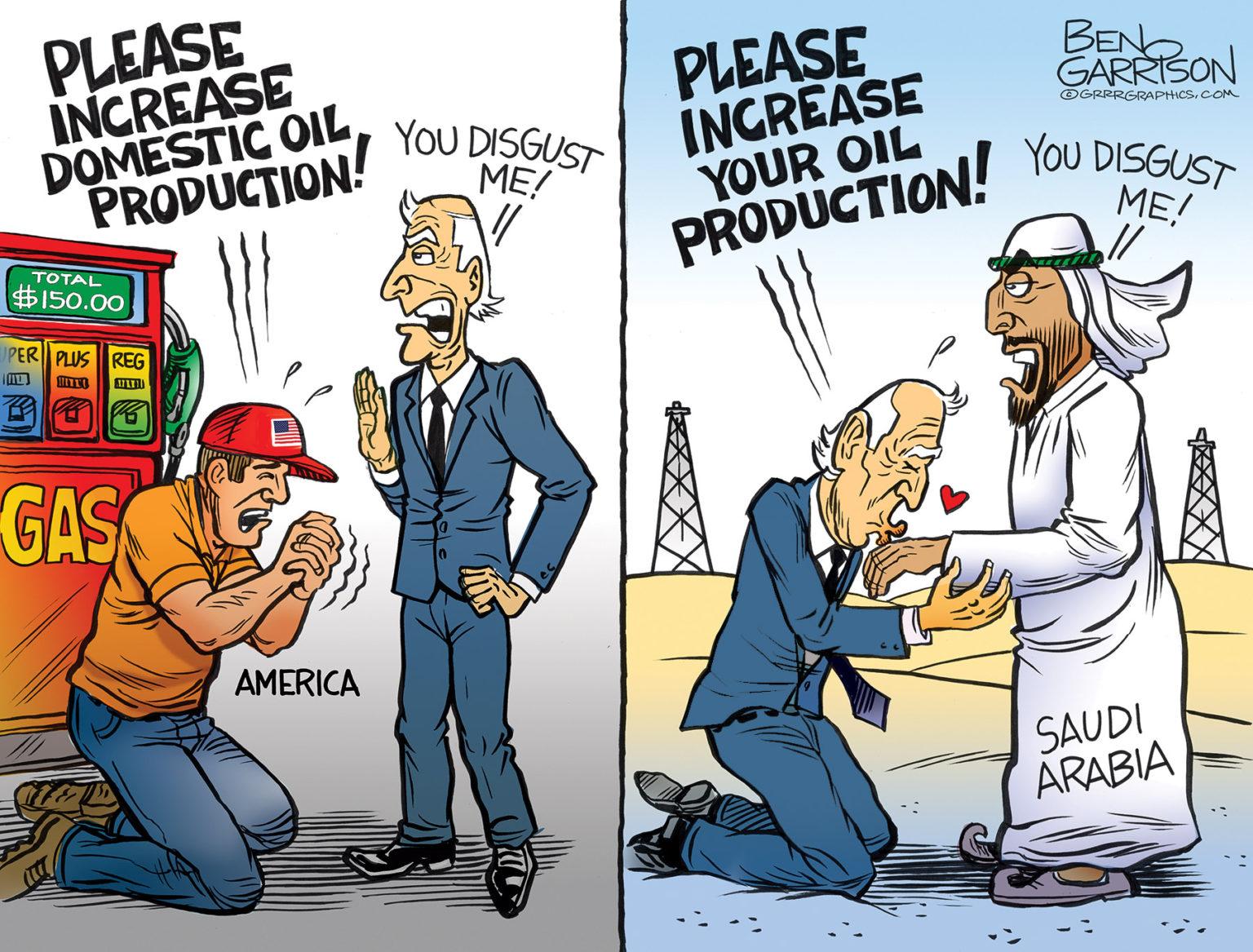
Joe Biden is playing dirty before the midterm elections by urging Saudi Arabia to delay the OPEC+ oil vote until December. The Saudis, who unofficially run OPEC+, do not respect Joe. OPEC+ voted on October 5 to cut oil production despite Joe’s desperate pleas. In a desperate attempt to avoid further embarrassment, Biden asked them to delay the next vote.

The Foreign Ministry of Saudi Arabia replied with a letter rejecting Biden’s requests. The kingdom said they declined Biden’s request in October for purely financial reasons. They reject the idea that they declined on behalf of Russia and said that they are not interfering in international conflicts. Worse, they believe that Biden is promoting the idea that Saudi Arabia is against the United States. In reality, they want to make money and be left alone. Oil is what keeps their kingdom afloat. The letter confirms their relationship with the United States is “strategic” as a trading partner and nothing more.

As for pushing back the next vote, that is not in Saudi Arabia’s interest. They explained that “economic analyses indicate that postponing the OPEC+ decision for a month, according to what has been suggested, would have had negative economic consequences.”

White House officials have confirmed Joe’s election interference. “We presented Saudi Arabia with analysis to show that there was no market basis to cut production targets, and that they could easily wait for the next OPEC meeting to see how things developed,” National Security Council spokesman John Kirby said in a statement. Yet, the White House swears this decision has nothing to do with the midterms.

This sounds like election interference to me.

Retail Sales Growth Drops Below Rate of Inflation, What Does That Tell You?


Posted originally on the conservative tree house on October 14, 2022 | Sundance 

You often hear me talk about how financial pundits and economic analysts are disconnected from Main Street.  Today we get a prime example of that from the Wall Street Journal.

The topline of the WSJ article is essentially that people are not spending money on anything except essential goods (housing, energy, fuel, food, etc), which is somewhat of a ‘duh tell us something we don’t know‘ type article.   However, the analytical part of the article is where you find the insufferable disconnect.   Here’s one example:

[Data Point 1] Gasoline prices dropped in September for the third month in a row, falling 4.9% from August.”  [Data Point 2] Sales at gasoline stations, a proxy for spending by car owners, declined 1.4% last month.” 

If gasoline dropped 4.9% in price, but sales only declined 1.4% that would indicate more physical gasoline was purchased at a lower price than the month before.   It’s not a hard concept to understand.

This is a retail sales reality even identified in the article itself, “Unlike many government reports, retail sales aren’t adjusted for inflation, so some swings reflect price changes rather than shifts in the amounts purchased.”

However, now look at this:  “Spending at restaurants and bars grew 0.5% in September from the prior month. But prices at restaurants grew 0.9% in the same month, according to a separate Labor Department report released Thursday, meaning that consumers are getting less for their spending.

No, that’s not what this means.

If restaurant prices increase 0.9%, but restaurant sales only increase 0.5% it means you are selling/serving fewer customers.  It doesn’t mean consumers getting less food, it means fewer consumers are eating at restaurants….   Which is caused by consumers having to prioritize their spending.

(WSJ) – […] Spending declined in categories linked to big purchases like cars, televisions, beds and golf clubs. Purchases at electronics and appliance stores declined 0.8% in September while spending at furniture stores fell 0.7%.

[…] Scott Brave, the head of economic analytics for Morning Consult, said consumers have started to pull back on optional purchases while still spending on the essentials.  “They are having to make tough decisions,” he said. (more)

Leading Edge of Field to Fork Inflation Starts to Arrive in September Producer Price Index


Posted originally on the conservative tree house on October 12, 2022 | Sundance 

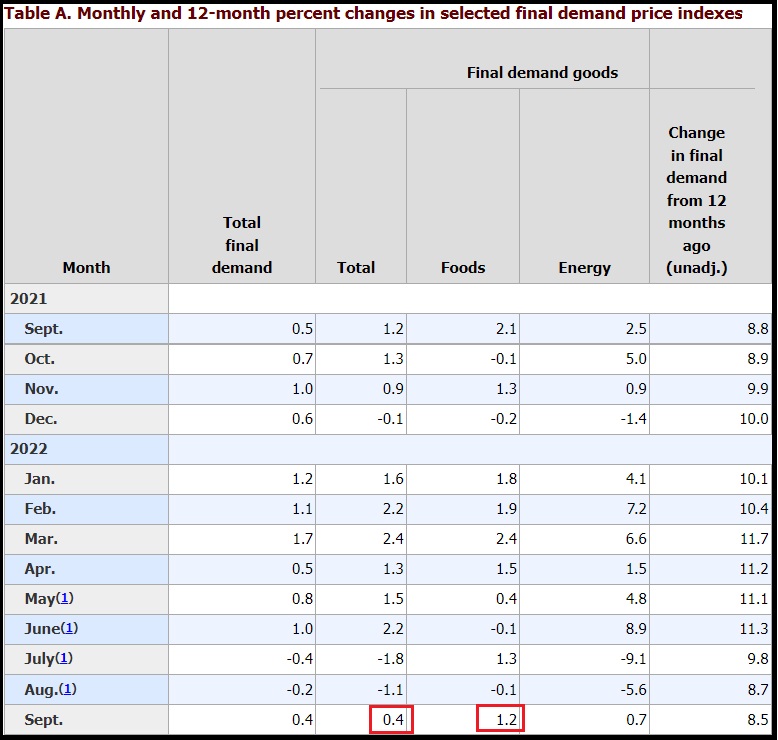
The “Producer Price Index” (PPI) is essentially the tracking of wholesale prices at three stages: Origination (commodity), Intermediate (processing), and then Final (to wholesale). Today, the Bureau of Labor and Statistics (BLS) released September price data [Available Here] showing another 8.5% increase year-over-year in Final Demand products at the wholesale level.  However, that’s not the bad news in this data.

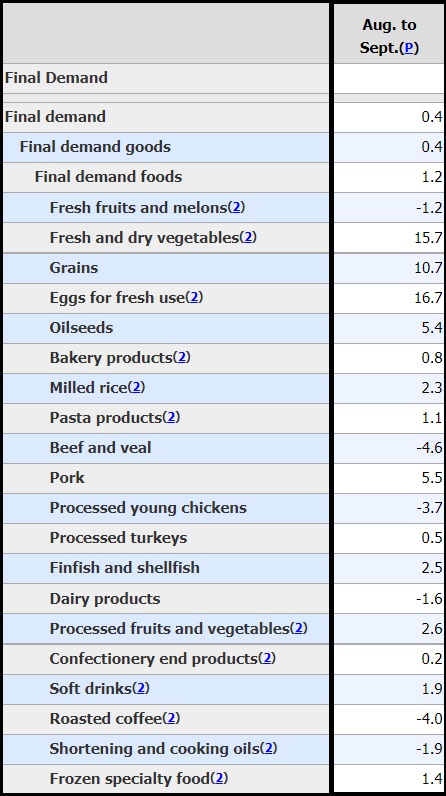
While the overall September PPI was higher than expected at 0.4%, the Final Demand Producer Price for food products in September was a whopping 1.2% (14.4% annualized).

The BLS notes the driver by saying, “a major factor in the September increase in prices for final demand goods was a 15.7-percent advance in the index for fresh and dry vegetables. Prices for diesel fuel, residential natural gas, chicken eggs, home heating oil, and pork also moved higher.”

That’s a 15.7% increase in price, in one month, for fresh and dry vegetables.  Annualized that’s a rate of price increase of 188.4% for vegetables.   Remember the warning about farm costs (energy, fertilizer, fuel) driving field to fork inflation at harvest?  This is the leading edge of that third wave of food price increases.

I have modified BLS Table-2 to focus specifically on food costs.  The data is on left.

You will note that ‘row crops’ are the big drivers along with grain and seed products.  This is exactly as we predicted it would be because those specific farming costs are the ones with greatest increase from energy, fuel, fertilizer, weed and insect control, and diesel costs.

All of those higher costs have been growing in the fields and will now surface at harvest.   The higher farm costs transfer from the field to the fork via the food supply chain.  This is only the leading edge of the price increase.

In October 2021 we first warned of the food price increases coming in distinct waves.  The first was Jan, Feb and March 2022.   The second wave was May through July 2022.  This third wave will be bigger than the first two and starts arriving this month, October 2022.

People laughed at me when I said in late 2022 eggs were going to reach .50¢ EACH ($6/doz).

Well, in September the price of fresh eggs jumped 16.7% in a single month.  That’s an annualized rate of price increase for eggs over 200%.

With hindsight you can clearly see the three waves of food price increases (BLS Table A):

Get ready and shop smart.

The October, November and December price increases in the grocery store are going to make the prior fresh food increases look small, as the full increased costs of farming operations starts to arrive at the supermarket.   Unfortunately, this will coincide with a wave of gasoline price increases, and the prices of natural gas are already skyrocketing.

.

Holiday Expenses Rise in Canada


Armstrong Economics Blog/Canada Re-Posted Oct 10, 2022 by Martin Armstrong

Wishing our friends in the north a happy Thanksgiving.

Canada’s Thanksgiving is not as widely celebrated as America’s November feast. However, outside Quebec, around 90% of Canadians plan to celebrate the holiday. Everything from fuel to food is more expensive this year. Statistics Canada reported a 10.8% rise in food prices this August, marking the fastest pace of food inflation since 1981.

The Agri-food Analytics Lab (AAL) and Angus Reid conducted a survey (sample size 1,244) to see how Canadians plan to celebrate the holiday this year. Turkey prices have risen 16% per kilogram this year. In British Columbia, 29% of respondents said that they would be making changes to the meals they typically prepare due to food prices, while 25% in Alberta and 20% in Manitoba said the same. Around 19% of those celebrating in Ontario will be changing the menu due to costs, followed by 17% in the Atlantic, 10% in Quebec, and 8% in Saskatchewan.

In addition to turkey prices increasing, potatoes have spiked by 22% this year. Bread and dairy prices have gone up 13%, while cranberries have increased by 12%. Prices vary based on location, but they’re up in every province. So many are grateful for the harvest, albeit less bountiful.

Categories: Canada

Dallas Fed: Over Half of Americans Experienced Real Wage Declines This Year


Armstrong Economics Blog/Inflation Re-Posted Oct 10, 2022 by Martin Armstrong

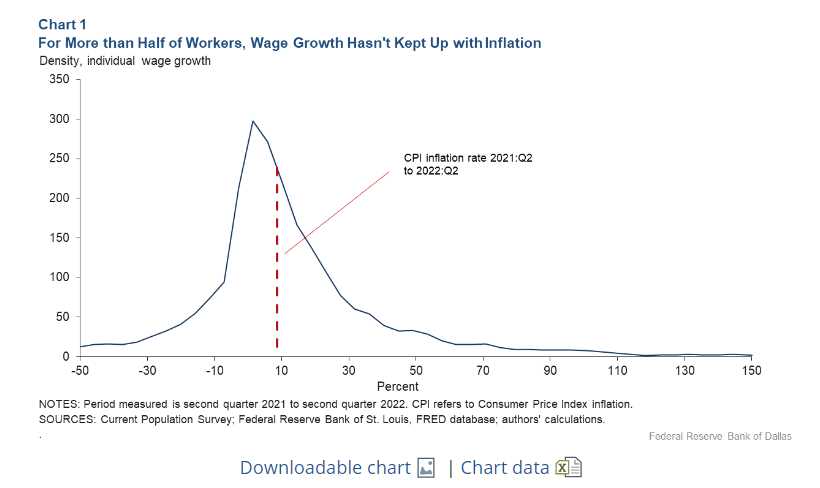
The Dallas Federal Reserve found that the decline in real wages is at a severity not seen in 25 years. Simply put, when adjusted for inflation, American’s paychecks are down despite wages going up. The median decline in real wages surpassed 8.5% this September.

"How severe are the losses for workers experiencing negative real wage growth? For the 53.4 percent of such workers in second quarter 2022, the median decline (that is, half of the declines were larger and half smaller) in real wage growth was 8.6 percent."

After examining real wages over the course of 12 months, the Dallas Fed found that 53.4% of all workers experienced real wage declines. Additional taxes under Biden have added to real wage decline as well. Peter C. Earle of the American Institute for Economic Research estimates that someone earning $70,000 annually now has $4,500 less in buying power in New York. “The bill for the Covid mitigation policies is due,” Earle said. “Record levels of fiscal and monetary policy expansion in the first half of 2020 are wrecking the purchasing power of the dollar. Thus even without a pay cut, wage earners are effectively earning less over time.”

The average median decline over the past 25 years has been 6.5% with real wage declines reaching between 5.7% to 6.8%. Inflation is simply too severe to compensate for any additional wages. The Fed continued to say:

"Despite the stronger wage growth due to the tightness of the labor market, a majority of workers are finding their wages falling even further behind inflation. For workers who experienced a decline in their real wage in second quarter 2022, the median decline was 8.6 percent.

While the past 25 years have witnessed episodes that show either a greater incidence or larger magnitude of real wage declines, the current time period is unparalleled in terms of the challenge employed workers face."

Musk Twitter Purchase Back on Table, Unfortunately with Plan for Everything App


Posted originally on the conservative tree house on October 4, 2022 | Sundance

The only thing I can do is research and write about it.  With an even stronger degree of certainty than originally expressed, and with all of the subsequent data points falling into alignment with the initial suspicions, the background of Jack’s Magic Coffee shop remains unchanged. {Go Deep}

Six weeks ago, the Twitter security ‘whistleblower’ came forward to congress.  The whistleblower is a former technology expert who came from within the research farm of DARPA, the Defense Advanced Research Projects Agency.  Peiter “Mudge” Zatko, is a well-known cybersecurity expert who left government work, entered the public world, and eventually became the head of Twitter security, reporting directly to the CEO. {Go Deep}

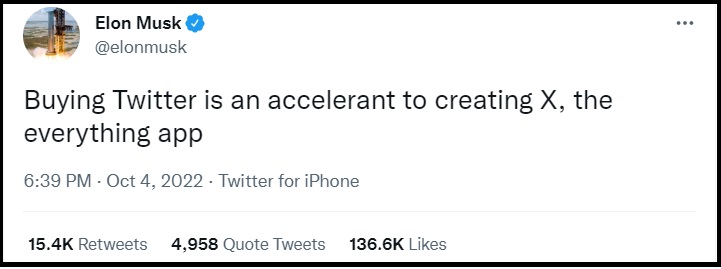
According to a recent SEC filing [LINK HERE], Elon Musk is now back to supporting the purchase of Twitter as the first step in creating the “everything app.”

{{{sarcastic voice}}} Gee, what could this be about?  I mean what could go wrong?….  We already know the infrastructure of Twitter’s operational database is tied into portals with the Dept of Homeland security {citation}, and now Musk wants to use that central infrastructure to create an all-inclusive “everything app”?

The bigger risk to the surveillance state is discovery that Twitter and the U.S. intelligence community are in a public-private partnership. The Dept of Homeland Security has access by design, not flaw.  How the stakeholder media are reporting on the issue shows the nature of the risk, (emphasis mine):

[…] The scathing disclosure, which totals around 200 pages, including supporting exhibits — was sent last month to a number of US government agencies and congressional committees, including the Securities and Exchange Commission, the Federal Trade Commission and the Department of Justice. The existence and details of the disclosure have not previously been reported. CNN obtained a copy of the disclosure from a senior Democratic aide on Capitol Hill. The SEC, DOJ and FTC declined to comment; the Senate Intelligence Committee, which received a copy of the report, is taking the disclosure seriously and is setting a meeting to discuss the allegations, according to Rachel Cohen, a committee spokesperson. (link)

How would it damage the U.S. government if previous claims about the Chinese government having access to all user data on TikTok, are shown to be exactly identical to the U.S. government having access to all user data on Twitter?

Let that question settle in for a few moments, because that is exactly what I have been alleging since, well, 2011, when the U.S. State Dept first collaborated with Twitter in a joint public-private partnership to use the platform as a communication tool exploiting the Arab Spring uprising in Egypt, Libya and beyond.

The issue of Jack’s Magic Coffee Shop is an issue of financial viability.  The business model of Twitter just doesn’t exist as a free social media discussion platform while running the ultra-expensive data processing system needed for millions of simultaneous users.  A global chat that requires exponential database responses as an outcome of simultaneous users is just ridiculously expensive. {Go Deep} However, if the computing system and massive database were being subsidized by the U.S. government, then the viability of the ‘free coffee‘ business model makes sense.

“Cloud computing is one of the core components of the strategy to help the IC discover, access and share critical information in an era of seemingly infinite data.” … “A test scenario described by GAO in its June 2013 bid protest opinion suggests the CIA sought to compare how the solutions presented by IBM and Amazon Web Services (AWS) could crunch massive data sets, commonly referred to as big data.” … “Solutions had to provide a “hosting environment for applications which process vast amounts of information in parallel on large clusters (thousands of nodes) of commodity hardware” using a platform called MapReduce. Through MapReduce, clusters were provisioned for computation and segmentation. Test runs assumed clusters were large enough to process 100 terabytes of raw input data. AWS’ solution received superior marks from CIA procurement officials”… (MORE)

♦ Legal Stuff – The issue of American citizen privacy and U.S. constitutional limits against the government listening in on communication is functionally obsolescent.  The Foreign Intelligence Surveillance Act (FISA) prohibits communication intercepts on U.S. citizens without a valid search warrant.  However, if a U.S. citizen is engaged in a conversation with a foreign person, all privacy restrictions are essentially gone. [Insert example of Michael Flynn taking to Russian Ambassador Sergey Kislyak here]

Your phone calls can be intercepted by the government from the foreign side of the call.  The govt can freely monitor the calls that involve foreign actors.  The only rule is that your privacy must be maintained. If the foreign actor is in communication with a U.S. citizen, the U.S. citizen must be “minimized” or not identified in any intercept.

However, what happens when the phone call is on a community line that is connected, and visible, to the entire world?   That’s the benefit of social media monitoring from a surveillance perspective. It is from that opaque and unresolved archaic legal perspective that surveillance authority of social media platforms, by the U.S. intelligence community, exists.   Now you see why the SSCI is taking an interest in the Twitter whistleblower, classic risk mitigation.

Hopefully, you can also see why the 200-page whistleblower document was leaked, by a Democrat staffer, to the Washington Post and CNN.

CNN defends the equity interests of the U.S. State Dept., and WaPo defend the Intelligence Community (CIA, DHS, etc).

Within the narrative as constructed you will note, “Zatko further alleges that Twitter’s leadership has misled its own board and government regulators about its security vulnerabilities, including some that could allegedly open the door to foreign spying or manipulation, hacking and disinformation campaigns.”

If the relationship between Twitter and the U.S. intelligence community is a public-private partnership, why would Twitter want to shut down the portals given to the Dept of Homeland Security?

Answer, they wouldn’t… Ergo the response from Twitter to the whistleblower complaint is (emphasis mine), “What we’ve seen so far is a false narrative about Twitter and our privacy and data security practices that is riddled with inconsistencies and inaccuracies and lacks important context.

Put another way, the “lacks important context” is the nature of the security risk, which is structural to the relationship between the intelligence community and the platform.  See how that works?

The integration between Twitter and the United States Intelligence Community has been hiding in plain sight:

July 26, 2021, (Reuters) – A counterterrorism organization formed by some of the biggest U.S. tech companies including Facebook (FB.O) and Microsoft (MSFT.O) is significantly expanding the types of extremist content shared between firms in a key database, aiming to crack down on material from white supremacists and far-right militias, the group told Reuters.

Until now, the Global Internet Forum to Counter Terrorism’s (GIFCT) database has focused on videos and images from terrorist groups on a United Nations list and so has largely consisted of content from Islamist extremist organizations such as Islamic State, al Qaeda and the Taliban.

Over the next few months, the group will add attacker manifestos – often shared by sympathizers after white supremacist violence – and other publications and links flagged by U.N. initiative Tech Against Terrorism. It will use lists from intelligence-sharing group Five Eyes, adding URLs and PDFs from more groups, including the Proud Boys, the Three Percenters and neo-Nazis.

The firms, which include Twitter (TWTR.N) and Alphabet Inc’s (GOOGL.O) YouTube, share “hashes,” unique numerical representations of original pieces of content that have been removed from their services. Other platforms use these to identify the same content on their own sites in order to review or remove it. (more)

A shared hashing protocol is a form of data system integration.  The databases of the identified social media platforms are integrated with the U.S. intelligence system.

…. And now Musk wants to integrate an “everything app”?

Follow the bouncing ball and you enter the world of the comprehensive surveillance state.   But if you don’t do anything wrong, you’ve got nothing to fear right?  Insert example of non-vaccinated repercussions, Canadian truckers and Dutch farmers here.  Then add a digital identity, digital currency, energy resource apportionment and social equity.  Where do you end up?

All I can do is research and write about it.

Even the influential members of the ‘Rebel Alliance‘ used to think I was crazy….  Not any longer.

.

.

….Me Right Now