Canadian Economy Halts – GDP Growth Drops to 0.1 Percent, and No-One Is Talking About Why…


The Canadian government shocked the professional financial and economic media with their latest fourth quarter GDP release showing the economy has essentially come to a grinding halt at 0.1% growth.  [Compare to U.S. GDP growth of 3%]

The Canadian Q4 GDP growth isn’t one percent, it’s one-tenth of one percent: 0.1%, essentially halted; but everyone discussing this is missing something very important.

First, The Financial Post headline:

[FP] Canada’s economy practically came to a halt in the final three months of 2018, in a much deeper-than-expected slowdown that brings the underlying strength of the expansion into doubt.

The country’s economy grew by just 0.1 per cent in the fourth quarter, for an annualized pace of 0.4 per cent, Statistics Canada said Friday from Ottawa. That’s the worst quarterly performance in two and a half years, down from annualized 2 per cent in the third quarter and well below economist expectations for a 1 per cent annualized increase.

While a slowdown was widely expected in the final months of the year due to falling oil prices, it’s a much bleaker picture than anyone anticipated with weakness extending well beyond the energy sector. Consumption spending grew at the slowest pace in almost four years, housing fell by the most in a decade, business investment dropped sharply for a second straight quarter, and domestic demand posted its largest decline since 2015.  (read more)

The financial punditry go on to give multiple reasons for the drop and all of them are factually accurate.  However, there’s a key aspect that I cannot find discussed in any analysis of the data.

A very specific key aspect.

First, let me say CTH does not want to see the Canadian economy falter; not even a little bit.  By disposition CTH wants to see economic abundance for everyone, especially our close friends and allies.  But stand back, look at the bigger, BIG, picture, the media always avoid discussing…. you’ve got to ask yourself how can Canada be slowing down at the exact same time the USA economy is skyrocketing?…. There’s a connection.

Again, all of the currently expressed financial reasons for the slowdown are accurate; I am not disputing them. However, it’s what they are not discussing that really matters.

In the third paragraph of the FP article I highlighted a partial sentence: “business investment dropped sharply for a second straight quarter.”  That means sharp drops in business investment for Canada in the time-frame  July 2018 through December 2018.

Now pause, and reference the U.S. fourth quarter: “Consumer spending continued to grow solidly and, most encouragingly, business investment growth recovered sharply after a dip in the third quarter. Despite big external headwinds and financial market volatility in the fourth quarter, U.S. firms are not retrenching sharply on capex.”

Astute economic followers will note what the background is.

♦In July, August, September (Q3) of 2018 the new NAFTA negotiation was in the final stages. The U.S. and Mexico had already come to the terms; Canada was the outlier having to re-join an agreement in September where they previously abandoned negotiations.

♦On October 1st, 2018, the first day of Q4, the USMCA was unveiled. Now the U.S., Mexico and Canada were all committed.  Throughout the fourth quarter, all business interests had an opportunity to review the much anticipated USMCA outcome and details.

Multinational corporations, domestic corporations, U.S. and Canadian businesses were all looking for the same very specific detail:  What happened with the NAFTA loophole?

Within the new USMCA the critically important NAFTA loophole was closed.

Over the past three decades both Canada and Mexico structured key parts of their independent trade agreements to take advantage of their unique access to the U.S. market.  Under the existing NAFTA, Mexico and Canada generate billions in economic activity through exploiting the NAFTA loophole.

China, Asia (writ large), and the EU enter into trade agreements with Mexico and Canada as back-doors into the U.S. market.  So long as corporations can avoid U.S. tariffs (and rules of origin that pertain to those tariffs), by going through Canada and Mexico they would continue to exploit this approach.

By shipping parts to Mexico and/or Canada; and by deploying satellite assembly facilities in Canada and/or Mexico; China, Asia and to a lesser extent EU corporations exploited a NAFTA loophole for rules of origin on finished goods.

Through a process of building, assembling or partially manufacturing their products in Mexico/Canada those foreign corporations could skirt U.S. trade tariffs and direct U.S. trade agreements.  The finished foreign products entered the U.S. under NAFTA rules.

Why deal with the U.S. when you can just deal with Mexico, and use NAFTA rules to ship your product directly into the U.S. market?

This exploitative approach, a backdoor to the U.S. market, was the primary reason for massive foreign investment in Canada and Mexico; it was also the primary reason why candidate Donald Trump, now President Donald Trump, wanted to shut down that loophole and renegotiate NAFTA.

At the conclusion of Round #6, just before giving up on Chrystia Freeland for good, this was the direct issue at the heart of a very frustrated U.S.T.R. Lighthizer’s strongly worded response to Canada:

[…]  In another proposal, Canada reserved the right to treat the United States and Mexico even worse than other countries if they enter into future agreements. Those other countries may, in fact, even include China, if there is an agreement between China and [Canada]. This proposal, I think if the United States had made it, would be dubbed a “poison pill.” We did not make it, though. Obviously, this is unacceptable to us, and my guess is it is to the Mexican side also. (read full remarks)

This loophole was the primary reason U.S. manufacturers relocated operations to Mexico.  Corporations within the U.S. Auto-Sector could enhance profits by building in Mexico or Canada using cheap parts imported from Asia/China.  The labor factor was not as big a part of the overall cost consideration as cheaper machined parts and imported raw materials.

If the U.S. applied the same tariffs to Canada and Mexico we apply to all trade nations, then the benefit of using Canada and Mexico -by those trade nations- is lost.

Corporations will no longer have any advantage, and many are likely to just deal directly with the U.S. This was the reason Trump, Lighthizer and Ross to retained Steel and Aluminum tariffs on Canada and Mexico until they agreed to the new USMCA rules.

When Trump took away the flawed NAFTA market access; and when Trump removed the ability of Mexico and Canada to broker themselves for economic benefit; there was no longer a financial benefit behind corporations investing in Canada.  Under a binding trade pact between the USMCA partners, the NAFTA flaw is closed.

As a direct outcome billions of investment dollars are now being removed from any future consideration into Canada.

That’s the overarching reason for the Canadian GDP to halt.

Here’s the proverbial $64,000 question:  Can Canada re-engineer their economy and actually begin to “make” products again, not just simply “assemble” foreign products from other nations?

  • Can Canada reverse three-decades of specifically structured economic policy decisions that were centered around this “assembly” (brokered) economy?
  • Can the environmentalists be put back into a box while heavy manufacturing and raw material development are reconstituted?
  • Can the environmentalists allow natural resource development?  Oil development, mining operations, lowered overall energy costs, etc?
  • Can Canada somehow lower national energy costs so that Heavy manufacturing might consider restarting? (NOTE: heavy manufacturing requires massive energy use.)
  • Can Canada find any industrial development investors who would be willing to take a chance on all the above?

See the problem?

The Canadian economy is not likely going to get better without a radical shift in Canadian political perspectives and outlook(s).

Then again, perhaps that’s really why Justin and Chrystia were so damned set on protecting their “cultural industries” (ie. media) from competition.

Think about it.

President Trump CPAC Speech 2019 – Video


President Donald Trump delivered a two-hour speech today at CPAC.

Here’s the video, the transcript will follow later.

European Tour – The Calm Before the Chaos?


I am writing from Frankfurt here for meetings ahead of the chaos awaiting the May elections. In Frankfurt, while the economy is clearly slowing, the financial capital is booming. New skyscrapers are rising to join those of Commerzbank, Deutsche Bank, DZ Bank, Helaba and others on Frankfurt’s skyline. This is another sign that there is a disparity between the financial world and the main street.

Nevertheless, behind the facade is a weakening banking sector that the ECB seems to be inspiring. Forcing negative interest rates where the banks must pay the ECB 0.4%, their rate of return on equity has fallen into a crash mode. The German banks’ average earnings have dwindled from once 4% back in 2010 to barely 1% into last year. Deutsche Bank, the biggest, tried to compete with Wall Street and paid the price. After four years of losses, finally, in 2018, Deutsche Bank made its first annual profit which was just a 0.4% return on equity.

As always, politics enters the game rather than logic. The German government wanted to see a Commerzbank and Deutsche Bank merge and offered some undisclosed assistance.  That assistance would most likely be writing off a portion of the 15% the German government still owns of Commerzbank, which is the legacy of a bail-out and a merger with the stricken Dresdner Bank back in 2008-2009. The government does not own shares in  Deutsche Bank.

The books of Commerzbank show the same problems as in Deutsche Bank so a merger between the two does not appear to solve any crisis. There are in addition rumors that Commerzbank is being considered by both French and Italian banks for a takeover. The prospects of a merger with Deutsche Bank from a non-German bank may be too ambitious politically speaking.

The German government is coming under great stress for the two biggest banks are not really very healthy at this moment and suitors are foreign – not German. Deutsche Bank could be merged with the French BNP, but that would be a loss of pride. Meanwhile,  the management at Deutsche Bank would prefer a deal with Switzerland’s UBS. A previous German bank, HVB of Munich, was taken over by Italy’s UniCredit. That was one embarrassment politicians seem reluctant to repeat. The bail-in policy was devised because politicians did not want to have to contribute to bank failures they saw as inevitable in Southern Europe. To have foreign banks eying up German banks, the pillar of the EU, somehow strike a deep blow into the political heart of the EU.

The ECB’s negative interest rate policy is seriously harming European banks yet they cannot figure out an alternative without having to admit there is a major flaw in the entire structural system in Europe. Forcing banks to pay the ECB to deposit reserves is really absurd.

What is most interesting is that the emotions are running high over issues such as BREXIT and the Euro Crisis. It appears that analysts from major institutions are not allowed to discuss anything to do with debt consolidation. This appears to be off the table for discussion. The proposals to create a Euro Bond are separate and distinct leaving the current national debts to be held by each member state. That hardly removes the threat of one member failure impacting the whole of the EU.

Meanwhile, there is a silent move to reduce exposure to Italian debt held by non-Italian institutions. There remains a concern that Italy could possibly follow Britain. There is growing respect that even the hint of such a possibility that Italy would withdraw from the Eurozone can result in a sharp decline in the value of Italian debt even if they never move to actually exit the Eurozone. Italy was one of the original founders of the Euro.

Overall, there appears to be a general consensus that everyone should just keep the Euro at all costs. However, without major structural reforms, it is hard to see how the problems will not take on a life of itself. The refusal to consider a debt consolidation leaves the Euro vulnerable to the politics of each member with rising popular trends in politics.

The Eurozone’s third-largest economy, Italy, already has debts of about €2.3 trillion euros, which is the equivalent to 132% of its GDP. However, it takes more than 4% of Italy’s GDP is now being used to service its debt load and this is with historically low interest rates. There are concerns behind the curtail that Italy can play a game of chicken. If they decide to leave the Eurozone, what about all the Italian debt held by the ECB? Who will lose? The Italians, Brussels or the financial markets as a whole?

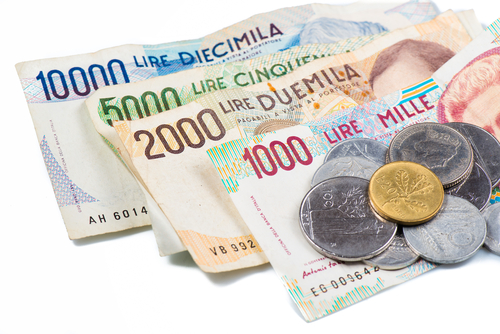
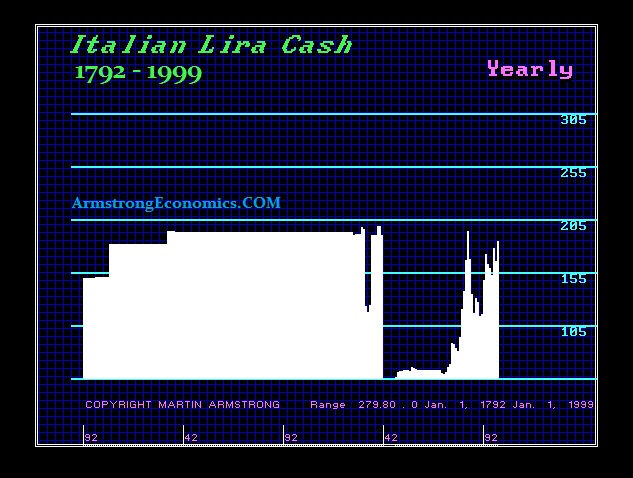
The lira was the official unit of currency in Italy until January 1, 1999, when it was replaced by the euro (euro coins and notes were not introduced until 2002). Old lira-denominated currency ceased to be legal tender on February 28, 2002. Beginning on January 1, 1999, all bonds and other forms of government debt by Eurozone nations were denominated in Euros. The value of the Euro, which started at USD 1.1686 on December 31st, 1998, rose during its first day of trading, Monday, January 4th, 1999, closing at approximately US$1.18. The Euro replaced the former European Currency Unit (ECU) at a ratio of 1:1 (US$1.1743).


Converting its national debt at 1.18, only resulted in economic chaos that devasted Italy. Whatever it owed previously in lira was suddenly now Euro. They experience their national debt doubling in real value the same as if you borrowed in Swiss franc for a mortgage that saw the Swiss franc double in value.  With the Euro trading in the 1.13 level, it is finally below the original conversion rate but even that ignores all the costs of services at high price levels.


By no means did Italy benefit from joining the Eurozone. To participate in the new currency, member states had to meet strict criteria such as a budget deficit of less than 3% of their GDP, a debt ratio of less than 60% of GDP, low inflation, and interest rates close to the EU average. Both France and Germany have been over that 60% level. France’s debt is currently at 97% of GDP while Germany is at 64% of GDP. Italy is 138% of GDP and Greece is at 178%. The Netherlands is at 56.7% of GDP, Austria is at 78.4%, Belgium is at 103% while Spain is at 98%. For comparison, the USA stands at 78%. This strict criterion has really failed to work and it was all mandatory simply because they refused to consolidate the national debts from the outset.

Greece failed to meet the criteria and was excluded from participating on January 1st, 1999. Eventually, Greece joined the Euro with the help of manipulations by Goldman Sachs on June 19th, 2000 when the drachma was fixed at 340.75.

This tour here in Europe is most interesting for the concerns are rising and there is a clear flight from Italian debt. Some of the most conservative portfolios in Europe have raised their exposure to the dollar from 5% to 30% which was attributed to the significant rally in the Dow since December. We even have central banks buying gold in search of diversification and a hedge against the uncertainty on the horizon come May. Needless to say, we have selected Rome for this year’s midterm WEC for this is the center of political attention behind the curtain.

Peak in Investment Grade Corporate Debt Matures by 2021


We have a very interesting crisis building in addition to the political chaos we see coming in 2020. By the time we reach 2021, we will have over $2 trillion in investment grade corporate debt maturing. This is going to present some very interesting problems. Up to now, we have advised our corporate clients to borrow at these rates and lock it in for 30 to 100 years. The bulk of corporations, who we do not advise, funded themselves short-term. With about $2 trillion maturing by 2021, they will end up pushing interest rates higher from there onward.

IMPORTANT – Kudlow on China: Layered, Sequential, Sector Tariffs as Enforcement Mechanism…


Okay, now USTR Robert Lighthizer’s cautiously worded enforcement testimony starts to take on a fuller context.  When Ambassador Lighthizer was testifying before the mostly decepticon House Ways and Means Committee, he started to outline his newly designed trade enforcement mechanism… but he stopped; he didn’t want to reveal too much.

Now listen to Larry Kudlow describe “enforcement”.  WATCH:

.

If you watched the USTR testimony you would have seen how the “enforcement” mechanism within the U.S-China trade negotiations was the priority for Lighthizer’s focus; and he specifically mentioned “layered” enforcement triggers, specific to each sector, and issue.

CTH has never seen a U.S. Trade Representative so structurally willing to clear-cut the entire bamboo forest if needed. Lighthizer is intensely focused on enforcement.

Congressional reps were focusing most questions around Chinese purchases of U.S. goods. Lighthizer was blowing through those questions like annoying gnats.   That’s not the focus of his structural engagement with the Chinese team. Lighthizer is going much deeper, into issues of much greater consequence than simply purchases via imports/exports.

While increased Chinese purchases to lower the deficit are a part of the goal, they are a very small part of the goal.  The protection of U.S. intellectual property; the removal of non-tariff trade barriers; the protection of U.S. ownership rights as Americans operate inside China; the confrontation of currency manipulation, and the sector by sector enforcement provisions are Lighthizer’s primary objective.

If you overlay the comments by NEC Chairman Larry Kudlow (above), with the insightful commentary about ‘enforcement’ by USTR Lighthizer earlier, we can see the picture emerging.

Lighthizer wasn’t specific, Kudlow gave more detail.

What Kudlow is outlining is what Lighthizer hinted toward.

Each of the sectors within the U.S-China trade agreement will have their own specific multi-staged enforcement mechanism that triggers one-way tariffs if China violates the terms; and China cannot retaliate.

Each trade sector will be protected on: [1] intellectual property rights (copyright, patents etc); [2] non tariff barriers (artificial Chinese regulatory hurdles); [3] private ownership external to the controlling reach of Chinese state-owned dictates; [4] as well as financial access and larger currency manipulation schemes.

Within each trade sector; and upon each protected aspect; Lighthizer is building-in a multi-tiered tariff system that would immediately punish the Chinese State-Owned system (all companies therein) with staged, one-way tariffs and countervailing duties that cannot be avoided and China cannot retaliate against.

In essence, and in practice, it sounds like the sector-specific American product protection means: if China violates the sector-specific terms, any terms, the equivalent (or closest equivalent) Chinese product would automatically cost more…. and the U.S. product would cost less.  An enforcement system giving U.S. producers and owners an immediate benefit; and giving China an immediate punishment.

[This would also likely apply to U.S. companies with Chinese controlling interests.]

This sounds like the enforcement framework within a heavy MOU; that is then guaranteed to transfer into the final, legal and binding agreement; and be applied to every element, within every sector, across the entirety of the U.S. commerce relationship with China.

Lighthizer described “steps” and “layers” of this protection at every level, and across every element, of commercial engagement with China.  However, Lighthizer didn’t describe the punishment; it sounds like Larry Kudlow did.

Advertisements

Justin From Canada is in Very Serious Legal Trouble – Former AG Testifies Against Prime Minister…


Justin from Canada is in very serious legal jeopardy after recent revelations that he interfered the Canadian Attorney General’s office regarding the prosecution of a Quebec engineering firm SNC-Lavalin surrounding bribes to Libyan government officials.

Canadian political pundit from Rebel MediaEzra Levant, tweeted out an excellent summary, and then provided a very well organized video to highlight stunning testimony from the former Canadian AG.  Here is Mr. Levant’s explanation:

For my American and British friends: Canada’s Justin Trudeau is done. He might try to fight on; I personally think he’s too damaged. He’s irreparably damaged. Here’s what happened in a few short tweets.

Trudeau was detonated today by his former Attorney General, Jody Wilson-Raybould, Canada’s first Aboriginal A-G. She just testified in Parliament, in meticulous detail, how Trudeau and his staff tried to get her to drop criminal charges against a corrupt company that he liked.

She refused to bend the law for Trudeau’s cronies. But they didn’t stop. Trudeau; his chief of staff; his principal secretary; even the finance minister. They met her ten times, phoned her ten more. trying to get the charges dropped. She wouldn’t. So Trudeau fired her as A-G.

The story leaked out earlier this month, but it was all anonymous sources. The former A-G herself didn’t say a word, saying she was bound by attorney-client privilege and cabinet confidences. She was effectively gagged; so Trudeau was the only one talking.

Trudeau took advantage of her enforced silence to claim she supported him and everything was fine. After all, when he fired her as A-G, he appointed her to the minor post of veterans minister.

When she heard him make that boast, she quit as veterans minister. He was shocked.

Then suddenly Gerald Butts, Trudeau’s right hand man — his best friend since college — resigned, claiming he had done nothing wrong. Which is odd. It looked like a compromise — Butts left, so Wilson-Raybould met with the cabinet and the caucus again.

Wilson-Raybould still didn’t say anything publicly. She hired a retired Supreme Court judge as her lawyer, to advise her on what she could say. Under pressure, the Liberal dominated Parliamentary committee invited her to testify, and Trudeau grudgingly waived some privilege.

So today she testified. In great detail. Exactly who pressured her. Exactly how. Exactly when. She named names. Including the prime minister himself. Here’s her statement: (LINK)

It’s against the law to pressure the Attorney General to obstruct a criminal prosecution. Here’s Canada’s Criminal Code. Section 139(2) is obstruction — it carries a 10-year prison term. (LINK)

Last detail. Jody Wilson-Raybould’s father was an Aboriginal activist who butted heads with Justin Trudeau’s father. Here they are bantering. Bill Wilson tells Pierre Trudeau that his daughter Jody wants to be PM one day. Maybe she will be?

Here’s a great video breakdown:

President Trump Surprises Troops During Stop at Elmendorf AFB, Alaska…


En route to the White House from Hanoi, Vietnam, Air-Force One stopped in Alaska for refueling.  During the stopover President Trump delivered remarks to U.S. troops stationed at Elmendorf AFB.

President Trump was greeted by Alaska Governor Mike Dunleavy who accompanied the president to a base hangar where U.S. troops were gathered.

CEA Chairman Kevin Hassett Discusses GDP Growth…


White House Council of Economic Advisers Chair Kevin Hassett discusses the U.S. economy’s 2.6 percent growth in the fourth quarter, and the outlook for the U.S. economy through the rest of 2019.

.

Notice how most of the financial pundits are focusing on what the “global economy” needs; specifically what the EU and China need to do to gain economic growth.  From that position, the U.S. trade reset is adverse to their financial interest; those financial interests are driven by Wall Street not Main Street.

Economic nationalists who understand the concept of ‘America First’ focus on what the USA economy needs, and do not accept a position that the U.S. should acquiesce our position to benefit the economic needs of other nations.  That’s the primary difference.

Few understand the MAGAnomic reset and what was predicted to happen in the space between disconnecting a Wall Street economic engine (globalism and multinationals) and restarting a Main Street economic engine (nationalism/America-First).  In 2016 CTH explained where we would be today.

President Trump’s MAGAnomic trade and foreign policy agenda is jaw-dropping in scale, scope and consequence. There are multiple simultaneous aspects to each policy objective; however, many have been visible for a long time – some even before the election victory in November ’16.

♦ When U.S. banks were allowed to merge their investment divisions with their commercial banking operations (the removal of Glass Stegal) something changed on Wall Street.

Companies who are evaluated based on their financial results, profits and losses, remained in their traditional role as traded stocks on the U.S. Stock Market and were evaluated accordingly. However, over time investment instruments -which are secondary to actual company results- created a sub-set within Wall Street that detached from actual bottom line company results.

The resulting secondary financial market system was essentially ‘investment markets’. Both ordinary company stocks and the investment market stocks operate on the same stock exchanges. But the underlying valuation is tied to entirely different metrics.

Financial products were developed (as investment instruments) that are essentially wagers or bets on the outcomes of actual companies traded on Wall Street. Those bets/wagers form the hedge markets and are [essentially] people trading on expectations of performance. The “derivatives market” is the ‘betting system’.

♦Ford Motor Company (only chosen as a commonly known entity) has a stock valuation based on their actual company performance in the market of manufacturing and consumer purchasing of their product. However, there can be thousands of financial instruments wagering on the actual outcome of their performance.

There are two initial bets on these outcomes that form the basis for Hedge-fund activity. Bet ‘A’ that Ford hits a profit number, or bet ‘B’ that they don’t. There are financial instruments created to place each wager. [The wagers form the derivatives] But it doesn’t stop there.

Additionally, more financial products are created that bet on the outcomes of the A/B bets. A secondary financial product might find two sides betting on both A outcome and B outcome.

Party C bets the “A” bet is accurate, and party D bets against the A bet. Party E bets the “B” bet is accurate, and party F bets against the B. If it stopped there we would only have six total participants. But it doesn’t stop there, it goes on and on and on…

The outcome of the bets forms the basis for the tenuous investment markets. The important part to understand is that the investment funds are not necessarily attached to the original company stock, they are now attached to the outcome of bet(s). Hence an inherent disconnect is created.

Subsequently, if the actual stock doesn’t meet it’s expected P-n-L outcome (if the company actually doesn’t do well), and if the financial investment was betting against the outcome, the value of the investment actually goes up. The company performance and the investment bets on the outcome of that performance are two entirely different aspects of the stock market. [Hence two metrics.]

♦Understanding the disconnect between an actual company on the stock market, and the bets for and against that company stock, helps to understand what can happen when fiscal policy is geared toward the underlying company (Main Street MAGAnomics), and not toward the bets therein (Investment Class).

The U.S. stock markets’ overall value can increase with Main Street policy, and yet the investment class can simultaneously decrease in value even though the company(ies) in the stock market is/are doing better. This detachment is critical to understand because the ‘real economy’ is based on the company, the ‘paper economy’ is based on the financial investment instruments betting on the company.

Trillions can be lost in investment instruments, and yet the overall stock market -as valued by company operations/profits- can increase.

Here’s the critical part – Conversely, there are now classes of companies on the U.S. stock exchange that never make a dime in profit, yet the value of the company increases.

This dynamic is possible because the financial investment bets are not connected to the bottom line profit. (Examples include Tesla Motors, Amazon and a host of internet stocks like Facebook and Twitter.) It is this investment group of companies that stands to lose the most if/when the underlying system of betting on them stops or slows.

Specifically due to most recent U.S. fiscal policy, modern multinational banks, including all of the investment products therein, are more closely attached to this investment system on Wall Street. It stands to reason they are at greater risk of financial losses overall with a shift in economic policy.

That financial and economic risk is the basic reason behind Trump and Mnuchin putting a protective, secondary and parallel, banking system in place for Main Street.

Big multinational banks can suffer big losses from their investments, and yet the Main Street economy can continue growing, and have access to capital, uninterrupted.

Bottom Line: U.S. companies who have actual connection to a growing U.S. economy can succeed; based on the advantages of the new economic environment and MAGA policy, specifically in the areas of manufacturing, trade and the ancillary benefactors.

Meanwhile U.S. investment assets (multinational investment portfolios) that are disconnected from the actual results of those benefiting U.S. companies, and as a consequence also disconnected from the U.S. economic expansion, can simultaneously drop in value even though the U.S. economy is thriving.

NEC Chairman Larry Kudlow Discusses Status of Economy, 4th Quarter GDP Result, China Trade…


National Economic Council Director Larry Kudlow appears on CNBC to discuss the latest releases of economic stats and the on-going trade talks between the U.S. and China.  Kudlow notes the U.S. and China are making progress specifically due to USTR Robert Lighthizer.  Interesting interview.

.

Nuance and team subtlety are important here. Larry Kudlow is a loyal soldier, no question, but his economic leaning is toward trade outcomes that benefit Wall Street… Robert Lighthizer is a fierce battle-hardened trade expert, with an outlook that is multi-generational toward Main Street.

Listen to Lighthizer talk about the economic future for his grandkids in his congressional testimony yesterday and you’ll see what I mean. NO COMPROMISE with China.  Lighthizer is prepared to fight all of Main Street’s enemies, including congress.