“Legendary financial and geopolitical cycle analyst Martin Armstrong has new data on how well the Biden economy is doing. Spoiler alert: It’s not doing well, and the financial system is about to tank. I asked Armstrong if the US government could default on its debt if countries around the world continue to stop buying it? Armstrong explained, “I think the US could default on its debt as early as 2025, but probably in 2027. We have kicked the can down the road as far as we can go. It’s not just in the United States. Europe is in the same boat. So is Japan. This is why they need war. They think by going into war, that’s the excuse to default on the debt. They simply will not pay China. If they try to sell their debt–good luck. We are not redeeming it. The same thing is happening in Europe. So, once that happens, you go into war, and that is their excuse on this whole debt thing to collapse, which wipes out pensions etc. Then they can blame Putin. This is the same thing Biden was doing before saying this was Putin’s inflation. Then, with the whole CBDC thing (central bank digital currency) . . . . the IMF has already completed its digital coin, and they want that to replace the dollar as the reserve currency for the world. . . . These people are desperately just trying to hang on to power. Nobody wants to give it up, and nobody wants to reform.”
I asked Armstrong what should the common person be doing now? Armstrong surprisingly said, “I think you need, safely, two years’ worth of food supply. . . .This is what I have. It’s not just prices will go up, but mainly because there will be shortages. Then, you do not know what they are going to do with the currency. . . . They will do whatever they have to do to survive. That’s what governments always do.”
Armstrong says his most recent data suggests that government approval ratings in the USA are worse that Biden’s 8% approval rating. Congress, according to Armstrong, is dragging the bottom with a 7% approval rating. Armstrong has long said that people will buy gold and silver when faith in government crashes. That is exactly what Armstrong is seeing around the world today. Gold is bouncing around the $2,300 level, and Armstrong sees “a new gold and silver rally coming soon.” War is also coming sooner than later with the announcement that Ukraine will be joining NATO as early as July. When the next war starts, Armstrong warns, “You are going to have to watch the bank because long term interest rates are going to go up. Nobody wants to buy government debt, and you are going to have to hunker down at that stage in the game.”
Armstrong is also predicting a big turn on or about May 7th of next week. Armstrong predicts a recession will start then and go on until 2028. GDP will continue to fall, and inflation will continue to rise. Armstrong says it is the perfect storm for a dreaded “stagflation economy.”
Posted originally on the CTH on February 1, 2024 | Sundanc
The popular farmer and trucker protests in the Netherlands, Germany, Poland, Romania, France and now Belgium are continuing.
Sensing the problematic nature of the uprising, watching the protests escalate to direct confrontation at parliament, and facing considerable political opposition on many domestic issues, the French government of Emmanuel Macron has agreed to the terms of the French farmers. However, the two major labor unions associated with the farmers in France are not asking for the protests to stop until they see the agreement of the French government in writing.
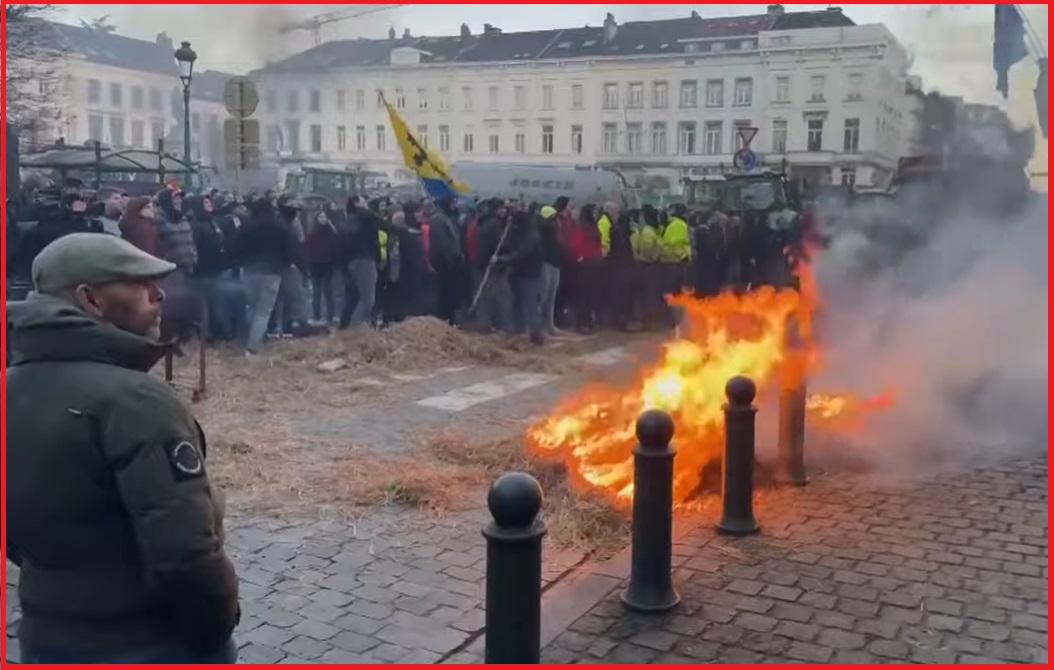
Protesting farmers blockaded multiple roads and camped outside the European parliament building in Brussels on Thursday, ahead of a EU leaders’ summit in the Belgian capital. The demonstrators lit two fires outside and placed their tractors in front of the European parliament building. Farmers have been protesting across Europe against the globalist agenda, rising costs in the agriculture sector and targeted taxes by the various governments.
(Associated Press) – France’s two major farmers unions announced they would lift country-wide blockades Thursday, shortly after the prime minister introduced new measures aimed at protecting their livelihoods that they described as “tangible progress.”
However, farmer activists who have snarled traffic along major highways around Paris said they would stay put at least another day to see the government commitments in writing, and both unions said they would closely monitor any government implementation.
“We don’t want to hear words of love. What we want is proof of love,” said Thierry Desforges, a farm union member at road blockade of the A6 highway in Chilly-Mazarin, south of Paris.
Thousands of French farmers have been demonstrating for a couple of weeks across the country in protests over low earnings, heavy regulation and what they call unfair competition from abroad. Similar protests also have extended across Europe, including at the European Union headquarters in Brussels.
Prime Minister Gabriel Attal, whose earlier promises to address farmers’ issues had failed to quell the French protests, announced a new set of measures Thursday.
They included tens of millions of euros in aid, tax breaks and a promise not to ban pesticides in France that are allowed elsewhere in Europe — which French farmers say leads to unfair competition. Attal also said France would immediately ban imports from outside the EU that use a pesticide banned in the bloc.
Arnaud Rousseau, president of France’s biggest farmers union FNSEA, and Young Farmers union President Arnaud Gaillot said Thursday that they were calling on their members to suspend the protests.
[…] At the Chilly-Mazarin blockade, Damien Greffin, a FNSEA representative, said farmers still need time to “better analyze the measures” as some appeared to him “a bit deceptive.”
Desforges, a fellow FNSEA member, remained cautious about proposals that concern the EU because “we know how Europe works, the countries still need to agree.”
Regarding domestic proposals, “we really need to wait and see if they are turned into law,” Desforges added. (read more)
Posted originally on Dec 11, 2023 By Martin Armstrong
Onions are the latest food staple facing extensive export restrictions in an effort to control domestic prices ahead of India’s 2024 national election. The Indian government has banned the export of onions until March 31, following similar measures for wheat and rice. These actions aim to boost domestic food supply and shield consumers from rising costs.
The nation is also restricting the usage of sugar cane juice in biofuel production to grow its reserves. The nation has also curbed wheat and rice exports in recent years and imposed significant duties. The restrictions have led to concerns about food inflation, prompting the government to take steps to stabilize the food supply.
The current food inflation rate in India is 6.61% as of October 2023, according to the Ministry of Statistics and Programme Implementation. This marks a slight decrease from the previous month’s rate of 6.62%. The cost of food in India increased by 6.61% in October 2023 compared to the same month in the previous year. The inflation rate for food in India is expected to be 5.90% by the end of the current quarter, but the government is preparing for higher food prices GLOBALLY.
As for the central bank, the Reserve Bank of India’s decision to leave its key policy rate unchanged has raised worries about higher food prices. The average retail prices of onions, rice, sugar, and tomatoes in India have seen noteworthy increases compared to the previous year.
Posted originally on the CTH on October 27, 2023 | Menagerie
I am in serious sourdough bread making mode now, as I usually am in the fall and winter. The urge to get my sourdough starter going usually hits the first brisk morning in September, but it was late coming this year due to our extended Indian summer.
I am looking for good soup recipes, maybe some fall vegetable and grain bowl ideas. Please share recipes and any requests you have!
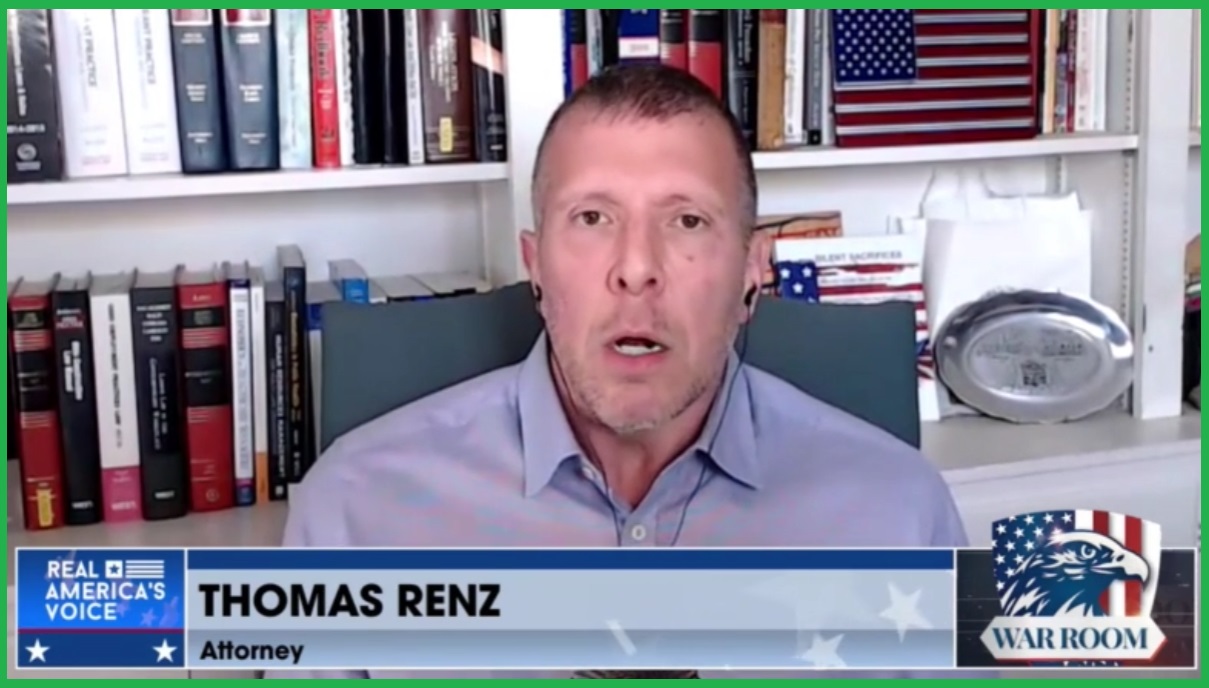
Attorney Thomas Renz was working on a legislative bill in Missouri for informed consent around vaccines, when suddenly he encountered pushback from Big Pharma and agriculture lobbyists. When he looked into the nature of their opposition, he discovered the intent to use mRNA technology in the U.S. food supply. Ever since he discovered this intention Renz has been trying to alert and warn everyone {Direct Rumble Link}.
Thomas Renz appears on the Bannon War Room for a discussion with Natalie Winters. The first segment begins at 04:58 of the video below:
The second part of the interview {Direct Rumble Link} is below. Start at 02:39:
.
I will have more information to share on this “genetically modified food” issue later this week. I opened a research file on mRNA vaccines in food and will share a basic interpretation of the current status as soon as I finish compiling the information.
Prior CTH research on Bovine Growth Hormone (BGH) in cattle and milk, and the origin of Bovine Spongiform Encephalopathy (BSE) commonly known as ‘mad cow’, will help to provide context to the current Rx and Big Ag intention with mRNA use in animal protein products. Again, more later.
Posted originally on the CTH on February 21, 2023 | Sundance
Follow the bouncing ball of consequence….
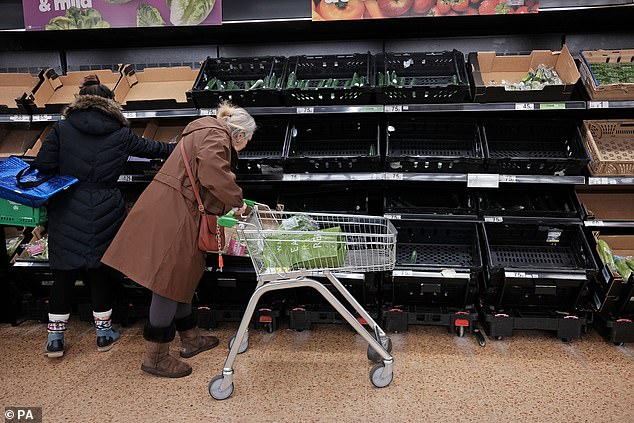
(Via Daily Mail) Vegetable rationing could last for ‘weeks’, it was warned today, after Morrisons joined Asda to became the second major supermarket to limit sales of certain items.
Perishables like tomatoes, potatoes, cucumber and broccoli have been restricted to just two or three per customer in a host of stores up and down the country.
The crisis has developed in recent weeks due to soaring energy costs which have forced British farmers to switch off greenhouses as they desperately try to make ends meet – leaving a dearth of home-grown produce. (read more)
While it is prudent to remind everyone how fortunate we are to have Florida, California and Mexico for North American vegetable supplies, ie. no dramatic supply shortages, the energy price pressure being applied by Biden policy will lead to even higher consumer prices for all row crops.
18 months ago (Oct 2021), CTH first strongly recommended restarting victory gardens at home. The same recommendation only strengthens.
Posted originally on the CTH on February 6, 2023 | Sundance
John Boyd Jr., President of the National Black Farmers Association appears on Newsmax TV to discuss the ongoing issue of higher farm input costs. Energy costs, fertilizer costs, fuel costs as well as all packing and distribution costs that are associated with petroleum manufacturing, are continuing to drive farm costs throughout the supply chain.
After a review of the current farm output status, there is a very strong possibility we will see the fourth wave of food inflation hit this spring, in combination with several manufacturing and production facilities. Again, the lack of consumer spending on durable goods has moderated the price in hard goods (supplies up, demand down); however, the highly consumable products like food, fuel and energy continue to experience upward price pressure as a direct result of Biden energy policy. WATCH:
.
If consumers could eat missiles and weapons, the U.S. government would be offsetting the costs. Unfortunately, for actual farming products, there is no government attention, policy or support. Apparently, food is still not considered a national security issue.
Posted originally on the CTH on January 30, 2023 | Sundance
This is a topic we have covered extensively, and it is great to see Tucker Carlson questioning the sudden alignment of various elements that are creating a very real food insecurity problem.
The #1 factor in the shortage of food production is the newly emboldened ‘western energy policy‘ and the impact energy has on everything from field (fertilizer) to fork (distribution). Other factors include government policy that blocks food development (Dutch, Irish and Sri Lanka Farmers), a sudden uptick in food facilities having major fires and damage, and a series of issues with the feed that goes into the production of proteins.
This is all happening as the advancement of insects as a more “sustainable” protein replacement is being advanced by the same western governments. However, if you happen to notice that all of the issues travel in the same direction, you are a conspiracy theorist, or something. WATCH:
We have been watching the predictable outcomes surrounding the western government shift to change energy policy for almost two years. Approximately a year ago we first said, “the absence of food will change things.”
As energy resources like natural gas were curtailed the resulting price increase and subsequent shortage of fertilizer was discussed in great detail well in advance.
Now, we are starting to see exactly what those warning voices were talking about.
An interesting article in ZeroHedge Saturday [SEE HERE] draws attention to how the media can no longer try to ignore the created global food crisis.
ZeroHedge – People on the other side of the planet are dropping dead from starvation right now, but most people don’t even realize that this is happening. Unfortunately, most people just assume that everything is fine and dandy. If you are one of those people that believe that everything is just wonderful, I would encourage you to pay close attention to the details that I am about to share with you. Global hunger is rapidly spreading, and that is because global food supplies have been getting tighter and tighter.
If current trends continue, we could potentially be facing a nightmare scenario before this calendar year is over. (read more)
The article then goes on to detail the issues and food shortages in Pakistan, India and the entire African continent. Factually, according to media reports on the region, the worst food crisis in history is happening – yet most U.S. and European Union media are avoiding it. The famine is happening in almost complete western silence.
Keep in mind, none of this is unexpected. In fact, the G7 countries discussed the pending problem in mid 2022, yet no one took any steps to avoid it.
Vladimir Putin’s military action against eastern Ukraine had nothing to do with the severe food shortages and inflation in Sri Lanka {link}. Nor did Russia have any influence over the Dutch government trying to stop food production {link}. Additionally, Putin had no control over Justin Trudeau’s decision to limit harvest yields by blocking the use of nitrogen-based fertilizer {link}. More importantly, it was not Vladimir Putin who forced all the western politicians to sign up for a new ‘climate friendly’ energy program that is destroying the ability of western farms to generate higher yield crops.
You do not need to be a farmer to understand that nitrogen/phosphorus-based industrial fertilizer has been the reason why farm yields have generated massive amounts of food on a global basis. The United States, Canada, the U.K. and places like the Netherlands have massively increased their ability to generate food for export, in large part due to the success of improved fertilizer and crop saving modern pesticides. Take those farming advancements away under the guise of climate change and you get Sri Lanka, Pakistan and now the African Continent.
Those western climate and energy policies create downstream consequences. The decision to chase a new global energy policy under the name “Build Back Better,” in combination with short-sighted EU sanctions against Russia, and you get food shortages.
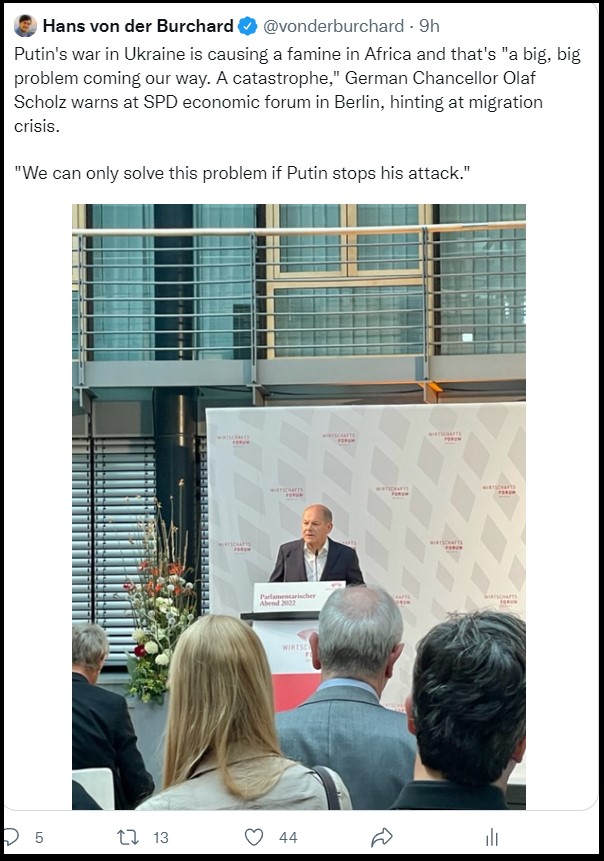
It was not Vladimir Putin who told British Prime Minister Boris Johnson and German Chancellor Olaf Scholz their proactive recommendation to switch from crop-based biofuels to human food would be blocked. That G7 decision was made by Justin Trudeau and Joe Biden. {link} Even more significantly, it was not Russia who threatened the multinational energy companies about investing in Africa for expanded natural gas supplies for their fertilizer needs. That threat came from the same western government alliance, per their instructions from the World Economic Forum group {link}.
It was predictable {JUNE 21st} {June 30th} and {July 6th} that western government leaders would seek to avoid responsibility for the food crisis they created, and throughout the latter part of 2022 we saw western media trying, desperately, to frame Russia for global food shortages in order to protect western politicians.
I said this in July of last year and as the consequences now surface it is even more critical to understand.
Joe Biden, NATO, the G7, the European Union, the World Bank, USAID, and every western leader in the United States and Europe stated in early and mid 2022 there will be food shortages in 2023.
They did not say there might be shortages; their statements were emphatic, there will be shortages.
Accept this basic cornerstone. Then ask why not a single proactive step has been taken by any of the aforementioned institutions or governments to alleviate what they declare is a certainty. Why?
Simple question, “why?”
If all of the western nations, non-govt organizations and heads of state, are aware of a coming food crisis, why is there no proactive response?
It is a question that even the most hardcore leftists will not answer, because there is only one answer. No action is being taken because they do not want to take action. No effort to avoid the crisis is being done, because they do not want the crisis avoided.
Peel all the layers of obfuscation and causation away, and what we find is the epicenter of the food shortage is directly the result of the Build Back Better agenda. A post-pandemic western government deliberate decision to radically change global energy development. In succinct terms, the climate change agenda.
However, regardless of how you feel about the validity of “climate change,” the cause of diminished food supplies is purposeful. It is not climate change causing food shortages. It is the purposeful action taken under the guise of mitigating climate change that is causing the shortage of food.
The collective Build Back Better energy policy of western governments’ is the reason for massive increases in energy costs, massive oil price jumps, gasoline price increases, significant increases in chemical costs, increases in diesel fuel costs, shortages of fertilizer created using natural gas, and the end result is lower crop yields, higher farming costs and eventually, food shortages. They knew this.
All of the organizations and government who have been decrying the future shortage of food, know it is the radical shift in energy resource development that is creating the crisis. This acceptance of reality begins the framework to understand just how entrenched and committed these western leaders are toward their beloved climate change agenda.
We are only just now beginning to see the first aspects of the food shortage. However, once the issue becomes unavoidable the western leaders will not and cannot accept the blame for what they have done. They will blame-cast, excuse and justify what is surfacing.
Food shortages will be blamed on the Ukraine conflict, Russian aggression, climate change and any various iteration of justification that does not identify the true cause, their energy ideology.
I’m not so sure that people fully understand what the entire system of western government would be willing to do to avoid being blamed for avoidable death on a potential scale that is quite alarming. All of the western leaders, institutions and governments are on the same boat. They are all in this together.
(June 22, 2022) – (Reuters) – The European Union is divided on how to help poorer nations fight a growing food crisis and address shortages of fertilizers caused by the war in Ukraine, with some fearing a plan to invest in plants in Africa would clash with EU green goals.
The need for food “clashes with EU green goals.”… Let that sink in.
Food shortages have historically contributed to revolutions more so than just international war. Poor grain harvests led to riots as far back as 1529 in the French city of Lyon. During the French Petite Rebeyne of 1436. (Great Rebellion), sparked by the high price of wheat, thousands looted and destroyed the houses of rich citizens, eventually spilling the grain from the municipal granary onto the streets. Back then, it was to go get the rich.
There was a climate change cycle at work and today’s climate zealots ignore their history altogether for it did not involve fossil fuels. The climate got worse at the bottom of the Mini Ice Age which was about 1650. It really did not warm up substantially until the mid-1800s. During the 18th century, the climate resulted in very poor crops. Since the 1760s, the king had been counseled by Physiocrats, who were a group of economists that believed that the wealth of nations was derived solely from the value of land and thereby agricultural products should be highly priced. This is why Adam Smith wrote his Wealth of Nations as a retort to the Physiocrats. It was their theory that justified imperialism – the quest to conquer more land for wealth; the days of empire-building.
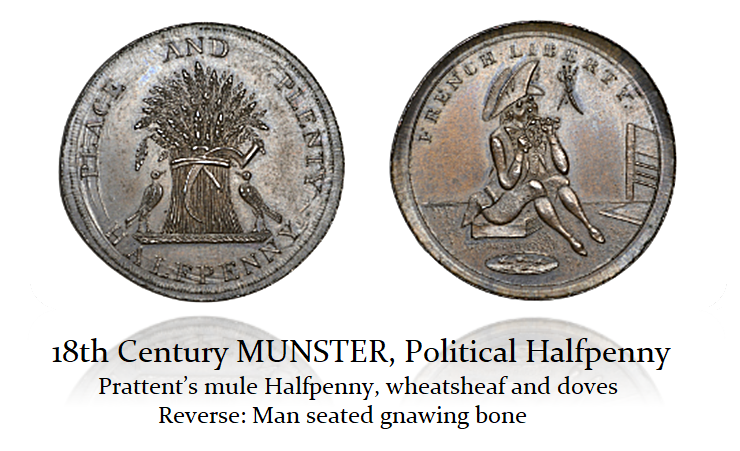
The King of France had listened to the Physiocrats who counseled him to intermittently deregulate the domestic grain trade and introduce a form of free trade. That did not go very well for there was a shortage of grain and this only led to a bidding war – hence the high price of wheat. We even see English political tokens of the era campaigning about the high price of grain and the shortage of food to where a man is gnawing on a bone.
Voltaire once remarked that Parisians required only “the comic opera and white bread.” Indeed, bread has also played a very critical role in French history that is overlooked. The French Revolution that began with the storming of the Bastille on July 14th, 1789 was not just looking for guns, but also grains to make bread.
The price of bread and the shortages played a very significant role during the revolution. We must understand Marie Antoinette’s supposed quote upon hearing that her subjects had no bread: “Let them eat cake!” which was just propaganda at the time. The “cake” was not the cake as we know it today, but the crust was still left in the pan after taking the bread out. This shows the magnitude that the shortage of bread played in the revolution.
In late April and May of 1775, the food shortages and high prices of grain ignited an explosion of such popular anger in the surrounding regions of Paris. There were more than 300 riots and looking for grain over just three weeks (3.14 weeks). The historians dubbed this the Flour War. The people even stormed the place at Versailles before the riots spread into Paris and outward into the countryside.
The food shortage became so acute during the 1780s that it was exacerbated by the influx of immigration to France during that period. It was a period of changing social values where we heard similar cries for equality. Eventually, this became one of the virtues on which the French Republic was founded. Most importantly, theFrench Constitution of 1791 explicitly stipulated a right to freedom of movement. It was mostly perceived to be a food shortage and the reason was the greedy rich. Thus, a huge rise in population was also contributed in part by immigration whereas it reached around 5-6 million more people in France in 1789 than in 1720.
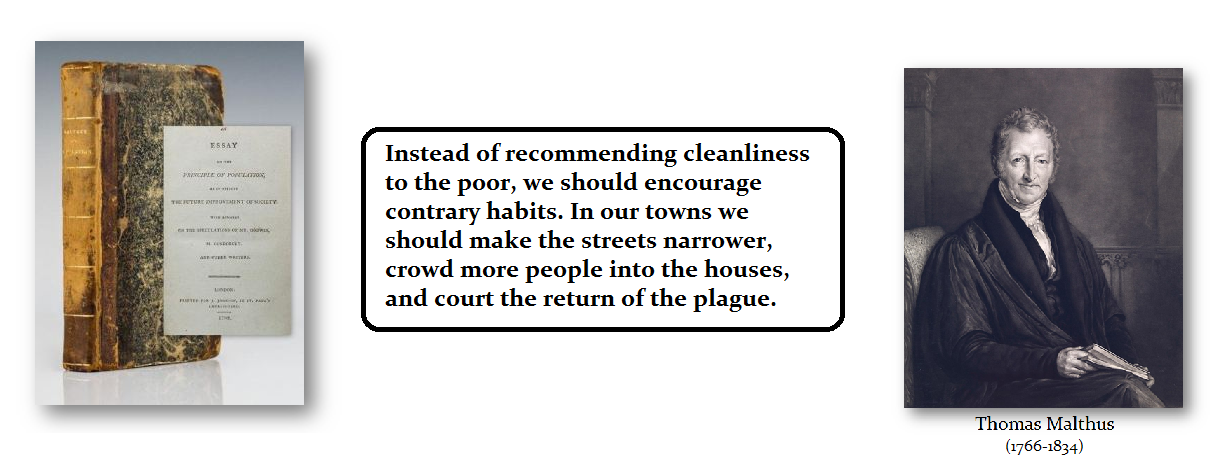
Against this backdrop, we have the publication by Thomas Malthus (1766-1834) An Essay on the Principle of Population was first published anonymously in 1798. He theorized that the population would outgrow the ability to produce food. We can see how his thinking formed because of the Mini Ice Age that bottomed in 1650. All of this was because of climate change which instigated food shortages. Therefore, it was commonly accepted that without a corresponding increase in native grain production, there would be a serious crisis.
The refusal on the part of most of the French to eat anything but a cereal-based diet was another major issue. Bread likely accounted for 60-80 percent of the budget of a wage-earner’s family at that point in time. Consequently, even a small rise in grain prices could spark political tensions. Because this was such an issue, and probably the major cause of the French Revolution among the majority, Finance Minister Jacques Necker (1732–1804) claimed that, to show solidarity with the people, King Louis XVI was eating the lower-class maslin bread. Maslin bread is from a mix of wheat and rye, rather than the elite manchet, white bread that is achieved by sifting wholemeal flour to remove the wheatgerm and bran.
That solidarity was seen as propaganda and the instigators made up the Marie Antoinette quote: Let them eat cake. . Then there was a plot drawn up at Passy in 1789 that fomented the rebellion against the crown shortly before the people stormed the Bastille. It declared “do everything in our power to ensure that the lack of bread is total, so that the bourgeoisie are forced to take up arms.”
It was also at this time when Anne Robert Jacques Turgot (1727-1781), Baron de l’Aulne, was a French economist and statesman. He was originally considered a physiocrat, but he kept an open mind and became the first economist to have recognized the law of diminishing marginal returns in agriculture. He became the father of economic liberalism which we call today laissez-faire for he put it into action. He saw the overregulation of grain production was behind also contributing to the food shortages. He once said: “Ne vous mêlez pas du pain”—Do not meddle with bread.
The French Revolution overthrew the monarchy and they began beheading anyone who supported the Monarchy and confiscated their wealth as well as the land belonging to the Catholic Church. Nevertheless, the revolution did not end French anxiety over bread. On August 29th, 1789, only two days after completing the Declaration of the Rights of Man and of the Citizen, the Constituent Assembly completely deregulated domestic grain markets. The move raised fears about speculation, hoarding, and exportation.
Then on October 21st, 1789, a baker, Denis François, was accused of hiding loaves from sale as part of a conspiracy to deprive the people of bread. Despite a hearing which proved him innocent, the crowd dragged François to the Place de Grève, hanged and decapitated him, and made his pregnant wife kiss his bloodied lips. Immediately thereafter, the National Constituent Assembly instituted martial law. At first sight, this act appears as a callous lynching by the mob, yet it led to social sanctions against the general public. The deputies decided to meet popular violence with force.
So, food has often been a MAJOR factor in revolutions. We are entering a cold period. Ukraine has been the breadbasket for Europe. Escalating this war will also lead to accelerating the food shortages post-2024. It is interesting how we learn nothing from history. Wars are instigated by political leaders while revolutions are instigated by the people.
I have created this site to help people have fun in the kitchen. I write about enjoying life both in and out of my kitchen. Life is short! Make the most of it and enjoy!
This is a library of News Events not reported by the Main Stream Media documenting & connecting the dots on How the Obama Marxist Liberal agenda is destroying America











 Centinel2012