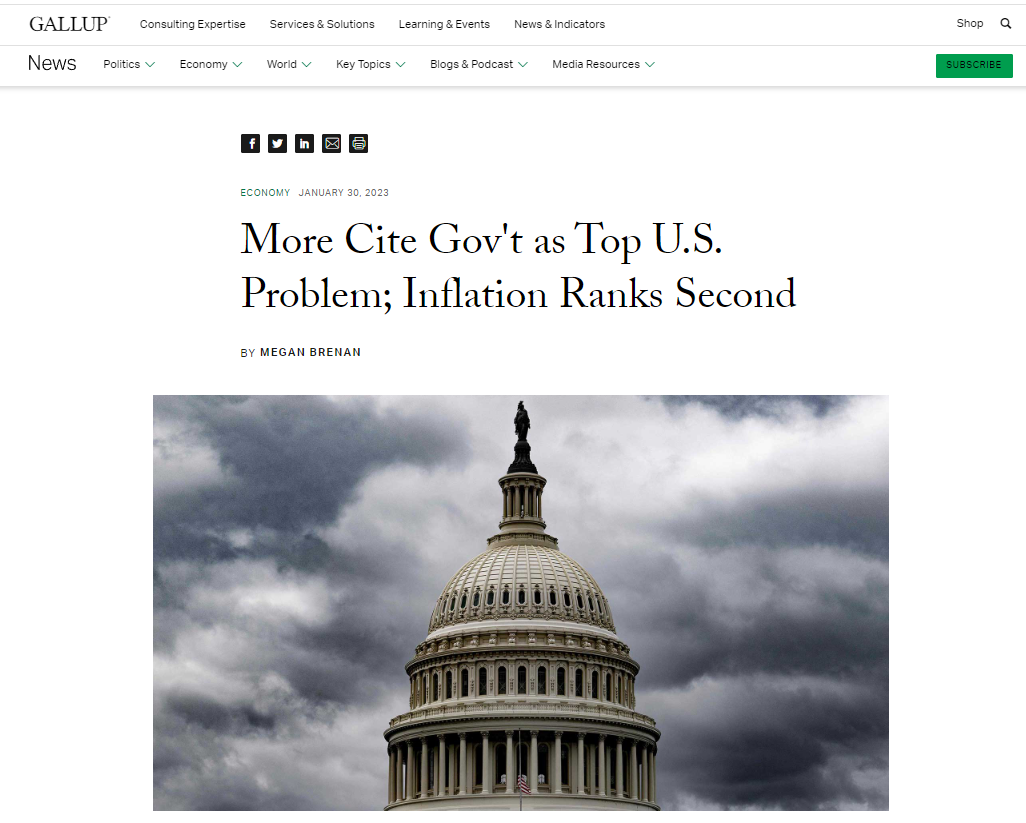
Gallup has just confirmed what our computer has been forecasting especially since 2011. The majority of Americans now say that a lack of leadership from President Biden and Congress is the country’s biggest problem and that means the entire world. Perhaps aliens should have a right to vote for the decisions of the Biden Administration are destroying lives around the world.
The Gallup Poll shows that it is the collapse of confidence in a government that is now viewed as the greatest threat even more so than inflation, the immigration crisis, and the state of the economy. Despite Americans suffering economically with higher taxes and inflation reducing the standard of living, they have cited that “the government/poor leadership” is now in the No. 1 spot taking that place from inflation over the past year. Gallup has reported that 21% of Americans name our incompetent government as the “most important problem facing this country today” compared to the 15% who said so last year, a Gallup Poll found.
Inflation and the economy came in last year as the top two issues — tied at 16% each — followed by the government (15%), immigration (8%), and unifying the country (6%). However, over the past year, Americans’ concerns with the economy fell 6% to 10%, with inflation falling one point to 15%, and immigration rose 3 points to 11%.
Just wait until they realize that the Biden Administration is so incompetent, it has allowed the Neocons to wage World War III on two fronts – China and Russia. These people will destroy Western Civilization and that is what 2032 is all about.
COMMENT: Good Morning Mr. Armstrong, a long-time reader and client of Socrates and your conferences. I just read your entry for Belarus drafting 18 to 60-year-olds. I had a feeling that eventually, that would take place here in the states. I can tell you without a doubt, I will never comply. My family has served in WWII and Vietnam. We have given enough. I absolutely despise our government. I am wondering if this is part of the continued collapse of the government. With such low recruitment levels and the political fallout from the past few years, they must realize people will not be forced to serve. Especially those with the means to defend themselves. Is this a main component of civil unrest here with separatist movements? Just curious if you can elaborate on what you think will happen when they institute a draft here. All the Best.
J
REPLY: My family has fought in every war since the American Revolution. My cousin still has the musket on his wall from the American Revolution. I lost half of my high school friends to Vietnam and my father and his three brothers were all in World War II and my grandfathers on both sides of the family were in World War I. There is no question that in a time of war, the first shot fired is both silent and never against an enemy. It is always against any truthful reporting of events.
The Defense Casualty Analysis System (DCAS) Extract Files contain records of 58,220 U.S. military fatal casualties of the Vietnam War. The government propaganda site, Wikipedia also directed by the Deep State, has low-balled the casualties claiming in total, all US and allied military deaths reached 282,000. We claim that is a victory for the VC lost 444,000 to possibly 666,000. The civilians who died have been low-balled with estimates of 405,000 up to 627,000. Just turn to Britannica and you get:
“In 1995 Vietnam released its official estimate of the number of people killed during the Vietnam War: as many as 2,000,000 civilians on both sides and some 1,100,000 North Vietnamese and Viet Cong fighters.”
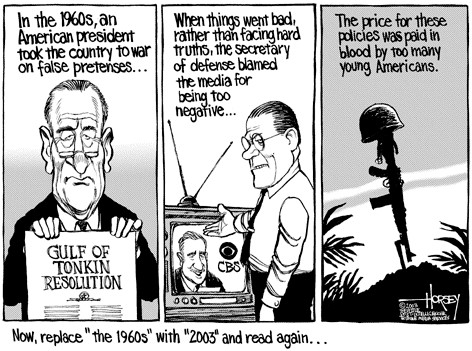
President Lydon Johnson knew there was no reason to enter Vietnam. He knew we could not get out easily. Still, he committed the country to war because the Neocons wanted it.
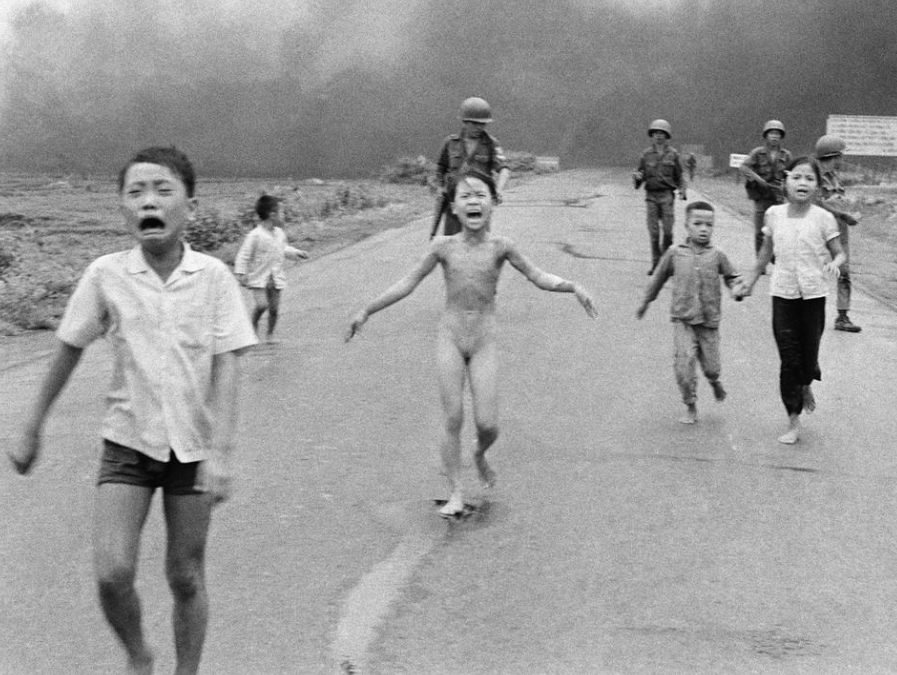
This is a famous photograph from Vietnam that is probably the most memorable of all time. You see South Vietnamese forces following terrified children. At the center is 9-year-old Phan Thi Kim Phùc, as she and other children are running from an aerial napalm attack on suspected Viet Cong hiding places on June 8, 1972. The plane accidentally dropped napalm on South Vietnamese troops and civilians. As always, just the collateral damage of war. The terrified girl had ripped off her burning clothes while fleeing. This photo was taken by Nick Ut of The Associated Press that captured the horror of Vietnam worldwide. It was 1972 when President Nixon said enough and promised to bring the troops home.
This 9-year-old make girl running from napalm, Phan Thi Kim Phúc, had profoundly changed her forever. Such people are tormented for a lifetime. They wake up at night dreaming over and over about the horror of those events for the rest of their lives. Kim Phúc was bitter and full of hatred she said. Later, she picked up the Bible and converted to Christianity. Today, she lives in Toronto with her family and helps other children victims of war around the world. It is those who survive who are profoundly tortured for the remainder of their lives. That is the real cost of war that nobody cares about.
The official estimate of civilian deaths in World War II stands at a total of 70–85 million. The actual military deaths were 21,000,000 to 25,500,000. There is ALWAYS an equal amount of civilian deaths in times of war. Those in power never want to talk about that.
Posted originally on the CTH on January 1, 2023 | Sundance
This is an interesting interview in that International Monetary Fund Globalist Director Kristalina Georgieva seems to be laying the landscape for some truthful economic news to surface on the geopolitical level; albeit keeping up the globalist pretenses around western collective energy policy.
One of the more important points Mrs. Georgieva hits on is the reopening of China, from district level COVID bubbles as a containment feature, and the likely impact it will have on global supply chains. Mrs. Georgieva is correct on this issue.
China continued operating their industrial manufacturing base (despite COVID) because they built strict covid isolation bubbles around their industrial sectors geographically. However, with China lifting those isolation bubbles, there is a great potential for the manufacturing sectors to be hit hard by short to medium term virus outbreaks. This could/will have the potential ripple effect of global supply disruptions.
In an ironic twist, ‘deglobalization’ is now a 2023 catchphrase as various nations realize having their supply chains both dependent and interconnected is not good when there are interruptions. A new discussion centering around being dependent on China is the specific issue now being raised. However, the globalists are isolating their viewpoints only to raw material resourcing and development. WATCH:
[Transcript] -MARGARET BRENNAN: I want you to take us around the world and kind of us give us that global view. Let’s start in China. China has been this hub of cheap manufacturing for the world, we are all so dependent on it but right now it looks like COVID cases are exploding as they start pulling back those zero COVID restrictions. What will that mean for the global economy Longterm and short-term?
GEORGIEVA: In the short term, bad news. China has slowed down dramatically in 2022 because of this tight zero COVID policy. For the first time in 40 years China’s growth in 2022 is likely to be at or below global growth. That has never happened before. And looking into next year for three, four, five, six months the relaxation of COVID restrictions will mean bush fire COVID cases throughout China. I was in China last week, in a bubble in the city where there is zero COVID. But that is not going to last once the Chinese people start traveling.
MARGARET BRENNAN: Because they also- they don’t have an effective vaccine right now.
GEORGIEVA: The- the vaccinations fall behind. They have not worked on anti-viral treatments and how that can be offered to people, and so they will go through this tough time. If they stay the course, and this is our advice, stay the course, over time they would be able to catch up with the rest of the world, both in terms of focusing their vaccinations, bringing mRNA vaccines into China, expanding antiviral treatment, and the economy would function. But for the next couple of months, it would be tough for China, and the impact on Chinese growth would be negative. The impact on the region would- would be negative. The impact on global growth would be negative.
MARGARET BRENNAN: Because this is the second-largest economy in the world, and we’ve learned how dependent the world is on the Chinese supply chain. So do you expect then, a domino effect? Will inflation get worse, because all of a sudden there aren’t workers healthy enough to go to factories in China?
GEORGIEVA: We expect that there would be counterweight from the sheer opening of the economy, because up to now, the biggest impact on global value chains came from restrictions due to COVID. When you close down a big city or a big port, the repercussions for the economy is- are significant. Now, we would have the impact of people getting sick, not going to work, but the economy would be open. So the expectations we have for China is to gradually move to a higher level of economic performance, and finish the year better off than it is going to start the year. But you’re absolutely right, the world has relied on China’s growth for a long, long, long time. Before COVID, China would deliver 34, 35, 40% of global growth. It is not doing it anymore. It is actually quite a stressful for the- for the Asian economies. When I talk to Asian leaders, all of them start with this question, what is going to happen with China? Is China going to return to a higher level of growth?
MARGARET BRENNAN: You’ve said that you fear that we are sleepwalking into a world that is poorer and less secure because of a split in the global economy between the US and China. What do you mean by that? Do you see efforts here in Washington to stop it?
GEORGIEVA: It is very easy to reflect on the benefits of the world being more integrated. When we look back over the last three decades, the world economy tripled because of this reliance on an integrated world economy. Who benefited the most? Emerging markets and developing economies, they quadrupled. But rich countries also benefited, they doubled in size of the economy. So we have to be careful not to throw the baby out with the bath water. Yes, the way we have operated created excessive dependency in global chains. We were too focused on costs, how can we make products cheaper. And COVID and then the senseless war Russia started against Ukraine has shown that this is not enough. We cannot just concentrate on what is cheaper. We have to think of the security of supplies and that means diversify the sources of products that make the economy function well, lifting up the level of cost. That economic logic is not only appropriate, it is a must to follow. But we shouldn’t go beyond. We shouldn’t say, okay, we break the world into blocks, one works here, the other one works there because the costs are very, very high. We calculated that just trade, limiting trade into two blocks, would chop $1.5 trillion from the global GDP year after year after year.
MARGARET BRENNAN: If you tried to separate the US and China?
GEORGIEVA: You separate- you separate them, there is an excessive cost. So the logic should be where for security reasons there has to be careful recalibration of supply chains, do it, but don’t go beyond- don’t go into benign areas of products that have no strategic significance but they benefit the US consumer, they benefit the world economy. And this is what we are arguing for, don’t go in a direction in which this separation would make everybody poorer and the world less secure.
MARGARET BRENNAN: So you’re telling Beijing and Washington, figure it out. You can’t be in conflict.
GEORGIEVA: What we have seen in Bali is an indication that this rationale–
MARGARET BRENNAN: You’re talking about the G20 meeting–
GEORGIEVA: The G20 meeting in Bali, when the two presidents, President Biden and President Xi Jinping, met, they spent three and a half hours discussing exactly that. Where is the point of contact that makes both countries better off? And where is that- that there are differences that cannot be bridged and therefore we have to keep them–
MARGARET BRENNAN: The US is trying to block some Chinese technology companies from doing business here. They’re taking measures that are drawing some pretty bright lines between the US and China. Is that tolerable?
GEORGIEVA: We always prefer countries to seek their common interest in economic integration. And when you start breaking the interactions that are based on fair trade, you harm your own people, you not only harm the- the Chinese and therefore it has to be thought through very carefully. Again, I want to be very clear, some diversification of supplies for the security of supply chains is necessary. COVID taught us this lesson, the war taught us this lesson. So the U.S. is right to look into some areas where strategically they need to guarantee the functioning of the U.S. economy without interruptions. But do that keeping in mind the interests of the American people that would like to still have prices moderating, and actually, when we think about prices, one good news we have for 2023 is that towards the end of the year, we do expect inflation to trim down. So don’t take actions that may be contrary to that trend.
MARGARET BRENNAN: But you are predicting inflation to slow to six and a half percent from about 7%. Is that right?
GEORGIEVA: Well, towards the end of the year, we- we project it would go even further down towards the end of 2023, provided central banks stayed the course. Our big worry is that with the economy slowing down globally, we are projecting global growth to go down to 2.7%, maybe even lower next year. Remember, 2021, it was 6%. It dropped to 3.2 this year, 2022. And it will continue to drop down if central banks get the cold foot and say, ‘oh, my god, growth is slowing down, let’s slow down the fight against inflation.’ We risk then inflation to be more persistent. So our message is to central banks, you have to see credible decline in inflation and only then you can think about re-calibrating rate policy.
MARGARET BRENNAN: One of your IMF researchers gave a pretty dire prediction. Overall this year, shocks will reopen economic wounds that were only partially healed post-pandemic. In short, the worst is yet to come and for many people, 2023 will feel like a recession. What do you need to brace for?
GEORGIEVA: The- this is- this is what we see in 2023. For most of the world economy, this is going to be a tough year, tougher than the year we leave behind. Why? Because the three big economies, U.S., E.U., China, are all slowing down simultaneously. The US is most resilient. The U.S. may avoid recession. We see the labor market remaining quite strong. This is, however, mixed blessing because if the labor market is very strong, the Fed may have to keep interest rates tighter for- for longer to bring inflation down. The E.U. very severely hit by the war in Ukraine. Half of the European Union will be in recession next year. China is going to slow down this year further. Next year will be a tough year for China. And that translates into negative trends globally. When we look at the emerging markets in developing economies, there, the picture is even direr. Why? Because on top of everything else, they get hit by high interest rates and by the appreciation of the dollar. For those economies that have high level of that, this is a devastation.
MARGARET BRENNAN: And I want to- I want to come back to you on that. And just to explain that for some of our listeners, a stronger dollar, it’s good for Americans when they go shopping abroad. It’s not good for poor countries who have taken out loans, for example, and borrowed money in dollars. And according to the IMF, 60% of low income countries are in distress because of this- this debt. So what does that look like? Do you- do you see governments collapsing with defaults? Does that bleed into the global financial system? I mean, how much of a contagion does this become?
GEORGIEVA: So far the countries that are in that distress are not systemically significant to trigger a debt crisis. Let’s just look at the map, which are these countries? Chad, Ethiopia, Zambia, Ghana, Lebanon, Surinam, Sri Lanka, very important for their people that we find the resolution to the debt problem, but the risk of contagion is not as high. However, if that list continues to grow, and let’s remember, 25% of emerging markets are trading in distressed territory, then the world economy may be for a bad surprise. And this is why at the IMF, we are working very hard to press for debt resolution for these countries and we have engaged the traditional creditors, the Paris Club, the non-traditional creditors, China, India, Saudi Arabia. I would call this very simple: urgency, we have to act. When I look at the- the debt of the world. Yes, we have to be concerned. During COVID, what did we do? Everywhere governments borrowed, rightly so, to help their people.
MARGARET BRENNAN: Money was cheap.
GEORGIEVA: Money was cheap, and we prevented a collapse of the world economy. That was the right thing to do. But once Russia invaded Ukraine and that added impetus to inflation, money is not- not cheap anymore. So what is the advice we give to governments? Focus on your budgets, make sure that you have sufficient revenues to collect and that you spend very wisely.
MARGARET BRENNAN: That’s good advice, but it’s not always easy politics to follow that advice, as you know–
GEORGIEVA: Of course it is not.
MARGARET BRENNAN: And so that’s why I want to- if- if you can explain for our viewers. You know, we spoke to the CEO of JPMorgan Chase, Jamie Dimon, recently, and he said he sees the global risk as explosive right now. He was saying things like migration, energy, national security, liquidity in the banking system, war, these are all the knock on effects of a government not being able to pay its bills and not being able to deliver for its people. Is that what you are seeing too?
GEORGIEVA: Well, what we’re seeing is the world has changed dramatically. It is a more shock prone world. The lessons we learned from the last couple of years are that no more we operate with relative predictability of what the future would bring. And these shocks COVID, the war, costs of living crisis, they compound their impact. What does that mean for governments? First and foremost, it means that we need to change our mindset towards more resilience, more precautionary actions. And at the IMF, this is what we tell our members. Act early, don’t wait until the problems deepen. And for those who need help, this is why we exist for the developing countries. The fund is a source of resilience and I am- I am very pleased that many of our members are coming to us. Just since the war started we got 16 countries coming for programs to the IMF, $90 billion in support for these countries. And right now we have 36 requests. So that acting early, when you see trouble, look for ways to strengthen your fundamentals, to have buffers to protect you and your people. This is the advice we give to governments. For those who don’t know the IMF, we were created from the ashes of the Second World War to stabilize the world economy. And at a moment like this, we come strong to help our members. My message, don’t think that we are going to go back to pre-COVID predictability. More uncertainty, more overlap of crises wait for us. Rather than crying for the time we had, we have to buckle up and act in that more agile, precautionary manner I described.
MARGARET BRENNAN: I want to make sure I get to Ukraine because I know we’re running out of time. You’ve said- excuse me- you’ve said the single most negative factor in the global economy is the war in Ukraine. And Vladimir Putin says this is going to go on for some time. President Zelensky said they need $55 billion in foreign support next year. He expects $20 billion from the IMF, is he going to get it?
GEORGIEVA: We are working on providing support for Ukraine. So far, out to the international financial institutions, we have provided the largest amount of financing for Ukraine, $2.7 billion in emergency financing, and we are working for 2023 to be a significant part of the support for Ukraine. I expect that sometime early in the year we will go to our board with the request. We have assessed the needs of Ukraine to range somewhere between three and five billion dollars a month. What Putin did with destroying critical infrastructure in Ukraine, this is horrific, and it means that in the next months the country would be more on the high end of this range because it is put in an awful position to have to restore access to electricity, to heat, to water. I have relatives in Ukraine. What I- what I know from them is it is cold, it is dark, and it is scary. Bombardments of civilian areas continue. What I also want to say is that Ukraine has proven to be remarkably resilient. Ukrainian economy is functioning. Pensions are being paid. When there is bombardment, restoration of energy, water, heat is done very quickly and we see revenues collected in Ukraine in a very disciplined manner to support the functioning of the country.
MARGARET BRENNAN: So the government’s not going to collapse?
GEORGIEVA: The government is very well functioning under incredibly difficult circumstances. No, they’re not going to collapse. And then the other thing that is so remarkable is actually the world has proven to be more resilient than we feared, a year in the beginning of the year. We look at the response to the energy shock in Europe, and Europe is moving towards independence from Russia decisively. Yes, there will be a tough winter, maybe the next one would be even tougher, but freedom from dependence on Russia is coming. It is going to be there.
MARGARET BRENNAN: I want to ask you two questions before we go. How do you describe the state of U.S. economics and politics?
GEORGIEVA: The US economy is remarkably resilient. Decision making in the US because of the way the political set is at the moment, it is more difficult. But nonetheless the US has taken some very important steps that are helping to the US economy. Like the child tax-
MARGARET BRENNAN: The tax credit. It expired.
GEORGIEVA: The credit that is it. It is contributing so significantly to reducing poverty in the US, like the infrastructure bill, like the Inflation Reduction Act. These are things that are bringing more dynamism in the US. Good for the US, good for the world. And of course staying on that course is going to be more challenging. But I do hope that the US is not going to slip into recession despite all these risks. We expect one third of the world economy to be in recession. And yes, as you said, even countries that are not in recession, it would feel like recession for hundreds of millions of people. But if that resilience of the labor market in the US holds, the US would help the world to get through a very difficult year.
MARGARET BRENNAN: And as I let you go, my final question is what leaves you hopeful in 2023?
GEORGIEVA: What leaves me hopeful is that I know when we work together, we can overcome the most dramatic challenges. In 2020, the world came together in the face of tremendous threat and was able to overcome this threat. In 2023 we have to do the same. And in this world of ours, of more frequent and devastating shocks, we have to hold hands, we have to work together. And my institution is there to bring together economic policymakers so we can be wise and persistent in the face of truly dramatic challenges we face.
MARGARET BRENNAN: Madam managing Director, thank you for your time this morning.
Posted originally on the CTH on December 30, 2022 | Sundance
Underreported and essentially invisible within the mainstream news cycles, a critical shortage of ordinary U.S. medicine has been growing and becoming an emergency situation for many families. If rationing kicks in fully, be careful about what you post on social media. Determining allowances based on political ideology is a real concern.
In a general sense the issue is mostly an outcome of the U.S. outsourcing drug ingredient procurement and manufacture to China and India. Many companies in both of those countries have been struggling with operational interruptions as a result of COVID-19. As supplies in the U.S. rapidly dwindle, local news media outlets are now starting to pick up on the issue. WATCH:
(Via Fox Business) – The nationwide shortage of basic antibiotics and critical medications that treat chronic conditions and bacterial infections has become the latest issue to hit the medical world. Consequently, it is forcing many doctors to rely on alternative medicines to treat patients.
“What was once an unthinkable situation—a shortage of basic antibiotics such as amoxicillin and Augmentin to treat ear and skin infections or even medications such as Albuterol to treat asthma—is now a harsh reality,” New York City-based emergency room physician Dr. Robert Glatter told FOX Business.
Even the “shortage of basic medications such as children’s Tylenol—integral to treating fever and mild to moderate pain—is impacting our ability to provide care for our patients,” Glatter said.
Currently, the Food and Drug Administration (FDA) has a list of more than 180 current or resolved drug shortages. He said there have been shortages of antivirals such as Tamiflu, which is used to treat high-risk patients with influenza, as well as diabetic medications such as Ozempic due to the “inappropriate and off-label use” of the medication for weight loss and cosmetic purposes.
Glatter predicted that the drug shortage problem rippling throughout the U.S. could last for at least another year, if not longer.
According to federal health officials, intermittent or reduced availability of certain products can occur for many reasons, including manufacturing and quality problems, delays and discontinuations.
However, Glatter said that the problem is in part because the U.S. is currently facing challenges in obtaining raw materials. For instance, source materials for manufacturing the active pharmaceutical ingredients in the majority of drugs come from China, which is dealing with limited production and output of raw materials involved in pharmaceutical manufacturing due to rigid lockdown measures, Glatter said.
The U.S. is also dependent on India for a significant number of generic medications, but India also relies on China for the raw materials used to produce active pharmaceutical ingredients, he added. (read more)
We accept the named legislation “Inflation Reduction Act” (IRA) is a legislative misnomer intended to obfuscate the true construct of the bill. The IRA was factually the ‘green new deal’ program packaged under the guise of an ‘inflation reduction’ premise. However, in order to discuss the outcome of the content we have to play the game of pretending around the purpose of the legislation.
Within the IRA there was a $7,500 tax credit for American made Electric Vehicles. The intent of the legislation was to provide incentives for U.S. consumers to purchase ‘sustainable’ and environmentally friendly electric cars, trucks, SUV’s etc made in America.
The Congressional Budget Office (CBO) scored the bill with this legislative intent in mind. However, the Treasury Department is now taking apart the granular details of the legislation in order to qualify foreign made vehicles for the $7,500 credit. The rules interpretation from the Treasury Dept essentially negates the CBO score, and the outcome is going to be much more expensive than initially stated.
Because the $7,500 comes in the form of a tax credit, the IRS (Treasury) is the institution making the determinations for qualification. Treasury is changing the qualifications to permit basically any EV to qualify, by parsing a difference between a leased vehicle and a purchased vehicle. Additionally, Treasury is changing the battery sourcing aspect by qualifying essentially any trade agreement as a Free Trade Agreement (FTA), saying the term Free Trade Agreement was undefined in the legislation.
As an outcome & simply cutting to the chase, EV batteries from just about anywhere, inside EV vehicles from basically anywhere, that are purchased as leases from just about any auto manufacturer, will qualify for the $7,500 credit. It’s all a shell game, with the Biden administration determining where the pea is located.
Dec 29 (Reuters) – The U.S. Treasury Department said Thursday that electric vehicles leased by consumers starting Jan. 1 can qualify for up to $7,500 in commercial clean vehicle tax credits, a decision that makes those assembled outside North America eligible.
The announcement is a win for South Korea and some automakers that earlier this month sought approval to use the commercial electric vehicle tax credit to boost consumer EV access. Automakers said the credit could be used to reduce leasing prices.
The $430 billion U.S. Inflation Reduction Act (IRA) passed in August ended $7,500 consumer tax credits for purchases of electric vehicles assembled outside North America, angering South Korea, the European Union, Japan and others. The new Treasury guidance does not change the definition of what constitutes North American assembly to make more vehicles eligible for EV purchases.
Treasury said it was using “longstanding tax principles” to determine consumer leasing could qualify for the EV tax credit.
The IRA also imposes significant battery minerals and component sourcing restrictions, sets income and price caps for qualifying vehicles and seeks to phase out Chinese battery minerals or components. The commercial credit does not, however, have the sourcing restrictions of the consumer credit.
Senator Joe Manchin, a Democrat who chairs the chamber’s energy panel, urged Treasury to pause implementation of both commercial and new consumer EV tax credits and said they had bent “to the desires of the companies looking for loopholes” and would seek new legislation that “prevents this dangerous interpretation from Treasury from moving forward.” (read more)
From the Wall Street Journal, “One of the documents released Thursday pointed out that because the legislation doesn’t define what a free-trade agreement is, the Treasury Department might consider other types of trade agreements to expand the eligibility. The department didn’t provide examples of such agreements, but trade lawyers have suggested that the 2019 bilateral trade agreement with Japan and the World Trade Organization’s government procurement agreement could be candidates.” (link)
I am reminded of the words from Democrat Congressman Alcee Hastings during the construction of the ObamaCare legislation. WATCH (10 secs):
COMMENT: Thoughts regarding your “Trump and 2024” comments. I’ve been following your blog for well over 10 years and signed up on your basic Socrates program months ago. I’m 67 and voted Democrat most of my life until 2016. I voted for Trump. No way I was voting for Hillary Clinton and considering the political DNC and Deep State gamesmanship following Trump’s victory I’ll likely never vote blue again. It was and is disgusting. I’m also a Floridian and voted for DeSantis. I think he’s a great governor for Florida. But there is absolutely no way I’ll vote for him for POTUS. If DeSantis is the GOP candidate I’ll stay home on voting day. In my mind, deep down, he’s just another RINO and will just return us to the status quo. He also has a few ghosts in his closet. I’m personally peeved that he held one of his first cabinet meetings in Israel. And his time at GITMO, if true, is likely to come back to haunt him.
To me Trump is the only one that would, shall we say, have the motivation to get done what really needs to get done inside the beltway and beyond. One would only hope he learned the necessary lessons and could surround himself with the right support staff. Of course, that’s the mystical, magical question. He obviously listened to McConnell too much last go around. I would never profess to have more insight than you and certainly not Socrates. I am simply expressing a personal belief that Trump is our best hope to navigate what’s coming our way. I’m not ready to give up on him yet…and if I do I’ll just throw in the towel and hope for the best. From a Loyal Follower of your Blog!
DH
REPLY: I think a lot of people just have a false impression of politics these days. They take what politicians say seriously. I also think that was Trump’s problem. He did try to actually keep his promises, which politicians routinely do not do. Biden said he would make abortion a constitutional right. He knew that was total BS. To create a Constitutional Amendment you first have to get it through Congress and then every state legislator must agree. It would take years even if you tried. which was total nonsense. But if it gets votes, no problem.
Trump thought being President actually meant you got to run the country like a corporation. They stuffed his cabinet and the Deep State always runs the game. He had to find that out the hard way.
As I said before, I could run for office promise whatever you want to hear. Then when you get there, the Party boss has a gathering and you are told how to vote and when. Just look at the votes in Congress. They are Party Line. Personally, I would prefer DeSantis to stay here in Florida. I think he has done a great job. However, Washington is nothing but a conflict of interest on steroids. Just look at how they poured money into Ukraine, Zelensky then fed it to FTX and FTX became the 2d largest donor to the Democrats. It was money laundering that will never be allowed to get to trial.
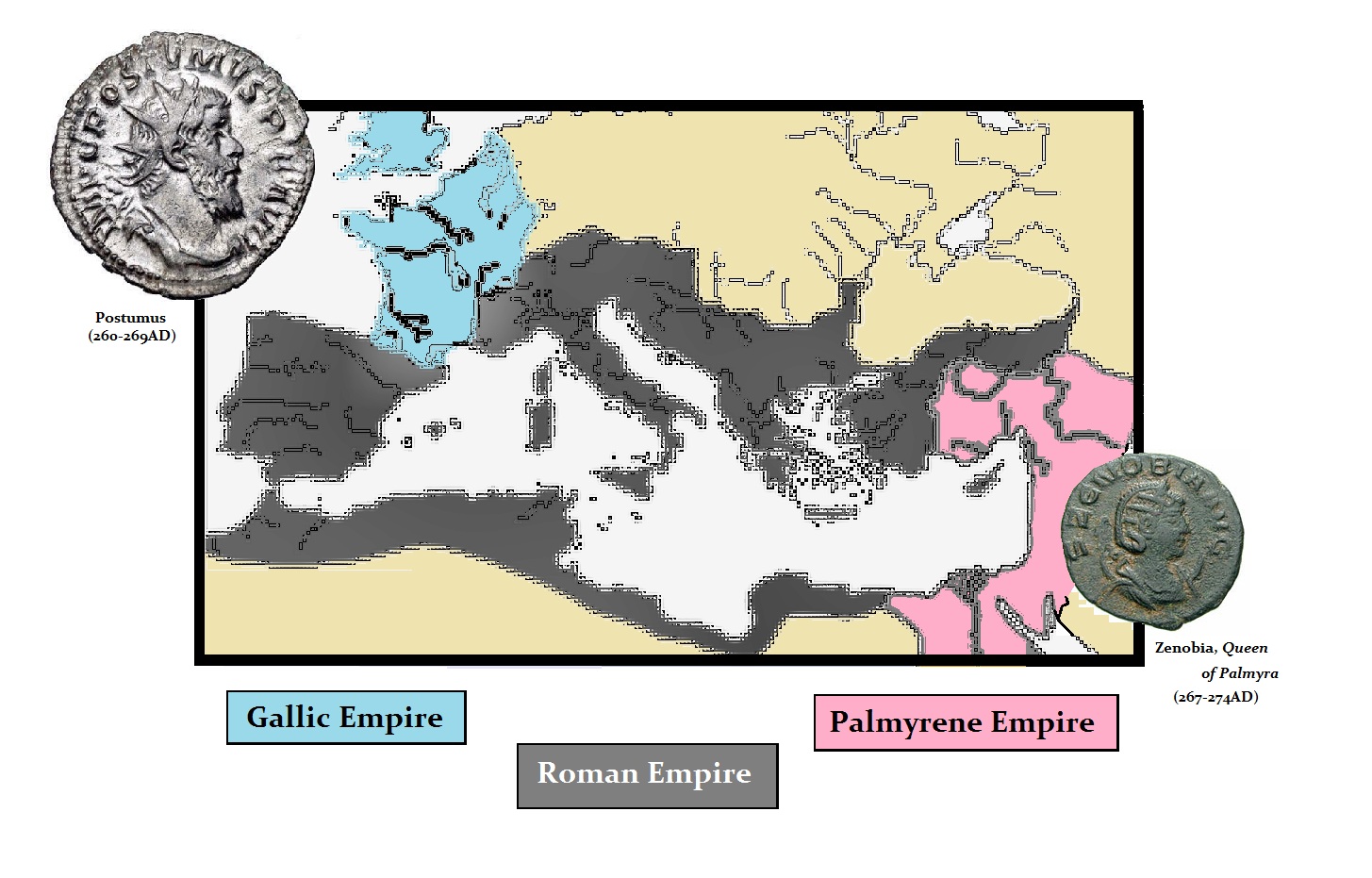
People do not understand that running the nation is far different than an individual state. Look at California and New Jersey v Florida and Texas. They do not even blend together to form a united country. In New Jersey, stores are not allowed to give you a bag. The governor is constructing windmills in the ocean and it’s only a matter of time before he outlaws gas cars and gas stations. The United States is rapidly becoming ungovernable as a united nation. The political difference is so great, it no longer makes sense to have a single nation. The Roman Empire split into three, a civil war was fought to bring it back together.
Then Diocletian divided the Empire in two and this created the Tetrarchy. That lasted just 23 years before Constantine I (307-337AD) reestablished one emperor. But then the West fell and the East survived as the Byzantine Empire after about 180 years. The official Byzantine Empire began in 498AD with the Monetary Reform of Anastasius I (491-518AD). The Byzantine Empire lasted until 1453. The likelihood of the separation of the United States begins to increase post-2024. The United States as we have known it may no longer exist post-2036.
Texas Senator Ted Cruz warns Attorney General Merrick Garland’s handpicked special counsel to probe former President Trump, Jack Smith, has a history of targeting Tea Party activists. One America’s John Hines has more from Capitol Hill.
A national security nightmare is about to unfold. In this episode, I address the dramatic situation, and the ramifications for our country moving forward. I also address the latest Twitter files drop and what it means for our broken FBI.
Posted originally on the CTH on December 18, 2022 | sundance
During my trip to DC in the summer of 2020 there were a myriad of disconcerting datapoints assembled; revelations that made sense of the madness and disappointments found everywhere. However, one of the key notations for future reference was to watch the political evolution of DHS and spot the jump where the ideological outlook turns into specific government action.
With the DHS/FBI portal within Twitter, and likely within all social media, now being openly discussed and mainstreamed, it’s worth revisiting an August 2021 tripwire crossed by DHS and then contemplating how that was influenced by a much larger ideological agenda.
The United States Department of Homeland Security made a quiet and alarming announcement on August 13, 2021, creating the official position of the United States Government under the Joe Biden regime. [SEE DHS STATEMENT HERE] According to the statement if you questioned the orthodoxy of government mandates, or COVID-19 responses from the U.S. government, you were -effective immediately- considered a “terrorist”, specifically a “Domestic Violent Extremist” (DVE).
Most people missed this remarkable development, yet it seemed to underpin a tenuous, unstable and fragile disposition of the current administration. Within this continuation of the Obama-era initiatives the Department of Homeland Security (DHS) seemed rather paranoid in their need to label anyone who would question the COVID-19 response.
Considering the polling at the time, more than half the country would be defined as dissidents and domestic terrorists within our homeland. Think about that.
DHS – The Secretary of Homeland Security has issued a new National Terrorism Advisory System (NTAS) Bulletin regarding the current heightened threat environment across the United States. […] These threats include those posed by domestic terrorists, individuals and groups engaged in grievance-based violence. […] Such threats are also exacerbated by impacts of the ongoing global pandemic, including grievances over public health safety measures and perceived government restrictions. (read more)
Notice the wording of that introductory paragraph. The government-imposed mandates, mask and vaccination requirements were only “perceived government restrictions.”
The chains that bound your expressions of liberty and freedom were essentially being defined as mere figments of your imagination. The rules and denials of activity that we are forced to live by, under the auspices of “public health and safety measures“, were described as perceived demands.
Most people missed this inflection point, but it was a substantive change in messaging from the United States Government.
The needle then being forced into the arm of federal workers by the Federal Government was not the problem.
It was the public perception of a forced medical treatment, and the need to control that perception that became the priority of the Dept of Homeland Security.
It was our perception of what they are doing that became the problem as outlined in this DHS bulletin. Here is where you must overlay the Twitter File revelations about the action the government took as an outcome of that shift. What followed in the censorship/control of social media by the same government agency, DHS, was an outcome of this ideological moment.
In essence We The People must correct our wrong-thoughts to eliminate carrying ‘the wrong perception’. Dear leader appreciates your compliance. At the time CTH noted to all readers the DHS statement was full blown Stazi-level propaganda. The bulletin continues:
[…] Through the remainder of 2021, racially- or ethnically-motivated violent extremists (RMVEs) and anti-government/anti-authority violent extremists will remain a national threat priority for the United States. These extremists may seek to exploit the emergence of COVID-19 variants by viewing the potential re-establishment of public health restrictions across the United States as a rationale to conduct attacks. Pandemic-related stressors have contributed to increased societal strains and tensions, driving several plots by domestic violent extremists, and they may contribute to more violence this year.
[…] There are also continued, non-specific calls for violence on multiple online platforms associated with DVE ideologies or conspiracy theories on perceived election fraud and alleged reinstatement, and responses to anticipated restrictions relating to the increasing COVID cases. (link)
This became the official position of the United States Government toward citizens in our nation. It is from this perspective that outreach and instructions to Twitter and various social media platforms originated.
Hopefully, in hindsight, you can see the importance of that narrative shift and how it ended with real consequences amid the speech platforms.
However, I want to move deeper, beyond that moment in 2021, deeper into the context that had taken hold of the various apparatus of government institutions. Back to that moment when the shift in approach became evident, albeit ignored for its consequence.
Immediately after Barack H Obama was successfully installed in office, something began to shift. While the U.S. media had always been biased, manipulative and dishonest, there was something bigger and deeper that changed after The Lightbringer achieved power and began his process of fundamental change.
The shift in the national security deployment, coincided with the merge between the intelligence apparatus and the new platforms of social media. The speed of the shift was directly connected to the speed of technology that was driving communication.
Together the intelligence apparatus, the customary U.S. media and Big Tech began testing how far and how fast they could control the outlook of Americans. Few people were paying attention to it…. there were some… but not many, and most of those who did notice were not connecting the dots to the actual tests.
The shift in attack direction from media (social and traditional) was alarming.
Normally the bias we encountered was framed to excuse or justify the transparently guilty of accountability. Bad people doing bad things were downplayed, excused and defended. However, in 2011 & 2012, the new era of controlling public opinion took shape and the system partners began falsely accusing the transparently innocent.
Read that again, because it was a profound difference, and inflection point.
Public opinion propaganda shifted from excusing the transparently guilty, to framing the transparently innocent.
Together with ideological institutions in government (Obama’s crew ie. DOJ etc.), the customary U.S. media and Big Tech system control operators began testing how far and fast they could control the outlook of Americans… to accuse the transparently innocent
Some transparently innocent examples included, George Zimmerman (Trayvon Martin), Police Officer Darren Wilson (Mike Brown), the Baltimore Six accused (Freddy Gray), Nick Sandmann, Kile Rittenhouse, and then ultimately the biggest example, Donald J Trump. Take a transparently innocent person and manipulate a public narrative to make them guilty.
In combination with this new use of the public-private partnership to target the transparently innocent, the social media platforms were instructed to remove content that ran counter to the false presentations.
Now, fast forward throughout a decade of the ideological shift (2011 to 2021) and what did the 2021 DHS terrorism bulletin do?
It expanded the targeting of the transparently innocent.
Instead of specific targets based on personage, the system of collaboration and control by DHS now extended to a whole of government effort to define people as ‘domestic terrorists.’ This is one long continuum of targeting the transparently innocent.
The target holds the same ideas, outlooks, worldviews, and expectations of Liberty and Freedom they held yesterday, last week, last month and perhaps even long before 9-11-01. However, now you are the problem. You are guilty. You are an extremist.
You didn’t change at all. Something else changed. But notice how the spotlight on what changed is YOU, and not the origin of the change?
You are the problem. It’s not the fault of those fundamentally changing the structures of freedom or liberty, you shifted to become the guilty party.
Can you see how they did that?
Can you see how the cancer cells of beta-test accusations against the transparently innocent metastasized and weaponized into a system that now uses the institutions of government against all of us, against the average American who might not accept the specific demands of government, ie. mask wearing, vaccinations, etc.
This government effort, a continuation of a narrative engineering strategy that originated in the aftermath of Obama’s election, specifically included the weaponization of social media and the compliance of the system operators who controlled Twitter, Facebook, Instagram, Google, Microsoft, YouTube, etc.
How can we help people to see this, to understand what took place?
I have created this site to help people have fun in the kitchen. I write about enjoying life both in and out of my kitchen. Life is short! Make the most of it and enjoy!
This is a library of News Events not reported by the Main Stream Media documenting & connecting the dots on How the Obama Marxist Liberal agenda is destroying America











 Centinel2012