The Japanese Yen – 397 by 2032?


Posted originally on Jun 26, 2024 By Martin Armstrong 

IBUSJY T 6 26 24

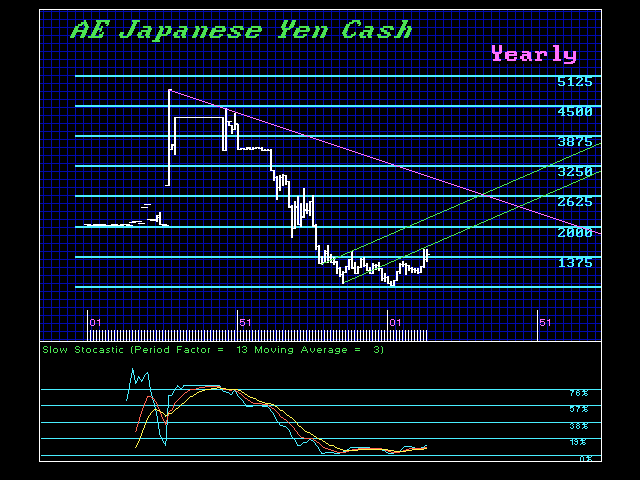
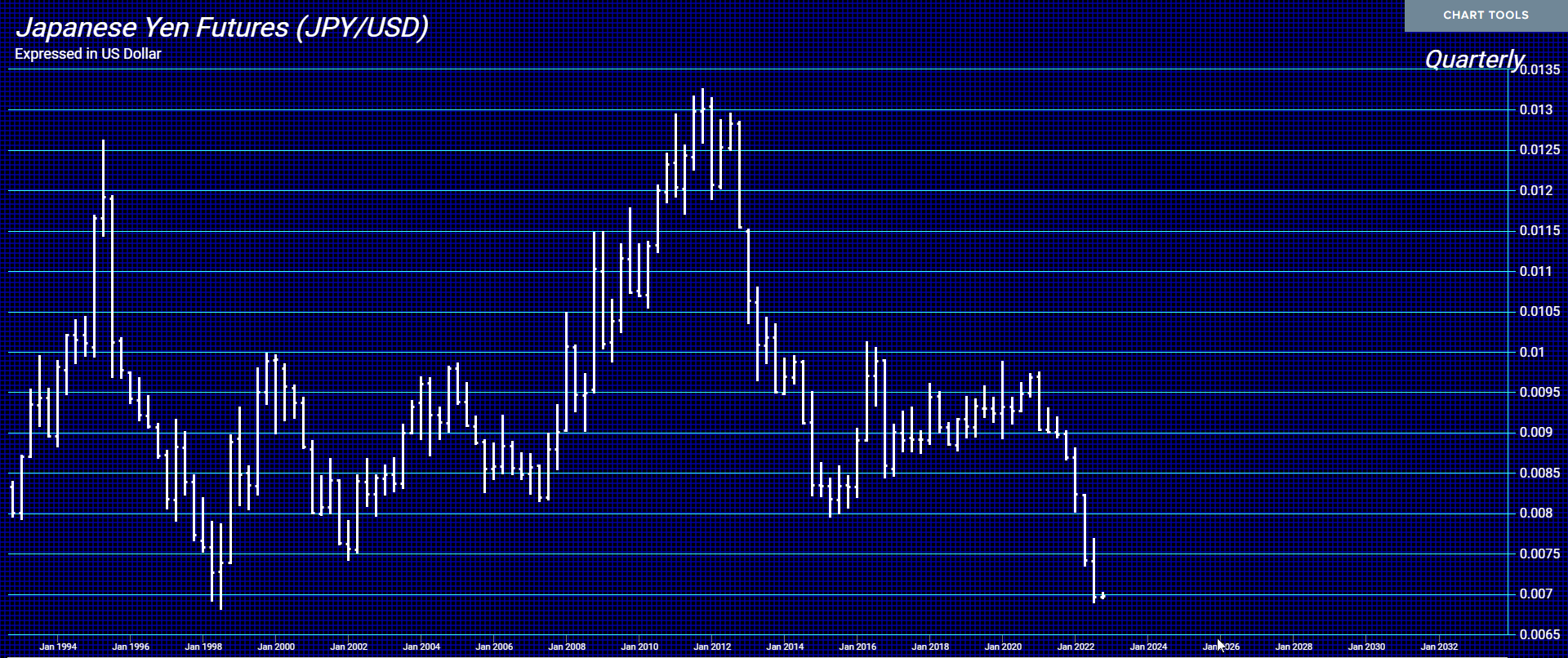
QUESTION: Marty, they called you Mr. Yen for good reason. I remember in 1998 when you sold $1 billion at 14700 on an MIT order (Market if Touched), and the dollar declined for 11 years thereafter. That 147 was your Yearly Bullish Reversal, which we blew through here in 2024, also on schedule. I remember that trade very well, and you said that if 147 were exceeded, the next stop would be 262. OK. We just hit 161. Are those forecasts from back then still valid?

TP

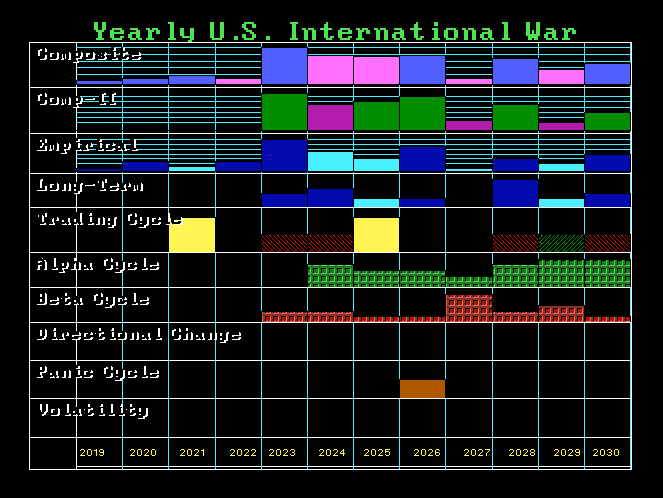
REPLY: Wow. You are still at it. My hat is off to you, as they say. Oh, I remember that trade very well. It was during the liquidity crisis with the collapse of Russia. Here is the Yen chart back to 1900. The primary resistance stands at the 210-212 level. We need 2024 to close above that Yearly Bullish Reversal at 147. Then, resistance will be below the Yearly Bullish Reversal of 262. It will form between 246 and 260. It appears to be a war on the horizon. Once the 262 level is exceeded, this points to 363, followed by 397 by the time we reach 2032.

Japan Slips to Fourth-Largest Economy


Posted originally on Feb 19, 2024 By Martin Armstrong 

The Last Days of Japan

Germany has overtaken Japan to become the world’s third-largest economy behind the US and China. Japan’s economy contracted by 0.4% in Q4 after a 3.3% decline in Q3. GDP hit $4.2 trillion in Japan in 2023 compared to Germany’s $4.4 trillion.

Japan’s economy is expected to grow by 1.4% this year. Still, Bank of Japan governor Kazuo Ueda held rates negative and warned that the future policy presented an “even more challenging year” ahead. The current interest rate in Japan is -0.10%, as the central bank falsely believed lowered rates would attract investment and stimulate the economy. The Bank of Japan has maintained a negative interest rate policy since 2016 without success.

Japanese public debt is a serious issue and now stands around $9.2 trillion (1.30 quadrillion yen), or 263% of GDP, and is the highest of any developed nation in relation to GDP. Around 43% of that debt is held by the Bank of Japan, and they have been unable to attract investors.

Inflation is gradually easing in Japan, with December producing a 2.6% figure in contrast to October’s 3.3% posting. However, Japan is becoming increasingly involved in overseas battles and recently sent another aid package to Ukraine in solidarity with the West. North Korea is constantly provoking the nation, and the situation in Taiwan is scaring away would-be foreign investors.

This shift in rank is not due to the German economy growing stronger. Germany is in a tough situation thanks to those in Brussels who eliminated its energy independence and implemented harsh regulations on every sector. There was once a time when people referred to Asia’s market as “Asia and Japan,” as Japan was the top runner for the continent. Various factors are contributing to Japan’s decline. I discuss this topic in further detail in the report “The Last Days of Japan.”

Japan Exports Fall in July, Driven by 14.3% Decline in Shipments to China


Posted originally on the CTH on August 17, 2023 | Sundance 

Some economic data released by the land of the rising sun points to a larger global weakness in manufacturing demand.   Within the data year-over-year exports from Japan fell in July by 0.3%, which is the first time since 2021 the contraction was noted.

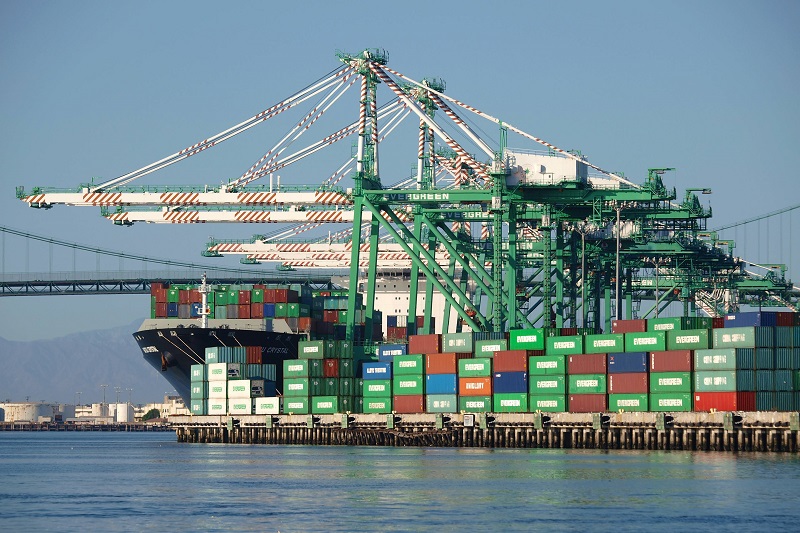
Digging a little deeper, the weakness in Japanese exports is driven primarily by a decline in exports to China of 14.3% in July, which follows a 10.9% decline in June.  Japan is a component supplier to China, which would indicate the demand for Chinese products globally is substantially less than Beijing has previously admitted.

That said, Japan’s direct export of finished goods to the U.S. actually increased 13.5%, mostly driven by the export of electric vehicles.

However, 13.5% is identical to the overall decrease in Japanese imports.

Essentially, component parts to China are down, but completed finished goods to the U.S. are up.  Overall, the results from Japan point to a soft overall global economic status, the result of continued contraction of Western economic activity.

TOKYO, Aug 17 (Reuters) – Japan’s exports fell in July for the first time in nearly 2-1/2 years, dragged down by faltering demand for light oil and chip-making equipment, underlining concerns about a global recession as demand in key markets such as China weaken.

Japanese exports fell 0.3% in July year-on-year, Ministry of Finance (MOF) data showed on Thursday, compared with a 0.8% decrease expected by economists in a Reuters poll. It followed a 1.5% rise in the previous month.

[…] Japanese policymakers are counting on exports to shore up the world’s No. 3 economy and pick up the slack in private consumption that has suffered due to rising prices.

However, the spectre of a sharper global slowdown and faltering growth in Japan’s major market China have raised concerns about the outlook.

The World Bank has warned that higher interest rates and tighter credit will take a bigger toll on global growth in 2024. (read more)

Meanwhile, I would not bet against Michael Burry.

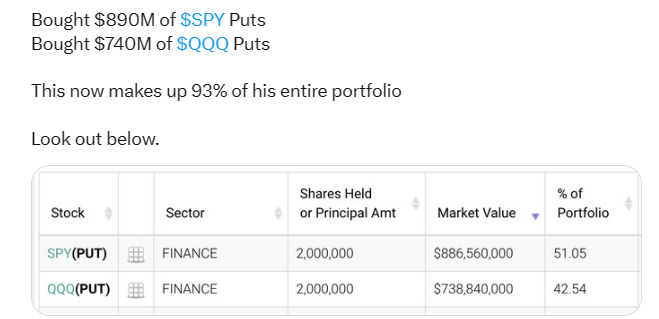
Burry is betting against the S&P 500 and Nasdaq 100 this week, according to his fund’s latest releases. Securities and Exchange Commission filings.  The filing shows that he is now holding options against the S&P 500, hedging $886.6 million against the index.

The filing also revealed that Burry sold his shares in Capitol One, First Republic, PacWest Bancorp, Wells Fargo and Western Alliance after betting on them earlier this year in Trying to make money from the regional banking crisis.  Burry also sold his stakes in Chinese e-commerce giants Alibaba and JD.com.

In addition, he bought $738.8 million in put options against the Invesco QQQ Trust ETF – a fund made up of popular high-tech Nasdaq companies, such as big tech companies Apple and Microsoft as well as Nvidia, Tesla and PepsiCo.

Burry has pulled money out of China investments and U.S. banks and is hedging against tech and the S&P.  He took these positions before the data from Japanese exports to China was released.

Japanese Prime Minister Fumio Kishida Survives Assassination Attempt – Suspect Carried Two Pipe Bombs, One Exploded


Posted originally on the CTH on April 15, 2023

Japanese Prime Minister Fumio Kishida escaped harm earlier today after a man holding what appeared to be two pipe bombs threw one near Kishida.  Remarkable video from the event showed citizens and police apprehending the suspect after one of the devices was thrown.  [Japan TV Story Here]

(Via Politico) – WAKAYAMA, Japan — Japanese Prime Minister Fumio Kishida was evacuated unharmed Saturday after someone threw an explosive device in his direction while he was campaigning at a fishing port in western Japan, officials said. Police wrestled a suspect to the ground as screaming bystanders scrambled to get away and smoke filled the air.

Although no one was hurt, and Kishida continued campaigning Saturday, the chaotic scene was reminiscent of the assassination nine months ago of former Prime Minister Shinzo Abe, which also came on a campaign tour and continues to reverberate in Japanese politics. Kishida was visiting Saikazaki port in Wakayama prefecture to support his ruling party’s candidate in a local election, and the explosion occurred just before he was to begin his speech.


A young man believed to be a suspect was arrested Saturday at the scene after he allegedly threw “the suspicious object,” Chief Cabinet Secretary Hirokazu Matsuno told reporters. Matsuno refused to comment on the suspect’s motive and background, saying police are still investigating.

TV footage shows Kishida standing with his back to the crowd. His security detail suddenly points to the ground near him, and the prime minister whips around, looking alarmed. The camera quickly turns to the crowd just as several people, including uniformed and plainclothes police officers, converge on a young man wearing a white surgical mask and holding what appears to be another device, a long silver tube.

As they collapse on top of the man, working to remove the tube from his hands, a large explosion is heard near where Kishida had been standing. The crowd scatters in panic as police roughly drag the man away. (read more)

Japan Secures Oil Deal with Russia


Armstrong Economics Blog/World Trade Re-Posted Apr 5, 2023 by Martin Armstrong

Japan is an energy-dependent nation that relies on imports to function. Despite being a G7 member, Japan has remained largely silent on the Russia-Ukraine war and is the only member to deny Zelensky’s pleas for weapons. The prime minister was the last in the alliance to visit Ukraine amid the war. The G7 nations set a $60 per barrel price cap on Russian crude but granted Japan a pass.

Japan has purchased nearly 748,000 barrels of Russian oil for $70 a piece in the first two months of the year alone. All of the MSM headlines read: “JAPAN BREAKS ALLIANCE WITH WESTERN ALLIES,” as if there were an alternative. Even conservative outlets are saying that Japan has broken ties with the West. Japan is unwilling to deliberately allow its nation to crumble from an energy shortage, unlike the “Build Back Better” nations.

Oil prices surged on Monday after OPEC+ announced plans to limit production, which will lead to a rise in global prices. Energy costs affect the cost of everything from the supply chain to food. Yet, the countries that have the ability to drill, such as the US and Canada, are refusing to do so despite energy prices significantly contributing to overall inflation and economic instability.

The West chastised India and China for purchasing Russian oil. They don’t want to lose their Japanese ally and are attempting to give them a “free pass,” but only until September. What happens then? Will Japan be forced to break its alliance with the G7? The West was hoping that longstanding tensions between China and Japan would push them into this proxy war, but the Japanese government is not willing to implode its economy. Let us also remember that Japan was forced to close numerous nuclear power plants after the earthquake hit in 2011. They are completely reliant on imports. It seems that only nations willing to surrender their economies in the name of abandoning fossil fuels, with no alternative, are ousted from the West’s good graces.

The Last Days of Japan


Armstrong Economics Blog/Japan Re-Posted Jan 23, 2023 by Martin Armstrong

We have been forecasting for several years now that those who have been focused on the demise of the dollar to the exclusion of everything else would be wrong because of what must fall first is both Europe and Japan. It is an all-out race to see who will be the first to collapse.

This special report on Japan is very critical for it provides a view of Asia v Europe. This is the prelude to the fall of socialism in the West. Communism collapsed in 1989. Now 34 years later, it is just our turn. It does not mean the end of the world. It simply means the end of the present monetary system as we have known it.

The Report covers the Japanese Yen spot and futures, the Nikkei 225 Cash Index, and the Japanese JGB Futures.

Assassin Who Killed Shinzo Abe Cleared to Stand Trial


Posted originally on the CTH on December 29, 2022 | Sundance 

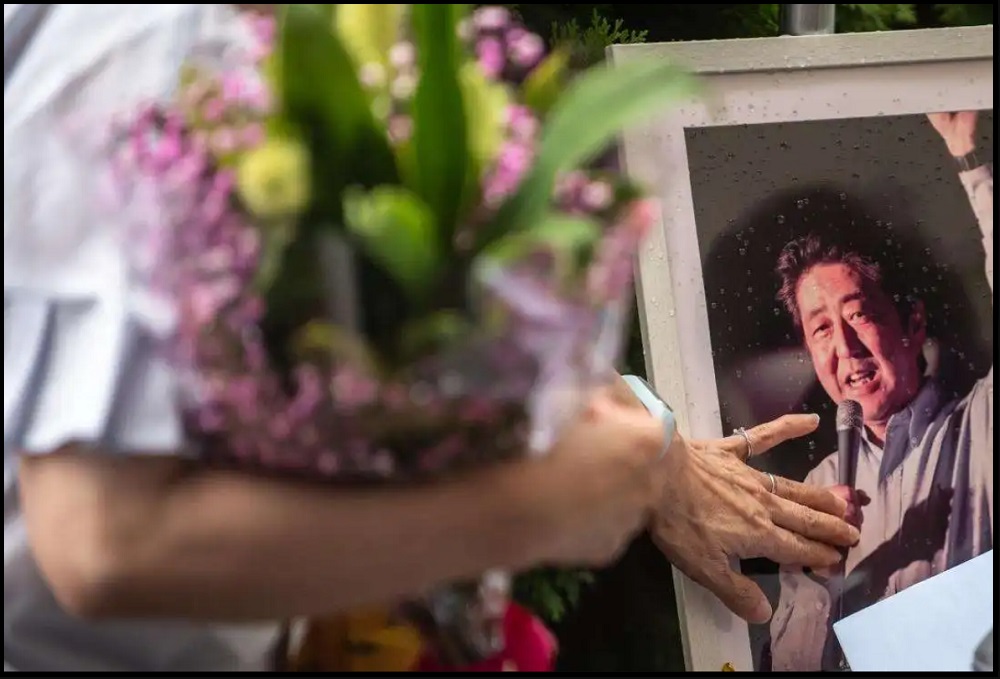
One of the greatest losses of 2022 was the assassination of former Japanese PM Shinzo Abe, a man beloved for his dedication to his country.  At the time of his murder Abe was leading a movement within government to reform the Japanese constitution and permit the assembly of a modern military as a bulwark against the rising influence of China.

During a rally to support reform candidates, Abe was assassinated by a young man named Yamagami Tetsuya.  Tetsuya was a former member of the maritime defense forces where he served for three years; he used a homemade black powder shotgun to kill Abe. After his capture Tetsuya was put through a psychological evaluation to determine his competency to stand trial.  After an evaluation investigators and prosecutors have determined Yamagami Tetsuya will face indictment for the murder of Shinzo Abe.

Japan – Investigative sources say Japanese prosecutors have decided to indict the suspect in the shooting death of former Prime Minister Abe Shinzo, based on the results of psychiatric evaluation.

Public prosecutors in Nara, western Japan, sent Yamagami Tetsuya to a detention house to determine whether he can be held criminally responsible, following his arrest in July.  The evaluation was conducted by interviewing the suspect about his family environment, his relationship with his mother and other matters.

Investigative sources say the prosecutors also determined that Yamagami is mentally fit to be tried, as he built handmade guns and carefully prepared for the attack by checking Abe’s campaign schedule.

The period of the suspect’s detention for mental evaluation will expire on January 10, and the prosecutors are expected to indict him by January 13, when his period of detention ends.

Yamagami fatally shot the former prime minister on July 8 during an election campaign speech in Nara.  The suspect reportedly told police that he was motivated by a grudge against the religious group widely known as the Unification Church. He says he shot Abe because he believed the former prime minister had close ties with the group. He also claimed his mother’s huge donations to the group left his family in financial ruin. (more)

Shinzo Abe’s leadership and influence in Japan is sorely missed.

1954 – 2022

Prime Minister Shinzo Abe was a transformative figure in Japanese politics.  A devout nationalist with a humble demeanor, Abe shifted the national sentiment from post war apology toward an outlook of pride in Japanese culture, work ethic and traditional value.  He was beloved by conservatives and patriots in Japan and disliked by leftists and globalists.

Prime Minister Shinzo Abe and President Donald Trump were friends before Mr. Trump entered politics.  First lady Melania Trump and Mrs Akie Abe were also friends, and the two couples spent a great deal of time together before and during President Trump’s term in office.

The Japan Outlook


Armstrong Economics Blog/Japan Re-Posted Oct 7, 2022 by Martin Armstrong

QUESTION: Marty, I greatly appreciate all you do to try to prevent this war cycle. You have said many times Socrates beats you. With missiles flying over Japan here, what do you see ahead?

AS

ANSWER: Nice to hear from you. It does not look very good. A year-end closing below 6805 will warn of a major crash in the Japanese yen next year.  I cannot stop the cycle. The best I can possibly do is perhaps reduce the amplitude. Even that is speculative. It just seems that we have insane leaders who care more about defeating Russia for this climate change nonsense. What they are doing to farmers in the Netherlands is insane. They know that the current monetary system is collapsing. They are using the war in hopes of creating an excuse and a diversion from their own sovereign debt defaults – hence you will own nothing and be happy.

All the market look to be cascading into 2023. This is not my opinion. I wish I did not even have to talk about this nonsense. The ray of hope is we get to restart the world economy post-2032. That is when we will hit the control-alt-delete. All I can do is try desperately to get society just for once to look at history and see what systems worked and what failed.

The Outlier of the West, Japan Core Inflation Rises 2.4% Year Over Year


Posted originally on the conservative tree house on August 19, 2022 | Sundance 

If you have been following along, you might remember the note we made in July about not every country willing to go along with the western agenda on energy reduction, climate change, and raising interest rates to shrink their economy down to the scale of diminished energy development {Go Deep}.

In addition to Russia, China, Iran, Brazil, South Africa, Argentina and India vociferously retaining their own economic and monetary independence, Mexican President AMLO literally blasted the program while visiting the White House and the Bank of Japan refused to join the mantra to raise interest rates.   Essentially, all of the aforementioned nations see the collective Build Back Better program for what it is, a path to poverty.

As a result of their non-compliance with the global bankers, which, not coincidentally I would point out, coincided with the assassination of Shinzo Abe, the government of Japan has been getting blasted by the proverbial ‘west’ (U.S, Canada, U.K, Europe and Australia).

Japan is attempting to deal with inflation by focusing on increasing energy production and security (the supply side); while the rest of the western group have been chasing the false promise of decreased inflation by lowering the demand side, ie. pretending not to know their energy policy is creating the increases in costs.

As a result of the distinctly different monetary approaches, the financial system has been trying to punish Japan and the financial media have been trying to point out every flaw in the Japanese economy as a result of their noncompliance.   However, as you will see in this Reuters article, the July inflation within Japan is moderating.  Inflation in Japan is 2.4% for July (year over year).

TOKYO, Aug 19 (Reuters) – Japan’s core consumer inflation accelerated in July to its fastest in seven-and-a-half years, driven by fuel and raw material prices and adding to the costs of living for households yet to see significant wage gains.

In a sign of broadening price pressure, the so-called “core core” index that strips away not just the impact of volatile fresh food but energy prices, also rose in July at the fastest annual pace in more than six years.

While inflation exceeded its 2% target for four straight months, the Bank of Japan (BOJ) is likely to remain an outlier in keeping monetary conditions ultra-loose with price rises still modest compared with other major economies.

“Food prices and a weak yen were the main culprits behind accelerating inflation,” said Yoshimasa Maruyama, chief market economist at SMBC Nikko Securities, adding that he expects core consumer inflation to reach 3% this year. (read more)

It is funny to see Reuters put out a *shock* styled article for 2.4% core inflation.   In the U.S. Joe Biden would be celebrating 2.4% inflation right now; however, his energy policy is driving that CORE inflation number well beyond 6%.

Japan is still in a tough place with increasing prices for their citizens, but it is nowhere near the scale of Europe and North America.

While their currency is suffering from not following the western agenda, they have several upsides.  First, exports from Japan to the United States and the EU now become even cheaper. With a higher dollar value, Japanese imports into the United States come at a discount.  This will help Japan export goods and retain a strong export economy.

Second, with Japan already a massive investor inside the United States, the dollars that are generated in profit from their operations are delivered back to Japan at a higher value.  A higher dollar value, the outcome of their breaking from the western central bank decision to raise rates, does not hurt Japan.  They bring back high valued dollars from their decades in investment into North America, and they continue exporting to the U.S. at a discount.

So, the nationalist outlooks of Japan, Brazil and even our Mexican neighbors are reflecting a pragmatic self-interest that so far has withstood the pressures from the western alliance to fall into line.  This is how those three countries are positioned to push back against the insufferable BBB agenda.

We can use the example of those western industrialized nations to show that not everyone is in alignment with this globalist multinational finance and corporate takeover.