Of course, YuuTube removed it to protect Pfizer. They are part of the media that has been targeting free speech and wants nothing but to sell humanity down the river. Here is the link to Project Veritas off the record with Pfizer.
In the video, there is a question if they are engaged in “gain of function” and he says no, Pfizer is experimenting to may an already human virus more potent. What Pfizer is doing is highly dangerous. Nonetheless, it is NOT gain-of-function. There is a difference.
The gain-of-function is taking a virus that does not infect humans and altering that virus to “gain the function” of infecting humans. What Pfizer is doing is taking an ALREADY human infecting virus such as COVID-19, and making it more potent by accelerating its mutation process. Their vaccines have been dangerous, in my opinion, for they have accelerated mutations all on their own. A virus is like any life form. It will mutate and adapt to survive. That is its main goal. Vaccinating everyone only causes the virus to mutate to survive. This is why so many people who died were vaccinated. The virus mutated and the vaccine never prevented someone from getting COVID-19.
Just to be fair and straight up here – there is a difference between the two processes. Pfizer realizes that their vaccines did not work and contributed to the mutation process. Personally, I prefer old-fashion types of vaccines and the days when governments protected the people instead of taking bribes to force people to do things than make no sense.
Posted originally on the conservative tree house January 27, 2023 | Sundance
The members of the ‘Big Club’ have spoken. Mrs. Ronna McDaniel wins reelection as Republican National Commitee Chairwoman for the fourth time.
Ronna McDaniel received 111 votes, Harmeet Dhillon received 51 votes, Mike Lindell received 4 votes and Lee Zeldin received one vote.
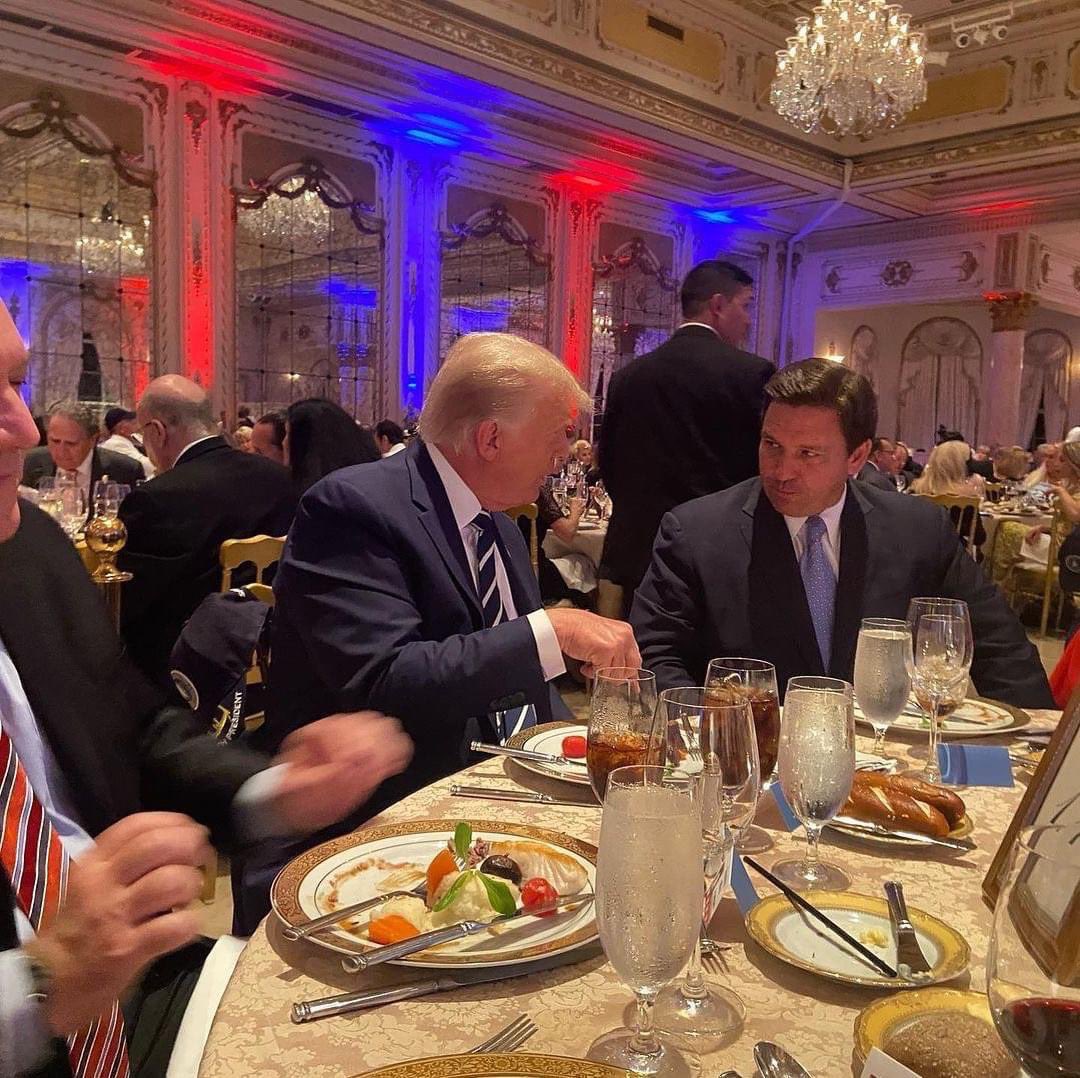
Florida Governor Ron “Top Gov” DeSantis expended some political capital with a failed endorsement for Harmeet Dhillon. President Trump stayed neutral in the race, preferring to let the RNC make their own decisions.
CALIFORNIA – Ronna McDaniel won a fourth term to head the Republican National Committee (RNC) during a secret ballot vote by members on Friday, capping off a contentious election spurred by calls within the party for new leadership.
McDaniel fended off two challengers — California attorney Harmeet Dhillon and MyPillow CEO Mike Lindell, a staunch denier of the 2020 presidential election results.
She received 111 votes, while Dhillon received 51 and Lindell received four. Former Rep. Lee Zeldin (R-N.Y.), who did not ultimately make a run for RNC chair, also received one vote.
The last three elections have proven disappointing for Republicans: The party lost the House in 2018, lost the Senate and presidency in 2020 and only gained a thin majority in the House in 2022. Many in the party cited last November’s midterms as a reason to elect fresh blood, as McDaniel oversaw the RNC through the last three elections.
McDaniel, in brief remarks, told RNC committee members that she heard the concerns from those who voiced criticism in the wake of the November elections while also projecting unity within the party.
“We need all of us. We heard you, grassroots. We know. We heard Harmeet, we heard Mike Lindell. But with us united and all of us going together, the Democrats are going to hear us in 2024 when we take back the White House and the Senate,” she said to applause in the room. (read more)
The RNC wants money, the DNC wants power. The RNC uses power to get money, the DNC uses money to get power. The ideology of the DNC drives their donor contributions, whereas the donor contributions to the RNC drives their ideology. This outlook explains the subtle difference between the two wings of the UniParty and also explains why Republicans have no ideological goals.
Food shortages have historically contributed to revolutions more so than just international war. Poor grain harvests led to riots as far back as 1529 in the French city of Lyon. During the French Petite Rebeyne of 1436. (Great Rebellion), sparked by the high price of wheat, thousands looted and destroyed the houses of rich citizens, eventually spilling the grain from the municipal granary onto the streets. Back then, it was to go get the rich.
There was a climate change cycle at work and today’s climate zealots ignore their history altogether for it did not involve fossil fuels. The climate got worse at the bottom of the Mini Ice Age which was about 1650. It really did not warm up substantially until the mid-1800s. During the 18th century, the climate resulted in very poor crops. Since the 1760s, the king had been counseled by Physiocrats, who were a group of economists that believed that the wealth of nations was derived solely from the value of land and thereby agricultural products should be highly priced. This is why Adam Smith wrote his Wealth of Nations as a retort to the Physiocrats. It was their theory that justified imperialism – the quest to conquer more land for wealth; the days of empire-building.
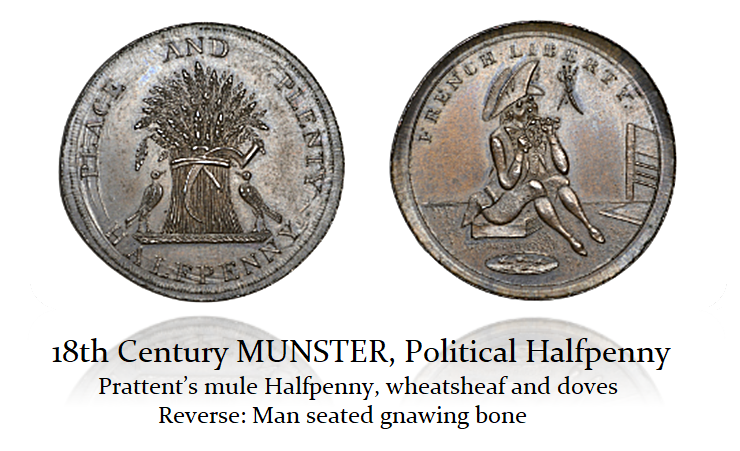
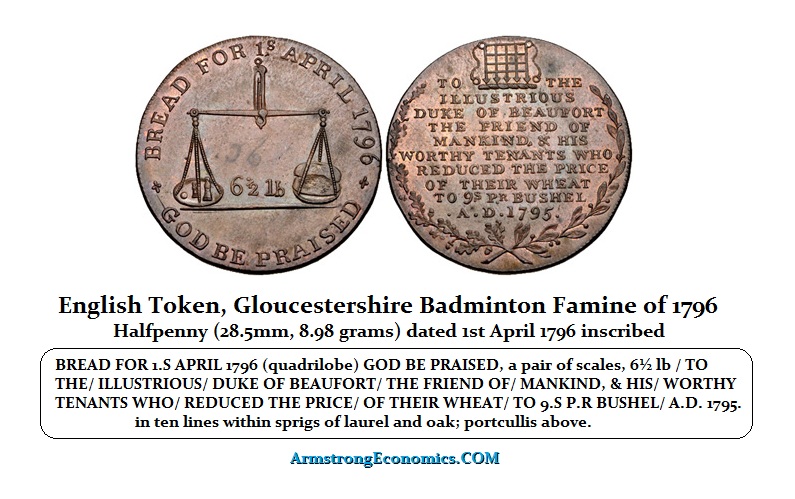
The King of France had listened to the Physiocrats who counseled him to intermittently deregulate the domestic grain trade and introduce a form of free trade. That did not go very well for there was a shortage of grain and this only led to a bidding war – hence the high price of wheat. We even see English political tokens of the era campaigning about the high price of grain and the shortage of food to where a man is gnawing on a bone.
Voltaire once remarked that Parisians required only “the comic opera and white bread.” Indeed, bread has also played a very critical role in French history that is overlooked. The French Revolution that began with the storming of the Bastille on July 14th, 1789 was not just looking for guns, but also grains to make bread.
The price of bread and the shortages played a very significant role during the revolution. We must understand Marie Antoinette’s supposed quote upon hearing that her subjects had no bread: “Let them eat cake!” which was just propaganda at the time. The “cake” was not the cake as we know it today, but the crust was still left in the pan after taking the bread out. This shows the magnitude that the shortage of bread played in the revolution.
In late April and May of 1775, the food shortages and high prices of grain ignited an explosion of such popular anger in the surrounding regions of Paris. There were more than 300 riots and looking for grain over just three weeks (3.14 weeks). The historians dubbed this the Flour War. The people even stormed the place at Versailles before the riots spread into Paris and outward into the countryside.
The food shortage became so acute during the 1780s that it was exacerbated by the influx of immigration to France during that period. It was a period of changing social values where we heard similar cries for equality. Eventually, this became one of the virtues on which the French Republic was founded. Most importantly, theFrench Constitution of 1791 explicitly stipulated a right to freedom of movement. It was mostly perceived to be a food shortage and the reason was the greedy rich. Thus, a huge rise in population was also contributed in part by immigration whereas it reached around 5-6 million more people in France in 1789 than in 1720.
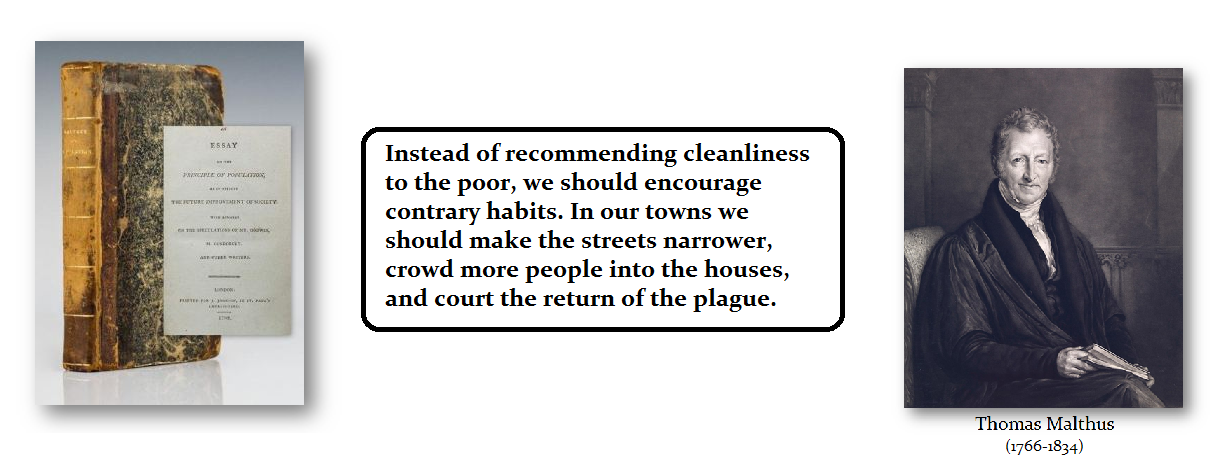
Against this backdrop, we have the publication by Thomas Malthus (1766-1834) An Essay on the Principle of Population was first published anonymously in 1798. He theorized that the population would outgrow the ability to produce food. We can see how his thinking formed because of the Mini Ice Age that bottomed in 1650. All of this was because of climate change which instigated food shortages. Therefore, it was commonly accepted that without a corresponding increase in native grain production, there would be a serious crisis.
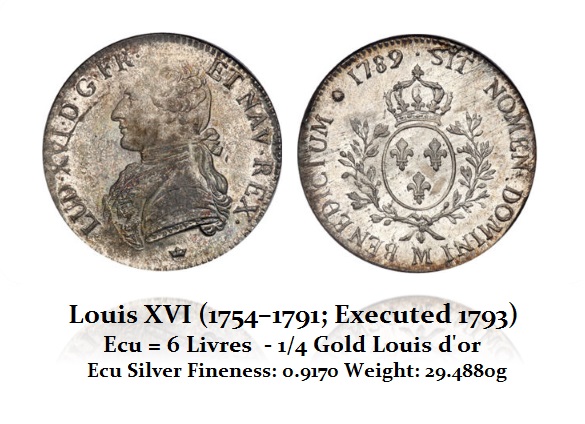
The refusal on the part of most of the French to eat anything but a cereal-based diet was another major issue. Bread likely accounted for 60-80 percent of the budget of a wage-earner’s family at that point in time. Consequently, even a small rise in grain prices could spark political tensions. Because this was such an issue, and probably the major cause of the French Revolution among the majority, Finance Minister Jacques Necker (1732–1804) claimed that, to show solidarity with the people, King Louis XVI was eating the lower-class maslin bread. Maslin bread is from a mix of wheat and rye, rather than the elite manchet, white bread that is achieved by sifting wholemeal flour to remove the wheatgerm and bran.
That solidarity was seen as propaganda and the instigators made up the Marie Antoinette quote: Let them eat cake. . Then there was a plot drawn up at Passy in 1789 that fomented the rebellion against the crown shortly before the people stormed the Bastille. It declared “do everything in our power to ensure that the lack of bread is total, so that the bourgeoisie are forced to take up arms.”
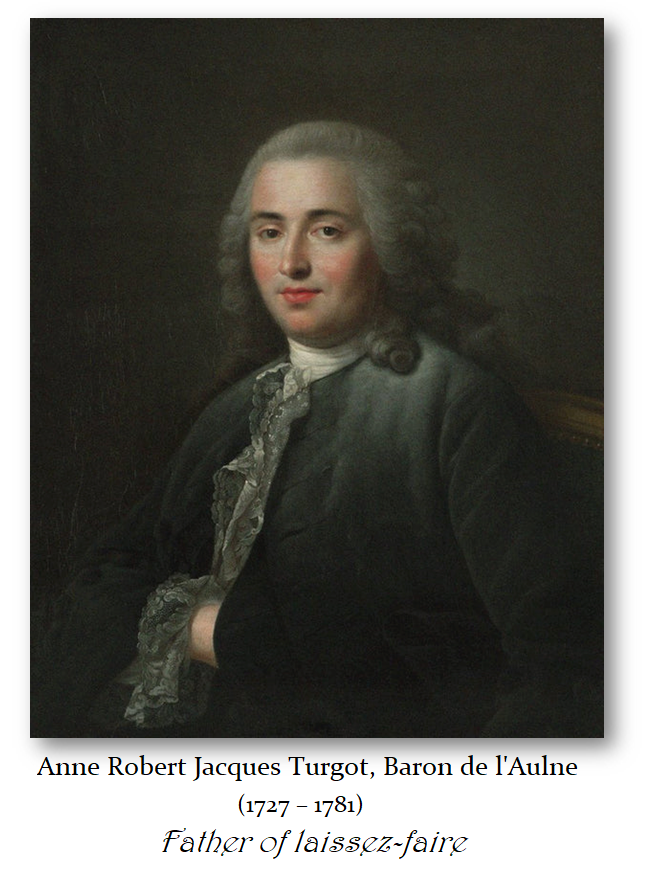
It was also at this time when Anne Robert Jacques Turgot (1727-1781), Baron de l’Aulne, was a French economist and statesman. He was originally considered a physiocrat, but he kept an open mind and became the first economist to have recognized the law of diminishing marginal returns in agriculture. He became the father of economic liberalism which we call today laissez-faire for he put it into action. He saw the overregulation of grain production was behind also contributing to the food shortages. He once said: “Ne vous mêlez pas du pain”—Do not meddle with bread.
The French Revolution overthrew the monarchy and they began beheading anyone who supported the Monarchy and confiscated their wealth as well as the land belonging to the Catholic Church. Nevertheless, the revolution did not end French anxiety over bread. On August 29th, 1789, only two days after completing the Declaration of the Rights of Man and of the Citizen, the Constituent Assembly completely deregulated domestic grain markets. The move raised fears about speculation, hoarding, and exportation.
Then on October 21st, 1789, a baker, Denis François, was accused of hiding loaves from sale as part of a conspiracy to deprive the people of bread. Despite a hearing which proved him innocent, the crowd dragged François to the Place de Grève, hanged and decapitated him, and made his pregnant wife kiss his bloodied lips. Immediately thereafter, the National Constituent Assembly instituted martial law. At first sight, this act appears as a callous lynching by the mob, yet it led to social sanctions against the general public. The deputies decided to meet popular violence with force.
So, food has often been a MAJOR factor in revolutions. We are entering a cold period. Ukraine has been the breadbasket for Europe. Escalating this war will also lead to accelerating the food shortages post-2024. It is interesting how we learn nothing from history. Wars are instigated by political leaders while revolutions are instigated by the people.
Posted originally on the CTH on January 26, 2023 | Sundance
President Trump transmitted a message to congress, warning them not to cut Social Security and Medicare {Direct Rumble Link}. Many politicians and pundits will look at Trump’s position from the perspective of it being good to campaign for older voters, but that’s not the core of his reasoning.
In 2016 CTH was the first place to evaluate the totality of President Trump’s economic policies; specifically, as those policies related to the entitlement programs around Social Security and Medicare. We outlined the approach Trump was putting forth and the way he was approaching the issue. In the years that followed, he was right. He was creating a U.S. economy that could sustain all of the elements the traditional political class were calling “unsustainable.”
Before getting to the details, here’s his video message and policy as delivered yesterday. WATCH:
Fortunately, we do not have to guess if President Trump is correct. We have his actual economic policy results to look at and see how the expansion of the economy was creating the type of growth that would sustain Social Security and Medicare. This was/is MAGAnomics at work.
♦ On Social Security – Unlike many other 2016 Republican candidates, Donald Trump did NOT call for rapid or wholesale changes to the current Social Security program; and there’s a very good reason why he was the only candidate who did not propose wholesale changes.
With the single caveat of “high income retirees” (over $250k annually), which previously Trump said he was open to negotiating on, President Trump does not consider these programs as “entitlements”. The American people pay into them, and the federal government has an obligation to fulfill the promises made upon collection.
To fully understand how Donald Trump views the solvency of Social Security, you must again understand his economic model and how it outlines growth.
The issue with Social Security, as viewed by Trump, is more of an issue with receipts and expenditures. If the aggregate U.S. economy is growing by a factor larger than the distribution needed to fulfill its entitlement obligations, then no wholesale change on expenditure is needed. The focus needs to be on continued and successful economic growth.
What you will find in all of Donald Trump’s positions, is a paradigm shift he necessarily understood must take place in order to accomplish the long-term goals for the U.S. citizen as it relates to “entitlements” or “structural benefits”.
All other candidates and politicians begin their policy proposals with a fundamentally divergent perception of the U.S. economy.
The customary political economy theory, carried by most politicians, positions them with an outlook of the U.S. economy based on “services”; a service-based economic model.
While this economic path has been created by decades old U.S. policy and is ultimately the only historical economic path now taught in school, President Trump initiated his economy policy with the intention to change the dynamic entirely, and that’s exactly what he did.
Because so many shifts -policy nudges- have taken place in the past several decades, few academics and even fewer MSM observers, were able to understand how to get off this path and chart a better course.
Donald Trump proposed less dependence on foreign companies for cheap goods, (the cornerstone of a service economy) and a return to a more balanced U.S. larger economic model where the manufacturing and production base can be re-established and competitive based on American entrepreneurship and innovation. This is the essence of MAGAnomics.
The key words in the prior statement are “dependence” and “balanced”. When a nation has an industrial manufacturing balance within the GDP there is far less dependence on the economic activity in global markets. In essence the U.S. can sustain itself, absorb global economic fluctuations and expand itself or contract itself depending on the free market.
When there is no balance, there is no longer a free market. The free market is sacrificed in favor of dependency, whether it’s foreign oil or foreign manufacturing, the dependency outcome is essentially the same. Without balance there is an inherent loss of economic independence, and a consequential increase in economic risk.
No other economy in the world innovates like the U.S.A. President Donald Trump saw/sees this as a key advantage across all industry – including manufacturing and technology.
The benefit of cheap overseas labor, which is considered a global market disadvantage for the U.S., is offset by utilizing innovation and energy independence. This was the core of the economic program that created so much immediate GDP growth in 2017, 2018 and 2019.
2017: […] “This policy will be successful in moving the U.S. economy away from low-growth secular stagnation towards significantly more buoyant performance. We would not be taken by surprise by a doubling of the growth rate of real GDP in the U.S. over the next two years, nor by a further significant move up of equity valuations and a material further appreciation of the dollar.” ~ David Folkerts-Landau, Chief Economist, Deutsche Bank
The third highest variable cost of goods beyond raw materials first, labor second, is energy. If the U.S. energy sector was unleashed -and fully developed- the manufacturing price of any given product would allow for global trade competition even with higher U.S. wage prices. This is why President Trump traveled to Saudi Arabia as his first foreign trip, followed closely by a trip to Asia. He was putting the basics of his U.S. economic policy into place.
Additionally, the U.S. has a key strategic advantage with raw manufacturing materials such as: iron ore, coal, steel, precious metals and vast mineral assets which are needed in most new modern era manufacturing. President Trump proposed we stopped selling these valuable national assets to countries we compete against – they belong to the American people; they should be used for the benefit of American citizens. Period. This was the central point of the Steel and Aluminum tariffs.
EXAMPLE: Prior to President Trump, China was buying and recycling our heavy (steel) and light (aluminum) metal products (for pennies on the original manufacturing dollar) and then using those metals to reproduce manufactured goods for sale back to the U.S.
As President, Donald Trump stopped that practice immediately, triggering a policy expectation that we do the manufacturing ourselves with the utilization of our own resources. Then he leveraged any sales of these raw materials in our international trade agreements.
When you combine FULL resource development (in a modern era) with the removal of over-burdensome regulatory and compliance systems, necessarily filled with enormous bureaucratic costs, Donald Trump began lowering the cost of production and the U.S. became globally competitive. In essence, Trump changed the economic paradigm, and we no longer were a dependent nation relying on a service driven economic model.
The cornerstone to the success of this economic turnaround was the keen capability of the U.S. worker to innovate on their own platforms. Americans, more than any country in the world, just know how to get things accomplished. Independence and self-sufficiency are part of the DNA of the larger American workforce.
In addition, as we saw in 2018 and 2019, an unquantifiable benefit came from investment, where the smart money play -to get increased return on investment- became putting capital INTO the U.S. economy, instead of purchasing foreign stocks.
With all of the above opportunities in mind, this is how President Trump put us on a pathway to rebuilding our national infrastructure.
The demand for labor increased, and as a consequence so too did the U.S. wage rate which was stagnant (or non-existent) for the past three decades.
As the wage rate increased, and as the economy expanded, the governmental dependency model was reshaped and simultaneously receipts to the U.S. treasury improved.
More money into the U.S Treasury and less dependence on welfare/social service programs have a combined exponential impact. You gain a dollar and have no need to spend a dollar – the saved sum is doubled. That was how the SSI and safety net programs were positioned under President Trump. Again, this is MAGAnomics.
When you elevate your America First economic thinking you begin to see that all of the “entitlements” or expenditures become more affordable with an economy that is fully functional.
As the GDP of the U.S. expands, so does our ability to meet the growing need of the retiring U.S. worker. We stop thinking about how to best divide a limited economic pie and begin thinking about how many more economic pies we can create. Simply put, we begin to….
…. Make America Great Again!
We know it works, because we have the results to cite.
It was the Fourth Quarter of 2019…..
Right before the pandemic would hit a few months later…. Despite two years of doomsayer predictions from Wall Street’s professional punditry, all of them saying Trump’s 2017 steel and aluminum tariffs on China, Canada and the EU would create massive inflation, it just wasn’t happening!
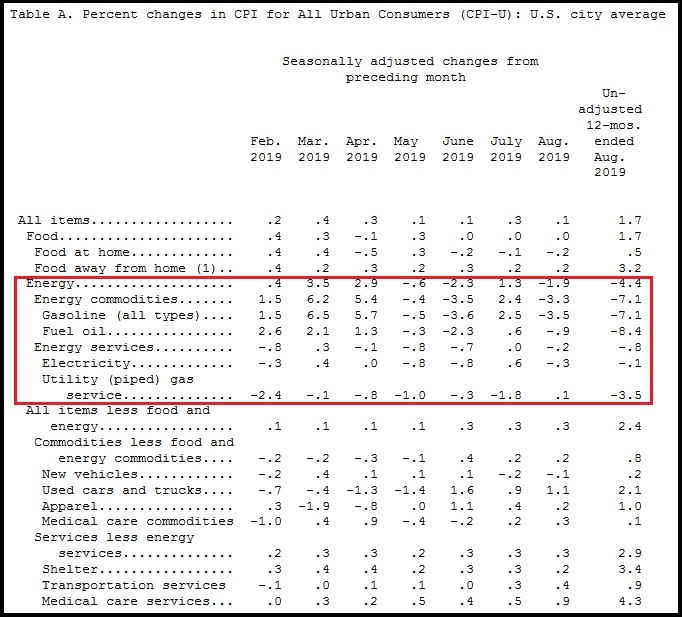
Overall year-over-year inflation was hovering around 1.7 percent [Table-A BLS]; yup, that was our inflation rate. The rate in the latter half of 2019 was firmed up with less month-over-month fluctuation, and the rate basically remained consistent. [See Below] The U.S. economy was on a smooth glide path, strong, stable and Main Street was growing with MAGAnomics at work.
A couple of important points. First, unleashing the energy sector to drive down overall costs to consumers and industry outputs was a key part of President Trump’s America-First MAGAnomic initiative. Lower energy prices help the worker economy, middle class and average American more than any other sector.
Which brings us to the second important point. Notice how food prices had very low year-over-year inflation, 0.5 percent. That is a combination of two key issues: low energy costs, and the fracturing of Big Ag hold on the farm production and the export dynamic:
(BLS) […] The index for food at home declined for the third month in a row, falling 0.2 percent. The index for meats, poultry, fish, and eggs decreased 0.7 percent in August as the index for eggs fell 2.6 percent. The index for fruits and vegetables, which rose in July, fell 0.5 percent in August; the index for fresh fruits declined 1.4 percent, but the index for fresh vegetables rose 0.4 percent. The index for cereals and bakery products fell 0.3 percent in August after rising 0.3 percent in July. (link)
For the previous twenty years food prices had been increasingly controlled by Big Ag, and not by normal supply and demand. The commodity market became a ‘controlled market’. U.S. food outputs (farm production) was controlled and exported to keep the U.S. consumer paying optimal prices.
President Trump’s trade reset was disrupting this process. As farm products were less exported the cost of the food in our supermarket became reconnected to a ‘more normal’ supply and demand cycle. Food prices dropped and our pantry costs were lowered.
The Commerce Dept. then announced that retail sales climbed by 0.4 percent in August 2019, twice as high as the 0.2 percent analysts had predicted. The result highlighted retail sales strength of more than 4 percent year-over-year. These excellent results came on the heels of blowout data in July, when households boosted purchases of cars and clothing.
The better-than-expected number stemmed largely from a 1.8 percent jump in spending vehicles. Online sales, meanwhile, also continued to climb, rising 1.6 percent. That’s similar to July 2019, when Amazon held its two-day, blowout Prime Day sale. (link)
Despite the efforts to remove and impeach President Trump, it did not look like middle-class America was overly concerned about the noise coming from the pundits. Likely that’s because blue-collar wages were higher, Main Street inflation was lower, and overall consumer confidence was strong. Yes, MAGAnomics was working.
Additionally, remember all those MSM hours and newspaper column inches where the professional financial pundits were claiming Trump’s tariffs were going to cause massive increases in prices of consumer goods?
Well, exactly the opposite happened [BLS report] Import prices were continuing to drop:
This was a really interesting dynamic that no-one in the professional punditry would dare explain.
Donald Trump’s tariffs were targeted to specific sectors of imported products. [Steel, Aluminum, and a host of smaller sectors etc.] However, when the EU and China respond by devaluing their currency, that approach hit all products imported, not just the tariff goods.
Because the EU and China were driving up the value of the dollar, everything we were importing became cheaper. Not just imports from Europe and China, but actually imports from everywhere. All imports were entering the U.S. at substantially lower prices.
This meant when we imported products, we were also importing deflation.
This price result is exactly the opposite of what the economic experts and Wall Street pundits predicted back in 2017 and 2018 when they were pushing the rapid price increase narrative.
Because all the export dependent economies were reacting with such urgency to retain their access to the U.S. market, aggregate import prices were actually lower than they were when the Trump tariffs began:
[…] Prices for imports from China edged down 0.1 percent in August following decreases of 0.2 percent in both July and June. Import prices from China have not advanced on a monthly basis since ticking up 0.1 percent in May 2018. The price index for imports from China fell 1.6 percent for the year ended in August.
[…] Import prices from the European Union fell 0.2 percent in August and 0.3 percent over the past 12 months.
So yes, we know President Trump can save Social Security and Medicare by expanding the economy with his America First economic policy. We do not need to guess if it is possible or listen to pundits theorize about his approach being some random ‘catch phrase’ disconnected from reality. Yes folks, we have the receipts.
This was MAGAnomics at work, and this is entirely what created the middle-class MAGA coalition. No other Republican candidate has this economic policy in their outlook because all other candidates are purchased by the Wall Street multinationals.
America First MAGAnomics is unique to President Trump because he is the only one independent enough to implement them.
That’s just the reality of the situation. They hate him for it…
Author’s note as said in 2016: “If I absolutely did not believe this economic model was doable, I would never expand the concept and place advocacy upon it. I am an absolute believer that we can, as a nation, reignite a solid manufacturing base and generate an expanding middle class.” Yes, I bet on Trump, and he was right.
Posted originally on the conservative tree house January 26, 2023 | Sundance
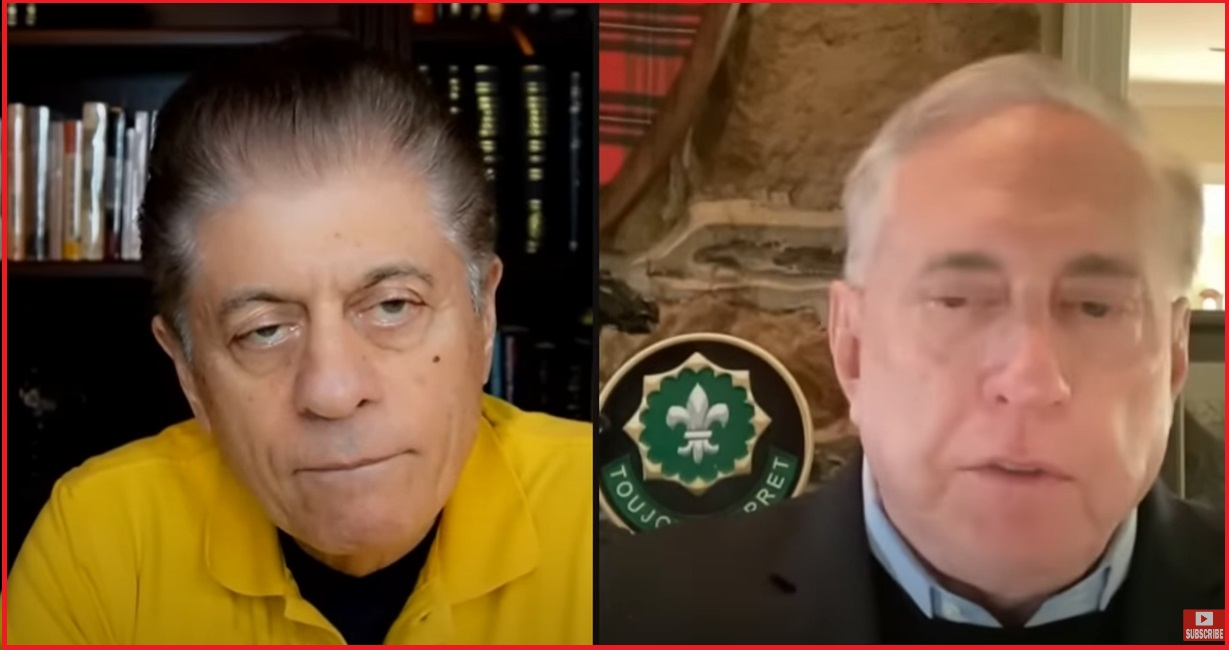
Col. Doug MacGregor appears with Judge Andrew Napolitano to explain the complexity of the tanks Biden has pledged to Ukraine. Additionally, MacGregor gives a different perspective than western media about the status of the war in Ukraine, the position and motive of the Russians and the overall status of the EU and NATO coalition.
MacGregor emphasizes that what the western public are told about the war is not consistent with the reality what is taking place on the ground in Ukraine. The term ‘hybrid warfare,’ which includes the U.S. State Dept. pushing a very specific propaganda message to the media, eventually runs into the reality of actual war fighting on the ground that is far more conventional.
The U.S. led NATO alliance may be winning the narrative, as outlined by media; however, the Russians are winning the actual fighting on the ground in Ukraine. In addition to noting the Russian cultural aspects of the conflict, Col MacGregor gives some somber analysis about how dangerous this is becoming as the U.S. political voices are not willing to concede or admit anything that runs counter to their promoted narrative. WATCH (prompted):
Posted originally on the CTH on January 26, 2023 | Sundance
Tucker Carlson covered the Project Veritas story about a Pfizer executive talking about the pharmaceutical company engineering new COVID strains via a process of modifying the virus called “directed evolution.” After the monologue segment, Tucker Carlson interviews Dr. Robert Malone. {Direct Rumble Link} WATCH:
The full crazy video of the Project Veritas confrontation with Jordon Trishton Walker, Pfizer’s Director of Research and Development, Strategic Operations – mRNA Scientific Planner, is below.
Posted originally on the CTH on January 26, 2023 | Sundance
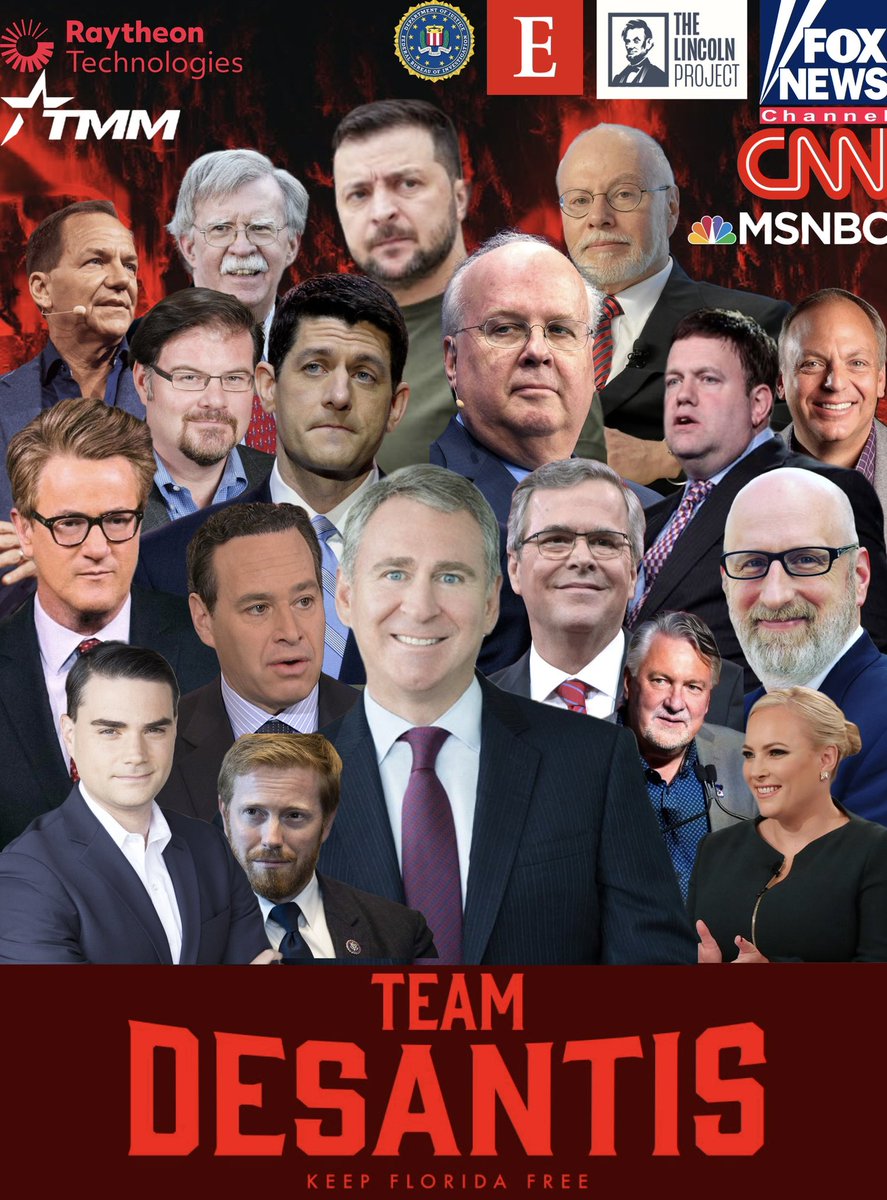
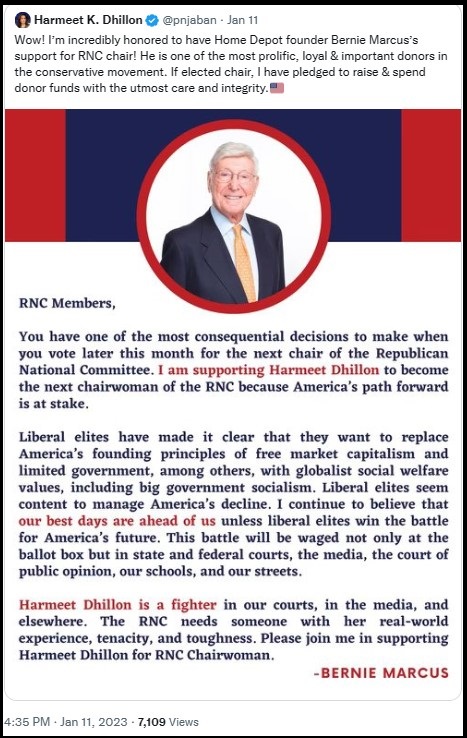
The pundits are noting the man who never expends political capital on an issue where he might lose, has finally expended some political capital. However, what the pundits don’t realize is this has all be gamed-out, strategized and planned by the people who manage Ron DeSantis. {Direct Rumble Link}
First, Mike Lindell announced he was going to challenge Ronna McDaniel for the RNC chair. This sent a shockwave through the Big Club because the potential for support from President Trump loomed over the Lindell announcement. America-First Mike Lindell is not controlled by corporate money, Wall Street, the multinationals or billionaire Big Donors who ultimately control the RNC as a big private club.
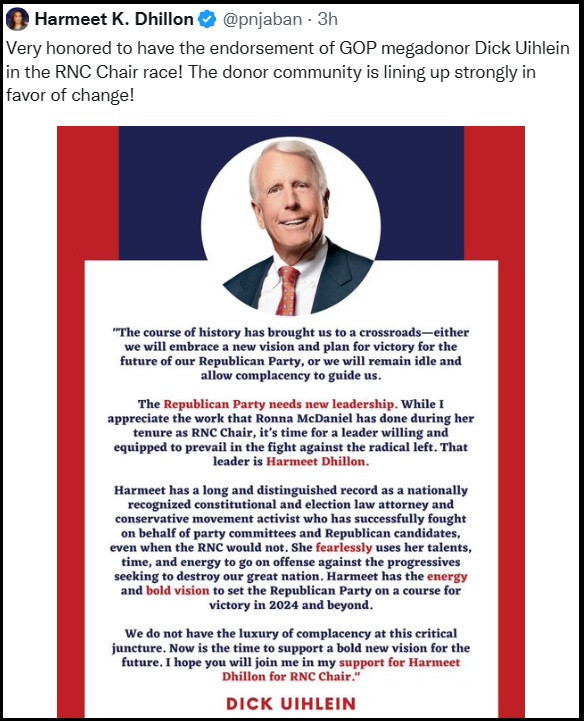
So, what happened?… Facing the possibility that Ronna McDaniel might be unseated, a week after Lindell’s announcement, Harmeet Dhillon steps into the picture.
Dhillion is a tenured Big Club member and voice for the billionaire class who fund her. Remember, Dhillon was paid over $1 million by the RNC, separate and above any costs connected to the Trump legal defense fund. Dhillon makes her money from the RNC, and if Lindell won the chairmanship, in addition to her friend losing the seat, Dhillon was financially at risk. Dhillon enters the race as an insurance policy, on behalf of the Big Club donors.
Notice that this interview is pre-taped. Charlie Kirk (TPUSA) the same group who organized the national campaign blitz after DeSantis’ 5 days in the bunker, strategically timed after the Mar-a-Lago raid, pre-tapes an interview with Ron DeSantis where the managed principal endorses Harmeet Dhillon for RNC chair. On the eve of the RNC vote, the interview is aired for maximum exposure. All of this is planned, coordinated, strategized and mapped out in advance. WATCH:
It’s not organic. All of this is scripted. All of it. Every bit of it. Harmeet Dhillon is already part of the DeSantis Big Club operation. The RNC roadmap in 2008 was for John McCain. The RNC roadmap for 2012 was for Mitt Romney. The RNC roadmap for 2016 was for Jeb Bush, and the RNC, Big Club, Wall Street, Billionaire and multinational corporate roadmap in 2024 is for Ron DeSantis. None of this is organic. All of this is scripted.
Once you see the strings….
Ironically, while advocating for Harmeet Dhillon, Ron DeSantis compares the ideology of Washington DC with the extreme left-wing ideology of Harmeet Dhillon’s hometown, San Francisco. lolol I bet the background manager squinted a little at that remark.
The Big Money that Steven Crowder was talking about in his media conflict with The Daily Wire, that’s the big money behind TPUSA. It’s all a conglomeration of Big Banks and multinational financial institutions, all operated within the same ideological outlook, that are behind the financial system that Charlie Kirk must adhere to.
Charlie Kirk, just like Ben Shapiro, is a puppet to the people in power with the money. They all have something in common.
All of these networked interests and stakeholders must make sure the RNC as a Big Club organization, is protected from those like Mike Lindell who they do not control. That’s the essential underpinning of all of this. The same stakeholders who were/are opposed to Donald Trump but were forced to back down a little after he became president.
It’s all about the money folks. That’s all this is about… Multiple millions for the RNC, multiple billions for the donor class on Wall Street and multiple trillions for the multinationals who operate in combination with government.
There are trillions at stake, and everything is about the economics of the thing.
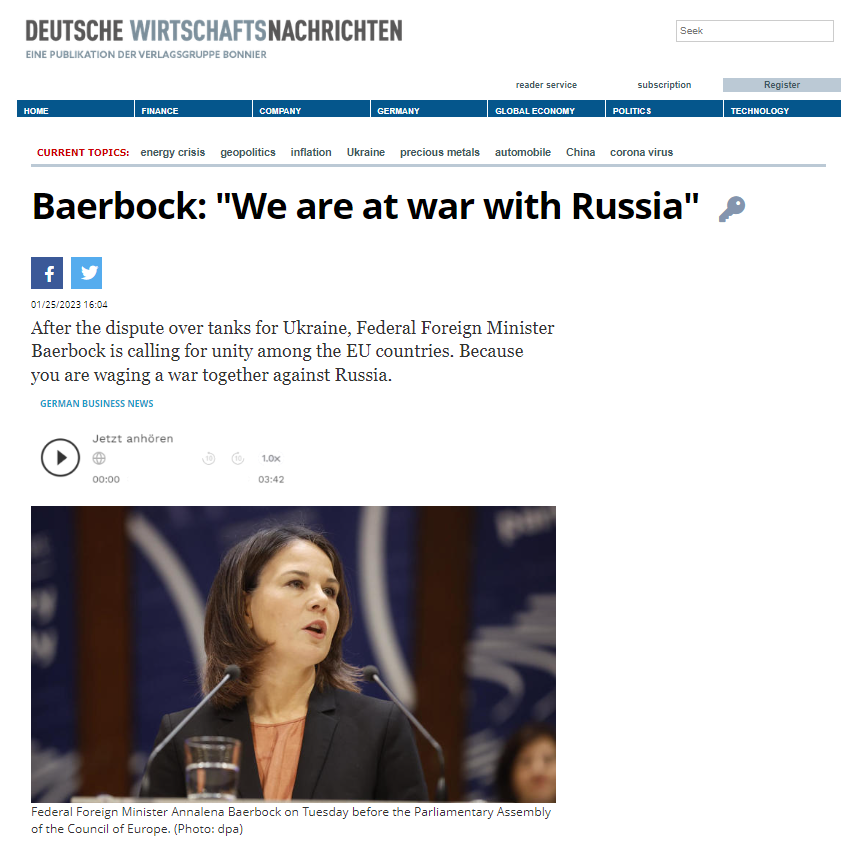
The German Federal Foreign Minister has actually come out and bluntly said: “We are at war with Russia.” I have been warning from the outset that the West has been the aggressor and deliberately did what it could to compel Putin to invade the very same way that Roosevelt did to Japan (1) by imposing an energy embargo (2) seizing all their assets in the USA, and (3) threatening to blockade any attempt to get energy from any other place. There were senate investigations into this very question that Roosevelt deliberately compelled Japan to attack Pearl Harbor just so he could then enter World War II whereas the people and Congress refused to fight Europe’s war. That view of distrust of FDR was so great, it compelled the US Senate to hold hearings into what did FDR know in advance of the Pearl Harbor attack.
Here we have the same pattern.
(1) In 2014 US installs an interim government in Ukraine which is unelected and immediately sense troops to attack the Donbas for wanting to separate from Ukraine after its own revolution
(2) West engages in the Minsk Agreement whereby Merkel has come out and acknowledged it was in bad faith and intended only to allow Ukraine to build its army while making a fool out of Putin for trusting the West
(3) Zelensky is elected promising to end corruption and the civil war with Russia
(4) VP Kamila Harris at Munich Security Conference tells Ukraine they should join NATO
(5) On February 23rd, 2022, Zelensky announces that Ukraine should rearm itself with nuclear weapons
February 24th, 2022, Putin intervenes to support the Donbas. If the United States even exists after World War III which they are promoting, then we would no doubt have a similar investigation into the deliberate policies that have rejected any possible peaceful negotiations and promoted war for the total destruction of Russia.
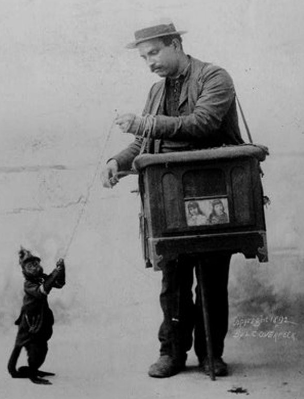
Putin has responded by saying that Germany is still occupied by the United States and it does as it is told. Indeed, all of Europe is totally out of its mind. You cannot push Russia into a corner and resurrect the old Iron Curtain this time from our side. That will NEVER bring peace and stability. Europe is indeed the monkey dancing to the tune of the organ grinder.
Running our war models, 2023 was the start and January was the target. I wish these forecasts were wrong. If Europe is going to even survive beyond 2027, it has better wake the hell up. The EU itself may not exist beyond 2024.
World Peace is attainable if we just look at Rome. After conquering various states, what kept them together? It was economics. Once everyone shared a common market, then the people benefited by manufacturing products and selling them to everyone else in the empire. We have taken the opposite approach adopting the theories of Karl Marx worrying about local jobs. It does not pay for the people to impose trade barriers so someone can grow a head of lettuce in the desert and sell it for $25. If another nation can produce a product at half the cost, that is not saving a local job, it is exploiting everyone else in the economy to pay higher prices for something that could be obtained far less. It REDUCES the standard of living for the whole – it does not advance society.
When people in Russia and China are linked economically with the consumers in America, then the governments are LESS LIKELY to push for war when that will undermine their people and their economic power. Blowing everyone else seems to be fund for politicians
Rome has shown us the way to peace. We ignore the lessons from history at our own peril.
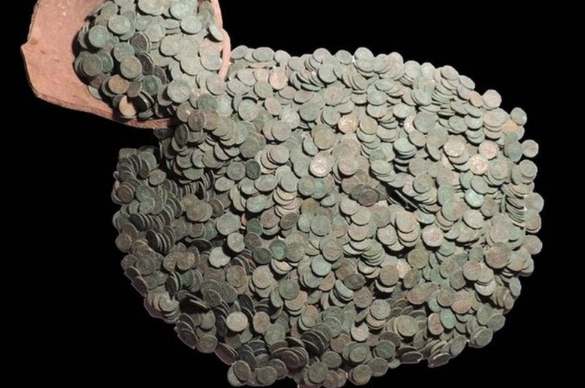
QUESTION: Why do you buy hoards? It is interesting. Just curious.
JY
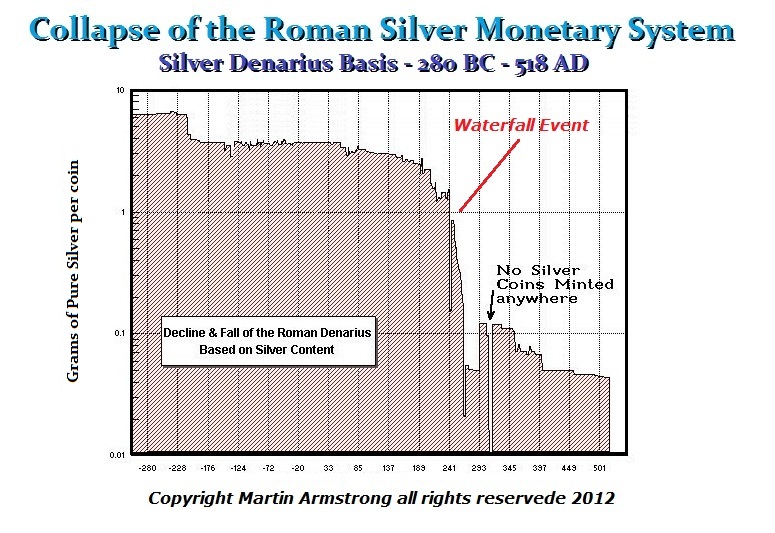
ANSWER: The coinage is the ONLY way to truly confirm the history. Much of the most important periods like the 3rd century AD, the fall of the Republic, or the Revolution during the Debt Crisis of the 1st century BC known as the Social War, can only be properly understood through the coinage lacking really detailed accounts of financially what was taking place. By recreating the monetary system using coinage, I was able to answer the question – How did Rome Fall? Gradually? Or Catastrophically? By assembling all the coinage, and testing it out, I could establish what nobody else could due using documents or archaeological digs. Rome collapsed in just 8.6 years.
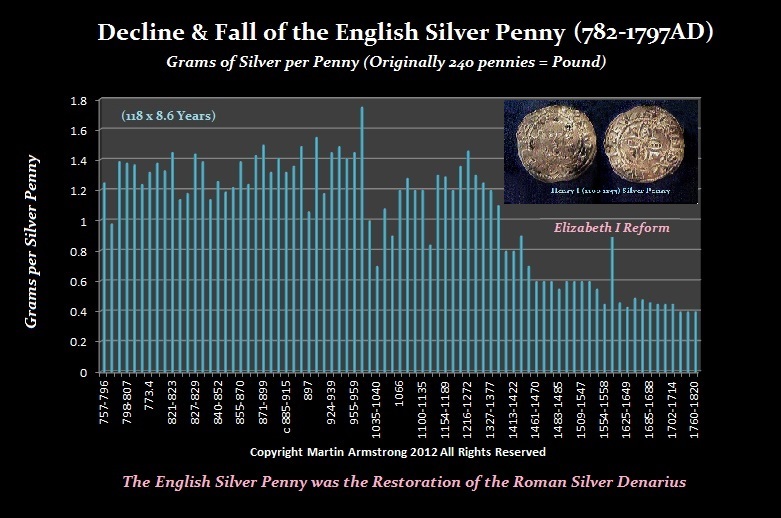
That was then observed in testing and using the same methods around the world. The collapse of the English coinage that inspired Gresham’s Law, bad money drives out good, also took just 8 years.
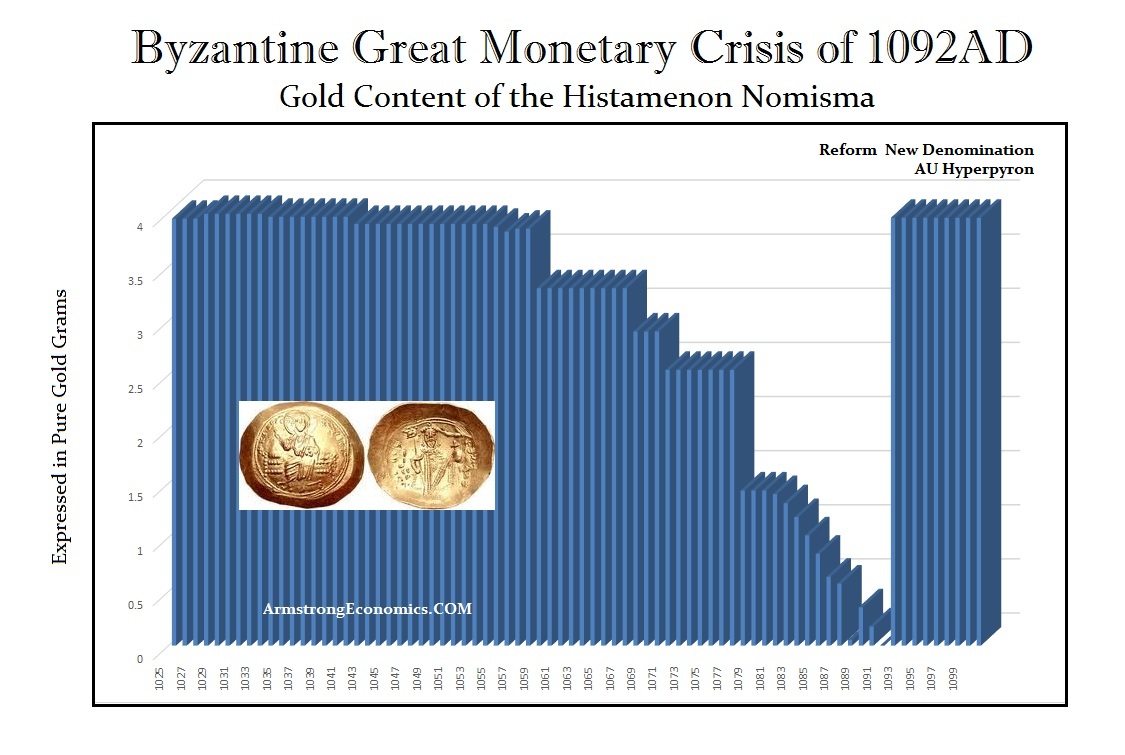
The Great Monetary Crisis of 1092 saw the gold content collapse also in just 8 years. The same pattern has unfolded time and time again. History repeats NOT because of wars or abstract theories. It repeats simply because human nature never changes – on technology.
The computer was about to forecast the fall of Communism in 1989.95 and it spread and took down the Berlin wall a few months after Tiananmen Square. People attributed that to modern communication. That was nonsense, The Roman Republic fell in 509 BC, and in the same few months in Athens, they too overthrew their tyrants, and Democracy was born.
The question is NOT how fast the information spreads. It could have traveled from Rome to Athens in a few days. The real question is how long does it take to filter through society to create political change?
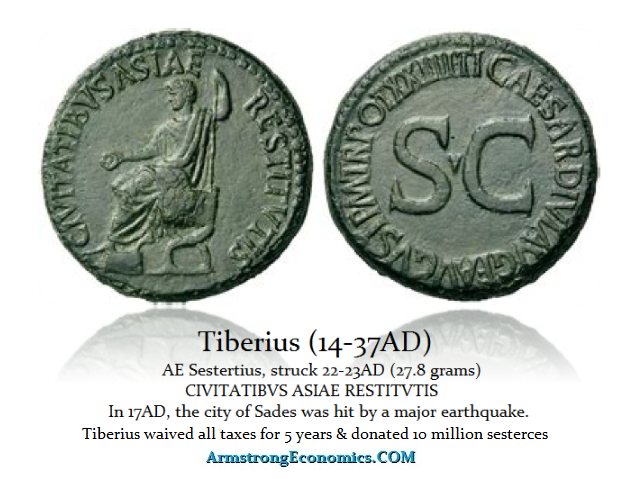
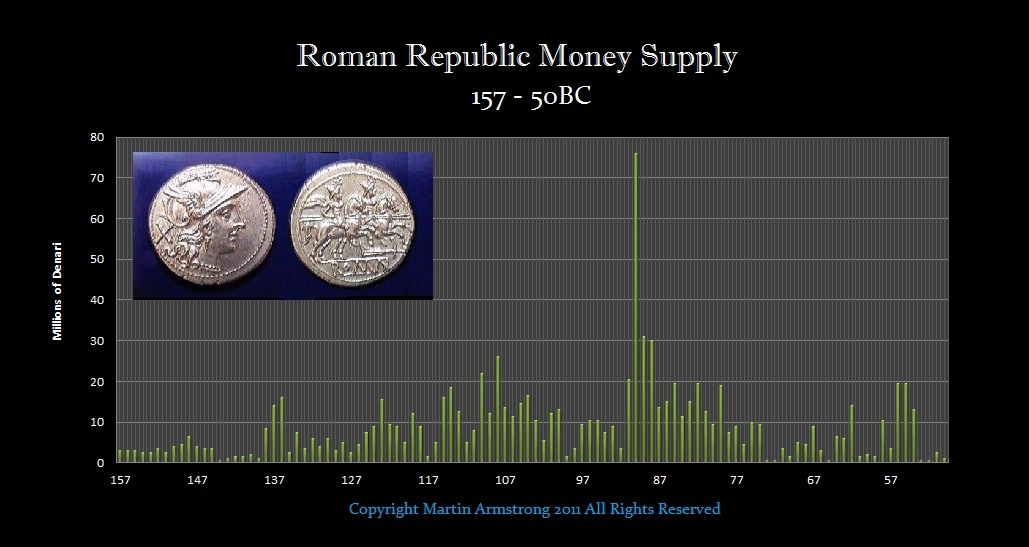
Therefore, assembling the number of coins by examining hoards and the number of different dies multiplied by 15,000 will give us a good idea of the money supply at that time as illustrated above. Granted, this research project cost tens of millions of dollars to produce. Nonetheless, it has yielded a wealth of information that enabled us to see specifically what took place economically. Human nature has not changed. When Rome burned, Nero did visit the victims. Tiberius issued coins for the aid of Asia when a major earthquake devasted the region we call Turkey today.
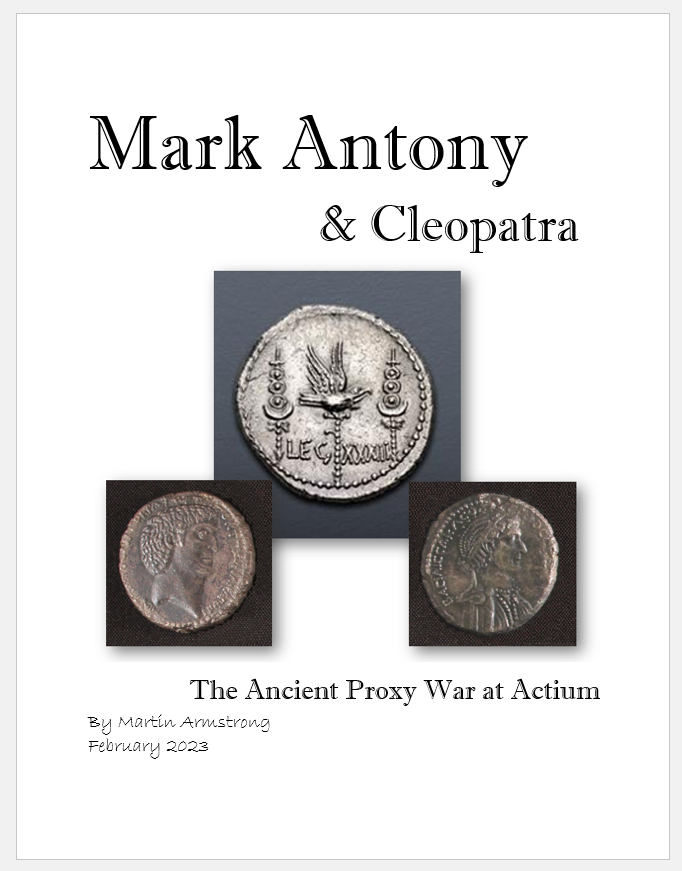
I am finishing a book on the famous Battle of Actium where Mark Antony lost to Octavian giving birth to Imperial Rome. The number of dies and the amount of coins issued by Antony demonstrates that the entire wealth of Egypt was at his disposal and it was really an Egyptian proxy war against Rome. The number of silver denarii struck had to be at least 25 million. The sheer massive amount of the increase in the money supply thanks to Egypt was huge. Antony’s coins remained in circulation for decades, although very work. They were the most common coin found in hoards at Pompeii in 79AD about 100 years later. Hoards enable us to see the cost of that war and how it changed Egypt and Rome.
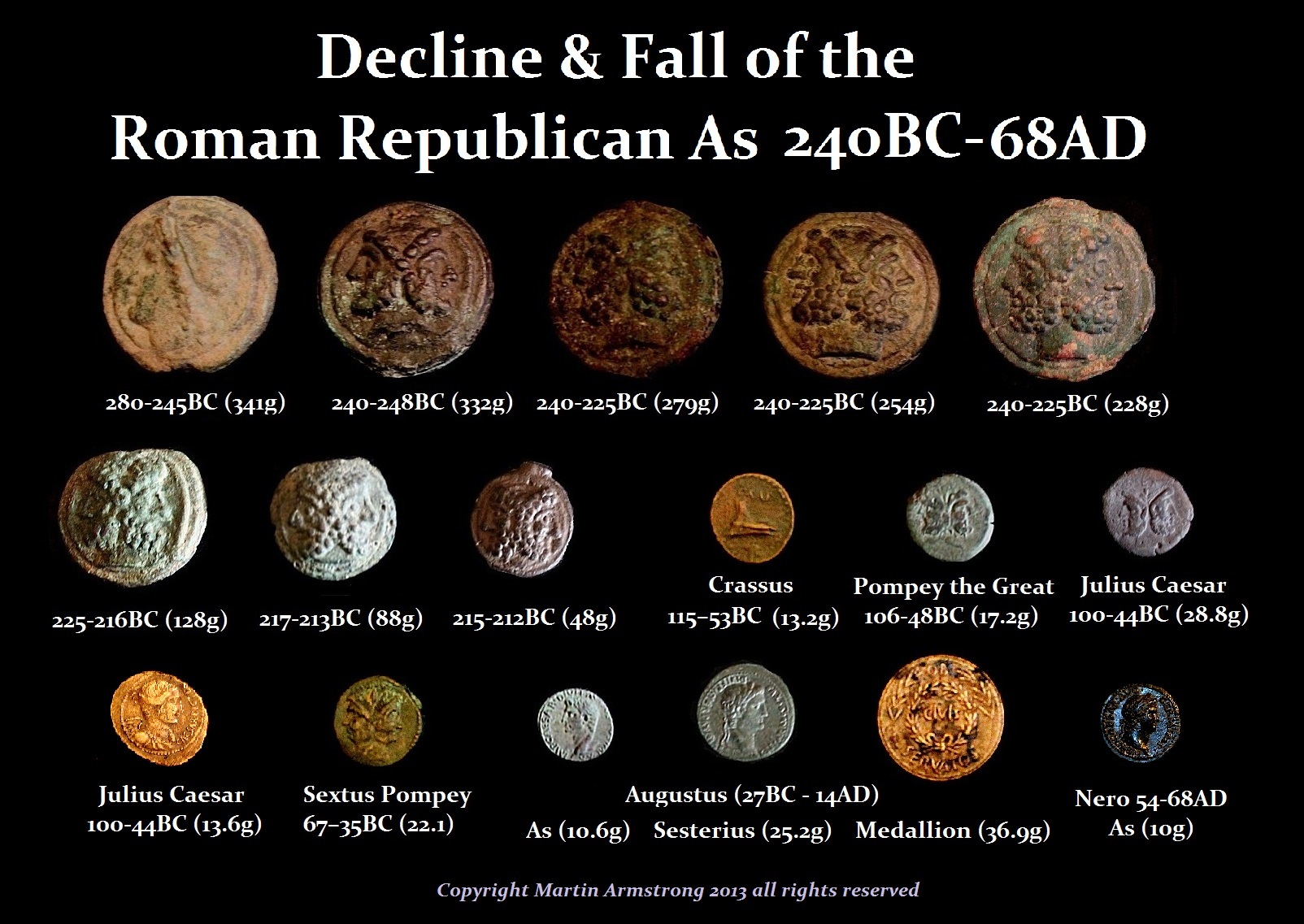
Where Rome began with bronze as its monetary unit and one pound was known as a Roman As, we can see that the price of the Punic Wars as what was one pound of bronze consistently declined. Here we found it was six waves of 51.6 years which are in themselves six waves of 8.6 years, that produced the major wave of 309.6 years. So if we look from the beginning of the Roman As being 341 grams in 280 BC, by the time we get to Nero in 54AD, the Roman As was about only 10 grams.
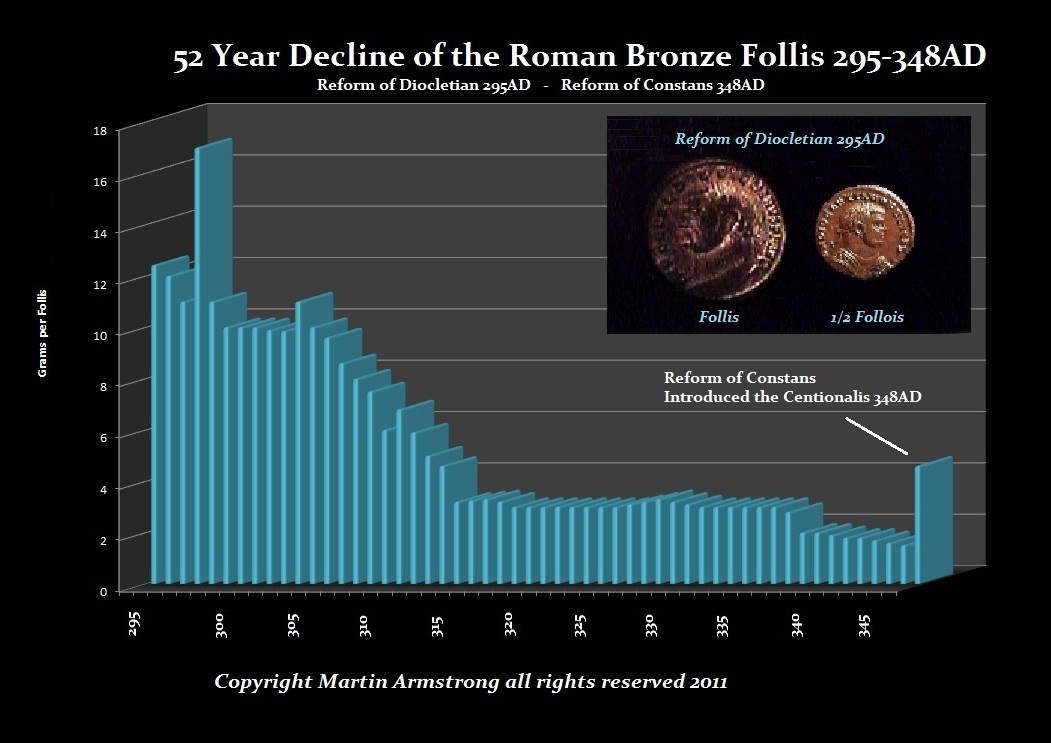
Even looking at the reforms of Diocletian in 295AD, his introduction of the follis declines remarkably also following the six waves of 8.6 years. I have looked at the monetary systems of Asia, the Middle East, Europe, and the Americas. they have conformed to the Economic Confidence Model confirming that this is a cycle that clearly incorporates everything from war to climate change.
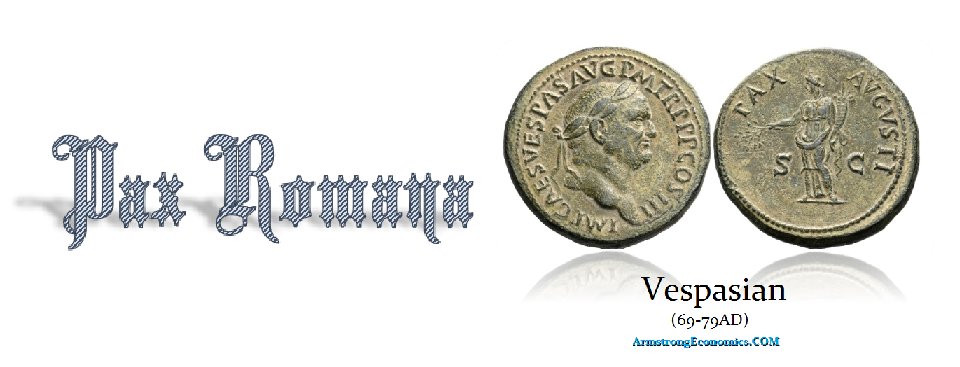
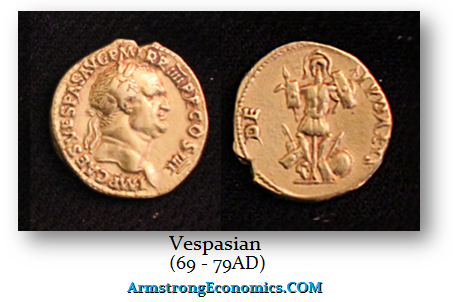
Even though Emperor Titus’ (79-81AD) reign was marked by a relative absence of military and political conflicts after his father, Vespasian (69-79AD) had defeated Judaea was defeated, there were several disasters during his brief leadership. On October 24 in 79 AD, Mount Vesuvius erupted and almost destroyed the cities and resort communities around Naples. The cities of Pompeii and Herculaneum were buried under stones and lava in 79AD shortly after Titus (79-81AD) came to power. Titus made all efforts to help the victims of the volcano and donated large amounts of money from the imperial treasury. The emperor visited Pompeii right after the tragedy happened.
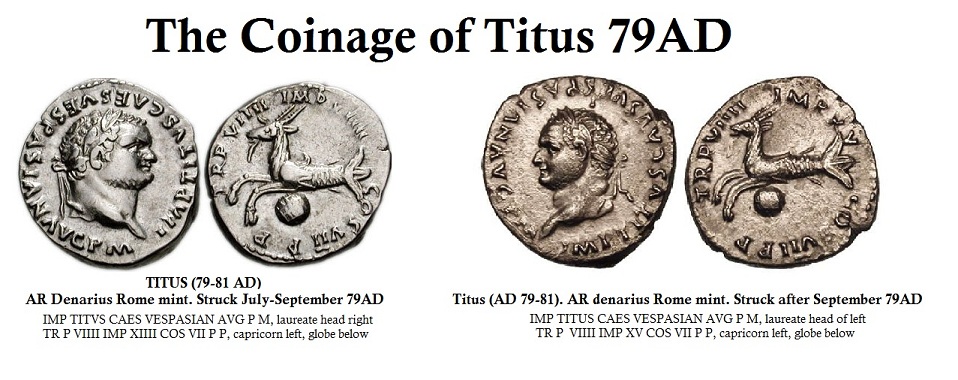
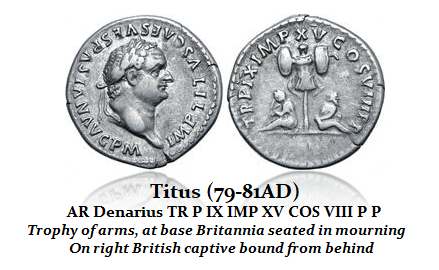
A single silver denarius was discovered in 1974 among the 180 silver coins buried in Pompeii. When it was cataloged, it overturned history. Titus’ father died on June 24th, 79 AD. Therefore, any coin of Titus as emperor would have to have the very first recording of his power “IMP VIIII” or 8th Imperator, which was a title that meant ‘leader of the army’ to the Romans. The coin discovered in Pompeii had the legend “IMP XV,” which was granted to Titus for the war in Britannia. Titus sent Gnaeus Julius Agricola who pushed further into Caledonia and managed to establish several forts there as recorded by Tacitus (Agricola 22). Therefore, Titus received the title of Imperator for the fifteenth time for this event, according to Cassius Dio (Roman History LXVI.20). This took place we know in September 79 AD about 3 months after becoming emperor following his father’s death. Obviously, if any coin was discovered in the ruins of Pompeii with “IMP XV” in its legend, then this provides absolute proof that the date for Vesuvius of August 24th, 79 AD cannot be correct.
Archeologists in Pompeii have discovered a remarkable inscription written in charcoal which has survived the catastrophe confirming that the eruption of Mt Vesuvius indeed took place in October 79AD as confirmed by the coin discovered and ignored by historians. The charcoal writing, discovered on the wall of a villa during a new phase of excavations, adds weight to a theory that the volcano destroyed the town in October 79AD rather than August of that year in line with Cassio Dio and the denarius of Titus. The date of August 24th, 79 AD, came from a letter addressed by Pliny the Younger to the Roman historian Tacitus, originally written some 25 years after the event.
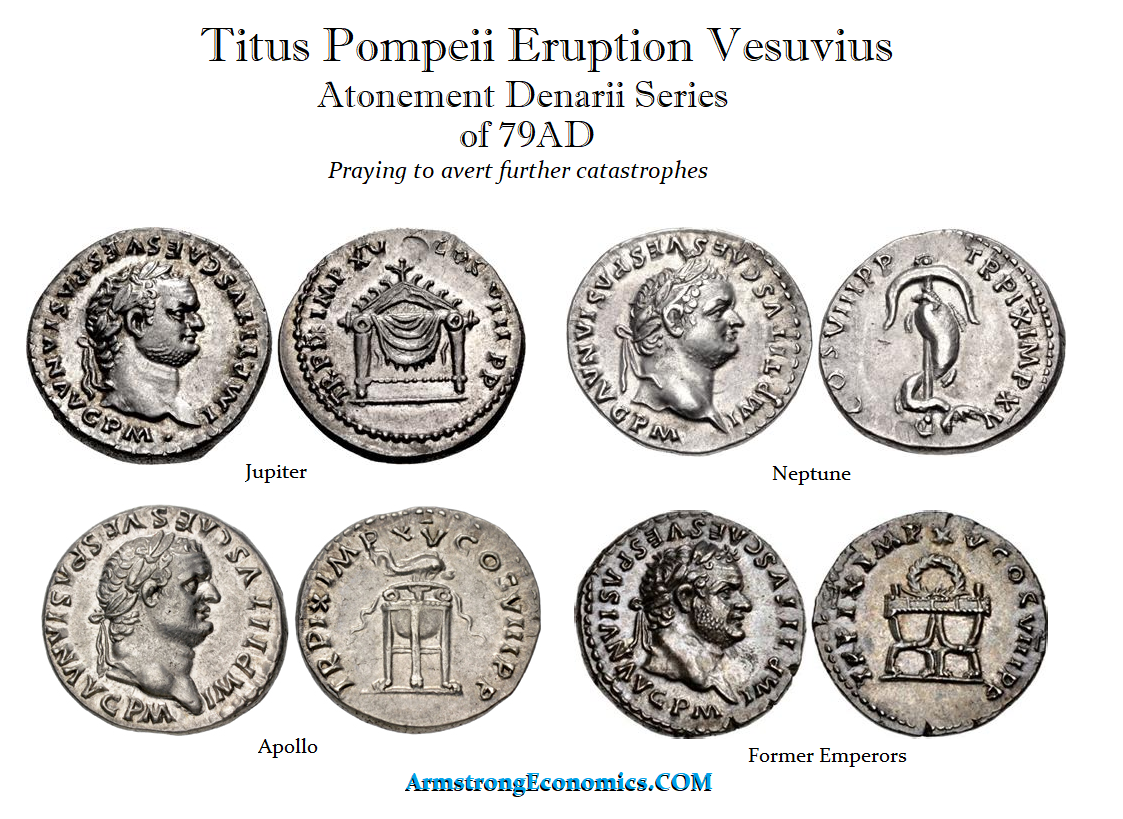
Titus devoted much of his silver coinage of Atonement to the gods for the disaster of Pompeii. There were four main Atonement issues commemorating the services of prayer and propitiation through which the emperor attempted to address the public alarm over the disaster. People often attributed such events to the gods being angry. The coinage showed emblems seeking the approval of Jupiter, Neptune, Apollo, and the deceased former Emperors to watch over the Roman people.
News actually spread rapidly around the Roman Empire. There were formal boards where notices would be posted in which important news and major events would be informed to the people much like such a board in a big company with notices to the employees. These boards were called the Acta Diurna and they were designed to inform the Roman people thereby avoiding fake news. We could call them ancient billboards in modern terms and even government officials would walk up and pin a written notice and the crowds would rush to see what is news. Thus, everyone knew of Pompeii in a matter of days. It did not take long for information to circulate.
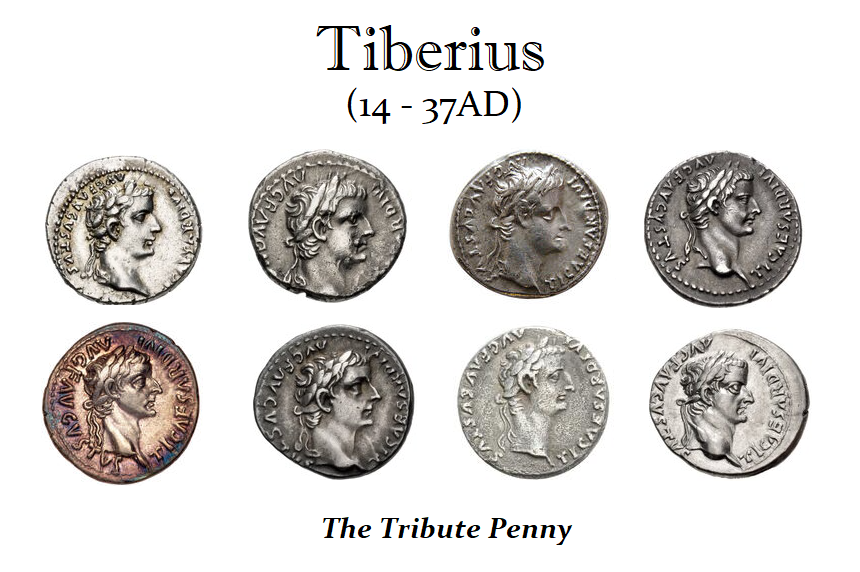
Because the coin dies back then were hand carved, we are able to identify the number of dies in use during a given year because each is unique. Just look at these portraits on the famous Tribute Penny of Tiberius (14-37AD). It all depended upon the artistic ability of the engraver.
The coin itself has taken its name because Jesus, referring to a denarius, which the English translated to “penny” because that was their silver coin, asked: “Whose is this image and superscription?” When answered that the likeness was Caesar, He replied; ”Render therefore unto Caesar the things which are Caesar’s and unto God the things that are God’s” (Matthew 22:20-21). Thus, the coin has been called the tribute penny meaning that was how you paid your taxes.
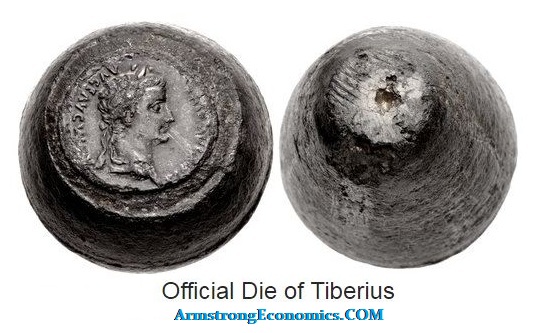
Hoards have enabled me to (1) see what was in circulation at that point in time for the hoard can be dated to around the most recent coin in the hoard. (2) I also have a number of ancient Roman dies like this one of Tiberius. Studies creating modern dies to test how many coins could be struck from such a die before it cracked provides a picture of about 15,000 coins.
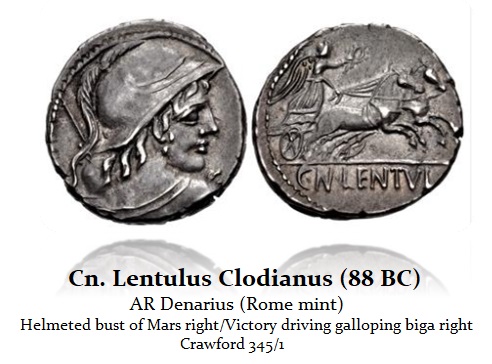
By completing die studies quantifying how many were in use, it then becomes possible to estimate the money supply. Here we can see that during the Social War of 90-87BC, there is a drastic increase in the quantity of coinage issued obviously to pay for soldiers. However, conducting metal testing on the coinage of this period, we find that Rome also debased the coinage slightly adding up to 10% copper to the silver. Therefore, studying hoards allows one to actually ascertain the extreme of monetary affairs.
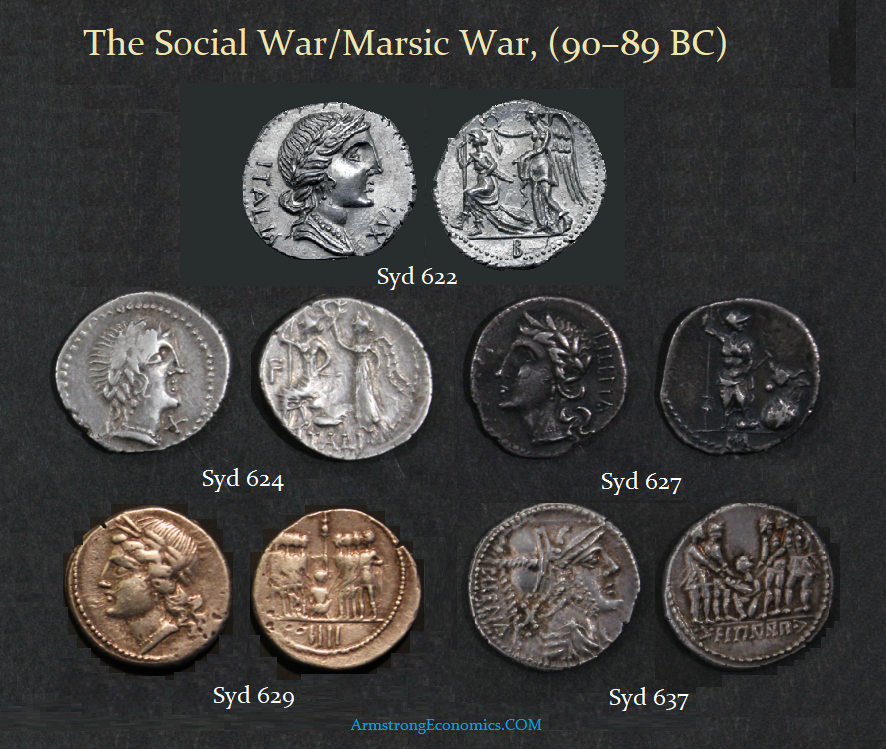
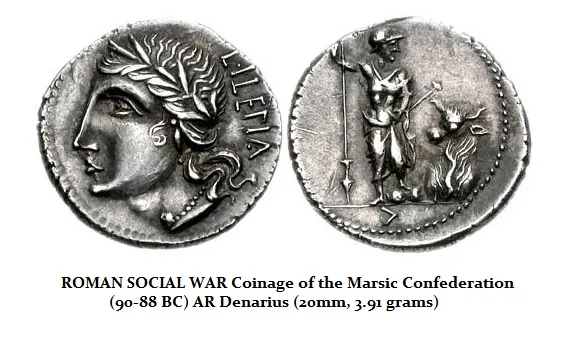
The Social War of the First Century BC was a failed Revolution against the corrupt Republic. The rebellion was waged by ancient Rome’s Italian allies (socii) who were denied equal rights with the Romans, despite the fact that they also fought alongside Romans in battle. They were seeking to separate and thus they fought for independence. Here are the coins of the rebels. They are very rare. You can see the theme celebrating the female head of Italia.
The allies in central and southern Italy had fought side by side with Rome in several wars and had grown restive under Roman autocratic rule, wanting instead Roman citizenship and the privileges it conferred. In 91 BC, the Roman tribune Marcus Livius Drusus proposed granting them Roman citizenship. The arrogance of the Senators erupted into a heated opposition. They went as far as to even Drusus for daring to propose such a decree. That resulted in the revolution.
When I dug deeper, the coinage with the debasement also reveals that there was a financial crisis. In all honesty, it was the Debt Crisis that ended the Roman Republic. There was a Sovereign Debt Crisis during the Roman Republic period that resulted in a dictatorship and a debt default. The Roman Debt Crisis of the 1st century BC has left behind a vivid account of what took place. The volume of gold and silver in Italy had increased dramatically during the late 2nd century BC following the Punic Wars. We have the first real gold coins issued by the Roman Republic at that time.
However, this concentration of wealth, which was akin to the United States after World War I and II, was absorbed by commercial expansion and investment in Gaul and Asia. A period of excessive concentration of money and large profits came to an end with the rise of the Social War of 91-88BC which was a war waged between the Roman Republic and several of the other cities in Italy (no taxation without representation), which prior to the war had been Roman allies for centuries. The war was begun by the Picentes because the Romans did not want to afford them Roman citizenship, thus leaving the Italian groups with fewer rights. The war resulted in a Roman victory and genocide against the Samnites. However, Rome granted Roman citizenship to almost all of its Italian allies, including the Samnites, to avoid another war. Therefore, we find that the debt crisis was correlated with a separatist movement – which we are beginning to see worldwide starting in Europe, but will eventually become a contagion in the United States as the conflict between left and right erupts after the November elections.
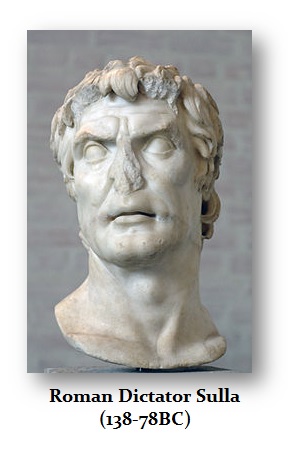
The Social War led to the complete state bankruptcy of the Roman State. We can see the dramatic rise in the money supply created during this time of war. This turmoil was then followed by the dictatorship of Sulla who then imposed an attempt to control the debt crisis capping interest rates at 12%. The previous legal rate was capped at 8.5%, but obviously, the market had exceeded that limit and Sulla had to confront that reality in 88BC. The debt crisis continued and then in 86 BC, the government was compelled into default. This is when the Valerian Law came into play. The State debts were defaulted on and thus reduced to 25%.
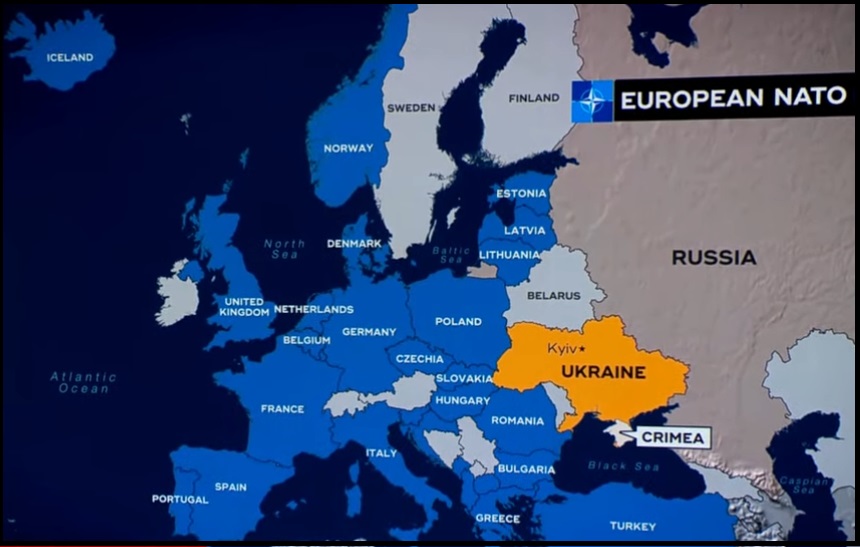
I wonder if the downside of the US occupation of Europe since WW2 and US subsidization of military aid has produced a culture of pacifism. Germany’s reluctance to supply tanks to Ukraine suggests other motives.
The media focuses more on Russia and internal dissent against Putin. One reads about defections and men trying to escape the draft. The real symptom is the fraying of Nato and the US mission in Europe.
I seriously doubt Europeans want war. These military alliances die over time. Unless there is a perceived military threat, Nato appears to be a relic like the Maginot Line fortifications in France decades ago.
To my memory, no military alliance has ever lasted long. They usually die off from wars waged or the passing of time. NAto now is on the clock. I think it will die this decade.
MS
REPLY: NATO is the problem. Russia, and its people, have no desire to invade Europe. The day of communism and its spread as a religious cult is over, except in the West where Socialism is the means of the power of the state and to keep the people dependent upon that power the very exact way that communism worked. Despite the fact that communism collapsed it was so inefficient and deprived the people of even freedom to imagine and curiosity that is the seed of advancing society. Without that freedom to imagine and the curiosity to discover new things, society withers and dies.
The Neocons see only hatred and war. John McCain openly met with the Neonatzis of Ukraine and promised them the funding to destroy Russia. Nobody thinks about the people. It is always this ideological endeavor to destroy an opponent as if this were a Roman Gladiator Contest to the death. They expect the people to utter the same words – “We who are about to die, salute you.”
NATO is a relic. It has NO PURPOSE unless it can constantly argue that Russia is the enemy and it will conquer all of Europe without NATO. This to me is the same as Athens demanding tribute from Greek cities that became the Delian League. That alliance of Greek city-states led by Athens was formed in 478 BC as a defense to a “possible” revenge invasion from Persia following the Greek victories at Marathon, Salamis, and Plataea during the 5th century BC. Persian never again even attempted such an invasion. But Athens extorted the Greek City States and moved the central Treasury from Delos to Athens and used all that tribute to build great monuments in Athens. The USA is like Athens. It defeated the German Nazis like Athens defeated the Persians. We created NATO to then defend against the Russian Communists, but have supported the Ukrainian Neonazis ever since and protected them from any prosecution.
That exploitation led to discontent and many then joined with Sparta to attack the arrogance of Athens. It was then that Persia supported Sparta to defeat Athens in 404 BC. The question is rather blunt. Will history repeat and Russia join with China to take down the arrogance of the West and make Stolenberg choke on his own words – “Weapons are the way to peace.” Sorry, but Rome showed us the way to peace – inclusion, and trade. The West has done nothing but rejects allowing Russia to enter the Western economy. Once the people are dependent upon trade, that is what creates peace – never arms.
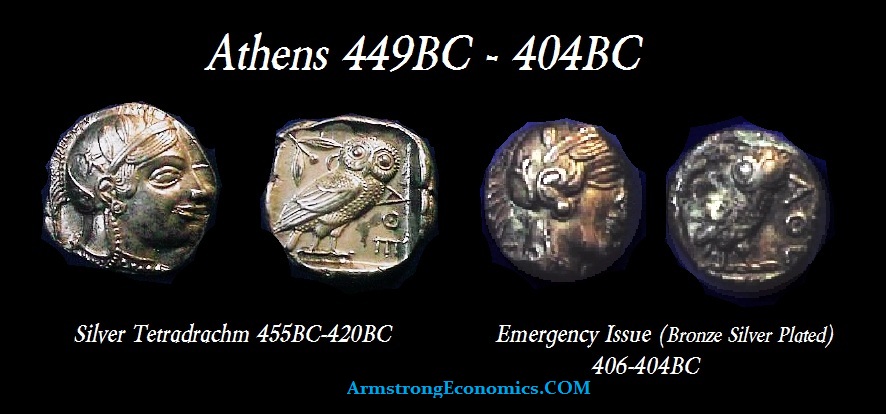
Athens fell in 404 BC. The cost of defending itself against Sparta backed by the Delian League and Persia led to its debasement of the coinage when the silver was running out. The emergency issue was bronze silver plated. The most common denomination became the drachm – debased at that. If history repeats, then the monetary system of the West will likewise collapse as it pours unjustified money into Ukraine – a government consumed with hatred. Peace will only come when the Ukrainian people overthrow Zelensky and wake up that they are merely being sacrificed in the war of hatred against Russia that is propelled by propaganda.
Just listen to the propaganda being spread by the Prime Minister of Finland who is prepared to also sacrifice her people on the altar of the Neocons.
I have created this site to help people have fun in the kitchen. I write about enjoying life both in and out of my kitchen. Life is short! Make the most of it and enjoy!
This is a library of News Events not reported by the Main Stream Media documenting & connecting the dots on How the Obama Marxist Liberal agenda is destroying America











 Centinel2012