Posted originally on Jul 8, 2025 by Martin Armstrong
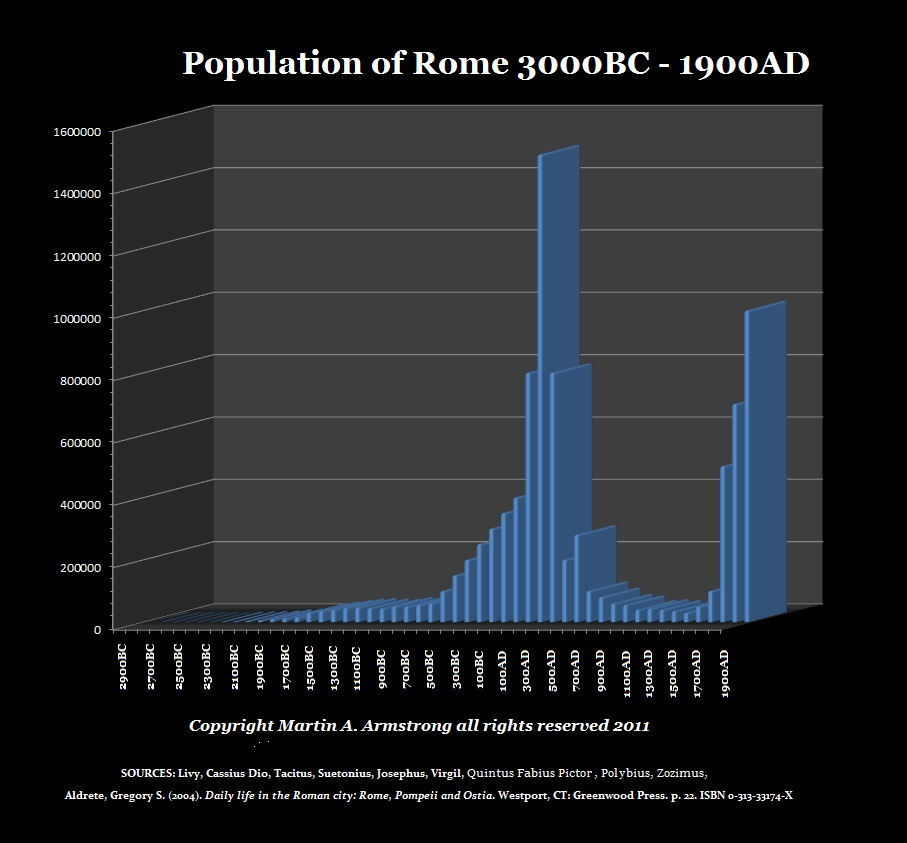
I have written about how Rome fell, and just by mapping the population of Rome, you can see the fate of many current nations and states operating under poor fiscal policies – people sell and just leave. It is different this time because, under socialism, the government has become abusive. When it came to integration, they sought to implement it by sheer force.
You can’t legislate the poor into prosperity by legislating the wealthy out of prosperity. Jobs are created by the wealthy who become wealthy because of their innovative vision – i.e., Henry Ford, Bill Gates, Steve Jobs, and so on. Henry Ford’s vision created the auto industry. Bill Gates, in bringing DOS to life, created the personal computer industry, as did Steve Jobs. How much employment did just those three men create? Far more than government.
Government creates nothing to advance society or to increase GDP in any positive manner. It is a natural human response not to pay taxes and this is why taxes have been the number one reason for civil war and revolution. It is always resentful to pay taxes, whereas giving money to help someone is rewarding. Taxes tend to support politicians and their pensions. If they must sell some assets to take a government job, it is tax-free. Few leave government without growing their net worth far beyond what one could typically earn through income or investments.
The great welfare state has produced a large segment of fraud and kept many people down since they would rather be taken care of than work to take care of themselves. Even in prison, many people are sentenced to 10 or 20 years, and the first thing they do is commit a crime to get back in, where they do not have to pay taxes, and they are taken care of. You destroy people’s lives for such a long period for non-violent crimes, and then expect them to have a fulfilling life thereafter?
In the United States, we have witnessed a significant shift in the population since the COVID-19 pandemic. People are continuing to flee authoritarian states with high taxes like California, New Jersey, and New York in favor of financially friendly states like Arizona, Texas, and Florida.
New Zealand once had a program where if a woman was pregnant and she had no idea who the father was, the government provided everything right down to a free home. They ended up with the highest percentage of women who had no idea who the father of their child was. Naturally, they did know the identity of the biological father, and he would jump out the back window when the social worker visited. They got everything for free then.
Any of these types of programs employ a divide-and-conquer strategy. The government cannot give to anybody anything that the government doesn’t first take from somebody else. When you reach a state where 50% of the people depend upon the other 50% to pay their bills, you end up with class warfare and bitterness. This is the cycle where civilization rises, peaks, and then crashes when government becomes the enemy of the people.
Posted originally on Jul 8, 2025 by Martin Armstrong
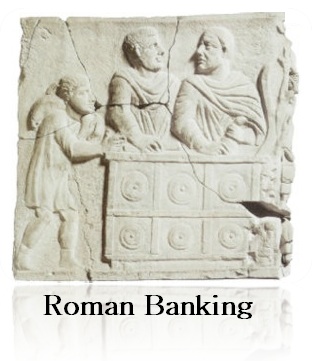
Banking has existed from the earliest of times and has taken many forms, from safe deposit storage, money changers, merchants with the ability to move money internationally, to money lenders. Some people wrongly assume that they can eliminate the business cycle by eliminating fractional banking. They assume that it will be possible to match lenders and borrowers to maturity contracts. They do not comprehend that this is the line of thinking that always leads to authoritarianism, all the way to communism.
The problem that will emerge from matching lenders and borrowers to a maturity contract is that the boom-bust cycle will still exist. There will always be the perpetual rise and fall in asset values caused by other factors (including human nature), not least of which will be changes in technology, civil unrest, and war that can alter capital flows. History offers a catalogue of solutions. All we need to test such an idea is to open the books.
People assume the cause of the business cycle is the fractional banking issue, as if that were eliminated, then you would flat-line the business cycle, creating utopia. Be very careful. This was the goal of Karl Marx as well. So the starting point is a basic question. Has fractional banking always existed? NO! Since the answer is no, then did the boom and bust cycle in banking exist even without fractional banking? The stark answer – YES.
In ancient times, financial panics also occurred without fractional banking. In Athens during 354BC, people borrowed money from the Temple unbeknownst to everyone else. They were speculating in real estate. The real estate market collapsed without fractional banking, and then it was exposed that the money was borrowed behind the curtain, so to speak, from the temple. Corrupt priests had all this money donated to Athena. She obviously was very frugal since she never seemed to go on a spending spree to buy shoes, owls, or spears. She wore a helmet so she didn’t need a hairdresser. So the priests could keep their hands out of the treasury. Oops – they were caught lending it out to their buddies for spare change. There was no fractional banking involved. They had the money and lent it to their buddies. The assets collapse because, as always, the mood of people changes with the seasons.
Fast forward to the 17th century, and we find the very same scheme played out by politicians. There was the collapse of Wisselbank in Amsterdam, where people had deposited their money and assumed the bank was strictly a safekeeping facility. They offered no loans and paid no interest. Little did they know, the government was using their deposits to fund its own trading.
The Wisselbank was founded in 1609. Upon first opening an account, a depositor paid a fee of ten guilders, three guilders, and three stuivers for each additional account. Two stuivers were paid for each transaction, except those of less than three hundred guilders, for which six stuivers were paid, in order to discourage the multiplicity of small transactions. A person who neglected to balance his account twice in the year forfeited 25 guilders. A person who ordered a transfer for more than what was upon his account, was obliged to pay three per cent for the sum overdrawn. The bank made further profit by selling foreign coin and bullion, which fell to it by the expiration of receipts, and by selling bank money at five percent and buying it at four percent. These sources of revenue were more than enough to pay for the wages of bank officers and defray the expense of management. (Adam Smith)
In 1602, the United East India Company (VOC) was formed from six trading companies in the Netherlands and granted a trade monopoly over the Indies. The bank was administered by a committee of city government officials concerned to keep its affairs secret. It initially operated on a deposit-only basis, but by 1657, it was allowing depositors to overdraw their accounts, and lending large sums to the Municipality of Amsterdam and the United East Indies Company (Dutch East India Company). Initially, this was kept confidential, but it had become public knowledge by 1790. The City of Amsterdam took over direct control in 1791 as a bailout, before finally closing it in 1819.
There is plenty of history of banking BEFORE fractional banking. Sorry, but that did not stop banking panics nor did it stop the business cycle with the boom and bust events. The Tulip Bubble was not leveraged with fractional banking. No matter what, the boom and bust cycle is driven by human nature. We do have a tendency to change our minds about everything from fashion to money.
The idea of matching lenders and borrowers sounds appealing. However, that will not eliminate the cycle. I can find no instance of such a flat line except during a Dark Age where there was no banking, private ownership, or any real economy. Coinage during the period is rare and is typically confined to the region where it was struck, demonstrating the lack of an economy or circulation due to trade.
Posted originally on Jul 8, 2025 by Martin Armstrong
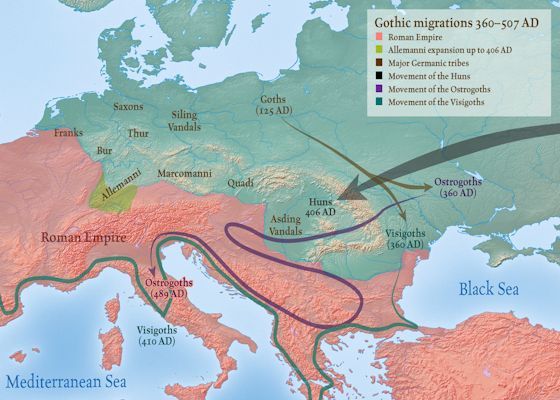
The globalists refuse to declare the migrant crisis an “invasion,” but we have history’s guidance to show us what happens when an unsustainable number of people enter a nation. The Goths, a non-military group considered migrants, are a perfect example. These men, women, and children sought refuge within the Roman Empire. This was not an invading army but rather a fleeing population seeking safety from the Huns. The Goths, long-time foes of the Romans, appealed to be admitted to Roman territory due to the threat they faced and needed to seek asylum. This event led to significant consequences and marked a turning point in the history of the Roman Empire.
The great Gothic migration involved hundreds of thousands of men, women, and children. While, to some degree, the growing unrest in the East pushed them southward, there is also little doubt that the border defenses of the Roman Empire had also been seriously weakened by the political instability and economic pressures that were building within Rome itself. Of course, the rumor of great plunder and riches available in Roman territory acted like a magnet much in the same way as the rumors of streets paved in gold in America prompted great European migrations during the 19th and early 20th centuries or the outdated stereotype of the American Dream.
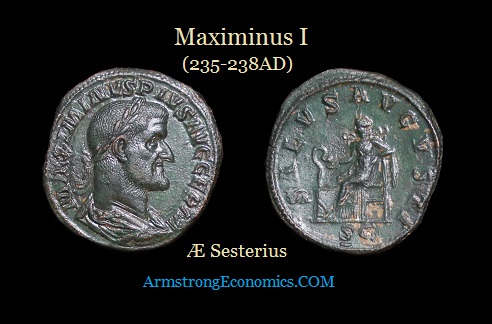
By 238 AD, the Gothic position was so threatening to the Roman Empire that Emperor Maximinus was forced to pay them vast amounts of tribute, similar to how countries currently pay all expenses for migrants. While his aim may have been to buy time, this demonstrated weakness on the part of the Romans, who were still in the middle of internal political struggles for power. Internal imperial rivalries ultimately defeated Maximinis. Within less than four years thereafter, the Goths began a series of raids along the Danube.
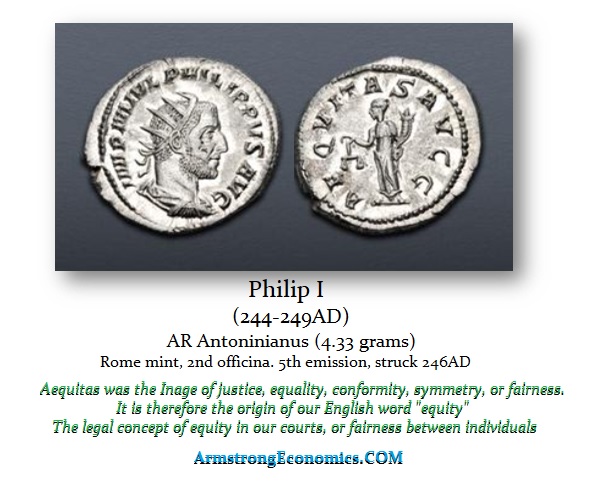
A decade later and Philip I attempted to quell the influx of migrants, but died while battling his successor, Trajan Decius. Rome was simply decaying gradually from internal struggles, which weakened the economy and constantly pitted one legion against another in a struggle for power. We see internal struggles today throughout the West as politics continue to divide the people. The Romans did not consider the Goths to be a force that would threaten the entire Empire, but rather more as a barbarian force looking for plunder rather than power.
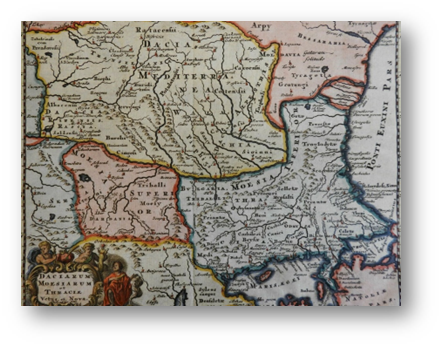
Trajanus Decius declared the Goths an enemy and attempted to force them out of the empire, only for the masses to return a year later. The Goths were prepared this time and formed several strategic alliances with enemies, such as the Dacian Carpi. This led to a full-scale invasion, and the Roman Empire suddenly found itself besieged as war raged on in Moesia, Dacia, and even in Thrace, while the main body of the Gothic invasion was preparing a descent into the region of the Black Sea.
After many battles, the Goths emerged as the new masters of the entire Danube territory, all the way to the Black Sea. Trebonianus Gallus emerged as the new Emperor who could do nothing to reverse the Empire’s humiliating defeat. The Goths now turned to Illyricum and Thrace, burning and plundering their way across the region. By 253 AD, the Goths set sail along the Black Sea, headed straight for Asia Minor, which was wide open and waiting to be plundered.
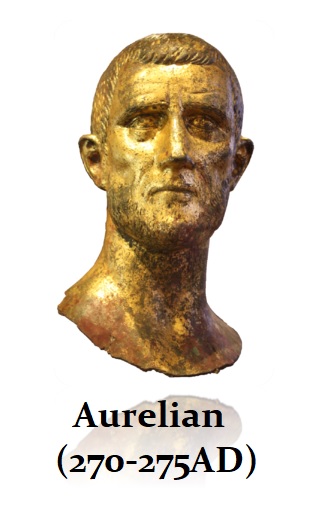
The Roman Empire was declining until Emperor Aurelian came to power and began restorative efforts, including anti-immigration policies. He not merely launched defensive measures, he moved on the offensive against the Goths and demolished them through a series of battles. The Goths were driven out of the Balkans and into Dacia. Aurelian also greatly restored the Black Sea defenses, which helped those regions rebuild their economies as well. However, Aurelian failed to pursue the barbarians into the Roman province of Dacia, pulling back and establishing the new border once again along the natural border as originally defined by Augustus – the Danube.
Aurelian’s decision to redraw the borders left Dacia in the hands of the Carpi and the Goths. Once the Goths were contained, they began to divide into two distinct groups – Ostrogothic and Visigothic kingdoms. These groups would evolve into powerful states that would ultimately bring down the Roman Empire in the West.
Those in favor of the Gothic migration stated that the newcomers would increase tax revenue and benefit the Roman economy. It was a humanitarian crisis and Rome’s responsibility to solve. Instead, the unsustainable influx of Gothic refugees contributed to the eventual fall of the Western Roman Empire. The event marked a turning point in Roman history and was part of a period in which the Roman Empire nearly collapsed under the combined pressures of invasion, civil war, plague, and economic depression. History always repeats.
Posted originally on CTH on July 7, 2025 | Sundance
Apparently, according to multiple sources citing a TSA internal memo, U.S. airline travelers no longer need to remove their shoes when going through the security screening process. [There’s nothing on TSA website]
Perhaps the USA will soon catch up to The Netherlands, where everything including your personage are scanned as you pass through the newer tech systems/gateways and you do not need to take off anything, nor remove anything from carryon luggage. It makes travel much faster.
YAHOO – In a sweeping update to airport security procedures, the Transportation Security Administration (TSA) has made a significant policy change: all travelers, regardless of PreCheck status, will now be allowed to keep their shoes on during security screening.
This marks the most significant revision to TSA’s screening process in more than two decades and effectively ends one of the most notorious post-9/11 requirements for air travel in the United States.
[…] Starting Monday, July 7, TSA officers nationwide will begin implementing the updated protocol. The policy applies to all U.S. airports and all passengers, whether they are enrolled in TSA PreCheck or not. The only known exception at this time is for individuals who are unable to present a REAL ID-compliant form of identification, a federal standard that was fully enforced back in May 2025. (read more)
Posted originally on CTH on July 7, 2025 | Sundance
White House Press Secretary Karoline Leavitt was asked about the DOJ/FBI investigative report citing that Jeffrey Epstein did not have a client list, did not use sex trafficking for blackmail and acted alone in the trafficking of thousands of underage girls for his own personal sexual deviances. That’s their story and they’re sticking to it. WATCH:
.
Sketchy. All of it.
The previous meeting DOJ/White House meeting with the CONservative “influencers” to discuss Jeffrey Epstein remains unresolved in motive. Prime Minister Benjamin Netanyahu will arrive at the White House shortly.
Posted originally on CTH on July 7, 2025 | Sundance
White House Press Secretary Karoline Leavitt holds a press briefing against the backdrop of multiple headline events. Anticipated Start Time 1:00pm ET. Livestream Links Below.
Posted originally on CTH on July 7, 2025 | Sundance
Yesterday, the DOJ and FBI released a memo concluding Jeffrey Epstein committed suicide, maintained no “client list,” and engaged in no blackmail – effectively debunking theories of his motives. This DOJ/FBI memo contradicts Attorney General Pam Bondi’s prior claims of reviewing such a client list. Many people are wondering what is going on?
If the memo content is accurate, Jeffrey Epstein trafficked in sex with thousands of minors for his own gratification. He was not providing underage girls to high profile clients and did not maintain a client list. Additionally, there is no evidence to support a supposition that Epstein’s actions were part of a system to generate blackmail of influential people.
Oddly, perhaps not, there is no information as to the source of his wealth or financing of his sick activity. Apparently, Jeffrey Epstein was able to conduct all of these targeting acts, and live a luxurious lifestyle surrounded by codependent enablers, from an unknown source of material wealth and income.
Yes, it all seems odd and irreconcilable.
You are not weird, strange or alone if you do not understand. None of it makes sense.
(VIA AXIOS) – President Trump’s Justice Department and FBI have concluded they have no evidence that convicted sex offender and disgraced financier Jeffrey Epstein blackmailed powerful figures, kept a “client list” or was murdered, according to a memo detailing the findings obtained by Axios.
The administration is releasing a video — in both raw and “enhanced” versions — that it says indicates no one entered the area of the Manhattan prison where Epstein was held the night he died in 2019.
The video supports a medical examiner’s finding that Epstein died by suicide, the two-page memo claims.
Why it matters: The findings represent the first time Trump’s administration has officially contradicted conspiracy theories about Epstein’s activities and his death — theories that had been pushed by the FBI’s top two officials before Trump appointed them to the bureau.
As social media influencers and activists, Kash Patel (now the FBI’s director) and Dan Bongino (now deputy director) were among those in MAGA world who questioned the official version of how Epstein died.
Patel and Bongino have since said Epstein killed himself. But it has become an article of faith online, especially on the right, that Epstein’s crimes also implicated government officials, celebrities and business leaders — and that someone killed him to conceal them.
The memo says no one else involved in the Epstein case will be charged. (Epstein’s associate Ghislaine Maxwell is serving a 20-year sentence for child sex trafficking and related offenses.)
Zoom in: According to the memo, investigators closely examined footage of Epstein’s Manhattan prison cell between around 10:40pm on Aug. 9, 2019, when Epstein was locked in his cell, and around 6:30am the next day, when he was found unresponsive. (MORE)
Posted originally on CTH on July 7, 2025 | Sundance
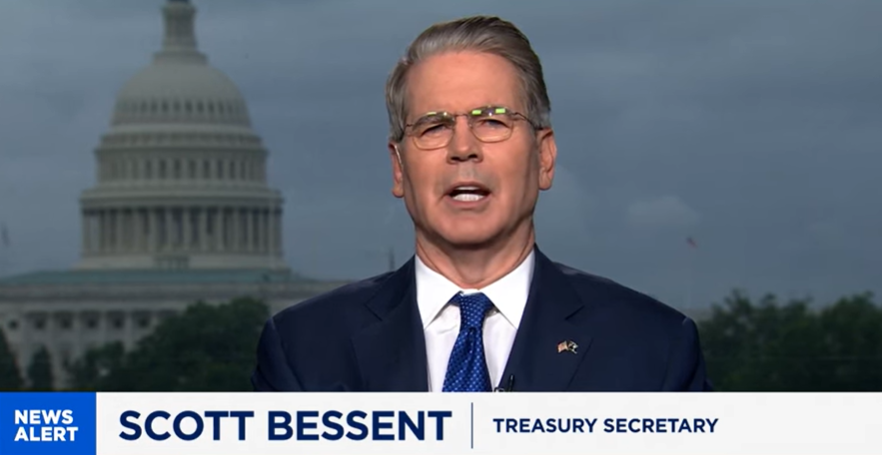
Appearing on CNBC to explain the big picture economics, Treasury Secretary Scott Bessent outlines how debt and deficit hawks are seemingly blind to the need for GDP growth to deal with federal spending.
From the outset of President Trump’s MAGAnomic policies in his T-1 and T-2 platform, growing the U.S. economy, expanding the size of the GDP is a key facet to dealing with debt and deficits. President Trump has always promoted economic policy that expands the size of the pie rather than focus on making smaller portions of each spending slice.
Secretary Bessent also explains the current status of the tariffs as delivered by the Trump administration. The next few days are exceptionally busy with incoming requests to renegotiate trade terms, and avoid countervailing duties. WATCH:
.
Big picture: Trump, Lutnick and Greer are now transmitting 1. Baseline tariffs (10-20%), 2. Reciprocity tariffs (trade imbalance) and 3. Section 232 tariffs (ex. Steel and Aluminum). Countries are notified and their tariff rate begins on August 1st.
I have created this site to help people have fun in the kitchen. I write about enjoying life both in and out of my kitchen. Life is short! Make the most of it and enjoy!
This is a library of News Events not reported by the Main Stream Media documenting & connecting the dots on How the Obama Marxist Liberal agenda is destroying America