Trading v Forecasts


Armstrong Economics Blog/Forecast Arrays Re-Posted Dec 5, 2022 by Martin Armstrong

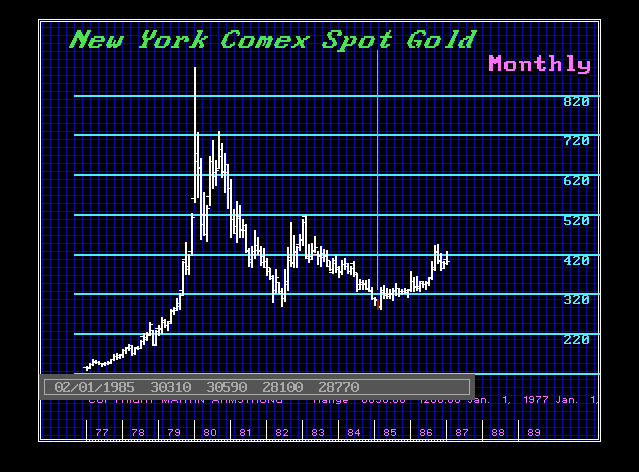
COMMENT: Marty; you should not be so hard on yourself. Nobody has tried harder than you to alter the outcome. Socrates is just unbeatable. I shared your hope that gold would have just cracked $1000 and that would have been a sling-sot up. But it stopped at $1045 and the reversals were elected and that was the end of that. As a long-term trader, I understood what you meant. I remember 1985 when gold just broke $300 and the leading gold analyst ___________ threw in the towel. You called that low and that’s when I started following your work. You weren’t just an analyst, you were a trader.

So ease up. You have done your best. As you said at the WEC, nobody has tried to defeat your own model as much as you, but you have always lost.

I for one hope you do Dubai in the Spring. It would be nice to see everyone in person again.

PD

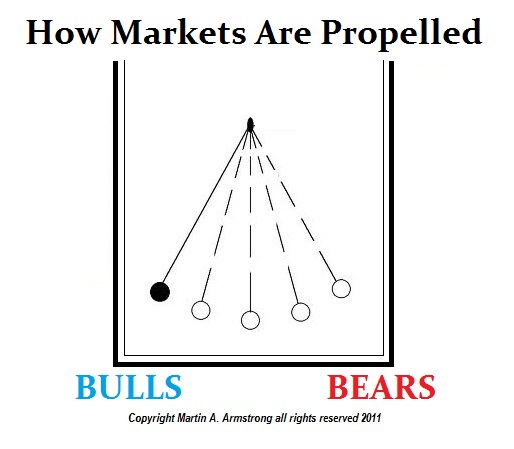
REPLY: Oh, yes. I remember that trade. It takes a trader to understand why I said if gold could crack $1,000, it would then be propelled straight up into a slingshot. Perhaps one of the most important trading tools is that the market is like a pendulum. The further it swings in one direction, the fast it will be propelled in the opposite. That is why when bubble markets peak, the vast majority of the decline takes place in two to three  key time units thereafter. The failure of gold to have cracked that $1,000 psychological level is also when it has languished thereafter.

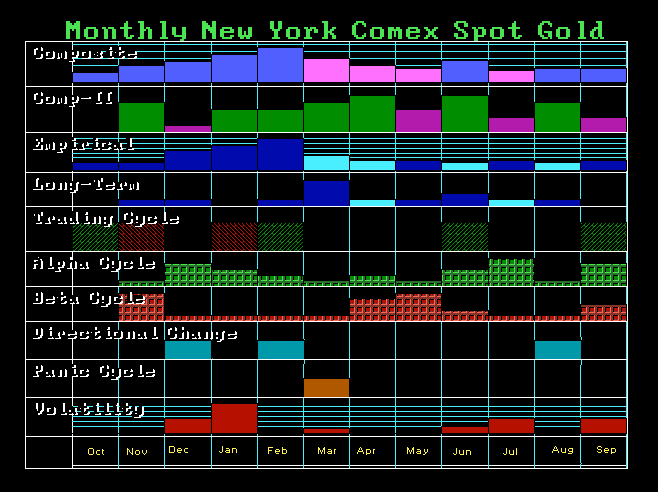
Here is the Array from October 1984. It called all the moves correctly and the major low was February with the Panic Cycle the very next month. The next temp high was on the next Directional Change in August 1985.

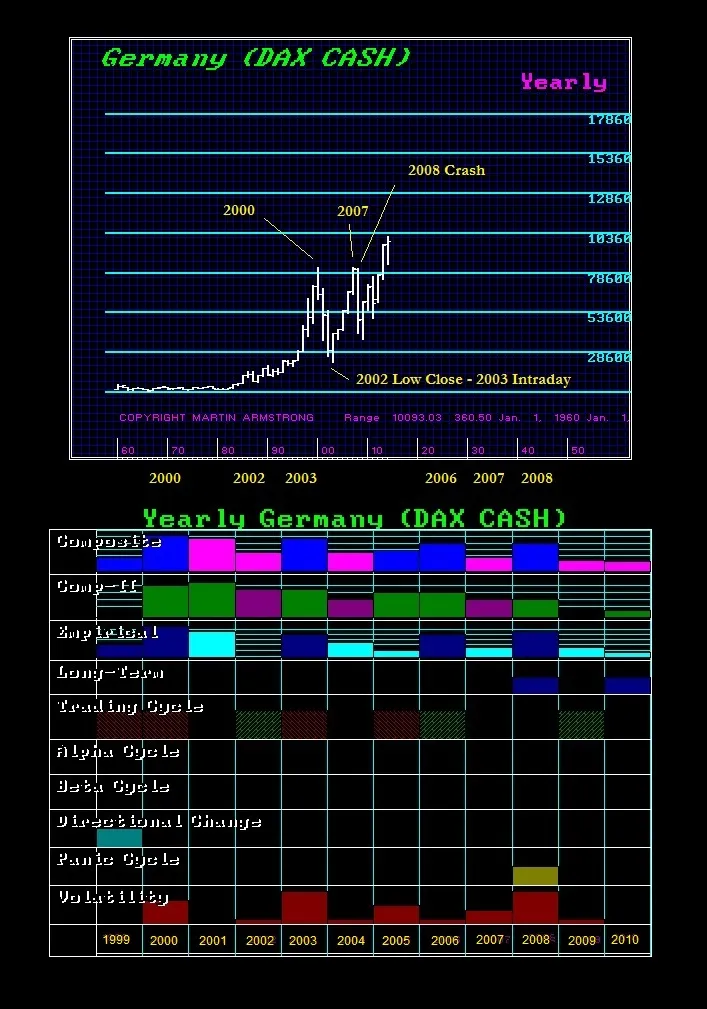
I have to admit, probably the one forecast of Socrates that really impressed me personally was the Array we published in 1999, which you can find on the Wayback Machine. It had targeted a Panic Cycle in 2008 – 10 years in ADVANCE! It was projecting the collapse globally of the 2008-2009 Financial Crisis. Obviously, my personal comments are not forecasts. I cannot beat Socrates and nobody else can possibly beat it.

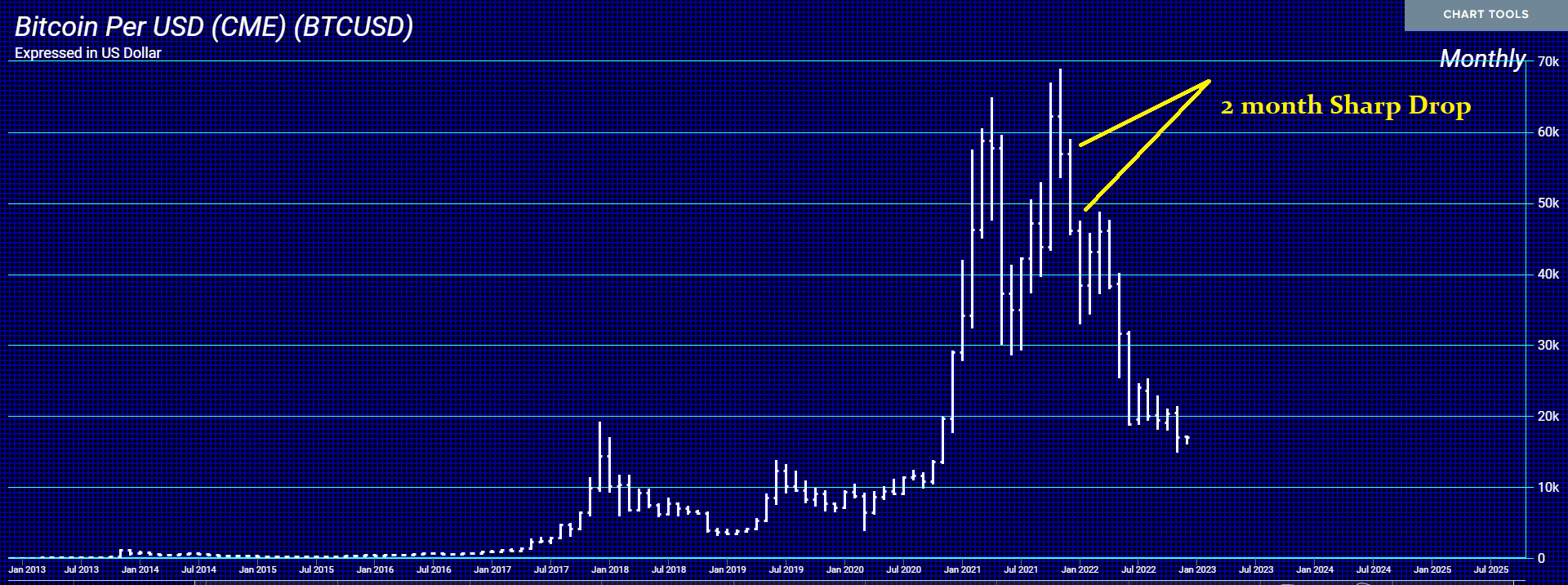
Trading observations are not forecasts. Even look at BitCoin Monthly. You see the standard 2-month decline, temp low, then the pendulum moves back in the opposite direction, but the power is diminished. The power is too strong on the decline side. These are just observations from being a trader. They are NOT the computer. So, yes, my comments are not forecasts but observations. The computer does the forecasting not me. Not even I can defeat Socrates.

Banks


Armstrong Economics Blog/Banking Crisis Re-Posted Dec 4, 2022 by Martin Armstrong

COMMENT: Thank you for all you do. Your input has guided me well.
I suspect my Bank is in deep trouble. _____ bank in ____ CA.
They specialize in small business. First red flag was freezing my account for no reason. I then bounced a check because my account was frozen. They could not give me a reason for freezing my account. Then they offered me, according to them, a great investment deal, that was the second red flag. Then I was contacted by a relationship manger. This was the third red flag.

Will be closing all my accounts with ______ next week.

MC

REPLY: There are clearly problems emerging since interest rates have risen and  many banks were not in a position to take the losses on long-term investments.

Always keep some cash. A word to the wise should be sufficient

Fixation with Numbers


Armstrong Economics Blog/Trading Re-Posted Dec 2, 2022 by Martin Armstrong

2032 – How Do We Approach Uncharted Waters? | Armstrong Economics

COMMENT: You Know…years ago, all these different monthly reports did not affect the markets day to day so much.

Now…Today..these reports send huge panic cycles in the markets every time they are announced. Doesn’t that tell you something about the future?? Doesn’t that tell you something about the US economy? The end keeps getting closer.

N

REPLY: This is clearly the uncertainty. Everything seems to be upside down. Nobody understands the future or what might even happen. Will there be war? Will inflation actually stop? Are we headed into a major recession? How can the markets rally facing a major recession? So many questions and most have just opinions.

Even my interpretations of the computer arrays are sometimes wrong. Things are unfolding on such a global scale that concerns are rising everywhere. You have North Korea shooting missiles off over Japan, NATO members think Ukraine should join NATO, and Iran is threatening nuclear war in the Middle East. All of this while Schwab tells the world we will own nothing and be happy. To many, it has become just flip a coin and see if you should buy or sell.

Labor Report Shows 263,000 Jobs Added in November, Combined with Significant Wage Growth 0.6% For Month


Posted originally on the CTH on December 2, 2022 | Sundance 

There’s a disconnect in the Main Street data that is perplexing from the standpoint of traditional economic and labor analysis.

There have been significant layoffs in the labor market as the result of diminished consumer spending activity. However, the Bureau of Labor and Statistics (BLS) is reporting a hotter than expected 263,000 new jobs in November [DATA HERE].

There were declines in jobs within the retail sector [-30,000 in Nov, -62,000 since August] and declines in warehousing and transportation [-15, 000 in November, -30,000 since July], which would indicate the outcome of lowered consumer spending on goods, or at least a change in consumer spending priorities.

Simultaneously, there were significant increases in jobs for leisure and hospitality [+88,000 in Nov], with the majority of those gains in food service and drinking.  However, that sector is still lower than the pre-pandemic by -980,000 jobs.  Also note people are not attending events with high ticket costs, the performing arts and spectator sports segment dropped 7,000 jobs [Table B-1]

Overall, if you were to look at the macro level jobs report, anything attached to the traditional spending of durable goods (retail stores) is declining.  However, the jobs related to the service or life experience are growing.  Oddly, and perhaps creepily, this dynamic falls in line with the ‘you will own nothing and be happy‘ cliche’ that has been oft spoken about the new post pandemic ‘Build Back Better‘ economy as espoused by the World Economic Forum.

Job gains in the infrastructure of life such as, building and construction, as well as the labor sector associated with skilled domestic service trades like plumbing, electricians, maintenance, etc are continuing to hold stable.  The major shift in the labor market surrounds the buying of durable goods which has disappeared along with the disappearance of discretionary income.   Which brings us to the wage portion of the BLS report.

Wage growth was a very high 0.6% for November and brings the annual rate of wage growth to 5.1%.   This outcome is almost certainly an outcome of workers demanding higher pay to cope with inflation, and employers needing to raise their wage rates in order to retain employees.

We also see an increase in the number of workers holding multiple jobs, as individuals are taking second jobs to cope with massive price increases in housing, food, fuel and energy. As noted within the BLS data:

In November, the average workweek for all employees on private nonfarm payrolls declined by 0.1 hour to 34.4 hours. In manufacturing, the average workweek for all employees decreased by 0.2 hour to 40.2 hours, and overtime declined by 0.1 hour to 3.1 hours. The average workweek for production and nonsupervisory employees on private nonfarm payrolls decreased by 0.1 hour to 33.9 hours.”

Fewer people are working, but more jobs are being worked – with lowered hours.

Higher wages are good; however, higher wages lead to higher prices for goods and services; which drives inflation higher, which creates the need for higher wages.   It’s an upward pressure spiral.

The supply side pressure on inflation, almost exclusively created by the BBB energy policy, shows absolutely no sign of lessening, despite the drop in demand for domestically produced finished consumer goods which has lowered overall industrial demand for energy.

The Build Back Better energy driven policy changes are creating very weird economic outcomes.

Prices are rising.  Consumers are squeezed.  Jobs attached to spending on goods are declining. Jobs attached to life experience and services expanding.

Ex.1 If you are working two jobs, now you might not have time to mow your grass – so you hire a lawn service.  The lawn service guys are charging more because the gasoline and business costs are higher…. which means you need to work a little longer at the second job to pay for the lawn service you don’t have time to do on your own because you need to work the second job.   That’s the dynamic we are seeing in the quantification of labor and job growth.

Ex.2 If you are working two jobs, you might not be cooking as much at home.  So, you grab dinner/lunch away from home.  The restaurants are charging more because the business costs are higher…. which means you need to work a little longer, ask for higher wages, in order to offset the time you don’t have to eat lunch/dinner at home.

This conflicting duality is what I always called the “serfesque driven economy.”  It is an outcome of erosion of the middle-class.  A status of individuality where your desires for life experience determine the need for your income.

You don’t own a car, you Uber.  You don’t own a house, you rent.  You don’t need a kitchen, you eat out.  Things seem ok, but you eventually become a serf to the people who control transportation costs, housing costs, food costs, etc.  Ultimately you have no control over the time you want to spend in enjoyment, because you don’t own the mechanisms of your life and need to work in order to afford maintaining the costs.  It’s a weird mental exercise.

There is a real outcome in this dynamic where the wealth gap increases.

Why I Look at the Dow First


Armstrong Economics Blog/Economics Re-Posted Nov 28, 2022 by Martin Armstrong

COMMENT: Why do you focus on the Dow over the S&P 500 and others?

ANSWER: New analysts claim that the S&P 500 provides a better picture of the markets compared to the Dow. Although the S&P 500 obviously has a larger catalog, the Dow is a direct reflection of international capital flows. Look toward the Dow to see where big money is moving.

The S&P 500 is domestic-oriented, and fund managers and institutions tend to focus on this index. The NASDAQ typically reflects retail, often tech-heavy, and usually does not peak at the same time. Each index offers a completely different perspective. The Dow Jones Industrials is the big money. You will notice that this index leads the way. It is the first out of a key low because it is typically the foreign capital based on currency. You will also notice the Dow tends to top out first because the big money tends to pull out first also due to currency.

Capital is flowing like never before, and the smart money is on the move. Socrates users have access to our capital flow heat map that shows where money is moving in real time. The USD remains the last safe haven, and money is pouring into the US. Look to the Dow for the best international perspective.

New Interview: Energy, Russia/Ukraine, Cryptos, US Civil War, Real Estate Crash


Armstrong Economics Blog/Armstrong in the Media

Posted Nov 26, 2022 by Martin Armstrong

Spread the love

Click here to listen to my latest interview on

“This Week in Money

Meloni Set to Abolish Italy’s Welfare State


Armstrong Economics Blog/Italy Re-Posted Nov 25, 2022 by Martin Armstrong

Italy’s new PM Giorgia Meloni revealed her first economic initiatives with a budget of 21 billion euros. The Italian government will no longer provide free handouts to those who simply refuse to work. This should not be controversial.

For starters, anyone eligible for welfare must actually reside in Italy. Those capable of working will have eight months to find employment before their free paycheck runs out. Alternatively, if someone refuses a job, they will be excluded from receiving welfare. The 5-Star’s citizens’ wage will be abolished by next year as the system has been abused by many who simply do not want to work. They are reviewing the pension system as well, but it’s too late to save the pension funds.

Italy’s first female PM is also encouraging couples to start families amid a birth rate crisis. Women may take a sixth month of maternity leave and still receive 80% of their salary. Meloni cut taxes on goods for newborns and feminine hygiene. Couples will receive a 50% increase in the “baby bonus,” and families with over three children will receive more incentives. Italy needs future taxpayers.

Everyone cheered when America appointed its first female vice president, but Kamala Harris has done nothing for women who still pay the pink tax and do not have access to maternity leave. It is astonishing how controversial this move has become with the papers calling Meloni a Fascist dictator for preventing working taxpayers from paying for those unemployed by choice.