Investment Exodus / Shifting Supply Chains – China Walks into Trump’s “Golden Ticket” Trap…


President Trump is executing one of the most brilliant geopolitical economic resets in the history of global trade. It really is stunningly remarkable how President Trump has controlled the entire landscape. The consequential phase now begins.

It is fascinating how the financial pundits didn’t see this coming. Perhaps one of the best indicators of where things are today comes from this quote within the South China Post:

“The Administration’s Section 301 tariffs and China’s retaliatory tariffs will now further disrupt – or even break – many thousands of supply chains in both countries.”

[Nelson Dong, a senior partner at Dorsey & Whitney]

The quote by Nelson Dong is stated *as if* shifting/breaking supply chains is a flaw in the approach. It’s not. Exactly the opposite is true; this is a feature of the strategic reset.  A specific and purposeful feature designed by President Trump.

What Dong is predicting is the deconstruction of “one-belt, one-road”.

As President Trump highlighted today, over time (and it won’t take long) there will be an exodus of multinational manufacturing away from China.  Corporations will shift their purchase agreements, manufacturing and assembly plans to ASEAN countries outside the investment ‘risk zone’ that is now China.

Notice some of the nuance (specific references) within President Trump’s tweets. Japan, Vietnam (President Trang Dai Quang), South Korea (KORUS), Philippines and India are positioned to pick-up business.

To counteract the predictable exodus the Chinese state-run enterprises (and banks) will offer incentives to retain the corporate manufacturing business. This process means China, in essence, subsidizes the tariffs:

China has no choice if they want to retain their economic model. Remember, China’s economy is deep (manufacturing) but also narrow. They are dependent on raw materials, customers and market access. {Go Deep}

Additionally, President Trump announces today he has not made any decision on the next phase of 25% tariffs on the remaining $350 billion in Chinese products.  He doesn’t need to.  Merely the possibility of additional tariffs will pause any further investment; and some companies not currently impacted will make decisions to avoid the possibility of impact.

President Trump has walked Chairman Xi into a trap.  There is only downside for China in the current dynamic.  In an effort to avoid the downside, China will bleed cash to retain their economic position…. However, this can only last so long.

President Trump knows the strength of our U.S. position is that our economy is deep and wide.  The U.S. is a self-sustaining economy.  Almost 80% of our internal production and manufacturing is purchased within our own market.

In the big picture – economic strength is an outcome of the ability of a nation, any nation, to support itself first and foremost. If a nations’ economy is dependent on other nations to survive it is less strong than a nation whose economy is more independent.

The reality of China as a dependent economic model; heck, they cannot even feed themselves; puts them at greater risk from the effects of global economic contraction.  However, more importantly it puts China at risk from President Trump’s strategic use of geopolitical economic leverage to weaken their economy.  Trump is exploiting that risk.

As things go forward, China cannot sustain a long-term economic conflict with the U.S.  As each day passes the ASEAN alliance will see their investment grow as companies pull-out of China and invest in S-Korea, Vietnam, Philippines, India etc.  The GDP of our allies (including Mexico) grows, and the controlled GDP of China, as an adversary, shrinks.

(LA Times) GoPro Inc. will move most of its U.S.-bound camera production out of China by summer, becoming one of the first brand-name electronics makers to take such action to minimize the impact of the U.S.-China trade war.

“Today’s geopolitical business environment requires agility,” GoPro Chief Financial Officer Brian McGee said in a statement Monday. “We’re proactively addressing tariff concerns.” The company is still deciding where to put the manufacturing operation. (more)

All of this was entirely predictable.  President Trump and Ambassador Lighthizer told the world what to expect in 2017:

Da Nang, Vietnam – United States Trade Representative Robert Lighthizer today released the following statement in response to President Trump’s speech on trade between the United States and the Indo-Pacific region, at the Asia Pacific Economic Cooperation (APEC) CEO Summit (emphasis mine):

“The President spoke loud and clear: the era of trade compromised by massive state intervention, subsidies, closed markets and mercantilism is ending. Free, fair and reciprocal trade that leads to market outcomes and greater prosperity is on the horizon.

“President Trump understands that too many nations talk about free trade abroad, only to shield their economies behind tariff and non-tariff barriers at home. The United States will no longer allow these actions to continue, and we are willing to use our economic leverage to pursue truly fair and balanced trade.

“I look forward to doing as the President instructed me and to pursue policies that will improve the lives of our workers, farmers and ranchers.” (link)

Steve Hilton Excellent Recap on China Trade Confrontation…


Looking at the retaliatory response from China today; there’s lots of great news.  China is doing exactly what President Trump quietly predicted.  They are walking directly into his trap.  Trump is a friggin’ genius…. more on that coming.

This video from Steve Hilton last night was very well presented.

Daniel Ellsberg: Secrets – Vietnam and the Pentagon Papers


SUBSCRIBE 436K
In 1971 Defense Department analyst, former U.S. Marine company commander and anti-Communist Daniel Ellsberg leaked the Pentagon Papers to the media. In this talk, Ellsberg presents an explosive inside account of how and why he helped bring an end to the Vietnam War and Richard Nixon’s presidency. He also talks about the current potential for war with Iraq and why he feels that would be a major mistake for the United States. Series: Voices [1/2003] [Public Affairs] [Humanities] [Show ID: 7033]


Why We Failed in Vietnam


Published on Jul 7, 2009

SUBSCRIBE 3.4K
George C. Herring, emeritus professor of history at the University of Kentucky, discusses the strategies and tactics that the U.S. employed in Vietnam during the W&L Alumni College program, “Vietnam: A Retrospective.”

Westmoreland: The General Who Lost Vietnam


Published on Nov 3, 2011

SUBSCRIBE 30K
Lewis Sorely presents “Westmoreland: The General Who Lost Vietnam,” as part of the U.S. Army Heritage and Education Center’s Perspectives in Military History Lecture Series.


Jordan Peterson | Full interview with NZ Herald journalist Simon Wilson


Published on Feb 22, 2019

SUBSCRIBE 31K
Controversial Canadian psychologist and author Jordan Peterson sits down with Simon Wilson. Full story: https://goo.gl/3hw7gY


Dr. Jordan Peterson – One Last Question


Published on Apr 8, 2019

SUBSCRIBE 58K
Senior Vice President, David Nasser, and Dr. Jordan B. Peterson sat down for a discussion after Dr. Peterson spoke at Liberty University’s Convocation on March 29, 2019, in Lynchburg, Va.

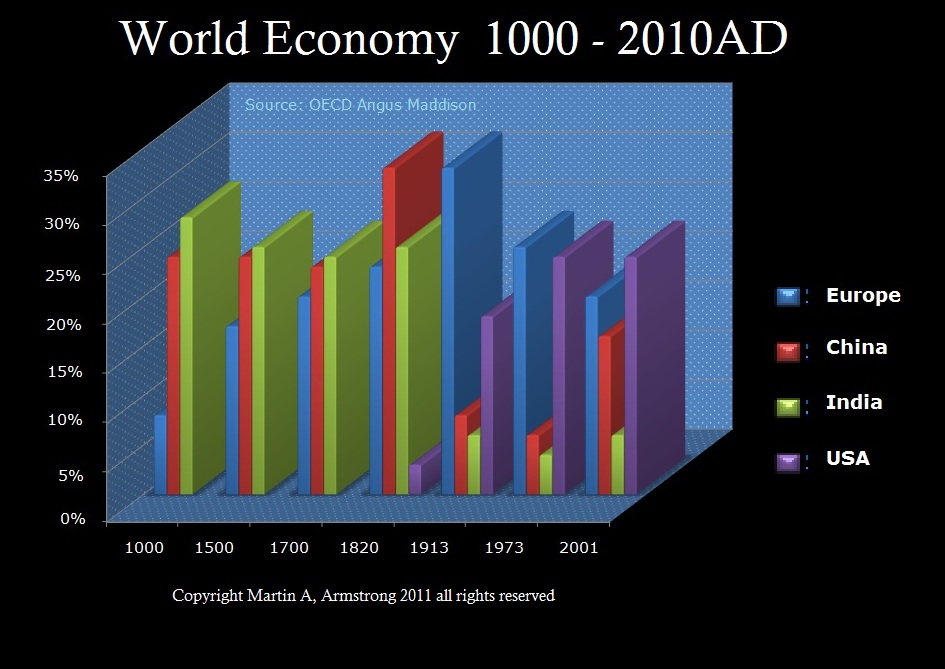
China the Coming Financial Capital of the World


QUESTION: Dear Martin,
During the WEC in Rome you’ve mentioned that center of finance moving to Asia after 2032. I’m wondering if work ethics from a country with no religion can be sustainable for so many years? My assumption is if the religion helped to shape the Europe’s success (and not any other part of the world at that time) and later on the USA (with religious work ethics), can it be preserved in China or will it fade away as people over there don’t want to work (they only do that in order to survive) ? Sorry for the strange question but didn’t manage to ask you during the WEC Rome on your thoughts on this topic,
Thank you,
MK

ANSWER: The work ethic is not really derived from religion but from the freedom under capitalism. Both in Russia and China, people retained their religious beliefs but in secret. Chine practiced the Tall Poppie Syndrom where they did not care what you thought provided you did not stick your head up above others. Russia under Stalin was one of paranoia. He directed children to report on their parents. This is why China has boomed for it left humanity intact. The Chinese are highly motivated to work more so than in the West. It is part of their culture.

Nevertheless, at some point, China will peak and then decline. The cycle will then return to Europe and then off to the Americas. As society expands, the birth rate declines and people want to enjoy the good life. You even see that is Augustus’ Family Laws.

The Threat of Protectionism


QUESTION: Marty:

I read you every day and I am one of the fortunate people to have a financial advisor that attends your Conference every year in the US.

I am wondering how Airbus will be affected in the future as the Euro further declines.

Thanks, RM

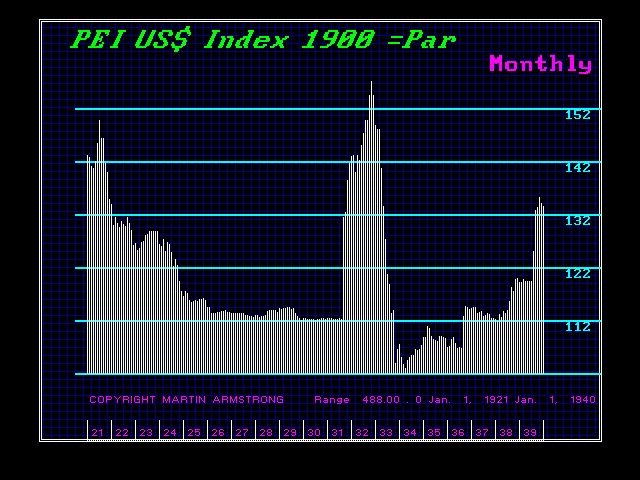
ANSWER: This is one of the aspects that caused the protectionism during the 1930s. As the turmoil in Europe unfolded, capital fled to the dollar pushing it higher. This invoked protectionism also propelled by the decline in commodity prices. The protectionism began with the agricultural sector and then spread to other areas.

As the dollar is pushed higher, we will see protectionism rise again probably 2021-2022. European companies that do not have professional hedging departments will suffer greatly.

Are we Heading into a Food Shortage?


COMMENT: Mr. Armstrong, I find it really distasteful that you laid out events well in advance and then everyone copies you without ever giving you credit. There are articles now appearing about the coming food shortage. The degree of plagiarism is unbelievable. It must be dishearting. I certainly begin to distrust these people and organizations for they certainly even know who you are.

LMS

REPLY: That is life. They are trying to sell something so they have to pretend to do the research to make money by getting people to read. The flooding wiped out stockpiles. Now the planting season is already behind on schedule because of the weather. As I have warned, the computer has been forecasting colder winters and shorter-summers. The planting season will decline and thus the danger of a serious food shortage as we head into 2024.

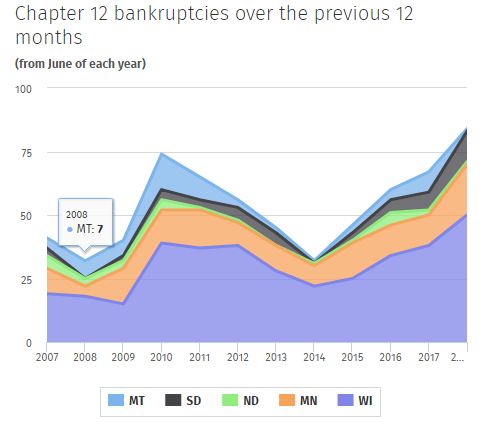
I previously wrote about the soaring bankruptcies among farmers and combine this with the flooding that continues, I believe the computer will be on point. I also wrote about how this year, the Russian wheat crop failed has failed because of the bitter cold with even April coming in as the coldest in more than 140 years. To make matters worse, our computer warns that the weather will not improve. The next 4 years will put even more financial pressure farmers. Even in Australia, the drought is sending the “roos” invading the cities and they like to feed precisely during Rush Hour.  The drought is so bad in Australia, that animals are dying for lack of feed crops.

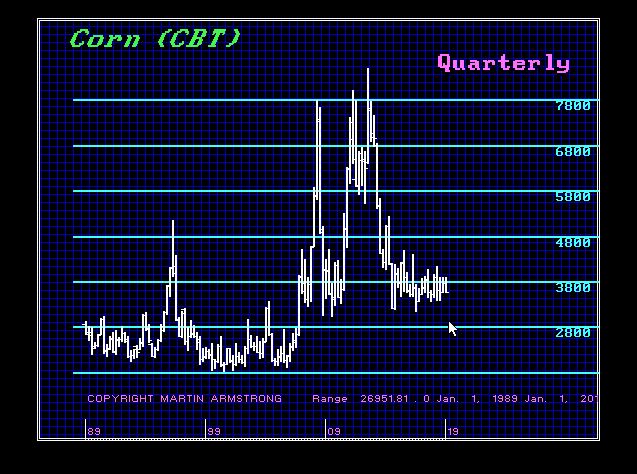
In the USA, four states are well behind on the planting schedule – Illinois, Minnesota, Indiana, and South Dakota. These four states combined to produce nearly 40% of the corn in the U.S. The charts are not yet responding to the fundamentals. This should begin to change next year. Nevertheless, we are building bases at higher levels. I have written plenty of times that any continuation of the weather beyond this season warns of a continued cooling trend. When our model is showing Global Cooling and 2019 has broken so many records, then there is a risk of a pending bull market in the price of food. This is something rather important enough to put on the agenda but governments prefer to listen to the Global Warming crowd to justify taxes.