Posted originally on Apr 16, 2025 by Martin Armstrong
It is no secret that US politicians are beholden to their AIPAC partners. Anyone who criticizes Bibi or Israel is deemed antisemitic, as the Israeli president recently called Candace Owens and Tucker Carlson, who are the only two major conservative voices speaking out against Israeli influence. The US sent over $30 billion to fund Israel’s war on Palestine, with $12 billion coming from the Trump Administration. Fifteen Democrats voted against continuing to fund Israel’s war on Palestine, but were outnumbered as every Republican and some Democrats insisted America must continue to fund its vassal state.
Let me be blunt—Palestinians cannot leave Gaza without approval from Israel. Two-thirds of Gaza has been declared a “no-go” zone by Israel. At the beginning of the month, the largest displacement since October 2023 occurred when Rafah and Gaza City were forced to evacuate. The Rafah Crossing in Egypt closed in March as Egypt does not wish to coordinate with Israel, believing the nation has violated the 1979 peace treaty. Israel has closed off its Erez Crossing to fleeing Palestinians. There is no safe route out of Gaza.
As of March 2, all aid to Gaza has been completely blocked. Food prices have soared by over 450%, but no aid or resources can reach Gaza. Around 66% of households no longer have access to water. WFP reports state that over 89,000 tons of food have been left to rot at the borders of Gaza as humanitarian workers cannot enter. There is no fuel. There is no transportation. There is no option for hospitals to remain open. As of March 9, all electricity has been cut off to Gaza.
Israel has destroyed everything within 1.5 km of its border with Palestine, including farms, factories, and homes. Benjamin Netanyahu denies that there is an ongoing ethnic cleansing of Gaza.
Article II of the Genocide Convention classifies a genocide as:
A mental element: the “intent to destroy, in whole or in part, a national, ethnical, racial or religious group, as such”; and
A physical element, which includes the following five acts, enumerated exhaustively:
Killing members of the group
Causing serious bodily or mental harm to members of the group
Deliberately inflicting on the group conditions of life calculated to bring about its physical destruction in whole or in part
Imposing measures intended to prevent births within the group
Forcibly transferring children of the group to another group
You can decide for yourself. The people of Gaza cannot leave. Hamas is using its own people as human shields, and they cannot escape Hamas or Israel. There is no Palestinian army to battle. The US is building one of the largest military bases in Lebanonto combat Hezbollah. We still do not know how Hamas broke through the Iron Dome. Civilians in Palestine who survive the bombings will starve, but at least governments can replace Gaza with the “Riviera of the Middle East” with the help of US taxpayers.
Posted originally on Apr 15, 2025 by Martin Armstrong
QUESTION: Marty, This report on all of Europe is unbelievable. Something like this would cost more than $100,000 from M——-, and they have an opinion, not actual, real forecasts. Do you intend to do one for Asia and South America?
PL
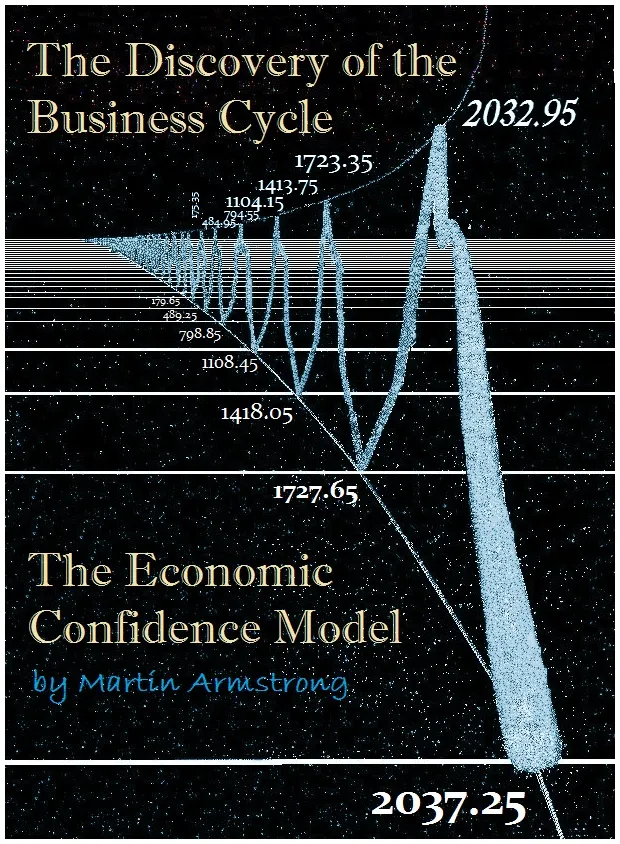
ANSWER: This took a lot of time to put together. The risk of war in Europe is so critical that I realized this was of urgent need. My next project is to get the ECM book out ASAP. It is 95% written. I have to do the final review. I feel this has to get out, given that the sequel to the Forecaster Movie will be in a couple of weeks.
Posted originally on Apr 15, 2025 by Martin Armstrong
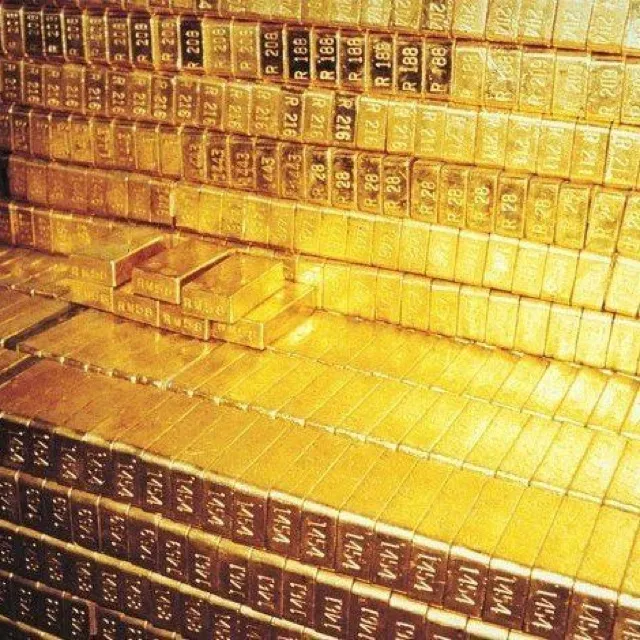
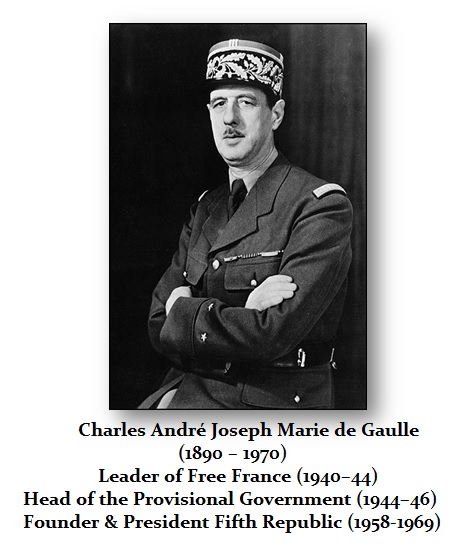
There is much speculation about Germany withdrawing its gold holdings from the United States. We have seen this occur in recent history. In the 1960s, French President Charles de Gaulle began challenging the U.S. dominance in the global monetary system. Gold typically flows where capital feels safe, but in this case, France repatriated its gold from the US due to political tensions.
In 1965, French President Charles de Gaulle withdrew his ministers from the Council of the EU, thereby constituting a de facto veto over all decisions, which became known as the “Empty Chair Crisis.” Several issues regarding European political integration led to the Empty Chair Crisis. There was a push at that time to create the quasi-federalization of Europe. De Gaulle believed that national governments should move towards integration. Still, he did not agree with the Commission’s attempt to create some new super-central state or a federalized Europe, extending powers of the EU beyond national borders as we have today, which Margaret Thatcher also opposed.
President Charles de Gaulle has proposed the Fouchet Plan was a plan back in 1961 to create a new grand design for Europe. Charles de Gaulle wanted to develop a three-power directorate, consisting of France, Britain and the United States. The idea was to form a new ‘Union of States’, as an alternative to the European Communities (EC). De Gaulle feared a loss of French national influence in the EC as there was a drive to federalize Europe back then.
After the failure of the Fouchet Plan and De Gaulle’s veto of the United Kingdom’s application for EC membership, the Commission attempted to move towards integration by proposing an idea that would combine the Common Agricultural Policy (CAP), the European Parliament, and Commission. De Gaulle supported the creation of the CAP and favored its enactment. However, he disagreed with the Parliament’s new role, the Commission’s strength, the shift towards federalization and a central state, and the budget proposals for financing the CAP. De Gaulle made it a condition that majority voting with a right to veto must exist if France was to participate in the EC. When de Gaulle was denied a more intergovernmental Commission or voting and veto rights, the French representative left the Council of Ministers thereby creating the Empty Chair Crisis.
The Luxembourg Accord was an agreement reached in January 1966 to resolve the “Empty Chair Crisis,” which had caused a stalemate within the European Economic Community. Then on June 21, 1966, de Gaulle withdrew France in a shocking move, taking its troops from the North Atlantic Treaty Organization (NATO). This decision, led by French president Charles de Gaulle, complicated relations between the U.S. and Europe amidst clashing American and Communist spheres of influence. Though France remained politically in NATO, its actions cast doubt on the organization’s future as a counter to Soviet military power and control back then.
From 1963 to 1966, France secretly implemented Operation Vide-Gousset to repatriate 3,313 tons of gold reserves from the Bank of England and the New York Federal Reserve. It took over 44 boat trips and 129 flights to export the gold back to the Banque de France. Since France converted its dollar holdings into gold, the French made out well when the dollar fell during the Bretton Woods period and lost 96% of its value against gold. France then withdrew from the London Gold Pool in 1966 after recovering its gold holdings to force the US to endure heavier losses.
France’s actions caused a gold run with nations eagerly reducing their holdings at the New York Fed. West Germany reclaimed 1,200 tons of gold. Switzerland increased gold purchases from both the US and UK, but did so more discreetly than France to avoid political upheaval. By 1971, before the gold window closed, the United Kingdom requested $3 billion in gold conversions from the US. This may have been the final move that pushed Nixon to act. The Netherlands and Belgium also began exporting gold holdings from the US at this time.
US gold stock fell from $22.7 billion in 1950 to $12 billion by 1971. On August 15, 1971, President Nixon closed the gold window, ending the convertibility of the dollar into gold. The 1971 closing of the gold window by Nixon cut the link to gold, ending Bretton Woods.
“The speculators have been waging an all-out war on the American dollar,” Nixon declared, and to “protect the dollar from the attacks of the international money speculators” would take “bold action.”
“I have directed [Treasury] Secretary Connolly to suspend temporarily the convertibility of the dollar into gold.”
France’s actions were a catalyst to the inevitable decision to close the gold window, but not the sole cause. Yet, as we are seeing today, the primary reason that nations would like to withdraw their holdings comes down to politics. Charles de Gaulle said that the dollar was “monumentally over-privileged” and moved to hurt the USD. The incoming German government is now looking to withdraw their holdings from the US solely due to their distaste for America.
Posted originally on Apr 15, 2025 by Martin Armstrong
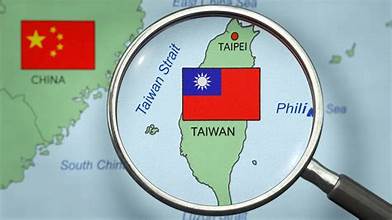
China and the United States are accustomed to trade wars. China is handling it as a business matter, but the bigger perceived threat is America’s involvement in the Taiwan Strait. The Chinese Defense Ministry issued a statement declaring that the United States has threatened national security by providing F-16 fighter aircraft to the Philippines and Taiwan.
“The United States stands strong with our allies and partners in the Indo-Pacific, and we continue to take decisive actions to counter threats, enhance economic resilience, and advance shared interests,” a spokesperson for the U.S. State Department told Newsweek.
Strengthening Taiwan and the Philippines is part of America’s ongoing military strategy first established during the Cold War to protect the US against the Soviet Union and China. These nations are within the First Island Chain, which America perceives as its first line of defense against China if war were to occur. The Ryukyu Islands, the Japanese archipelago, Borneo, and the Kuril Islands are also included in this plan that spans from the Kamchatka Peninsula in the northeast to the Malay Peninsula. The US is prepared to enforce blockades in the event of conflict and has maintained a presence in the area.
The People’s Liberation Army Navy (PLAN) has become the world’s largest surface fleet. China is prepared to deploy nuclear submarines, aircraft carriers, and advanced missile systems to fight back against the US and its allies in this region.
In fact, China recently carried out a large-scale naval exercise across the First Island Chain. Around 90 vessels and fighter jets practiced patrolling this area, specifically near Taiwan. The PLA Rocket Force now has ballistic and air-breathing missiles that it believes can destroy the US Navy.
Last month, Taipei purchased 66 new F-16/D Block 70 fighter jets from the US. Manila placed an order for 16 F-16C Block 70/72 fighter jets along with other military supplies earlier in April. America maintains that it is maintaining its promises from the 1979 Taiwan Relations Act, which promises to provide Taiwan with “defensive weapons.”
“The proposed sale of this equipment and support will not alter the basic military balance in the region,” said the US Defense Security Cooperation Agency after providing military aid to the Philippines. The 1951 mutual defense treaty states that an attack on the US or the Philippines in the Pacific would propel both nations into war.
The tensions surrounding this area are far more concerning than the tariff issue. China believes that the US is threatening its sovereignty by dismissing the One China policy and attempting to deter China from overpowering the region. The US believes it is taking appropriate countermeasures to protect itself and its allies against Chinese aggression. As pressures build, both nations are prepared to boost their presence and defense spending in the region.
Posted originally on Apr 15, 2025 by Martin Armstrong
The United States has about 330 million people, and one in every $3 spent in world trade is by American Consumers. Europe has 450 million people, but it still clings to Marxism, is highly regulated, and is very anti-entrepreneurial. Trump fails to grasp here that trade wars will NOT even the score. The global consumer market seems to be ignored. As I have explained, the Current Account, which people call the trade account, also includes all interest and dividends on stocks, bonds, and investments. In theory, if China bought 100% of the US national debt, then the perceived trade deficit from interest of $1 trillion would flow to China, and this has nothing to do with jobs or manufacturing anything.
Let’s clarify trade. The United States has the largest economy in the world, so it’s the top contributor to global consumer spending. China would be next, followed by countries like Japan, Germany, the UK, India, and so on. Note that China is already the #2 consumer-based economy. Europe is far too Marxist, and it still clings to the old theories of Mercantilism. The average German has less net wealth than an Italian, yet they are the biggest economy.
In recent years, the global GDP has been around $100 trillion. Depending on the economy, consumer spending typically makes up about 60-70% of a country’s GDP. So, if we take 65% of $100 trillion, that’s about $65 trillion in global consumer spending annually in theory. Now, breaking this down by country. The US GDP is around $25 trillion. If US consumer spending is about 68% of GDP, that would be roughly $17 trillion. Therefore, the US share would be 17/65, approximately 26%. That means we have a US consumption-driven economy.
China’s GDP is around $18 trillion. However, consumer spending as a percentage of GDP is lower, maybe around 40%, because their economy is more investment—and export-driven. So 40% of $18 trillion is $7.2 trillion. That would be about 11% of the global total ($7.2T / $65T).
Let’s compare this to Japan’s GDP, which is about $4.9 trillion. Consumer spending there is higher as a percentage, maybe around 55%, so $2.7 trillion. That’s roughly 4.15% globally.
Germany’s GDP is around $4.2 trillion. With consumer spending at around 50% of GDP, that’s $2.1 trillion, so 3.2% globally.
India’s GDP is approximately $3.4 trillion. Consumer spending accounts for a larger part, maybe 60%, so the total is $2.04 trillion, which is about 3.14% of the global total.
The UK’s GDP is about $3.1 trillion. Consumer spending at 60% would be $1.86 trillion, so around 2.86%.
France’s GDP is $2.9 trillion. Consumer spending at 55% gives $1.6 trillion, about 2.46%.
Brazil’s GDP is $2.0 trillion. If consumer spending is 60%, that’s $1.2 trillion, so 1.85%.
Italy’s GDP is $2.1 trillion. Consumer spending at 60% would be $1.26 trillion, around 1.94%.
Canada’s GDP is $2.0 trillion. Consumer spending at 57% gives $1.14 trillion, which is 1.75%.
South Korea’s GDP is $1.7 trillion. Consumer spending at 50% is $0.85 trillion, so 1.3%.
Russia’s GDP is around $1.8 trillion. If consumer spending is 50%, that’s $0.9 trillion, about 1.38%.
Australia’s GDP is $1.6 trillion. Consumer spending at 55% would be $0.88 trillion, 1.35%.
Consequently, the total for these top countries is around 59.65%, leaving about 40.35% for the rest of the world. This is all based on rough estimates. Then we also have nominal GDP vs. PPP (Purchasing Power Parity). However, consumer spending in nominal terms is usually what’s used for such global comparisons, further complicating our exercise.
Another consideration: The figures I used for consumer spending as a percentage of GDP might not be accurate for each country. For example, China’s consumer spending as a percentage of GDP has been increasing but was historically lower. According to the World Bank, in 2022, China’s household final consumption expenditure was about 38% of GDP. The US was around 68%, Japan about 55%, Germany 52%, India was around 59%, UK 63%, France 54%, Brazil 64%, Italy 61%, Canada 57%, South Korea 48%. So my initial estimates were somewhat close but may need adjustment.
US: 25T GDP * 68% = 17T
China: 18T * 38% = 6.84T
Japan: 4.9T * 55% = 2.695T
Germany: 4.2T * 52% = 2.184T
India: 3.4T * 59% = 2.006T
UK: 3.1T * 63% = 1.953T
France: 2.9T * 54% = 1.566T
Brazil: 2.0T * 64% = 1.28T
Italy: 2.1T * 61% = 1.281T
Canada: 2.0T * 57% = 1.14T
South Korea: 1.7T * 48% = 0.816T
Russia: 1.8T * 52% = 0.936T (assuming 52%)
Australia: 1.6T * 55% = 0.88T
Spain: 1.4T * 58% = 0.812T
So total consumer spending from these 14 countries is approximately $41.389 trillion out of about $65 trillion globally.
Now, converting each country’s consumer spending to a percentage of global:
US: 17 / 65 = 26.15%
China: 6.84 / 65 ≈ 10.52%
Japan: 2.695 / 65 ≈ 4.15%
Germany: 2.184 / 65 ≈ 3.36%
India: 2.006 / 65 ≈ 3.09%
UK: 1.953 / 65 ≈ 3.00%
France: 1.566 / 65 ≈ 2.41%
Brazil: 1.28 / 65 ≈ 1.97%
Italy: 1.281 / 65 ≈ 1.97%
Canada: 1.14 / 65 ≈ 1.75%
South Korea: 0.816 / 65 ≈ 1.26%
Russia: 0.936 / 65 ≈ 1.44%
Australia: 0.88 / 65 ≈ 1.35%
Spain: 0.812 / 65 ≈ 1.25%
Others: 36.3%
Please remember that these percentages are estimates of global consumer spending by country based on GDP and consumption patterns. The United States is the largest consumer-based economy in the world, and about 26% of total world spending involves the American consumer. China is only 10.5%, and Japan is at 4.1%. Europe comes in at around 12%.
In summary, China is actively trying to build a more consumer-based economy, with policies and trends supporting this shift. However, structural and demographic challenges might slow this transition into 2028. The progress is evident, but it’s a work in progress. After 2032, they hold the potential to surpass the United States as the financial capital of the world. The problem in the United States is that the Democrats keep trying to oppress the economy like Europe, imposing socialistic goals that are not economically efficient.
Key Evidence of China’s Transition:
Rising Consumption Share of GDP:
Household consumption contributed 53% of GDP in 2023, up from ~35% in 2010. While still lower than the U.S. (~68-70%), this marks significant growth.
Services and high-tech industries are expanding, reflecting demand for healthcare, education, and entertainment.
Policy Shifts:
“Dual Circulation” Strategy:
Emphasizes domestic consumption (internal circulation) alongside international trade, reducing reliance on exports.
Social Reforms:
Efforts to strengthen social safety nets (pensions, healthcare) aim to lower household savings rates, freeing income for spending.
Urbanization and Middle-Class Growth:
Over 60% of China’s population now lives in cities, fostering a consumer class with higher disposable income.
E-Commerce and Digital Economy:
China leads globally in e-commerce (e.g., Alibaba, JD.com) and digital payments, facilitating consumer spending. The digital economy accounts for ~40% of GDP.
Challenges to a Consumer-Driven Model:
Structural Imbalances:
Investment and exports still dominate (e.g., state-led infrastructure, real estate). Transition requires rebalancing toward the private sector and services.
Household debt
has risen to ~62% of GDP (2023), potentially constraining spending.
Demographic and Social Factors:
Aging Population: By 2035, 30% of citizens will be over 60, likely increasing savings and reducing consumption.
Income Inequality: Rural-urban gaps and uneven wealth distribution limit broad-based consumption growth.
Geopolitical and Economic Risks:
Trade tensions and global demand volatility (e.g., post-COVID, U.S.-China decoupling) pressure China to prioritize domestic demand.
Real estate sector
Slowdowns could dampen consumer confidence.
China is deliberately building a consumer-based economy through policy reforms, urbanization, and digital innovation, rejecting the European mercantilist economic philosophy. While progress is evident, structural hurdles, such as reliance on investment aging demographics, mean the transition will be gradual but ongoing. The government’s success in addressing these challenges will determine the pace and sustainability of this shift. China’s economy remains a hybrid model, blending consumption growth with traditional drivers like state investment.
The current account is a key component of a country’s balance of payments, recording international transactions in goods, services, income, and transfers. It consists of four main components:
Trade in Goods (Visible Trade):
Exports and imports of tangible products (e.g., machinery, vehicles, electronics).
The balance of trade in goods is often referred to as the “merchandise trade balance.”
Trade in Services (Invisible Trade):
Exports and imports of intangible services (e.g., tourism, financial services, education, consulting, transportation).
Combined with trade in goods, this forms the trade balance (goods and services).
Primary Income (Income Flows):
Cross-border income from investments and employment:
Investment income: Dividends, interest, profits from foreign investments (e.g., dividends from overseas stocks).
Compensation of employees: Wages, salaries, or benefits earned by workers in a foreign country (e.g., remittances from expatriates).
Secondary Income (Current Transfers):
One-way transfers where no goods, services, or assets are exchanged in return:
Remittances: Money sent by migrants to their home country.
Foreign aid/grants: Government transfers (e.g., disaster relief, development aid).
Pensions, gifts, or donations: Transfers between individuals or organizations.
A Trade War based on just the gross of the Current Account does NOT reflect our trade deficit or surplus.
Foreign investors overall own roughly 10-20% of Manhattan’s high-end residential properties (e.g., condos), with Europeans constituting a significant but minority share of this group. For example, if Europeans account for 30-40% of foreign-owned properties, their stake might be 3-8% of Manhattan’s luxury residential market. While exact figures are elusive, Europeans likely own 3-7% of Manhattan’s total real estate, with higher concentrations in luxury residential and prime commercial sectors. This is only an estimate and not definitive. Any income, such as rents, on that property will flow out through the current account and will appear as a trade deficit when it has NOTHING to do with trade.
As of 2023, approximately 23-24% of the total U.S. national debt is held by foreign entities. This calculation is based on foreign holdings of around $7.4 trillion out of $31.4 trillion at the time. Therefore, of about $1 trillion in interest expenditures. Thus, about $230+ billion is flowing out through the current account that has nothing to do with trade. The major holders of US national debt include Japan, China, and the United Kingdom.
Understanding these components is now CRITICAL in the middle of a trade war. The sale of US debt will go through the capital account, but it will reduce the interest paid to foreigners that go through the current account, creating the illusion of a trade deficit. I disagree with Trump’s formulas, and the risk of a permanent trade war with China is now assured unless he gets on a private phone call. You cannot make public demands against China for then they cannot back down based on their culture.
Posted originally on Apr 14, 2025 by Martin Armstrong
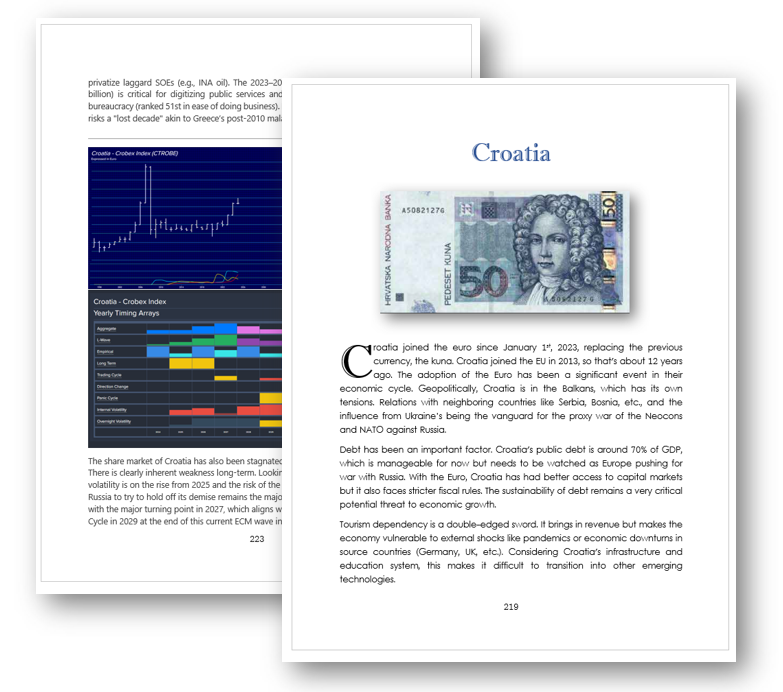
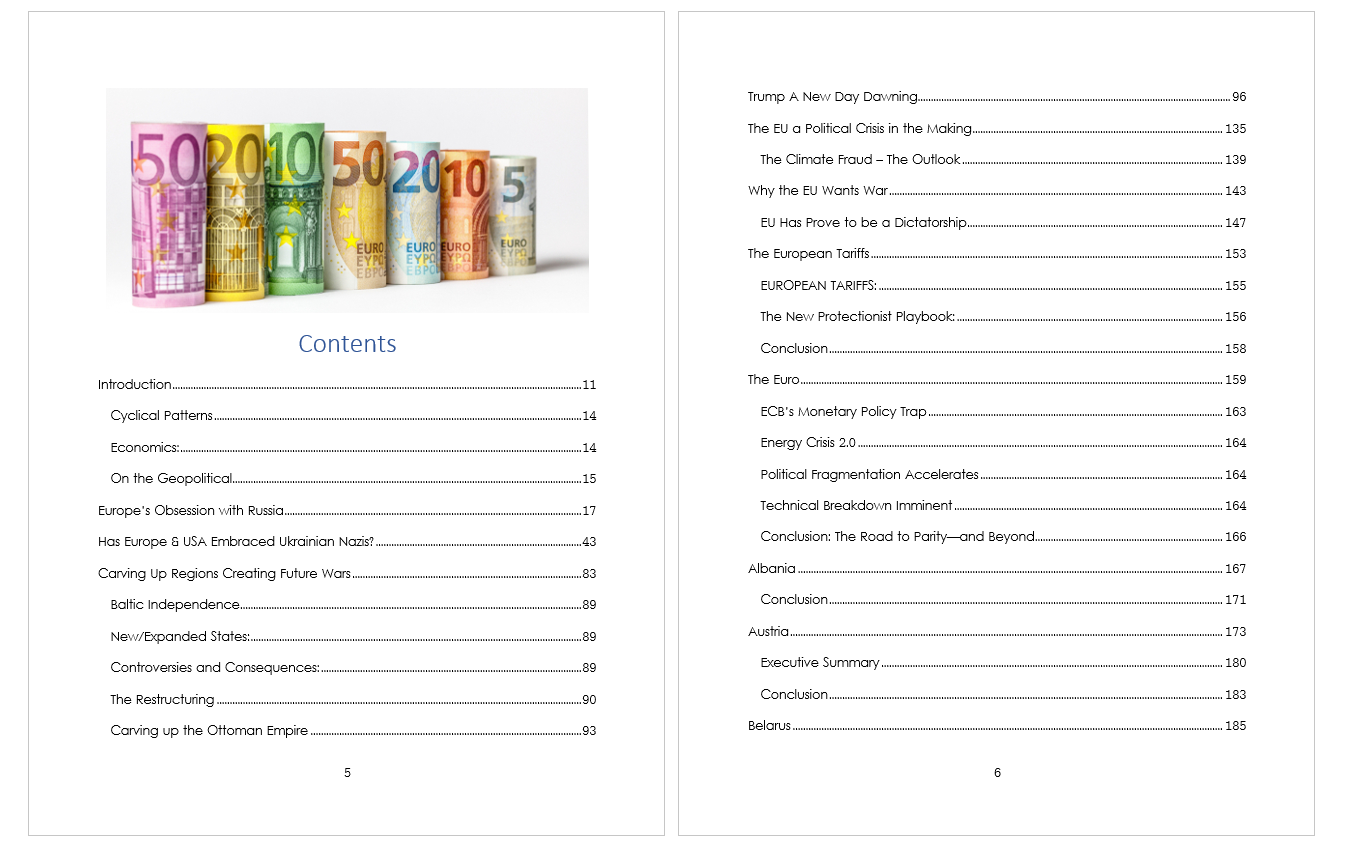
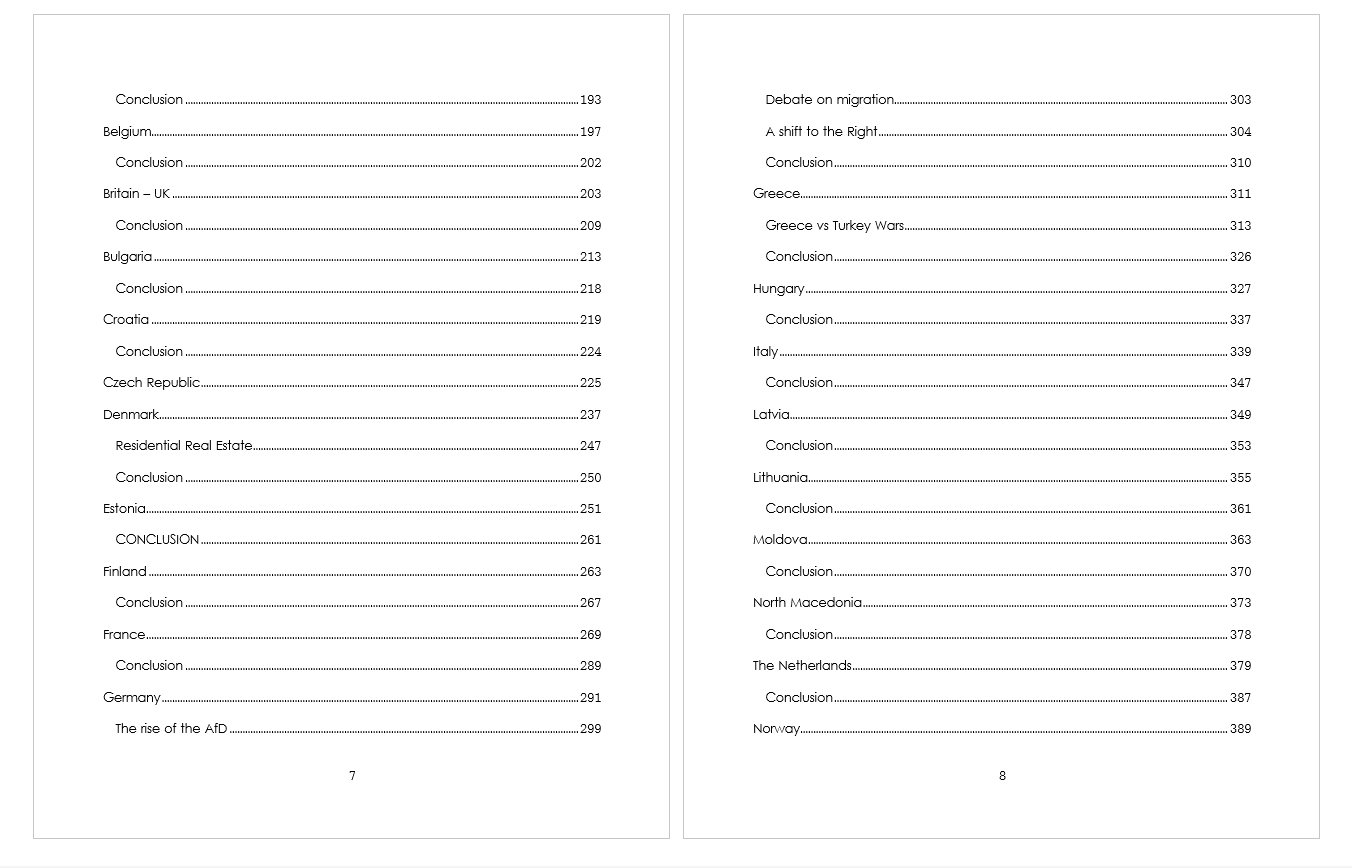
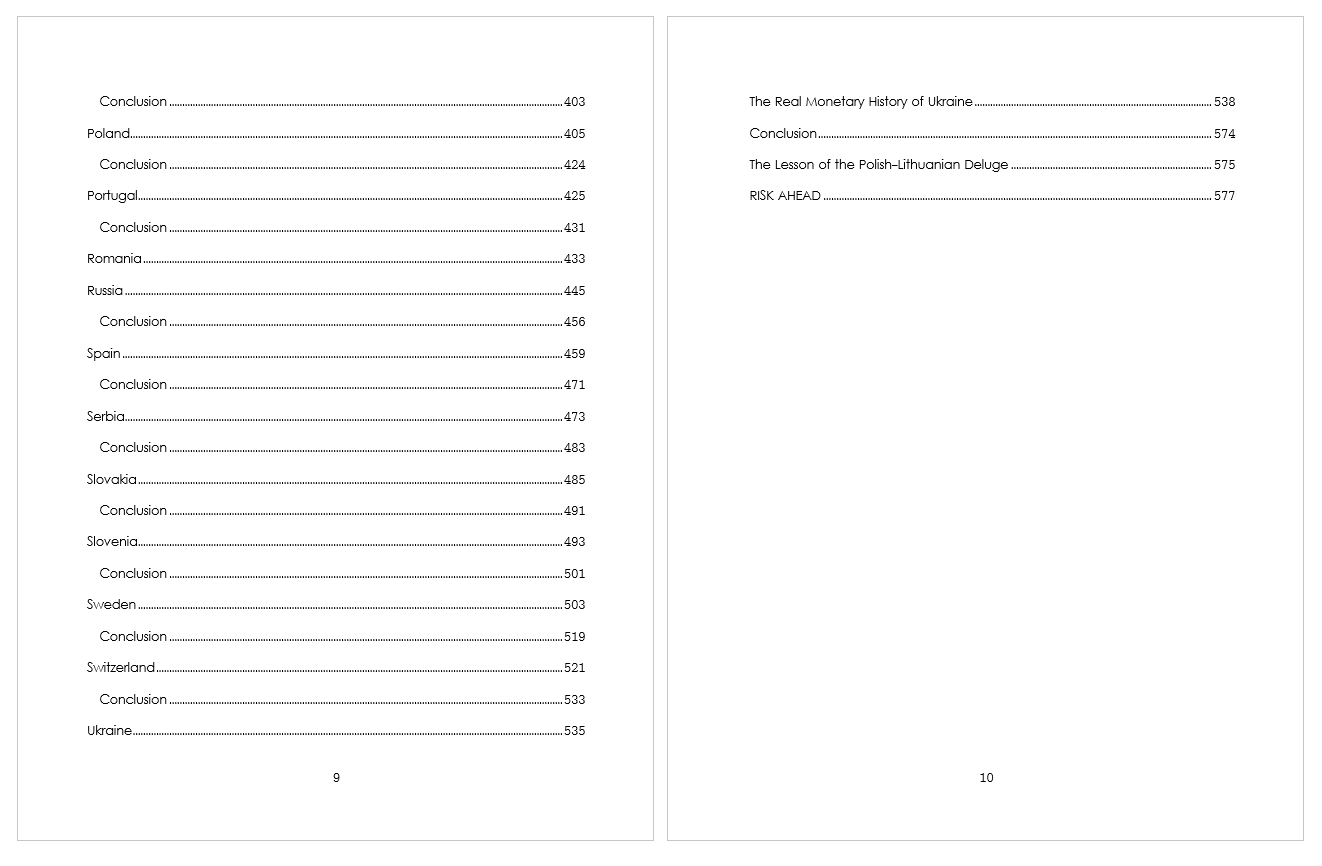
Our Institutional Report covering Europe’s countries with their forecasts generally out to 2032 has been a monumental effort. We greatly appreciate your patience, but this is vital for the decision-making for future investment in Europe. Things are certainly different from the past. Countries like Sweden and Switzerland, which had been neutral during previous world wars, have surrendered their neutrality and will not prove a safe harbor for capital during this conflict. Sweden has joined NATO and even sent jets to Poland. Switzerland gave up all foreigners with accounts and seized over $8 billion of accounts belonging to Russians, abandoning its historic traditions.
This report covers countries that nobody else even covers.
This also addresses the War with Russia & The eventual breakup of the EU itself
577 Pages fully illustrated with Charts and Arrays Per County, covering Currency and share markets
This Report is massive, and the price is $10,000 per institution.
(Please email to let us know how many reports you may need)
Posted originally on Apr 14, 2025 by Martin Armstrong
Germany has sought to ban the AfD Party as Democracy has no place in the European Union and they are the sole party combatting the European globalist agenda. I reported in January when AfD became the second-most popular party in the nation. Recent polls now indicate that AfD has surpassed the Christian Democratic Union/Christian Social Union to become the most popular party in Germany.
Ispos poll shows that a quarter of the nation now backs AfD, a 4 point rise from February. The Christian Democratic Union/Christian Social Union fell to 24% from 28.6%. Backing for the Social Democratic Party continued its decline and now stands at at 15%. The left-wing Linke Party advanced 2 points to 11%, while the Greens remained relatively stagnant at the same level of support.
This is a remarkable achievement as a nationalist party has not led in the polls since the founding of the current Republic of Germany. “For the first time in the AfD’s short history, we are the strongest party in Germany. Thank you for your tremendous trust — political change will come!” AfD Co-Chairwoman Alice Weidel posted on X. “Citizens want political change — not a ‘business as usual’ coalition between the CDU/CSU and SPD!” she later wrote.
There is a correlation with AfD’s growing support and the number of undocumented migrants infiltrating the German welfare state and causing crime to skyrocket. AfD has vowed to restore Germany for the people of Germany and implement mass deportation campaigns. The group does not want to adhere to the EU’s open border policy or the Build Back Better agenda. The party has called for a “remigration” or mass deportation operation similar to what Trump is currently conducting in the US.
Europe’s open border policies began in Germany under former Chancellor Angela Merkel, who urged Syrians to flee and seek asylum within Germany in 2015. That same year, Germany experienced a massive uptick of 2.14 million arrivals. Other figures believe the number is far higher. There are now an estimated14 million immigrants in Germany, most of whom are not there legally.
I have stated many times that Angela Merkel created this entire mess in 2015 to reverse her polls when they were turning against her because of her hard line against Greece, which had forgiven Germany’s debt at the end of the war. Violent crimes in Germany reached a 15-year high last year, a 5.5% YoY rise, andMIGRANTS WERE RESPONSIBLE FOR 40% OF THOSE CRIMES.
The cost on the welfare state is astounding. Germany spend at least 23.2 billion euros on supporting refugees last year after spending 29.7 billion euros the year prior. In fact, the government as admitted to spending over 20 billion euros each year since open borders were implemented. We are talking about over 5% of the federal budget going directly toward illegal residents.
Every article in the mainstream media calls AfD a far-right extremist hate group, therefore demonizing the 25% of the population who agrees with their values. Nationalist sentiments are rising throughout Europe, much to the dismay of the bureaucrats. All of this is unfolding right on schedule.
Posted originally on Apr 14, 2025 by Martin Armstrong
The violence against Tesla owners has gone too far. Left-leaning politicians have done nothing to stop the ongoing attacks by deranged individuals who believe they are “activists.” Nazi swastikas are appearing on Teslas throughout the world, while other vehicles are being set on fire. Now, these psychopaths have resorted to attacking people while driving.
A pregnant womanin Vancouver was driving a Tesla when a large rock shattered her front windshield. The rock was thrown so hard that it went through the windshield and hit the pregnant woman. “We are working to determine whether this was a criminal act, and if someone intentionally targeted this Tesla,” said Vancouver police spokesman Sgt. Steve Addison. “This very serious incident could easily have resulted in someone’s death, but for a few inches.” There have been over 28 attacks on Teslas in Vancouver alone since Trump took office on January 20.
The woman was taken to the hospital with non-life-threatening injuries. Police declared that she and her unborn baby, a life not recognized by the left, could have died as a result of the attack. Other drivers on the road could have been injured. What more will it take for politicians on the left to WAKE UP and DEMAND A STOP TO THE VIOLENCE!
Instead of condoning the violence, politicians are asking the people to raise hell to mislead the world into believing that the people do not support Donald Trump or those in his administration like Elon Musk. No politician on the left will declare these attacks an act of terrorism. Yet, bomb squads have been called to homes and businesses. Fire departments have been on high alert. There have even been cases of gunshots fired into office buildings.
Former House Speaker Nancy Pelosi (D-Calif.) spent years condemning January 6. She accused Trump of stoking continued violence” and enticing a “terrorist mob” into a “violent assault” that left her with “physical scars and emotional trauma.” Yet, as we know from her own daughter’s documentary, Pelosi herself called off the National Guard that day to encourage the riot.
A reporter recently asked Pelosi to comment on the Tesla attacks. “I’m so sorry, I’m a little bit late here right now,” was her only reply. House Minority Leader Hakeem Jeffries (D-N.Y.) also refused to provide a comment to reporters that day, but later issued a statement on his website to condemn the victims. “There are legitimate ways in a civilized society to express strong disagreement with far-right extremists who are trying to dismantle the American way of life. Violence is never acceptable,” Jeffries wrote.
Rep. Summer Lee (D-PA) has refused to call the attacks “violent.” Bernie Sanders is perhaps the only Democrat to call the attacks violent, but refuses to declare them acts of terrorism. “I don’t know what domestic terrorism is in this context. It’s outrageous. People have the right to protest [Elon] Musk and Tesla, but no one should engage in violence, period,” Sanders said. “Boycotts are common, but violence must cease. It should not be part of our national dialogue.”
The Oxford Dictionary states “terrorism” is defined as “the unlawful use of violence and intimidation, especially against civilians, in the pursuit of political aims.”
In Canada where the aforementioned incident occurred, terrorism is defined as the following:
“Domestic terrorism: Violent, criminal acts committed by individuals and/or groups to further ideological goals stemming from domestic influences, such as those of a political, religious, social, racial, or environmental nature.”
The ongoing viciousness toward Tesla owners are TERRORISM by every definition—politically motivated acts of violence.
Posted originally on Apr 14, 2025 by Martin Armstrong
The technology coming out of China is quite remarkable. China has unveiled the world’s first pilotless air taxi service. The Civil Aviation Administration of China (CAAC) issued Air Operator Certificates (OCs) to EHang Holdings in Guangdong Province and its subsidiary, Heyi Aviation. The companies believe this will boost China’s tourism sector and pave the way for the normalization of flying vehicles over the next five years.
EHang’s EH216-S is a two-seat electric drone that can travel at a top speed of 80 mph (130 km/h) over a range of 18.6 miles (30 km). Heyi Aviation has a similar model as well that is meant for “low-altitude economy” flights. Initial operations will be restricted to closed-loop routes that land and takeoff at the same location.
Ehang’s Vice President He Tianxing said phase one of pilotless taxis will begin this year into 2026, focusing solely on tourism travel in Zhuhai, Shenzhen, Taiyuan, Wuxi, Wenzhou and Wuhan. Flights will initially vary from three to 10 minutes as phase one is about novelty and the excitement of air travel rather than commuting or transportation. Tianxing said the experience is “just like riding in a car.”
“The human-carrying pilotless aviation and the low-altitude economy, as an emerging industry, is still in its developmental stage and remains a national strategic focus in China’s aviation sector,” EHang said. There are still many challenges to be addressed and improvements to be made, requiring industry-wide collaborations.”
Phase two will occur from 2026 to 2030 to include urban air taxis capable of traveling longer distances. These taxis will be used for actual commuting and transport purposes, creating a new “low-altitude economy.”
The US has attempted to compete with eVTOL aircrafts for “power-left” vehicles, according to the Federal Aviation Administration, and are designed to land and take off vertically to avoid the need for a runway. However, the FAA has not approved of a pilotless aircraft. Estimates stat that this business could grow into a $30 billion opportunity by 2035.
China expects the new low-altitude economy, which also includes drones and air sports, to be worth $205 billion (1.5 trillion yuan) by the end of 2025. The CCP is aggressively pushing this new niche and expects it to double in size by 2035. What was once an idea seen only in science fiction films is now a reality. It will be quite interesting to see how this technology plays out in potentially reshaping travel.
I have created this site to help people have fun in the kitchen. I write about enjoying life both in and out of my kitchen. Life is short! Make the most of it and enjoy!
This is a library of News Events not reported by the Main Stream Media documenting & connecting the dots on How the Obama Marxist Liberal agenda is destroying America