Posted originally on the conservative tree house on October 24, 2021 | Sundance | 66 Comments
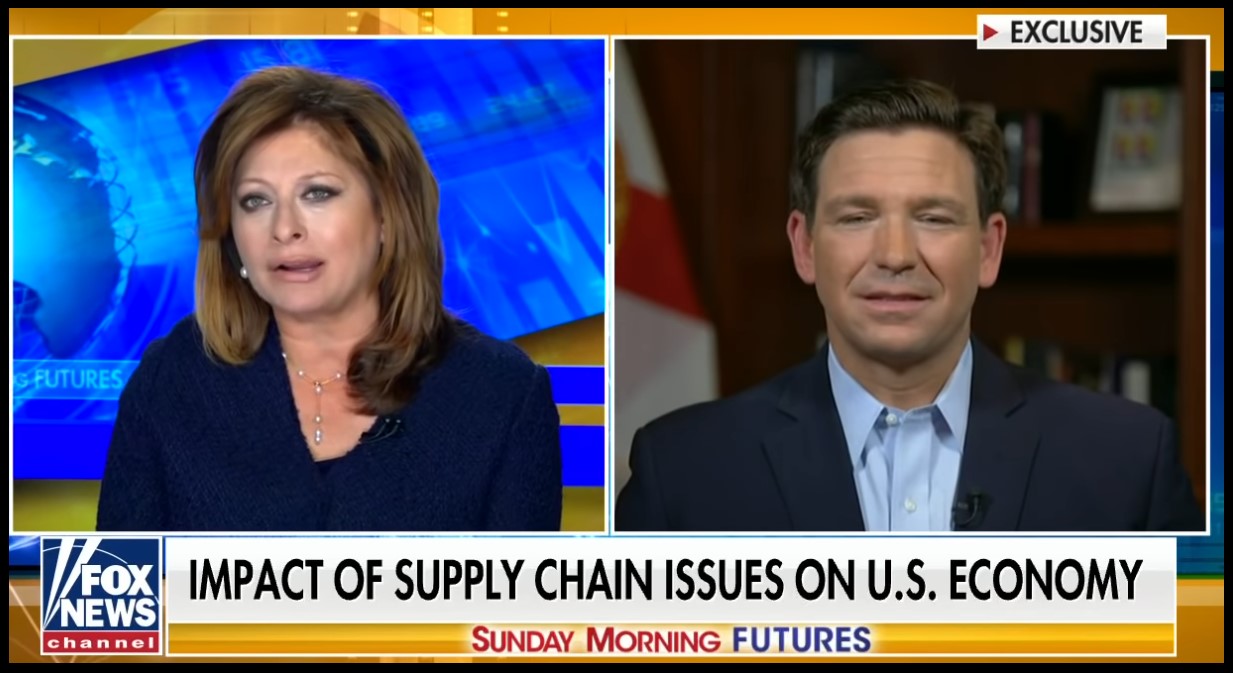
Appearing with Maria Bartiromo this morning, Florida Governor Ron DeSantis discussed how commonsense approaches to COVID-19 can keep economic growth continuing while taking simple precautions. As noted by the Florida governor, his policies at a state level generated almost half of all national job gains in September.
DeSantis noted the Florida ports are able to handle additional capacity to off-load any transcontinental shipments and keep products flowing further into the U.S. mainland. Several shipping companies have already diverted ships into Florida ports to take advantage of the state opportunity. Additionally, DeSantis outlines his intent for a recently announced special legislative session to pass state laws protecting workers from getting fired as a result of their vaccine status.
As the national media continue to attack DeSantis in an effort to support a national agenda promoted by the Biden administration, the influential Florida governor vows to push back against overreaching federal mandates and keep the principal of individual liberty at the center of his policy. WATCH:
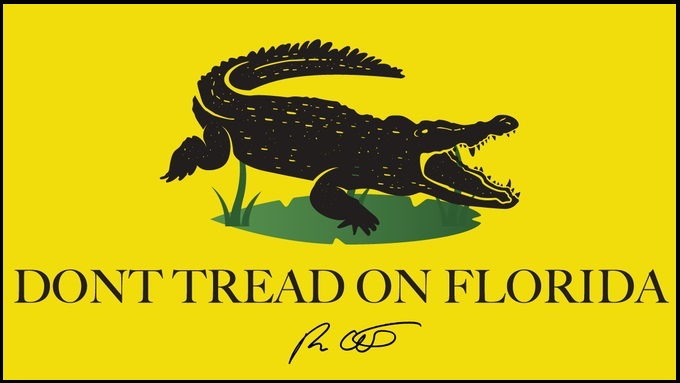
Recently the Florida Governor also unveiled his own version of the Gadsden Flag specific to his state.
Posted originally on the conservative tree house on October 24, 2021 | Sundance | 98 Comments
The screamingly high rate of pricing inflation is catastrophic to the American working middle class; however, there is one small benefit. More and more people are waking up to the reality that free market principles have been destroyed; what we have now are markets controlled by massive multinationals.
This isn’t news for CTH readers. Long before prices started to rise, we stood up against pressure from so-called ‘conservative’ pundits to outline that free markets were a joke in the modern economic era. The truth inside the economic argument is precisely why we stood up to support candidate Donald J Trump in 2015; and the truth inside that economic argument is exactly why we will stand again to support him if he runs again in 2024. Everything, e.v.e.r.y.t.h.i.n.g… every scintilla of a thing, centers around the economics of it. Economic security on every scale is what keeps YOU free.
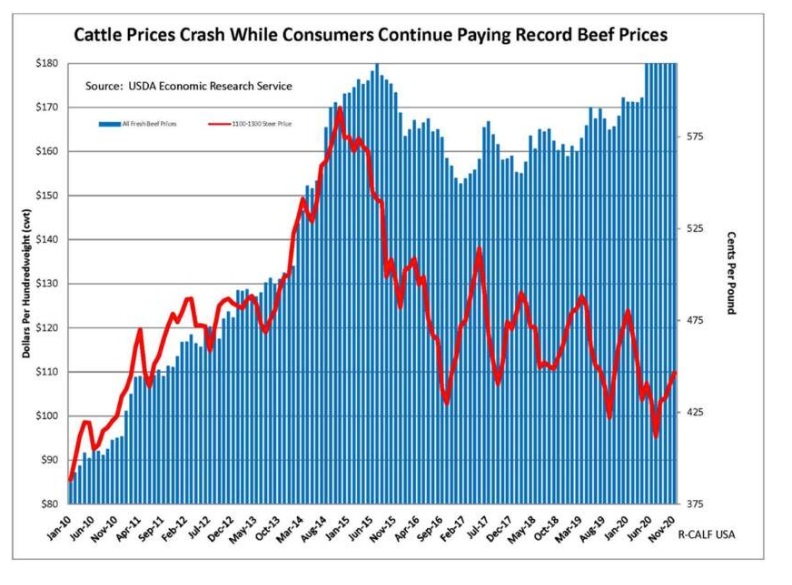
In a brilliant outline of how the beef and cattle industry is now trying to fight back against the multinationals of Tyson Foods, JBS, Cargill and National Beef, Matt Stoller uses the cattle industry to talk about what we have outlined on these pages for ten years. The distance from the red line (steer price) to the blue bar (beef price) is the scale of the multinational profits inside this controlled commodity:
MATT STOLLER – […] Despite high consumer prices, independent ranchers are losing money, and going out of business. “If we don’t get some of these problems fixed quickly, we won’t have any independent ranchers in this country,” explained Oklahoma Farmers Union president Scott Blubaugh.
Why are there high prices to consumers and low prices to cattle ranchers? Grassley had an answer. “The four major beef packing companies control 80% of the cattle industry,” he told the House members. And they are what he called “a chokepoint” for the entire sector. In other words, follow the money. In the beef industry, it’s not Amazon, Apple, Google, and Facebook suppressing business, but “the Big Four” – Tyson’s, JBS, Cargill and National Beef, who control 85% of the market (and more in some regions). (read more)
Many Americans are recently awake to the singular indulgent ideology that surrounds DC politics, the UniParty. When it comes to creating systems to maintain their elite status, both Republicans and Democrats are joined in unity. The America First MAGA agenda was -and is- against their interests.
However, the UniParty political fraud also applies to our political economy, Main Street -vs- Wall Street. Just like the election, understanding the deception in modern economics means understanding previous false and promoted assumptions.
The professional political class would like both sides on the political continuum to continue disunity, argument/disagreement on the outcome and avoid discussing the root cause. It is within a comprehensive understanding of the root cause where Americans find unity.
Remember, there is no such thing as a “commodity” market in the free market sense of the word. Those commodity markets are now “controlled markets“, and fully under the control of massive multinational agricultural corporations.
When I say most multinational corporations hate capitalism many people look confused.
Multinationals want control; some call that corporatism…. but the names are moot. Multinationals want control of price and profit, and capitalism does not allow them control. That is why multinationals do not want capitalism. Multinationals use lobbyists to generate regulations that stall competition.
Multinationals do not want competition; they are, by nature of their interest, anti-capitalists.
This misunderstanding is everywhere.
Let me help by sharing a short video that explains why:
President Trump was confronting multinational corporations and the global constructs of economic systems that were put in place to the detriment of the host (USA) ie YOU.
There are trillions at stake, and it is always about the economics; everything else is chaff and countermeasures.
The road to a “service-driven economy” is paved with a great disparity between financial classes. The wealth gap is directly related to the inability of the middle class to thrive.
Elite financial interests, including those within Washington DC, gain wealth and power, the U.S. workforce is reduced to servitude, “service”, of their affluent needs.
The destruction of the U.S. industrial and manufacturing base is EXACTLY WHY the middle class has struggled, and exactly why the wealth gap exploded in the past 30 years.
Behind this dynamic, we find the international corporate and financial interests who were inherently at risk from President Trump’s “America First” economic and trade platform. Believe it or not, President Trump was up against an entire world economic establishment. Conversely Joe Biden is an ally of the multinational corporations.
When we understand how trade works in the modern era, we understand why the agents within the system are so adamantly opposed to U.S. President Trump.
♦The biggest lie in modern economics, willingly spread and maintained by corporate media, is that a system of global markets still exists.
It doesn’t.
Every element of global economic trade is controlled and exploited by massive institutions, multinational banks and multinational corporations. Institutions like the World Trade Organization (WTO) and World Bank control trillions of dollars in economic activity.
Underneath that economic activity there are people who hold the reigns of power over the outcomes. These individuals and groups are the stakeholders in direct opposition to principles of America First national economics. Collectively known as “The Big Club”.
The modern financial constructs of these entities have been established over the course of the past three decades. When you understand how they manipulate the economic system of individual nations, you begin to understand why they are so fundamentally opposed to President Trump.
In the Western World, separate from communist control perspectives (ie. China), “Global markets” are a modern myth; nothing more than a talking point meant to keep people satiated with sound bites they might find familiar. Global markets have been destroyed over the past three decades by multinational corporations who control the products formerly contained within global markets.
The same is true for “Commodities Markets”. The multinational trade and economic system, run by corporations and multinational banks, now controls the product outputs of independent nations. The free market economic system has been usurped by entities who create what is best described as ‘controlled markets’.
U.S. President Trump understood what had taken place. He used economic leverage as part of a broader national security policy; and to understand who opposes President Trump, specifically because of the economic leverage he creates, it becomes important to understand the objectives of the global and financial elite who run and operate the institutions. The Big Club.
Understanding how trillions of trade dollars influence geopolitical policy we begin to understand the three-decade global financial construct they seek to retain and protect.
That is, global financial exploitation of national markets.
FOUR BASIC ELEMENTS:
♦Multinational corporations purchase controlling interests in various national outputs (harvests and raw materials), and ancillary industries of developed industrial western nations. {example}
♦The Multinational Corporations making the purchases are underwritten by massive global financial institutions, multinational banks. (*Note*, in China it is the communist government underwriting the purchase.)
♦The Multinational Banks and the Multinational Corporations then utilize lobbying interests to manipulate the internal political policy of the targeted nation state(s).
♦With control over the targeted national industry or interest, the multinationals then leverage export of the national asset (exfiltration) through trade agreements structured to the benefit of lesser developed nation states – where they have previously established a proactive financial footprint.
Against the backdrop of President Trump confronting China; and against the backdrop of NAFTA renegotiated; and against the necessary need to support the key U.S. steel and aluminum industries; revisiting the economic influences within the modern import/export dynamic will help conceptualize the issues at the heart of the matter.
There are a myriad of interests within each trade sector that make specific explanation very challenging; however, here’s the basic outline.
For three decades economic “globalism” has advanced, quickly. Everyone accepts this statement, yet few actually stop to ask who and what are behind this – and why?
Influential people with vested financial interests in the process have sold a narrative that global manufacturing, global sourcing, and global production was the inherent way of the future. The same voices claimed the American economy was consigned to become a “service-driven economy.”
What was always missed in these discussions is that advocates selling this global economy message have a vested financial and ideological interest in convincing the information consumer it is all just a natural outcome of economic progress.
It’s not.
It’s not natural at all. It is a process that is entirely controlled, promoted and utilized by large conglomerates, lobbyists, purchased politicians and massive financial corporations.
Again, I’ll try to retain the larger altitude perspective without falling into the traps of the esoteric weeds. I freely admit this is tough to explain, and I may not be successful.
Bulletpoint #1:♦ Multinational corporations purchase controlling interests in various national elements of developed industrial western nations.
This is perhaps the most challenging to understand. In essence, thanks specifically to the way the World Trade Organization (WTO) was established in 1995, national companies expanded their influence into multiple nations, across a myriad of industries and economic sectors (energy, agriculture, raw earth minerals, etc.). This is the basic underpinning of national companies becoming multinational corporations.
Think of these multinational corporations as global entities now powerful enough to reach into multiple nations -simultaneously- and purchase controlling interests in a single economic commodity.
A historic reference point might be the original multinational enterprise, energy via oil production. (Exxon, Mobil, BP, etc.)
However, in the modern global world, it’s not just oil; the resource and product procurement extends to virtually every possible commodity and industry. From the very visible (wheat/corn) to the obscure (small minerals, and even flowers).
Bulletpoint #2 ♦ The Multinational Corporations making the purchases are underwritten by massive global financial institutions, multinational banks.
During the past several decades national companies merged. The largest lemon producer company in Brazil, merges with the largest lemon company in Mexico, merges with the largest lemon company in Argentina, merges with the largest lemon company in the U.S., etc. etc. National companies, formerly of one nation, become “continental” companies with control over an entire continent of nations.
Or, it could be over several continents or even the entire world market of Lemon/Widget production. These are now multinational corporations. They hold interests in specific segments (this example lemons) across a broad variety of individual nations.
National laws on Monopoly building are not the same in all nations. Most are not as structured as the U.S.A or other more developed nations (with more laws). During the acquisition phase, when encountering a highly developed nation with monopoly laws, the process of an umbrella corporation might be needed to purchase the targeted interests within a specific nation. The example of Monsanto applies here.
Bulletpoint #3 ♦The Multinational Banks and the Multinational Corporations then utilize lobbying interests to manipulate the internal political policy of the targeted nation state(s).
With control of the majority of actual lemons, the multinational corporation now holds a different set of financial values than a local farmer or national market. This is why commodities exchanges are essentially dead.
In the aggregate, the mercantile exchange is no longer a free or supply based market; it is now a controlled market exploited by mega-sized multinational corporations.
Instead of the traditional ‘supply/demand’ equation determining prices, the corporations look to see what nations can afford what prices. The supply of the controlled product is then distributed to the country according to their ability to afford the price. This is essentially the bastardized and politicized function of the World Trade Organization (WTO). This is also how the corporations controlling WTO policy maximize profits.
Back to the lemons. A multinational corporation might hold the rights to the majority of the lemon production in Brazil, Argentina and California/Florida. The price the U.S. consumer pays for the lemons is directed by the amount of inventory (distribution) the controlling corporation allows in the U.S.
If the U.S. lemon harvest is abundant, the controlling interests will export the product to keep the U.S. consumer spending at peak or optimal price. A U.S. customer might pay $2 for a lemon, a Mexican customer might pay .50¢, and a Canadian $1.25.
The bottom line issue is the national supply (in this example ‘harvest/yield’) is not driving the national price because the supply is now controlled by massive multinational corporations.
The mistake people often make is calling this a “global commodity” process. In the modern era this “global commodity” phrase is particularly nonsense.
A true global commodity is a process of individual nations harvesting/creating a similar product and bringing that product to a global market. Individual nations each independently engaged in creating a similar product.
Under modern globalism, this process no longer takes place. It’s a complete fraud. Massive multinational corporations control the majority of production inside each nation, and therefore control the global product market and price. It is a controlled system.
EXAMPLE: Part of the lobbying in the food industry is to advocate for the expansion of U.S. taxpayer benefits to underwrite the costs of the domestic food products they control. By lobbying DC, these multinational corporations get congress and policy-makers to expand the basis of who can use Food Stamps, EBT and SNAP benefits (state reimbursement rates).
Expanding the federal subsidy for food purchases is part of the corporate profit dynamic.
With increased taxpayer subsidies, the food price controllers can charge more domestically and export more of the product internationally. Taxes, via subsidies, go into their profit margins. The corporations then use a portion of those enhanced profits in contributions to the politicians. It’s a circle of money.
In highly developed nations this multinational corporate process requires the corporation to purchase the domestic political process (as above) with individual nations allowing the exploitation in varying degrees. As such, the corporate lobbyists pay hundreds of millions to politicians for changes in policies and regulations; one sector, one product, or one industry at a time. These are specialized lobbyists.
It is ironic when we discuss corporate financial payments to government officials in foreign countries we call them corrupt. However, in the United States we call it lobbying, the process is exactly the same.
EXAMPLE: The Committee on Foreign Investment in the United States (CFIUS)
CFIUS is an inter-agency committee authorized to review transactions that could result in control of a U.S. business by a foreign person (“covered transactions”), in order to determine the effect of such transactions on the national security of the United States.
CFIUS operates pursuant to section 721 of the Defense Production Act of 1950, as amended by the Foreign Investment and National Security Act of 2007 (FINSA) (section 721) and as implemented by Executive Order 11858, as amended, and regulations at 31 C.F.R. Part 800.
The CFIUS process has been the subject of significant reforms over the past several years. These include numerous improvements in internal CFIUS procedures, enactment of FINSA in July 2007, amendment of Executive Order 11858 in January 2008, revision of the CFIUS regulations in November 2008, and publication of guidance on CFIUS’s national security considerations in December 2008 (more)
Bulletpoint #4 ♦ With control over the targeted national industry or interest, the multinationals then leverage export of the national asset (exfiltration) through trade agreements structured to the benefit of lesser developed nation states – where they have previously established a proactive financial footprint.
The process of charging the U.S. consumer more for a product, that under normal national market conditions would cost less, is a process called exfiltration of wealth. This is the basic premise, the cornerstone, behind the catch phrase ‘globalism’.
It is never discussed.
To control the market price some contracted product may even be secured and shipped with the intent to allow it to sit idle (or rot). It’s all about controlling the price and maximizing the profit equation. To gain the same $1 profit, a widget multinational might have to sell 20 widgets in El-Salvador (.25¢ each), or two widgets in the U.S. ($2.50/each).
Think of the process like the historic reference of OPEC (Oil Producing Economic Countries). Only in the modern era massive corporations are playing the role of OPEC and it’s not oil being controlled, thanks to the World Trade Organization (WTO) it’s almost everything.
Again, this is highlighted in the example of taxpayers subsidizing the food sector (EBT, SNAP etc.), the corporations can charge U.S. consumers more. Ex. more beef is exported, red meat prices remain high at the grocery store, but subsidized U.S. consumers can better afford the high prices.
Of course, if you are not receiving food payment assistance (middle class), you can’t eat the steaks because you can’t afford them. (Not accidentally, it’s the same scheme in the ObamaCare healthcare system)
Agriculturally, multinational corporate Monsanto says: ‘all your harvests are belong to us‘. Contract with us, or you lose because we can control the market price of your end product. Downside is that once you sign that contract, you agree to terms that are entirely created by the financial interests of the larger corporation; not your farm.
The multinational agriculture lobby is massive. We willingly feed the world as part of the system; but you, as a grocery customer pay more per unit at the grocery store because domestic supply no longer determines domestic price.
Within the agriculture community the (feed-the-world) production export factor also drives the need for labor. Labor is a cost. The multinational corps have a vested interest in low labor costs. Ergo, open border policies. (ie. willingly purchased republicans not supporting border wall etc.).
This corrupt economic manipulation/exploitation applies over multiple sectors, and even in the sub-sector of an industry like steel. China/India purchases the raw material, coking coal, then sells the finished good (rolled steel) back to the global market at a discount. Or it could be rubber, or concrete, or plastic, or frozen chicken parts etc.
The ‘America First’ Trump-Trade Doctrine upset the entire construct of this multinational export/control dynamic. Team Trump focused exclusively on bilateral trade deals, with specific trade agreements targeted toward individual nations (not national corporations).
‘America First’ is also specific policy at a granular product level looking out for the national interests of the United States, U.S. workers, U.S. companies and U.S. consumers.
Under President Trump’s Trade positions, balanced and fair trade with strong regulatory control over national assets, exfiltration of U.S. national wealth was essentially stopped. That’s why we saw so much economic expansion between 2017 and 2020.
However, America First also put many current multinational corporations, globalists who previously took a stake-hold in the U.S. economy with intention to export the wealth, in a position of holding contracted interest in an asset they could no longer exploit.
Traditional Fascism was authoritarian government working hand-in-glove with corporations to achieve totalitarian objectives. It didn’t work because the principles of free people cast aside the authoritarianism. Then along came a new approach to achieve the same objective.
The World Economic Forum (WEF) was created to use the same fundamental associations of government and corporations; only this time the WEF was organized for multinational corporations to assemble and tell the various governments how to cooperate to achieve control. Fascism is the underlying objective. The WEF just flipped the internal dynamic.
Some have called this corporatism. However, the relationship between government and multinationals is just fascism essentially reversed with the government doing what the corporations tell them to do. Brutally obvious example: Big Pharma telling governments to promote the vaccine, and figure out the control details later.
Perhaps now we understand better how massive multi-billion multinational corporations and the political institutions they pay for were aligned against President Trump. The WEF will never relent in their need to see the risk he/we represented destroyed…..
…… Even if that means a pandemic is deployed.
I will never relent in my support for anyone who fights this enemy.
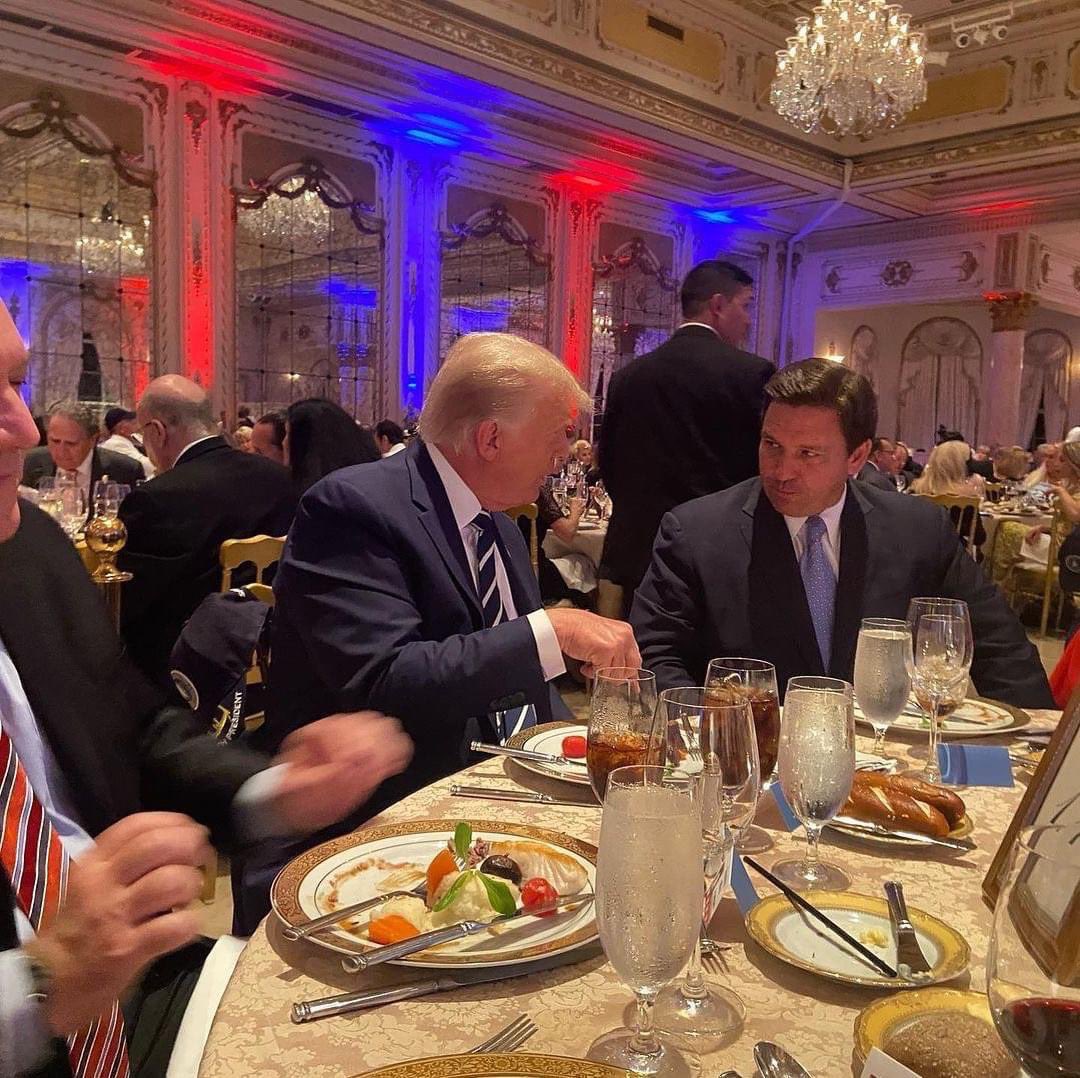
PS. If Florida Governor Ron DeSantis wants to take the lead point in the America-First economic recovery, he needs to understand who the enemy is and drop his connections to any/all Wall Street and multinational corporate donors. This is not a debatable issue.
Here is a simple explanation of property rights for those who would like to abolish capitalism. Klaus Schwab says, “You will own nothing, and you will be happy.” I think it is important to understand what this entails. I have said before that socialism cannot exist outside of authoritarianism to force people to comply with its mandates. Under communism, the government seizes the means of production, land, and you own nothing. While there are different forms of socialism, the government has the ability to take your property rights away through taxes and laws to prevent anyone from being unequal.
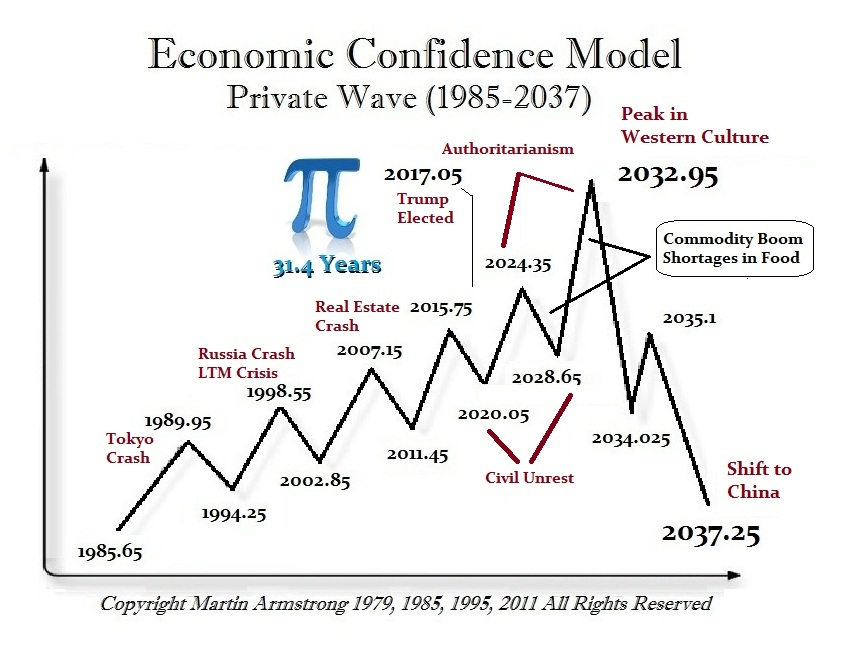
That said, the third cycle of the 51.6-year Economic Confidence Model wave from the rise of socialism in 1882.45, 1934.05, and 1985.65 is the wave when Marxism collapsed. Governments and people like Klaus Schwab are making a major effort to take over the world by sheer force and have used this virus to destroy the economy to justify nationalizing industry. The very first wave into this cycle saw the collapse of communism in 1989.95 and 43 years later (half an 86-year cycle), we will experience the collapse of Western socialism — 2032.95. There is no stopping this cycle, but we can, at best, reduce the amplitude.
At last, Federal Reserve Chairman Jerome Powell has begun speaking independently as he departs from the Biden agenda. Former President Trump and Powell notoriously clashed over interest rates, and we heard time and time again that the central bank was independent of government rule. Once Biden entered the White House, Powell seemed to be more on-board with pushing forth his agenda and a shoo-in for reelection. Recently, Powell came under fire for share trading he made last October as central bankers have become the new scapegoat, and now, his tone has changed.
While speaking at a virtual conference with the Bank for International Settlements on Friday, Powell surprised many by taking a hawkish tone. The dual mandate of maintaining both maximum employment and low inflation has become nearly impossible. Powell cited the main culprit – maintaining maximum employment under the Biden Administration.
Short of directly condemning the administration, Powell said the obvious situation now is that the US is still five million jobs beneath pre-pandemic levels. During his final question regarding outstanding concerns, the chairman reluctantly stated, “Italy is one thing in this successful management of…theeconomic exit from the pandemic.” That’s right – the chairman of the Federal Reserve has acknowledged that maintaining pandemic prohibitions and forced mandates is stifling economic growth. He went on to state how the economy is “missing an essential piece of output because of the constraints and the non-full opening of the service sector,” and he believes we need to give them time to come back. The service sector has experienced notably higher unemployment than other sectors. In some states, people cannot step foot in a restaurant unless they provide proof of vaccination. That is deterring a portion of the population from even spending money on that sector, not to mention employers are unable to fill positions after prolonged government handouts and forced vaccine mandates.
Powell lost his “transitory” tone on inflation, conceding he understands how “painful” inflation has been for everyone who is affected every time they make a purchase. Yet, it is not possible to maintain inflation without maximum employment. Yellen, who is fully on-board with the Biden agenda, recently said she is confident the US labor force will recover near-term. Powell admitted that conditions will be “extremely punching, certainly in the short-term,” and we may see a labor recovery in a year or so, but it largely depends on government and not Fed policy.
Posted originally on the conservative tree house on October 22, 2021 | Sundance | 242 Comments
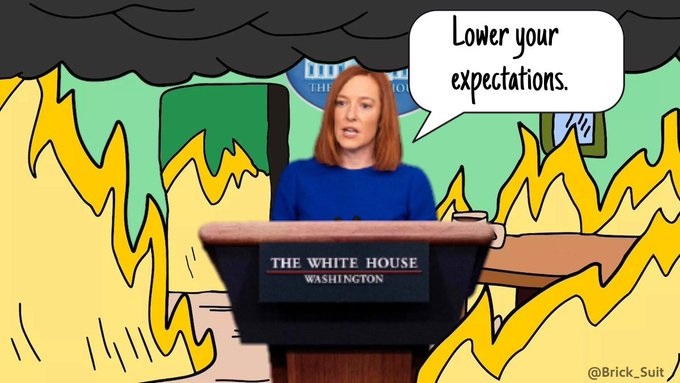
Earlier today White House Press Secretary Jennifer Psaki falsely claimed a United States President can do nothing about gasoline prices. This is an oft familiar claim by the political left, it is also one of the more transparently false assertions in their arsenal of deceit. First, WATCH:
So what can a U.S. President and administration specifically do?
We have abundant U.S. energy resources. Quite literally the strongest in the entire world.
Permit the use of preexisting approved leases in ANWAR (Alaska) to put more volume into the Alaskan oil pipeline that is severely underutilized.
Finish the Dakota access pipeline.
Re-approve the preexisting energy leases in New Mexico, Arizona, NE Atlantic and Gulf of Mexico.
Retract the stoppage of the Keystone pipeline to permit efficient oil transport shipments from Canada.
Stop blocking the expansion of coastal oil refineries in Texas, Louisiana and Alabama (regulatory issue), as well as Northwest, Northeast and Southeast Seaboard.
Continue to develop natural gas as a clean burning fuel.
Drive Liquefied Natural Gas (LNG) as an export.
None of this requires any approval from OPEC. Strategically the all of the above approach enhances U.S. national security and diminishes the influence of Russia, China and Iran. Within six months of the above, gasoline will plummet.
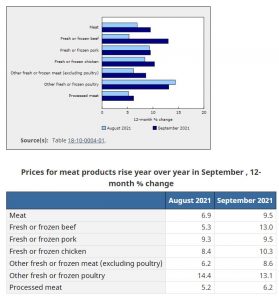
(Image from Statistics Canada: Prices for meat products rise year over year in September)
Canada’s CPI rose 4.4% YoY this September, according to Statistics Canada. Every major sector saw gains, but meat prices spiked 9.5%, marking the fastest pace of growth since April 2015. Canada’s Food Price Report for 2021, released in December 2020, predicted that meat prices would rise 4.5% to 6.5% in 2021, a drastic underestimate. Dr. Sylvain Charlebois, project lead and Director of the Agri-Food Analytics Lab at Dalhousie University warned people that they should develop “immunity” to rising prices. “Immunity to higher food prices requires more cooking, more discipline and more research. It’s as simple as that.” Gaslighting the people to believe they need to change their lives, rather than government change their policy, is at play once again.
Let me remind you that Bill Gates and others have been advocating for a move to 100% synthetic beef. But his logic only applies to the “rich” countries such as the US and Canada. “Weirdly, the US livestock, because they’re so productive, the emissions per pound of beef are dramatically less than emissions per pound in Africa,” Gates said in an interview in February 2021. “So no, I don’t think the poorest 80 countries will be eating synthetic meat. I do think all rich countries should move to 100% synthetic beef. You can get used to the taste difference, and the claim is they’re going to make it taste even better over time. Eventually, that green premium is modest enough that you can sort of change the [behavior of] people or use regulation to totally shift the demand.” This ties into the climate change agenda and the idea that starvation can help us shift to zero CO2. I should mention that the article added a disclaimer that Bill Gates is an “investor either personally or through Breakthrough Energy Ventures in several of the companies he mentions below, including Beyond Meats, Carbon Engineering, Impossible Foods, Memphis Meats, and Pivot Bio.”
Biden and Trudeau have made it known that they are on board with the climate change agenda, so that could be a preview of what is to come. Back to Statistic Canada’s December report – the forecast lists COVID-19 restrictions and the oil price war for rising food prices. Perhaps a certain pipeline could have assisted the fuel crisis. Yet, Biden rescinded the permit early in his presidency, and Trudeau feigned disappointment but did not push back on the matter. Basically, the two main components that the report notes are somewhat within government’s control.
How will this affect Canadian families? So far, the average food expenditure for a family of four is C$13,907, a 5% increase of C$695 compared to last year.
Posted originally on the conservative tree house on October 21, 2021 | Sundance | 291 Comments
“If you build it, they will come”…
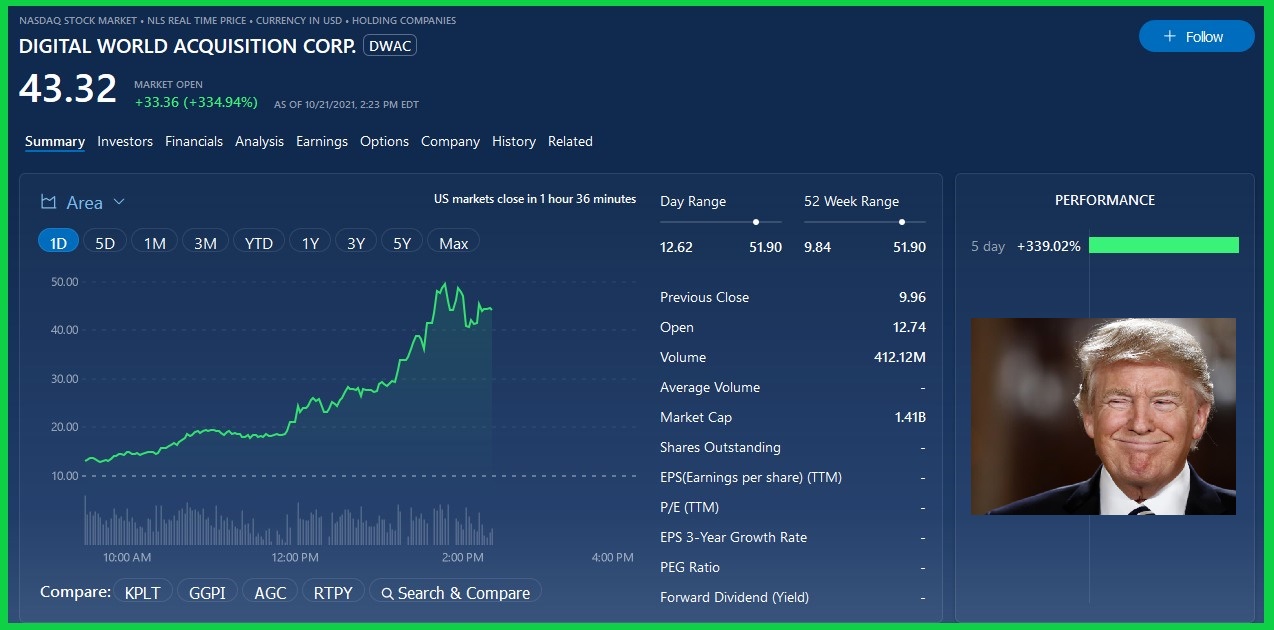
It would appear there is a great deal of interest in the newly announced Trump Media and Technology Group as shares for the special media acquisition company, DWAC, the firm merging with Trump to lead the fundraising have skyrocketed after the announcement.
Beginning the day around $10/share, the value of DWAC jumped to a session high $51/share, as more than 412 million shares have been traded. Buy orders outpace sell orders by 3 to 1. [Current CNBC ticker here] DWAC is by far the most active stock as MAGA retail investors climb on board the opportunity to challenge Big Tech with Trump social media. They even tried numerous times to stop trading…. but the people kept coming, and coming, and coming….
(CNBC) – […] DWAC’s stock surged as much as 400% to $51 per share Thursday after trading was halted multiple times due to volatility.
Digital World Acquisition was the single most actively traded stock on the Fidelity platform Thursday, and was by far the most traded name on the consolidated tape of New York Stock Exchange and Nasdaq listings.
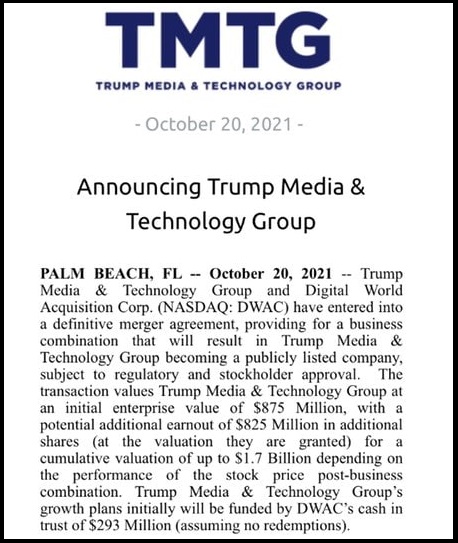
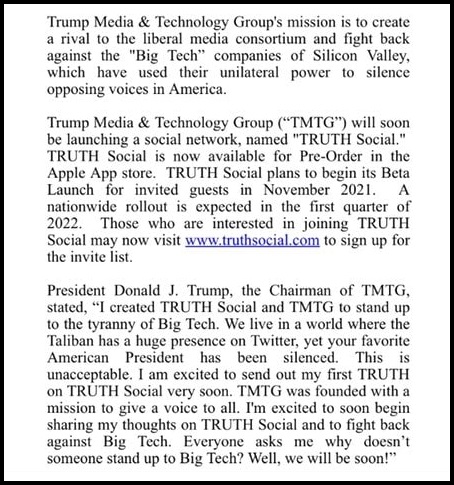
[…] In a press release Wednesday night, Trump’s new company, Trump Media & Technology Group, said it and DWAC “have entered into a definitive merger agreement, providing for a business combination that will result in Trump Media & Technology Group becoming a publicly listed company, subject to regulatory and stockholder approval.” Trump also said he would roll out a platform called “TRUTH Social,” which he claimed will “stand up to the tyranny of Big Tech.” (read more)
Once “we get the pandemic under control, the global economy comes back, these pressures will mitigate and I believe will go back to normal levels,” Treasury Secretary Janet Yellen stated, echoing “transitory” sentiments by Fed Chairman Jerome Powell. Powell believes supply chain bottlenecks are the main culprit for inflation. Well, the Biden Administration appointed the secretaries of Commerce, Agriculture and Transportation to create a supply chain task force to fix the influx issues.
Sameera Fazili, a deputy director of the White House National Economic Council, stated, “Our approach to supply chain resilience needs to look forward to emerging threats from cybersecurity to climate issues.” Is climate change the issue here? Is this an indication of where the government will misdirect resources once again? Fazili further displayed how out of touch the government is with the current crisis by saying inflation due to supply shortages is “kind of [a] good problem to be having,” as it indicates demand. The countless number of businesses and consumers currently paying for basic living expenses at up to 30-year highs may not see the glass half full at the moment.
Then, the Biden Administration met with the workers at the Port of Los Angeles this week, where it was agreed upon that the port would operate 24/7 to address issues. Ports in Los Angeles and Long Beach, California, account for 40% of all shipments into the US, which seems to be a good start. Even Walmart, FedEx, and UPS have agreed to unload their shipments at non-peak hours to help the process. Oh, wait, the ongoing worker shortage. Companies are begging people to apply, and it remains to be seen whether the ports will be able to maintain proper staffing to run at full capacity around the clock. Then the need for a sufficient number of truck drivers becomes an issue as well. Even if the ports do reach full capacity, what about the spike in fuel prices? Energy prices have caused the price of transportation to skyrocket, which is then passed on to the consumer. The US government is approaching this issue from a domestic standpoint as well and not factoring in the reason why inflation and supply shortages are not limited to the US.
Socrates indicated that inflation could rally into 2034, and based on the current solutions, the computer will likely be correct once again. Perhaps we should all view inflation through rose-colored glasses and view the 5.4% YoY spike in September as “kind of a good problem to be having.”
Consumer debt in the US reached $14.88 trillion in 2020, according to Experian’s consumer debt study. That is a $3 trillion increase in the past decade, and spending in 2021 has only amplified. Nearly 42% of US adults have reported falling deeper into debt since March 2020, and according to a survey by BankRate.com, 2,400 of 1,297 adults had credit card debt of which 47% contributed that debt to the pandemic. Credit card debt is difficult to crawl out from, with the average APR well above 16%. Even more alarming is that 54% of adults hold on to their credit card debt for at least a year, and with that rising interest, it will take years to pay it off (if ever).
Inflation is not deterring retail sales in the US. I have stated that other countries line up to sell their exports to America, making the US the top consumer economy, and the top economy overall as consumer spending accounts for two-thirds of GDP. Even with inflation up 5.4% YoY in September, retail sales spiked 0.7% despite analysts’ at the Dow predicting a -0.2% decline. Why?
Of course, people must spend to meet their basic living expenses, and those expenses have spiked in every area from food, energy, to real estate. However, there is additional spending occurring post-pandemic as optimism rises. People hoard when they fear the future. Without taking into account other factors, people are beginning to spend again because the easing restrictions and vaccinations has led them to believe that their future financial situations will brighten.
A study on the psychology of consumer spending points to interesting aspects of human nature (Carter T.J. (2014) The Psychological Science of Spending Money). “There is obviously the direct monetary cost, but also the opportunity cost: all of the other ways that one could have spent this money must now be foregone. Thus, a more psychological definition of the psychological act of spending money would be a simultaneous loss (of money and opportunity) and gain (of some good or service) for oneself and/or someone else that one chooses to undertake based on some beliefs about future hedonic states,” as noted by a 2014 study on consumer behavior (Bijleveld E., Aarts H. (eds) The Psychological Science of Money. Springer, New York, NY. https://doi.org/10.1007/978-1-4939-0959-9_10). The study found that the act of spending itself is “hedonically neutral,” and they used the analogy that “dropping $20 down a storm sewer would feel worse than finding $20 on the street would feel good.”
However, anticipated v anticipatory emotions come into play before acquiring new physical possession, be it a stock in your portfolio or a new iPhone in your pocket. On anticipation, we may feel a natural high as “we decide whether and how to spend money based on how we anticipate the various courses of action will make us feel.” (Mellers et al., 1999 ; Shiv & Huber, 2000). Anticipatory emotions are what we experience when we actually acquire the purchase (e.g., we may feel happiness after purchasing equity that we expect to profit on or guilty after buying a candy bar).
The study dissects consumers into different categories, but for the sake of keeping the blog post a reasonable length, let’s go right to the source – hedonic adaptation (e.g., after positive (or negative) events (i.e., something good or bad happening to someone), and a subsequent increase in positive (or negative) feelings, people return to a relatively stable, baseline level of affect (Diener, Lucas, & Scollon, 2006). “Focusing only on the immediate spike in happiness and ignoring the subse-quent [sic] decline means that the anticipated experience—the one on which people base their expectations, and thus, their decisions—may be quite different from the actual experience, increasing the chances of disappointment.” So, we may experience a short spike in dopamine after a purchase, but that high may wear off. The pain of payment affects all consumers, but interestingly, paying with a credit card temporarily mitigates the negative feelings associated with a payment:
“Cash payments are immediate and visceral—the money literally leaves your hands and becomes some-one [sic] else’s possession. Credit cards, on the other hand, are abstract and distant; they allow you to put off the pain of paying until next month, often while enjoying the benefit immediately. Spending money this way may seem painless, and almost certainly does reduce the negative anticipatory emotions that might prevent one from making a purchase, but it only forestalls the inevitable. When the end of the month rolls around and the credit card bill comes due, that pain may actually be magnified because the pleasure you experienced is already in the past.”
Cash transactions are becoming an ancient relic, and if the government had its way, we likely wouldn’t pay in cash at all. As online buying rises in popularity and people opt to pull out their plastic cards rather than physical paper, the initial cost of the purchase may not resonate. Retail therapy is in itself a hedonic act that may provide short-term happiness but often leads to buyers’ remorse when the purchase cost outweighs the benefits. It is important to note the risks associated with this move into a cashless society. The immediate impact of a purchase may not be felt for some time, at which it may be too late. As they say, when you’re in a (debt) hole, stop digging.
I have created this site to help people have fun in the kitchen. I write about enjoying life both in and out of my kitchen. Life is short! Make the most of it and enjoy!
This is a library of News Events not reported by the Main Stream Media documenting & connecting the dots on How the Obama Marxist Liberal agenda is destroying America





 Centinel2012