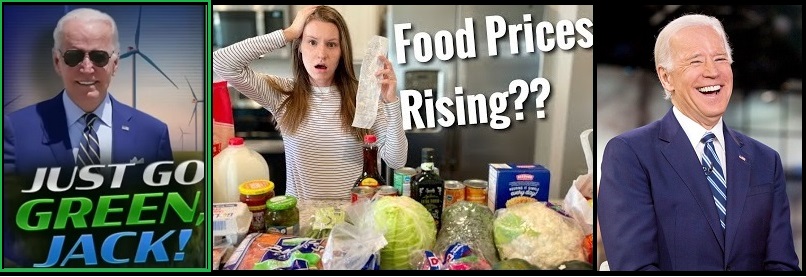
Egg Prices Surge to Record Levels as Christmas Grocery Prices Hit Consumers


Posted originally on the CTH on December 22, 2022 | Sundance 

The price for a dozen eggs continues climbing as explanations turn toward blaming bird flu.  However, the avian influenza may explain a recent spike, but the longer duration of escalating food price commodities is much deeper than momentary fluctuations.  These are energy dependent products.
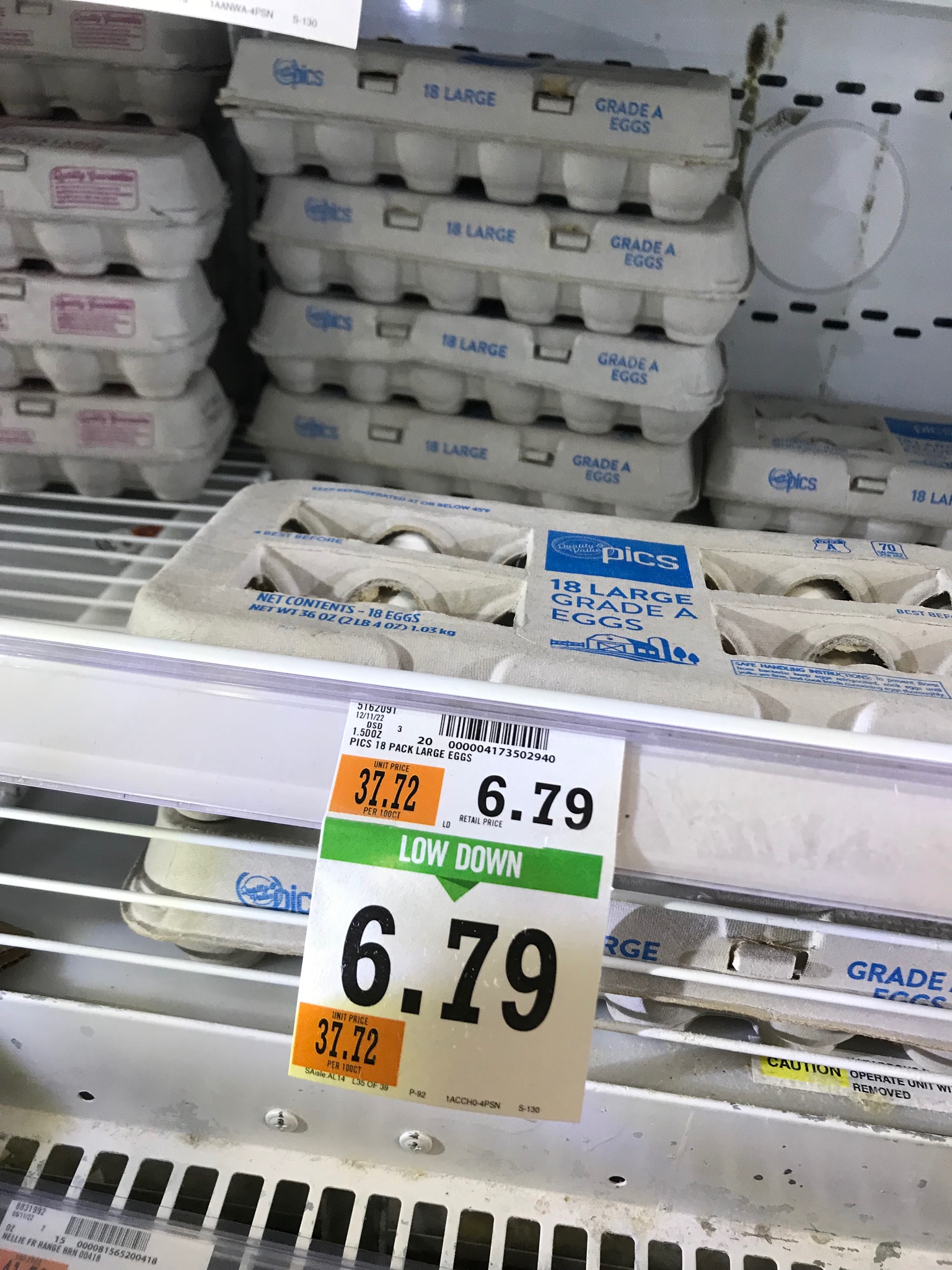
As CTH noted last year, watch egg prices as a general gauge for overall food inflation (eggs hit almost every process in the supply chain), and watch potato availability to gauge overall row crop stability (staple commodity on every plate, venue).

Additionally, as previously noted, as energy prices continue rising pay attention to the prices on ‘organic’ products.  Rising energy prices drive up costs for large commercially processed food supplies at a much higher rate than smaller organic production.  People are starting to notice the ‘organic’ option is almost at price parity.

Wall Street Journal – […] Wholesale prices of Midwest large eggs hit a record $5.36 a dozen in December, according to the research firm Urner Barry. Retail egg prices have increased more than any other supermarket item so far this year, climbing more than 30% from January to early December compared with the same period a year earlier, and outpacing overall food and beverage prices, according to the data firm Information Resources Inc.

For supermarkets, eggs are a staple product that most consumers pick up on trips to the grocery store, similar to milk and butter. To maintain store traffic, grocers said they have been sacrificing some profits on eggs to keep prices for consumers competitive. Some suppliers are projecting potential relief in price by February or March, but cold weather could hamper production in the near term, executives said.

[…] Grocery prices have continued to increase this year because of what companies have said are higher costs of labor, ingredients and logistics, helping supermarkets generate higher sales and profits. Those factors have propelled egg prices, too. As eggs get more costly, some supermarkets are selling more organic eggs that are sometimes less expensive than conventional varieties, while suppliers say consumer demand has remained steady despite higher prices. (read more)

Additionally, the overall price for a Christmas meal is much higher than it was in 2021.

(Via Fox) […] The holiday dinner grocery basket is estimated to cost an average of $60.29, according to data from Datasembly. That’s 16.4% higher than last year’s basket when comparing the same exact basket of goods. It’s also double the year-over-year increase reported last year at 8.2%, according to the retail data firm.

[…] The 13 products included stuffing mix, corn, green beans, frozen apple pie, whipped topping, butter, cranberry sauce, bone-in spiral-cut ham, egg nog, homestyle biscuits, russet potatoes, white frozen young turkey and homestyle roasted turkey gravy.

According to the data, biscuits had the highest price increase year-over-year, rising 47.7%. Butter and russet potatoes weren’t far behind with prices rising 38% and 32.6%, respectively, the data showed. (read more)

Keep in mind, this week you should be seeing competitive pricing on beef, specifically standing rib roasts.  Retailers will be competing with each other on the staple table items, and this creates an opportunity to buy and freeze beef at a lower price.

2023 will be a year when shopping smart will become increasingly important.  Prices are likely to continue rising; one thing is certain, as long as energy costs keep increasing, food prices will not drop.  Use the season(s) and holiday sales as opportunities to purchase specific items at lower prices; then store, freeze or can at home for use when the price of those same items is much higher.
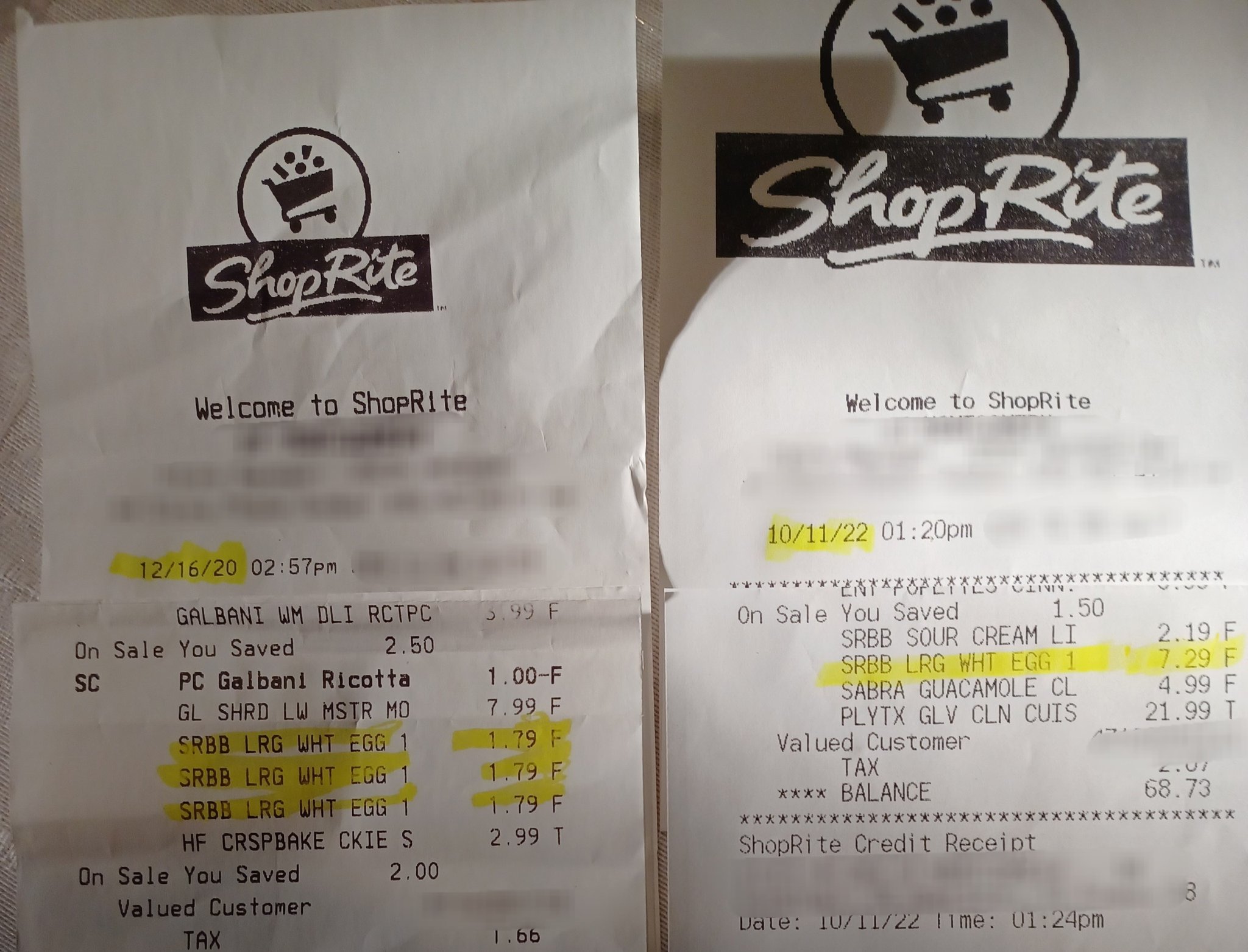

Eggs at Christmas 2020 $1.79/doz.  -VS-  Eggs October 2022 $7.29/doz.

A National Security Nightmare Is Happening (Ep. 1917) – The Dan Bongino Show


The Dan Bongino Show Published originally on December 19, 2022 

A national security nightmare is about to unfold. In this episode, I address the dramatic situation, and the ramifications for our country moving forward. I also address the latest Twitter files drop and what it means for our broken FBI.

AOC Climate Change Documentary Flop


Armstrong Economics Blog/Climate Re-Posted Dec 16, 2022 by Martin Armstrong

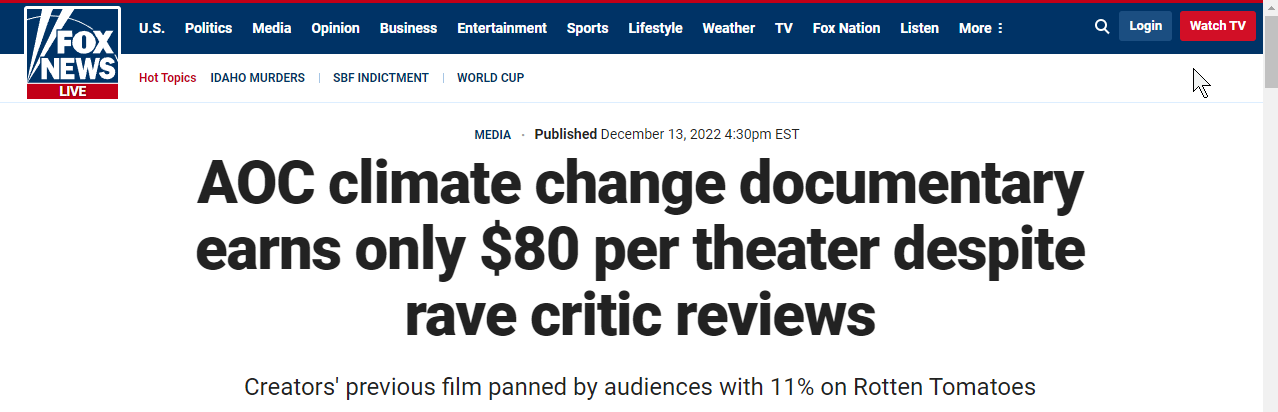
AOC’s four year in the making Documentary of fighting for Climate Change was a complete flop. It debuted in movie theaters around the country and took in $10,000 averaging $80 per movie theater. Of course, the leftist media hail the film, and it was the worst debut of any film in history.Just maybe people are becoming WOKE – walking up to the real propaganda.

Biden Will Pay African Union Additional $2.5 Billion to Stop Africa from Developing Domestic Farm Fertilizer


Posted originally on the CTH on December 15, 2022 | Sundance 

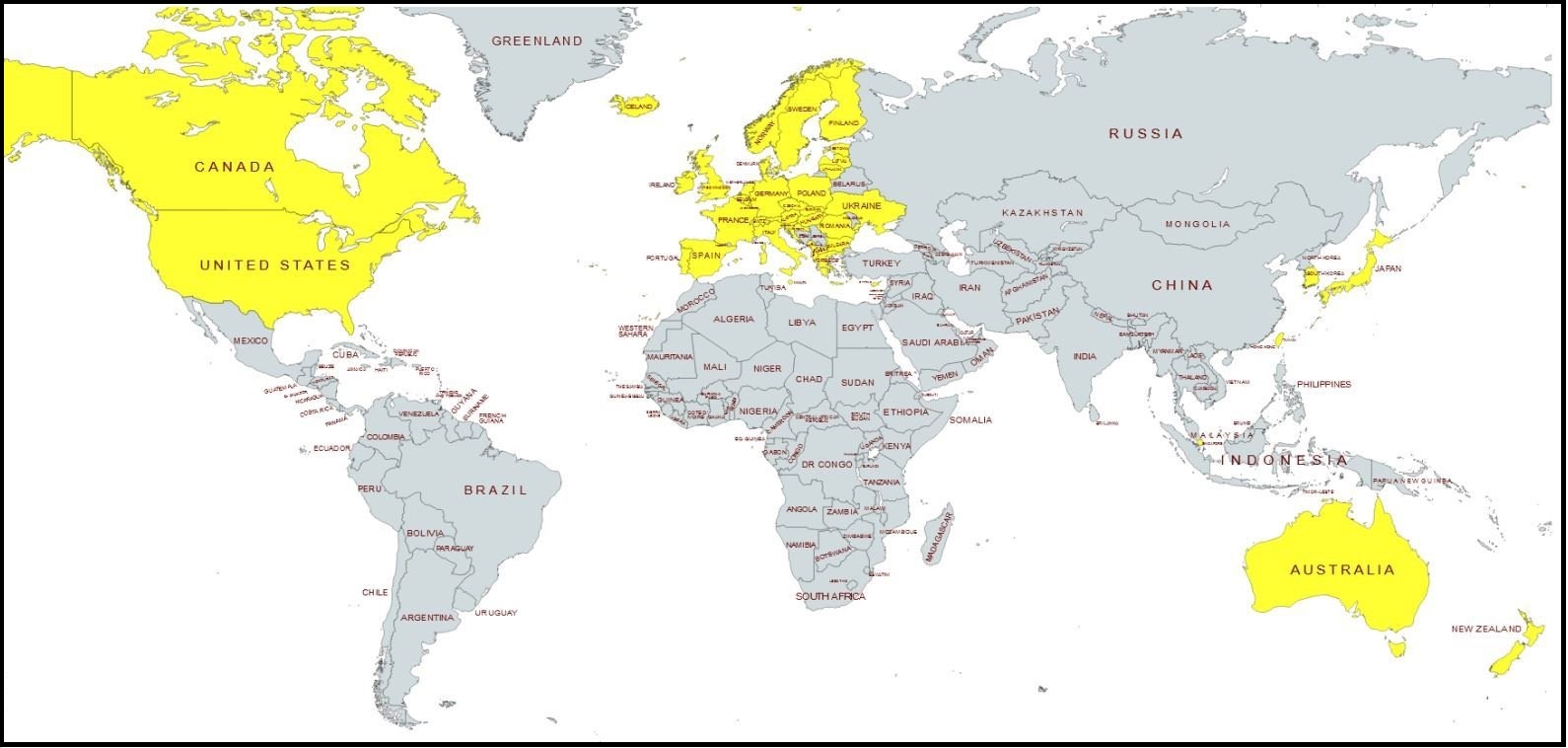
The G7 leaders have been debating the problem of African farming for quite a while. The issue surrounds the conflicts between the G7 climate change agenda and the need for Africa to develop fertilizer production to enhance their farming and crop yields.

As noted in a Reuters article from June, “the European Union is divided on how to help poorer nations fight a growing food crisis and address shortages of fertilisers caused by the war in Ukraine, with some fearing a plan to invest in plants in Africa would clash with EU green goals.”  As the argument unfolded, “the EU Commission explicitly opposed” any effort to enhance African fertilizer development, “warning that supporting fertilizer production in developing nations would be inconsistent with the EU energy and environment policies.”  

The energy development corporations, the source industry needed to create the components for nitrogen-based fertilizer, have been waiting to invest in African energy production pending the approval of western government decisions.  Addressing the issue today, Joe Biden told the African Union the United States would send an emergency $2.5 billion in food crisis aid to offset the inability of Africa to feed itself.

In essence, instead of Western government policy supporting energy production in Africa that would lead to a greater farm yield, and by extension a greater level of food independence, the Biden administration would rather restrict energy/food development in Africa and send them food subsidies; because, climate change.

(White House) – […]  President Biden announced an additional $2.5 billion in emergency aid and medium to long-term food security assistance for resilient African food systems and supply markets, which builds upon over $11 billion in U.S. humanitarian and food security assistance for this year alone.  President Biden also launched a new strategic partnership on food security between the United States and the African Union.  

Together, we will leverage the public and private sectors, along with multilateral development banks and international financial institutions to accelerate transformational investments in sustainable and resilient food systems to prevent food shocks before they happen.

The compounding impacts of the global pandemic, the growing pressures of the deepening climate crisis, high energy and fertilizer costs, and protracted conflicts – including Russia’s war in Ukraine – have pushed weak supply chains to the brink and dramatically increased malnutrition and food insecurity — particularly for African countries. (read more)

The Biden administration would rather people starve than be able to feed themselves in order to retain the climate change agenda.

This is globalism and elitism in its full glory.  Western politicians, along with multinational corporations, in control of global trade and finance are deciding who lives and who dies according to their climate change ideology.   This is how important their Build Back Better scheme is to them.

Liberalism or modern totalitarian leftism is on display as the great global cleaving continues.

The elites in western government think they still have the power to control the rest of the world.  However, the absence of food changes things and creates a risk to their agenda.

Many people are starting to realize -through the farming aspect- that western ideology, as manifest in modern globalism, is dangerous.  The Davos crowd is willing to kill millions if that is what it takes to retain their climate change ideology.

Keep watching this closely.  The multinational U.S. media will continue burying the issue protecting the ruling class.

June 2022, Reuters Article

June 2022 – CTH Outline

December 2022 – White House Announcement 

Maker of Electric Jeep Vehicles Closing Illinois Plant and Moving to Mexico


Posted originally on the CTH on December 11, 2022 | Sundance 

Stellantis is a multinational automaker contracted for the electric version of the Jeep Cherokee.  Citing high costs to produce electric vehicles, on Friday Stellantis announced a decision to idle the Belvedere, Illinois plant starting on Feb. 28, 2023, and notified 1,350 workers of the layoffs.

(Via Fox) […] “This difficult but necessary action will result in indefinite layoffs, which are expected to exceed six months and may constitute a job loss under the Worker Adjustment and Retraining Notification (WARN) Act. As a result, WARN notices have been issued to both hourly and salaried employees,” it said. “The company will make every effort to place indefinitely laid off employees in open full-time positions as they become available.”

Today The Daily Mail is reporting that production of the electric Jeep will take place in Mexico.

Hundreds of workers are expected to be laid off when automaker Stellantis closes an assembly plant in northern Illinois early next year, citing the challenge of rising costs of electric vehicle production.

The company, which employs about 1,350 workers at the plant in Belvidere, Illinois, said the action will result in indefinite layoffs and it may not resume operations as it considers other options. 

Stellantis said the industry ‘has been adversely affected by a multitude of factors like the ongoing COVID-19 pandemic and the global microchip shortage, but the most impactful challenge is the increasing cost related to the electrification of the automotive market.’

The Belvidere plant, produces the Jeep Cherokee SUV, will be idle starting on February 28, 2023, Stellantis said. The plant in Toluca, Mexico will now produce the vehicles. (read more)

One aspect of this move that deserves additional attention is the U.S. and Canada focus on new energy policy, against the backdrop of Mexico telling the Biden administration the USMCA partner was going to continue development of traditional oil, coal and natural gas energy production.

Should Mexico continue to maintain a more traditional energy policy, they will likely create a greater cost incentive for all manufacturers.  With electricity rates skyrocketing in the U.S. and Canada, any energy dependent manufacturer would see an additional advantage to production in Mexico.

It will be worthwhile watching this dynamic closely and seeing what type of pressure the Biden administration will apply to Mexican President Andres Manuel Lopez-Obrador to fall in line.

Labor Report Shows 263,000 Jobs Added in November, Combined with Significant Wage Growth 0.6% For Month


Posted originally on the CTH on December 2, 2022 | Sundance 

There’s a disconnect in the Main Street data that is perplexing from the standpoint of traditional economic and labor analysis.

There have been significant layoffs in the labor market as the result of diminished consumer spending activity. However, the Bureau of Labor and Statistics (BLS) is reporting a hotter than expected 263,000 new jobs in November [DATA HERE].

There were declines in jobs within the retail sector [-30,000 in Nov, -62,000 since August] and declines in warehousing and transportation [-15, 000 in November, -30,000 since July], which would indicate the outcome of lowered consumer spending on goods, or at least a change in consumer spending priorities.

Simultaneously, there were significant increases in jobs for leisure and hospitality [+88,000 in Nov], with the majority of those gains in food service and drinking.  However, that sector is still lower than the pre-pandemic by -980,000 jobs.  Also note people are not attending events with high ticket costs, the performing arts and spectator sports segment dropped 7,000 jobs [Table B-1]

Overall, if you were to look at the macro level jobs report, anything attached to the traditional spending of durable goods (retail stores) is declining.  However, the jobs related to the service or life experience are growing.  Oddly, and perhaps creepily, this dynamic falls in line with the ‘you will own nothing and be happy‘ cliche’ that has been oft spoken about the new post pandemic ‘Build Back Better‘ economy as espoused by the World Economic Forum.

Job gains in the infrastructure of life such as, building and construction, as well as the labor sector associated with skilled domestic service trades like plumbing, electricians, maintenance, etc are continuing to hold stable.  The major shift in the labor market surrounds the buying of durable goods which has disappeared along with the disappearance of discretionary income.   Which brings us to the wage portion of the BLS report.

Wage growth was a very high 0.6% for November and brings the annual rate of wage growth to 5.1%.   This outcome is almost certainly an outcome of workers demanding higher pay to cope with inflation, and employers needing to raise their wage rates in order to retain employees.

We also see an increase in the number of workers holding multiple jobs, as individuals are taking second jobs to cope with massive price increases in housing, food, fuel and energy. As noted within the BLS data:

In November, the average workweek for all employees on private nonfarm payrolls declined by 0.1 hour to 34.4 hours. In manufacturing, the average workweek for all employees decreased by 0.2 hour to 40.2 hours, and overtime declined by 0.1 hour to 3.1 hours. The average workweek for production and nonsupervisory employees on private nonfarm payrolls decreased by 0.1 hour to 33.9 hours.”

Fewer people are working, but more jobs are being worked – with lowered hours.

Higher wages are good; however, higher wages lead to higher prices for goods and services; which drives inflation higher, which creates the need for higher wages.   It’s an upward pressure spiral.

The supply side pressure on inflation, almost exclusively created by the BBB energy policy, shows absolutely no sign of lessening, despite the drop in demand for domestically produced finished consumer goods which has lowered overall industrial demand for energy.

The Build Back Better energy driven policy changes are creating very weird economic outcomes.

Prices are rising.  Consumers are squeezed.  Jobs attached to spending on goods are declining. Jobs attached to life experience and services expanding.

Ex.1 If you are working two jobs, now you might not have time to mow your grass – so you hire a lawn service.  The lawn service guys are charging more because the gasoline and business costs are higher…. which means you need to work a little longer at the second job to pay for the lawn service you don’t have time to do on your own because you need to work the second job.   That’s the dynamic we are seeing in the quantification of labor and job growth.

Ex.2 If you are working two jobs, you might not be cooking as much at home.  So, you grab dinner/lunch away from home.  The restaurants are charging more because the business costs are higher…. which means you need to work a little longer, ask for higher wages, in order to offset the time you don’t have to eat lunch/dinner at home.

This conflicting duality is what I always called the “serfesque driven economy.”  It is an outcome of erosion of the middle-class.  A status of individuality where your desires for life experience determine the need for your income.

You don’t own a car, you Uber.  You don’t own a house, you rent.  You don’t need a kitchen, you eat out.  Things seem ok, but you eventually become a serf to the people who control transportation costs, housing costs, food costs, etc.  Ultimately you have no control over the time you want to spend in enjoyment, because you don’t own the mechanisms of your life and need to work in order to afford maintaining the costs.  It’s a weird mental exercise.

There is a real outcome in this dynamic where the wealth gap increases.