Smart Investor Article (English Translation Provided)


Armstrong Economics Blog/Armstrong in the Media Re-Posted Apr 15, 2022 by Martin Armstrong

I recently appeared on the cover of “Smart Investor” after being approached by journalist Ralph Malisch. Click here to read the full interview (German).

The English translation is available below:

Smart Investor talks to legendary cycle analyst Martin Armstrong about Corona, war and reshaping the world

Smart Investor: Mr. Armstrong, in 2015, The Forecaster, a powerful film about your life, was released. We interviewed you extensively in Smart Investor 5/2015. How have you been doing in the meantime and what are your current projects?
Armstrong:  I was involved in a sequel to the film that will be out later this year. Otherwise, we have expanded our services and have now launched our computer system, which is the system that the government wanted for itself. It now produces over 1,000 written reports every day all over the world without human intervention. We now use it in over 40 countries, which means we probably have the largest institutional customer base in the world.

Smart Investor 5/2015

Smart Investor: Would you briefly explain your forecasting approach to our readers again?
Armstrong:  In the 1980s and 1990s, I was one of the top international hedge fund managers, even being named hedge fund manager of the year for predicting the collapse of Russia, which triggered the 1998 hedge fund Long-Term Capital Management crisis. During that time, I’d watched global investment capital refocus on markets and then move on—leaving Japan in 1989, Southeast Asia in 1994, and Russia in 1998, followed by the euro. All of this was fueled by capital flows. One can follow these movements of capital and see how they cause the boom-bust cycles around the globe.

Smart Investor: The topic of Corona has kept us under its spell for more than two years. Was this turning point, or a drastic event like this, visible in your cycle model?
Armstrong: Yes, I warned at our own World Economic Conference that if our model flipped in January 2020 (= year 2020.05) the market would crash. We were even able to pinpoint the exact day for the March 2020 bottom. Had an event like Corona happened during an uptrend, it would have been largely ignored. But if something like this happens while the model is turning down, then sentiment is inherently bearish. We also warned that there would be a scarcity-based commodity cycle from January 2020 to 2024.

Smart Investor: In our perception, major pandemics occur with a certain regularity. Have you thought about some kind of plague cycle and how it might continue?
Armstrong: Such epidemics have always existed – but never in history have governments reacted so madly. The global lockdown has cost jobs and created bottlenecks in supply chains that will persist for several years to come. It was an absurd response that was proven wrong and caused a lot more damage. Most people know someone who got sick from COVID but didn’t die from it. Those who died would likely have died from any form of respiratory disease, such as occurs during the annual cycle of influenza. It was not a dangerous plague that killed 30% to 50% of the population like smallpox or the black plague in the 14th century.

Smart Investor: Now a new dominant event has been triggered with the hot war in Ukraine. How does this war fit into your model, specifically the war cycle?
Armstrong: That too came at exactly the “right” time. Our model showed 1/16/2022. Unfortunately, instead of trying to bring peace to the world, the West has demonized Putin. The claim that Putin wanted to restore the old Soviet Union was pure propaganda. For the past 22 years he has made no attempt to restore communism, only calling Lenin himself a communist. He did not try to expand the borders but warned against NATO encroachment. In war, both sides spread propaganda, and it is always important to be objective about the claims of both sides. Putin’s invasion of Ukraine was consistent with his warnings and came four days after US Vice President Harris recommended Ukraine join NATO. That was totally irresponsible.

Smart Investor: Can you see in your models which regions or countries will suffer the most in this conflict, who will get off lightly and who will be the beneficiaries?
Armstrong: On both sides there are what we call neocons, people who just hate the other side. They cannot sleep at night as long as their enemy exists. Unfortunately, the deteriorating economic outlook is a reminder that war has often served as a diversionary tactic in the past. It looks like China is allying itself with Russia. I believe the confiscation of Russian private property was a serious violation of international law. Others, too, will realize that their assets could be confiscated if their country got into a dispute with the West. This would, of course, lead to a drop in global investment. It is precisely this process that seems to have started and, according to our models, will only get much worse over the next ten years. Disputes between countries are likely to remain at this level. The arrest of individuals simply because they are Russian is reminiscent of the internment camps for Japanese in the US during World War II solely on the basis of their ethnicity. It is very detrimental to the world economy when free investment is hampered.

Image: © Angelov – stock.adobe.com

Smart Investor: If we understand it correctly, the cycles develop largely independently of the specific actions of individuals. It’s hard to imagine, but would an escalation have been inevitable even if the Russian President hadn’t given the order for the invasion?
Armstrong: That’s right. Demonizing Putin is absurd. There have been far worse leaders in history, like Hitler or Stalin, who could kill millions of people without thinking twice. The development of things is primarily determined by the economy. Normally you don’t bite the hand that feeds you. But imposing sanctions on Russia has exactly the opposite effect: they isolate Russia and sever economic ties, leading to casualties and in turn evoking anger and retaliation. Rome survived for 1,000 years because the conquered provinces benefited from selling their products to Rome. The confiscation of Russia’s currency reserves is above all a warning to China to be very careful in its dealings with the West. For China, the exclusion of Russia from the SWIFT system only means that it is working flat out to introduce its variant of CIPS. Saudi Arabia just agreed to sell oil for yuan. These measures only guarantee that conflicts will continue to escalate and the world economy will be split in half.

Smart Investor: As investors, we try to prepare for strong cycles like these. Which asset classes or sectors should one avoid in this situation and where can one expect safety?
Armstrong:  Government bonds in particular are to be avoided. Governments will default and you will get nothing back. The loans from European governments from before the Second World War are now just an attractive wall decoration. When a company goes bust, its assets are sold and at least you get something back. But you can’t just run into the art museum and steal Picassos in the government. In times of war and geopolitical conflict, real assets are the best security.

Smart Investor: Gold is considered the safe haven, and Bitcoin is also perceived as such in some places. However, these two assets are also more of a thorn in the side of our governments. What do you think of the idea that the Russia argument could make life difficult for investors here in the future?
Armstrong: Gold has lost its mobility – so you can’t hop on a plane and fly somewhere with a briefcase full of gold coins or bars. Cryptocurrencies are vulnerable, because without a power grid, credit cards are a thing of the past. The government is trying to switch to digital currencies and they will not allow competition so they will confiscate cryptocurrencies. The best is paper money or small denomination silver coins that are recognizable to the average person. Tin cans will also have an exchange value if there is no electricity grid.

Smart Investor: Gold and cryptocurrencies are also the main alternatives to paper money, which the war is putting additional pressure on. Will the US dollar and euro survive this?
Armstrong:  The US dollar will outlast the euro, but if we get into a real world war, the paper dollars could lose their value too. Europe has historically canceled its fiat money, while the
US dollar has never been cancelled. Even Canada is now nullifying its currency.

Smart Investor: The Great Reset, the World Economic Forum and Prof. Dr. Klaus Schwab are making waves in Europe. During the corona pandemic, the government measures literally dismantled the medium-sized economy. What do you think of the corporations’ “Big Plan” and are the actors’ ideas compatible with the cycles?
Armstrong: The Great Reset is indeed a real goal. It’s not a conspiracy theory. The three stumbling blocks along the way were Trump, Putin and Xi. They got rid of the first one, and now the propaganda has turned to demonizing Putin and Xi. They believe that if they get rid of these two leaders, they can unite the world under the United Nations. Our models have warned that authoritarianism will rise in this final decade. But they will fail. Marx succeeded only because serfdom in Russia did not end until 1861, while in Europe it only lasted until the fourteenth century. So the people owned nothing, and it was easy to confiscate the wealth of the aristocrats. Today people own their own houses, cars and save for the future. The slogan “You will have nothing and be happy” propagated by the WEF is a red herring. Governments can no longer borrow indefinitely and there will be a default. To disguise this fact, the impression is given that all debts are being forgiven and that they are doing it for you. The guaranteed basic income will be there to replace the pension funds that hold government debt today.

Smart Investor: Thank you very much for your very interesting explanations.

In stock market circles, the American Martin Armstrong (born 1949) is considered a legend. As early as the early 1980s, he correctly predicted the stock market crash of 1987 – and in the midst of the panic he predicted new highs for 1989. He also predicted the bursting of the Japanese stock bubble at the end of 1989. He made his forecasts using the “Economic Confidence Model” (ECM) he developed himself, which is based on a database on the history of coins, which Armstrong used to reconstruct the (financial) history. You can find his daily updated assessments on the blog https://armstrongeconomics.com .
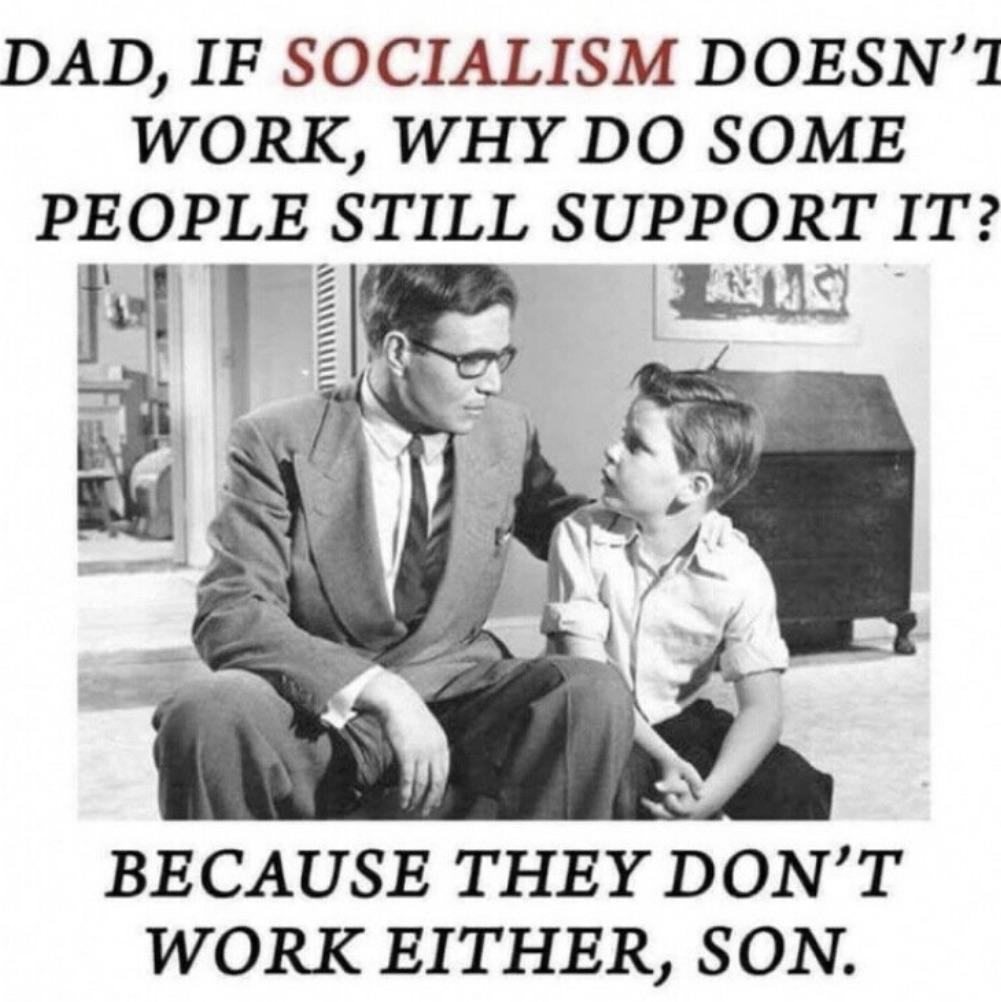
Father Explains Socialism to Son


Armstrong Economics Blog/Humor Re-Posted Apr 15, 2022 by Martin Armstrong

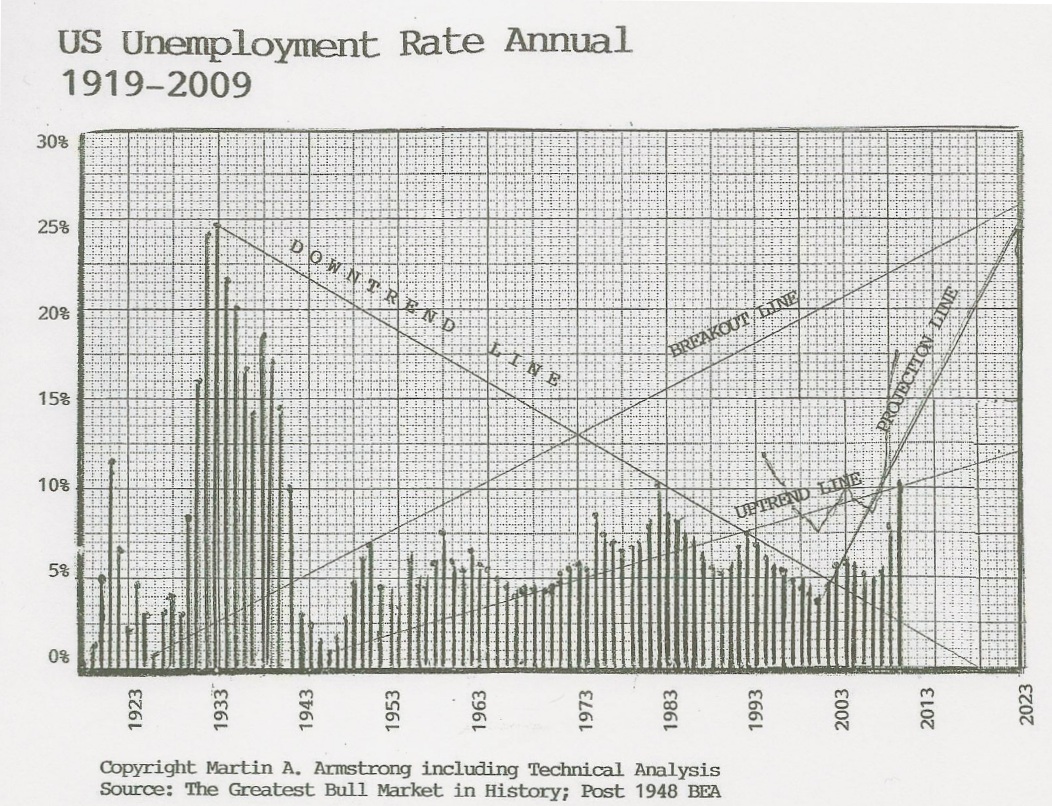
Inflation & the Cost of Labor = Unemployment Decline of the USA


Armstrong Economocs Blog/Economics Re-Posted Apr 14, 2022 by Martin Armstrong

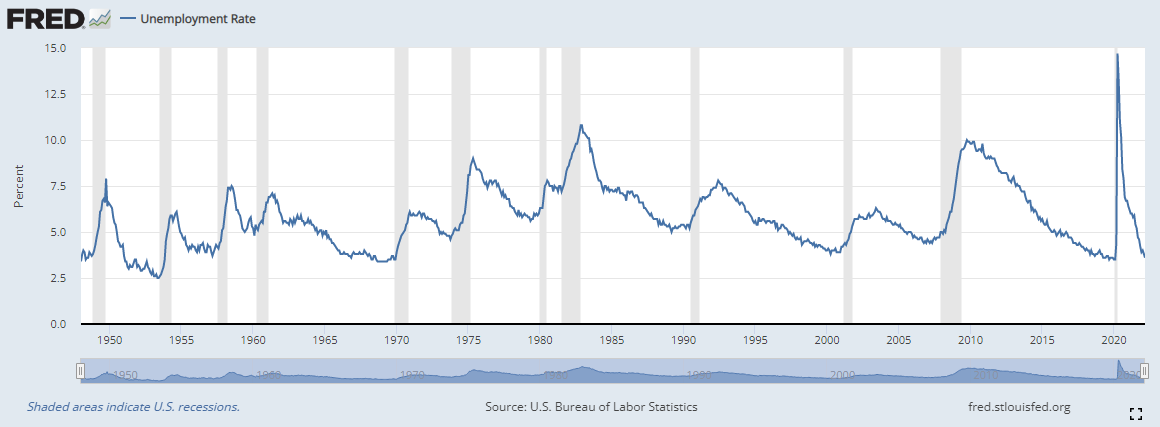
To me, it is fascinating how everything dovetails in together when the computer is monitoring everything on a global scale. The projection that unemployment could reach 15% in 2020 not only came true, but it did so tied into the whole COVID scam which has provided the mechanism for government control over the population and to implement one aspect of the intended Agenda 2030 and the elimination of Democracy. But more serious than that, we still face the risk of more than 25% unemployment in the post-2024 period.

Right now, everywhere I do I see help wanted signs. Even at FedEx the other day I saw a sign help wanted. There is another aspect to this inflation and GREEN regulation that is undermining the entire world economy. We are already short over 80,000 truck drivers and then California imposing demands that Trucks must now comply with their insane regulations by January will kill off even more trucks and we can expect inflation to well exceed 20% even in their manipulated statistics.

The higher the inflation, the lower the net real wages, and this then compels small businesses to raise wages but this produces COST-PUSH inflation on top of the SHORTAGE-INFLATION and this is a lethal combination for the economy going forward. This means small businesses will decline unable to find employees and the higher the inflation, the fewer people can afford to buy. This all combines to the WORST economic outlook possible post-2024.

So stock up on that food. This is going to get much worse. With all the threats the US hurls now at China, they may think they are a Lion when they look in the mirror, but if I was China, locking down Shanghai which is the busiest port in the world will not only further wipe out trucking companies in the USA, but it will result in a further jump in inflation. So threatening sanctions against China will worsen the economy and we have already divided the world economy by ending Globalization. This is eventually the end of the United States and the dollar. Even the IMF has come out and warned this is undermining the dollar as the reserve currency.

We have the WORST possible crop of politicians in charge and they are just jumping on the bandwagon to hate Putin without ever understanding that they have dealt a permanent death blow to the world economy. Thus, our projection on unemployment may sound instance exceeding the highs of the Great Depression, but the inflation is reducing the living standards and the reduces economic activity, and that in turn results in businesses failing and jobs vanishing.

The United States has abused its position and it may think that it is a Lion, but it has been reduced to just a cat. They should pay attention to the military. The Pentagon has been trying to throw cold water on this heated invasion talk over Russia and threatening China with sanctions if they dare to help Russia is just insane. They know they are far stronger with Russia than to let Russia fall and the West would only then turn against them. There is deep concern that the USA will lose in a war with China. These politicians had better look at reality rather than the image they see in the mirror.

History repeats became human nature never changes. Although Athens was enjoying a golden age while led by Pericles, this soon came to an end and thus began the fall of Athens in 431 BC when the 27-year-long Peloponnesian War began. Athens became extremely arrogant and compelled others to donate to their treasury to protect them against another invasion by the Persians which did not happen – today’s Russia. This led to discontent and the image of Athens became tainted by arrogance.

Sparta, which was a communist society, had longed for dominance in Greece. In May of 431 BC, war broke out between Athens and Sparta. The Peloponnesian War (431–404 BC) was fought between the Delian League, which was led by Athens, and the Peloponnesian League, which was led by Sparta. Historians have traditionally divided the war into three phases. However, there were two major causes of the rise and fall of Athens. First is the conflict between the oligarchy and democracy, and its arrogance. The democracy produced many great leaders, but unfortunately, also many bad leaders. Their arrogance lived off of the past glory of the great leaders during the Persian Wars, and it led to the end of Athenian power in Greece.

The decline and fall of the United States is following the very same pages from history. It is the arrogance of the United States threatening China while attempting to destroy Russia that will be what historians write about when the dust settles.

In His Own Words, Elon Musk Explains Why He Tendered an Offer to Purchase Twitter (Video)


Posted originally on the conservative tree house on April 14, 2022 | Sundance

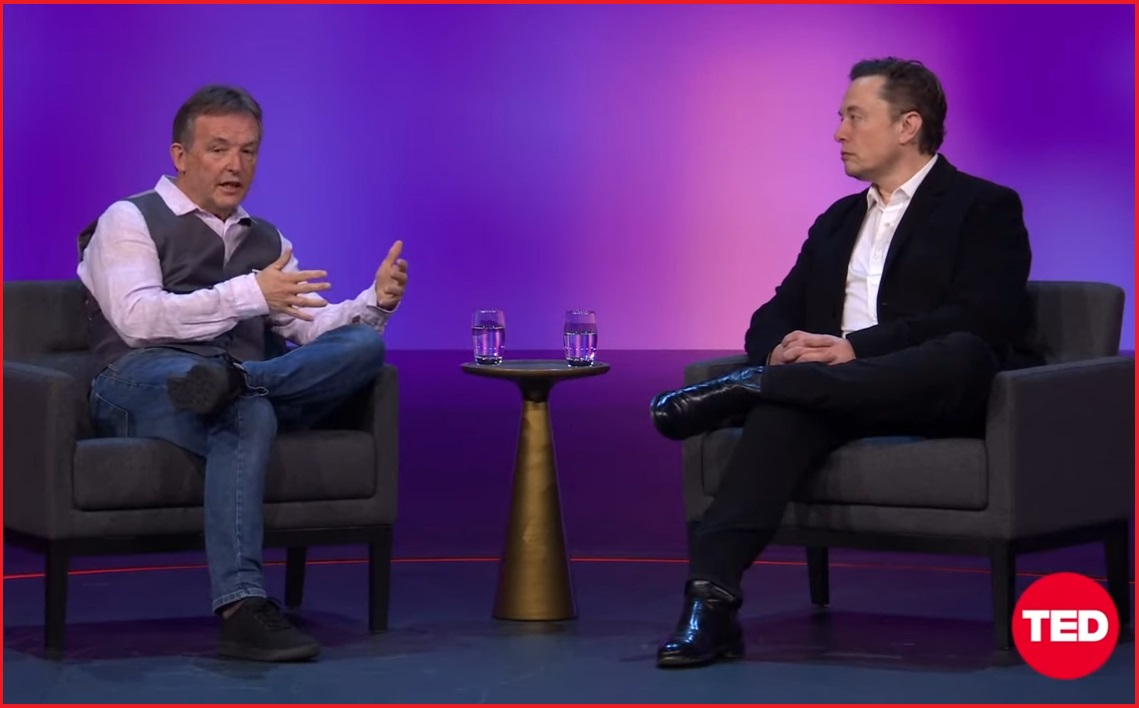
Appearing on Stage in Vancouver earlier today with the head of TED Chris Anderson, Elon Musk discusses why he has made a financial bid to purchase the social media platform Twitter.  The video is prompted to 11:40 when Musk takes the stage, the first part of the conversation surrounds the Twitter announcement that had made global headlines only a few hours earlier.  WATCH:

Florida Republican Legislature Unify in Support for DeSantis Redistricting Map


Posted originally on the conservative tree house on April 14, 2022 | Sundance 

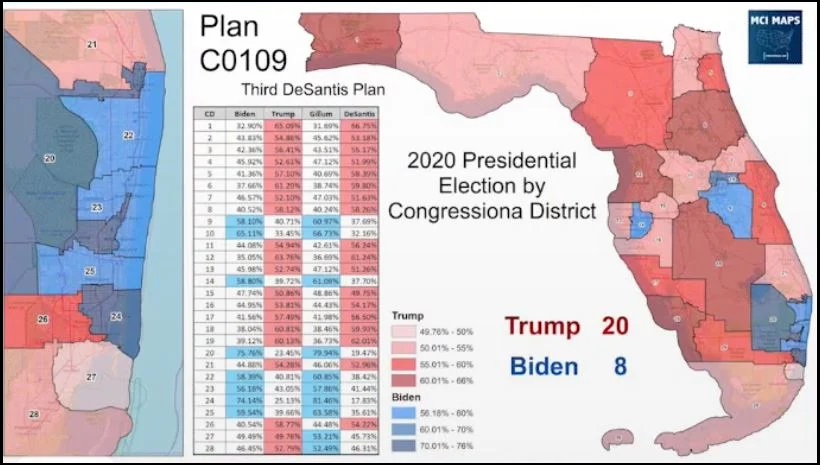
Late last month Florida Governor Ron DeSantis vetoed a legislative redistricting proposal for the state’s new expanded districts.  Florida is gaining a congressional seat as an outcome of the last census and a rapid growth in population.

The concern DeSantis expressed last month was not with the state house or state senate districts, but rather with the new congressional district mapping. {Background} Attorneys for the governor’s office and state saw a conflict between the legislative map and the constitutional provisions for district assignment.  The Governor’s office wrote a new map eliminating the gerrymandering which ultimately, based on the 2020 election outcome, would appear to give 20 districts to Republican areas and 8 districts to Democrat areas

Of course, the professional activists within the Democrat apparatus are apoplectic. “If this map is enacted, Florida will be sued.,” tweeted Marc Elias, a Democratic Party elections lawyer.  However, the Republican state legislature has indicated their full support in advance of a special session to affirm the new redistricting map.

FLORIDA – A Republican-favorable congressional redistricting plan that Gov. Ron DeSantis’ office released Wednesday landed quick support from the leader of the Senate’s reapportionment efforts.

Democrats, meanwhile, said the once-a-decade redistricting process has gone “extreme partisan” and threatened legal challenges.

State lawmakers will return to Tallahassee next week for a special session after DeSantis vetoed a congressional map passed during this year’s regular session. Senate Reapportionment Chairman Ray Rodrigues, R-Estero, found the plan released Wednesday by the governor’s office more than acceptable.

“After thoroughly reviewing the governor’s submission and a discussion with our legal counsel, I have determined that the governor’s map reflects standards the Senate can support,” Rodrigues wrote in a memo to senators. (read more)

The map appears solid from my perspective and based on sound -easily defensible- districting that represents the people within the state.  There are no weird contortions and strange boundaries in an effort to shape the congressional outcome.  The population boundaries are pretty straightforward.

I think the apoplexy from the moonbat wing of the Democrat machine is because (a) they know the map will easily pass legal scrutiny, and (b) Democrats are losing support within the state of Florida with each passing day.

The Democrat party nuttery is not going over well with most Floridians.  Latinos have abandoned the DNC social agenda in record numbers, and the overlay of the Biden inflation economy is a problem that looms too heavy.  The Florida 2022 vote will be a rebuke of Democrats on a scale that will likely be historic.

Ever since Governor DeSantis finally dealt with the Broward County vote manipulation and regional fraud, the Democrats have been losing.  Democrats in Florida are a sad and angry bunch, with no one except the deep blue media to console them.

March Retail Sales Report Shows Contraction in Non-Essential Consumer Spending


Posted originally on the conservative tree house on April 14, 2022 | sundance 

The U.S. Census Bureau {LINK} reports the March retail sales data {pdf LINK} showing a contraction in sales overall (excluding gasoline) and a massive contraction in on-line sales.  As we expected, we are seeing the continued demand side contraction for non-essential purchases.

First, when you review the data, keep in mind all of the statistics are based on dollars.  Currently the BLS calculates the rate of inflation at 8.5 percent year over year. So, when we look at retail sales figures, we must remember the items being sold cost more.  Any reported sales figures in a sector that do not exceed the inflation in that sector, indicates decline in units sold.

The top-line for March retail sales is 0.5% growth; however, the rate of inflation is 8.5%, so the amount of goods sold is substantially less than the 0.5% dollar increase would indicate.  Subtract the sales of gasoline (w/ massive price increases), and retail sales are negative (-0.3%) in March.  SEE TABLE-2

A good category to note the contraction in non-essential purchases is electronics and appliances.  Again, CORE inflation in that segment is around 6%, and yet total sales were only 3.3% higher, meaning less actual units sold.  Compared to 2021, electronics and appliance sales dropped 9.7%.

Showing how much people are pinched, gasoline prices are around 60% higher than this time last year, yet gas station sales only increased by 8.9%.  This means people are buying a lot less fuel at much higher prices.  People have shifted their transportation habits because gas costs so much.

Two more very interesting notes:

Food and beverage stores only reflected a 1.0% increase in sales, amid massive inflation in that sector.  People are buying less food at higher prices.  The year-over-year rate of retail sales increase for supermarkets is 8.4%, however, prices in the grocery store are well beyond 20%.  Again, food prices are changing shopping habits.   You can see the same trend in Health and Beauty Care products.  Consumers are being thrifty and prioritizing their expenses away from non-essentials.

Secondly, perhaps the most obvious shift in consumer spending is noted in on-line (nonstore) retailers.  March retail sales dropped 6.4 percent for on-line shoppers, again as a consequence of much higher on-line prices and some product unavailability.

The bottom line of the Retail Sales report is not unfamiliar to us.  What we are seeing is a lessening in overall consumer spending, as the costs for food, fuel, energy and housing have skyrocketed.   The demand for non-essential purchases is what we would naturally expect to see amid a nation having to make tough purchasing decisions based on inflation.

The economic policy of the people behind Joe Biden is catastrophic, and it appears to be a feature not a flaw.

That said, wise people -including people here- know how to extend their budgets and make use of raw ingredients for multiple purposed meals.  Keep doing that as much as possible to offset the dramatic increases in price.  Look for sales, use coupons, multipurpose products and be smart with purchase decisions.

We can and will get through this together.

If you have tips for people to assist with lowering costs of everyday items, please feel free to share them in the comments section below.  We always find excellent ideas around us for small ways to save.

Coming from a family whose Tupperware® was a matching set of Cool Whip containers, I can tell you there are times when being frugal is a valued skillset.  I welcome all the great advice we share as a community, and I will not let these horrible government officials remove joy.

I’ve been broke more than most, but I ain’t never been poor.

I appreciate you.

Elon Musk Makes a Massive Proposal, Offers to Purchase Twitter for $41 Billion With Plan to Take Company Private


Posted originally on the conservative tree house on April 14, 2022 | sundance

April 14, 2022 | sundance | 553 Comments

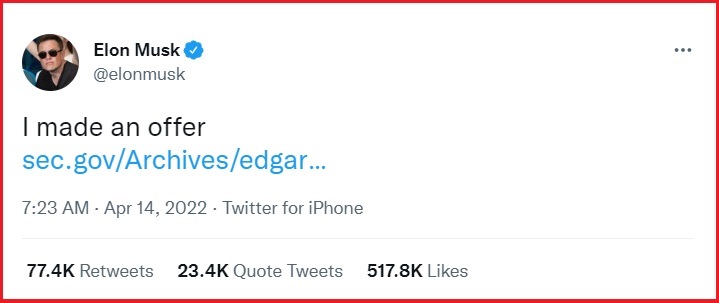
The richest man in the world, Tesla CEO Elon Musk, made an offer to purchase the Twitter platform for a price of $41 billion.  The offer represents a value of 38% more than the current evaluation.  [SEC FILING HERE]  The offer is filed with the US Securities and Exchange Commission proposing a full takeover for $54.20 per share in cash.

Within the filing Elon Musk states his intentions:

“I invested in Twitter as I believe in its potential to be the platform for free speech around the globe, and I believe free speech is a societal imperative for a functioning democracy.  However, since making my investment I now realize the company will neither thrive nor serve this societal imperative in its current form. Twitter needs to be transformed as a private company.

As a result, I am offering to buy 100% of Twitter for $54.20 per share in cash, a 54% premium over the day before I began investing in Twitter and a 38% premium over the day before my investment was publicly announced. My offer is my best and final offer and if it is not accepted, I would need to reconsider my position as a shareholder. Twitter has extraordinary potential.  I will unlock it. (SEC LINK)

What Elon Musk appears to be doing is perhaps the biggest story that few understand.

I share this perspective having spent thousands of hours in the past several years deep in the weeds of tech operating systems, communication platforms, and the issue of simultaneous users.   What Twitter represents, and what Musk is attempting, is not what most would think.

In the big picture of tech platforms, Twitter, as an operating model, is a massive high-user commenting system.

Twitter is not a platform built around a website; Twitter is a platform for comments and discussion that operates in the sphere of social media.  As a consequence, the technology and data processing required to operate the platform does not have an economy of scale.

There is no business model where Twitter is financially viable to operate…. UNLESS the tech architecture under the platform was subsidized.

In my opinion, there is only one technological system and entity that could possibly underwrite the cost of Twitter to operate.  That entity is the United States Government, and here’s why.

Unlike websites and other social media, Twitter is unique in that it only represents a platform for user engagement and discussion.  There is no content other than commentary, discussion and the sharing of information – such as linking to other information, pictures, graphics, videos url links etc.

In essence, Twitter is like the commenting system on the CTH website.  It is the global commenting system for users to share information and debate.  It is, in some ways, like the public square of global discussion.   However, the key point is that user engagement on the platform creates a massive amount of data demand.

Within the systems of technology for public (user engagement) commenting, there is no economy of scale.  Each added user represents an increased cost to the operation of the platform, because each user engagement demands database performance to respond to the simultaneous users on the platform.  The term “simultaneous users” is critical to understand because that drives the cost.

According to the Wall Street Journal, Twitter has approximately 217 million registered daily users, and their goal is to expand to 315 million users by the end of 2023.   Let me explain why things are not what they seem.

When people, users, operate on a tech platform using the engagement features, writing comments, hitting likes, posting images, links etc, the user is sending a data request to the platforms servers.  The servers must then respond allowing all simultaneous users to see the change triggered by the single user.

Example: when you hit the “like” button feature on an engagement system, the response (like increasing by one) must not only be visible to you, but must also be visible to those simultaneously looking at the action you took.   If 100,000 simultaneous users are looking at the same thing, the database must deliver the response to 100,000 people.  As a result, the number of simultaneous users on a user engagement platform drives massive performance costs.  In the example above, a single action by one person requires the server to respond to 100,000 simultaneous users with the updated data.

As a consequence, when a commenting platform increases in users, the cost not only increases because of that one user, the cost increases because the servers need to respond to all the simultaneous users.   Using CTH as an example, 10,000 to 15,000 simultaneous commenting system users, engaging with the servers, costs around $4,500/mo.

This is why most websites, even big media websites, do not have proprietary user engagement, i.e. commenting systems.  Instead, most websites use third party providers like Disqus who run the commenting systems on their own servers.  Their commenting systems are plugged in to the website; that defers the cost from the website operator, and the third party can function as a business by selling ads and controlling the user experience.  [It also sucks because user privacy is non existent]

The key to understanding the Twitter dynamic is to see the difference between, (a) running a website, where it doesn’t really matter how many people come to look at the content (low server costs), and (b) running a user engagement system, where the costs to accommodate the data processing -which increase exponentially with a higher number of simultaneous users- are extremely expensive.   Twitter’s entire platform is based on the latter.

There is no economy of scale in any simultaneous user engagement system.  Every added user costs exponentially more in data-processing demand, because every user needs a response, and every simultaneous user (follower) requires the same simultaneous response.  A Twitter user with 100 followers (simultaneously logged in) that takes an action – costs less than a Twitter user with 100,000 followers (simultaneously logged in), that takes an action.

If you understand the cost increases in the data demand for simultaneous users, you can see the business model for Twitter is non-existent.

Bottom line, more users means it costs Twitter more money to operate.  The business model is backwards from traditional business.  More customers = higher costs, because each customer brings more simultaneous users….. which means exponentially more data performance is needed.

User engagement features on Twitter are significant, because that’s all Twitter does.  Not only can users write comments, graphics, memes, videos, but they can also like comments, retweet comments, subtweet comments, bookmark comments, and participate in DM systems.  That is a massive amount of server/data performance demand, and when you consider simultaneous users, it’s almost unimaginable in scale.  That cost and capacity is also the reason why Twitter does not have an edit function.

With 217 million users, you could expect 50 million simultaneous users on Twitter during peak operating times.  My back of the envelope calculations, which are really just estimations based on known industry costs for data performance and functions per second, would put the data cost to operate Twitter around at least $1 billion per month (minimum).  In 2021, Twitter generated $5.1 billion in revenue, according to the Wall Street Journal.

There is no business model, even with paying subscribers, for Twitter to exist.  As the business grows, the costs increase, and the costs to subscribers would grow.  So, what is going on?

The only way Twitter, with 217 million users, could exist as a viable platform is if they had access to tech systems of incredible scale and performance, and those systems were essentially free or very cheap.  The only entity that could possibly provide that level of capacity and scale is the United States Government – combined with a bottomless bank account.

If my hunch is correct, Elon Musk is poised to expose the well-kept secret that most social media platforms are operating on U.S. government tech infrastructure and indirect subsidy.  Let that sink in.

The U.S. technology system, the assembled massive system of connected databases and server networks, is the operating infrastructure that offsets the cost of Twitter to run their own servers and database.  The backbone of Twitter is the United States government.

There is simply no way the Fourth Branch of Government, the U.S. intelligence system writ large, is going to permit that discovery.

In the old days, we gathered in the town square…


Posted on Rumble by Tulsi Gabbard  originally Published on April 13, 2022 

Social media platforms serve as our virtual town squares. But if they deny us our right to free speech, our democratic republic cannot survive. John Adams said, “A Constitution of Government once changed from Freedom, can never be restored. Liberty once lost is lost forever.”

The World is Laughing at America


Armstrong Economics Blog/North America Re-Posted Apr 14, 2022 by Martin Armstrong

Above is a clip from “Studio 22,” a program on the Saudi government-owned television network MBC. The skit portrays US President Biden as mentally incompetent, repeatedly fumbling his words, forgetting names, and falling asleep behind the podium. Biden’s declining mental health is apparent every time that he is permitted to speak publicly. This is how other nations now view the US, as everyone sees there is a puppet at the helm. Biden makes America appear weak on the international stage.

The skit is far from a comedy sketch. Joe Biden has referred to Vice President Kamala Harris as the “First Lady,” as portrayed on the Saudi program. Recently he called Michelle Obama the former vice president and referred to Ukrainians as Iranians. Let us not forget how his “gaffe” nearly caused World War III when he declared that Putin needed to be removed from power. The White House simply retracts his statements and makes excuses for his erratic behavior.

Even with pre-scripted cards, Biden continually forgets the topic at hand and has been filmed repeatedly being redirected by his handlers at various functions. Even Secretary Psaki is jumping ship as she can no longer deflect the truth. The entire world sees the leader of the United States as a complete fool. Yet, he was allegedly the most popular presidential candidate and secured a record number of votes. The Democrats chose the wrong puppet; besides his slim margin of supporters with cognitive dissonance, no one believes that he is leading the nation.

The Supply Chain Crisis Will Worsen


Armstrong Economics Blog/Climate Re-Posted Apr 14, 2022 by Martin Armstrong

The supply chain issues across the world are continually worsening due to government mismanagement. It seems as if there are sinister intentions at play, as these new restrictions seem to be a deliberate attempt to destroy the global economy.

California’s far-left politicians only implement laws to hurt the people. The California Air Resources Board (CARB) recently revised its Air Resources Board Truck and Bus Regulation:

“The Air Resources Board (ARB) Truck and Bus Regulation requires diesel trucks and buses that operate in California to be upgraded to reduce emissions. By January 1, 2023, nearly all trucks and buses will need to have 2010 model year engines or equivalent. Compliance requirements are currently in effect.”

Therefore, by January, all trucking companies will need to upgrade their trucks to newer models or slim down their fleets. Joe Rajkovacz, director of governmental affairs and communications at the Western States Trucking Association, said that the new law will eliminate 80,000 commercial trucks from operating, accounting for 17% of the trucks in the state. “We in the industry know that if you think there was a supply chain problem over the last year, wait until you take this many trucks out of the marketplace that are not replaceable. You can be talking about something we as a country have never seen before,” he stated.

CARB continues to deny that removing 17% of the trucking fleet will impact the supply chain crisis. “There is simply no evidence to support any claim that the current supply chain issues have any connection to the state’s effort to clean up California’s trucks emissions,” a representative stated.

Trucking companies are pleading for this ruling to be repealed as they simply cannot afford new trucks. Small trucking companies will go under.

Peter Navarro, former manufacturing adviser to former President Donald Trump, called the situation “Woke microeconomics.” Reducing fossil fuels with no other alternative available seems appealing to the far-left. They do not realize that their save the environment plight cannot dismantle the industrial world without repercussions. Woke microeconomics will lead to our downfall.